
Allen Bradley 1326AB high-performance AC servo motor
Torque (T pa=peak acceleration torque, T ss=steady-state torque, T pd=peak deceleration torque, T r=static torque)
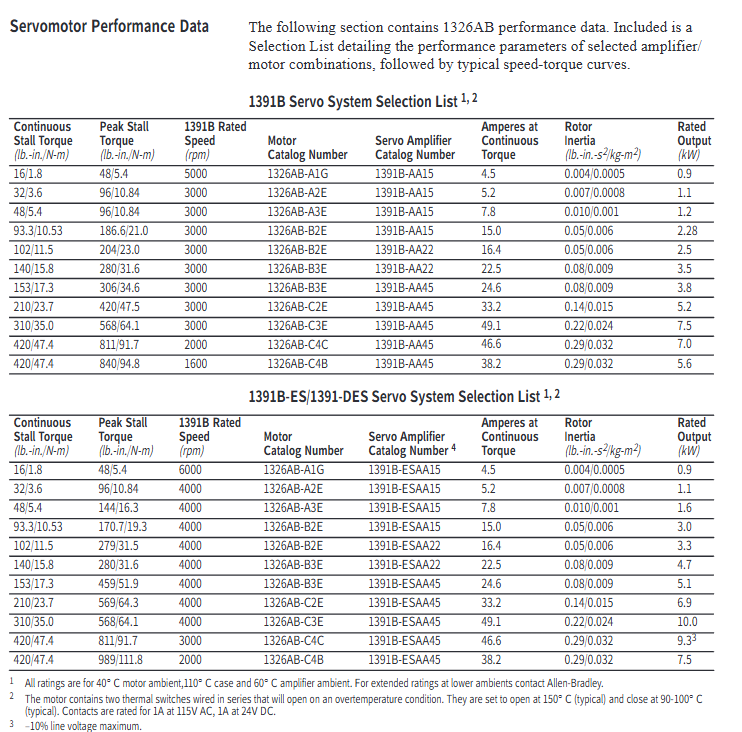
Intermittent operation zone: suitable for acceleration and deceleration scenarios, with a duty cycle RMS torque ≤ rated torque to avoid overheating.
Installation and Dimensional Specifications
1. Mechanical installation requirements
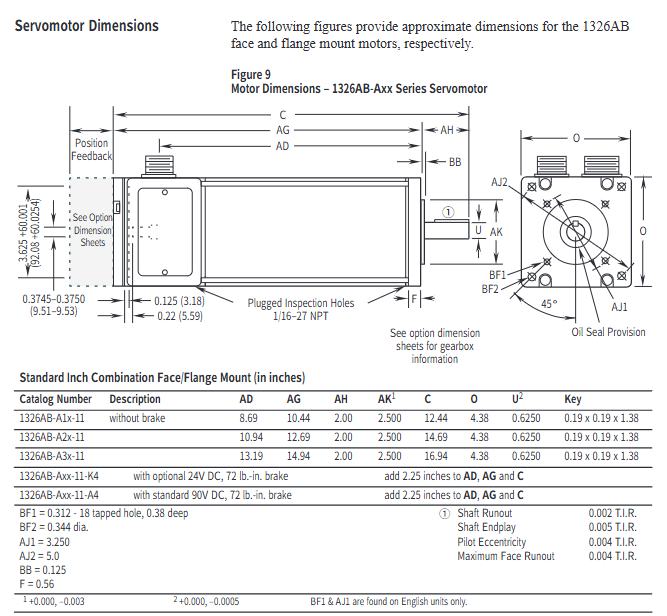
Rail adaptation: The A/B/C series both support 35 × 7.5mm DIN rails (models 199-DR1, etc.). The top hook of the module is locked by rotation after being hooked in, and the grounding resistance should be ≤ 2 Ω (detected through the metal shell of the RS-232 port).
Axial load limit: Radial and axial loads must meet the bearing life requirements (B10 life of 15000 hours). Taking the C series as an example, the maximum radial load at 500rpm is 900lbs, and the axial load is 600lbs (refer to the load curve in Figure 8 for details).
2. Key dimensions (taking imperial flanges as an example)
Series length AD (inches) flange diameter O (inches) shaft diameter U (inches) keyway size (inches) with brake length increase (inches)
A1x-11 8.69 4.38 0.625 0.19×0.19×1.38 2.25
B2x-11 13.16 5.88 1.125 0.25×0.25×1.50 2.25
C3x-11 17.38 7.63 1.375 0.31×0.31×2.00 2.5
3. Cable installation
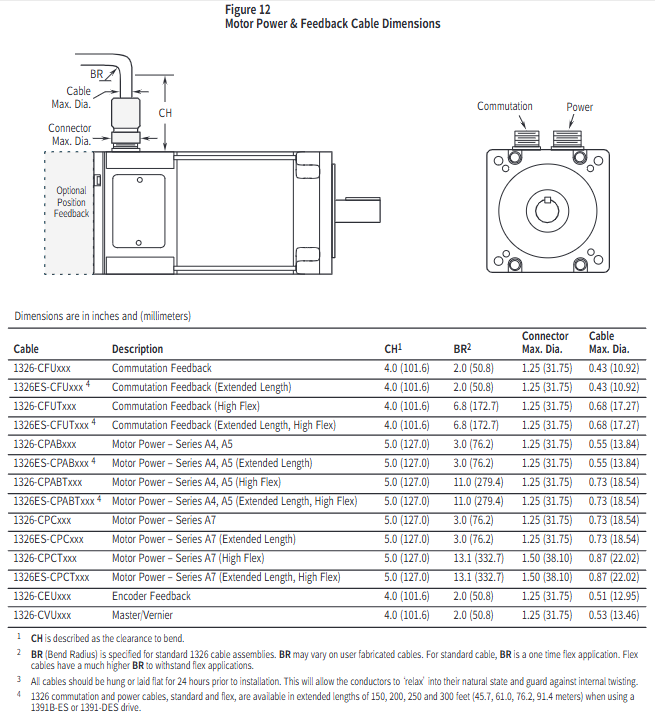
Wiring specifications: Power cables (1326-CPABxx) are wired by color (red=PWR, white=CAN_S, blue=CAN_L, black=COM, bare wire=shielded); The feedback cable (1326 CFUxx) needs to distinguish between the switching signal and the encoder signal, and the shielding layer should be grounded separately.
Bending radius: The standard cable has a single bending radius of ≥ 2 inches (50.8mm), and the high flexibility drag chain cable has a bending radius of ≥ 6.8 inches (172.7mm). Before installation, it needs to be laid flat for 24 hours to release internal stress.
Application Selection and Calculation Guide
1. Selection steps
Determine the speed requirement: Calculate the peak speed of the motor based on the mechanical transmission ratio (for example, if the lead screw is 2 inches and the slide table speed is 400ipm, then the motor speed=400/2=200rpm, with a 20% margin to be reserved).
Calculate continuous torque: Taking screw drive as an example based on load type (friction, cutting force, etc.):
T m=6.28 × e 1 × e 2 × G.R. (W 1 × u+Trust) × Lead × 1.1 (W 1=slide weight, u=friction coefficient, Lead=lead screw, e 1/e 2=lead screw/gearbox efficiency, G.R.=transmission ratio, 1.1 is safety factor)
Verify peak torque: Considering acceleration and deceleration requirements, the calculation formula is:
Peak torque (J total=total moment of inertia, Δ rpm=speed change, t accel=acceleration time, T l=load torque)
Match motor parameters: Ensure that the peak speed of the motor is ≥ the calculated value, the continuous torque is ≥ the required value, and the total inertia is ≤ 5 times the motor inertia (to avoid response lag).
2. Typical application calculation example (screw drive)
Known conditions: slide weight of 500lbs, friction coefficient of 0.05, lead screw of 1 inch, transmission ratio of 1:1, efficiency of 0.9, acceleration time of 0.5 seconds, and speed from 0 to 1000rpm.
Continuous torque calculation: T m=6.28 × 0.9 × 1 (500 × 0.05) × 1 × 1.1 ≈ 5.0 lb in, select A1G (16 lb in) to meet the demand.
Peak torque calculation: Total inertia=sliding table inertia (386500 × (6.281) 2 ≈ 0.0033 lb in ²)+motor inertia (0.004)=0.0073, peak torque=9.6 × 0.5 0.0073 × 1000+0 ≈ 1.52 lb in, which is less than the A1G peak value of 48 lb in and meets the requirements.
Maintenance and safety precautions
Thermal protection: The maximum temperature of the motor winding is 150 ° C (H-class insulation). When the ambient temperature exceeds 40 ° C, it needs to be de rated for use (for every 10 ° C increase, the torque is de rated by 10%).
Brake usage: The brake is only used for static load holding (switching ≤ 90 times per hour) and cannot be used for positioning or frequent braking. The 24V DC brake requires the user to provide their own power supply (0.88-1.2A).
Protection level: IP65 is only applicable to situations with shaft seals and no external feedback/fan. Additional protection is required in humid or corrosive environments.
Troubleshooting: When triggering the thermal switch, it is necessary to first investigate issues such as excessive load and poor heat dissipation. Resetting requires waiting for the winding temperature to drop to 90-100 ° C.
- OMRON
- ABB
- General Electric
- EMERSON
- Honeywell
- HIMA
- ALSTOM
- Rolls-Royce
- MOTOROLA
- Rockwell
- Siemens
- Woodward
- YOKOGAWA
- FOXBORO
- KOLLMORGEN
- MOOG
- KB
- YAMAHA
- BENDER
- TEKTRONIX
- Westinghouse
- AMAT
- AB
- XYCOM
- Yaskawa
- B&R
- Schneider
- KONGSBERG
- NI
- WATLOW
- ProSoft
- SEW
- ADVANCED
- Reliance
- TRICONEX
- METSO
- MAN
- Advantest
- STUDER
- DANAHER MOTION
- Bently
- Galil
- EATON
- MOLEX
- DEIF
- B&W
- ZYGO
- Aerotech
- DANFOSS
- Beijer
- Moxa
- Rexroth
- Johnson
- WAGO
- TOSHIBA
- BMCM
- SMC
- HITACHI
- HIRSCHMANN
- Application field
- XP POWER
- CTI
- TRICON
- STOBER
- Thinklogical
- Horner Automation
- Meggitt
- Fanuc
- Baldor
- SHINKAWA
- Other Brands
- UniOP
- KUKA
- Iba
- Beckhoff
- ADLINK
-
 SIGMATEK Krauss Maffei PC301-K 01-310-301-K Industrial PC
 -
 SIGMATEK SDD310-23 VARAN Servo Drive
 -
 SIGMATEK CDM 163 and CIC 011 C-DIAS Input Modules
 -
SIGMATEK MDP 101-1 Power Module
-
 SIGMATEK CM5V020 Wiring Circuit with CTMS020
 -
 SIGMATEK CCP521 C-DIAS Processor Module
 -
 SIGMATEK MDP 101-K Power Module
 -
 SIGMATEK ETEK C-IPC 733MHz VIA Eden 7000
 -
 SIGMATEK DCP 643 DIAS PLC CPU Module
 -
 SIGMATEK TAE121 12-200-121 Operator Terminal
 -
 Sigmatek TMS012-T Injection Moulding Technology Module
 -
Sigmatek MDD 121-1 Controller
-
 Sigmatek CDM167 Module
 -
Sigmatek DCP082 DIAS Central Unit
-
 Sigmatek ETT731 Built-In Terminal Touch
 -
Sigmatek CCP521 C-DIAS Processor Module
-
 Sigmatek Krauss Maffei PC301-K Control Cabinet PC
 -
 Sigmatek CIC-21 C-DIAS CAN Module
 -
Sigmatek CIO-011 Multi I O Module
-
 Sigmatek 01-450-152D C-IPC 152 Industrial PC
 -
SIGMATEK 01-450-024 C-IPC 128MB VIA 733MHz
-
SIGMATEK CCL-081 C-DIAS Processor Module
-
 SIGMATEK CP311 20-004-311 Module
 -
 SIGMATEK EP00000262 SLIDES MIDI I O-V3 Controller
 -
SIGMATEK TMS012-T Slides Technology Module
-
SIGMATEK MDD111-1 Drive Axis Module
-
 SIGMATEK MDP101-1 PLC Module
 -
 SIGMATEK CP111 S-DIAS Processor Module
 -
 DEMAG ErgoControl Sigmatek NC4 Display Unit
 -
 SIGMATEK DCP642 Module
 -
 Sigmatek Demag NC4 9617.067.03 Control Module
 -
 Sigmatek DCP 643 Central Processing Unit
 -
Sigmatek VI 021 S-SLIDES VARAN Interface Module
-
 Sigmatek SDD340-46 Servo Drive 14kVA
 -
 Sigmatek DSI021 Slide Siemens Interface
 -
Sigmatek CCL912 C-SLIDES CPU PSU Module
-
 Sigmatek ETV1521 VARAN Control Panel
 -
 Sigmatek ET322 Operator LCD Terminal
 -
 Sigmatek MDD1111 DIAS Drive Module
 -
 Sigmatek CAM123 Module
 -
 SIGMATEK CP111 VARAN Ethernet Controller
 -
 SigmaTek MDD 111 Axle Module
 -
SIGMATEK CIO013 C-DIAS I O Module
-
 SIGMATEK AKM52K-ANC2GBB0 Servomotor 640VDC
 -
 SIGMATEK ETT321 01-230-321 Touch Screen
 -
 SIGMATEK NC4Kompakt 01-250-010-D Safety Controller
 -
 SIGMATEK CIO011 C-DIAS Multi I O Module
 -
 SIGMATEK MDD 121-1 Drive Axis Module
 -
SIGMATEK CDM163 Control Module
-
 Sigma-Tek 4000HR-3 Heading Reference Directional Gyro
 -
 Sigmatek DIAS DAI 883 Analog Input Module
 -
Sigmatek 0332.554.03 Printed Circuit Board Card
-
 Sigma Tek 5000B-36 Attitude Gyro 8130
 -
Demag NC4 0332.554.03 Sigmatek Control Board
-
Sigmatek IPC Pentium 300 CF Industrial PC
-
Sigmatek MDP 102 PLC Module
-
 Sigmatek DTO163 Digital Output Module
 -
 Sigmatek PCT151 Touch IPC 15 Panel and I-PC C300
 -
Sigmatek CCL911 CD Processor Module
-
 Sigmatek SCP011 S-DIAS Safety CPU Module
 -
Sigmatek SE051 Network Splitter Module
-
Sigmatek CIO011 C-DIAS I O Module
-
 Sigmatek SE051 Ethernet Splitter
 -
 Sigmatek CCL911 CD Processor Module
 -
 Sigmatek SDD310-4 DIAS Drive 14kVA
 -
Sigmatek CTMS020 C-DIAS Technology Module
-
Sigmatek CTMS020 CD Technology Module
-
Sigmatek CTO167 C-SLIDES Digital Output Module
-
 Sigmatek C-IPC 152 Industrial PC
 -
 Sigmatek SDD310-4 SLIDES Drive 310
 -
SIGMATEK MDP 102-1 DIAS Power Module
-
 SIGMATEK SCP111 S-DIAS Safety CPU Industrial
 -
SIGMATEK CAO081 Analog Output Module
-
SIGMATEK DCC080L Control Module
-
 SIGMATEK MDP101-1 Power Module
 -
 SIGMATEK SCP111 S-DIAS Safety CPU
 -
 SIGMATEK PC325-K Industrial PC
 -
SIGMATEK ETT 731 Operator Terminal
-
 SIGMATEK DSV011 SLIDES Hub Module 05-023-011
 -
SIGMATEK 12-780-012 R8-IPC Industrial Computer
-
 Sigmatek SE051 Ethernet Splitter
 -
Sigmatek DAI 883 DIAS Analog Module
-
 Sigma Tek 4000B-30 Directional Gyro
 -
 Sigmatek CP112 S-DIAS Processor Module
 -
Sigmatek SDD310 DIAS Drive
-
Sigmatek SDD120-23 DIAS Drive 14kVA
-
Sigmatek C-IPC 152 Industrial PC
-
Sigmatek CIV513 VARAN Control Module
-
Sigmatek DCP 082 Processor Module
-
Sigmatek C-IPC Industrial PC 01-450-023 GEB
-
 SIGMATEK PC572 Operating Terminal
 -
 SIGMATEK DCC041 DIAS Compact Controller HW 6.10
 -
SIGMATEK C-IPC 152 1GB Celeron M440 Controller
-
 SIGMATEK 01-310-322-K PC322-K Industrial PC
 -
SIGMATEK TAE732-P Touch Screen Operator Panel
-
SIGMATEK 01-018-100 Control Module
-
SIGMATEK DDI-164 Digital Input Module
-
 Sigma-Tek 5000B-36 Artificial Horizon
 -
 SIGMATEK 12-780-012 R8-IPC Geode LX800 Computer
 -
SIGMATEK CTMS 020 Servo Drive
-
Sigmatek MDD121-1 Controller
-
Sigmatek ETV1021-L VARAN Terminal
-
Sigmatek DST022 DIAS Module
-
Sigmatek CCP512-K C-Dias Processor Module
-
Sigmatek SRO 021 Relay Output Module
-
 Sigmatek SDI 101 Digital Input Module
 -
 Sigmatek IPC 221 Industrial PC
 -
Sigmatek DNC-305 Digital Input Module
-
 Sigmatek SDD335 DIAS Drive
 -
Sigmatek C-IPC Industrial Controller
-
 SIGMATEK 01-450-031 C-IPC 256MB LX800 Computer
 -
SIGMATEK SDD310-3 DIAS Drive 310
-
 SIGMATEK DSV011 SLIDES Hub Module 05-023-011
 -
SIGMATEK CNC031 CD Analog Module 12-011-031
-
SIGMATEK 01-450-031 C-IPC 256MB LX800
-
SIGMATEK 01-450-026 C-IPC VIA 733MHz Controller
-
 SIGMATEK DCP-643 DIAS CPU Module with DKL-003
 -
SIGMATEK MDD111-L DIAS Drive Axis Module
-
SIGMATEK SDD310-23-L DIAS Drive 310
-
 SIGMATEK Viscotec ETV0551 Touch Panel
 -
 SIGMATEK PC321K Industrial Computer
 -
SIGMATEK MDP 102-1 SLIDES Power Module
-
 SIGMATEK TAE-151 12-200-151 Light Terminal
 -
SIGMATEK CP102 20-004-102P6995B HMI Panel
-
 SIGMATEK CAM-123 12-017-123-C Analog Mixing Module
 -
SIGMATEK DCC041 DIAS Compact Controller
-
SIGMATEK DVI021 and DKL015 DIAS Power Module
-
 SIGMATEK SDD340-46 SDD Series Servo Drive


