
TOSHIBA MG08-D SERIES ENTERPRISE CAPACITY HDD
TOSHIBA MG08-D SERIES ENTERPRISE CAPACITY HDD
The Enterprise Capacity 7200 rpm HDD models offer up to 8 TB[1], a choice of interface (SATA -MG08ADA Series, and SAS - MG08SDA Series), as well as a choice of 512 Native(512n) sector or 512 emulation(512e) sector technologies. All models utilize a power-efficient mechanical design incorporating the latest advancements in HDD technology. MG08-D Series models are designed to provide plug-and-play robustness using the industry standard 3.5-inch[2] form factor. Model options supporting Sanitize Instant Erase (SIE) and Self-Encrypting Drive (SED).
KEY FEATURES
Industry Standard 3.5-inch 26.1 mm Height Form Factor Up to 8 TB Capacity
7200 rpm Performance
Choice of SATA 6 Gbit/s or Dual-Port SAS 12 Gbit/s Interface
550 Total TB Transferred per Year Workload Rating[3]
Choice of 512n or 512e (Advanced Format) Sector Technology
Sanitize Instant Erase (SIE) and Self-Encrypting Drive (SED) Option Models Available
APPLICATIONS
Engineered for Mid-line / Nearline Business Critical Workloads
Tier 2 Business-Critical Servers and Storage Systems
Servers Supporting Workloads that Benefit from Higher Capacity per Spindle
Capacity-Optimized Data Center Storage Systems
IT infrastructure designed around Enterprise Capacity HDD performance
Applications and hypervisors that require legacy 512 Native Sector Technology
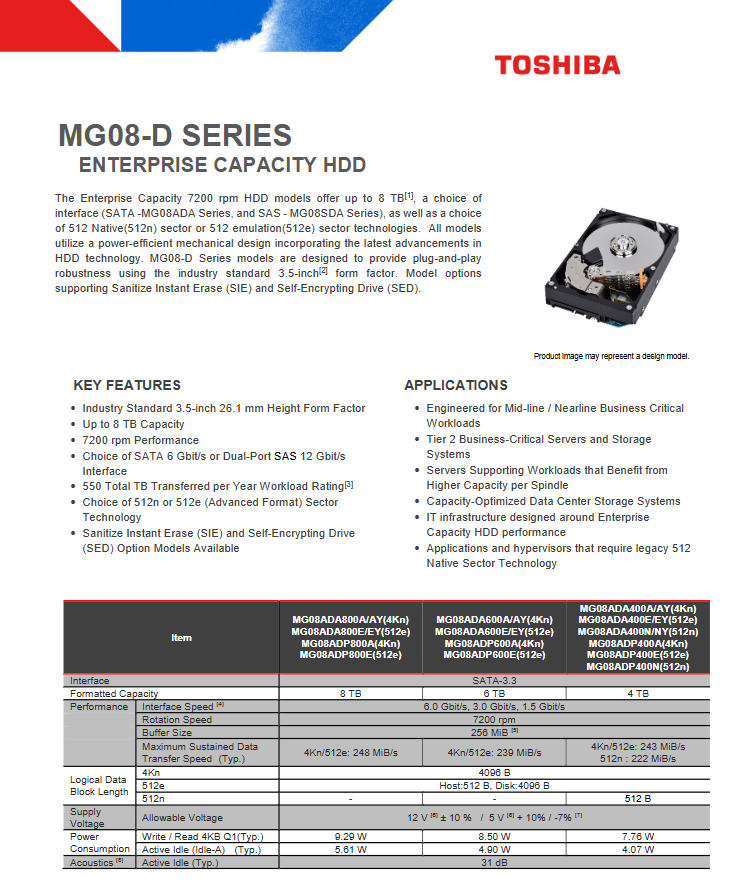
Detailed performance parameters
(1) Core performance indicators
1. Data transmission and processing capability
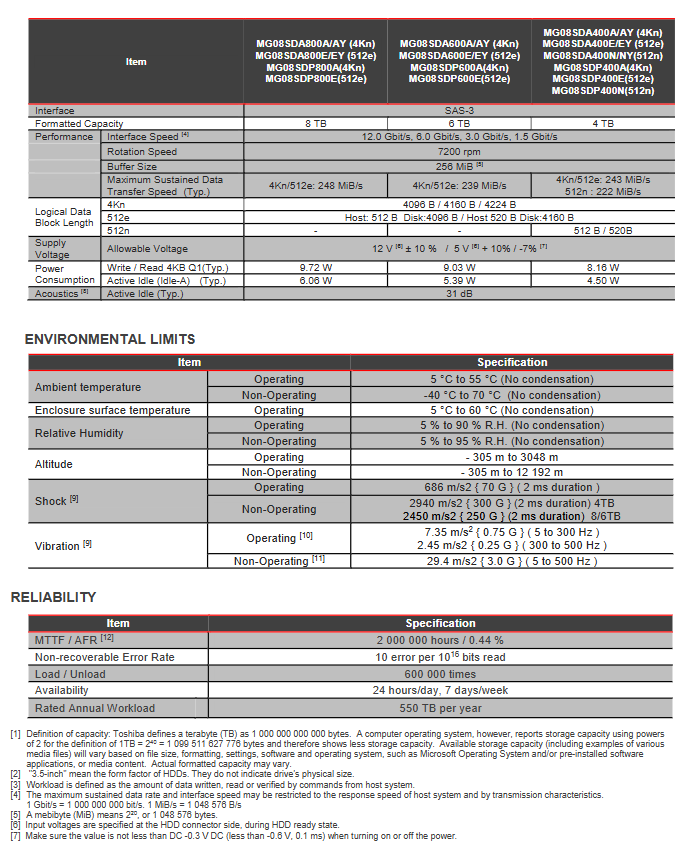
Cache size: The entire series is uniformly configured with 256 MiB cache (1 MiB=1048576 bytes), which reduces disk seek times by increasing cache capacity, improves random read and write performance, and continuous transmission stability.
Maximum sustained data transmission speed (typical value):
4Kn/512e format: 8 TB version (SATA/SAS) can reach up to 248 MiB/s; The 6 TB version is 239 MiB/s; The 4 TB version is 243 MiB/s, which meets the high-speed transmission needs of high-capacity data backup, archiving, video streaming storage, and other scenarios.
512n format: The 4 TB version is 222 MiB/s, which is lower than the advanced format but can ensure the performance stability of the legacy system.
Logical data block length:
4Kn format: 4096 B (some SAS models support 4160 B, 4224 B);
512e format: host side 512 B, disk side 4096 B (some SAS models support 520 B on the host side and 4160 B on the disk side);
512n format: 512 B (some SAS models support 520 B).
2. Power consumption and heat dissipation performance
The MG08-D series adopts energy-saving mechanical design, with power consumption gradually changing with increasing capacity, balancing performance and energy efficiency. Typical values are as follows (write/read 4KB Q1 scenario):
4 TB version: SATA interface 7.76 W, SAS interface 8.16 W;
6 TB version: SATA interface 8.50 W, SAS interface 9.03 W;
8 TB version: SATA interface 9.29 W, SAS interface 9.72 W.
The active idle state (Idle-A, typical value) has lower power consumption:
4 TB version: SATA interface 4.07 W, SAS interface 4.50 W;
6 TB version: SATA interface 4.90 W, SAS interface 5.39 W;
8 TB version: SATA interface 5.61 W, SAS interface 6.06 W, effectively reducing the overall energy consumption and heat dissipation pressure of the data center.
3. Noise control
In active idle state, the noise level of the entire series is 31 dB (measured according to ISO 7779 standards), which belongs to the low noise level of enterprise grade hard drives and is suitable for deployment in data centers or data center environments with certain noise restrictions.
(2) Power supply requirements
Allowable voltage range: 12 V ± 10%, 5 V+10%/-7% (input voltage is based on the hard disk connector end, measured in the ready state of the hard disk);
Power switch requirements: When turning on or off, the voltage should not be lower than -0.3 V DC (the duration of being lower than -0.6 V should not exceed 0.1 ms) to avoid voltage fluctuations causing damage to the hard drive.
Environmental adaptability and reliability
(1) Environmental operation restrictions
1. Temperature and humidity
Working condition: temperature 5 ° C~55 ° C (no condensation), relative humidity 5%~90% (no condensation);
Non working state (storage/transportation): Temperature -40 ° C~70 ° C (no condensation), relative humidity 5%~95% (no condensation), suitable for the environmental conditions of different regions' computer rooms and temperature and humidity changes during equipment transportation.
2. Altitude and mechanical properties
Altitude: working state -305 m~3048 m (about 10000 feet), non working state -305 m~12192 m (about 40000 feet), can be deployed in data centers in high-altitude areas;
Impact resistance: The working state can withstand an impact of 70 G (686 m/s ²) for a duration of 2 ms; in non working state, the 4 TB version can withstand an impact of 250 G (2450 m/s ²), and the 6 TB/8 TB version can withstand an impact of 300 G (2940 m/s ²), ensuring the impact resistance during equipment installation and transportation;
Anti vibration: Under working conditions, the frequency range of 5-300 Hz can withstand 0.75 G (7.35 m/s ²) vibration, and the frequency range of 300-500 Hz can withstand 0.25 G (2.45 m/s ²) vibration (random seek read/write, default retry setting, logarithmic scan vibration conditions); Under non working conditions, the frequency range of 5-500 Hz can withstand a vibration of 3.0 G (29.4 m/s ²), adapting to the vibration environment of data center rooms.
(2) Core reliability indicators
The MG08-D series is designed according to the highest reliability standards of enterprise level, with the following key indicators:
Mean Time to Failure (MTTF): 2000000 hours (calculated based on 8760 hours per year, 7 x 24 hours of operation), which means that under normal usage conditions, the average failure interval of the hard drive exceeds 228 years, ensuring long-term stable operation;
Annual Failure Rate (AFR): 0.44%, much lower than consumer grade hard drives, reducing maintenance costs and failure risks in data centers;
Unrecoverable error rate: For every 10 ¹⁶ bits of data read, the number of errors does not exceed 10, ensuring the integrity of data storage;
Loading/Unloading Times: 600000 times, suitable for scenarios where the hard drive frequently starts and stops for a long time;
Annual rated workload: 550 TB/year (workload defined as the amount of data written, read, or verified by the host system through commands), supports continuous operation for 7 × 24 hours, and is suitable for high load and high concurrency usage requirements in data centers;
Reliability supplement: When the surface temperature of the HDA (hard drive component) of the hard drive continues or exceeds 40 ° C for a long time, it may reduce the reliability of the product, and reasonable heat dissipation needs to be ensured in the design of the computer room.
Applicable scenarios and application value
(1) Core applicable scenarios
Mid line/Nearline Business Critical Workload: As an "intermediate layer" storage between high-speed performance disks and archive cold data disks, it balances performance and capacity and is suitable for critical data storage such as financial data, customer information, business system logs, etc. that require fast access and large capacity requirements.
Tier 2 Business Critical Servers and Storage Systems: Suitable for non core but important business servers such as office automation servers, mail servers, small and medium-sized database servers, providing stable storage support.
High Capacity per Spindle Beneficial Server: By using a single disk with high capacity (up to 8 TB), it reduces the number of hard drives in the server, lowers hardware procurement costs, energy consumption, and server room space occupation, making it suitable for scenarios such as high-capacity distributed storage and cloud storage nodes.
Capacity optimized data center storage system: designed to meet the capacity layering requirements of data centers, it is used to store massive amounts of non real time access data, such as backup data, archived data, video surveillance recordings, etc., achieving efficient utilization of storage resources.
Applications and virtual machine monitoring programs that rely on legacy 512 native sector technology: The 4 TB version supports 512n sector technology, seamlessly replacing traditional hard drives and ensuring smooth migration and stable operation of older systems (such as early Windows Server and specialized industrial software).
(2) Application value
Strong compatibility: Through multi option design of interfaces and sector technology, it adapts to new and old IT infrastructure, avoiding system reconstruction costs caused by storage device upgrades for enterprises;
Total cost optimization: High capacity design reduces the number of hard disk deployments, low power consumption reduces long-term operating energy consumption, low failure rate reduces maintenance costs, and achieves cost optimization throughout the entire lifecycle of hardware procurement, operation, and maintenance;
Data security assurance: Some models support SIE instant erase and SED self encryption functions, meeting enterprise data security compliance requirements and reducing data leakage risks;
Stability and availability: Enterprise level reliability indicators (2 million hours MTTF, 0.44% AFR) and 7 × 24-hour operation capability ensure continuous and stable operation of business systems, reducing business interruptions caused by storage failures.
- OMRON
- ABB
- General Electric
- EMERSON
- Honeywell
- HIMA
- ALSTOM
- Rolls-Royce
- MOTOROLA
- Rockwell
- Siemens
- Woodward
- YOKOGAWA
- FOXBORO
- KOLLMORGEN
- MOOG
- KB
- YAMAHA
- BENDER
- TEKTRONIX
- Westinghouse
- AMAT
- AB
- XYCOM
- Yaskawa
- B&R
- Schneider
- KONGSBERG
- NI
- WATLOW
- ProSoft
- SEW
- ADVANCED
- Reliance
- TRICONEX
- METSO
- MAN
- Advantest
- STUDER
- DANAHER MOTION
- Bently
- Galil
- EATON
- MOLEX
- DEIF
- B&W
- ZYGO
- Aerotech
- DANFOSS
- Beijer
- Moxa
- Rexroth
- Johnson
- WAGO
- TOSHIBA
- BMCM
- SMC
- HITACHI
- HIRSCHMANN
- Application field
- XP POWER
- CTI
- TRICON
- STOBER
- Thinklogical
- Horner Automation
- Meggitt
- Fanuc
- Baldor
- SHINKAWA
- Other Brands
- UniOP
- KUKA
- Iba
- Beckhoff
- ADLINK
-
 Sigmatek MDD111-1 DIAS Drive Axis Module
 -
 Sigmatek DKL042 05-024-042 Terminal Module
 -
 Sigmatek DM822 Control Module
 -
 Sigmatek CDM167 12-008-167-O Module
 -
 Sigmatek TAE151 Touch Display Unit
 -
 Sigmatek DCC041 SLIDES Module 05-700-041-D
 -
 Sigmatek AKM65M-ANC2GBB0 PM Servo Motor
 -
 Sigmatek ETT221 01-230-221 Operator Terminal
 -
 Sigmatek SLIDES DAM 124 Analog Module
 -
Sigmatek AKM31C-ANCNGBB0 Servo Motor
-
 Mannesmann Demag Sigmatek CP626 Central Unit
 -
 SIGMATEK 0332.554.03 Board 371071000154
 -
 SIGMATEK 12-250-021 Base Plate Back Panel CM5V020
 -
 SIGMATEK DM162 S-DIAS Digital Mix Module
 -
 DEMAG ERGOTECH 061 381 66 Sigmatek 9842.243.02 Circuit Board
 -
 SIGMATEK CP313-1 PLC Module
 -
Sigmatek ETV0551-2 VARAN Touch Terminal
-
 Sigmatek SDM 081 FS S-Dias Safety Module
 -
 DEMAG 05-250-023 Ergotech Motherboard with Sigmatek TMS012
 -
Sigmatek CM5V020 12-250-023-K Wiring Base
-
 Sigma Tek 5000B-37 Attitude Gyro Indicator
 -
 Sigmatek SDD120-2 DIAS Drive
 -
 Sigmatek CME221 Memory Module
 -
 Sigmatek DCP640 DIAS Central Unit
 -
 Sigmatek STO040 Safety Output Module
 -
Sigmatek CET281 Control Panel
-
 Sigmatek CIPC LX800 Demag NC5 CPU
 -
 Sigmatek DKL093 05-024-093 Terminal Module
 -
 Sigmatek AI088 20-009-088 Analog Input Module
 -
Sigmatek CAI888 Analog Input Module
-
SIGMATEK CCA021 12-025-021 Analog Output Module
-
SIGMATEK 1104.579.05 Control Module
-
SIGMATEK SDI100 Digital Input Module
-
 SIGMATEK C-IPC 256MB LX800 Compact Dias
 -
 SIGMATEK 9423.090.02 Control Module
 -
SIGMATEK C-IPC 256 Power Supply 148498
-
 SIGMATEK CAI025 Analog Input Module
 -
 SIGMATEK CTO166 Digital Output Module
 -
 SIGMATEK CP112 20-004-112 Processor Module
 -
SIGMATEK CAI887 12-009-887 Safety Module
-
 Sigma-Tek 4000B-31 Directional Gyro 1U262-002-42
 -
Sigmatek C-IPC 256MB LX800 IPC Controller
-
Sigmatek C-IPC 01-450-031 Industrial PC LX800
-
Sigmatek C-IPC 256 Industrial PC Controller
-
Sigmatek CCP-531 PLC Processor Module
-
Sigmatek CDI163 Digital Input Module
-
 Sigmatek ETV0501 VARAN Terminal 12-230-0501
 -
 Sigmatek CTMS020 C-DIAS Technology Module
 -
 Sigmatek CIV512 VARAN Switch Module
 -
 Sigmatek HU011 20-080-011 Interface Module
 -
SIGMATEK SLIDES DAM 124 Module
-
 SIGMATEK C-IPC 161 01-450-161L Industrial PC
 -
SIGMATEK C-IPC 128MB VIA 733MHz 01-450-024-K
-
 SIGMATEK 12-780-012 R8-IPC Geode LX800 Module
 -
SIGMATEK CAM124 Analog Module
-
 SIGMATEK S1 032-8AF61-R4 EZ Servo Motor
 -
 SIGMATEK CTO163 Digital Output Module
 -
 SIGMATEK CCP082 12-004-082 Processor Module
 -
 SIGMATEK CRCH081 C-DIAS Temperature Module
 -
 SIGMATEK PC322-K 01-310-322-K Industrial PC
 -
SIGMATEK SDD310-2 Servo Drive
-
 SIGMATEK AI084 Analog Input Module
 -
SIGMATEK CRCH081 12-752-081 Temperature Module
-
Sigma-Tek 5000L-4 Attitude Gyro 1U284-001-3
-
 SIGMATEK CM5V020 12-250-023-K Wiring Module
 -
Sigma-Tek 4000H-6 Directional Gyro IU262-035-7
-
 SIGMATEK Dias DCP160 05-004-160 Processor Module
 -
SIGMATEK 0147.395.02 Control Module
-
SIGMATEK A1084 Control Module
-
SIGMATEK DI200 20-006-2000 Digital Input Module
-
Sigmatek DNC115 Encoder Module
-
 Sigmatek DAM122 05-017-122 Analog Module
 -
Sigmatek 9802.289.01 Control Board TA71 Display
-
Sigmatek TO127 20-007-127 Digital Output Module
-
Sigmatek DNC031 05-011-031 Digital Module
-
Sigmatek VI022 20-003-022 Interface Module
-
Sigmatek CAI085 Analog Input Module
-
 Sigmatek CP111 S-DIAS CPU Module
 -
Sigmatek CTMS030 Krauss Maffei Module
-
 Sigmatek CAM123 Control Module
 -
 Sigmatek TAE732-P 01-240-732-P Touch Display Unit
 -
Sigmatek MDM021 Digital Mixed Module
-
Sigmatek DCP642 DIAS Central Unit
-
 Sigmatek CST022 12-014-022 C-DIAS Module
 -
 Sigmatek SRO021 20-893-021 Safety Relay Output
 -
 Krauss Maffei MC5 Control System Sigmatek
 -
 Sigmatek DC061 Module 18-24VDC 300mA
 -
 Herrmann EVT0855 Ultrasonic Welder Touch Panel
 -
Sigmatek CIV521 Control Module 1.4A 2W
-
Sigmatek DDI61 05-006-161 Digital Input Module
-
SIGMATEK ETT312-E Touch Terminal 01-230-312
-
Cessna S3326-1 Sigma Tek 5000B-67 Gyro 1U149-015-9
-
SIGMATEK PS101 Power Supply Module
-
SIGMATEK 0332.554.03 Control Module 371071000154
-
 SIGMATEK ETT312-E Touch Terminal 01-230-312
 -
SIGMATEK CDM163 Control Module
-
 SIGMATEK VSV046 16-023-046 Module
 -
SIGMATEK AM221 20-017-221 Analog Module
-
SIGMATEK CTS051 12-053-051 Control Module
-
SIGMATEK AM221 20-017-221 Analog Module
-
Sigmatek CSDI161 12-891-161 Safety Input Module
-
Sigma Tek 4000C-1 Directional Gyro Indicator
-
Sigmatek ETV0501 12-230-0501 VARAN Terminal
-
Sigmatek DDM165 SLIDES Module
-
Sigmatek N100 20-011-100 Control Module
-
Sigmatek AKM54K-ANC2R-B0 PM Servo Motor
-
Sigmatek CTO166 Digital Output Module
-
Sigmatek CP212-K 20-004-212-K CPU Module
-
Sigmatek CDI161 Digital Input Module
-
Sigmatek DCC080 05-700-080-2 Control Module
-
 SIGMATEK SCP011 S-DIAS Safety CPU
 -
SIGMATEK SCP011 S-DIAS Safety CPU
-
SIGMATEK SRO022 Relay Output Module
-
SIGMATEK MDD 121 Drive Axis Module
-
SIGMATEK DSI021 SLIDES Siemens Interface
-
SIGMATEK DIAS DCP161 Module 05-004-161
-
 Sigmatek ETT312 Built-in Touch Terminal
 -
SIGMATEK DCP 643 DIAS Controller System
-
SIGMATEK CIO021 Multi I/O Module
-
SIGMATEK CTMS020 Control Module
-
 Sigmatek CME 221 Memory Module
 -
Sigmatek 0420.615.01 Control Board
-
Sigmatek CP111 20-004-111 CPU Module
-
Sigmatek 9405.065.03 Control Board
-
Sigmatek ETEK 01-450-032-K C-IPC 256MB Industrial PC
-
Sigmatek CTO163 12-007-163 Safety Output Module
-
Sigmatek TO081 20-007-081 Digital Output Module
-
 Sigmatek SI021 20-022-021 Safety Input Module


