
Emerson PACSystems ™ Ethernet Switch SLM082
Emerson PACSystems ™ Ethernet Switch SLM082
Product Core Overview
(1) Product positioning
SLM082 is a powerful management industrial switch suitable for harsh industrial environments such as wide temperature, high dust, and humidity. It supports web, console (CLI), third-party SNMP software, and exclusive "PACSystems Ethernet Switch Configuration Tool" for management, and can configure multiple switches simultaneously and monitor their status.
(2) Software core functions
Specific description of functional categories
Network redundancy supports the world's fastest redundant Ethernet ring (with a recovery time of less than 10ms when 250 devices are cascaded), enabling ring coupling and dual home topology; Compatible with RSTP (802.1w) Fast Spanning Tree Protocol
Network management supports the SNMP v1/v2/v3 protocol; Support VLAN partitioning based on port/802.1Q standards; Support LLDP (Link Layer Discovery Protocol) to automatically discover network node information
Event notifications can generate event alerts through email (SMTP), SNMP Trap, and relay output
Traffic control supports 802.1p Quality of Service (QoS) to ensure real-time traffic; Support IGMP Snooping multicast filtering to reduce network bandwidth usage
Security protection supports port enable/disable, MAC address based port security, 802.1x port authentication, and Radius centralized password management; SNPv3 encryption authentication
(3) Hardware core features
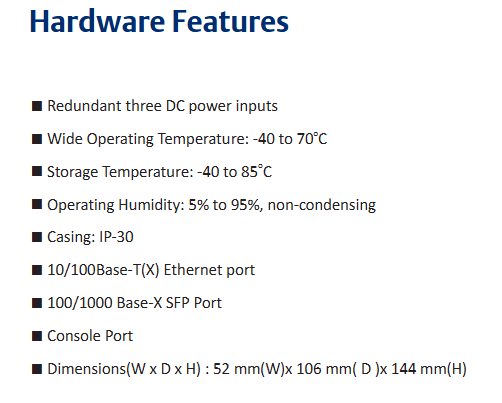
Power supply: Three redundant DC inputs.
Environmental adaptability: working temperature -40~70 ℃, storage temperature -40~85 ℃, working humidity 5%~95% (no condensation), protection level IP30.
Port configuration: 8 10/100Base-T (X) Ethernet ports (RJ45 interface), 2 100/1000Base-X SFP optical ports, and 1 Console port.
Physical dimensions: 52mm (width) x 106mm (depth) x 144mm (height).
Hardware Installation
SLM082 supports two installation methods to meet the needs of different industrial scenarios:
(1) DIN rail installation
The switch backplane comes with a DIN rail kit, which can be directly fastened to the standard DIN rail for fixation. The installation steps are simple and do not require additional drilling.
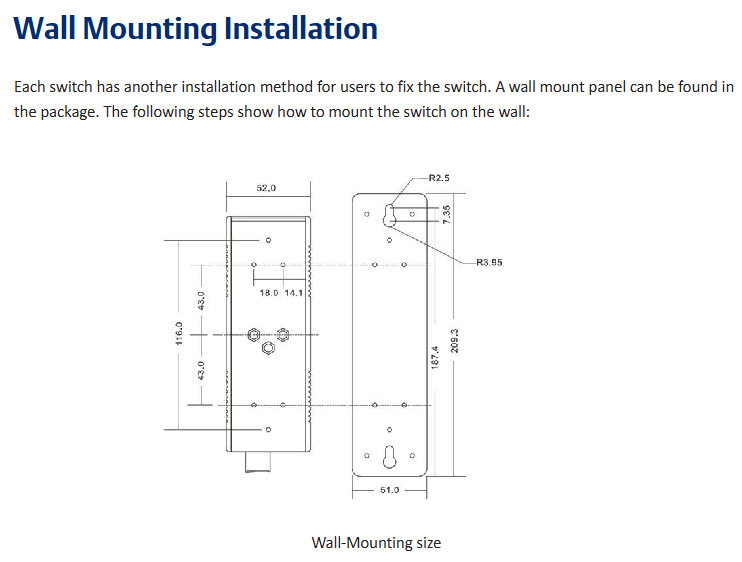
(2) Wall mounted installation
The packaging contains a wall mounted panel, which needs to be punched on the wall according to the dimensions indicated in the manual (such as aperture, hole spacing, etc.). After fixing the wall mounted panel with screws, the switch can be installed.
Hardware interface and indicator lights
(1) Front panel interface (Table 3.1)
Interface Type Quantity Function Description
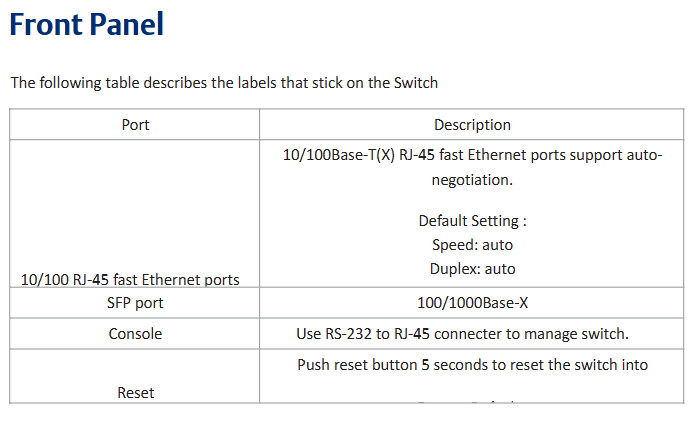
10/100Base-T (X) ports with 8 RJ45 interfaces, supporting automatic negotiation (rate/duplex mode), default rate "automatic", duplex "automatic", flow control "disabled"
100/1000Base-X SFP ports with 2 optical ports, used to connect fiber optic modules and support high-speed data transmission
Console port with one RJ45 interface, connected to the computer via an RS-232 adapter cable for CLI management
Press the Reset button for 5 seconds to restore the switch to factory settings
(2) Meaning of front panel indicator lights (Table 3.2)
LED identification color status description
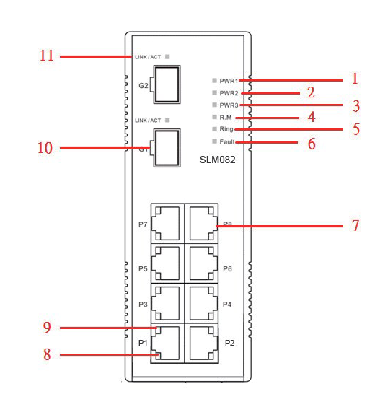
The green constant light of PW1/PW2/PW3 corresponds to the activated power supply module (PW1/PW2) or power interface (PW3)
R. The M (Ring Master) green constant light switch is the master node (Ring Master) of the redundant ring
The redundant ring with green constant brightness has been enabled;
Slow flashing: Redundant ring topology abnormality;
Flash: Redundant ring is working normally
Fault: The yellow light is constantly on, indicating a power failure or port interruption/malfunction
10/100Base-T (X) port LNK/ACT green constant light: port link established;
Flashing: The port is transmitting data and the link and activity status of the corresponding Ethernet port
10/100Base-T (X) port Full Duplex yellow constant light port works in full duplex mode
SFP port LNK/ACT green/yellow constant light: optical port link established;
Blinking: The optical port is transmitting data, and the corresponding link and activity status of the optical port are flashing
(3) Top panel component
Terminal block: includes PW1/PW2 (12-48V DC power input) and relay output interfaces( 1A@24VDC ).
Power interface (PW3): 12-45V DC power input socket.
Reset button: Press for 3 seconds to reset the device, press for 5 seconds to restore factory settings.
Console port: RJ45 interface, used for CLI management connection.
Cable Configuration
(1) Ethernet cable
Applicable standards: 10BASE-T supports Category 3/4/5 unshielded twisted pair (UTP), while 100BASE-TX requires Category 5 UTP.
Maximum transmission distance: Both are 100m (328 feet), with RJ45 connectors.
Pin definition: In 100BASE-TX/10BASE-T cables, pins 1/2 are used for sending data and pins 3/6 are used for receiving data; Supports automatic MDI/MDI-X functionality, allowing for direct connection between computers and switches (without the need for crossovers).
(2) SFP optical module and fiber optic
Optical module type: Supports multi-mode (transmission distance 0-550m, wavelength 850nm, fiber specifications 50/125 μ m or 62.5/125 μ m) and single-mode SFP modules, with LC connectors.
Connection rule: The TX port of switch A needs to be connected to the RX port of switch B to ensure the correct transmission of optical signals.
(3) Console cable
Cable specifications: The package contains a DB-9 (female) to RJ45 cable, which is used to connect the computer COM port to the switch Console port.
Pin correspondence: Pin 2 (RD, receive data) of the computer end (DB-9 male head) corresponds to Pin 2 (TD, send data) of the DB-9 female head, Pin 3 (TD, send data) corresponds to Pin 3 (RD, receive data) of the female head, and Pin 5 (GD, ground) corresponds to Pin 5 (GD, ground) of the female head.
Web Management Configuration
Web management is based on the built-in HTML web pages (Flash storage) of the switch, supporting IE5.0 and above browsers (with Java Applets network port permissions enabled), and compatible with both HTTP and HTTPS modes.
(1) Login preparation and default parameters
Default parameters: IP address 192.168.0.100, subnet mask 255.255.255.0, default gateway 192.168.0.254, username/password "admin".
Login steps: Open the browser and enter "http:///device IP" or "https://device IP". Enter the username and password to enter the management interface.
(2) Core configuration function
1. Basic Settings (5.1.5)
Switch information: System name (maximum 64 bytes), physical location, contacts, firmware version (default 1.03), kernel version (default v2.49), device MAC address, etc. can be modified.
Administrator password: Old username/password verification is required, and the new password must be at least 8 characters long, containing 1 uppercase letter, 1 number, and 1 special character (such as @ # $).
IP configuration: You can manually set IP/subnet mask/gateway/DNS, or enable DHCP clients to automatically obtain IP (if there is a DHCP server in the network).
SNTP time synchronization: After enabling the SNTP client, you can set the time zone (such as GMT Greenwich Mean Time), SNTP server IP, and support daylight saving time configuration (setting start and end times and offsets).
2. Backup and Upgrade (5.1.6)
Configure backup/restore: Back up the current configuration file (such as data.bin) through the TFTP server, or restore the configuration from the TFTP server.
Firmware upgrade: Prepare a TFTP server and store firmware files (such as image. bin). Enter the server IP and file name in the interface, click "Upgrade" to complete the upgrade (power off is prohibited during the upgrade, and the physical loop must be removed first).
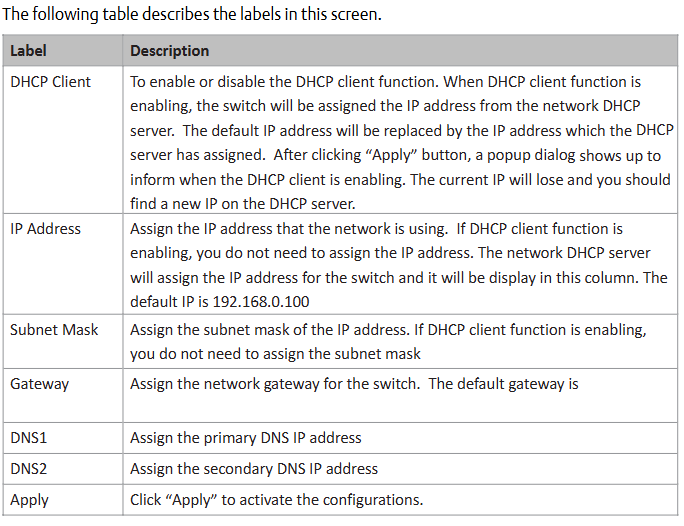
3. DHCP Server (5.1.7)
Function switch: When enabled, the switch acts as a DHCP server and can assign dynamic IP addresses to LAN devices.
Parameter configuration: Set IP allocation range (such as 192.168.0.2-192.168.0.200), subnet mask, gateway DNS, And the IP lease duration (default 168 hours).
Port IP binding: A fixed IP can be assigned to a specified port to ensure that the device obtains the same IP every time it connects.
4. Port settings (5.1.8)
Port control: Set port enable/disable, rate/duplex mode (such as auto negotiation, 100 full), flow control mode (symmetric/asymmetric), and port security (only allow MAC addresses in the security list to forward data when enabled).
Rate limit: It can limit the inbound/outbound traffic of ports and support classification restrictions based on "broadcast frames", "broadcast+multicast frames", and "broadcast+multicast+flood unicast frames".
Trunk port aggregation: supports static aggregation or 802.3ad LACP dynamic aggregation, merging multiple physical ports into logical links to improve bandwidth; The number of active ports in the aggregation group can be set, and the backup port will be automatically activated in case of failure.
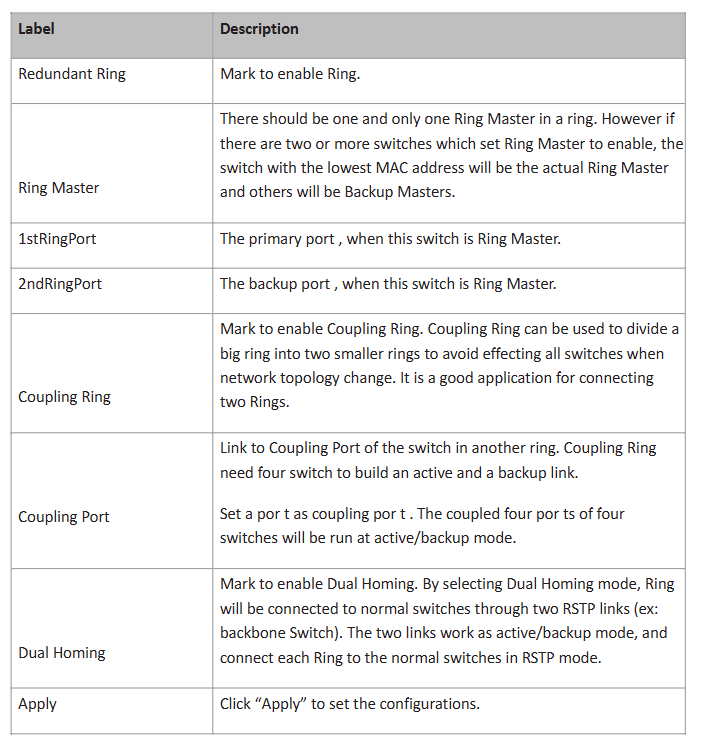
5. Network redundancy (5.1.9)
Redundant Ring: Supports three topologies: ring, ring coupling, and dual homing. It requires specifying the "Ring Master", "First Ring Port", and "Second Ring Port"; Ring coupling is used to split a large ring into two small rings, reducing the impact of topological changes; Dual attribution is used to connect redundant rings and backbone switches through RSTP links.
RSTP configuration: After enabling RSTP, the bridge priority (0-61440, a multiple of 4096, with higher priority for smaller values), maximum aging time (6-40 seconds), Hello time (1-10 seconds), and forwarding delay (4-30 seconds) can be set, satisfying the formula "2 × (forwarding delay -1) ≥ maximum aging time ≥ 2 × (Hello time+1)".
6. VLAN configuration (5.1.10)
802.1Q Tag VLAN: Based on the IEEE 802.1Q standard, cross vendor switch VLAN partitioning is achieved by inserting VLAN tags (VID) into Ethernet frames, supporting GVRP protocol automatic synchronization of VLAN configuration; By default, all ports belong to the default VLAN with VID=1 (which cannot be deleted). Ports can be set to Access (only carrying untagged frames), Trunk (only carrying tagged frames), or Hybrid (simultaneously carrying two types of frames) modes.
Port based VLAN: Logical networks are divided by ports, and only members of the same VLAN can exchange data. Ports that are not selected are automatically assigned to another VLAN; Ignore VLAN tags when enabled.
7. Traffic priority (5.1.12)
QoS strategy: Supports "strict priority" (high priority queue data is transmitted first until empty) or "8:4:2:1 weighted fair queue" (proportionally transmitting high/medium/low/lowest priority queue data).
Priority classification:
Port based: Assign a priority level of "high/medium/low/lowest" to each port.
Based on COS/802.1p: Map to level 4 queue according to the 802.1p field values (0-7) in the frame.
Based on TOS/DSCP: Map to level 4 queue according to the TOS/DSCP field values (0-63) in the IP header.
8. Security Configuration (5.1.14)
IP Security: Only allow IPs in the 'Secure IP List' to manage switches through Web/SNMP.
Port security: After enabling, the port is prohibited from learning new MAC addresses and only forwards MAC frames from the security list.
MAC blacklist: Discard frames with target MAC addresses in the blacklist to prevent specific devices from receiving data.
802.1x authentication: Radius server IP, authentication port (default 1812), billing port (default 1813), shared key, etc. need to be configured, supporting four authorization modes: port "Accept", "Reject", "Authorize", and "Disable".
9. Alarm and Monitoring (5.1.15-5.1.17)
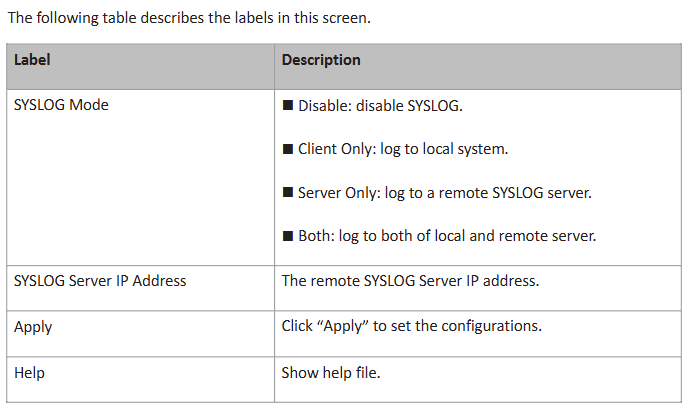
System alarms: Supports SYSLOG (local/remote server logs), SMTP email alarms, and can be triggered by events such as "system cold start", "power status", "SNMP authentication failure", "redundant ring topology change", etc; The fault relay is triggered synchronously when an alarm is triggered, and the Fault LED is constantly on.
Status monitoring: View MAC address table (dynamic/static entries, support aging time setting), port statistics (data volume, error frames, etc.), system event logs (can be refreshed/cleared), port mirroring (copy source port TX/RX data to target port monitoring).
- OMRON
- ABB
- General Electric
- EMERSON
- Honeywell
- HIMA
- ALSTOM
- Rolls-Royce
- MOTOROLA
- Rockwell
- Siemens
- Woodward
- YOKOGAWA
- FOXBORO
- KOLLMORGEN
- MOOG
- KB
- YAMAHA
- BENDER
- TEKTRONIX
- Westinghouse
- AMAT
- AB
- XYCOM
- Yaskawa
- B&R
- Schneider
- KONGSBERG
- NI
- WATLOW
- ProSoft
- SEW
- ADVANCED
- Reliance
- TRICONEX
- METSO
- MAN
- Advantest
- STUDER
- DANAHER MOTION
- Bently
- Galil
- EATON
- MOLEX
- DEIF
- B&W
- ZYGO
- Aerotech
- DANFOSS
- Beijer
- Moxa
- Rexroth
- Johnson
- WAGO
- TOSHIBA
- BMCM
- SMC
- HITACHI
- HIRSCHMANN
- Application field
- XP POWER
- CTI
- TRICON
- STOBER
- Thinklogical
- Horner Automation
- Meggitt
- Fanuc
- Baldor
- SHINKAWA
- Other Brands
- UniOP
- KUKA
- Iba
- Beckhoff
- ADLINK
-
 Sigmatek Wiring Board V2 DIAS 05-250-023
 -
 Sigmatek CP102 20-004-102 S-DIAS CPU Module
 -
 SIGMATEK SLIDES CNC 115 Module
 -
 SIGMATEK DCC080 05-700-080-2 Control Module
 -
 SIGMATEK MDD 121 Drive Axis Module
 -
 SIGMATEK CIO011 C-DIAS Multi I/O Module
 -
SIGMATEK CIV512 Servo Drive
-
 SIGMATEK CM5V020 12-250-021-K Wiring Module
 -
 SIGMATEK CIO011 12-013-011 Multi I/O Module
 -
 SIGMATEK 01-450-031 C-IPC Industrial Computer
 -
 SIGMATEK AKM24D-ANBNGBB0 Servo Motor
 -
 DEMAG NC4 LP0001289.03 Control Module
 -
 Sigmatek ETEK Industrial PC C-IPC with Option Module
 -
 Sigmatek AO081 20-010-081 Analog Output Module
 -
 Sigmatek CNC 031 Positioning Module
 -
 Sigmatek CP731-K 20-004-731-K CPU Module
 -
Sigmatek MDD 3320-JR-A Drive Module
-
 Sigmatek PM Servo Motor AKM52K-ANC2GBB0
 -
Sigmatek MDP 101 09-403-101 Power Module
-
 Sigmatek S-SLIDES AO046 Analog Output Module
 -
 Sigmatek ICA111 20-102-111 Interface Module
 -
 SIGMATEK DCP646 Module 05-004-646
 -
 SIGMATEK SDI101 Digital Input Module 20-891-101
 -
 SIGMATEK S3330-2 Directional Gyro Altitude Instrument
 -
SIGMATEK MDP102-1 Controller
-
 SIGMATEK SMT 01-230-321 Touch Screen
 -
SIGMATEK Krauss Maffei PC301-K 01-310-301-K Industrial PC with 8GB SSD
-
 SIGMATEK ETT731 01-230-731 Built-in Touch Terminal
 -
 SIGMATEK CIV521 Control Module
 -
 SIGMATEK DME 128 Module 05-005-128
 -
 SIGMATEK SCP111-S 20-890-111-S S-DIAS Safety CPU Module
 -
 Sigmatek SCP111 S-DIAS Safety CPU
 -
 Sigmatek CRIF081 Interface Module
 -
Sigmatek CP112-1 S-DIAS CPU Module
-
 Sigmatek MDD121-L DIAS Drive Axis Module
 -
 Sigmatek C-IPC 01-450-024 Industrial PC
 -
Sigmatek SDD215-23 SLIDES Drive
-
 Sigmatek DPS001 DIAS System Components
 -
Sigma-Tek 4000B-30 Directional Gyro
-
 Sigmatek SDD340-46 SDD Series Drive
 -
 Sigmatek CEZ221 Euromap67 I O Module
 -
 SIGMATEK VI021 Interface Module
 -
SIGMATEK CP731-K Control Module
-
SIGMATEK Krauss Maffei PC321-K Industrial PC
-
SIGMATEK ET322 Operator Terminal
-
SIGMATEK CP102 Control Module 24VDC
-
SIGMATEK SRO021 Relay Output Module
-
 SIGMATEK DCP640 DIAS Central Unit
 -
 SIGMATEK MDD 121 Drive Axis Module
 -
SIGMATEK AI043 Analog Input Module
-
 ENOTEC OXITEC 5000 SME-53310000 Oxygen Analyzer
 -
SIGMATEK Krauss Maffei PC301-K 01-310-301-K Industrial PC
-
 SIGMATEK SDD310-23 VARAN Servo Drive
 -
 SIGMATEK CDM 163 and CIC 011 C-DIAS Input Modules
 -
SIGMATEK MDP 101-1 Power Module
-
 SIGMATEK CM5V020 Wiring Circuit with CTMS020
 -
SIGMATEK CCP521 C-DIAS Processor Module
-
 SIGMATEK MDP 101-K Power Module
 -
SIGMATEK ETEK C-IPC 733MHz VIA Eden 7000
-
 SIGMATEK DCP 643 DIAS PLC CPU Module
 -
SIGMATEK TAE121 12-200-121 Operator Terminal
-
Sigmatek TMS012-T Injection Moulding Technology Module
-
Sigmatek MDD 121-1 Controller
-
Sigmatek CDM167 Module
-
Sigmatek DCP082 DIAS Central Unit
-
 Sigmatek ETT731 Built-In Terminal Touch
 -
Sigmatek CCP521 C-DIAS Processor Module
-
 Sigmatek Krauss Maffei PC301-K Control Cabinet PC
 -
 Sigmatek CIC-21 C-DIAS CAN Module
 -
Sigmatek CIO-011 Multi I O Module
-
Sigmatek 01-450-152D C-IPC 152 Industrial PC
-
SIGMATEK 01-450-024 C-IPC 128MB VIA 733MHz
-
SIGMATEK CCL-081 C-DIAS Processor Module
-
 SIGMATEK CP311 20-004-311 Module
 -
 SIGMATEK EP00000262 SLIDES MIDI I O-V3 Controller
 -
SIGMATEK TMS012-T Slides Technology Module
-
SIGMATEK MDD111-1 Drive Axis Module
-
 SIGMATEK MDP101-1 PLC Module
 -
 SIGMATEK CP111 S-DIAS Processor Module
 -
 DEMAG ErgoControl Sigmatek NC4 Display Unit
 -
 SIGMATEK DCP642 Module
 -
 Sigmatek Demag NC4 9617.067.03 Control Module
 -
Sigmatek DCP 643 Central Processing Unit
-
Sigmatek VI 021 S-SLIDES VARAN Interface Module
-
 Sigmatek SDD340-46 Servo Drive 14kVA
 -
Sigmatek DSI021 Slide Siemens Interface
-
Sigmatek CCL912 C-SLIDES CPU PSU Module
-
Sigmatek ETV1521 VARAN Control Panel
-
 Sigmatek ET322 Operator LCD Terminal
 -
 Sigmatek MDD1111 DIAS Drive Module
 -
Sigmatek CAM123 Module
-
 SIGMATEK CP111 VARAN Ethernet Controller
 -
 SigmaTek MDD 111 Axle Module
 -
SIGMATEK CIO013 C-DIAS I O Module
-
 SIGMATEK AKM52K-ANC2GBB0 Servomotor 640VDC
 -
 SIGMATEK ETT321 01-230-321 Touch Screen
 -
 SIGMATEK NC4Kompakt 01-250-010-D Safety Controller
 -
 SIGMATEK CIO011 C-DIAS Multi I O Module
 -
SIGMATEK MDD 121-1 Drive Axis Module
-
SIGMATEK CDM163 Control Module
-
Sigma-Tek 4000HR-3 Heading Reference Directional Gyro
-
Sigmatek DIAS DAI 883 Analog Input Module
-
Sigmatek 0332.554.03 Printed Circuit Board Card
-
 Sigma Tek 5000B-36 Attitude Gyro 8130
 -
Demag NC4 0332.554.03 Sigmatek Control Board
-
Sigmatek IPC Pentium 300 CF Industrial PC
-
Sigmatek MDP 102 PLC Module
-
 Sigmatek DTO163 Digital Output Module
 -
 Sigmatek PCT151 Touch IPC 15 Panel and I-PC C300
 -
Sigmatek CCL911 CD Processor Module
-
Sigmatek SCP011 S-DIAS Safety CPU Module
-
Sigmatek SE051 Network Splitter Module
-
Sigmatek CIO011 C-DIAS I O Module
-
 Sigmatek SE051 Ethernet Splitter
 -
 Sigmatek CCL911 CD Processor Module
 -
Sigmatek SDD310-4 DIAS Drive 14kVA
-
Sigmatek CTMS020 C-DIAS Technology Module
-
Sigmatek CTMS020 CD Technology Module
-
Sigmatek CTO167 C-SLIDES Digital Output Module
-
Sigmatek C-IPC 152 Industrial PC
-
 Sigmatek SDD310-4 SLIDES Drive 310
 -
SIGMATEK MDP 102-1 DIAS Power Module
-
 SIGMATEK SCP111 S-DIAS Safety CPU Industrial
 -
SIGMATEK CAO081 Analog Output Module
-
SIGMATEK DCC080L Control Module
-
 SIGMATEK MDP101-1 Power Module
 -
SIGMATEK SCP111 S-DIAS Safety CPU
-
 SIGMATEK PC325-K Industrial PC


