
Yokogawa ROTOMETER RAMC Metal Variable Area Flow Meter
Yokogawa ROTOMETER RAMC Metal Variable Area Flow Meter
Positioning and core use
The dedicated user manual for Yokogawa ROTOMETER RAMC series metal variable area flow meters is suitable for volumetric/mass flow measurement of liquids and gases, especially for turbulent, opaque or corrosive fluid scenarios. The core uses float magnetic transmission to achieve flow indication and supports extended functions such as electronic transmitters and limit switches.
Core principles and structure of the product
1. Measurement principle
RAMC is a variable area flowmeter that operates based on the principle of "float force balance"
The fluid flows through the conical measuring tube from bottom to top, generating upward lift on the float;
The float rises to the equilibrium position of "lift=gravity+buoyancy", and its height is proportional to the flow rate;
The float is equipped with a built-in magnet, which drives the indicator pointer through magnetic transmission or triggers the electronic transmitter to output a 4-20mA signal/limit switch action.
Key feature: Within the "viscosity independent range" (fluid viscosity below a specific value), flow rate is only related to float height; When exceeding this range, the influence of viscosity on measurement needs to be considered, and the calibration scale and EEPROM need to be recalculated by the manufacturer.
2. Product structure and core components
Component Name Function Description
The conical measuring tube provides a float rising channel, and the material is selected according to the corrosiveness of the fluid (such as stainless steel 1.4404/316L, PTFE)
Float core sensing element, built-in magnet, material adapted to fluid characteristics (such as corrosion-resistant alloy)
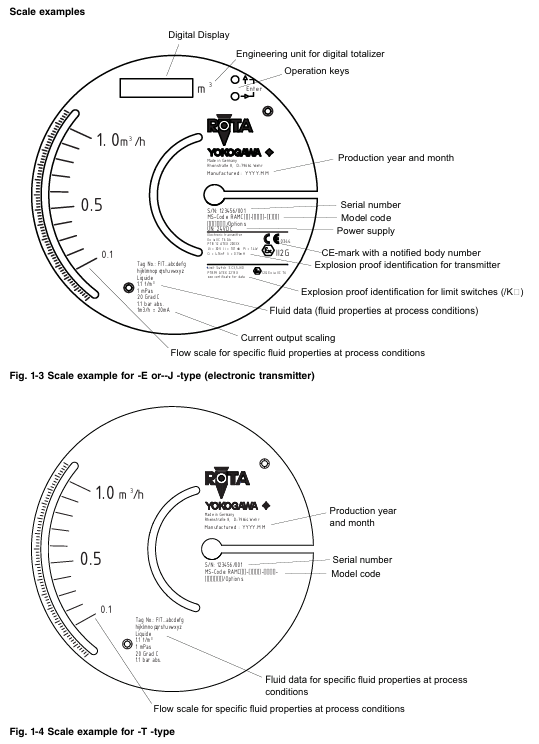
Indicator mechanical pointer indicates flow rate, optional LCD digital display (displaying flow rate, cumulative value, percentage, etc.)
The electronic transmitter (- E/- J type) converts the float position into a 4-20mA analog signal, while the - J type supports HART 7 communication
Limit switch (/K1-/K10 options) realizes flow upper and lower limit alarm, supporting standard type (/K1-/K3) and fail safe type (/K6-/K10)
Calibration EEPROM stores customized calibration data (such as fluid density, temperature, viscosity parameters), corresponding one-to-one with the measuring tube
Installation and wiring specifications
1. Preparation before installation and environmental requirements
Environmental restrictions:
Temperature: -40 ° C~+70 ° C (standard), -20 ° C~+60 ° C (explosion-proof type);
Avoid strong vibrations, corrosive environments (if necessary, choose high anti-corrosion coating shells), and strong magnetic field interference (keep a distance from solenoid valves, etc. Ferromagnetic objects should be kept away from ≥ 250mm);
The distance between adjacent RAMCs should be ≥ 300mm to prevent mutual interference of magnetic fields.
Pipeline requirements:
It must be installed vertically, with the fluid flow direction being "downward and upward", and the flanges should be aligned parallel to avoid pipeline stress;
For models with a nominal diameter greater than RAMC08, it is necessary to reserve a straight pipe section for the first 5 times the nominal diameter and a straight pipe section for the last 3 times the nominal diameter;
If the fluid may contaminate the measuring tube, it is recommended to install a bypass pipeline for easy disassembly and cleaning of the equipment.
2. Pipeline connection and wiring operation
Flange connection: Supports EN, ASME and other standard flanges, and bolt torque must strictly follow the specifications, such as DN15 PN40 flange (EN 1092-1) torque of 9.8 Nm, DN50 PN40 flange torque of 57 Nm; PTFE lined flanges require additional attention to sealing performance to avoid fluid leakage.
Wiring specifications:
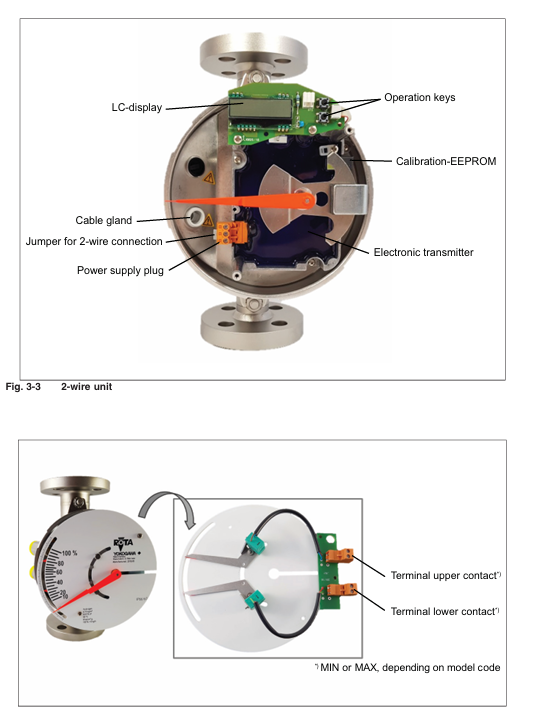
Cable sealing sleeve: Suitable for cables with a diameter of 6-9mm. If not in use, M16 × 1.5 (shell 90 type) or M20 × 1.5 (shell 91 type) blind plug sealing is required for the entrance;
Signal and power separation: Analog signals (4-20mA), digital communication (HART), and power cables need to be wired separately to avoid interference;
Grounding requirements: The protective grounding (PE terminal) must be firmly connected, with a grounding resistance of ≤ 100 Ω, and an additional external grounding clamp is required for the 91 type shell.
Core functions and parameter configuration
1. Operation of electronic transmitter (- E/- J type)
(1) Basic functions and parameter settings
The electronic transmitter supports functions such as flow display, cumulative value statistics, 4-20mA output calibration, etc. It can be configured through two operation keys (up key "exit", down key "switch menu", combination key "confirm"). The core parameters are as follows:
Function Description of Key Setting Items for Parameter Categories
Display function (F11) default display of flow/cumulative value/percentage/temperature cumulative value, switchable units (such as m ³/h, L/min, kg/s)
Unit setting (F12/F13): Volume/mass unit+time unit. The European version supports m ³, Nm ³, kg, etc., while the American version (/A12 option) supports gal, scf, etc
Damping setting (F21): Smooth output signal for 0/1/5/10 seconds to reduce the impact of flow fluctuations, with a default of 1 second
Current output (F3-) 4-20mA/0-20mA switch 2-wire system default 4-20mA, adjustable zero point (F32) and range (F33), 20 μ A per step
Fault detection (F4-) error code displayed as "08" indicates that the float is stuck and needs to be cleaned or automatically zeroed (F74)
Float stuck detection (F7-) on/off, monitoring lower limit (5%/15%/30% Qmax), monitoring time 5/15 minutes optional. If there is no signal fluctuation beyond the deadline, a fault alarm will be triggered
(2) HART 7 communication (- J type exclusive)
Communication features: Supports 2-wire 4-20mA overlay with HART signal, enables remote parameter configuration and data reading (such as real-time flow, cumulative value, diagnostic information), supports multi slave mode (up to 63 devices), and can set polling address 1-63.
Core functions:
Process variable monitoring: real-time reading of flow rate, temperature, current output, etc;
Fault diagnosis: detect RAM errors, ADC faults, EEPROM anomalies, etc;
Burst mode: Continuously sending specified data (such as traffic+cumulative value) to reduce communication latency;
Trend configuration: Record 12 sets of historical data, with adjustable sampling intervals of 1-2 hours.
2. Limit switch (/K1-/K10 options)
Type and Function:
Standard type (/K1-/K3): Supports MAX/MIN dual contacts and complies with EN 60947-5-6 (NAMUR) standard;
Fault safe type (/K6-/K10): When power is cut off, the contacts automatically switch to a safe state and require a dedicated power supply (such as/K2E,/W4F).
Parameter configuration: Set the MIN-MAX/MIN-MIN/MAX-MAX function by switching the direction of the power supply. For example, when the K3 option is paired with the W2B power supply, the S1/S2 relay position determines the contact logic.
Explosion proof certification and safety regulations
1. Explosion proof type and applicable scenarios
RAMC provides two types of explosion-proof designs: intrinsic safety (Ex ia) and explosion-proof (Ex db), covering major certification systems worldwide. The core parameters are as follows:
Certification Type Model Options Explosion proof Mark Applicable Area Key Parameters (Electronic Transmitter)
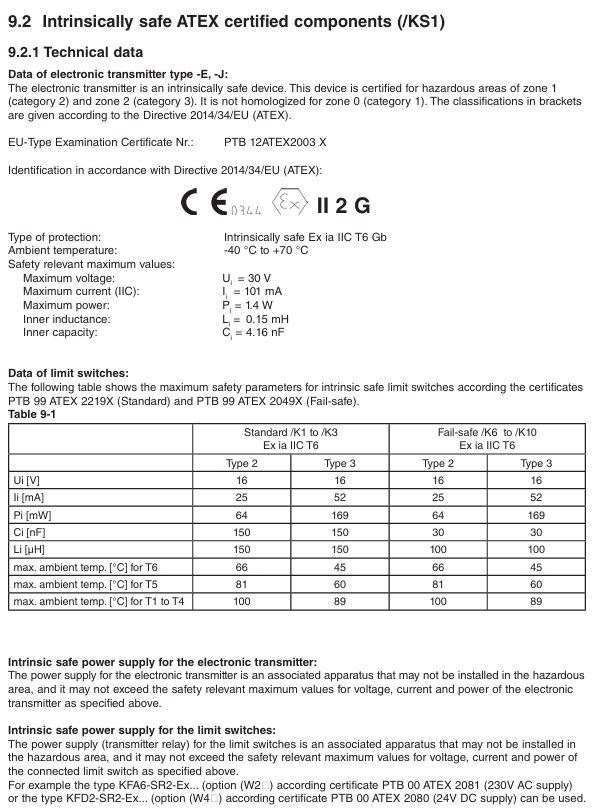
ATEX/KS1 (intrinsic safety) Ex ia IIC T6 Gb Zone 1/2 (gas), Zone 21/22 (dust) Ui=30V, Ii=101mA, Pi=1.4W
IECEx/ES1 (Intrinsic Safety) Ex ia IIC T6 Gb Global Explosion proof Zone Li=0.15mH, Ci=4.16nF
NEPSI (China)/NS1 (Intrinsic Safety) Ex ia IIC T6 Gb Explosion proof Area Environmental Temperature in China -40 ° C~+70 ° C
FM/UL (US Canada)/FS1 (Intrinsic Safety) Class I Div1 GP A-D T6 US Canada Zone 1/Zone 2 Vi=30V, Ii=100mA, Pi=1.4W
EAC (Eurasian Economic Union)/GS1 (Explosion proof+Dust) Ex db IIC T6 Gb/Ex tb IIIC T80 ° C Db Eurasian Union Explosion proof Area Surface Temperature ≤ 80 ° C (T6)
2. Explosion proof installation and operation taboos
Intrinsic safety requirements:
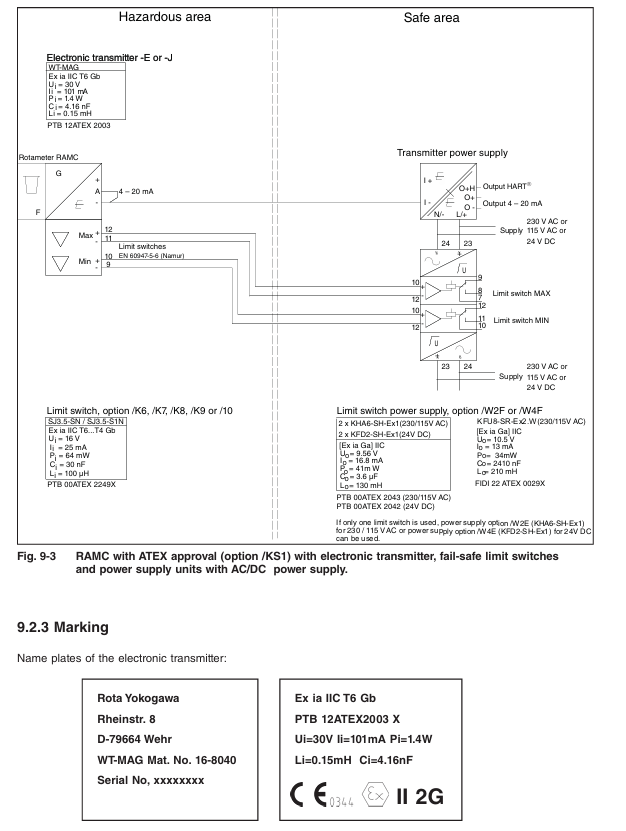
The power supply must be a certified associated device (such as KFA6-SR2-Ex2. W) installed in a safe area;
The cable capacitance/inductance should be ≤ Ci/Li (e.g. Ci=4.16nF, Li=0.15mH) to avoid safety risks caused by exceeding the limit.
Explosion proof type requirements:
Power off and wait for 15 minutes before opening the lid to ensure the safety of the internal gas;
The cable sealing sleeve must comply with the IEC 60079-1 standard and be sealed with certified blind plugs for entry purposes;
When the shell is damaged (such as the observation window breaking), it should be immediately stopped to avoid the failure of explosion-proof performance.
Maintenance and troubleshooting
1. Daily maintenance and regular inspections
Routine inspection (weekly):
Pointer/display screen: Confirm that the flow indication matches the actual working conditions without any jamming or jumping;
Sealing state: The flange and cable sealing sleeve have no leakage, and the shell has no corrosion;
Explosion proof mark: The label is clear, without wear or detachment.
Regular maintenance (every 6 months):
Cleaning: The measuring tube and float need to be disassembled and cleaned (avoiding the use of corrosive solvents), and the magnetic properties of the float should be checked for normal operation;
Calibration: The electronic transmitter needs to be verified for 4-20mA output accuracy through a HART communicator, and the limit switch needs to be tested for contact action reliability;
Grounding inspection: The grounding resistance is ≤ 100 Ω, and the grounding terminal is not loose.
2. Common faults and troubleshooting
Possible causes and solutions for the fault phenomenon
The pointer is unresponsive/stuck, the float is stuck by impurities, and the inner wall of the measuring tube is scaled. Disassemble and clean the float and measuring tube, and replace the float if necessary
Electronic transmitter has no output power supply fault, calibration EEPROM is missing, wiring is loose. Check power supply (24VDC ± 10%), reinsert EEPROM, and tighten wiring terminals
HART communication failure, load resistance not between 250-600 Ω, pole address conflict, adjust load resistance, reset unique pole address (1-63)
The flow indication deviation is large, and the viscosity/density of the fluid does not match the calibration value. The wear of the float provides new fluid parameters, and the manufacturer recalculates the scale; Replace the worn float
Improper threshold setting for triggering limit switch misoperation, recalibration of switch threshold due to magnetic field interference (such as 5% Qmax), and staying away from strong magnetic field sources
Application of Safety Instrumented System (SIS)
1. Applicable models and safety functions
RAMC only comes with fail safe limit switches (V1) and standard limit switches (V2), which can be used for SIS as flow monitoring components connected to safety instrument functions (SIF). The core realizes "flow over limit alarm" or "emergency cut-off trigger", and supports SIL1-SIL2 levels (depending on configuration and verification cycle).
2. Key SIS requirements
Verification cycle: It should be set according to safety integrity requirements, with a recommended duration of 1-5 years. The verification coverage rate should be ≥ 99%, and the verification results should be recorded (such as forcing the float to trigger the MAX/MIN threshold and verifying the switch action);
Reliability data: V1 type (fail safe switch) SFF=61%, MTBF=530 years, V2 type (standard switch) SFF=42%, MTBF=401 years. Detailed FMEDA reports can be obtained from the manufacturer;
Lifecycle: Designed for a lifespan of 10 years, if exceeded, reliability needs to be reassessed or core components such as measuring tubes and floats need to be replaced.
Compliance and Disposal Standards
1. Compliance with PED Pressure Equipment Directive
RAMC complies with 2014/68/EU (PED), the measuring tube is classified as "pipeline", the heating element (/T1-/T6 options) is classified as "container", fluid group 1-2, module H, and some models (such as RAMC03-15) belong to Class III pressure equipment and need to comply with pressure temperature ratings (such as stainless steel material -196 ° C~370 ° C, PTFE material -80 ° C~130 ° C).
2. Requirements for abandonment and return to factory
Decontamination treatment: After coming into contact with harmful fluids, the equipment should be thoroughly cleaned to avoid residual corrosion or toxicity. A "Decontamination Declaration" should be submitted when returning to the factory;
Environmental disposal: It belongs to WEEE equipment (2012/19/EC) and is prohibited from being mixed with municipal waste. It must be collected by professional institutions or returned to designated outlets in Yokogawa for disposal.
Summary and selection suggestions
1. Core advantages
Wide applicability scenarios: Supports corrosive, opaque, turbulent fluids, temperature range -196 ° C~370 ° C, pressure range PN16~PN100;
Flexible function expansion: optional electronic transmitter (HART communication), limit switch (fail safe), explosion-proof certification (global major system);
Low maintenance cost: The measuring tube and float are made of durable materials (such as 316L stainless steel), with no vulnerable parts. Calibration only requires replacing the EEPROM and scale.
2. Key parameters for selection
Fluid characteristics: Select the material of the measuring tube/float based on density, viscosity, and corrosiveness (such as PTFE for strong corrosion and stainless steel for conventional fluids);
Explosion proof requirements: Hazardous areas require matching certification types (such as China Select/NS1, US Canada Select/FS1);
Signal output: Remote monitoring should select the - J type (HART), only local indication should select the - T type, and alarm control should be equipped with/K series limit switches.
- OMRON
- ABB
- General Electric
- EMERSON
- Honeywell
- HIMA
- ALSTOM
- Rolls-Royce
- MOTOROLA
- Rockwell
- Siemens
- Woodward
- YOKOGAWA
- FOXBORO
- KOLLMORGEN
- MOOG
- KB
- YAMAHA
- BENDER
- TEKTRONIX
- Westinghouse
- AMAT
- AB
- XYCOM
- Yaskawa
- B&R
- Schneider
- KONGSBERG
- NI
- WATLOW
- ProSoft
- SEW
- ADVANCED
- Reliance
- TRICONEX
- METSO
- MAN
- Advantest
- STUDER
- DANAHER MOTION
- Bently
- Galil
- EATON
- MOLEX
- DEIF
- B&W
- ZYGO
- Aerotech
- DANFOSS
- Beijer
- Moxa
- Rexroth
- Johnson
- WAGO
- TOSHIBA
- BMCM
- SMC
- HITACHI
- HIRSCHMANN
- Application field
- XP POWER
- CTI
- TRICON
- STOBER
- Thinklogical
- Horner Automation
- Meggitt
- Fanuc
- Baldor
- SHINKAWA
- Other Brands
- UniOP
- KUKA
- Iba
- Beckhoff
- ADLINK
-
 Sigmatek MDD111-1 DIAS Drive Axis Module
 -
 Sigmatek DKL042 05-024-042 Terminal Module
 -
 Sigmatek DM822 Control Module
 -
 Sigmatek CDM167 12-008-167-O Module
 -
 Sigmatek TAE151 Touch Display Unit
 -
 Sigmatek DCC041 SLIDES Module 05-700-041-D
 -
 Sigmatek AKM65M-ANC2GBB0 PM Servo Motor
 -
 Sigmatek ETT221 01-230-221 Operator Terminal
 -
 Sigmatek SLIDES DAM 124 Analog Module
 -
Sigmatek AKM31C-ANCNGBB0 Servo Motor
-
 Mannesmann Demag Sigmatek CP626 Central Unit
 -
 SIGMATEK 0332.554.03 Board 371071000154
 -
 SIGMATEK 12-250-021 Base Plate Back Panel CM5V020
 -
 SIGMATEK DM162 S-DIAS Digital Mix Module
 -
 DEMAG ERGOTECH 061 381 66 Sigmatek 9842.243.02 Circuit Board
 -
 SIGMATEK CP313-1 PLC Module
 -
Sigmatek ETV0551-2 VARAN Touch Terminal
-
 Sigmatek SDM 081 FS S-Dias Safety Module
 -
 DEMAG 05-250-023 Ergotech Motherboard with Sigmatek TMS012
 -
Sigmatek CM5V020 12-250-023-K Wiring Base
-
 Sigma Tek 5000B-37 Attitude Gyro Indicator
 -
 Sigmatek SDD120-2 DIAS Drive
 -
 Sigmatek CME221 Memory Module
 -
 Sigmatek DCP640 DIAS Central Unit
 -
 Sigmatek STO040 Safety Output Module
 -
Sigmatek CET281 Control Panel
-
 Sigmatek CIPC LX800 Demag NC5 CPU
 -
 Sigmatek DKL093 05-024-093 Terminal Module
 -
 Sigmatek AI088 20-009-088 Analog Input Module
 -
Sigmatek CAI888 Analog Input Module
-
SIGMATEK CCA021 12-025-021 Analog Output Module
-
SIGMATEK 1104.579.05 Control Module
-
SIGMATEK SDI100 Digital Input Module
-
 SIGMATEK C-IPC 256MB LX800 Compact Dias
 -
 SIGMATEK 9423.090.02 Control Module
 -
SIGMATEK C-IPC 256 Power Supply 148498
-
 SIGMATEK CAI025 Analog Input Module
 -
 SIGMATEK CTO166 Digital Output Module
 -
 SIGMATEK CP112 20-004-112 Processor Module
 -
SIGMATEK CAI887 12-009-887 Safety Module
-
 Sigma-Tek 4000B-31 Directional Gyro 1U262-002-42
 -
Sigmatek C-IPC 256MB LX800 IPC Controller
-
Sigmatek C-IPC 01-450-031 Industrial PC LX800
-
Sigmatek C-IPC 256 Industrial PC Controller
-
Sigmatek CCP-531 PLC Processor Module
-
Sigmatek CDI163 Digital Input Module
-
 Sigmatek ETV0501 VARAN Terminal 12-230-0501
 -
 Sigmatek CTMS020 C-DIAS Technology Module
 -
 Sigmatek CIV512 VARAN Switch Module
 -
 Sigmatek HU011 20-080-011 Interface Module
 -
SIGMATEK SLIDES DAM 124 Module
-
 SIGMATEK C-IPC 161 01-450-161L Industrial PC
 -
SIGMATEK C-IPC 128MB VIA 733MHz 01-450-024-K
-
 SIGMATEK 12-780-012 R8-IPC Geode LX800 Module
 -
SIGMATEK CAM124 Analog Module
-
 SIGMATEK S1 032-8AF61-R4 EZ Servo Motor
 -
 SIGMATEK CTO163 Digital Output Module
 -
 SIGMATEK CCP082 12-004-082 Processor Module
 -
 SIGMATEK CRCH081 C-DIAS Temperature Module
 -
 SIGMATEK PC322-K 01-310-322-K Industrial PC
 -
SIGMATEK SDD310-2 Servo Drive
-
 SIGMATEK AI084 Analog Input Module
 -
SIGMATEK CRCH081 12-752-081 Temperature Module
-
Sigma-Tek 5000L-4 Attitude Gyro 1U284-001-3
-
 SIGMATEK CM5V020 12-250-023-K Wiring Module
 -
Sigma-Tek 4000H-6 Directional Gyro IU262-035-7
-
 SIGMATEK Dias DCP160 05-004-160 Processor Module
 -
SIGMATEK 0147.395.02 Control Module
-
SIGMATEK A1084 Control Module
-
SIGMATEK DI200 20-006-2000 Digital Input Module
-
Sigmatek DNC115 Encoder Module
-
 Sigmatek DAM122 05-017-122 Analog Module
 -
Sigmatek 9802.289.01 Control Board TA71 Display
-
Sigmatek TO127 20-007-127 Digital Output Module
-
Sigmatek DNC031 05-011-031 Digital Module
-
Sigmatek VI022 20-003-022 Interface Module
-
Sigmatek CAI085 Analog Input Module
-
 Sigmatek CP111 S-DIAS CPU Module
 -
Sigmatek CTMS030 Krauss Maffei Module
-
 Sigmatek CAM123 Control Module
 -
 Sigmatek TAE732-P 01-240-732-P Touch Display Unit
 -
Sigmatek MDM021 Digital Mixed Module
-
Sigmatek DCP642 DIAS Central Unit
-
 Sigmatek CST022 12-014-022 C-DIAS Module
 -
 Sigmatek SRO021 20-893-021 Safety Relay Output
 -
 Krauss Maffei MC5 Control System Sigmatek
 -
 Sigmatek DC061 Module 18-24VDC 300mA
 -
 Herrmann EVT0855 Ultrasonic Welder Touch Panel
 -
Sigmatek CIV521 Control Module 1.4A 2W
-
Sigmatek DDI61 05-006-161 Digital Input Module
-
SIGMATEK ETT312-E Touch Terminal 01-230-312
-
Cessna S3326-1 Sigma Tek 5000B-67 Gyro 1U149-015-9
-
SIGMATEK PS101 Power Supply Module
-
SIGMATEK 0332.554.03 Control Module 371071000154
-
 SIGMATEK ETT312-E Touch Terminal 01-230-312
 -
SIGMATEK CDM163 Control Module
-
 SIGMATEK VSV046 16-023-046 Module
 -
SIGMATEK AM221 20-017-221 Analog Module
-
SIGMATEK CTS051 12-053-051 Control Module
-
SIGMATEK AM221 20-017-221 Analog Module
-
Sigmatek CSDI161 12-891-161 Safety Input Module
-
Sigma Tek 4000C-1 Directional Gyro Indicator
-
Sigmatek ETV0501 12-230-0501 VARAN Terminal
-
Sigmatek DDM165 SLIDES Module
-
Sigmatek N100 20-011-100 Control Module
-
Sigmatek AKM54K-ANC2R-B0 PM Servo Motor
-
Sigmatek CTO166 Digital Output Module
-
Sigmatek CP212-K 20-004-212-K CPU Module
-
Sigmatek CDI161 Digital Input Module
-
Sigmatek DCC080 05-700-080-2 Control Module
-
 SIGMATEK SCP011 S-DIAS Safety CPU
 -
SIGMATEK SCP011 S-DIAS Safety CPU
-
SIGMATEK SRO022 Relay Output Module
-
SIGMATEK MDD 121 Drive Axis Module
-
SIGMATEK DSI021 SLIDES Siemens Interface
-
SIGMATEK DIAS DCP161 Module 05-004-161
-
 Sigmatek ETT312 Built-in Touch Terminal
 -
SIGMATEK DCP 643 DIAS Controller System
-
SIGMATEK CIO021 Multi I/O Module
-
SIGMATEK CTMS020 Control Module
-
 Sigmatek CME 221 Memory Module
 -
Sigmatek 0420.615.01 Control Board
-
Sigmatek CP111 20-004-111 CPU Module
-
Sigmatek 9405.065.03 Control Board
-
Sigmatek ETEK 01-450-032-K C-IPC 256MB Industrial PC
-
Sigmatek CTO163 12-007-163 Safety Output Module
-
Sigmatek TO081 20-007-081 Digital Output Module
-
 Sigmatek SI021 20-022-021 Safety Input Module


