
ABB Ability ™ Symphony ® Plus MR series (Melody Rack) control system
Traditional production facilities require the maintenance of multiple independent controller subsystems, while the MR series integrates multifunctional capabilities through an extensible controller platform that combines openness and high availability, avoiding compatibility issues with multiple systems, reducing overall operational complexity, and bringing higher returns to enterprise assets.
ABB Ability ™ Symphony ® Plus MR series (Melody Rack) control system
Core positioning and value of the product
ABB Ability ™ Symphony ® The Plus MR series (also known as Melody Rack) is a modular, high availability, and easy to configure efficient control system, mainly aimed at industrial fields such as power generation and water treatment. Its core goal is to help users improve production control efficiency, maximize process availability, reduce maintenance costs, and support rapid response to market demand changes, adapting to automation tasks in factories of different sizes through flexible architecture and powerful functions.
Traditional production facilities require the maintenance of multiple independent controller subsystems, while the MR series integrates multifunctional capabilities through an extensible controller platform that combines openness and high availability, avoiding compatibility issues with multiple systems, reducing overall operational complexity, and bringing higher returns to enterprise assets.
Core functions and technical features
1. Flexible hardware architecture and I/O system
(1) Modular assembly and installation method
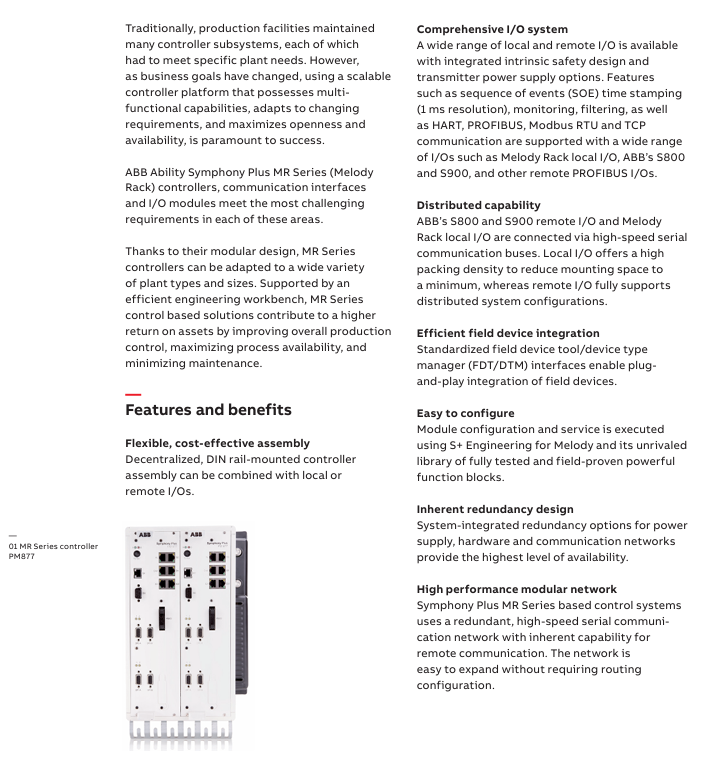
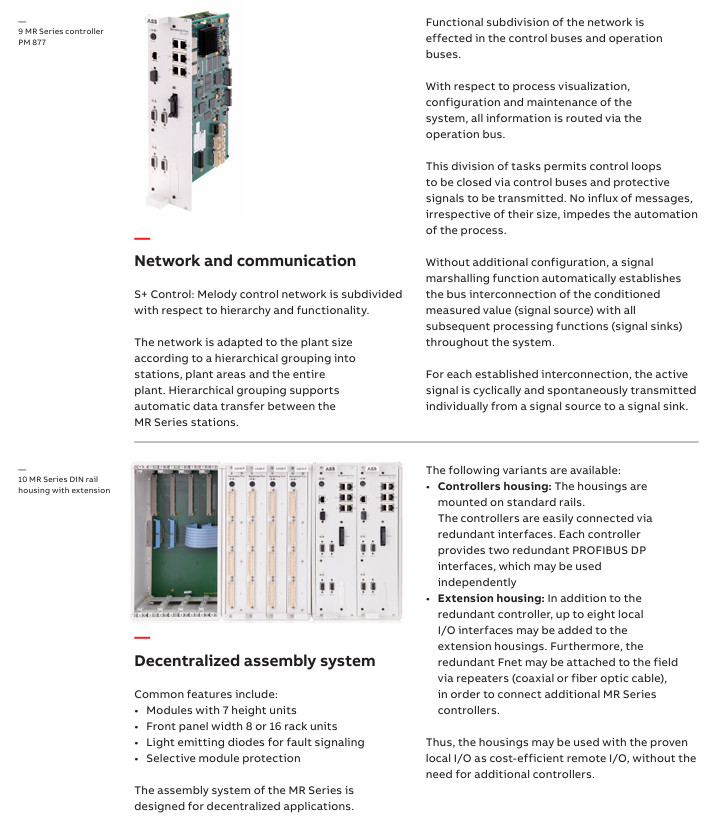
Deployment form: Supports distributed DIN rail installation, can be combined with local I/O or remote I/O (such as ABB S800, S900 series and other PROFIBUS remote I/O), suitable for centralized or decentralized system layouts;
Installation compatibility: Provides three installation methods: cabinet installation, DIN rail installation, and 19 inch rack installation, which can be combined and used in the same project to facilitate the upgrading and renovation of existing facilities;
Space optimization: The high packaging density of local I/O modules can minimize installation space and reduce cabinet occupancy costs.
(2) Comprehensive I/O types and functions
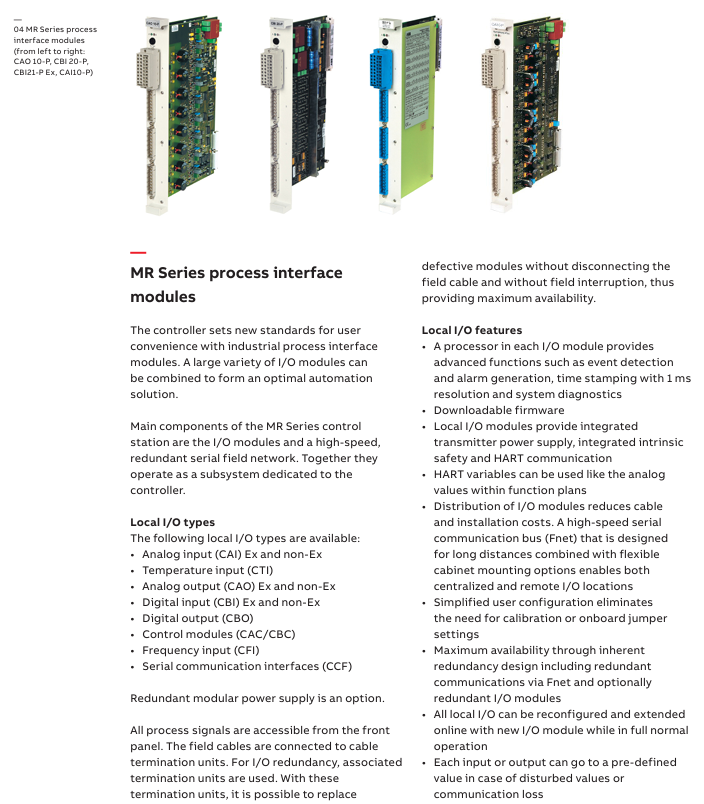
The MR series provides a wide range of local I/O modules, covering common signal requirements in industrial scenarios, and supporting intrinsic safety (Ex i) design and HART communication. The specific types and features are as follows:
Specific classification of I/O module types and core functions
Analog Input (CAI) Ex version/non Ex version integrated transmitter power supply, 1ms resolution timestamp, signal monitoring and filtering, supports equal use of HART variables and analog signals
Temperature Input (CTI) - Accurately collects temperature signals and adapts to different industrial temperature measurement scenarios
Analog output (CAO) Ex version/non Ex version provides continuous control signals and supports preset value output under fault conditions
Digital input (CBI) Ex/non Ex version event detection and alarm generation, 1ms timestamp, compatible with switch signal acquisition
Digital Output (CBO) - controls external actuators (such as solenoid valves) and supports redundant configurations to enhance availability
Control module (CAC/CBC) CAC 10-P (closed-loop output), CBC 11-P (drive control) CAC is used for continuous controllers, PI step controllers, etc; CBC is used for switch actuators, motor drives, etc., and can operate independently of the controller
Frequency Input (CFI) - collects frequency signals, adapts to monitoring parameters such as speed and flow rate
Serial Communication Interface (CCF) - expands external communication such as Modbus and PROFIBUS, supporting third-party device access
(3) I/O redundancy and maintenance convenience
Redundant design: Supports I/O module redundancy, communication bus (Fnet, high-speed serial bus) redundancy, and power module can also choose redundant configuration to ensure no single point of failure;
Online maintenance: By using dedicated wiring terminal units, it is possible to replace faulty I/O modules without disconnecting on-site cables and without interrupting the production process;
Online expansion: I/O modules can be reconfigured or added during normal system operation without downtime, ensuring process continuity.
High performance controllers and control capabilities
(1) Core parameters and functions of the controller
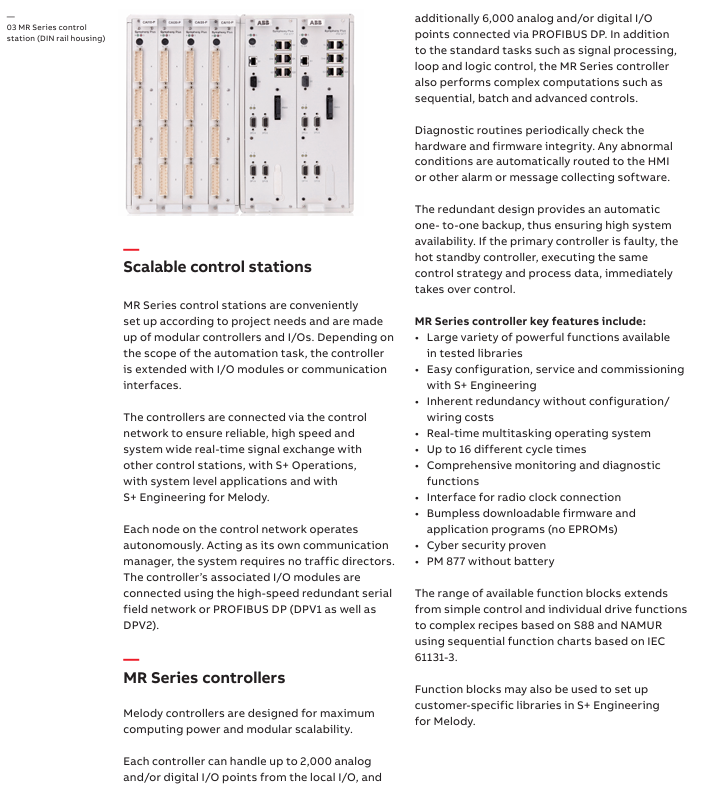
The MR series controller (represented by PM877) has powerful computing and control capabilities, suitable for complex industrial scenarios, and key features include:
I/O processing capability: A single controller can handle local I/O (2000 analog/digital points)+PROFIBUS DP remote I/O (6000 analog/digital points), totaling 8000 I/O points;
Control function coverage: supports open-loop/closed-loop control, sequential control, batch control, and advanced control (such as formula management based on S88 standard and fault handling based on NAMUR standard), meeting complex control strategies in fields such as power generation and water treatment;
Performance: Equipped with a real-time multitasking operating system, supporting 16 different cycle times, with a time synchronization accuracy of 0.5ms between controllers and a sequence of events (SOE) timestamp resolution of 1ms, ensuring real-time performance and data accuracy;
Diagnosis and safety: Regularly check the integrity of hardware and firmware, and automatically report abnormal states to HMI or alarm system; Compliant with network security standards (DSAC), the battery free design reduces maintenance costs, and the performance is improved compared to the previous generation product (CMC 50/60), with power consumption reduced by 50% compared to PM875/876.
(2) Redundancy guarantee and seamless switching
The controller adopts a "hot standby" redundancy design, which does not require additional configuration or wiring:
The main controller and backup controller operate synchronously with the same control strategy and process data;
If the main controller fails, the backup controller immediately takes over control, achieving "disturbance free switching" and ensuring system availability (high average time between failures).
Standardized communication and network architecture
(1) Multi level communication network
The MR series adopts a layered and functionally segmented network architecture to ensure real-time control and operational flexibility. The specific levels are as follows:
Technical characteristics of core functions at the network level
Control the network to achieve real-time signal interaction between controllers and between controllers and I/O modules, closed-loop control and protection signal transmission redundant high-speed serial network, no routing configuration required, supports remote communication, and is not affected by operational layer message traffic
Operate network connection engineering workstations (S+Engineering), operation workstations (S+Operations), and system servers to transmit visual data, configuration information, and maintenance instructions, supporting simultaneous access by multiple users
Fieldbus interface docking with third-party devices and intelligent electronic devices (IEDs) supports PROFIBUS DP (DPV0/DPV1/DPV2), Modbus RTU/TCP, IEC 61850 (electrical subsystem integration)
(2) Key communication interface capability
PROFIBUS DP: A single controller supports 2 PROFIBUS lines, each line can be redundant, the transmission rate is adjustable from 9.6kbit/s to 12Mbit/s, supports PROFIBUS-DP/PA converters, and is compatible with Ex area devices;
Modbus: The local interface card provides Modbus RTU, and the controller has built-in Modbus TCP. A single controller supports 128 Modbus TCP servers and 16 Modbus TCP slaves, making it easy to interface with third-party instruments PLC;
IEC 61850: Intelligent Electronic Devices (IEDs) that directly integrate electrical subsystems without the need for additional gateways, simplifying the integrated design of electrical and control systems in the field of power generation.
Efficient engineering tools and software support
(1) S+Engineering for Melody Engineering Platform
This platform is the core configuration tool of the MR series, which achieves efficient project management through a client server architecture. Its core advantages include:
Single source data management: System configuration information is stored in a single database, eliminating duplicate data entry, ensuring data consistency, and supporting import/export of common file formats (such as Excel);
Multi user collaboration: The configuration server supports simultaneous connection of 10 clients, and engineers can remotely debug (from loop level to controller basic functions), which is suitable for efficient progress in hot debugging and project closure stages;
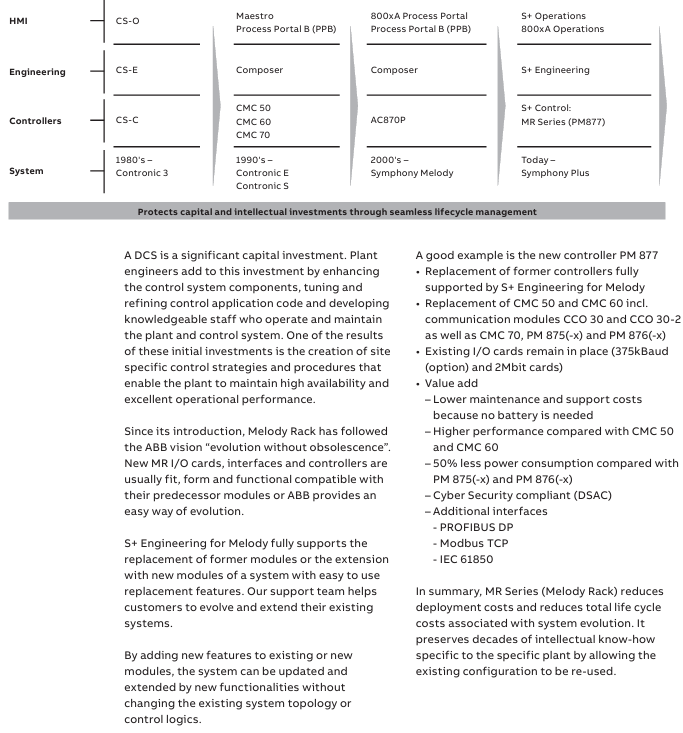
Version and Lifecycle Management: Integrated version control, version comparison, and rollback functions, supporting offline engineering design to avoid the impact of online modifications on production; Support replacing old modules (such as CMC 50/60/70, PM875/876) with new modules (such as PM877) without changing the existing topology and control logic;
Function Block Library: Provides a powerful function block library that has been verified on site, covering simple controls (such as MAX/MIN, 2 out of 3 logic), complex controls (such as polygon curves, batch formulas), supports user-defined function block libraries, and is programmed based on IEC 61131-3 standard Sequential Function Diagram (SFC).
(2) On site equipment integration
Through standardized FDT/DTM (Field Device Tool/Device Type Manager) interfaces, on-site devices can be "plug and play", and configuration and diagnostic information can be transmitted to the system layer through the control network, supporting asset optimization and device management applications.
System compatibility and lifecycle advantages
1. Backward compatibility and smooth upgrade
The MR series follows ABB's "evolution without exclusion" philosophy to ensure compatibility between old and new systems
Hardware compatibility: New I/O modules and controllers (such as PM877) are compatible with previous generation modules (such as CMC series) in terms of installation size and functional interfaces. Existing I/O cards can be retained for use (supporting 375kBaud and 2Mbit cards);
Software support: S+Engineering for Melody provides a tool for replacing old modules, without the need to rewrite control logic. Simply update the firmware to extend new features (such as adding IEC 61850 interfaces);
Investment protection: Users can reuse the factory specific control strategies and operational processes accumulated by decks to avoid "starting over" during upgrades and reduce capital and labor costs.
2. Industry Applications and Case Scale
The MR series is widely used in the fields of power generation and water treatment. As of document release (2018):
We have provided control solutions for over 60000 MW of new power generation projects worldwide;
The installed capacity covers multiple types of units, such as NEU (50 units), NAS (40 units), CEU (860 units), MED (120 units), etc., with a total of over 1200 devices in operation, verifying the maturity and reliability of the technology.
- OMRON
- ABB
- General Electric
- EMERSON
- Honeywell
- HIMA
- ALSTOM
- Rolls-Royce
- MOTOROLA
- Rockwell
- Siemens
- Woodward
- YOKOGAWA
- FOXBORO
- KOLLMORGEN
- MOOG
- KB
- YAMAHA
- BENDER
- TEKTRONIX
- Westinghouse
- AMAT
- AB
- XYCOM
- Yaskawa
- B&R
- Schneider
- KONGSBERG
- NI
- WATLOW
- ProSoft
- SEW
- ADVANCED
- Reliance
- TRICONEX
- METSO
- MAN
- Advantest
- STUDER
- DANAHER MOTION
- Bently
- Galil
- EATON
- MOLEX
- DEIF
- B&W
- ZYGO
- Aerotech
- DANFOSS
- Beijer
- Moxa
- Rexroth
- Johnson
- WAGO
- TOSHIBA
- BMCM
- SMC
- HITACHI
- HIRSCHMANN
- Application field
- XP POWER
- CTI
- TRICON
- STOBER
- Thinklogical
- Horner Automation
- Meggitt
- Fanuc
- Baldor
- SHINKAWA
- Other Brands
- UniOP
- KUKA
- Iba
- Beckhoff
- ADLINK
-
 Bonfiglioli ISMET LCVT050 DK308/50 Line Reactor
 -
 Bonfiglioli C 22 2 F GR063 Gearbox
 -
 Bonfiglioli C31 3 P P63 PV V5 Reducer
 -
 Bonfiglioli CM-485 T Communication Module
 -
 Bonfiglioli W75UF1D30P90B5 Gearbox
 -
 Bonfiglioli BN63 B4 VF49 Gearmotor 0.18kW
 -
 Bonfiglioli ACT 400-004 FA Frequency Inverter
 -
 Bonfiglioli W110U100P90B5B3 Worm Gearbox
 -
 Bonfiglioli SYN10 T 400 05 AF Inverter
 -
 Bonfiglioli MP080.1.4.15.16.40.80.100 Gearbox
 -
Bonfiglioli SYN10S Inverter
-
 Bonfiglioli VF44L2P160 Gearmotor
 -
Bonfiglioli W 86 U 40 P90 B5 B3 Gear Reducer
-
 Bonfiglioli BTD5-1870-05-400 Servomotor
 -
 Bonfiglioli MP 080 2 2C Gearbox with BLDC Motor
 -
 Bonfiglioli MP080.1.10 Planetary Gearbox
 -
 Bonfiglioli C212PHS Reducer
 -
 Bonfiglioli MVF 49F1 Gearbox with ICME T71B4
 -
 Bonfiglioli VF 49 v P71 B5 Gearbox
 -
Bonfiglioli VF 44 P1 Gearmotor
-
 Bonfiglioli C 22 2 NP 6.1 Helical Gearbox
 -
Bonfiglioli F203 316.9 Gearbox with Kaiser Motor
-
 Bonfiglioli SYN10 S 220 07 AF Frequency Inverter
 -
Bonfiglioli 301L251.8-HC-P90 Gearbox 1/51.8
-
 Bonfiglioli ACT401-25A Frequency Inverter
 -
 Bonfiglioli W75 U D30 30 P90B14 B3 Worm Drive
 -
 Bonfiglioli 830G2310M-307638 Motor
 -
 Bonfiglioli C112-P-P90 Inline Gearbox i=6.2
 -
Bonfiglioli SYN10-S-220-03-AF AC Drive
-
 Bonfiglioli VFR49 A HS Worm Drive i=180 B3
 -
Bonfiglioli ACT 401-29 A AC VFD Drive 22kW
-
 Bonfiglioli VF49PIP63B14 Gearbox
 -
 Bonfiglioli ANG 410-18 2 FA Inverter
 -
 Bonfiglioli GVX2000-7.5-T Converter
 -
 Bonfiglioli EM-ENC-02-24 Optical Module
 -
 Bonfiglioli ACT 401-33 A VFD Drive
 -
 Bonfiglioli MVF 49F1 Gearbox with ICME T71B4
 -
 Bonfiglioli BN112M4 Motor
 -
Bonfiglioli MP080.1.7 Planetary Gearbox
-
 Bonfiglioli VF-EP 49 BN-71-B2 Gearmotor
 -
 Bonfiglioli W75UD3010P80B14B3 Gear Reducer
 -
Bonfiglioli W 110 U 100 P80 B5 B3 Worm Gearbox
-
Bonfiglioli ACT 201-11 FA Frequency Inverter 1.5kW
-
Bonfiglioli MP080380STDISS5 Planetary Gearbox
-
 Bonfiglioli ACU 210-05 1 FA Frequency Inverter
 -
 Bonfiglioli BN63B4 Electric Motor 265 460V
 -
Bonfiglioli BN 63 C 2 Electric Motor
-
Bonfiglioli 12.502.410 BCLP 40XDSM Assembly
-
Bonfiglioli ACU401-13FA Frequency Inverter
-
Bonfiglioli MP 130.2.20.15.16.40.80.100 Gearbox
-
Bonfiglioli VF49N60HSB3 Gearbox
-
 Bonfiglioli VF30P Gearbox
 -
Bonfiglioli ACU410-31A5 Inverter
-
 Bonfiglioli 301L251.8 Gearbox
 -
Bonfiglioli 8XNC63040004 Electric Motor
-
Bonfiglioli VF30F115P63B14B3 Gearbox
-
 Bonfiglioli RAN 28/DA HS Right Angle Gear Unit
 -
 Bonfiglioli 300L220.1PCP90E Gear Unit
 -
Bonfiglioli BN90LA4 Motor
-
Bonfiglioli KG2001030 Gear Unit
-
 Bonfiglioli VF44F135P71B14B3 with VF30 Combination
 -
Bonfiglioli W63 U P90B5 B3 Gear Motor 10:1
-
Bonfiglioli W75 U D30 15 P90 B5 B3 Gearbox
-
 Bonfiglioli B310 DC Motor 600W 3000rpm
 -
Bonfiglioli W 110 U 100 P80 B5 B3 Gearbox
-
 Bonfiglioli VF44P120P71B5B3 Worm Gearbox
 -
 Bonfiglioli BN 71 B 2 Gearmotor VF44 F1 P71B14
 -
 Bonfiglioli 2E130136140005 Assembly Reference
 -
Bonfiglioli KE0702030 Gearbox
-
Bonfiglioli ACT400-004A Frequency Inverter
-
 Bonfiglioli W110 UFC1 P100 B14 B6 Gearbox
 -
 Bonfiglioli Vectron ZBA400-010FC Inverter
 -
 Bonfiglioli 700C-1H Final Drive Motor
 -
Bonfiglioli VF 86 P Gearbox
-
Bonfiglioli W63 U 15 Gearbox
-
 Bonfiglioli VF/W30/63U450P63B14B3 Gearbox
 -
 Bonfiglioli BN 63 A 2 Gear Motor
 -
Bonfiglioli BN 63B 4 Motor
-
 Bonfiglioli VF44P17 Gearmotor
 -
Bonfiglioli T56BN/4 Asynchronous Motor
-
Bonfiglioli W63UF1P90B5 Worm Gearbox
-
Bonfiglioli ACU401-13FA Frequency Inverter
-
Bonfiglioli W63UFC1P90B5 Worm Gearbox
-
Bonfiglioli W75 1/50 D30 Speed Reducer
-
 Bonfiglioli KG2401180 Non Standard Gearbox
 -
Bonfiglioli ACU 201 07 FA Frequency Inverter
-
 Bonfiglioli RAN25SA1HSB3 Gear Unit
 -
Bonfiglioli SPL400 17F Industrial Drive 3.7kW
-
Bonfiglioli VF63P124P71B14B3 Worm Gearbox
-
Bonfiglioli W63U64P71B5B3 Worm Gearbox
-
Bonfiglioli BN90LA4FD Motor
-
Bonfiglioli ANG 410-33 6A Inverter
-
 Bonfiglioli CM-CAN 149-650-034 179-675 140 Communication Module
 -
Bonfiglioli WR110U120P90B5B3 Gearbox
-
Bonfiglioli C 112 F S05 Gearmotor with Pump
-
 Bonfiglioli C50 2P P100 Gear Reducer
 -
 Bonfiglioli ACT 401-31A Inverter 30kW
 -
 Bonfiglioli A102UH25S1PV Gearmotor
 -
Bonfiglioli ACT 201-05 FA Inverter
-
Bonfiglioli AGL402-21 3FA Inverter
-
Bonfiglioli VF49 V 71B14 Gearbox with ESA 6S 12 Motor
-
Bonfiglioli GVX2002-22-T Inverter 22kW
-
Bonfiglioli BN63A2 Electric Motor
-
Bonfiglioli EM I/O-03 I/O Module
-
Bonfiglioli C112 U P63 Inline Gearbox
-
Bonfiglioli BRA 400-075 BF2 Brake Chopper
-
Bonfiglioli VF49 P1 HSRB Worm Gearbox
-
Bonfiglioli GVX2000-18.5-T Inverter
-
Bonfiglioli BMD 118 14 3000 400 165 24 K 67 TC1 Drive
-
Bonfiglioli WR 86 U 120 P80 B5 V5 Gearbox
-
 Bonfiglioli W110U56P100B5B3 Gear Reducer
 -
Bonfiglioli A202 UR 35.4 Bevel Gearbox
-
Bonfiglioli ACU 401-26A Inverter
-
 Bonfiglioli BN 71 B 4 Motor
 -
 Bonfiglioli Vectron BTD5-1870-05-400 Servo Motor
 -
Bonfiglioli BE 80B 4 Motor with C122PP80 Gear
-
Bonfiglioli TR160225STD130ACD Gear Unit
-
Bonfiglioli W 63 U 24 P71 Gearbox
-
Bonfiglioli Trasmital KYB MHKAYABAKTMAGA050VP34 Hydraulic Track Drive
-
Bonfiglioli EM-ABS-01 Encoder Module
-
Bonfiglioli RPS Log 100 Data Logging Module
-
Bonfiglioli VF49P1P71B14 Gearbox
-
Bonfiglioli W86U Right Angle Gear Reducer
-
Bonfiglioli W63 U P71B5 Gear Reducer
-
Bonfiglioli W63UP90B5 Gearmotor
-
 Bonfiglioli VER/S 400-150 Inverter
 -
Bonfiglioli F202 H30 P80 Gearbox
-
Bonfiglioli W75UD307P90B14 Gearbox


