
ABB AFS series switches
The AFS650 and AFS670 Family offers many features which are required in the utility environments, including fast protection schemes, redundant power supply and alarm contacts, and enables the stepwise introduction of Smart Grid applications, such as integration of renewable energy sources, advanced distribution automation solutions and similar.
ABB AFS series switches
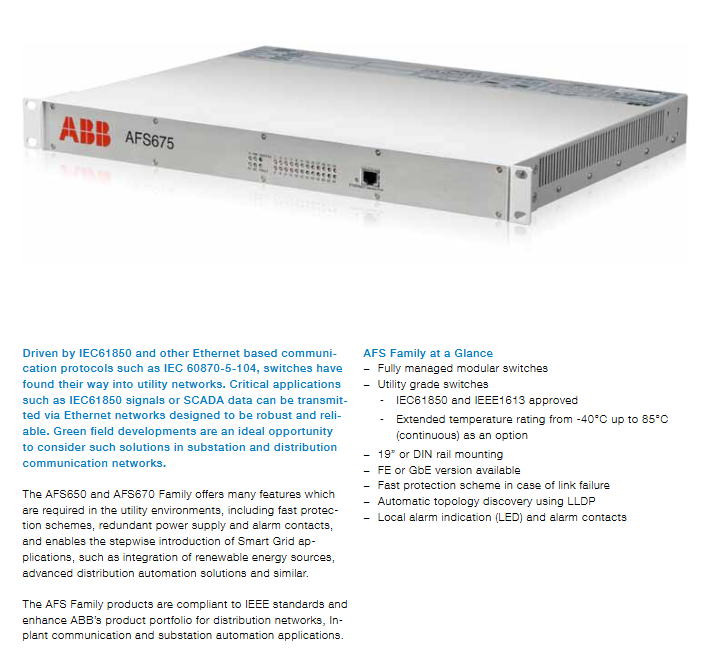
Driven by IEC61850 and other Ethernet based communication protocols such as IEC 60870-5-104, switches have found their way into utility networks. Critical applications such as IEC61850 signals or SCADA data can be transmitted via Ethernet networks designed to be robust and reliable. Green field developments are an ideal opportunity to consider such solutions in substation and distribution communication networks.
The AFS650 and AFS670 Family offers many features which are required in the utility environments, including fast protection schemes, redundant power supply and alarm contacts, and enables the stepwise introduction of Smart Grid applications, such as integration of renewable energy sources, advanced distribution automation solutions and similar.
The AFS Family products are compliant to IEEE standards and enhance ABB’s product portfolio for distribution networks, Inplant communication and substation automation applications.
AFS Family at a Glance
−Fully managed modular switches
−Utility grade switches
- IEC61850 and IEEE1613 approved
- Extended temperature rating from -40°C up to 85°C (continuous) as an option
−19” or DIN rail mounting
−FE or GbE version available
−Fast protection scheme in case of link failure
−Automatic topology discovery using LLDP
−Local alarm indication (LED) and alarm contacts
Typical Topology
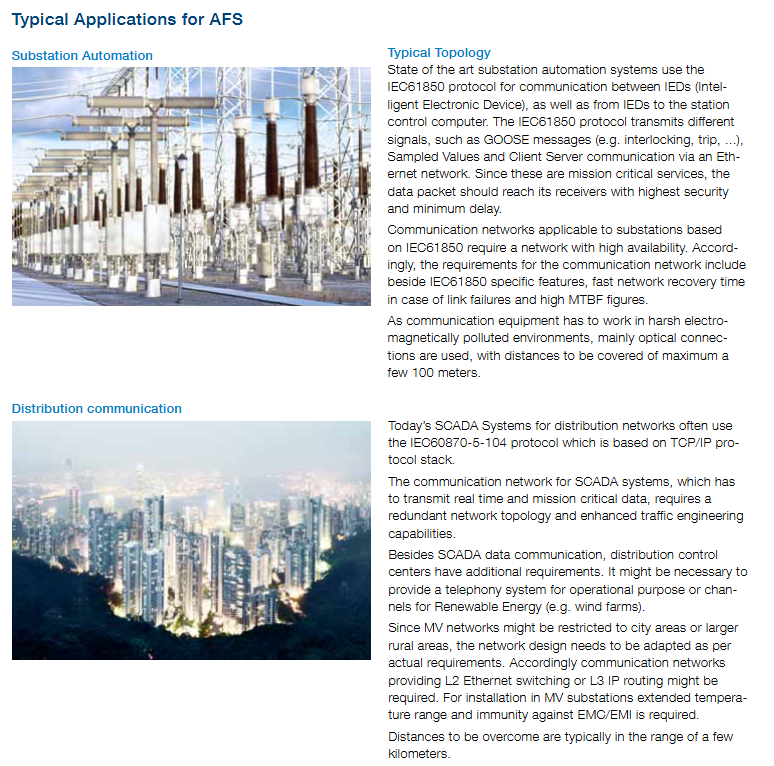
State of the art substation automation systems use the IEC61850 protocol for communication between IEDs (Intelligent Electronic Device), as well as from IEDs to the station control computer. The IEC61850 protocol transmits different signals, such as GOOSE messages (e.g. interlocking, trip, ...), Sampled Values and Client Server communication via an Ethernet network. Since these are mission critical services, the data packet should reach its receivers with highest security and minimum delay.
Communication networks applicable to substations based on IEC61850 require a network with high availability. Accordingly, the requirements for the communication network include beside IEC61850 specific features, fast network recovery time in case of link failures and high MTBF figures.
As communication equipment has to work in harsh electromagnetically polluted environments, mainly optical connections are used, with distances to be covered of maximum a few 100 meters.
Today’s SCADA Systems for distribution networks often use the IEC60870-5-104 protocol which is based on TCP/IP protocol stack.
The communication network for SCADA systems, which has to transmit real time and mission critical data, requires a redundant network topology and enhanced traffic engineering capabilities.
Besides SCADA data communication, distribution control centers have additional requirements. It might be necessary to provide a telephony system for operational purpose or channels for Renewable Energy (e.g. wind farms).
Since MV networks might be restricted to city areas or larger rural areas, the network design needs to be adapted as per actual requirements. Accordingly communication networks providing L2 Ethernet switching or L3 IP routing might be required. For installation in MV substations extended temperature range and immunity against EMC/EMI is required.
Distances to be overcome are typically in the range of a few kilometers.
Today’s In-plant applications require enhanced Ethernet communication functionality. Various services such as CCTV, public address or access control systems require communication with a central server or operator console.
In-plant communication refers to applications dealing with security of the infrastructure and recovery to normal operation after an incident. Therefore high availability of the communication network and high performance features are required.
Some of the In-Plant applications require significant bandwidth (e.g. CCTV), therefore a proper planning of the network for the initial and future expansion is needed.
To allow supervision and historical analysis it is necessary to synchronize end devices (e.g. cameras) from a central time server.
Product series classification and core parameters
(1) Classification logic and core differences
The AFS series is divided into two core product lines based on installation methods, port size, and functional expansion. Each sub model is precisely adapted to different scenario requirements:
Product series, sub models, installation methods, core structure, port configuration, power specifications, power consumption range, special functions
Compact AFS650/655 DIN rail (optional wall mounted) with fixed port design, metal casing with up to 10 ports (electrical/optical/SFP cage), including up to 3 GbE ports (electrical/SFP/combo) Low voltage: 18-60VDC; High voltage: 48-320VDC, 90-265VAC, supports redundant power supply 12-21W multi-mode/single-mode optical ports optional, suitable for small and medium-sized equipment access scenarios
Rack type AFS670/675 19 inch rack modular design (12 slots, 2 ports/module) up to 28 ports (electrical/optical/SFP cage), supporting FE/GbE, optical ports including SFP cage, SC, ST and other types of low voltage: 18-60VDC; High voltage: 77-300VDC, 90-265VAC, supports redundant power supply (spring clip or connector interface) 10-40W (no PoE), supports PoE power supply (only power type H/Z), high port density, suitable for multi device access in large substations
Rack enhanced AFS677/AFR677 19 inch rack fixed port design, with 16 GbE combo ports (TX RJ45 or SFP slots) in a metal shell, and AFS670/675 10-40W (without PoE). AFR677 adds L3 routing functionality (RIPv1/v2, OSPFv2, VRRP) to adapt to complex backbone network scenarios
(2) Key common parameters
Environmental adaptability: Standard working temperature range of 0-60 ℃, optional -40 ℃ to 85 ℃ continuous working wide temperature version, meeting extreme weather conditions and indoor and outdoor installation requirements of substations; Fanless design+optional conformal coating to reduce mechanical failure points and improve stability in dusty and humid environments.
Switching performance: Adopting a store and forward switching mode, the typical switching delay at a rate of 100Mbit/s is only 2.7 μ s; The MAC address table has a capacity of 8000 entries, supports 4042 VLANs (255 can be enabled simultaneously), and has 4 priority queues to achieve fine-grained traffic management.
Optical port configuration: support multi-mode (MM), single-mode (SM) SFP module and single fiber version, adapt to different transmission distance requirements (multi-mode for substation ≤ hundreds of meters, single-mode for distribution interval kilometers).
Core technical characteristics and compliance standards
(1) Core technological advantages
Fast fault recovery and redundancy mechanism: Supports triple protection protocols - RSTP (Fast Spanning Tree Protocol, IEEE802.1D), MRP (Media Redundancy Protocol, IEC62439), and E-MRP (Enhanced MRP). In the event of a link failure in a ring topology, millisecond level switching can be achieved. Combined with redundant power supply design, it ensures that the communication network has "no single point of failure" and meets the "zero interruption" requirements of power services; Simultaneously supporting sub ring configuration and redundant ring coupling, adapting to complex network topologies.
Full scenario protocol compatibility: Native support for core protocols in the power industry IEC61850 (including GOOSE messages, sampling values, client server communication), IEC60870-5-104 (SCADA system specific), as well as TCP/IP protocol stack related protocols (UDP, TCP, IP, ICMP, etc.); The network standards are compatible with IEEE802.1 series (VLAN, port authentication, topology discovery), IEEE802.3 series (Ethernet, link aggregation, PoE), IEEE1588 (PTP precision time synchronization), etc., achieving seamless integration with intelligent electronic devices (IEDs), RTUs, servers and other terminals.
Security protection system: hardware level supports port disabling and physical isolation; At the software level, it has functions such as IEEE802.1x port authentication, SSH encrypted transmission, SNPv3 encrypted authentication, Radius centralized password management, and multi-level user permission control; Implementing business isolation through VLAN (IEEE802.1Q) to avoid interference from different types of data and ensure the transmission security of sensitive data such as SCADA and control instructions.
Flexible management capability: Supports multi-dimensional management methods - SNMP V1/V2/V3 (compatible with mainstream network management platforms), command-line interface (Telnet), WEB interface (visual operation); Built in LLDP (Link Layer Discovery Protocol) enables automatic topology discovery, while RMON remote monitoring, port mirroring, SFP diagnosis, and other functions facilitate fault location; Configure recovery adapter (CRA), watchdog, and rollback function to quickly restore abnormal configurations and improve operational efficiency.
Value added function expansion: Some models support PoE (IEEE802.3af) power supply, which can provide power for outdoor cameras, wireless APs and other terminals, reducing wiring costs; Support SNTP (Simple Network Time Protocol) to achieve time synchronization of terminal devices such as cameras and IEDs, ensuring the accuracy of timestamps for log and video data; Port rate limitation (in/out direction, kbps step) can prevent high bandwidth services (such as CCTV) from occupying critical communication resources.
(2) Compliance and Certification Standards
This series of switches has passed multiple rigorous certifications in the power industry, ensuring reliability in extreme environments and critical business scenarios
Core industry certifications: IEC61850 approval (power automation communication standard), IEEE1613 approval (electromagnetic compatibility standard for network equipment in the power industry), CSA/UL safety certification.
Electromagnetic compatibility (EMC/EMI): Complies with EN61000-4 series standards (ESD: 8kV contact discharge/15kV air discharge); Surge: Power line 2kV ground/1kV line; Electromagnetic radiation: 35Vpp/m, 80-2700MHz), IEEE C37.90 series standards (high voltage pulse ± 5kV line to ground, electromagnetic field 35v/m, 80-1000MHz), can resist strong electromagnetic interference in substations.
Mechanical reliability: Through IEC60068-2-27 impact testing (15g, 11ms duration, 18 impacts) and IEC60068-2-6 vibration testing (multi frequency, long-term testing), it can adapt to mechanical stress during transportation and on-site installation.
Network protocol compliance: Fully compatible with RFC series standards (such as RFC 791 IP protocol, RFC 793 TCP protocol, RFC 2131 DHCP protocol, etc.), ensuring interoperability with devices from different vendors.
Three typical application scenarios and solutions
(1) Substation automation communication
Scenario requirements: Based on the IEC61850 protocol, communication between IED devices and between IEDs and station control computers is implemented to transmit key data such as GOOSE interlocking signals, trip instructions, and sampling values. Low latency (millisecond level), high availability (high MTBF), and resistance to electromagnetic interference are required, with communication distances typically within a few hundred meters.
Solution:
Hardware configuration: Choose AFS670/675 rack mounted switches (high port density) or AFS650 compact switches (small substations), with multi-mode optical ports as the main configuration (suitable for short distance transmission), and configure redundant power supply.
Network architecture: Pure Layer 2 switching network, using redundant topology (ring or dual link), enabling MRP/E-MRP fast redundancy protocol to ensure ≤ millisecond level switching in case of link failure.
Optimization design: Divide business (such as control signals, sampling values, and operation and maintenance data) through VLANs, set priority queues for QoS, and ensure priority transmission of key data such as trip instructions; Adopting SNMP protocol to achieve centralized network management, LED indicator lights and alarm contacts provide real-time feedback on device status.
(2) Communication between distribution substations
Scenario requirements: Based on the IEC60870-5-104 protocol, transmit real-time SCADA data, while also carrying VoIP voice communication, renewable energy (such as wind power, photovoltaic) data upload and other services; The communication distance is usually several kilometers, and it needs to adapt to different urban and rural environments, requiring network redundancy, high security, and wide temperature operation.
Solution:
Hardware configuration: Select AFS677/AFR677 rack enhanced switch (backbone network) or AFS655 compact switch (terminal access), with GbE ports for backbone network and single-mode optical ports for uplink configuration (suitable for long-distance transmission).
Network architecture: FE/GbE backbone network, using redundant ring topology and enabling MRP/E-MRP protocol; The AFR677 model can achieve multi subnet interconnection through L3 routing functions (RIPv1/v2, OSPFv2), and VRRP protocol ensures routing redundancy.
Security and Management: Enable IEEE802.1x authentication and SSH encryption to ensure secure data transmission; Monitor the status of the entire network through a centralized management system, adapt to AC/DC wide voltage input power supply, and meet the power supply needs of field substations.
(3) In plant communication
Scenario requirements: Support in plant security (CCTV, access control), public broadcasting, equipment monitoring and other business communication, requiring high bandwidth (adapted to CCTV video streaming), convenient equipment power supply (PoE), time synchronization (log/video timestamp), and fast fault recovery.
Solution:
Hardware configuration: Select the AFS670/675 model (camera powered) that supports PoE function, connect the GbE upstream port to the central server, and configure optical ports for transmission links over 100 meters.
Network architecture: FE/GbE backbone network, using star or ring topology, with RSTP protocol enabled to ensure link redundancy; Port rate control prevents video streams from occupying too much bandwidth.
Key function: Implement time synchronization of terminal devices through SNTP protocol; IEEE802.1x port authentication protects the security of outdoor camera access; Quickly restart the device after power failure to reduce business interruption time.
Customer core revenue
Environmental adaptation and reliability assurance: Power grade hardware design, high EMC/EMI anti-interference capability, wide temperature operating range, redundant power supply, and fanless design ensure long-term stable operation in harsh environments of substations, with excellent MTBF (mean time between failures) performance.
Business continuity improvement: The Fast Redundancy Protocol (MRP/E-MRP) enables millisecond level switching of link failures, coupled with multiple security protection mechanisms, to ensure "zero interruption" transmission of critical businesses such as SCADA and IEC61850.
Deployment and operation efficiency optimization: Supports multiple installation methods of 19 inch rack/DIN rail, modular design (AFS670/675) for easy port expansion; Multi dimensional management tools (WEB/Telnet/SNMP), automatic topology discovery, fault alarms, and other functions reduce operational complexity.
Maximizing investment value: Port density can be expanded from 8 to 28, supporting functional extensions such as FE/GbE, PoE, L3 routing, etc., adapting to different scale requirements from small and medium-sized substations to large distribution networks; Cross vendor and cross protocol compatibility capabilities, protecting existing equipment investments and supporting future smart grid application upgrades.

- OMRON
- ABB
- General Electric
- EMERSON
- Honeywell
- HIMA
- ALSTOM
- Rolls-Royce
- MOTOROLA
- Rockwell
- Siemens
- Woodward
- YOKOGAWA
- FOXBORO
- KOLLMORGEN
- MOOG
- KB
- YAMAHA
- BENDER
- TEKTRONIX
- Westinghouse
- AMAT
- AB
- XYCOM
- Yaskawa
- B&R
- Schneider
- KONGSBERG
- NI
- WATLOW
- ProSoft
- SEW
- ADVANCED
- Reliance
- TRICONEX
- METSO
- MAN
- Advantest
- STUDER
- DANAHER MOTION
- Bently
- Galil
- EATON
- MOLEX
- DEIF
- B&W
- ZYGO
- Aerotech
- DANFOSS
- Beijer
- Moxa
- Rexroth
- Johnson
- WAGO
- TOSHIBA
- BMCM
- SMC
- HITACHI
- HIRSCHMANN
- Application field
- XP POWER
- CTI
- TRICON
- STOBER
- Thinklogical
- Horner Automation
- Meggitt
- Fanuc
- Baldor
- SHINKAWA
- Other Brands
- UniOP
- KUKA
- Iba
- Beckhoff
- ADLINK
-
 SIGMATEK ICA111 Module
 -
 SIGMATEK MDD 121-1 Drive Axis Module
 -
 SIGMATEK M5V121 12-300-121 Krauss Maffei M5 Display Unit
 -
SIGMATEK CTMS 020 CD Technology Module 12-250-011
-
 SIGMATEK PCT122 Touch Panel
 -
 Stöger MCS4100 SIGMATEK Control Module
 -
 SIGMATEK Krauss Maffei M5 Keyboard Unit M5K902 12-310-902
 -
 SIGMATEK SD310-2 Servo Drive Module
 -
 SIGMATEK CM5V020 CD Wiring Circuit Module
 -
SIGMATEK ENGEL Robot Drive M3 02220-8748
-
 Sigmatek CFF011 Drive Module
 -
 Sigmatek DCP642 DIAS Central Unit
 -
 Sigmatek SDM081 S-DIAS Safety Module
 -
 Sigmatek C-IPC 01-450-024 Industrial PC
 -
Sigmatek Kompakt NC4 Control Module
-
 Sigmatek VI021 VARAN Interface Module
 -
 Sigmatek Engel RD-M6-2 Robot Drive
 -
Sigmatek CNC031 Positioning Module
-
Sigmatek TO161 Digital Output Module
-
Sigmatek CCL912 CPU PSU Module
-
Sigmatek ETV0821 Operator Terminal
-
 SIGMATEK ET 261 Operator Terminal
 -
 SIGMATEK CP731-K Control Module 20-004-731-K
 -
 SIGMATEK ETEK Motherboard 12-250-021-K CM5V020
 -
 Sigmatek DEZ 181 DIAS Input Output Module
 -
 Sigmatek IPC111-D Industrial PC
 -
 SIGMATEK AKM54L-ANC2GBB0 Servomotor with Gearhead
 -
SIGMATEK CTMS020 CM5V020 CNC Controller
-
 DEMAG ERGOTECH 061 381 66 Sigmatek Control Unit
 -
 Sigmatek DAI 883 Module
 -
 Sigmatek ETV1521 Control Panel Installation Terminal
 -
 Sigmatek 9802.289.01 Board Control TA71 Display
 -
 Wittmann Sigmatek EU-252 proDrive W4 Servo Drive
 -
 Sigmatek CDM166 C-DIAS Module
 -
Sigmatek DCP082 DIAS Central Unit
-
 Sigmatek CCP081 C-DIAS Processor Module
 -
Sigmatek MD111-1 Drive Module
-
Sigmatek ETV0821 Operator Terminal
-
 Sigmatek ISE021 Interface Module
 -
 Sigmatek DCC080L Slide Control Module
 -
 Sigmatek AI075 Analog Input Module
 -
SIGMATEK TO161 20-007-161 Module
-
 SIGMATEK CIC011 Module
 -
 SIGMATEK AE0000318502 Hand Terminal Pendant
 -
 Sigmatek Krauss Maffei PC323-K Control Unit
 -
Sigmatek Krauss Maffei PC321-K Control Cabinet PC
-
SIGMATEK CIV521 Control Module
-
SIGMATEK C-IPC-171 Industrial PC
-
 SIGMATEK MDP101-L DIAS Drive Network Module
 -
 Sigmatek Krauss Maffei PC323-K Control Cabinet PC
 -
 SIGMATEK CRCH081 C-SLIDES Temperature Module
 -
 Sigmatek PC301-E6 Industrial PC SSD
 -
 Sigmatek SDI101 S-SLIDES Safety Input Module
 -
 Sigmatek CIV521 VARAN Control Module
 -
 Kollmorgen Sigmatek AKM42G-ANCNGBB0 Servo Motor
 -
 Sigmatek PC 521 Process Controller
 -
 Sigmatek Geode LX800 12-780-012 Industrial PC
 -
 Sigmatek STO081 S-DIAS Safety Output Module
 -
 Sigmatek SCP111 S-DIAS Safety CPU Module
 -
 Sigmatek CDI161 Industrial I O Module
 -
Sigmatek Wiring Board V2 DIAS 05-250-023
-
Sigmatek CP102 20-004-102 S-DIAS CPU Module
-
SIGMATEK SLIDES CNC 115 Module
-
 SIGMATEK DCC080 05-700-080-2 Control Module
 -
SIGMATEK MDD 121 Drive Axis Module
-
 SIGMATEK CIO011 C-DIAS Multi I/O Module
 -
SIGMATEK CIV512 Servo Drive
-
 SIGMATEK CM5V020 12-250-021-K Wiring Module
 -
 SIGMATEK CIO011 12-013-011 Multi I/O Module
 -
SIGMATEK 01-450-031 C-IPC Industrial Computer
-
SIGMATEK AKM24D-ANBNGBB0 Servo Motor
-
 DEMAG NC4 LP0001289.03 Control Module
 -
 Sigmatek ETEK Industrial PC C-IPC with Option Module
 -
Sigmatek AO081 20-010-081 Analog Output Module
-
Sigmatek CNC 031 Positioning Module
-
Sigmatek CP731-K 20-004-731-K CPU Module
-
Sigmatek MDD 3320-JR-A Drive Module
-
Sigmatek PM Servo Motor AKM52K-ANC2GBB0
-
Sigmatek MDP 101 09-403-101 Power Module
-
Sigmatek S-SLIDES AO046 Analog Output Module
-
Sigmatek ICA111 20-102-111 Interface Module
-
 SIGMATEK DCP646 Module 05-004-646
 -
SIGMATEK SDI101 Digital Input Module 20-891-101
-
 SIGMATEK S3330-2 Directional Gyro Altitude Instrument
 -
SIGMATEK MDP102-1 Controller
-
SIGMATEK SMT 01-230-321 Touch Screen
-
SIGMATEK Krauss Maffei PC301-K 01-310-301-K Industrial PC with 8GB SSD
-
 SIGMATEK ETT731 01-230-731 Built-in Touch Terminal
 -
SIGMATEK CIV521 Control Module
-
 SIGMATEK DME 128 Module 05-005-128
 -
 SIGMATEK SCP111-S 20-890-111-S S-DIAS Safety CPU Module
 -
Sigmatek SCP111 S-DIAS Safety CPU
-
Sigmatek CRIF081 Interface Module
-
Sigmatek CP112-1 S-DIAS CPU Module
-
Sigmatek MDD121-L DIAS Drive Axis Module
-
 Sigmatek C-IPC 01-450-024 Industrial PC
 -
Sigmatek SDD215-23 SLIDES Drive
-
 Sigmatek DPS001 DIAS System Components
 -
Sigma-Tek 4000B-30 Directional Gyro
-
 Sigmatek SDD340-46 SDD Series Drive
 -
 Sigmatek CEZ221 Euromap67 I O Module
 -
 SIGMATEK VI021 Interface Module
 -
SIGMATEK CP731-K Control Module
-
SIGMATEK Krauss Maffei PC321-K Industrial PC
-
SIGMATEK ET322 Operator Terminal
-
SIGMATEK CP102 Control Module 24VDC
-
SIGMATEK SRO021 Relay Output Module
-
SIGMATEK DCP640 DIAS Central Unit
-
 SIGMATEK MDD 121 Drive Axis Module
 -
SIGMATEK AI043 Analog Input Module
-
 ENOTEC OXITEC 5000 SME-53310000 Oxygen Analyzer
 -
SIGMATEK Krauss Maffei PC301-K 01-310-301-K Industrial PC
-
 SIGMATEK SDD310-23 VARAN Servo Drive
 -
 SIGMATEK CDM 163 and CIC 011 C-DIAS Input Modules
 -
SIGMATEK MDP 101-1 Power Module
-
SIGMATEK CM5V020 Wiring Circuit with CTMS020
-
SIGMATEK CCP521 C-DIAS Processor Module
-
 SIGMATEK MDP 101-K Power Module
 -
SIGMATEK ETEK C-IPC 733MHz VIA Eden 7000
-
 SIGMATEK DCP 643 DIAS PLC CPU Module
 -
SIGMATEK TAE121 12-200-121 Operator Terminal
-
Sigmatek TMS012-T Injection Moulding Technology Module
-
Sigmatek MDD 121-1 Controller
-
Sigmatek CDM167 Module
-
Sigmatek DCP082 DIAS Central Unit
-
 Sigmatek ETT731 Built-In Terminal Touch
 -
Sigmatek CCP521 C-DIAS Processor Module
-
Sigmatek Krauss Maffei PC301-K Control Cabinet PC


