
Bender EDS3090/-91/-92/-96 series
Please observe the limits on the area of application stated in the technical specifications, as well as the measuring categories for the measuring clamps used. If, in the specific case, measuring current transformers other than the measuring clamps supplied are used with the EDS195P(M), adequate nominal insulation voltage must be ensured for the connection wires and transformer (overvoltage category, see Technical data).
Do not make any unauthorised changes to the device. Only use spare parts and optional accessories sold or recommended by the manufacturer.
Any other use than that described in this manual is regarded as improper.
Bender EDS3090/-91/-92/-96 series
Intended use
The portable insulation fault location system EDS309… is used to locate insulation faults in IT systems. All variants are suitable for the measurement of residual currents in TN and TT systems. The EDS3096PG is particularly suitable for insulation fault location in electrically isolated systems.
Please observe the limits on the area of application stated in the technical specifications, as well as the measuring categories for the measuring clamps used. If, in the specific case, measuring current transformers other than the measuring clamps supplied are used with the EDS195P(M), adequate nominal insulation voltage must be ensured for the connection wires and transformer (overvoltage category, see Technical data).
Do not make any unauthorised changes to the device. Only use spare parts and optional accessories sold or recommended by the manufacturer.
Any other use than that described in this manual is regarded as improper.
Device features
Portable insulation fault location systems for IT systems AC 0…790 V, 42…460 Hz/DC 0…960 V or deenergised systems
Residual current measurement in TN/TT systems
Use in main and control circuits, photovoltaic systems
Measuring clamps 20/52 mm (115 mm optional)
Robust aluminium case, convenient to carry
Locating current injectors PGH18… with variable locating current 1…25 mA
Integrated locating voltage for deenergised systems (PGH186)
Insulation fault EDS195P(M)
Backlit LC display, 3 x 16 characters
Measuring clamps 20/52 mm included in the scope of delivery
Accumulator (delivered with a power supply unit)
Response value insulation fault location 2…10 mA for main circuits
Response value insulation fault location 0.2…1 mA for control circuits
Response value residual current measurement 10 mA…10 A
Selectable operating mode insulation fault location/residual current measurement

Function of the system components
The following system components are required for correct operation:
Locating current injector PGH18…
The PGH18… generates a defined locating current. The current depends on the insulation fault and the system voltage.
The PGH185 or PGH186 limits the locating current to maximum 25 mA or maximum 10 mA depending on the switch setting.
The PGH183 limits the locating current to maximum 2.5 mA or maximum 1 mA depending on the switch setting.
The PGH186 applies the locating current in electrically isolated IT systems or in IT systems with a system (voltage <50 ~V) using an integrated voltage source (DC 50 V).In
IT systems with a system voltage > 50 V the existing voltage in the system is used to drive the locating current.
Insulation fault locator EDS195P(M)
Insulation fault location (I_{Delta L}) (EDS mode) for use in IT AC or DC systems:
Either as a component of the portable equipment for insulation fault location EDS309…
Or as an additional insulation fault locator in permanently installed equipment for insulation fault location with IRDH575, iso685-x-P or isoxx1685xP or PGH1… as well as EDS4…
EDS195PM - only devices with the suffix "M" have the measuring signal output for connecting an oscilloscope
Residual current measurement (lior) (mode) for usage in TN or TT AC systems.
Measuring clamps
Measuring clamps measure the locating current or the residual current. They have a test lead approx. 2 m long. They are connected to the EDS195P(M) via a BNC connector.
If measuring current transformers are used instead of measuring clamps, you will need the adapter supplied: BNC/4-mm connector. See “Component list”, page 14.
Coupling device AGE185
The coupling device AGE185 expands the nominal voltage range of the equipment for insulation fault location EDS309…. It enables the equipment to be connected to system nominal voltages up to AC 790 V or DC 960 V.
Residual current measurement is possible in TT and TN systems (earthed systems) using the device variants listed below. The following overview describes which tasks can be done with which models.
Equipment for insulation fault location in main circuits
1. Permissible system voltage in the main circuits:
Insulation fault location in IT systems up to AC 42…460 Hz, 20…575 V and DC 20…504 V
Insulation fault location using AGE185 up to AC 42…460 Hz, 500…790 V and DC 400…960 V
EDS3090:
Can be used in IT systems in which a locating current injector (e.g. PGH471) or an ISOMETER® with integrated locating current injector (e.g. iso685-x-P) is already installed.
EDS3090PG:
Can be used in IT systems in which no locating current generator and no ISOMETER® with integrated locating current generator is installed.
Supply voltage for the locating current generator PGH185 supplied: AC 50…60 Hz, 230 V
EDS3090PG-13:
• Can be used in IT systems in which no locating current generator and no ISOMETER® with integrated locating current generator is installed.
Supply voltage for the locating current generator PGH185-13 supplied: AC 50…60 Hz, 90…132 V
2. Permissible system voltage in the main circuits:
Insulation fault location in IT systems up to AC 42…460 Hz, 0…575 V and DC 0…504 V
Insulation fault location using AGE185 up to AC 42…460 Hz, 500…790 V and DC 400…960 V
EDS3096PG:
Can be used in IT systems in which no locating current generator and no ISOMETER® with integrated locating current generator is installed.
Supply voltage for the locating current generator PGH186 supplied: AC 50…60 Hz, 230 V
Insulation fault location, also in IT systems electrically isolated on all poles
EDS3096PG-13:
Can be used in IT systems in which no locating current generator and no ISOMETER® with integrated locating current generator is installed.
Supply voltage for the locating current generator PGH186-13 supplied: AC 50…60 Hz, 90…132 V
Insulation fault location, also in IT systems electrically isolated on all poles
EDS3096PV:
Applicable in PV systems without a locating current injector installed
Supply voltage for the delivered locating current injector PGH186: AC 50…60 Hz, 230 V
Insulation fault location, also in IT systems disconnected on all poles or in de-energised IT systems
Accessories CTAF:
Set with flexible clamps with band lengths of 500 and 1000 mm
Application for cables with bigdimensions or in systems with narrow space conditions
Combinable with EDS3090, EDS3092, EDS3096
The minor response sensitivity towards the clamps PSA3… in chapter "Response sensitivity characteristics of the EDS195PM" in the manual must be considered.
Equipment for insulation fault location in control circuits
Permissible system voltage in the control circuits:
Insulation fault location in IT systems up to AC 42…460 Hz, 20…265 V and DC 20…308 V
EDS3091:
Can be used in IT systems in which a locating current injector (e.g. PGH473) or an ISOMETER® with integrated locating current injector (e.g. iso685-x-P) is already installed.
EDS3091PG:
Can be used in IT systems in which no locating current generator and no ISOMETER® with integrated locating current generator is installed.
Supply voltage for the locating current generator PGH183 supplied: AC 50…60 Hz, 230 V
EDS3091PG-13:
Can be used in IT systems in which no locating current generator and no ISOMETER® with integrated locating current generator is installed.
Supply voltage for the locating current generator PGH183-13 supplied: AC 50…60 Hz, 90…132 V
Equipment for insulation fault location in main circuits and control circuits
EDS3092PG:
Contains the components and combines the features of the EDS3090PG and EDS3091PG
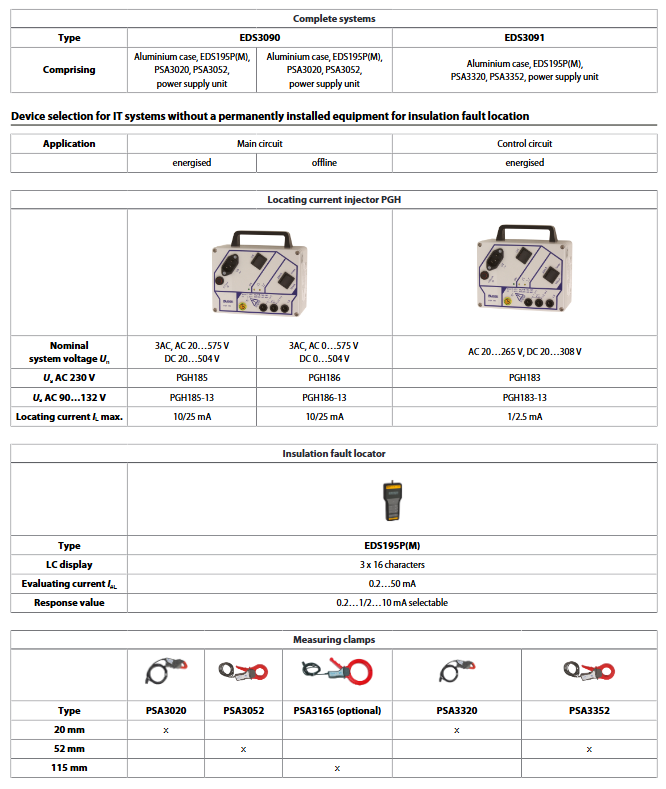
Core components and technical parameters
(1) Detailed explanation of core components
1. EDS195P (M) insulation fault locator (system control core)
As the operation and data processing center for the entire equipment, EDS195P (M) integrates two measurement modes, with the following key features:
Function and operation:
Mode switching: Select "Insulation Fault Localization Mode (EDS mode, compatible with IT system)" or "Residual Current Measurement Mode (RCM mode, compatible with TN/TT system)" using the "FF" key;
Data management: Support HOLD key to save measurement values, RESET key to clear fault memory, MENU key to adjust parameters (response values, measurement clamp types, etc.);
Display and alarm: 3-line 16 character backlit LCD display screen, supporting device information (model, software version) and real-time measurement value display; The ALARM LED light flashes when it exceeds the threshold, and remains on after the fault is cleared (activating the fault memory).
Hardware configuration:
Interface: BNC interface (for connecting measuring pliers), Micro USB interface (for charging/external power supply), only the "M" suffix model (EDS195PM), including oscilloscope measurement signal output interface;
Power supply: 3 NiMH R6 AA rechargeable batteries (1.2V, ≥ 2000mAh, battery life ≤ 150h), 3 LR6 AA disposable batteries, or 5V DC USB power supply, power consumption ≤ 0.5W;
Protection and size: IP40 protection level, ABS plastic shell (UL94 V-0 flame retardant), size 84 × 197 × 30mm, weight ≤ 350g.
2. PGH18 series positioning current injector (fault positioning signal source)
Responsible for generating stable positioning current to drive IT system insulation fault location, with clear adaptation scenarios for different models:
Injector model adaptation scenario maximum positioning current (optional) core characteristics power supply voltage
PGH183 control circuit 1mA/2.5mA low current output, suitable for control circuit small signal scenarios 230V AC/90-132V AC (-13 subtype)
PGH185 main circuit 10mA/25mA medium high current output, suitable for high load scenarios of 230V AC/90-132V AC (-13 subtype) in the main circuit
PGH186 main circuit/photovoltaic system/power-off system 10mA/25mA built-in 50V DC positioning voltage, suitable for full pole isolation, low voltage (<50V) or power-off IT system 230V AC/90-132V AC (-13 subtype)
Operation design: including ON/OFF switch, current gear switch, back with magnetic strip (can be attached to metal cabinet), equipped with operation indicator light and positive and negative positioning current cycle indicator light for easy on-site operation and observation.
3. Measurement clamp and coupler (signal acquisition and voltage expansion)
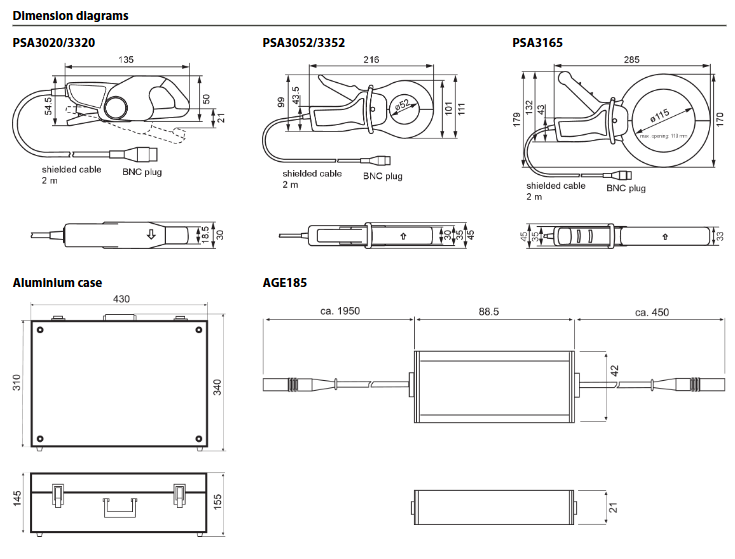
Measurement pliers: Classified by jaw diameter and adaptation scenario, the core parameters are as follows: | Model | Jaw diameter | Adaptation scenario | Measurement range | Transformation ratio | Weight | Size (W × H ×) D) || PSA3020/PSA3320 | 20mm | Main circuit/control circuit (thin cable) | PSA30:10A/10mA; PSA33:1A/0.1mA | PSA30:10A/10mA; PSA33: 1A/0.1mA | ≤ 300g | 135 × 65 × 30mm | | PSA3052/PSA3352 | 52mm | Main circuit/control circuit (conventional cable) | Same as corresponding model above | Same as corresponding model above | ≤ 700g | 216 × 111 × 45mm | | PSA3165 (optional) | 115mm | Main circuit (thick cable) | 10A/10mA | 10A/10mA | ≤ 1300g | 285 × 179 × 45mm | CTAF kit (optional) | Flexible tape (500/1000mm) | Narrow space/large-sized cable | 25mA-50mA | - | Including shell, flexible tape, BNC cable, etc|
Common features: All are equipped with 2m long shielded wires, connected to EDS195P (M) through BNC connectors, with a protection level of IP40, in compliance with CAT III (AC 600V)/CAT IV (AC 300V) safety levels.
AGE185 coupler (optional):
Function: Expand the system voltage range to AC 42-460Hz 500-790V, DC 400-960V, and adapt to high-voltage IT systems;
Parameters: IP30 protection, safety laboratory connector (green and yellow grounding wire 1mm ²), weight ≤ 200g, size 88.5 × 42 × 21mm.
(2) Key technical parameters
1. Measure performance parameters
Measurement Function Adaptation System Core Parameters Measurement Accuracy Frequency Range
Insulation fault location (main circuit) IT system response value: 2-10mA (default 5mA), positioning current: 10-25mA ± 30%/± 2mA AC 42-460Hz
Insulation fault location (control circuit) IT system response value: 0.2-1mA (default 0.5mA), positioning current: 1-2.5mA ± 30%/± 0.2mA AC 42-460Hz
Residual current measurement (PSA30 series clamp) TN/TT system measurement range: 10mA-10A, response value: 10mA-10A (default 100mA) 42-60Hz: ± 5%; 61-1000Hz:±20% AC 42-1000Hz
Residual current measurement (PSA33 series clamp) TN/TT system measurement range: 2mA-2A, response value: 5mA-1A (default 100mA) with the same accuracy as AC 42-1000Hz as above
2. Environmental and safety parameters
Working temperature: -10 ℃~+55 ℃
Climate rating (IEC 60721): Fixed use 3K22, transportation 2K11, long-term storage 1K22
Mechanical grade (IEC 60721): Fixed use 3M11, transportation 2M4, long-term storage 1M12
Insulation coordination: compliant with IEC 60664-1/IEC 60664-3, rated impulse voltage 4kV (main circuit)/0.8kV (control circuit)
Pollution level: Main circuit level 3, control circuit level 2
Working principle and operation process
(1) Core working principle
1. IT system insulation fault location (EDS mode)
Positioning current injection: The PGH18 series injector injects an adjustable positioning current of 1-25mA into the IT system. When the system voltage is greater than 50V, it is driven by the system's own voltage. When the system voltage is less than or equal to 50V or powered off (only PGH186), it is driven by the built-in 50V DC voltage;
Fault location: Measuring the current distribution around the cable with pliers, there is a significant difference in current before and after the fault point. EDS195P (M) locates the insulation damage point by analyzing the strength and direction of the current signal;
Balance adjustment: When the insulation state of the system changes and causes the positioning current to deviate from the set value, the injector and locator cooperate to adjust and maintain current stability, ensuring positioning accuracy.
2. Measurement of residual current in TN/TT system (RCM mode)
Signal acquisition: Measure the clamp surrounding the three-phase four wire/five wire system line and collect the total residual current (vector sum of phase and neutral line currents);
Data processing: EDS195P (M) filters harmonic interference (1-8 harmonics can be disabled), calculates the actual residual current value, and compares it with the set response value;
Alarm triggered: When the residual current exceeds the response value, the ALARM LED flashes and fault data is recorded for subsequent traceability.
(2) Standard Operating Procedure
1. Insulation fault location (IT system, taking EDS3096PG as an example)
Equipment preparation: Check the connection status of EDS195PM, PGH186 injector, PSA3020/3052 measuring pliers, and ensure that the battery is fully charged or connected to USB power supply;
Injector deployment: Connect PGH186 to the IT system through a safety measurement cable, ensure reliable grounding of the PE end, and select the current level (10mA/25mA) based on the system voltage;
Measurement clamp operation: Use the measurement clamp to wrap around each branch cable in sequence, ensuring that the clamp is tightly closed and avoiding interference;
Mode setting: Switch to "EDS mode" on EDS195PM, select the appropriate measurement clamp type (PSA30xx), adjust the response value (default 5mA for the main circuit);
Fault location: Observe the current value of the LCD display screen. The branch where the current suddenly changes or approaches the injected current is the fault branch, gradually narrowing down the range to the specific fault point;
End operation: After positioning is completed, turn off the power supply of the injector and locator, remove the connecting cable, and erase the fault memory.
2. Residual current measurement (TN-S system)
Equipment preparation: Connect the PSA3052 measuring pliers to EDS195PM via BNC cable, turn on the equipment and switch to "RCM mode";
Measurement clamp deployment: Wrap the measurement clamp around the L1, L2, L3, and N wires (excluding the PE wire) of the TN-S system to ensure coverage of all live conductors;
Parameter settings: Select the type of measuring clamp, adjust the response value (default 100mA), enable or disable harmonic indication;
Data reading: After stabilization, press the "HOLD" button to lock the measurement value and record the remaining current data; If the value exceeds the response value and the ALARM LED flashes, it is necessary to investigate the potential leakage of the circuit;
Closing of operation: Shut down the equipment and organize the measuring pliers and cables.
Installation and usage precautions
(1) Installation specifications
Cable connection: When connecting the injector to the system, it is necessary to distinguish between the phase sequence and the PE end, and the green and yellow grounding wires must be reliably grounded; When measuring the clamp connection, the BNC joint should be tightened to avoid poor contact;
Voltage Expansion: When the system voltage exceeds AC 575V/DC 504V, AGE185 coupler must be connected in series, otherwise it may damage the equipment;
Measurement clamp matching: The main circuit must use PSA30 series clamps, and the control circuit must use PSA33 series clamps, which cannot be mixed, otherwise the measurement accuracy cannot be guaranteed;
Environmental requirements: Avoid use near corrosive gases, strong vibrations, direct sunlight, or heat sources. Protect against humid environments and ensure ventilation and heat dissipation of equipment.
(2) Safety operation taboos
Live operation: Strictly comply with the safety level requirements of CAT III/CAT IV, and operators must wear protective equipment such as insulated gloves and insulated shoes;
Power supply safety: Use the original matching power adapter or batteries that meet the specifications, and prohibit the use of non-standard 5V USB power supplies to avoid overvoltage damage;
Equipment modification: It is not allowed to disassemble, modify equipment or replace non original parts without authorization, otherwise the warranty will be invalid and there will be safety risks;
Troubleshooting: When the equipment malfunctions, immediately stop using it and contact Bender's official after-sales service for repair. Do not disassemble or repair it yourself;
Battery maintenance: When not in use for a long time, the battery should be removed to avoid leaking and damaging the equipment; When charging, use the original USB charger, and the charging time should not exceed 5 hours.
(3) Maintenance and Calibration
Daily maintenance: Regularly clean the equipment casing and measuring pliers with a dry cloth to avoid dust and oil accumulation; Check whether the insulation layer of the cable is damaged and whether the BNC joint is oxidized;
Calibration requirements: The equipment needs to be regularly returned to Bender's original factory or authorized institution for calibration to ensure measurement accuracy meets standards. The recommended calibration cycle is 1-2 years;
Accessory replacement: When vulnerable parts such as measuring pliers and cables are damaged, original accessories need to be replaced. After replacement, a simple test should be conducted to confirm that the equipment is working properly.
- OMRON
- ABB
- General Electric
- EMERSON
- Honeywell
- HIMA
- ALSTOM
- Rolls-Royce
- MOTOROLA
- Rockwell
- Siemens
- Woodward
- YOKOGAWA
- FOXBORO
- KOLLMORGEN
- MOOG
- KB
- YAMAHA
- BENDER
- TEKTRONIX
- Westinghouse
- AMAT
- AB
- XYCOM
- Yaskawa
- B&R
- Schneider
- KONGSBERG
- NI
- WATLOW
- ProSoft
- SEW
- ADVANCED
- Reliance
- TRICONEX
- METSO
- MAN
- Advantest
- STUDER
- DANAHER MOTION
- Bently
- Galil
- EATON
- MOLEX
- DEIF
- B&W
- ZYGO
- Aerotech
- DANFOSS
- Beijer
- Moxa
- Rexroth
- Johnson
- WAGO
- TOSHIBA
- BMCM
- SMC
- HITACHI
- HIRSCHMANN
- Application field
- XP POWER
- CTI
- TRICON
- STOBER
- Thinklogical
- Horner Automation
- Meggitt
- Fanuc
- Baldor
- SHINKAWA
- Other Brands
- UniOP
- KUKA
- Iba
- Beckhoff
- ADLINK
-
 SIGMATEK ICA111 Module
 -
 SIGMATEK MDD 121-1 Drive Axis Module
 -
 SIGMATEK M5V121 12-300-121 Krauss Maffei M5 Display Unit
 -
SIGMATEK CTMS 020 CD Technology Module 12-250-011
-
 SIGMATEK PCT122 Touch Panel
 -
 Stöger MCS4100 SIGMATEK Control Module
 -
 SIGMATEK Krauss Maffei M5 Keyboard Unit M5K902 12-310-902
 -
 SIGMATEK SD310-2 Servo Drive Module
 -
 SIGMATEK CM5V020 CD Wiring Circuit Module
 -
SIGMATEK ENGEL Robot Drive M3 02220-8748
-
 Sigmatek CFF011 Drive Module
 -
 Sigmatek DCP642 DIAS Central Unit
 -
 Sigmatek SDM081 S-DIAS Safety Module
 -
 Sigmatek C-IPC 01-450-024 Industrial PC
 -
Sigmatek Kompakt NC4 Control Module
-
 Sigmatek VI021 VARAN Interface Module
 -
 Sigmatek Engel RD-M6-2 Robot Drive
 -
Sigmatek CNC031 Positioning Module
-
Sigmatek TO161 Digital Output Module
-
Sigmatek CCL912 CPU PSU Module
-
Sigmatek ETV0821 Operator Terminal
-
 SIGMATEK ET 261 Operator Terminal
 -
 SIGMATEK CP731-K Control Module 20-004-731-K
 -
 SIGMATEK ETEK Motherboard 12-250-021-K CM5V020
 -
 Sigmatek DEZ 181 DIAS Input Output Module
 -
 Sigmatek IPC111-D Industrial PC
 -
 SIGMATEK AKM54L-ANC2GBB0 Servomotor with Gearhead
 -
SIGMATEK CTMS020 CM5V020 CNC Controller
-
 DEMAG ERGOTECH 061 381 66 Sigmatek Control Unit
 -
 Sigmatek DAI 883 Module
 -
 Sigmatek ETV1521 Control Panel Installation Terminal
 -
 Sigmatek 9802.289.01 Board Control TA71 Display
 -
 Wittmann Sigmatek EU-252 proDrive W4 Servo Drive
 -
 Sigmatek CDM166 C-DIAS Module
 -
Sigmatek DCP082 DIAS Central Unit
-
 Sigmatek CCP081 C-DIAS Processor Module
 -
Sigmatek MD111-1 Drive Module
-
Sigmatek ETV0821 Operator Terminal
-
 Sigmatek ISE021 Interface Module
 -
 Sigmatek DCC080L Slide Control Module
 -
 Sigmatek AI075 Analog Input Module
 -
SIGMATEK TO161 20-007-161 Module
-
 SIGMATEK CIC011 Module
 -
 SIGMATEK AE0000318502 Hand Terminal Pendant
 -
 Sigmatek Krauss Maffei PC323-K Control Unit
 -
Sigmatek Krauss Maffei PC321-K Control Cabinet PC
-
SIGMATEK CIV521 Control Module
-
SIGMATEK C-IPC-171 Industrial PC
-
 SIGMATEK MDP101-L DIAS Drive Network Module
 -
 Sigmatek Krauss Maffei PC323-K Control Cabinet PC
 -
 SIGMATEK CRCH081 C-SLIDES Temperature Module
 -
 Sigmatek PC301-E6 Industrial PC SSD
 -
 Sigmatek SDI101 S-SLIDES Safety Input Module
 -
 Sigmatek CIV521 VARAN Control Module
 -
 Kollmorgen Sigmatek AKM42G-ANCNGBB0 Servo Motor
 -
 Sigmatek PC 521 Process Controller
 -
 Sigmatek Geode LX800 12-780-012 Industrial PC
 -
 Sigmatek STO081 S-DIAS Safety Output Module
 -
 Sigmatek SCP111 S-DIAS Safety CPU Module
 -
 Sigmatek CDI161 Industrial I O Module
 -
Sigmatek Wiring Board V2 DIAS 05-250-023
-
Sigmatek CP102 20-004-102 S-DIAS CPU Module
-
SIGMATEK SLIDES CNC 115 Module
-
 SIGMATEK DCC080 05-700-080-2 Control Module
 -
SIGMATEK MDD 121 Drive Axis Module
-
 SIGMATEK CIO011 C-DIAS Multi I/O Module
 -
SIGMATEK CIV512 Servo Drive
-
 SIGMATEK CM5V020 12-250-021-K Wiring Module
 -
 SIGMATEK CIO011 12-013-011 Multi I/O Module
 -
SIGMATEK 01-450-031 C-IPC Industrial Computer
-
SIGMATEK AKM24D-ANBNGBB0 Servo Motor
-
 DEMAG NC4 LP0001289.03 Control Module
 -
 Sigmatek ETEK Industrial PC C-IPC with Option Module
 -
Sigmatek AO081 20-010-081 Analog Output Module
-
Sigmatek CNC 031 Positioning Module
-
Sigmatek CP731-K 20-004-731-K CPU Module
-
Sigmatek MDD 3320-JR-A Drive Module
-
Sigmatek PM Servo Motor AKM52K-ANC2GBB0
-
Sigmatek MDP 101 09-403-101 Power Module
-
Sigmatek S-SLIDES AO046 Analog Output Module
-
Sigmatek ICA111 20-102-111 Interface Module
-
 SIGMATEK DCP646 Module 05-004-646
 -
SIGMATEK SDI101 Digital Input Module 20-891-101
-
 SIGMATEK S3330-2 Directional Gyro Altitude Instrument
 -
SIGMATEK MDP102-1 Controller
-
SIGMATEK SMT 01-230-321 Touch Screen
-
SIGMATEK Krauss Maffei PC301-K 01-310-301-K Industrial PC with 8GB SSD
-
 SIGMATEK ETT731 01-230-731 Built-in Touch Terminal
 -
SIGMATEK CIV521 Control Module
-
 SIGMATEK DME 128 Module 05-005-128
 -
 SIGMATEK SCP111-S 20-890-111-S S-DIAS Safety CPU Module
 -
Sigmatek SCP111 S-DIAS Safety CPU
-
Sigmatek CRIF081 Interface Module
-
Sigmatek CP112-1 S-DIAS CPU Module
-
Sigmatek MDD121-L DIAS Drive Axis Module
-
 Sigmatek C-IPC 01-450-024 Industrial PC
 -
Sigmatek SDD215-23 SLIDES Drive
-
 Sigmatek DPS001 DIAS System Components
 -
Sigma-Tek 4000B-30 Directional Gyro
-
 Sigmatek SDD340-46 SDD Series Drive
 -
 Sigmatek CEZ221 Euromap67 I O Module
 -
 SIGMATEK VI021 Interface Module
 -
SIGMATEK CP731-K Control Module
-
SIGMATEK Krauss Maffei PC321-K Industrial PC
-
SIGMATEK ET322 Operator Terminal
-
SIGMATEK CP102 Control Module 24VDC
-
SIGMATEK SRO021 Relay Output Module
-
SIGMATEK DCP640 DIAS Central Unit
-
 SIGMATEK MDD 121 Drive Axis Module
 -
SIGMATEK AI043 Analog Input Module
-
 ENOTEC OXITEC 5000 SME-53310000 Oxygen Analyzer
 -
SIGMATEK Krauss Maffei PC301-K 01-310-301-K Industrial PC
-
 SIGMATEK SDD310-23 VARAN Servo Drive
 -
 SIGMATEK CDM 163 and CIC 011 C-DIAS Input Modules
 -
SIGMATEK MDP 101-1 Power Module
-
SIGMATEK CM5V020 Wiring Circuit with CTMS020
-
SIGMATEK CCP521 C-DIAS Processor Module
-
 SIGMATEK MDP 101-K Power Module
 -
SIGMATEK ETEK C-IPC 733MHz VIA Eden 7000
-
 SIGMATEK DCP 643 DIAS PLC CPU Module
 -
SIGMATEK TAE121 12-200-121 Operator Terminal
-
Sigmatek TMS012-T Injection Moulding Technology Module
-
Sigmatek MDD 121-1 Controller
-
Sigmatek CDM167 Module
-
Sigmatek DCP082 DIAS Central Unit
-
 Sigmatek ETT731 Built-In Terminal Touch
 -
Sigmatek CCP521 C-DIAS Processor Module
-
Sigmatek Krauss Maffei PC301-K Control Cabinet PC


