
ABB UNS0119A-P V101 Controller Module
ABB UNS0119A-P V101 Controller Module
Brand background
In the field of industrial control and electrical engineering, ABB is undoubtedly an insurmountable monument. Since its birth in 1988 through the merger of ASEA and BBC, ABB has always adhered to the spirit of innovation and deeply cultivated globally. From being the first to launch a three-phase transmission system and ushering in a new era of power transmission, to developing the world's first self cooling transformer to revolutionize power equipment, ABB's technological innovations continue to reshape the industry landscape. Nowadays, ABB, with operations spanning over 100 countries and 132000 employees, has established a complete technology and service system in various fields such as power and industrial automation. Its profound technical accumulation and excellent brand reputation have laid a solid foundation for the birth and application of the UNS0119A-P V101 controller module.
Product Core Overview
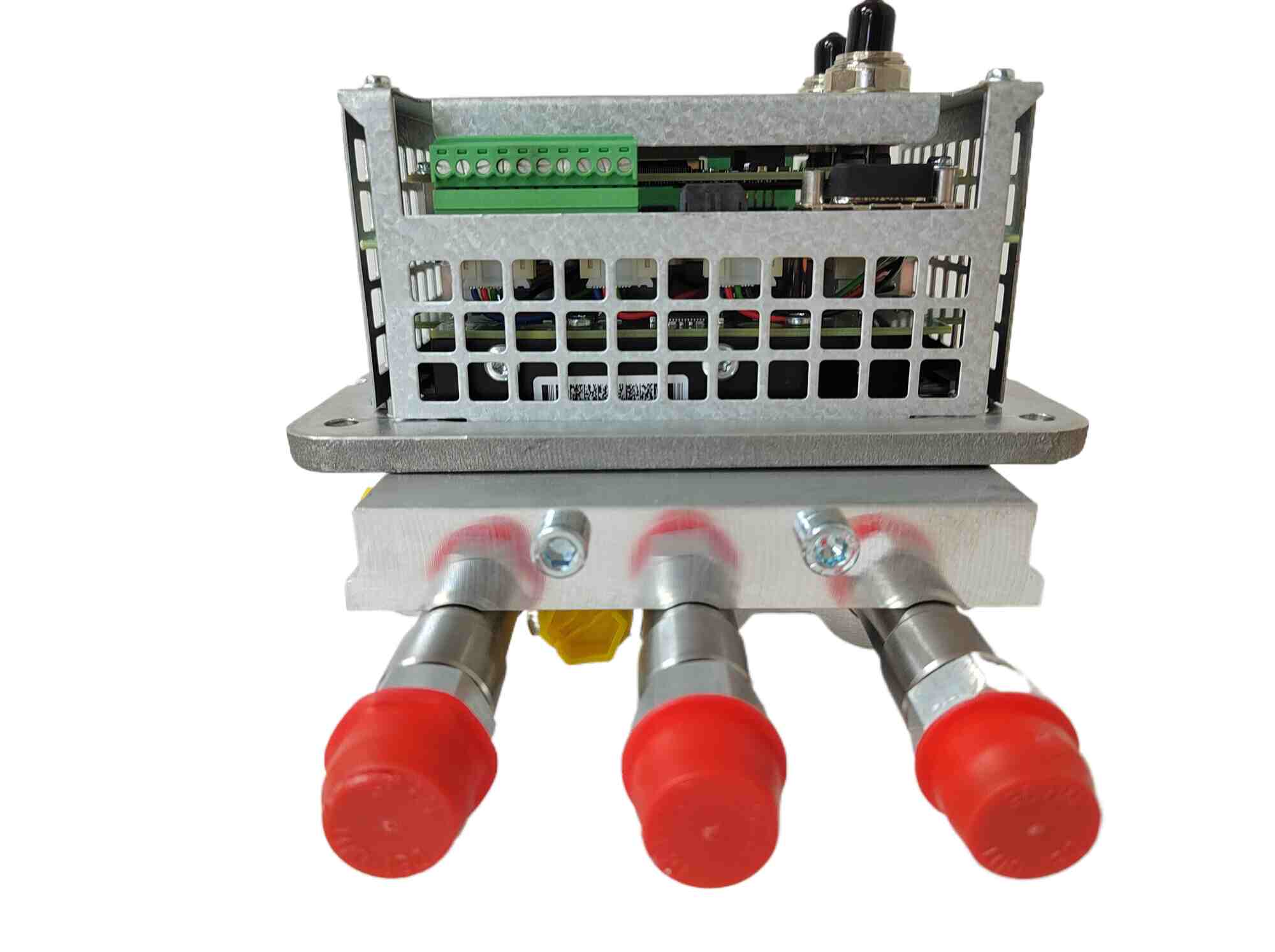
The ABB UNS0119A-P V101 controller module, as an important member of ABB's industrial automation product line, is an intelligent control device that combines advanced technology and high reliability. It is carefully designed for various complex industrial environments, capable of accurately and efficiently handling diverse control tasks, and plays a central nervous system like key role in industrial automation control systems. Through precise control and collaborative scheduling of various devices, this module helps enterprises improve production efficiency, ensure product quality, and promote industrial production towards intelligence and refinement.
Core functions
Super computing and decision-making capabilities: The UNS0119A-P V101 is equipped with an advanced microprocessor, which has high-speed data processing and complex logic computing capabilities. It can collect and analyze massive amounts of data from on-site devices such as sensors and actuators in real time, and make precise decisions and generate corresponding control instructions in a very short time based on preset control algorithms, ensuring that various parameters in the industrial production process are always maintained within the ideal range, providing solid guarantees for the stability and efficiency of production.
Multi communication interaction function: The controller module is equipped with rich communication interfaces, among which the Ethernet interface can easily access the internal network of the enterprise and achieve high-speed data exchange with the upper computer monitoring system, PLC and other devices. Engineers can remotely monitor the module's operating status and adjust control parameters in real time. The RS485 interface provides the possibility for it to connect with numerous smart instruments and devices that support Modbus RTU protocol, easily achieving interconnection and intercommunication between devices, and building a comprehensive and efficient industrial automation communication network.
Flexible I/O configuration capability: In terms of I/O ports, a large number of digital input and output ports can quickly respond to switch signals, used for basic operations such as controlling the start stop and status monitoring of equipment, such as controlling the forward and reverse rotation of motors, detecting the operation/stop status of equipment, etc. The analog input and output ports are dedicated to processing continuously changing signals, such as temperature, pressure, flow rate, and other analog parameters. The module can accurately collect and output analog signals, finely adjust related equipment, and meet the diverse signal processing and control requirements in industrial production.
Convenient programming and customization features: Supports multiple industrial standard programming languages, such as ladder diagrams, structured text, etc., making it easy for engineers skilled in graphical programming or professionals accustomed to text programming to get started. With the visual programming software provided by ABB, users can complete module configuration, parameter setting, and program writing through an intuitive graphical interface, greatly reducing programming difficulty and improving development efficiency. More importantly, users can flexibly adjust module functions and parameters based on actual production processes and control requirements, achieve customized control solutions, and make the controller module perfectly adapt to various complex application scenarios.
Working principle
When UNS0119A-P V101 is put into operation, firstly, various signals from the on-site equipment will be continuously transmitted to the controller module. The analog signals such as temperature and pressure detected by sensors, as well as the digital signals generated by buttons, limit switches, etc., enter the module through corresponding input interfaces. The analog signal is converted into a digital signal by a high-precision analog-to-digital converter inside the module, and then sent to the microprocessor together with the directly input digital signal. The microprocessor performs deep analysis, complex calculations, and precise judgments on these input signals based on pre written and stored control programs and algorithms in memory. After processing, the microprocessor outputs the generated control instructions in the form of digital signals. To control analog actuators such as regulating valves, frequency converters, etc., digital signals need to be converted into analog signals through a digital to analog converter before being transmitted to the actuator; If controlling digital actuators such as relays, contactors, etc., digital signals are directly output to drive their actions. In addition, throughout the entire control process, the controller module continuously exchanges data with other devices through communication interfaces to achieve information sharing and collaborative operations, thereby ensuring the stable and efficient operation of industrial automation systems.
Advantages and highlights
Excellent reliability guarantee: In terms of hardware design, a redundant power supply design scheme is adopted. When one power supply encounters a failure, the other power supply can seamlessly switch and continue to supply power to the module, ensuring its uninterrupted operation. At the same time, through special circuit layout, shielding measures, and filtering technology, the module has strong anti-interference ability, which can effectively resist the interference of complex electromagnetic environment in industrial sites and work stably under harsh working conditions. Moreover, it integrates comprehensive fault self diagnosis functions, which can monitor the real-time operation status of its hardware and software. Once a fault is detected, an alarm mechanism is immediately triggered and corresponding protective measures are taken to minimize the losses caused by equipment failures and significantly improve the availability and stability of the system.
High efficiency and energy-saving features are prominent: in the process of data processing and control instruction execution, the algorithm and hardware architecture are optimized to reduce its own energy consumption. At the same time, with precise control capabilities, the operation status of industrial equipment can be optimized and adjusted, enabling the equipment to operate in efficient and energy-saving conditions, effectively reducing energy waste, and helping enterprises reduce long-term operating costs.
High flexibility and scalability: The flexibility of programming and configuration enables it to quickly respond to changes in different industrial production processes and control requirements, whether it is simple single machine control or complex production line automation control, it can be easily adapted. In addition, the module has excellent scalability, and users can easily add or replace other functional modules according to the needs of system scale expansion or functional upgrade, such as adding communication modules to expand communication protocol support, adding I/O modules to expand port numbers, thereby achieving smooth system upgrade and expansion.
Usage precautions reminder
Strict control of installation environment: To ensure stable module performance and long service life, it should be installed in a dry, well ventilated, and suitable temperature environment. It is generally recommended to maintain the ambient temperature between 0 ℃ and 50 ℃. It is strictly prohibited to install in places with high temperature, high humidity, high dust or strong electromagnetic interference, as these harsh environmental factors may cause damage, performance degradation or even malfunction of module electronic components.
Rigorous wiring operation specifications: It is necessary to strictly follow the product manual for wiring operations, ensuring that each cable is firmly and correctly connected, and resolutely avoiding wiring errors such as short circuits and open circuits. Especially when connecting power and signal cables, carefully check the cable specifications and polarity. If the wiring is improper, it is highly likely to damage the module and cause serious consequences.
Careful and meticulous programming and parameter setting: Before programming and parameter setting, engineers must have a deep understanding of the actual control requirements and the various functions of the module. Be extra cautious when setting parameters, as incorrect parameter settings may cause abnormal device operation or even damage the device. It is recommended to back up the existing parameters before setting important ones, so that in case of any issues with parameter settings, they can be quickly restored to their original state.
Regular maintenance and inspection are indispensable: it is crucial to conduct comprehensive maintenance and inspection of the controller module regularly, including checking for physical damage to the hardware appearance, loose wiring, and normal operation of the cooling fan. At the same time, closely monitor the firmware update information released by ABB and regularly update the firmware versions of modules to obtain the latest functional support, performance optimization, and vulnerability fixes, further enhancing the stability and security of the system.
- OMRON
- ABB
- General Electric
- EMERSON
- Honeywell
- HIMA
- ALSTOM
- Rolls-Royce
- MOTOROLA
- Rockwell
- Siemens
- Woodward
- YOKOGAWA
- FOXBORO
- KOLLMORGEN
- MOOG
- KB
- YAMAHA
- BENDER
- TEKTRONIX
- Westinghouse
- AMAT
- AB
- XYCOM
- Yaskawa
- B&R
- Schneider
- KONGSBERG
- NI
- WATLOW
- ProSoft
- SEW
- ADVANCED
- Reliance
- TRICONEX
- METSO
- MAN
- Advantest
- STUDER
- DANAHER MOTION
- Bently
- Galil
- EATON
- MOLEX
- DEIF
- B&W
- ZYGO
- Aerotech
- DANFOSS
- Beijer
- Moxa
- Rexroth
- Johnson
- WAGO
- TOSHIBA
- BMCM
- SMC
- HITACHI
- HIRSCHMANN
- Application field
- XP POWER
- CTI
- TRICON
- STOBER
- Thinklogical
- Horner Automation
- Meggitt
- Fanuc
- Baldor
- SHINKAWA
- Other Brands
- UniOP
- KUKA
- Iba
- Beckhoff
- ADLINK
-
 Sigmatek CME 221 Memory Module
 -
Sigmatek 0420.615.01 Control Board
-
 Sigmatek CP111 20-004-111 CPU Module
 -
 Sigmatek 9405.065.03 Control Board
 -
 Sigmatek ETEK 01-450-032-K C-IPC 256MB Industrial PC
 -
 Sigmatek CTO163 12-007-163 Safety Output Module
 -
 Sigmatek TO081 20-007-081 Digital Output Module
 -
 Sigmatek SI021 20-022-021 Safety Input Module
 -
 Sigmatek 05-052-014 Control Module HW 1.0
 -
 Sigmatek TO127 20-007-127 Digital Output Module
 -
 Sigmatek SV141 20-023-141 VARAN Splitter
 -
 SIGMATEK CIV513 C-DIAS VARAN Control Module
 -
 Sigmatek DCP 642 SLIDES Control Module with DKL002
 -
 Sigma-Tek 5000B-36 Attitude Gyro
 -
SIGMATEK 01-450-024 C-IPC Industrial Computer
-
 SIGMATEK CP102 S-DIAS Processor Module
 -
 Sigmatek CRCH081 12-752-081 PLC Module
 -
 SIGMATEK SDD340-46 Series Drive
 -
 SIGMATEK TAE731 Touch Display Unit
 -
 SIGMATEK CDM167 Module 12-008-167-O
 -
 SIGMATEK TO161 Digital Output Module
 -
 Sigmatek NC4 45291000003 Control Board
 -
 Sigmatek HGW1033-3 Handheld Wireless Unit
 -
Sigmatek CAI0811 Analog Input Module
-
 Sigmatek STO081 S-DIAS Safety Output Module
 -
 Sigmatek C-IPC 01-450-171-V Industrial PC
 -
 Sigmatek S1 032-8AF61-R4 EZ Servo Motor
 -
 Sigmatek CM5V020 Baseplate 12-250-021-K
 -
 Sigmatek HGT833-W Panel
 -
 Sigmatek NC4 45291000003 Control Module
 -
 SIGMATEK 12-780-012 R8-IPC Geode LX800
 -
 SIGMATEK CCP081 Processor Module
 -
SIGMATEK SCP011 S-DIAS Safety CPU
-
 SIGMATEK ETT1533 Touchscreen 01-230-1533
 -
SIGMATEK AI043 Analog Input Module
-
 SIGMATEK CTMS020 Control Module
 -
 SIGMATEK SLIDES VARAN Interface VAC 012
 -
 SIGMATEK Compact Control Unit 06038666
 -
 SIGMATEK CP112 Control Module
 -
 SIGMATEK MDP 101-1 Power Supply Module
 -
 Sigmatek CCP621 C-SLIDES Processor Module
 -
Sigmatek MDD111 Axle Module
-
 Sigmatek CCL912 C-SLIDES CPU PSU Module
 -
Demag NC4 0332.554.03 Sigmatek Control Board
-
Sigmatek Krauss Maffei PC321-K Control Cabinet PC
-
 Sigmatek CNC W150 Circuit Board Wittmann Robot
 -
 Sigmatek AKM44G-ANCNGBB0 Servo Motor
 -
 Sigmatek CSCP011 Safety Module 12-890-011
 -
Mannesmann Demag Sigmatek CP126 Central Unit
-
 Sigmatek ISE021 Interface Module 20-101-021
 -
Sigmatek CCP251 C-DIAS Processor Module
-
 SIGMATEK ET 352 Terminal
 -
SIGMATEK SV141 Module 20-023-141
-
 SIGMATEK NC-337 3 Axis Module
 -
 Sigmatek MDP 101 Power Module
 -
SIGMATEK HGT834-W Teach Pendant
-
Sigmatek C-DIAS Processor Module CCL912
-
 SIGMATEK CP627 Module
 -
 SIGMATEK PC 323-K Controller
 -
SIGMATEK MDD121 Controller Module
-
 SIGMATEK ICA111 Module
 -
SIGMATEK MDD 121-1 Drive Axis Module
-
SIGMATEK M5V121 12-300-121 Krauss Maffei M5 Display Unit
-
SIGMATEK CTMS 020 CD Technology Module 12-250-011
-
 SIGMATEK PCT122 Touch Panel
 -
Stöger MCS4100 SIGMATEK Control Module
-
 SIGMATEK Krauss Maffei M5 Keyboard Unit M5K902 12-310-902
 -
 SIGMATEK SD310-2 Servo Drive Module
 -
SIGMATEK CM5V020 CD Wiring Circuit Module
-
SIGMATEK ENGEL Robot Drive M3 02220-8748
-
 Sigmatek CFF011 Drive Module
 -
 Sigmatek DCP642 DIAS Central Unit
 -
 Sigmatek SDM081 S-DIAS Safety Module
 -
Sigmatek C-IPC 01-450-024 Industrial PC
-
Sigmatek Kompakt NC4 Control Module
-
Sigmatek VI021 VARAN Interface Module
-
Sigmatek Engel RD-M6-2 Robot Drive
-
Sigmatek CNC031 Positioning Module
-
Sigmatek TO161 Digital Output Module
-
Sigmatek CCL912 CPU PSU Module
-
Sigmatek ETV0821 Operator Terminal
-
 SIGMATEK ET 261 Operator Terminal
 -
 SIGMATEK CP731-K Control Module 20-004-731-K
 -
 SIGMATEK ETEK Motherboard 12-250-021-K CM5V020
 -
Sigmatek DEZ 181 DIAS Input Output Module
-
 Sigmatek IPC111-D Industrial PC
 -
SIGMATEK AKM54L-ANC2GBB0 Servomotor with Gearhead
-
SIGMATEK CTMS020 CM5V020 CNC Controller
-
 DEMAG ERGOTECH 061 381 66 Sigmatek Control Unit
 -
 Sigmatek DAI 883 Module
 -
 Sigmatek ETV1521 Control Panel Installation Terminal
 -
 Sigmatek 9802.289.01 Board Control TA71 Display
 -
 Wittmann Sigmatek EU-252 proDrive W4 Servo Drive
 -
Sigmatek CDM166 C-DIAS Module
-
Sigmatek DCP082 DIAS Central Unit
-
Sigmatek CCP081 C-DIAS Processor Module
-
Sigmatek MD111-1 Drive Module
-
Sigmatek ETV0821 Operator Terminal
-
 Sigmatek ISE021 Interface Module
 -
 Sigmatek DCC080L Slide Control Module
 -
Sigmatek AI075 Analog Input Module
-
SIGMATEK TO161 20-007-161 Module
-
SIGMATEK CIC011 Module
-
 SIGMATEK AE0000318502 Hand Terminal Pendant
 -
 Sigmatek Krauss Maffei PC323-K Control Unit
 -
Sigmatek Krauss Maffei PC321-K Control Cabinet PC
-
SIGMATEK CIV521 Control Module
-
SIGMATEK C-IPC-171 Industrial PC
-
 SIGMATEK MDP101-L DIAS Drive Network Module
 -
 Sigmatek Krauss Maffei PC323-K Control Cabinet PC
 -
SIGMATEK CRCH081 C-SLIDES Temperature Module
-
 Sigmatek PC301-E6 Industrial PC SSD
 -
 Sigmatek SDI101 S-SLIDES Safety Input Module
 -
 Sigmatek CIV521 VARAN Control Module
 -
Kollmorgen Sigmatek AKM42G-ANCNGBB0 Servo Motor
-
Sigmatek PC 521 Process Controller
-
 Sigmatek Geode LX800 12-780-012 Industrial PC
 -
 Sigmatek STO081 S-DIAS Safety Output Module
 -
 Sigmatek SCP111 S-DIAS Safety CPU Module
 -
 Sigmatek CDI161 Industrial I O Module
 -
Sigmatek Wiring Board V2 DIAS 05-250-023
-
Sigmatek CP102 20-004-102 S-DIAS CPU Module
-
SIGMATEK SLIDES CNC 115 Module
-
 SIGMATEK DCC080 05-700-080-2 Control Module
 -
SIGMATEK MDD 121 Drive Axis Module
-
 SIGMATEK CIO011 C-DIAS Multi I/O Module
 -
SIGMATEK CIV512 Servo Drive
-
SIGMATEK CM5V020 12-250-021-K Wiring Module


