
YOKOGAWA YS100 series instrument
YOKOGAWA YS100 series instrument
Product Overview
(1) Product positioning and core applications
The YS100 series instruments are industrial grade control and monitoring equipment launched by Yokogawa Electric, covering multiple models such as multifunctional controllers, programmable controllers, alarm indicators, and automatic/manual operation stations, with core adaptability to industrial process control scenarios. As a key extension option, its communication function supports two mainstream communication methods: RS-485 communication (option code/A31) is used to build a distributed monitoring network with monitoring computers (such as PCs), and DCS-LCS communication (option code/A32) is used to access the Yokogawa CENTUM-XL/μ XL distributed control system, realizing equipment status monitoring, parameter configuration, and remote operation, providing stable and flexible human-machine interaction and system linkage solutions for industrial automation.
(2) Applicable models and document basic information
Applicable models for communication function
Communication option code supports model but not supports model
/A31 (RS-485 communication) YS150, YS170, YS131, YS135, YS136 None
/A32 (DCS-LCS communication) YS150, YS170, YS135, YS136 YS131 (with alarm indicator)
(3) Overview of Startup Process
The communication function activation of YS100 series instruments needs to follow standardized procedures, and the core steps include:
Open the box and check the product specifications and communication option configuration (confirm if A31 or A32 options are pre installed);
Complete equipment installation and communication wiring (wiring according to RS-485 or DCS-LCS requirements);
Connect the power supply and enter engineering mode to configure communication parameters (address, baud rate, etc.);
Load control program (programmable model such as YS170) or directly perform communication function testing;
After verifying the stability of the communication link and confirming that data reading, writing, and remote operations are normal, enter the normal operating state.
Core communication specifications
(1) RS-485 Communication Specification (Option Code/A31)
1. Interface and protocol parameters
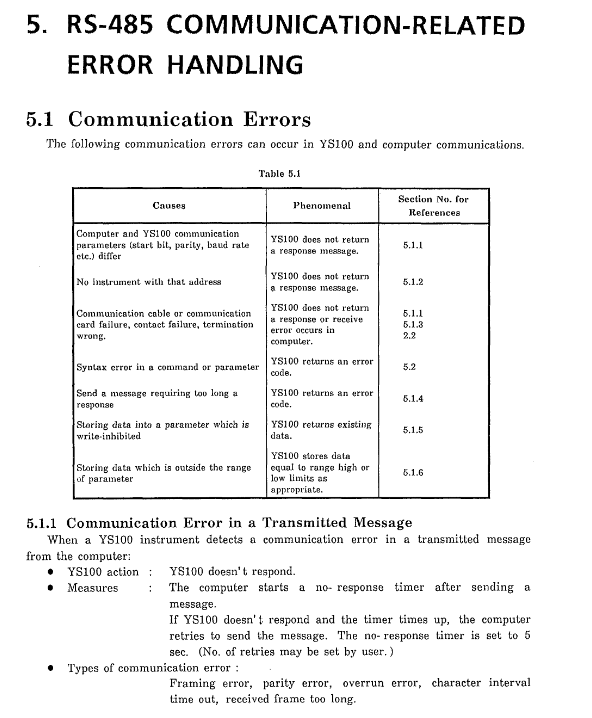
Communication interface: RS-485 five signal interface, including SD (A) (sending data A), SD (B) (sending data B), RD (A) (receiving data A), RD (B) (receiving data B), SG (signal ground);
Communication protocol: no protocol (command response message format), asynchronous transmission mode;
Transmission parameters: baud rate supports four adjustable levels of 1200/2400/4800/9600bps; Stop position 1 or 2; Parity check supports no check (NO), odd check (ODD), and even check (EVENT);
Data format: ASCII 8-bit encoding, single block text structure, maximum length of a single message is 220 bytes (including CR carriage return and LF line break);
Transmission characteristics: Half duplex communication, bit transmission order is the least significant bit first; The character interval timer is 0.1 seconds, and if it expires, it is judged as a communication error;
Error detection: Supports vertical parity check (even/odd/none), can identify frame errors, parity errors, overflow errors, etc.
2. Connection capability and physical characteristics
Connection method: 1: n multi station connection, a single RS-485 port can connect up to 16 YS100 series instruments, and each instrument needs to be assigned a unique address (1-16);
Communication distance: maximum transmission distance of 1200m (using recommended cables);
Recommended cable: shielded twisted pair, wire diameter 0.5~1.25mm ² (AWG No.20~AWG No.16), such as Hitachi wire CO-SPEV-SB (A) 3Px0.5PQ;
Terminal resistor: A terminal resistor of 120 Ω± 1%, 1/2W, 100ppm/℃ must be connected at both ends of the communication cable. The receiving side is controlled by the JP1 jumper on the RS-485 communication board (ON is enabled, OFF is disabled), and an additional resistor needs to be installed on the instrument panel for the four wire transmission side.
(2) DCS-LCS Communication Specification (Option Code/A32)
1. Adaptation system and connection parameters
Adaptation system: Yokogawa distributed control system CENTUM-XL, μ XL;
Communication link: Connected to DCS field control unit (such as MFCU of μ XL) through LCS loop communication card;
Connection capability: A single LCS card can support up to 8 YS100 instruments, and a single MFCU can install up to 3 LCS cards, so a single MFCU can connect up to 24 instruments; A single EFCS on-site control station can connect up to 120 instruments;
Wiring requirements: KS4 cable (maximum transmission distance of 100m), communication cable using shielded SCCD twisted pair;
Core feature: YS100 instrument is registered as an internal instrument of DCS, supporting monitoring and operation through DCS operator station without additional programming. Monitoring functions can be assigned through standard FIF (Fill In Forms) method.
2. Corresponding relationship between DCS instrument models
YS100 series models, DCS internal instrument models, core monitoring permissions
YS150 (Multi functional Controller) SLPC supports PV/SV/MV read-write, PID parameter configuration, and alarm status monitoring
YS170 (Programmable Controller) SLPC supports PV/SV/MV read and write, program control parameter adjustment, and alarm status monitoring
YS135 (SV setting automatic/manual station) SMST-111 supports PV monitoring, SV setting, and high/low limit alarm configuration
YS136 (MV setting automatic/manual station) SMST-121 supports PV monitoring, MV setting, and upper and lower limit configuration of operating variables
Installation and wiring specifications
(1) Terminal allocation
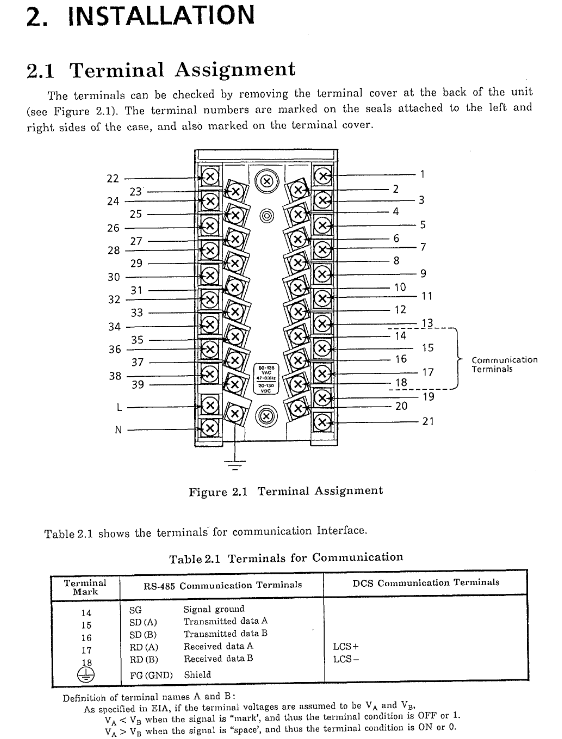
The communication terminal of YS100 series instruments is located on the back of the equipment, and can be viewed after removing the terminal cover. The terminal number is marked on the sealing parts and terminal cover on both sides of the chassis. The core communication terminals are assigned as follows:
Terminal Number RS-485 Communication Function DCS-LCS Communication Function Remarks
14 Signal Ground (SG) LCS+, LCS - dual function terminal, switch usage according to communication options
15 Send Data A (SD (A)) - Used only for RS-485 communication
16 Send Data B (SD (B)) - Used only for RS-485 communication
17 Receive Data A (RD (A)) - Used only for RS-485 communication
18 Receive Data B (RD (B)) - Used only for RS-485 communication
FG (GND) shielding layer grounding shielding layer grounding forced grounding, used for anti-interference
Note: The voltage definition of terminals A and B follows the EIA standard: when the signal is "mark" and VA<VB, the corresponding terminal status is OFF or 1; When the signal is "space" and VA>VB, the corresponding terminal status is ON or 0.
(2) RS-485 communication wiring
1. Four wire wiring system
Applicable scenarios: Bidirectional communication scenarios that require simultaneous sending and receiving, with higher communication stability;
Wiring requirements: Use 4-core shielded twisted pair cables to connect SD (A), SD (B), RD (A), and RD (B) respectively. The signal ground (SG) and shielding layer (FG) should be grounded together to avoid common mode interference;
Terminal resistance: Connect 120 Ω terminal resistors between SD (A) - SD (B) and RD (A) - RD (B) on the monitoring computer side and the farthest instrument side, respectively.
2. Two wire wiring system
Applicable scenarios: scenarios with low communication speed requirements and sensitive wiring costs;
Wiring requirements: Use 2-core shielded twisted pair, short-circuit SD (A) and RD (A), short-circuit SD (B) and RD (B), and connect them to the bus. Signal ground and shielding layer ground;
Terminal resistor: Connect a 120 Ω terminal resistor between the short circuited terminals at both ends of the bus.
3. Wiring precautions
Avoid parallel laying with power cables. If crossing is necessary, maintain a 90 ° vertical crossing to reduce electromagnetic interference;
The shielding layer needs to be grounded at one end (recommended to be grounded on the monitoring computer side) to avoid the formation of a grounding loop at both ends;
The cable length cannot exceed 1200m, and if it exceeds this limit, a signal amplifier (compatible with RS-485 protocol) must be used;
When multiple instruments are connected, a bus topology structure is used, and star connections are prohibited to avoid signal reflection.
(3) DCS-LCS communication cabling
1. Core wiring structure
Link composition: DCS field control unit (such as MFCU) → LCS communication card → TE08 terminal block → YS100 instrument, connected to SCCD twisted pair cable through KS4 cable;
Wiring distance: The maximum length of a single section of KS4 cable is 100m. The length of the SCCD twisted pair between the TE08 terminal block and the instrument should be adjusted according to the site layout, and the total attenuation should be controlled;
Shielding requirement: The shielding layer of all communication cables must be connected to the shielding terminal (S) of TE08 terminal block to achieve unified grounding.
2. YS100 and TE08 terminal block wiring
Wiring method: Each YS100 instrument is connected to the LCS+and LCS - terminals of the TE08 terminal block through SCCD twisted pair cables. Terminal 17 corresponds to LCS+, and terminal 18 corresponds to LCS -;
Connection restriction: A single TE08 terminal block can connect up to 8 YS100 instruments, and multiple instruments can be connected in parallel on the same LCS+or LCS - bus.
Communication parameter configuration
(1) Configure entrance and basic parameters
1. Configuration method
The communication parameters are set through the engineering panel group (CONFIG1 menu) on the instrument front-end panel, and only the enable/disable of the terminal resistor needs to be operated through the JP1 jumper on the RS-485 communication board (hardware configuration).
2. Core configuration parameters (CONFIG1 menu)
Line number display item function description default value optional range remark
1 SET configuration enable/disable INHB (disable) INHB, ENBL (enable) must be set to ENBL to modify other parameters
5 COMM communication function display -485 (RS-485), LCS (DCS-LCS) automatically recognizes installed communication options without manual setting
When COMWR communication is enabled with ENBL (allowed) and INHB (prohibited), instrument parameters cannot be modified through communication
8 ADRS RS-485 instrument addresses 1~16. Multiple instruments cannot be duplicated and are not related to DCS-LCS communication
9 STBIT RS-485 stop bits 1 and 2 need to be consistent with the monitoring computer settings
10 PAR RS-485 parity check NO (no check) NO, ODD, EVENT need to be consistent with the monitoring computer settings
11 BPS RS-485 baud rates 1200, 2400, 4800, 9600 need to be consistent with the monitoring computer settings
(2) Computer mode settings
1. Mode type and scope of application
The YS100 series instrument supports two computer modes for achieving deep control of the instrument by the monitoring system:
SPC mode: The monitoring system sends a set value (SV), and the instrument automatically runs according to the set value;
DDC mode: The monitoring system sends operation signals (MV), and the instrument directly outputs the signal;
Applicable restrictions: Only YS150 and YS170 support SPC and DDC modes; YS131, YS135, and YS136 do not support computer mode.
2. C mode configuration
C mode activation: When the "C" key LED of the instrument front-end operation mode key lights up, it enters C mode, which is divided into CAS (cascade mode) and CMP (computer mode);
CAS mode: Receive external cascaded input signals (1-5V) as the set values for YS150/YS170, YS135, and YS136;
CMP mode: CMOD1 (YS135/YS136 only CMOD1) needs to be set as CMP in the CONFIG2 menu. At this time, the set value or operation value can be set from the monitoring computer through SPC/DCD mode.
3. Backup mode settings
Trigger condition: In computer mode, if the instrument does not receive a monitoring system signal or receives a Fail signal, it is determined as a monitoring system failure and automatically switches to backup mode;
Mode options: YS150/YS170 can be set through the BMOD1/BMOD2 parameters in the CONFIG2 menu. BUA is the automatic backup mode, and BUM is the manual backup mode (maintaining output); YS135/YS136 default to fixed BUM mode;
Recovery mechanism: After the monitoring system returns to normal, the instrument needs to manually switch back to computer mode or trigger recovery through communication commands.
(3) Operating mode switching rules
1. YS150/YS170 (RS-485 communication)
Core mode: Supports AUT (automatic), MAN (manual), CAS (cascade), SPC (computer set value control), DDC (computer operation value control), BUA/BUM (backup mode);
Switching logic: SPC/DCD mode is activated through CMP mode, and switches to BUA/BUM when the monitoring system fails; Manual operation can switch between AUT/MAN through the "A/M" button on the panel. In computer mode, you need to exit CMP mode before switching;
Special rule: When using selector control, CMOD2 must be set to CAS; When the DDC status is ON (DDCF1=1) and the mode is AUT/MAN, pressing the C key can directly switch to DDC mode.
2. YS150/YS170 (DCS-LCS communication)
Mode correspondence: The LOOP status displayed on the DCS operator station corresponds one-to-one with the instrument mode, AUT corresponds to automatic mode, MAN corresponds to manual mode, CAS corresponds to cascade mode, and SPC/DCD corresponds to computer mode;
Operation permissions: The DCS side can modify SV (automatic mode) and MV (manual mode). In computer mode, only commands can be sent through the monitoring system, and the DCS side cannot directly modify the set values.
3. YS135/YS136 (Universal Communication)
YS135: Supports CAS (cascade, output CIN1 input value), MAN (manual, output manual set value), DDC (computer mode, output monitoring system set value), DDC mode cannot be activated from the DCS side;
YS136: Supports CAS (cascade, output CIN1 input value), MAN (manual, output manual operation value), DDC (computer mode, output monitoring system operation value), MV setting is only available in MAN mode.
- OMRON
- ABB
- General Electric
- EMERSON
- Honeywell
- HIMA
- ALSTOM
- Rolls-Royce
- MOTOROLA
- Rockwell
- Siemens
- Woodward
- YOKOGAWA
- FOXBORO
- KOLLMORGEN
- MOOG
- KB
- YAMAHA
- BENDER
- TEKTRONIX
- Westinghouse
- AMAT
- AB
- XYCOM
- Yaskawa
- B&R
- Schneider
- KONGSBERG
- NI
- WATLOW
- ProSoft
- SEW
- ADVANCED
- Reliance
- TRICONEX
- METSO
- MAN
- Advantest
- STUDER
- DANAHER MOTION
- Bently
- Galil
- EATON
- MOLEX
- DEIF
- B&W
- ZYGO
- Aerotech
- DANFOSS
- Beijer
- Moxa
- Rexroth
- Johnson
- WAGO
- TOSHIBA
- BMCM
- SMC
- HITACHI
- HIRSCHMANN
- Application field
- XP POWER
- CTI
- TRICON
- STOBER
- Thinklogical
- Horner Automation
- Meggitt
- Fanuc
- Baldor
- SHINKAWA
- Other Brands
- UniOP
- KUKA
- Iba
- Beckhoff
- ADLINK
-
 Sigmatek MDD111-1 DIAS Drive Axis Module
 -
 Sigmatek DKL042 05-024-042 Terminal Module
 -
 Sigmatek DM822 Control Module
 -
 Sigmatek CDM167 12-008-167-O Module
 -
 Sigmatek TAE151 Touch Display Unit
 -
 Sigmatek DCC041 SLIDES Module 05-700-041-D
 -
 Sigmatek AKM65M-ANC2GBB0 PM Servo Motor
 -
 Sigmatek ETT221 01-230-221 Operator Terminal
 -
 Sigmatek SLIDES DAM 124 Analog Module
 -
Sigmatek AKM31C-ANCNGBB0 Servo Motor
-
 Mannesmann Demag Sigmatek CP626 Central Unit
 -
 SIGMATEK 0332.554.03 Board 371071000154
 -
 SIGMATEK 12-250-021 Base Plate Back Panel CM5V020
 -
 SIGMATEK DM162 S-DIAS Digital Mix Module
 -
 DEMAG ERGOTECH 061 381 66 Sigmatek 9842.243.02 Circuit Board
 -
 SIGMATEK CP313-1 PLC Module
 -
Sigmatek ETV0551-2 VARAN Touch Terminal
-
 Sigmatek SDM 081 FS S-Dias Safety Module
 -
 DEMAG 05-250-023 Ergotech Motherboard with Sigmatek TMS012
 -
Sigmatek CM5V020 12-250-023-K Wiring Base
-
 Sigma Tek 5000B-37 Attitude Gyro Indicator
 -
 Sigmatek SDD120-2 DIAS Drive
 -
 Sigmatek CME221 Memory Module
 -
 Sigmatek DCP640 DIAS Central Unit
 -
 Sigmatek STO040 Safety Output Module
 -
Sigmatek CET281 Control Panel
-
 Sigmatek CIPC LX800 Demag NC5 CPU
 -
 Sigmatek DKL093 05-024-093 Terminal Module
 -
 Sigmatek AI088 20-009-088 Analog Input Module
 -
Sigmatek CAI888 Analog Input Module
-
SIGMATEK CCA021 12-025-021 Analog Output Module
-
SIGMATEK 1104.579.05 Control Module
-
SIGMATEK SDI100 Digital Input Module
-
 SIGMATEK C-IPC 256MB LX800 Compact Dias
 -
 SIGMATEK 9423.090.02 Control Module
 -
SIGMATEK C-IPC 256 Power Supply 148498
-
 SIGMATEK CAI025 Analog Input Module
 -
 SIGMATEK CTO166 Digital Output Module
 -
 SIGMATEK CP112 20-004-112 Processor Module
 -
SIGMATEK CAI887 12-009-887 Safety Module
-
 Sigma-Tek 4000B-31 Directional Gyro 1U262-002-42
 -
Sigmatek C-IPC 256MB LX800 IPC Controller
-
Sigmatek C-IPC 01-450-031 Industrial PC LX800
-
Sigmatek C-IPC 256 Industrial PC Controller
-
Sigmatek CCP-531 PLC Processor Module
-
Sigmatek CDI163 Digital Input Module
-
 Sigmatek ETV0501 VARAN Terminal 12-230-0501
 -
 Sigmatek CTMS020 C-DIAS Technology Module
 -
 Sigmatek CIV512 VARAN Switch Module
 -
 Sigmatek HU011 20-080-011 Interface Module
 -
SIGMATEK SLIDES DAM 124 Module
-
 SIGMATEK C-IPC 161 01-450-161L Industrial PC
 -
SIGMATEK C-IPC 128MB VIA 733MHz 01-450-024-K
-
 SIGMATEK 12-780-012 R8-IPC Geode LX800 Module
 -
SIGMATEK CAM124 Analog Module
-
 SIGMATEK S1 032-8AF61-R4 EZ Servo Motor
 -
 SIGMATEK CTO163 Digital Output Module
 -
 SIGMATEK CCP082 12-004-082 Processor Module
 -
 SIGMATEK CRCH081 C-DIAS Temperature Module
 -
 SIGMATEK PC322-K 01-310-322-K Industrial PC
 -
SIGMATEK SDD310-2 Servo Drive
-
 SIGMATEK AI084 Analog Input Module
 -
SIGMATEK CRCH081 12-752-081 Temperature Module
-
Sigma-Tek 5000L-4 Attitude Gyro 1U284-001-3
-
 SIGMATEK CM5V020 12-250-023-K Wiring Module
 -
Sigma-Tek 4000H-6 Directional Gyro IU262-035-7
-
 SIGMATEK Dias DCP160 05-004-160 Processor Module
 -
SIGMATEK 0147.395.02 Control Module
-
SIGMATEK A1084 Control Module
-
SIGMATEK DI200 20-006-2000 Digital Input Module
-
Sigmatek DNC115 Encoder Module
-
 Sigmatek DAM122 05-017-122 Analog Module
 -
Sigmatek 9802.289.01 Control Board TA71 Display
-
Sigmatek TO127 20-007-127 Digital Output Module
-
Sigmatek DNC031 05-011-031 Digital Module
-
Sigmatek VI022 20-003-022 Interface Module
-
Sigmatek CAI085 Analog Input Module
-
 Sigmatek CP111 S-DIAS CPU Module
 -
Sigmatek CTMS030 Krauss Maffei Module
-
 Sigmatek CAM123 Control Module
 -
 Sigmatek TAE732-P 01-240-732-P Touch Display Unit
 -
Sigmatek MDM021 Digital Mixed Module
-
Sigmatek DCP642 DIAS Central Unit
-
 Sigmatek CST022 12-014-022 C-DIAS Module
 -
 Sigmatek SRO021 20-893-021 Safety Relay Output
 -
 Krauss Maffei MC5 Control System Sigmatek
 -
 Sigmatek DC061 Module 18-24VDC 300mA
 -
 Herrmann EVT0855 Ultrasonic Welder Touch Panel
 -
Sigmatek CIV521 Control Module 1.4A 2W
-
Sigmatek DDI61 05-006-161 Digital Input Module
-
SIGMATEK ETT312-E Touch Terminal 01-230-312
-
Cessna S3326-1 Sigma Tek 5000B-67 Gyro 1U149-015-9
-
SIGMATEK PS101 Power Supply Module
-
SIGMATEK 0332.554.03 Control Module 371071000154
-
 SIGMATEK ETT312-E Touch Terminal 01-230-312
 -
SIGMATEK CDM163 Control Module
-
 SIGMATEK VSV046 16-023-046 Module
 -
SIGMATEK AM221 20-017-221 Analog Module
-
SIGMATEK CTS051 12-053-051 Control Module
-
SIGMATEK AM221 20-017-221 Analog Module
-
Sigmatek CSDI161 12-891-161 Safety Input Module
-
Sigma Tek 4000C-1 Directional Gyro Indicator
-
Sigmatek ETV0501 12-230-0501 VARAN Terminal
-
Sigmatek DDM165 SLIDES Module
-
Sigmatek N100 20-011-100 Control Module
-
Sigmatek AKM54K-ANC2R-B0 PM Servo Motor
-
Sigmatek CTO166 Digital Output Module
-
Sigmatek CP212-K 20-004-212-K CPU Module
-
Sigmatek CDI161 Digital Input Module
-
Sigmatek DCC080 05-700-080-2 Control Module
-
 SIGMATEK SCP011 S-DIAS Safety CPU
 -
SIGMATEK SCP011 S-DIAS Safety CPU
-
SIGMATEK SRO022 Relay Output Module
-
SIGMATEK MDD 121 Drive Axis Module
-
SIGMATEK DSI021 SLIDES Siemens Interface
-
SIGMATEK DIAS DCP161 Module 05-004-161
-
 Sigmatek ETT312 Built-in Touch Terminal
 -
SIGMATEK DCP 643 DIAS Controller System
-
SIGMATEK CIO021 Multi I/O Module
-
SIGMATEK CTMS020 Control Module
-
 Sigmatek CME 221 Memory Module
 -
Sigmatek 0420.615.01 Control Board
-
Sigmatek CP111 20-004-111 CPU Module
-
Sigmatek 9405.065.03 Control Board
-
Sigmatek ETEK 01-450-032-K C-IPC 256MB Industrial PC
-
Sigmatek CTO163 12-007-163 Safety Output Module
-
Sigmatek TO081 20-007-081 Digital Output Module
-
 Sigmatek SI021 20-022-021 Safety Input Module


