
Allen Bradley 1753 Series GuardPLC 1800 Controller
Allen Bradley 1753 Series GuardPLC 1800 Controller
Core framework and scope of application of the document
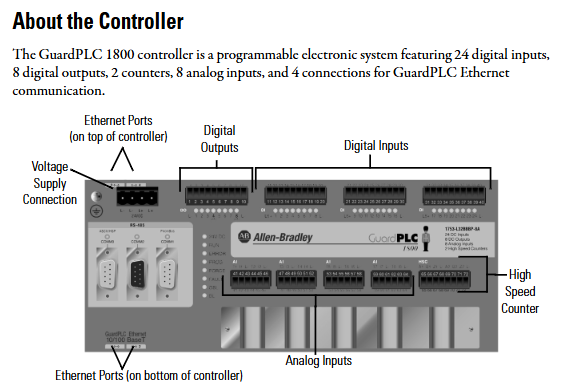
The document follows the logical mainline of "security standards → hardware awareness → installation and practical operation → functional verification", covering the entire process of controller preparation to later testing. The applicable product is GuardPLC 1800 safety controller, which is a programmable electronic system (PES) with safety certification. It integrates 24 digital inputs, 8 digital outputs, 2 high-speed counters, 8 analog inputs, and 4 GuardPLC Ethernet communication interfaces. It complies with SIL 3 (IEC 61508) and PLe (ISO 13849-1 Cat.4) safety levels and is suitable for scenarios with extremely high requirements for fault tolerance and risk control, such as mechanical safety control and process safety monitoring.
Core content sorting
(1) Controller Overview and Safety Standards
Core functions and hardware composition
Function integration: Supports the separation of secure and non secure communication. Secure communication is connected to distributed I/O, other GuardPLC controllers, or OPC servers through 4-channel 10/100BaseT RJ45 interfaces (GuardPLC Ethernet protocol); Non secure communication is achieved through 3-channel 9-pin D-shell interfaces (RS-485, etc.) to realize functions such as Modbus slave and Profibus DP slave (only 1753-L32BBBP-8A).
Hardware structure: including DIN rail installation buckle, 24V DC power interface, I/O plug-in terminal, high-speed counter interface, Ethernet interface (top 2+bottom 2), reset button (received design, anti misoperation), status indicator lights (24V DC, RUN, ERROR, PROMess, etc.). The controller is of open design and needs to be installed in a closed enclosure (protection level ≥ IP20).
Safety and Environmental Regulations
Operation qualification: It must be operated by trained professionals who are familiar with the application requirements of safety related PES (such as EN ISO 13849-1, IEC 61508).
Static electricity protection: The controller is sensitive to static electricity. When operating, it is necessary to touch a grounded object to discharge and wear a grounding wristband. It is forbidden to touch the pins or components of the circuit board. When idle, it should be stored in anti-static packaging.
Environmental requirements:
Working temperature: 0 ° C~60 ° C (32 ° F~140 ° F), storage temperature: -40 ° C~85 ° C (-40 ° F~185 ° F);
Relative humidity of 10%~95% (no condensation), pollution level 2 industrial environment, altitude ≤ 2000 meters (no need to downgrade);
It needs to be installed inside a metal casing with flame retardant properties (flame propagation level 5VA/V0, etc.), and the interior can only be accessed through tools to avoid the risk of electric shock.
(2) Installation process: from fixing to grounding
DIN rail installation (only supports DIN rail, not panel installation)
Align the guide rail: Hang the top slot of the controller on the IEC standard DIN rail (such as 199-DR1), and it is recommended to use galvanized yellow chromium steel material for the guide rail (to ensure good grounding). Fix it every 200mm (7.8 inches) and install end anchors.
Locking device: Insert a flathead screwdriver into the gap between the housing and the buckle, pull the buckle downwards, push the controller towards the guide rail, and release the buckle to complete the locking process; Reverse the operation during disassembly.
Heat dissipation requirements: Install horizontally with a minimum gap of 100mm (3.94 inches) above and below, avoiding installation above heating equipment to ensure air circulation. Install a fan if necessary.
Grounding configuration
Double grounding: The controller is functionally grounded through DIN rail, and protective grounding must be connected through a dedicated grounding screw (with grounding symbol) in the upper left corner of the housing. The grounding wire must comply with local electrical regulations (refer to Industrial Automation Wiring and Grounding Guidelines 1770-4.1).
Guide rail requirements: It is prohibited to use guide rails made of aluminum, plastic, or other materials that are prone to corrosion or have poor conductivity, in order to avoid equipment failure or safety risks caused by poor grounding.
(3) Wiring Specification: Power Supply and I/O Circuit
Power wiring (24V DC)
Power requirements: An isolated power supply that complies with EN 60950/UL 1950 must be used, and it must be of the SELV (Safety Extra Low Voltage) or PELV (Protection Extra Low Voltage) level. The SELV voltage should be ≤ 30V rms/42.4V peak/60V DC, and the PELV must be connected to a protective grounding.
Wiring details: Connect the power supply through a 4-pin terminal, and ensure that L+(positive pole) and L - (negative pole) are correctly connected (without reverse polarity protection, as reversing the connection may damage the controller); The terminal supports a maximum of 2.5mm ² (14 AWG) wire and requires external 10A delay fuse protection; The L+and L - terminals are internally connected, and 24V DC Daisy chain power can be supplied to other devices through the remaining terminals.
Current characteristics: The maximum current consumption of the controller is 9A (including I/O load), and it requires 1A for its own operation. The remaining 8A can be used to power input/output devices.
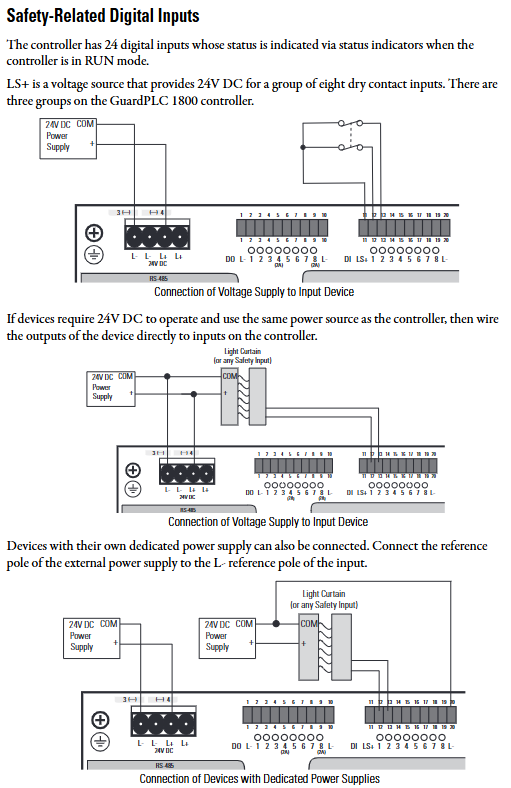
Digital input wiring (24 channels, divided into 3 groups, with 8 channels per group)
Power supply and circuit: Each set of inputs is powered by an independent LS+(24V DC sensor power supply with short-circuit protection), and the input signal is referenced to L - (common terminal); Supports dry contact input or sensors with independent power supply (such as safety light curtains), and the negative pole of the external power supply needs to be connected to the controller L.
Safety design: Following the "closed circuit principle", the input signal is reset to "0" by default in case of a fault (power-off safety state); If an input fault (such as a short circuit) is detected, the input signal of the fault channel is forced to be "0", and the FAILT indicator light is activated.
Terminal specifications: The terminal supports 0.13-1.3mm ² (26-16 AWG) wires, with a tightening torque of 0.51N · m (4.5 lb · in). Terminals 11-20, 21-30, and 31-40 correspond to three sets of input LS+, input channel, and L-。
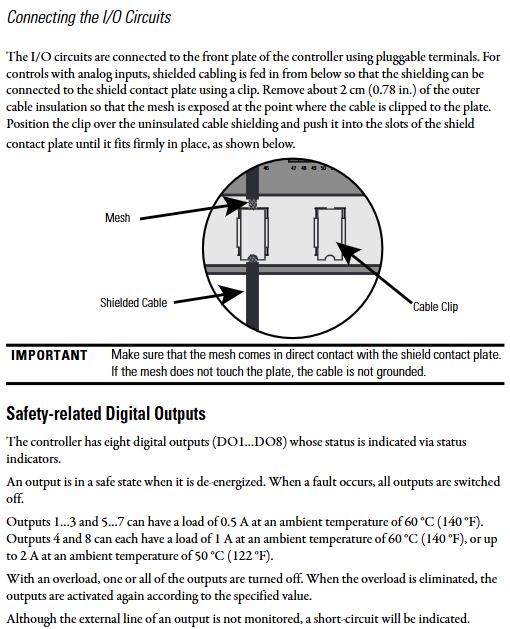
Digital output wiring (8 channels)
Load capacity:
At channels 1-3 and 5-7, the maximum current per channel is 0.5A at 60 ° C;
Channels 4 and 8 (heavy-duty channels): 1A/channel at 60 ° C, 2A/channel at 50 ° C;
The total output current is ≤ 7A, with a minimum load of 2mA per channel. When overcurrent occurs, the output is turned off and automatically restored after troubleshooting.
Wiring requirements: The output circuit should use L - (terminal 1/10) of the corresponding group as the common terminal. Even if L - is internally connected, it is still recommended to use it according to the group (EMC test verification configuration); It is recommended to parallel 1N4004 diodes to suppress interference voltage for inductive loads.
Safety feature: In the event of a fault, all outputs are forced to shut down (in a power-off safety state), and there is no monitoring of the external circuit. However, a short circuit will trigger a fault indication.
Analog input wiring (8 channels, single polarity)
Signal type:
Voltage signal: 0~10V DC (requires an external 10k Ω shunt resistor);
Current signal: 0~20mA (requires an external 500 Ω shunt resistor);
Unused analog inputs need to be short circuited (connected to I and L -) to avoid interference.
Wiring specifications: Use shielded twisted pair cables, with both ends of the shielding layer grounded, and a maximum wiring length of 300m (984 feet); Terminals 41-64 correspond to transmitter power supply (T1-T8), signal input (I1-I8), and reference terminal (L -) with 8 inputs, supporting 0.13-1.3mm ² (26-16 AWG) wires.
High speed counter wiring (2 channels, 24 bits)
Function configuration: Each counter includes three terminals: A (counting input), B (direction input), and Z (reset input). It supports 5V/24V DC signals and has a maximum input frequency of 100kHz. It can be used as a counter or a 3-digit Gray code decoder.
Wiring requirements: Use shielded twisted pair cables, with both ends of the shielding layer grounded, and a maximum wiring length of 500m (1640 feet); Terminals 65-72 correspond to A1/B1/Z1/L - and A2/B2/Z2/L - of the 2-channel counter, and unused inputs do not need to be terminated.
(4) Communication connection: Separation of secure and non secure
Secure Communication (GuardPLC Ethernet)
Interface configuration: 4 RJ45 interfaces (top 2+bottom 2), connected internally through an Ethernet switch, supporting automatic negotiation (full/half duplex, 10/100Mbps), can use direct or crossover Ethernet cables, supporting star/line topology (network loops are prohibited).
Application scenario: Connect distributed security I/O, other GuardPLC controllers, OPC servers (requiring 1753-OPC modules) and programming software, with MAC address attached to the bottom RJ45 interface.
Non secure communication (3-channel 9-pin D-shell interface)
Interface function:
COMM1:RS-485, Supports Modbus slave (1753-L32BBBM-8A) or Profibus DP slave (1753-L32BBBP-8A);
COMM2: Reserved (TBD);
COMM3:RS-485, Support GuardPLC ASCII protocol;
Pin definitions: Pin 3 (RxD/TxD-A) and Pin 8 (RxD/TxD-B) are for data transmission and reception, Pin 5 (DGND) is for data ground, Pin 6 (VP) is for 5V power supply, and Pin 4/9 are for control signals.
Default parameters: IP address defaults to 192.168.0.99, system ID (SRS) defaults to 60000, and custom parameters can be recorded through transparent labels (note not to obstruct ventilation holes).
(5) Fault diagnosis and status indication
Reset button operation
Trigger scenario: When forgetting the online password for programming software and unable to obtain IP address/SRS, use an insulated needle to press the reset button (top received hole, 4-5cm from the left edge).
Reset process: Press and hold the button for 20 seconds, while restarting the controller (power off and then on). After resetting, only the default account is retained, and the IP address/SRS is restored to its default value; Restore the parameters modified before or after resetting during the next power on (depending on whether they have been modified).
Controller self-test
Power monitoring: Alarm 1 is triggered when the 24V DC voltage is below 19.3V (recording internal variables), alarm 2 is triggered when the voltage is below 15.4V (preparing to shut down), and automatic shutdown is triggered when the voltage is below 13.0V.
Temperature monitoring: A warning is triggered when the temperature is between 60 ° C and 70 ° C, a main alarm is triggered when the temperature is above 70 ° C, and the main alarm is released when the temperature drops to 64 ° C and 54 ° C (the warning is retained). When the temperature drops below 54 ° C, it returns to normal.
Interpretation of status indicator lights
|Indicator light | Status | Meaning|
|24V DC | Always on | 24V DC power supply is normal|
|| Off | No power supply or power failure|
|RUN | Always on | Running normally (executing programs, processing I/O, communication, self-test)|
|| Blinking | STOP mode (no program executed, output reset, triggered by emergency stop)|
|| OFF | VNet STOP mode (see ERROR light)|
|ERROR | Always on | Hardware failure (controller, I/O, counter), system software error, watchdog timeout (out of cycle), software restart required|
|| Off | No errors|
|PROGress | Always on | Uploading new controller configuration|
|| Blinking | Upload new operating system to non-volatile ROM|
|FAULT | Always on | Program logic error, configuration failure, operating system damage|
|| Flashing | ROM write error, I/O failure|
|OSL | Blinking | Emergency Operating System Loader Activation|
|BL | Blinking | Boot loader unable to load operating system|
|Ethernet (green/yellow) | Green constant light | Full duplex; Huang Changliang: Connection establishment|
|| Green flashing | Conflict; Yellow flashing: Interface activity|
(6) Technical specifications and certification
Core parameters
Memory: Maximum 250KB user program memory, 250KB application data memory;
Safety performance: minimum watchdog time of 10ms, minimum safety time of 20ms;
Insulation voltage: 50V DC (basic insulation) between I/O and Ethernet, Ethernet and DC power supply;
Protection level: IP20 (controller body), size 257 × 114 × 66mm (width × height × depth), weight 1.2kg.
Safety certifications: UL Listed (USA&Canada), CE (EMC Directive 2004/108/EC), C-Tick (Australia), T Ü V certification (SIL 3/IEC 61508, PLe/ISO 13849-1).
Key considerations and supplementary resources
Compliance verification: Wiring must comply with local electrical regulations (such as NEC, IEC), and safety circuit design must meet corresponding safety level requirements to avoid reducing safety performance due to improper configuration.
EMC protection: Shielded wires are required for analog inputs, high-speed counters, and Ethernet, with both ends of the shielding layer grounded; Install a filter in the power circuit to reduce the impact of electromagnetic interference on safety functions.

- OMRON
- ABB
- General Electric
- EMERSON
- Honeywell
- HIMA
- ALSTOM
- Rolls-Royce
- MOTOROLA
- Rockwell
- Siemens
- Woodward
- YOKOGAWA
- FOXBORO
- KOLLMORGEN
- MOOG
- KB
- YAMAHA
- BENDER
- TEKTRONIX
- Westinghouse
- AMAT
- AB
- XYCOM
- Yaskawa
- B&R
- Schneider
- KONGSBERG
- NI
- WATLOW
- ProSoft
- SEW
- ADVANCED
- Reliance
- TRICONEX
- METSO
- MAN
- Advantest
- STUDER
- DANAHER MOTION
- Bently
- Galil
- EATON
- MOLEX
- DEIF
- B&W
- ZYGO
- Aerotech
- DANFOSS
- Beijer
- Moxa
- Rexroth
- Johnson
- WAGO
- TOSHIBA
- BMCM
- SMC
- HITACHI
- HIRSCHMANN
- Application field
- XP POWER
- CTI
- TRICON
- STOBER
- Thinklogical
- Horner Automation
- Meggitt
- Fanuc
- Baldor
- SHINKAWA
- Other Brands
- UniOP
- KUKA
- Iba
- Beckhoff
- ADLINK
-
 Alcatel-Lucent 9500-MPR ODU 300 MPT 23GHz 3DB23045HMAA02 Microwave Radio
 -
 Alcatel-Lucent 9500-MPR ODU MPT-HC 11GHz 3DB20548ACAA01 Microwave Radio
 -
 Alcatel Lucent 3DH03173AKAA Module
 -
 Alcatel-Lucent 76-0300-02 CSM-V2 PCB
 -
 Alcatel 9400 UX ODU Module 3CC06729ABAA
 -
 Alcatel-Lucent 408981363 Jigsaw A Band Block 24/-48V KS24624L58
 -
 Alcatel 3BA53095 PCB Card
 -
 Alcatel 2C7-1005-000 Bell Jar Holder Ring Teflon PC7-1005-000
 -
 Alcatel-Lucent ES640 PWDQAGKUAA 5ESS 48V DC Alarm Control Unit
 -
 Alcatel-Lucent 9500-MPR ODU 300 23GHz Microwave Radio MPT 3DB23045HM
 -
 Alcatel-Lucent KFA720 WMOTCMVLAB Optical System Interface Carrier
 -
 Alcatel-Lucent 9500-MPR ODU MPT-HC V2 15GHz Microwave Radio 3DB20373BAAB04
 -
 Alcatel-Lucent AKM70 S1-7 SMUX1 Sub-Multiplexer – T3PQWAEAAH
 -
 Alcatel-Lucent 107486490 DDM-2000 SONET DS3 Circuit Pack – BBG4B
 -
 Alcatel-Lucent SBEVM BNJ82 1:12 Module – AV950-01168
 -
 Alcatel-Lucent 938A Optical Loss Set – Test & Measurement Kit
 -
Alcatel-Lucent MS1025-25O16-ED Fiber Optic Unit – 48VDC
-
 Alcatel-Lucent 9500-MPR ODU MPT-HC 23GHz 1/1P Microwave Radio 3DB20473BA AA04
 -
Alcatel-Lucent bCEM-U Control Module – 3BK28676ABAC01
-
 Alcatel ASI20 Detector Control Module
 -
 Alcatel Lucent 130B S-1 PWPQ08B Power Unit
 -
 Alcatel-Lucent 9500-MPR ODU MPT-HC V2 9558HC 6GHz 3DB20441BBAA02
 -
Alcatel-Lucent 9500-MPR ODU MPT-MC 15GHz 3DB20824AAAA02 Microwave Radio
-
Alcatel-Lucent 9500-MPR ODU MPT-MC 15GHz 3DB20822AAAB02 Microwave Radio
-
 Alcatel-Lucent 3AL92111AA 1P10GSO Interface Module
 -
 Alcatel 8220 CTT 450 Turbo Pump Controller 127821
 -
 Alcatel-Lucent 3AL78823AAAE 02 Module
 -
 Alcatel-Lucent 90-0413-01 Universal Card
 -
 Alcatel-Lucent BRMA 10Base-T/100Base-TX Connecting Box 3BA56170ACAB010842
 -
 Woodward Micronet 5453-279 Rev E Chassis Rack for TMR Control
 -
 Alcatel-Lucent KFA632 WMOTBUKLAA 10G Optical Interface Carrier
 -
Alcatel-Lucent 9500-MPR ODU MPT-HC V2 3DB20474BAAB04 23GHz Microwave Radio
-
 Alcatel-Lucent KFA720 WMOTCMVLAB SFP/XFP Optical Interface Carrier
 -
 Alcatel-Lucent 3AL00114AB Universal Interface Module
 -
 Alcatel-Lucent BBG9 S1:1 OHCTL Optical Hardware Control Module
 -
 Alcatel-Lucent FB16401-A-I03 GTD-5 Analog Master/Slave Control Board
 -
 Alcatel-Lucent MCR1721B Control Module
 -
Alcatel-Lucent 9500-MPR 3DB20547ACAA01 ODU MPT-HC 11GHz Microwave Radio
-
 Alcatel-Lucent 3HE01014AAAA02 Interface Module
 -
 Alcatel-Lucent 244-2091-005 High Density Digital Line Card V1.5
 -
 Alcatel-Lucent LAMBDAXTREME WWAA36 Optical Amplifier Module
 -
Alcatel-Lucent 9500-MPR ODU MPT-HC 6GHz 2P-2 Radio 3DB20444BAAA05
-
Alcatel-Lucent 9500-MPR ODU MPT-HC V2 9558HC MPT-XP 6GHz 3DB20442BBAA02
-
Alcatel-Lucent 9500-MPR ODU MPT-HC 23GHz 3DB20476ABAA01 Microwave Radio
-
 Alcatel Lucent 3HE01019AAAA01 Module
 -
 Alcatel CPU5 3BA23071 PCB Card with IO2 3BA23050 Set
 -
Alcatel-Lucent 9500-MPR ODU MPT-HC V2 9558HC 6GHz 3DB20443BBAA02
-
 Alcatel Lucent 500-1113-211 Rev H Channel Bank Assembly
 -
Alcatel Lucent 89-0419-B-2 BA9ATS0FAB Frontal Compute Module
-
Alcatel-Lucent LambdaXtreme 1625 WWAF31 Optical Amplifier CP Module
-
 Alcatel Z24 3BA53065 Analog Extension Card 3BA52065 AAAA KAZZB-01
 -
 Alcatel 3EH08263AAXX000448 OmniPCX Office Large PBX System
 -
 Alcatel Lucent VSEM-C 3FE62453 XA VAUCAJZKAA 7330 DSLAM Line Card
 -
 Alcatel-Lucent 9500-MPR ODU MPT-HC 3DB20432BAAA04 18GHz Microwave Radio
 -
 Alcatel-Lucent 9500-MPR ODU MPT-HC 3DB20546ACAA01 11GHz Microwave Radio
 -
 Alcatel-Lucent 3DB04823AAAA Circuit Board
 -
 Alcatel-Lucent 3DB04530AAAA Circuit Board
 -
 Westell MDIU Modular DAS Interface Unit CS21-005-105Q
 -
 Alcatel-Lucent 90-0423-01 Control Card
 -
 Alcatel-Lucent 3AL91792AA 01 iL-1.2 Optical Interface LC Connector
 -
 Alcatel-Lucent 109637454 WA82 SP2B MODL908832 – Interface Module
 -
 Alcatel-Lucent MDEE DPB11 Part 109773580 – Digital Processing Board
 -
 Alcatel 3EH76027ADAD OmniPCX Enterprise Communication Server R500/30.4
 -
Alcatel-Lucent 3EH73084AEJD Gateway Driver Board GD-3 – Communication Interface
-
Alcatel-Lucent 9500-MPR ODU Radio MPT-HC V2 3DB20476BAAB04 23 GHz Microwave Outdoor Unit
-
 Alcatel-Lucent 9396 Digital 2U NodeB Indoor – UMTS Base Station
 -
 Alcatel-Lucent 3HE03607AA CFM-XP Control Fabric Module – Switch Fabric Controller
 -
 Alcatel-Lucent 8232 DECT Mobile Handset – Cordless Enterprise Phone
 -
 Alcatel-Lucent 244-2082-201 Sierra NAC V3.1 Slave Package – Network Access Control
 -
 Alcatel-Lucent 408154912 CPU Rear I/O Pack Card – Backplane Interface Module
 -
 Alcatel-Lucent 3AL82037ADAA SFP Module
 -
Alcatel-Lucent OMQ 408645968 Optical Module
-
Alcatel-Lucent 9500 MPR 8-Slot Shelf 3DB18485AB
-
 Alcatel-Lucent 408154904 CPU I/O Card
 -
 Alcatel-Annecy 5150 CP Turbo Vacuum Pump
 -
 Alcatel-Lucent 3EH73084AEJD08 Card
 -
Alcatel-Lucent 3EH73050ABAB Interface Card
-
Alcatel-Lucent 3HE06151ABAA01 SFP Line Card
-
 Alcatel-Lucent 8DG59242AD Power Filter
 -
Alcatel-Lucent IMM48-1GB-TX 48-Port Module
-
Alcatel Lucent 3CM03285MQ02 Module
-
 Alcatel 3HE07158BA 7750 SR-12 IMM-2PCA-FP3 Optical Transceiver
 -
 Alcatel-Lucent 9396 Digital 2U NodeB Outdoor with Indoor Mainframe and Alarm Module
 -
Alcatel Lucent MPX-16/64-T-L3 MPX1664TL3 Multiplexer Module
-
 Alcatel Lucent 3EH73052AB Power Supply Module
 -
 Alcatel Lucent ASM2-155FM-2W-4C ASM2155FM2W4C Switch Fabric Module
 -
 Alcatel Lucent 3AL00124ABAB Interface Card
 -
Alcatel-Lucent 1AB429380001 Cable Assembly
-
Alcatel Z24 3BA53065 Analog Extension Card 3BA53065AA
-
Alcatel-Lucent 9500-MPR 11GHz MPT-HC ODU Microwave Packet Radio 3DB20371ACAA01
-
 Alcatel-Lucent RRH1900-4x45 Remote Radio Head
 -
 Alcatel-Lucent 3HE00028AA Ethernet Line Card
 -
 Alcatel-Lucent 3HE04939CE CWDM SFP Transceiver
 -
 Nokia Alcatel-Lucent 3FE66546AA Fan Module
 -
 Alcatel-Lucent SSP-6 Speech Signal Processor Board
 -
Alcatel-Lucent 500-1113-212 Channel Bank Assembly
-
Alcatel-Lucent EZ32-2 Board 3BA23265ADKE 01
-
 Alcatel-Lucent GSM-FM-2W-4C Filter Module
 -
 Alcatel-Lucent 3AL00378AF Interface Card
 -
Alcatel-Lucent 3AL00124ABAC Interface Module
-
Alcatel-Lucent BJB1 PWPQALGAAG 48V Independent Microprocessor Board
-
 Alcatel Lucent MDR-8000 Microwave Digital Radio MDR-8506-4 with 13 Modules
 -
 Alcatel Lucent 3AL00424AA Interface Card
 -
 Alcatel Lucent 3BA73012AB Power Supply Module
 -
 Alcatel Lucent ESX-100C-32W ESX100C32W Power Supply Module
 -
 Alcatel Lucent GSX-K-FM-2W GSXKFM2W Fan Module
 -
 Alcatel 8DG59247AA Optical Protection Switch Card
 -
 Alcatel Lucent 91-E03100-B 91E03100B Interface Module
 -
 Alcatel Lucent FSX-FM-1W FSXFM1W Fan Module
 -
 Alcatel Lucent RRH2X40-07L-AT Remote Radio Head
 -
Alcatel-Lucent 9500-MPR MSS-8 Shelf 3DB18485CA
-
 Alcatel Annecy ACP20 Vacuum Pump CP20
 -
 Alcatel-Lucent 9500 MPR P32E1DS1 E1 PDH Card
 -
 Alcatel-Lucent J98726AL-2 D4OI210DAA Module
 -
 Alcatel 409113651 RRH700L1 700MHz Remote Radio Head
 -
 Alcatel io2 3ba23050 PCB Card
 -
Alcatel-Lucent MDR-8000 MDR-8706-8 Digital Radio
-
 Alcatel-Lucent ACT2300M Turbo Pump Controller AF042134A
 -
 Alcatel-Lucent OmniPCX Office Medium PowerCPU PRA-TI
 -
Alcatel-Lucent 9500 MPR 23GHz ODU 3DB23045HDAA01
-
 Alcatel-Lucent 9500 MPR ODU Outdoor Unit 300 11GHz TX Low HP 3DB23035AAAA01
 -
 Alcatel-Lucent ECNT-C 3FE25676 BA AK 06 Termination Card
 -
Alcatel Lucent MDR-8000 Microwave Digital Radio MDR-8606-45 with 13 Modules
-
Alcatel-Lucent 849144415 KS-24829L1 Remote Radio Head v1.4
-
 Alcatel CFF 450 Turbo Pump Controller 137171
 -
 Alcatel-Lucent ACS108 109579896 004 Access Controller
 -
Alcatel-Lucent OS6850-48 Network Switch with PS-126W-AC Power Supply
-
 Alcatel Lucent DFP-CM-14B/2T Filter DCMA Base Station


