
Foxboro Evo FBM237 Analog Output Module
Foxboro Evo FBM237 Analog Output Module
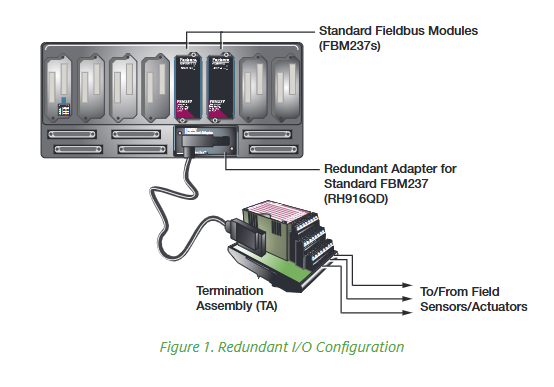
The FBM237 contains eight 0-20 mA analog output channels. In situations where control system reliability is important, the FBM237 may have a redundant module installed. This permits all eight outputs to maintain operation in the presence of a single fault and during the time that the suspect module is removed and replaced. The 0-20 mA signals are electrically compatible with HART ® field devices.
FEATURES
PHYSICAL DESIGN
REDUNDANT ANALOG OUTPUTS
HIGH RELIABILITY
The redundancy of the module pair, coupled with the high coverage of faults, provides a very high subsystem availability time.
Either module in the redundant pair may be replaced without upsetting field output signals to the good module. The module can be removed/replaced without removing field device termination cabling,power, or communications cabling.
FIELDBUS COMMUNICATION
A Fieldbus Communications Module or a Control Processor interfaces to the redundant 2 Mbps module Fieldbus used by the FBMs. The FBM237 accepts communication from either path (A or B) of the 2 Mbps Fieldbus — should one path fail or be switched at the system level, the module continues communication over the active path.
The module mounts on the Standard Modular baseplate, which accommodates up to eight Fieldbus Modules. The Modular baseplate is either DIN rail mounted or rack mounted, and includes signal connectors for redundant Fieldbus, redundant independent DC power, and termination cables.
Redundant modules must be located in adjacent odd/even position pairs on the baseplate (positions 1 and 2, 3 and 4, 5 and 6, or 7 and 8). To achieve the redundant output, a redundant adapter module is placed on the two adjacent baseplate termination cable connectors to provide a single termination
Key Features
Environmental adaptability: Complies with ISA S71.04 G3 level harsh environmental standards, can withstand vibration (0.75g @ 5-500Hz), wide temperature range (working -20~70 ℃, storage -40~70 ℃), and is suitable for industrial high temperature and high dust scenes;
Hot plugging and maintenance: Module replacement does not require dismantling of on-site wiring, power or communication cables, and redundant module maintenance does not affect the operation of on-site equipment; Partial termination components (TA) with bypass sockets, supporting temporary output maintenance through bypass stations (such as P0900HJ);
Status indication: The front LED light provides real-time feedback on the communication status, power status, and channel faults of the module, making it easy to quickly locate problems;
Communication reliability: Connected to the fieldbus communication module (FCM) or control processor (FCP) through a 2 Mbps redundant fieldbus, supporting A/B dual path switching, and ensuring uninterrupted data transmission in case of single path failure.
Hardware parameters and technical specifications
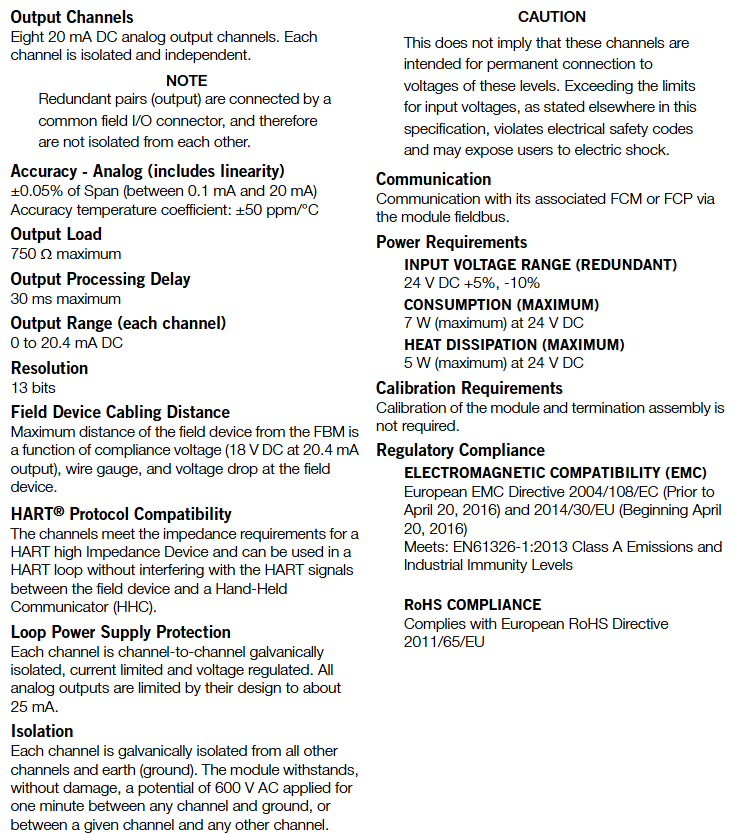
(1) Output and precision parameters
Parameter category specific specifications
Channel configuration includes 8 independent channels, with each channel being Galvanically isolated (between channels, channel to ground)
Accuracy (including linearity) ± 0.05% range (within the range of 0.1~20mA), temperature coefficient ± 50 ppm/℃ (temperature changes have little impact on accuracy)
Maximum output delay of 30ms (meets the real-time requirements of most industrial controls)
Resolution of 13 bits (high output adjustment accuracy, supports fine control signal output)
Circuit power supply protection with independent current limitation and voltage regulation for each channel to avoid overload damage
The wiring distance depends on the compliant voltage (18V DC at 20.4mA), wire specifications, and equipment voltage drop, and supports a maximum of 30m cables
(2) Power supply and power consumption
Power input: 24V DC (redundant mode, allowable range+5%/-10%, i.e. 21.6-26.4V DC), requires independent redundant power supply;
Power consumption: Maximum 7W (running) at 24V DC, maximum heat dissipation of 5W, reserved heat dissipation space is required to avoid module overheating.
(3) Physical and environmental parameters
Parameter category specification requirements
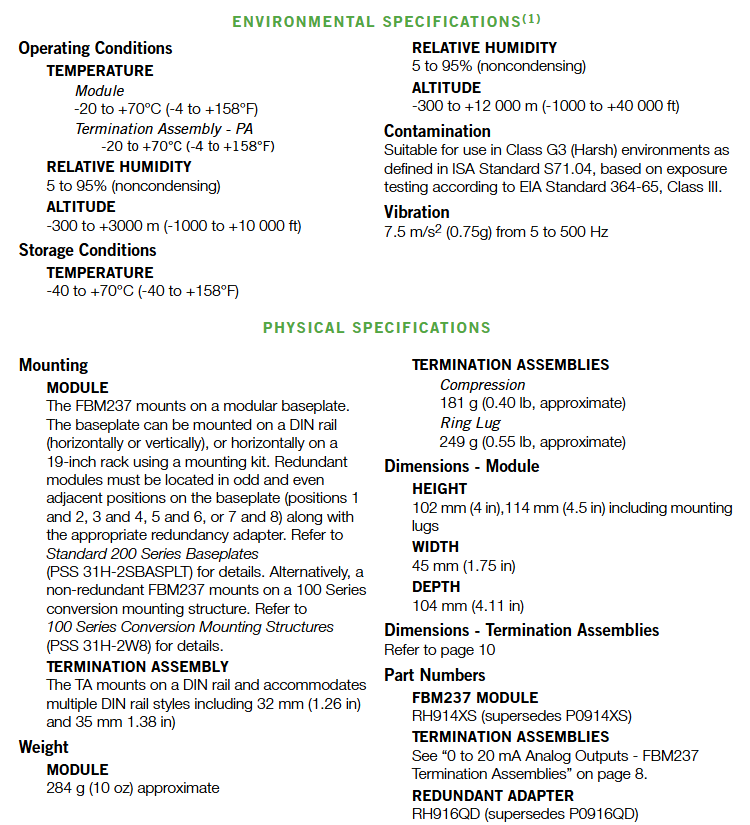
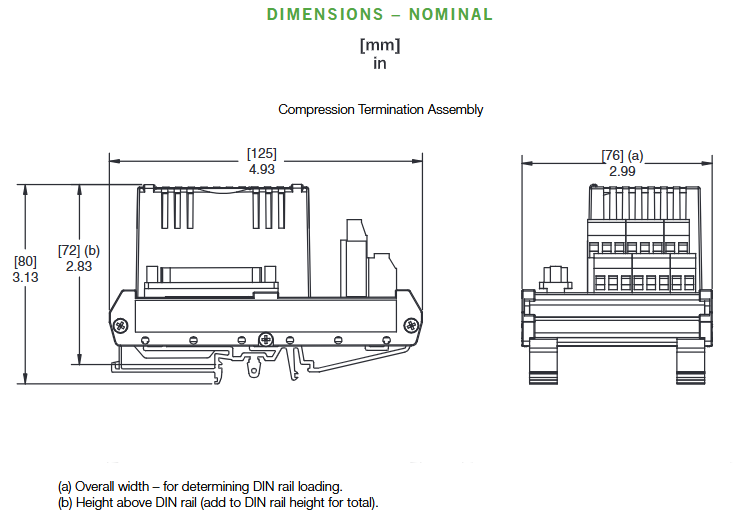
Dimensions (module) height 102mm (including installation ears 114mm) x width 45mm x depth 104mm, single slot design
The weight module weighs approximately 284g (10oz); TA approximately 181-249g (0.40-0.55lb, depending on terminal type)
Working environment temperature -20~70 ℃, humidity 5%~95% (non condensing), altitude -300~3000m
Storage environment temperature -40~70 ℃, humidity 5%~95% (no condensation), altitude -300~12000m
The pollution level complies with EIA 364-65 Class III and is suitable for harsh environments with ISA S71.04 G3 level (high dust, high humidity)
Installation and Termination Component (TA) Configuration
FBM237 needs to be used in conjunction with a dedicated base, termination assembly (TA), and cables. Installation and wiring must follow strict specifications, with the following core requirements:
(1) Base and installation
Base type:
Modular base: Supports DIN rail (32mm/35mm) or 19 inch rack installation, with a maximum capacity of 8 FBM modules per base;
Redundant installation: Redundant modules need to be fixed in adjacent odd/even positions, connected to the base terminals through the redundant adapter RH916QD, to achieve two modules sharing one TA signal interface.
Installation specifications:
Heat dissipation space: Reserve ≥ 25mm space on each side of the module to avoid the influence of adjacent devices on heat dissipation;
Grounding requirements: Galvanized yellow chromium steel DIN rails are preferred for the base to ensure reliable grounding, and aluminum/plastic rails are prohibited (which may cause poor grounding).
(2) Termination Component (TA) Selection
TA is a key component connecting FBM237 with on-site actuators, providing signal switching and bypass maintenance functions. It needs to be selected according to the scenario, and the specific model and adaptation scenario are as follows:
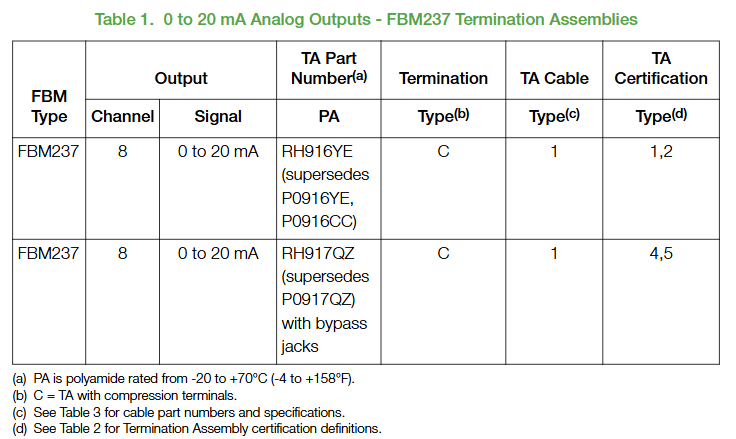
TA model core function adaptation scenario authentication type
RH916YE (main TA) 8-channel signal transfer, no bypass function, normal scenario (no online maintenance required) Type 1/2 (compatible with hazardous areas)
RH917QZ (main TA) 8-channel with bypass socket, supporting bypass station access to critical scenarios (requiring online maintenance, such as chemical reaction kettle) Type 4/5 (ordinary area+Class 2 circuit)
TA connection: TA connects to the base through a Type 1 cable (25 pin D-sub interface), with a maximum cable length of 30m, supporting 2 materials:
P/PVC: polyurethane outer layer+PVC insulation, temperature range -20~80 ℃, suitable for ordinary industrial environments;
LSZH (Low Smoke Zero Halogen): Low smoke zero halogen release at high temperatures, suitable for enclosed environments such as ships and subways, with a temperature range of -40~105 ℃;
Wiring specifications: TA supports solid/multi strand wires of 0.2~4mm ² (24~12 AWG), and multi strand wires with wire ears should be 0.2~2.5mm ² (with or without plastic sleeves), with terminal torque in accordance with manufacturer specifications.
Compliance certification and security requirements
(1) Core certification
The FBM237 module and its supporting TA comply with global safety, electromagnetic compatibility, and environmental standards in multiple regions, with the following core certifications:
Specific standards and levels for certification categories
Hazardous Area Certification North America: UL/UL-C Class I Division 2 Groups A-D, Temperature Code T4;
Europe: ATEX 2014/34/EU II 3 G Ex nA IIC T4 (DEMKO certification, except RH917QZ);
International: Compliant with IECEx standards and suitable for Zone 2 hazardous areas
Electromagnetic Compatibility (EMC) EU EMC Directive 2014/30/EU, compliant with EN 61326-1:2013 Class A (Emission and Immunity in Industrial Environments)
Low Voltage Safety EU Low Voltage Directive 2014/35/EU, communication circuits comply with UL Class 2 standards (NFPA 70 Article 725, CSA C22.1 Section 16)
Environmental compliance complies with the EU RoHS 2011/65/EU directive, restricting the use of harmful substances such as lead and mercury
Ship certification ABS type approval, French Classification Society (BV) EC31 environmental category certification, applicable to ship automation systems
(2) Safety operation requirements
Electrical safety:
Isolation restriction: Although the module can withstand 600V AC, it is prohibited to connect to excessive voltage (such as 220V AC) for a long time to avoid insulation damage;
Wiring specifications: On site wiring should distinguish between positive and negative poles. In redundancy mode, ensure that the two modules have independent power supplies to prevent redundancy failure caused by single point power failure.
Dangerous area operation:
Shell requirements: It must be installed in a certified shell with a protection level of IP54 or above, and the shell must be opened with tools to prevent unauthorized operation;
Maintenance process: Power off or confirm that the area is in a non hazardous environment before connecting/disconnecting cables. Redundant module replacement should be carried out after the faulty module is powered off.
Upgrade and compatibility instructions
FBM237 is mainly used to replace the Foxboro 100 series FBM37 analog output module. When upgrading, the following compatibility points should be noted:
Hardware replacement: A single FBM237 can directly replace one FBM37, and on-site wiring can be reused in two ways:
Direct adaptation: Use the documentation to specify the TA (such as RH916YE) and rewire it to the TA terminal;
Adapter reuse: Connect the terminated component adapter (TAA, refer to PSS 31H-2W4) directly to the original FBM37 wiring without rewiring.
Software adaptation:
Should be paired with Foxboro Evo control software v8. x+or Control Core Services v9.0+, supporting AOUTR redundant function block configuration;
The failure safety parameters need to be pre-set in the software (such as a fallback current of 0mA and a fault delay time) to ensure that the actuator is in a safe state in case of a fault.
- OMRON
- ABB
- General Electric
- EMERSON
- Honeywell
- HIMA
- ALSTOM
- Rolls-Royce
- MOTOROLA
- Rockwell
- Siemens
- Woodward
- YOKOGAWA
- FOXBORO
- KOLLMORGEN
- MOOG
- KB
- YAMAHA
- BENDER
- TEKTRONIX
- Westinghouse
- AMAT
- AB
- XYCOM
- Yaskawa
- B&R
- Schneider
- KONGSBERG
- NI
- WATLOW
- ProSoft
- SEW
- ADVANCED
- Reliance
- TRICONEX
- METSO
- MAN
- Advantest
- STUDER
- DANAHER MOTION
- Bently
- Galil
- EATON
- MOLEX
- DEIF
- B&W
- ZYGO
- Aerotech
- DANFOSS
- Beijer
- Moxa
- Rexroth
- Johnson
- WAGO
- TOSHIBA
- BMCM
- SMC
- HITACHI
- HIRSCHMANN
- Application field
- XP POWER
- CTI
- TRICON
- STOBER
- Thinklogical
- Horner Automation
- Meggitt
- Fanuc
- Baldor
- SHINKAWA
- Other Brands
- UniOP
- KUKA
- Iba
- Beckhoff
- ADLINK
-
 SIGMATEK ICA111 Module
 -
 SIGMATEK MDD 121-1 Drive Axis Module
 -
 SIGMATEK M5V121 12-300-121 Krauss Maffei M5 Display Unit
 -
SIGMATEK CTMS 020 CD Technology Module 12-250-011
-
 SIGMATEK PCT122 Touch Panel
 -
 Stöger MCS4100 SIGMATEK Control Module
 -
 SIGMATEK Krauss Maffei M5 Keyboard Unit M5K902 12-310-902
 -
 SIGMATEK SD310-2 Servo Drive Module
 -
 SIGMATEK CM5V020 CD Wiring Circuit Module
 -
SIGMATEK ENGEL Robot Drive M3 02220-8748
-
 Sigmatek CFF011 Drive Module
 -
 Sigmatek DCP642 DIAS Central Unit
 -
 Sigmatek SDM081 S-DIAS Safety Module
 -
 Sigmatek C-IPC 01-450-024 Industrial PC
 -
Sigmatek Kompakt NC4 Control Module
-
 Sigmatek VI021 VARAN Interface Module
 -
 Sigmatek Engel RD-M6-2 Robot Drive
 -
Sigmatek CNC031 Positioning Module
-
Sigmatek TO161 Digital Output Module
-
Sigmatek CCL912 CPU PSU Module
-
Sigmatek ETV0821 Operator Terminal
-
 SIGMATEK ET 261 Operator Terminal
 -
 SIGMATEK CP731-K Control Module 20-004-731-K
 -
 SIGMATEK ETEK Motherboard 12-250-021-K CM5V020
 -
 Sigmatek DEZ 181 DIAS Input Output Module
 -
 Sigmatek IPC111-D Industrial PC
 -
 SIGMATEK AKM54L-ANC2GBB0 Servomotor with Gearhead
 -
SIGMATEK CTMS020 CM5V020 CNC Controller
-
 DEMAG ERGOTECH 061 381 66 Sigmatek Control Unit
 -
 Sigmatek DAI 883 Module
 -
 Sigmatek ETV1521 Control Panel Installation Terminal
 -
 Sigmatek 9802.289.01 Board Control TA71 Display
 -
 Wittmann Sigmatek EU-252 proDrive W4 Servo Drive
 -
 Sigmatek CDM166 C-DIAS Module
 -
Sigmatek DCP082 DIAS Central Unit
-
 Sigmatek CCP081 C-DIAS Processor Module
 -
Sigmatek MD111-1 Drive Module
-
Sigmatek ETV0821 Operator Terminal
-
 Sigmatek ISE021 Interface Module
 -
 Sigmatek DCC080L Slide Control Module
 -
 Sigmatek AI075 Analog Input Module
 -
SIGMATEK TO161 20-007-161 Module
-
 SIGMATEK CIC011 Module
 -
 SIGMATEK AE0000318502 Hand Terminal Pendant
 -
 Sigmatek Krauss Maffei PC323-K Control Unit
 -
Sigmatek Krauss Maffei PC321-K Control Cabinet PC
-
SIGMATEK CIV521 Control Module
-
SIGMATEK C-IPC-171 Industrial PC
-
 SIGMATEK MDP101-L DIAS Drive Network Module
 -
 Sigmatek Krauss Maffei PC323-K Control Cabinet PC
 -
 SIGMATEK CRCH081 C-SLIDES Temperature Module
 -
 Sigmatek PC301-E6 Industrial PC SSD
 -
 Sigmatek SDI101 S-SLIDES Safety Input Module
 -
 Sigmatek CIV521 VARAN Control Module
 -
 Kollmorgen Sigmatek AKM42G-ANCNGBB0 Servo Motor
 -
 Sigmatek PC 521 Process Controller
 -
 Sigmatek Geode LX800 12-780-012 Industrial PC
 -
 Sigmatek STO081 S-DIAS Safety Output Module
 -
 Sigmatek SCP111 S-DIAS Safety CPU Module
 -
 Sigmatek CDI161 Industrial I O Module
 -
Sigmatek Wiring Board V2 DIAS 05-250-023
-
Sigmatek CP102 20-004-102 S-DIAS CPU Module
-
SIGMATEK SLIDES CNC 115 Module
-
 SIGMATEK DCC080 05-700-080-2 Control Module
 -
SIGMATEK MDD 121 Drive Axis Module
-
 SIGMATEK CIO011 C-DIAS Multi I/O Module
 -
SIGMATEK CIV512 Servo Drive
-
 SIGMATEK CM5V020 12-250-021-K Wiring Module
 -
 SIGMATEK CIO011 12-013-011 Multi I/O Module
 -
SIGMATEK 01-450-031 C-IPC Industrial Computer
-
SIGMATEK AKM24D-ANBNGBB0 Servo Motor
-
 DEMAG NC4 LP0001289.03 Control Module
 -
 Sigmatek ETEK Industrial PC C-IPC with Option Module
 -
Sigmatek AO081 20-010-081 Analog Output Module
-
Sigmatek CNC 031 Positioning Module
-
Sigmatek CP731-K 20-004-731-K CPU Module
-
Sigmatek MDD 3320-JR-A Drive Module
-
Sigmatek PM Servo Motor AKM52K-ANC2GBB0
-
Sigmatek MDP 101 09-403-101 Power Module
-
Sigmatek S-SLIDES AO046 Analog Output Module
-
Sigmatek ICA111 20-102-111 Interface Module
-
 SIGMATEK DCP646 Module 05-004-646
 -
SIGMATEK SDI101 Digital Input Module 20-891-101
-
 SIGMATEK S3330-2 Directional Gyro Altitude Instrument
 -
SIGMATEK MDP102-1 Controller
-
SIGMATEK SMT 01-230-321 Touch Screen
-
SIGMATEK Krauss Maffei PC301-K 01-310-301-K Industrial PC with 8GB SSD
-
 SIGMATEK ETT731 01-230-731 Built-in Touch Terminal
 -
SIGMATEK CIV521 Control Module
-
 SIGMATEK DME 128 Module 05-005-128
 -
 SIGMATEK SCP111-S 20-890-111-S S-DIAS Safety CPU Module
 -
Sigmatek SCP111 S-DIAS Safety CPU
-
Sigmatek CRIF081 Interface Module
-
Sigmatek CP112-1 S-DIAS CPU Module
-
Sigmatek MDD121-L DIAS Drive Axis Module
-
 Sigmatek C-IPC 01-450-024 Industrial PC
 -
Sigmatek SDD215-23 SLIDES Drive
-
 Sigmatek DPS001 DIAS System Components
 -
Sigma-Tek 4000B-30 Directional Gyro
-
 Sigmatek SDD340-46 SDD Series Drive
 -
 Sigmatek CEZ221 Euromap67 I O Module
 -
 SIGMATEK VI021 Interface Module
 -
SIGMATEK CP731-K Control Module
-
SIGMATEK Krauss Maffei PC321-K Industrial PC
-
SIGMATEK ET322 Operator Terminal
-
SIGMATEK CP102 Control Module 24VDC
-
SIGMATEK SRO021 Relay Output Module
-
SIGMATEK DCP640 DIAS Central Unit
-
 SIGMATEK MDD 121 Drive Axis Module
 -
SIGMATEK AI043 Analog Input Module
-
 ENOTEC OXITEC 5000 SME-53310000 Oxygen Analyzer
 -
SIGMATEK Krauss Maffei PC301-K 01-310-301-K Industrial PC
-
 SIGMATEK SDD310-23 VARAN Servo Drive
 -
 SIGMATEK CDM 163 and CIC 011 C-DIAS Input Modules
 -
SIGMATEK MDP 101-1 Power Module
-
SIGMATEK CM5V020 Wiring Circuit with CTMS020
-
SIGMATEK CCP521 C-DIAS Processor Module
-
 SIGMATEK MDP 101-K Power Module
 -
SIGMATEK ETEK C-IPC 733MHz VIA Eden 7000
-
 SIGMATEK DCP 643 DIAS PLC CPU Module
 -
SIGMATEK TAE121 12-200-121 Operator Terminal
-
Sigmatek TMS012-T Injection Moulding Technology Module
-
Sigmatek MDD 121-1 Controller
-
Sigmatek CDM167 Module
-
Sigmatek DCP082 DIAS Central Unit
-
 Sigmatek ETT731 Built-In Terminal Touch
 -
Sigmatek CCP521 C-DIAS Processor Module
-
Sigmatek Krauss Maffei PC301-K Control Cabinet PC


