
BENDER IRDH575 Series Digital Ground Fault Monitor
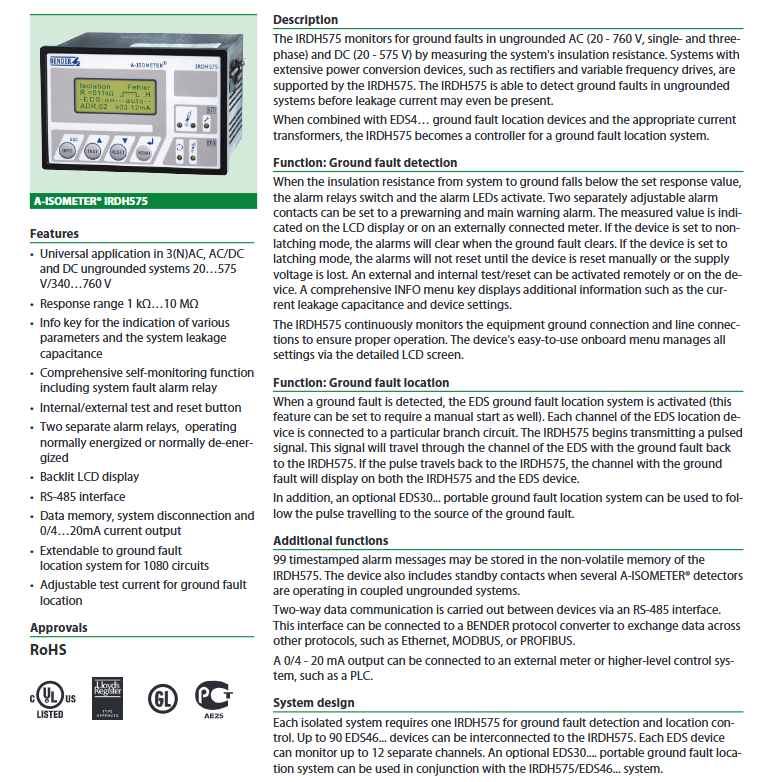
Applicable systems: ungrounded (floating) AC/DC systems, including 3 (N) AC, AC/DC hybrid, pure DC systems, suitable for industrial scenarios with power conversion equipment such as rectifiers and frequency converters
Core value: By monitoring the insulation resistance of the system to ground, ground faults can be detected in advance (can be identified when there is no leakage current), which can be expanded into a ground fault location system to accurately locate the fault circuit and ensure the electrical safety of ungrounded systems
BENDER IRDH575 Series Digital Ground Fault Monitor
Product Overview
(1) Product positioning and core applications
IRDH575 is an industrial grade digital grounding fault monitoring and positioning control device launched by BENDER in Germany. It is designed specifically for ungrounded (floating) AC/DC systems, with the core used to monitor the system's insulation resistance to ground, identify grounding fault risks in advance, and can be expanded into a precise grounding fault positioning system. It is suitable for complex industrial scenarios with power conversion equipment such as rectifiers and frequency converters, such as factory power distribution systems, PLC control systems, new energy equipment, etc. Through the dual functions of "fault detection+precise positioning", it ensures the electrical safety and continuous operation of ungrounded systems.
(2) Core Features and Compliance Standards
1. Core Features
Strong universality: Suitable for 3 (N) AC, AC/DC hybrid, pure DC ungrounded systems, with voltage coverage of 20-575V (low voltage type) and 340-760V (high voltage type).
Early warning: By measuring the insulation resistance (response range 1k Ω... 10M Ω), grounding faults can be detected before leakage current occurs, preventing potential problems.
Positioning Expansion: Paired with EDS4 series positioning devices, it can cover up to 1080 circuits and accurately locate fault branches and sources.
Comprehensive functions: It has multiple functions such as graded alarm, data storage, two-way communication, self-monitoring, etc., and is suitable for industrial centralized monitoring needs.
2. Compliance and Certification
Following standards: DIN EN 61557-8/9, IEC 61557-8/9, ASTM F1669M-96, IEC 60664-1 (Insulation Coordination), etc.
Environmental certification: RoHS certification, in compliance with environmental requirements.
Safety level: Flame retardant level UL94V-1, protection level IP30 (internal components)/IP40 (door mounted), suitable for harsh industrial environments.
Core functions and operational features
(1) Ground fault detection function
Insulation resistance monitoring:
Measurement principle: Inject weak test signals into the system through a built-in measurement circuit to monitor the insulation resistance of the system to ground, with a response range of 1k Ω... 10M Ω, supporting two-level independent alarm threshold settings (R_an1 warning, R_an2 main alarm), and can distinguish between "potential risks" and "serious faults" as needed.
Measurement accuracy: 10k Ω... 10M Ω range error 0%...+20%, 1k Ω... 10k Ω range error+2k Ω, measurement voltage ≤ 40V, measurement current ≤ 220 µ A (when Rf=0 Ω), will not affect the normal operation of the system.
Adaptation characteristics: Allow system leakage capacitance ≤ 150 (500) µ F, suitable for industrial systems with filtering capacitors, rated frequency range 50... 460Hz, supports low-frequency scenarios (<50Hz, reference characteristic curve).
Hierarchical alarm mechanism:
Alarm output: 3 switch contacts (SPDT), corresponding to warning (K1), main alarm (K2), system fault/EDS alarm (K3), supporting constant power on or off operation mode. Factory default K1/K2 is constant power off, K3 is constant power on.
Alarm mode: self-locking mode (manual reset after fault clearance), non self-locking mode (automatic reset after fault clearance), can be switched through menu settings.
Status indication: Alarm LED1 (warning), Alarm LED2 (main alarm), and system fault LED correspond to different alarm levels, providing visual feedback on the severity of the fault.
Self monitoring function:
Continuously monitor the grounding connection, line connection, and internal circuit status of the equipment itself. In case of abnormalities, trigger the K3 relay action and light up the system fault LED to avoid missed reporting due to equipment failure.
Support built-in/external test buttons (N/D contacts), long press the TEST button to activate self-test and verify whether the alarm circuit and display system are normal.
(2) Ground fault location function
System expansion configuration:
Core components: IRDH575 host+EDS460 (main circuit positioning)/EDS461 (control circuit positioning)+dedicated current transformers (W series/8000 series), optional EDS30... portable positioning system.
Scalability: Supports up to 90 EDS4 series devices for interconnection, with each EDS device capable of monitoring 12 circuits, covering a total of 1080 circuits, suitable for large-scale industrial power distribution systems.
Positioning workflow:
Trigger method: Automatically activate the positioning system upon detecting a ground fault, or manually activate the positioning function.
Signal transmission: IRDH575 sends pulse test signals (pulse/interval=2s/4s), with adjustable test current (≤ 1/2.5/10/25/50mA), suitable for different circuit impedance characteristics.
Fault identification: The signal is returned to the host through the fault circuit, and the LCD synchronously displays the fault EDS device address, circuit number, and signal strength (mA/µ A). The EDS device also synchronously indicates the fault channel locally.
Portable troubleshooting: optional EDS30... portable positioning system, tracks pulse signals to the source of faults, suitable for mobile troubleshooting and complex wiring scenarios.
(3) Data storage and communication functions
Data recording and querying:
Non volatile memory can store 99 alarm messages with timestamps, including fault type, insulation resistance value, occurrence time, etc. Data will not be lost after power failure, making it easy to trace and analyze faults.
The INFO key can quickly query system leakage capacitance, device setting parameters, alarm history, and other information without entering deep menus.
Communication interface:
RS-485 interface (BMS protocol): Supports bidirectional communication between devices, with a maximum cable length of 1200m. It is recommended to use shielded cable J-Y (ST) Y 2 × 0.6mm ² (shielded layer single ended PE), equipped with a 120 Ω terminal resistor (controlled by micro switch S1).
Protocol extension: Can connect to Bendel protocol converters, adapt to industrial protocols such as Ethernet, MODBUS, PROFIBUS, etc., and achieve interconnection with upper level systems such as PLC and DCS.
Analog output: 0/4... 20mA optional, load ≤ 500 Ω, can convert insulation resistance signal into standard analog quantity, and connect to external instruments or centralized monitoring system.
(4) Operation and display functions
Display system:
Backlit LCD screen (4 × 16 characters, character height 5mm), supports multilingual display such as Chinese/English, real-time display of insulation resistance value (1k Ω... 10M Ω), system status, EDS device information, alarm history, etc.
Auxiliary display: The "s" symbol indicates that a new measurement is in progress, EDS mode display (AUTO/MANUAL/ON/OFF), test pulse polarity indication (Point=valid BMS communication, H=new historical record).
Operation buttons:
Function keys: INFO (information query), MENU (menu settings), ESC (return), TEST (self-test), RESET (reset).
Navigation keys: up/down arrow keys (menu scrolling), Enter key (confirm settings).
External Expansion: Supports connecting external reset buttons (N/E contacts or jumpers), and the device can automatically reset when the terminal is open, suitable for remote operation scenarios.
Detailed technical parameters
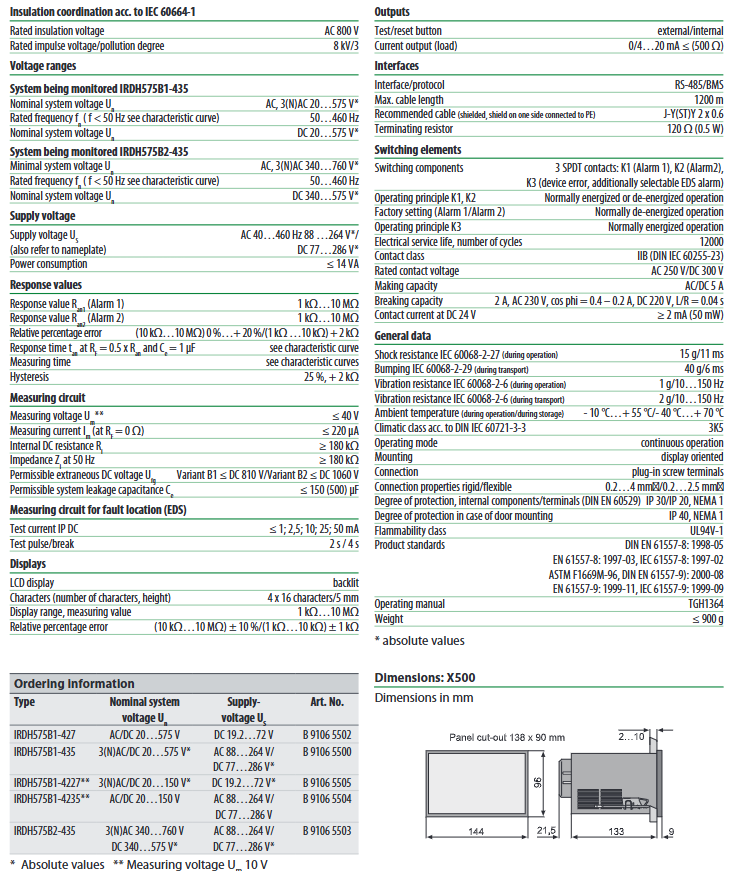
(1) Electrical parameters
Category specific specifications
Monitoring system voltage IRDH575B1-435: AC 20... 575V (3 (N) AC/single-phase) DC 20…575V
IRDH575B2-435: AC 340... 760V (3 (N) AC/single-phase) DC 340…575V
The power supply voltage is AC 88... 264V (50... 460Hz), DC 77... 286V, and two 6A fuses are required for IT system power supply
Power consumption ≤ 14 VA
Insulation coordination rated insulation voltage AC 800V, rated impulse withstand voltage 8kV (pollution level 3)
Measure the internal DC resistance of the circuit to be ≥ 180k Ω, 50Hz impedance to be ≥ 180k Ω, and allow external DC voltage B1 ≤ 810V/B2 ≤ 1060V
Relay parameters: rated contact voltage AC 250V/DC 300V, connection capacity AC/DC 5A, breaking capacity 2 A(AC 230V,cosφ=0.4)、0.2A(DC 220V,L/R=0.04s), Electrical lifespan of 12000 cycles
Analog output 0/4... 20mA, load ≤ 500 Ω
(2) Environmental and mechanical parameters
Category specific specifications
Working environment temperature -10 ℃...+55 ℃
Storage environment temperature -40 ℃...+70 ℃
Climate grade DIN IEC 60721-3-3 (3K5)
Impact resistance performance during operation: 15g/11ms (IEC 60068-2-27); During transportation: 40g/6ms (IEC 60068-2-29)
Vibration resistance performance during operation: 1g/10... 150Hz; During transportation: 2g/10... 150Hz (IEC 60068-2-6)
Protection level: IP30 for internal components and IP20 for terminals (NEMA 1); IP40 (NEMA 1) for door installation
Installation method: Panel installation, hole size 138 × 90mm, installation direction is display facing outward
Plug in screw terminals for wiring terminals, supporting rigid conductors of 0.2... 4mm ² and flexible conductors of 0.2... 2.5mm ²
Shell and weight flame retardant grade UL94V-1, weight ≤ 900g
(3) Communication and interface parameters
Category specific specifications
Communication interface RS-485/BMS protocol, supporting bidirectional data transmission
The cable requires shielded cable J-Y (ST) Y 2 × 0.6mm ², with the shielding layer connected to PE at one end
Maximum communication distance 1200m
Terminal resistance of 120 Ω (0.5W), controlled by micro switch S1 to enable/disable
External button test button (N/D contact), reset button (N/E contact or jumper)
Backup contact STANDBY contact, when closed, the device enters standby mode and stops sending measurement signals
System installation and typical configuration
(1) Installation points
Power supply configuration: The power supply circuit is connected in series with 6A fuses, and the IT system needs to be equipped with two fuses to ensure equipment overcurrent protection.
Grounding requirements: The equipment grounding terminal (KE) should be reliably grounded, and the RS-485 cable shielding layer should be single ended with PE to reduce electromagnetic interference.
Wiring specifications: Measurement circuits and power cables should be laid separately to avoid cross interference. The wiring between EDS equipment and current transformers should follow polarity requirements.
Installation environment: Choose a location with good ventilation, away from heat sources and strong electromagnetic interference sources, and meet the requirements of working temperature (-10...+55 ℃) and protection level.
(2) Typical application configuration
1. Main circuit monitoring and positioning system (AC 20... 575V)
Configuration components: IRDH575B1-435+EDS460+W series current transformer+6A fuse.
Applicable scenarios: Factory three-phase main distribution circuit, with each EDS460 monitoring 12 main circuit branches and supporting cascading expansion of multiple EDS460 units.
Wiring method: L1/L2/L3/N passes through the current transformer, the IRDH575 host is connected to the system phase line and ground, and the EDS460 communicates with the host through the AB terminal.
2. Control circuit monitoring and positioning system (DC 20... 308V)
Configuration components: IRDH575B1-435+EDS461+8000 series current transformer+PLC.
Applicable scenarios: PLC control circuits, DC instrument circuits, EDS461 adapts to the high sensitivity requirements of control circuits and supports monitoring of grounding faults in PLC input and output circuits.
Wiring method: The control circuit wire passes through the current transformer, and IRDH575 and EDS461 communicate through the AB terminal. The analog output is connected to the PLC for centralized monitoring.
Model specifications and ordering information
(1) Core model differentiation
Model Monitoring System Voltage Range Applicable Scenarios Key Characteristics
IRDH575B1-435 AC 20... 575V, DC 20... 575V low voltage ungrounded system (industrial+civilian) basic type, covering the vast majority of industrial control and distribution systems
IRDH575B2-435 AC 340... 760V, DC 340... 575V high voltage ungrounded system (industrial specific) adapted to high voltage distribution circuits, allowing for higher external DC voltages
(2) Recommended supporting components
Component Name, Model, Function Description, Applicable Scenarios
The main circuit positioning device EDS460 monitors 12 AC main circuit branch factory main distribution and motor circuits
Control circuit positioning device EDS461 monitors 12 DC control circuit branches PLC control and instrument circuits
Portable positioning system EDS3090/EDS3091 mobile tracking fault source complex wiring, hidden fault troubleshooting
The W series current transformer is compatible with the AC main circuit and is compatible with EDS460
The 8000 series current transformer is compatible with DC control circuits and is compatible with EDS461
Protocol Converter - Convert to MODBUS/PROFIBUS for centralized monitoring of the upper system
Precautions and Maintenance Guidelines
(1) Precautions for use
Equipment installation and wiring must be operated by qualified electrical professionals, strictly following local electrical safety regulations and manual requirements.
It is strictly prohibited to modify the internal circuits or parameters of the equipment without authorization. The test current setting should match the circuit characteristics to avoid damage to the load caused by excessive current.
When wiring, it is necessary to distinguish between the monitoring system voltage and the power supply voltage to avoid permanent damage to the equipment caused by misconnection. The IT system power supply must be equipped with two fuses.
RS-485 communication cables require the use of shielded cables, with the shielding layer grounded at one end. Terminal resistors should be used for long-distance communication to reduce signal attenuation and interference.
(2) Key points of daily maintenance
Regular inspection: Check the status of the LED indicator lights, whether the wiring terminals are loose, and whether the grounding connection is reliable every month to ensure the normal operation of the equipment.
Functional testing: Long press the TEST button every quarter for self inspection to verify whether the alarm output and display system are normal, and at the same time check the response of alarm linkage devices (such as sound and light alarms, circuit breakers).
Data cleaning: After reaching 99 alarm history records, they need to be cleaned up in a timely manner to avoid affecting the storage of new data. They can be cleared through the RESET button or menu operation.
Fault handling: If an alarm occurs, first check the insulation resistance value and fault location through the LCD, and troubleshoot issues such as insulation damage and load leakage. After troubleshooting, press the RESET button to reset.
- OMRON
- ABB
- General Electric
- EMERSON
- Honeywell
- HIMA
- ALSTOM
- Rolls-Royce
- MOTOROLA
- Rockwell
- Siemens
- Woodward
- YOKOGAWA
- FOXBORO
- KOLLMORGEN
- MOOG
- KB
- YAMAHA
- BENDER
- TEKTRONIX
- Westinghouse
- AMAT
- AB
- XYCOM
- Yaskawa
- B&R
- Schneider
- KONGSBERG
- NI
- WATLOW
- ProSoft
- SEW
- ADVANCED
- Reliance
- TRICONEX
- METSO
- MAN
- Advantest
- STUDER
- DANAHER MOTION
- Bently
- Galil
- EATON
- MOLEX
- DEIF
- B&W
- ZYGO
- Aerotech
- DANFOSS
- Beijer
- Moxa
- Rexroth
- Johnson
- WAGO
- TOSHIBA
- BMCM
- SMC
- HITACHI
- HIRSCHMANN
- Application field
- XP POWER
- CTI
- TRICON
- STOBER
- Thinklogical
- Horner Automation
- Meggitt
- Fanuc
- Baldor
- SHINKAWA
- Other Brands
- UniOP
- KUKA
- Iba
- Beckhoff
- ADLINK
-
 Sigmatek CFF011 Drive Module
 -
 Sigmatek DCP642 DIAS Central Unit
 -
 Sigmatek SDM081 S-DIAS Safety Module
 -
 Sigmatek C-IPC 01-450-024 Industrial PC
 -
 Sigmatek Kompakt NC4 Control Module
 -
 Sigmatek VI021 VARAN Interface Module
 -
 Sigmatek Engel RD-M6-2 Robot Drive
 -
Sigmatek CNC031 Positioning Module
-
Sigmatek TO161 Digital Output Module
-
 Sigmatek CCL912 CPU PSU Module
 -
 Sigmatek ETV0821 Operator Terminal
 -
 SIGMATEK ET 261 Operator Terminal
 -
 SIGMATEK CP731-K Control Module 20-004-731-K
 -
 SIGMATEK ETEK Motherboard 12-250-021-K CM5V020
 -
 Sigmatek DEZ 181 DIAS Input Output Module
 -
 Sigmatek IPC111-D Industrial PC
 -
 SIGMATEK AKM54L-ANC2GBB0 Servomotor with Gearhead
 -
SIGMATEK CTMS020 CM5V020 CNC Controller
-
 DEMAG ERGOTECH 061 381 66 Sigmatek Control Unit
 -
 Sigmatek DAI 883 Module
 -
 Sigmatek ETV1521 Control Panel Installation Terminal
 -
 Sigmatek 9802.289.01 Board Control TA71 Display
 -
 Wittmann Sigmatek EU-252 proDrive W4 Servo Drive
 -
 Sigmatek CDM166 C-DIAS Module
 -
Sigmatek DCP082 DIAS Central Unit
-
 Sigmatek CCP081 C-DIAS Processor Module
 -
Sigmatek MD111-1 Drive Module
-
Sigmatek ETV0821 Operator Terminal
-
 Sigmatek ISE021 Interface Module
 -
 Sigmatek DCC080L Slide Control Module
 -
 Sigmatek AI075 Analog Input Module
 -
SIGMATEK TO161 20-007-161 Module
-
 SIGMATEK CIC011 Module
 -
 SIGMATEK AE0000318502 Hand Terminal Pendant
 -
 Sigmatek Krauss Maffei PC323-K Control Unit
 -
Sigmatek Krauss Maffei PC321-K Control Cabinet PC
-
SIGMATEK CIV521 Control Module
-
SIGMATEK C-IPC-171 Industrial PC
-
 SIGMATEK MDP101-L DIAS Drive Network Module
 -
 Sigmatek Krauss Maffei PC323-K Control Cabinet PC
 -
 SIGMATEK CRCH081 C-SLIDES Temperature Module
 -
 Sigmatek PC301-E6 Industrial PC SSD
 -
 Sigmatek SDI101 S-SLIDES Safety Input Module
 -
 Sigmatek CIV521 VARAN Control Module
 -
 Kollmorgen Sigmatek AKM42G-ANCNGBB0 Servo Motor
 -
 Sigmatek PC 521 Process Controller
 -
 Sigmatek Geode LX800 12-780-012 Industrial PC
 -
 Sigmatek STO081 S-DIAS Safety Output Module
 -
 Sigmatek SCP111 S-DIAS Safety CPU Module
 -
 Sigmatek CDI161 Industrial I O Module
 -
Sigmatek Wiring Board V2 DIAS 05-250-023
-
 Sigmatek CP102 20-004-102 S-DIAS CPU Module
 -
SIGMATEK SLIDES CNC 115 Module
-
 SIGMATEK DCC080 05-700-080-2 Control Module
 -
SIGMATEK MDD 121 Drive Axis Module
-
 SIGMATEK CIO011 C-DIAS Multi I/O Module
 -
SIGMATEK CIV512 Servo Drive
-
 SIGMATEK CM5V020 12-250-021-K Wiring Module
 -
 SIGMATEK CIO011 12-013-011 Multi I/O Module
 -
SIGMATEK 01-450-031 C-IPC Industrial Computer
-
SIGMATEK AKM24D-ANBNGBB0 Servo Motor
-
 DEMAG NC4 LP0001289.03 Control Module
 -
 Sigmatek ETEK Industrial PC C-IPC with Option Module
 -
Sigmatek AO081 20-010-081 Analog Output Module
-
Sigmatek CNC 031 Positioning Module
-
Sigmatek CP731-K 20-004-731-K CPU Module
-
Sigmatek MDD 3320-JR-A Drive Module
-
Sigmatek PM Servo Motor AKM52K-ANC2GBB0
-
Sigmatek MDP 101 09-403-101 Power Module
-
Sigmatek S-SLIDES AO046 Analog Output Module
-
Sigmatek ICA111 20-102-111 Interface Module
-
 SIGMATEK DCP646 Module 05-004-646
 -
SIGMATEK SDI101 Digital Input Module 20-891-101
-
 SIGMATEK S3330-2 Directional Gyro Altitude Instrument
 -
SIGMATEK MDP102-1 Controller
-
SIGMATEK SMT 01-230-321 Touch Screen
-
SIGMATEK Krauss Maffei PC301-K 01-310-301-K Industrial PC with 8GB SSD
-
 SIGMATEK ETT731 01-230-731 Built-in Touch Terminal
 -
SIGMATEK CIV521 Control Module
-
 SIGMATEK DME 128 Module 05-005-128
 -
 SIGMATEK SCP111-S 20-890-111-S S-DIAS Safety CPU Module
 -
Sigmatek SCP111 S-DIAS Safety CPU
-
Sigmatek CRIF081 Interface Module
-
Sigmatek CP112-1 S-DIAS CPU Module
-
 Sigmatek MDD121-L DIAS Drive Axis Module
 -
 Sigmatek C-IPC 01-450-024 Industrial PC
 -
Sigmatek SDD215-23 SLIDES Drive
-
 Sigmatek DPS001 DIAS System Components
 -
Sigma-Tek 4000B-30 Directional Gyro
-
 Sigmatek SDD340-46 SDD Series Drive
 -
 Sigmatek CEZ221 Euromap67 I O Module
 -
 SIGMATEK VI021 Interface Module
 -
SIGMATEK CP731-K Control Module
-
SIGMATEK Krauss Maffei PC321-K Industrial PC
-
SIGMATEK ET322 Operator Terminal
-
SIGMATEK CP102 Control Module 24VDC
-
SIGMATEK SRO021 Relay Output Module
-
SIGMATEK DCP640 DIAS Central Unit
-
 SIGMATEK MDD 121 Drive Axis Module
 -
SIGMATEK AI043 Analog Input Module
-
 ENOTEC OXITEC 5000 SME-53310000 Oxygen Analyzer
 -
SIGMATEK Krauss Maffei PC301-K 01-310-301-K Industrial PC
-
 SIGMATEK SDD310-23 VARAN Servo Drive
 -
 SIGMATEK CDM 163 and CIC 011 C-DIAS Input Modules
 -
SIGMATEK MDP 101-1 Power Module
-
SIGMATEK CM5V020 Wiring Circuit with CTMS020
-
SIGMATEK CCP521 C-DIAS Processor Module
-
 SIGMATEK MDP 101-K Power Module
 -
SIGMATEK ETEK C-IPC 733MHz VIA Eden 7000
-
 SIGMATEK DCP 643 DIAS PLC CPU Module
 -
SIGMATEK TAE121 12-200-121 Operator Terminal
-
Sigmatek TMS012-T Injection Moulding Technology Module
-
Sigmatek MDD 121-1 Controller
-
Sigmatek CDM167 Module
-
Sigmatek DCP082 DIAS Central Unit
-
 Sigmatek ETT731 Built-In Terminal Touch
 -
Sigmatek CCP521 C-DIAS Processor Module
-
Sigmatek Krauss Maffei PC301-K Control Cabinet PC
-
 Sigmatek CIC-21 C-DIAS CAN Module
 -
Sigmatek CIO-011 Multi I O Module
-
Sigmatek 01-450-152D C-IPC 152 Industrial PC
-
SIGMATEK 01-450-024 C-IPC 128MB VIA 733MHz
-
SIGMATEK CCL-081 C-DIAS Processor Module
-
SIGMATEK CP311 20-004-311 Module
-
 SIGMATEK EP00000262 SLIDES MIDI I O-V3 Controller
 -
SIGMATEK TMS012-T Slides Technology Module
-
SIGMATEK MDD111-1 Drive Axis Module
-
 SIGMATEK MDP101-1 PLC Module


