
YASKAWA Power Regenerative Unit R1000 Series
400V three-phase series: models 4A03P5~4A0300, suitable for motor power of 5~422HP, rated output current of 7~629A;
All models are designed for "Normal Duty" and optimized for energy regeneration scenarios with variable torque loads.
Core features: Supports 120 ° excitation control, MEMOBU/Modbus communication, PID closed-loop control, automatic fault restart, maintenance life monitoring, and complies with international standards such as UL 508C, IEC/EN 61800-5-1, as well as CE and RoHS compliance requirements.
YASKAWA Power Regenerative Unit R1000 Series
Core specifications of the product
Model coverage:
200V three-phase series: models 2A03P5~2A0105, suitable for motor power of 5~141HP, rated output current of 14~413A;
400V three-phase series: models 4A03P5~4A0300, suitable for motor power of 5~422HP, rated output current of 7~629A;
All models are designed for "Normal Duty" and optimized for energy regeneration scenarios with variable torque loads.
Core features: Supports 120 ° excitation control, MEMOBU/Modbus communication, PID closed-loop control, automatic fault restart, maintenance life monitoring, and complies with international standards such as UL 508C, IEC/EN 61800-5-1, as well as CE and RoHS compliance requirements.
Receiving and unboxing inspection
1. Safety precautions
It is prohibited to transport equipment through the front cover or terminal cover to avoid damage caused by the main body falling;
When handling equipment and circuit boards, it is necessary to follow the electrostatic discharge (ESD) process to prevent circuit damage.
2. Model and nameplate verification
Key information on the nameplate: model (such as CIMR-RU2A0073AAA), rated capacity, input/output specifications, software version, serial number, and place of origin (Japan);
Model interpretation: Taking "CIMR-RU2A0073AAA" as an example, "RU" represents the R1000 series, "2A" is the 200V level, "0073" is the rated output capacity code, and "AAA" is the standard configuration.
3. Classification of enclosure types
IP20/UL Type 1: Suitable for indoor wall mounted or control cabinet installation, retaining IP20 protection even after removing the top protective cover;
IP00/Open Type: It needs to be installed inside a protective panel, without additional shell protection, and relies on external environmental isolation.
Mechanical Installation: Environmental Requirements and Operating Standards
1. Installation environment requirements
Specific requirements for environmental dimensions: Remarks
Temperature IP00 model: -10~+50 ℃; IP20 model: -10~+40 ℃ overheating requires capacity reduction to avoid severe temperature fluctuations
Humidity ≤ 95% RH, no condensation to prevent moisture and short circuit of the circuit board
Altitude ≤ 1000 meters (without capacity reduction); 1000~3000 meters: For every 100 meters increase, the capacity is reduced by 1%. At high altitudes, the heat dissipation capacity needs to be evaluated
Vibration low-power models (2A03P5~2A0053, etc.): 10-20Hz (9.8m/s ²), 20-55Hz (5.9m/s ²); High power models (2A0073~2A0105, etc.): 20~55Hz (2.0m/s ²) Avoid direct contact with vibration sources
The surrounding environment should be free of dust, oil mist, metal debris, corrosive gases, and direct sunlight. Installation on flammable surfaces or placement of flammable materials is prohibited
2. Installation method and spacing requirements
Installation direction: Only supports vertical installation. Tilting can cause poor heat dissipation and damage to internal components.
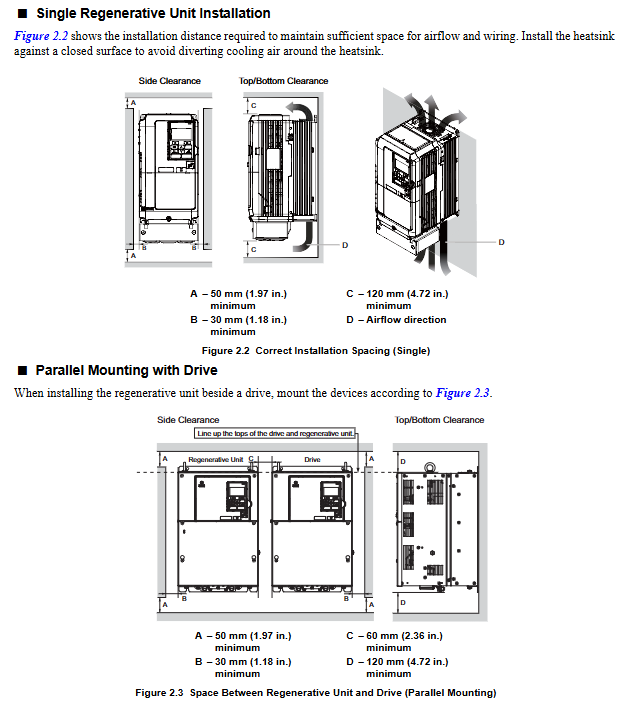
Single installation spacing:
Up and down direction: at least 120mm (heat dissipation space);
Left and right direction: at least 30mm (wiring and heat dissipation);
Rear: It should be tightly attached to the enclosed surface to avoid the dispersion of cooling airflow.
Side by side installation (with drive):
Ordinary side by side: minimum spacing of 50mm, top aligned;
Tightly side by side (only for low-power models 2A03P5~2A0028, etc.): spacing of 2mm, parameter L8-35=1 needs to be set, while considering capacity reduction.
3. Precautions for lifting and protection
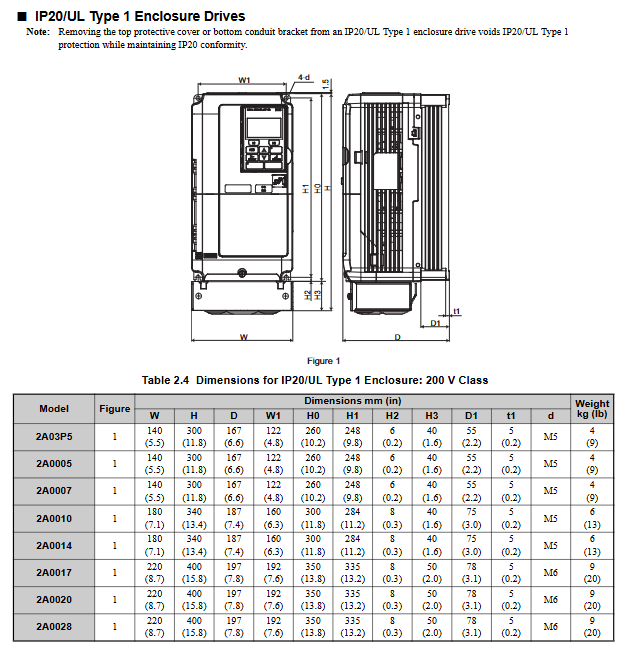
High power models (2A0073, 2A0105, etc.) are equipped with lifting rings and are only used for temporary installation. Long term suspension is prohibited;
When lifting vertically, it is necessary to first fix the front cover, terminal block and other components. The vibration/impact during suspension should not exceed 1.96m/s ², and flipping or leaving unattended is prohibited.
Electrical installation: wiring specifications and safety requirements
1. Main circuit wiring (prevention and control of core risk points)
Terminal differentiation:
Input terminals (R/L1, S/L2, T/L3): connected to three-phase power supply, matched with equipment voltage level (200V level connected to 200~240V, 400V level connected to 380~480V);
Output terminals (+, -): Connect to the DC bus of the driver, be careful not to reverse the positive and negative poles;
Voltage detection terminals (r1/11, l/21, t1/31): detect the phase sequence and voltage of the input power supply, and take power from the primary side of the power coordination reactor.
Wiring requirements:
Wire specifications: Select according to the rated current of the model. For example, 2A03P5 uses 14AWG (American standard) or 3.5mm ² (European standard) wire, 4A0300 uses 300kcmil wire, and circular crimping terminals are required;
Tightening torque: M4 screws 2.1~2.3N · m, M8 screws 5.4~6.0N · m, excessive tightening may damage the terminals;
Grounding: Independently grounded, not sharing grounding wire with high current equipment such as welding machines; Grounding resistance of 200V level ≤ 100 Ω, 400V level ≤ 10 Ω.
2. Control circuit wiring (anti-interference and functional configuration)
Digital input (S1~S8):
Support sinking/sourcing mode, switched through SC-SP/SC-SN jumper, default sinking mode;
Default functions: S1 (forced operation), S2 (automatic operation), S3 (external fault), S4 (fault reset), customizable through H1 series parameters.
Analog inputs (A1~A3):
A1/A3 default voltage input (0~10V/-10~10V), A2 default current input (4~20mA), switched through DIP switch S1;
For signal assignment, it is necessary to set the gain (H3-03/H3-07/H3-11) and bias (H3-04/H3-08/H3-12) to match the signal range.
Communication interfaces (R+, R -, S+, S -):
Supports RS-422/RS-485 for MEMOBU/Modbus communication, with the maximum transmission distance being related to the baud rate (up to 115.2kbps);
The terminal resistor needs to be enabled at the end of the bus (DIP switch S2 set to ON), and the communication line needs to be wired separately from the main power line.
3. Handling of special wiring scenarios
Long cable wiring: When the length of the control circuit analog signal line is ≤ 50 meters, and the main circuit cable is>50 meters, the carrier frequency should be reduced to avoid leakage current flowing through the large trigger protection;
12 pulse rectification configuration: The 4A0930/4A1200 models require the removal of jumper wires such as R/L1-R1/L11, and an external 3-winding transformer.
Start programming and operation: from parameter setting to trial run
1. Use of digital operator (core control interface)
Button functions:
RUN/STOP: Local start/stop, with the STOP key having the highest priority;
LO/RE: Switch between local/remote control, only operable during shutdown;
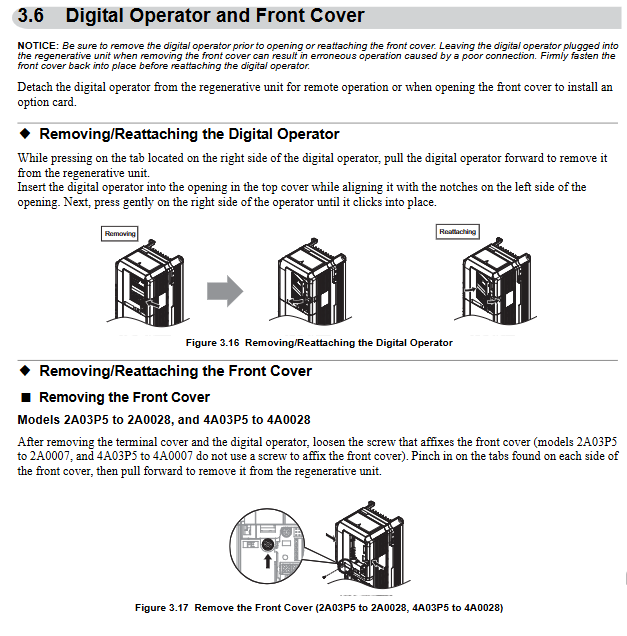
F1/F2: Switch display data/help menu, ESC returns to the previous level, ENTER confirms parameters.
Display interpretation:
Status display: "Rdy" (ready), "FWD/REV" (forward/reverse), ALM light (alarm/fault);
Monitoring interface: can view parameters such as DC bus voltage (U1-52), input current (U1-55), power (U1-57), etc.
2. Core parameter configuration (classified by application scenario)
(1) Basic initialization
Parameter A1-03 (initialization parameter):
0: No initialization;
1110: User defined initialization;
2220: 2-wire control initialization;
3330:3 wire system control initialization;
5550: oPE04 fault reset.
(2) Operation mode and control configuration
B1-02 (run command selection): 0 (numeric operator), 1 (numeric input), 2 (communication), 3 (tab);
C7-16 (minimum running time): In forced running mode, set the minimum holding time from start to stop (default 1.00 seconds);
L5-01 (number of fault restarts): 0-10 times, supports automatic restarts after overcurrent, overvoltage and other faults.
(3) Protection parameter configuration
L2-05 (undervoltage detection level): default 190V for 200V level, default 380V for 400V level, adjustable as needed;
L8-02 (overheating alarm level): default 85~140 ℃ (random variation), exceeding this temperature triggers an oH alarm;
L8-35 (installation method selection): 0 (IP00 model), 1 (tightly arranged), 2 (IP20 model), 3 (external heat sink).
3. Trial operation process (phased verification)
(1) No load trial operation
Step: Disconnect the load → Set as local control → Set low frequency (such as 6Hz) → Start the equipment → Check the motor direction, vibration, and current (should be 50% lower than the rated current) → Gradually increase the frequency to the rated value and observe the stability of operation.
(2) Test run with load
Preparation: Connect the load, confirm that the emergency stop circuit is effective, and check the PID feedback signals (such as pressure and flow sensors);
Operation: Start from low frequency (such as 20Hz), monitor input current (U1-55), DC bus voltage (U1-52), adjust PID parameters (b5-02 proportional gain, b5-03 integration time) to optimize response speed.
Troubleshooting and maintenance: ensuring long-term stable operation
1. Common faults and solutions
Possible causes and solutions for fault codes
OC (overcurrent) motor short circuit/insulation damage, short acceleration and deceleration time, load blockage check motor winding, extend acceleration and deceleration time, reduce load or increase model size
OV (overvoltage) input voltage is too high, deceleration is too fast, brake resistor is not connected, check power supply, prolong deceleration time, install brake resistor
OL2 (overload) load exceeds rated torque, excessive regenerative energy reduces load, optimizes regenerative energy distribution, and replaces high-capacity models
CE (communication error) loose communication line, mismatched baud rate, noise interference check wiring, unified communication parameters, strengthened shielding and grounding
EF3 (external fault S3) S3 terminal wiring error, external device fault verification H1-03 parameter setting, troubleshooting external device faults
2. Regular maintenance plan
(1) Daily inspection (daily)
Appearance: No abnormal noise, odor, or vibration, and the cooling fan is running normally;
Display: No alarm code, stable parameters such as current and voltage;
Environment: Confirm that the temperature and humidity meet the installation requirements and there is no dust accumulation.
(2) Regular maintenance (by cycle)
Maintenance project cycle operation requirements
Check the blade wear of the cooling fan after running for 20000 hours or 10 years, replace it with a fan of the same model, and reset the parameter o4-03
Measure the capacitance of the main circuit capacitor after 5-7 years of operation. If it is lower than 80% of the initial value, it needs to be replaced. Monitor the lifespan through U4-05
Check the torque of the main and control circuit terminals every 6 months to prevent looseness and heating during terminal tightening
Clean the radiator with compressed air every 3 months after power failure to avoid clogging the air duct
3. Maintain monitoring function
Parameters U4 series: U4-03 (fan running time), U4-04 (fan life percentage), U4-05 (capacitor life percentage), U4-06 (soft charging relay life). If it is less than 20%, it needs to be replaced in advance.
Peripheral equipment and communication configuration
1. Standard configuration and peripheral equipment
Required equipment: power coordination reactor, current suppression reactor, fuse (model needs to be matched according to the model);
Optional devices: 24V power supply (PS-A10LB/HB), USB replication unit (JVOP-181), LED operator (JVOP-182), communication tab (MECHATROLINK-II, CC Link, etc.).
2. MEMOBU/Modbus communication configuration
Communication parameters:
H5-01 (slave address): 0~FFH, default 1FH, ensure unique address;
H5-02 (baud rate): 0 (1200bps)~8 (115200bps), default 3 (9600bps);
H5-03 (checksum): 0 (no checksum), 1 (even checksum), 2 (odd checksum), default 0.
Communication function: Supports reading monitoring data, writing parameters, controlling operation/stop, fault reset, and can be remotely controlled through PLC or upper computer.
- OMRON
- ABB
- General Electric
- EMERSON
- Honeywell
- HIMA
- ALSTOM
- Rolls-Royce
- MOTOROLA
- Rockwell
- Siemens
- Woodward
- YOKOGAWA
- FOXBORO
- KOLLMORGEN
- MOOG
- KB
- YAMAHA
- BENDER
- TEKTRONIX
- Westinghouse
- AMAT
- AB
- XYCOM
- Yaskawa
- B&R
- Schneider
- KONGSBERG
- NI
- WATLOW
- ProSoft
- SEW
- ADVANCED
- Reliance
- TRICONEX
- METSO
- MAN
- Advantest
- STUDER
- DANAHER MOTION
- Bently
- Galil
- EATON
- MOLEX
- DEIF
- B&W
- ZYGO
- Aerotech
- DANFOSS
- Beijer
- Moxa
- Rexroth
- Johnson
- WAGO
- TOSHIBA
- BMCM
- SMC
- HITACHI
- HIRSCHMANN
- Application field
- XP POWER
- CTI
- TRICON
- STOBER
- Thinklogical
- Horner Automation
- Meggitt
- Fanuc
- Baldor
- SHINKAWA
- Other Brands
- UniOP
- KUKA
- Iba
- Beckhoff
- ADLINK
-
 SIGMATEK ICA111 Module
 -
 SIGMATEK MDD 121-1 Drive Axis Module
 -
 SIGMATEK M5V121 12-300-121 Krauss Maffei M5 Display Unit
 -
SIGMATEK CTMS 020 CD Technology Module 12-250-011
-
 SIGMATEK PCT122 Touch Panel
 -
 Stöger MCS4100 SIGMATEK Control Module
 -
 SIGMATEK Krauss Maffei M5 Keyboard Unit M5K902 12-310-902
 -
 SIGMATEK SD310-2 Servo Drive Module
 -
 SIGMATEK CM5V020 CD Wiring Circuit Module
 -
SIGMATEK ENGEL Robot Drive M3 02220-8748
-
 Sigmatek CFF011 Drive Module
 -
 Sigmatek DCP642 DIAS Central Unit
 -
 Sigmatek SDM081 S-DIAS Safety Module
 -
 Sigmatek C-IPC 01-450-024 Industrial PC
 -
Sigmatek Kompakt NC4 Control Module
-
 Sigmatek VI021 VARAN Interface Module
 -
 Sigmatek Engel RD-M6-2 Robot Drive
 -
Sigmatek CNC031 Positioning Module
-
Sigmatek TO161 Digital Output Module
-
Sigmatek CCL912 CPU PSU Module
-
Sigmatek ETV0821 Operator Terminal
-
 SIGMATEK ET 261 Operator Terminal
 -
 SIGMATEK CP731-K Control Module 20-004-731-K
 -
 SIGMATEK ETEK Motherboard 12-250-021-K CM5V020
 -
 Sigmatek DEZ 181 DIAS Input Output Module
 -
 Sigmatek IPC111-D Industrial PC
 -
 SIGMATEK AKM54L-ANC2GBB0 Servomotor with Gearhead
 -
SIGMATEK CTMS020 CM5V020 CNC Controller
-
 DEMAG ERGOTECH 061 381 66 Sigmatek Control Unit
 -
 Sigmatek DAI 883 Module
 -
 Sigmatek ETV1521 Control Panel Installation Terminal
 -
 Sigmatek 9802.289.01 Board Control TA71 Display
 -
 Wittmann Sigmatek EU-252 proDrive W4 Servo Drive
 -
 Sigmatek CDM166 C-DIAS Module
 -
Sigmatek DCP082 DIAS Central Unit
-
 Sigmatek CCP081 C-DIAS Processor Module
 -
Sigmatek MD111-1 Drive Module
-
Sigmatek ETV0821 Operator Terminal
-
 Sigmatek ISE021 Interface Module
 -
 Sigmatek DCC080L Slide Control Module
 -
 Sigmatek AI075 Analog Input Module
 -
SIGMATEK TO161 20-007-161 Module
-
 SIGMATEK CIC011 Module
 -
 SIGMATEK AE0000318502 Hand Terminal Pendant
 -
 Sigmatek Krauss Maffei PC323-K Control Unit
 -
Sigmatek Krauss Maffei PC321-K Control Cabinet PC
-
SIGMATEK CIV521 Control Module
-
SIGMATEK C-IPC-171 Industrial PC
-
 SIGMATEK MDP101-L DIAS Drive Network Module
 -
 Sigmatek Krauss Maffei PC323-K Control Cabinet PC
 -
 SIGMATEK CRCH081 C-SLIDES Temperature Module
 -
 Sigmatek PC301-E6 Industrial PC SSD
 -
 Sigmatek SDI101 S-SLIDES Safety Input Module
 -
 Sigmatek CIV521 VARAN Control Module
 -
 Kollmorgen Sigmatek AKM42G-ANCNGBB0 Servo Motor
 -
 Sigmatek PC 521 Process Controller
 -
 Sigmatek Geode LX800 12-780-012 Industrial PC
 -
 Sigmatek STO081 S-DIAS Safety Output Module
 -
 Sigmatek SCP111 S-DIAS Safety CPU Module
 -
 Sigmatek CDI161 Industrial I O Module
 -
Sigmatek Wiring Board V2 DIAS 05-250-023
-
Sigmatek CP102 20-004-102 S-DIAS CPU Module
-
SIGMATEK SLIDES CNC 115 Module
-
 SIGMATEK DCC080 05-700-080-2 Control Module
 -
SIGMATEK MDD 121 Drive Axis Module
-
 SIGMATEK CIO011 C-DIAS Multi I/O Module
 -
SIGMATEK CIV512 Servo Drive
-
 SIGMATEK CM5V020 12-250-021-K Wiring Module
 -
 SIGMATEK CIO011 12-013-011 Multi I/O Module
 -
SIGMATEK 01-450-031 C-IPC Industrial Computer
-
SIGMATEK AKM24D-ANBNGBB0 Servo Motor
-
 DEMAG NC4 LP0001289.03 Control Module
 -
 Sigmatek ETEK Industrial PC C-IPC with Option Module
 -
Sigmatek AO081 20-010-081 Analog Output Module
-
Sigmatek CNC 031 Positioning Module
-
Sigmatek CP731-K 20-004-731-K CPU Module
-
Sigmatek MDD 3320-JR-A Drive Module
-
Sigmatek PM Servo Motor AKM52K-ANC2GBB0
-
Sigmatek MDP 101 09-403-101 Power Module
-
Sigmatek S-SLIDES AO046 Analog Output Module
-
Sigmatek ICA111 20-102-111 Interface Module
-
 SIGMATEK DCP646 Module 05-004-646
 -
SIGMATEK SDI101 Digital Input Module 20-891-101
-
 SIGMATEK S3330-2 Directional Gyro Altitude Instrument
 -
SIGMATEK MDP102-1 Controller
-
SIGMATEK SMT 01-230-321 Touch Screen
-
SIGMATEK Krauss Maffei PC301-K 01-310-301-K Industrial PC with 8GB SSD
-
 SIGMATEK ETT731 01-230-731 Built-in Touch Terminal
 -
SIGMATEK CIV521 Control Module
-
 SIGMATEK DME 128 Module 05-005-128
 -
 SIGMATEK SCP111-S 20-890-111-S S-DIAS Safety CPU Module
 -
Sigmatek SCP111 S-DIAS Safety CPU
-
Sigmatek CRIF081 Interface Module
-
Sigmatek CP112-1 S-DIAS CPU Module
-
Sigmatek MDD121-L DIAS Drive Axis Module
-
 Sigmatek C-IPC 01-450-024 Industrial PC
 -
Sigmatek SDD215-23 SLIDES Drive
-
 Sigmatek DPS001 DIAS System Components
 -
Sigma-Tek 4000B-30 Directional Gyro
-
 Sigmatek SDD340-46 SDD Series Drive
 -
 Sigmatek CEZ221 Euromap67 I O Module
 -
 SIGMATEK VI021 Interface Module
 -
SIGMATEK CP731-K Control Module
-
SIGMATEK Krauss Maffei PC321-K Industrial PC
-
SIGMATEK ET322 Operator Terminal
-
SIGMATEK CP102 Control Module 24VDC
-
SIGMATEK SRO021 Relay Output Module
-
SIGMATEK DCP640 DIAS Central Unit
-
 SIGMATEK MDD 121 Drive Axis Module
 -
SIGMATEK AI043 Analog Input Module
-
 ENOTEC OXITEC 5000 SME-53310000 Oxygen Analyzer
 -
SIGMATEK Krauss Maffei PC301-K 01-310-301-K Industrial PC
-
 SIGMATEK SDD310-23 VARAN Servo Drive
 -
 SIGMATEK CDM 163 and CIC 011 C-DIAS Input Modules
 -
SIGMATEK MDP 101-1 Power Module
-
SIGMATEK CM5V020 Wiring Circuit with CTMS020
-
SIGMATEK CCP521 C-DIAS Processor Module
-
 SIGMATEK MDP 101-K Power Module
 -
SIGMATEK ETEK C-IPC 733MHz VIA Eden 7000
-
 SIGMATEK DCP 643 DIAS PLC CPU Module
 -
SIGMATEK TAE121 12-200-121 Operator Terminal
-
Sigmatek TMS012-T Injection Moulding Technology Module
-
Sigmatek MDD 121-1 Controller
-
Sigmatek CDM167 Module
-
Sigmatek DCP082 DIAS Central Unit
-
 Sigmatek ETT731 Built-In Terminal Touch
 -
Sigmatek CCP521 C-DIAS Processor Module
-
Sigmatek Krauss Maffei PC301-K Control Cabinet PC


