
YOKOGAWA AFV40S/AFV40D on-site control unit (with cabinet)
YOKOGAWA AFV40S/AFV40D on-site control unit (with cabinet)
Core hardware configuration and specifications
1. Core module configuration
Module Type Single Redundancy (AFV40S) Double Redundancy (AFV40D) Key Description
1 power module (PW481/PW482/PW484), 2 optional dual power supplies (redundant configuration) supporting 100-120V AC/220-240V AC/24V DC
1 processor module (CP461/CP471) 2 (redundant of the same model) CP471 needs to be equipped with R6.05 or above control functions
1 ESB bus coupling module (EC401/EC402), optional dual redundancy 2 (EC401/EC402, mandatory dual redundancy) EC401 can connect up to 9 nodes, EC402 can connect up to 11 nodes
Up to 6 I/O modules (non-standard configuration) must comply with the FIO system installation restrictions
2. Built in components of the cabinet
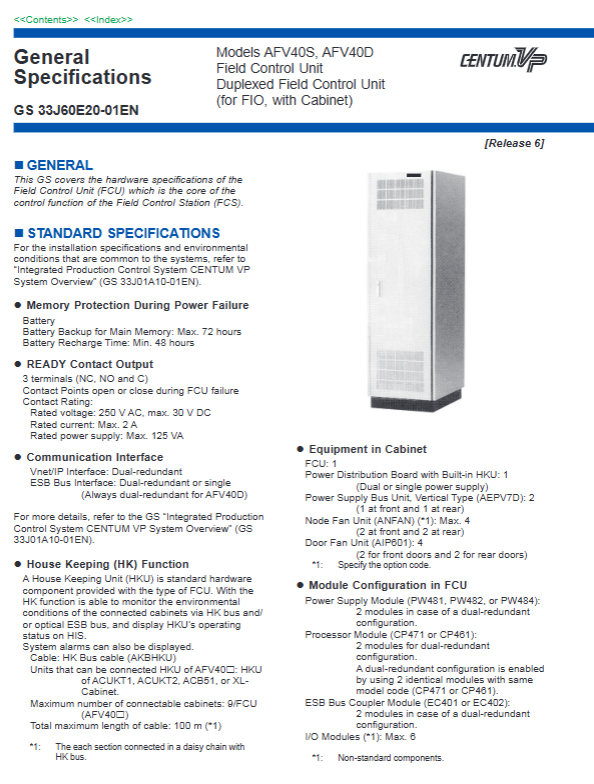
Basic components: 1 FCU, 1 power distribution board with HKU, 2 vertical power bus units (1 front and 1 rear)
Cooling components: 4 door fans (2 for each front and rear door), node fans (ANFAN, configured according to the number of units)
Monitoring component: HKU (House Keeping Unit), standard configuration, supports cabinet environment monitoring
3. Communication interface specifications
Core characteristics of interface type redundancy configuration
Vnet/IP interface dual redundancy (AFV40S selectable power supply, AFV40D forced dual power supply) system control network, redundant switching ensures stable communication
ESB bus interface AFV40S: single/dual redundancy; AFV40D: Mandatory dual redundant connection node unit, EC401 supports bus topology, EC402 supports upper and lower connection nodes
The HK bus interface is connected to the external cabinet HKU via a single channel, with AKBHKU cable and a total length of ≤ 100m
READY contact output 3 terminal (NC/NO/C) fault, contact on/off, rated 250V AC/30V DC, maximum 2A/125VA
Key parameters and physical characteristics
1. Electrical parameters
Parameter specifications
Power supply voltage 100-120V AC (50/60Hz), 220-240V AC (50/60Hz), 24V DC
Maximum power consumption 100-120V AC: 2500VA; 220-240V AC:2860VA; 24V DC:71A
Power down protection: Main memory battery backup takes up to 72 hours and charging takes at least 48 hours
Protection level IP20
2. Physical characteristics
Parameter specifications
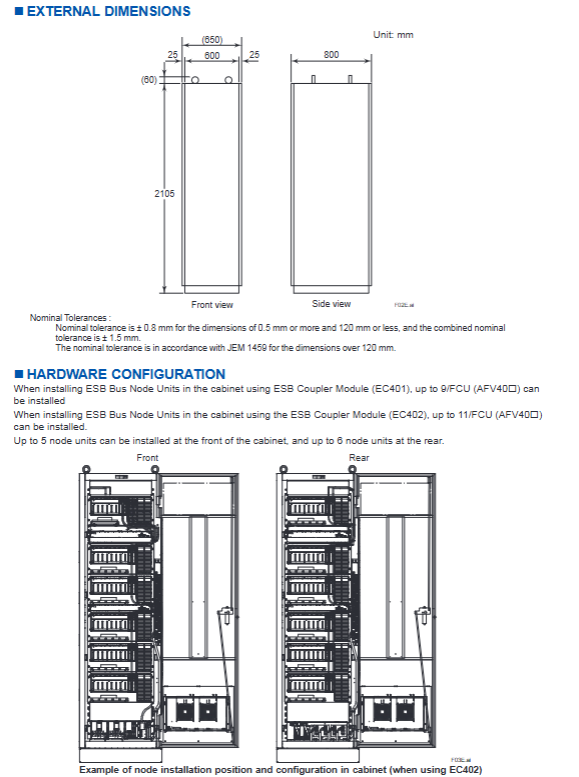
External dimensions (mm) Height 2105 x Width 800 x Depth 600 (including 25mm front and rear protrusions)
Weight approximately 240kg (excluding nodes); About 360kg (fully equipped with 11 nodes)
Paint color subject: Frost white (Munsell 2.5Y 8.4/1.2); Channel Base: Spring Black (Munsell 3.3PB2.5/0.5)
Grounding terminal M8 screw terminal connection
Power connection M6 screw terminal connection, supports dual power supply system
Installation restrictions and connection capabilities
1. Node unit connection restrictions
Limit type specifications
Maximum number of connected nodes 13/FCU (ANB10 /ANB11 )
The maximum number of installed units in the cabinet is 11 (ANB10 node unit+ANT10U optical ESB relay unit)
There are a maximum of 5 installation positions in the front and 6 installation positions in the rear of the cabinet
Installation sequence: Install the ANB10 node unit first, and then install the ANT10U relay unit
The optical ESB node connection requires the use of ANT401/ANT411 optical relay modules, with a maximum transmission distance of 50km
2. Fan configuration rules
Number of required node fans (ANFAN) for the total number of units in the cabinet (ANB10 +ANT10U)
0-4 of 1 (option code/1-FAN)
5-9 of 2 (Option Code/2-FAN)
10 of 3 (option code/3-FAN)
11 of 4 (option code/4-FAN)
3. Cable and topology limitations
ESB bus cable: Use YCB301 dedicated cable, pre installed in the cabinet, additional connection is required between ANB10 and ANT10U
HK bus: AKBHKU cable is used to connect external cabinets, with a total length of ≤ 100m (daisy chain connection)
Optical ESB bus: supports chain/star topology and requires the use of ANT401/ANT411 relay modules
Model code and options
1. Basic model and core suffix
Product Model Core Suffix Description Key Configuration
AFV40S (single redundancy) - A/- S (processor type); 3/4 (Vnet/IP and power supply); 1-4 (ESB bus); 1/2/4 (power type) selectable/dual redundant ESB bus, single/dual power supply
AFV40D (dual redundancy) - A/- S (processor type); 4 (Vnet/IP and power supply); 2/4 (ESB bus); 1/2 (power type) mandatory dual redundancy Vnet/IP and ESB bus
2. Main option codes
Option code function description associated model
/ - S1F single ESB bus+single power node unit ANB10S-3 5
/- D2F dual redundant ESB bus+dual power node unit ANB10D-4 5
/ - T2A dual power optical ESB relay unit ANT10U-4 5
/ - FAN node fans (configured by quantity) ANFAN
/CH Channel Base with Cable Hole (300 × 40mm)-
/CE with CE/RCM/AAC/KC certification-
/ATDOC Explosion proof Manual (ATEX Directive Adaptation)-
Software and accessory requirements
Software requirements: A separate software license is required. We recommend VP6F1700 control function software and VP6F3100 Project I/O license
SEM functional requirements: The use of event sequence manager requires specific hardware conditions, refer to GS 33J30D10-01EN
Standard accessories: 2 door fan filters (Part No.T9070CB)
Related products: Cabinet Connection Kit (Model AKT211), Cabinet Side Panel (ACB2P, requires paired configuration)
Key issues
Question 1: What is the core difference between AFV40S and AFV40D? How to select based on project redundancy requirements?
answer
Core Differences:
Redundancy configuration: AFV40S is single redundancy (optional dual redundancy for processor/power/ESB bus), AFV40D is full dual redundancy (mandatory dual redundancy for processor/power/Vnet/IP/ESB bus);
Suffix restrictions: AFV40D only supports dual redundancy related suffixes (such as ESB bus with only 2/4 options), while AFV40S supports single/dual redundancy suffixes;
Node Unit: AFV40S supports single/dual power node units, while AFV40D only supports dual redundant ESB+dual power node units (ANB10D-4 5).
Selection principle:
High reliability requirements (such as critical process control): Choose AFV40D, fully redundant configuration to avoid single point of failure;
Cost sensitive and non critical scenarios: Choose AFV40S and configure single/dual redundant ESB buses and power supplies as needed;
Number of nodes ≤ 9: AFV40S with EC401; Number of nodes 10-11: AFV40S with EC402, AFV40D with EC402.
Question 2: What are the key rules for unit installation and fan configuration in the AFV40 cabinet? How to avoid installation violations?
answer
Unit installation rules:
Quantity limit: A maximum of 11 units (ANB10 +ANT10U) can be installed in the cabinet, with ≤ 5 units in the front and ≤ 6 units in the rear;
Installation sequence: ANB10 node unit must be installed first, followed by ANT10U optical relay unit;
Cable connection: The ESB bus cable (YCB301) inside the cabinet has been pre installed, and manual connection is required between ANB10 and ANT10U.
Fan configuration rules:
The number of node fans (ANFAN) is configured according to the total number of units (0-4 → 1, 5-9 → 2, 10 → 3, 11 → 4);
Door fans are standard configuration (4 units), no additional selection is required.
Avoid violations:
Install strictly in the order of "ANB10 priority", without reversing unit types;
Accurately select fan option codes based on the total number of units, without omission or excessive configuration;
The optical ESB node needs to be connected through the ANT401/ANT411 relay module, not directly connected to the FCU.
Question 3: What are the communication interface and power configuration options for AFV40? How to adapt to different on-site power supply conditions?
answer
Communication interface selection:
Vnet/IP interface: dual redundant configuration (AFV40S can provide a single power supply, AFV40D requires dual power supply), used for system control network;
ESB bus interface: AFV40S can be selected as a single menu (EC401/EC402 × 1) or dual redundancy (EC401/EC402 × 2), AFV40D is mandatory dual redundancy, used to connect node units;
HK bus interface: single channel, used to connect external cabinet HKU, total length ≤ 100m.
Power configuration selection:
Power supply type: Supports 100-120V AC (50/60Hz), 220-240V AC (50/60Hz), 24V DC, specified by suffix code;
Power redundancy: AFV40S can provide single/dual power supply, while AFV40D requires dual power supply.
On site adaptation plan:
Conventional industrial power supply (220-240V AC): choose suffix "2", AFV40S can be a single power supply (suffix "3") or a dual power supply (suffix "4");
Low voltage scenario (24V DC): Select suffix "4" and confirm that the on-site DC power supply capacity is ≥ 71A;
Cross border project: Select option code "/CE" to obtain CE/RCM/ECC/KC multi certification adaptation;
Explosion proof scenario: Select option code "/ATDOC" to obtain the ATEX Directive Adaptation Manual.
- OMRON
- ABB
- General Electric
- EMERSON
- Honeywell
- HIMA
- ALSTOM
- Rolls-Royce
- MOTOROLA
- Rockwell
- Siemens
- Woodward
- YOKOGAWA
- FOXBORO
- KOLLMORGEN
- MOOG
- KB
- YAMAHA
- BENDER
- TEKTRONIX
- Westinghouse
- AMAT
- AB
- XYCOM
- Yaskawa
- B&R
- Schneider
- KONGSBERG
- NI
- WATLOW
- ProSoft
- SEW
- ADVANCED
- Reliance
- TRICONEX
- METSO
- MAN
- Advantest
- STUDER
- DANAHER MOTION
- Bently
- Galil
- EATON
- MOLEX
- DEIF
- B&W
- ZYGO
- Aerotech
- DANFOSS
- Beijer
- Moxa
- Rexroth
- Johnson
- WAGO
- TOSHIBA
- BMCM
- SMC
- HITACHI
- HIRSCHMANN
- Application field
- XP POWER
- CTI
- TRICON
- STOBER
- Thinklogical
- Horner Automation
- Meggitt
- Fanuc
- Baldor
- SHINKAWA
- Other Brands
- UniOP
- KUKA
- Iba
- Beckhoff
- ADLINK
-
 Sigmatek MDD111-1 DIAS Drive Axis Module
 -
 Sigmatek DKL042 05-024-042 Terminal Module
 -
 Sigmatek DM822 Control Module
 -
 Sigmatek CDM167 12-008-167-O Module
 -
 Sigmatek TAE151 Touch Display Unit
 -
 Sigmatek DCC041 SLIDES Module 05-700-041-D
 -
 Sigmatek AKM65M-ANC2GBB0 PM Servo Motor
 -
 Sigmatek ETT221 01-230-221 Operator Terminal
 -
 Sigmatek SLIDES DAM 124 Analog Module
 -
Sigmatek AKM31C-ANCNGBB0 Servo Motor
-
 Mannesmann Demag Sigmatek CP626 Central Unit
 -
 SIGMATEK 0332.554.03 Board 371071000154
 -
 SIGMATEK 12-250-021 Base Plate Back Panel CM5V020
 -
 SIGMATEK DM162 S-DIAS Digital Mix Module
 -
 DEMAG ERGOTECH 061 381 66 Sigmatek 9842.243.02 Circuit Board
 -
 SIGMATEK CP313-1 PLC Module
 -
Sigmatek ETV0551-2 VARAN Touch Terminal
-
 Sigmatek SDM 081 FS S-Dias Safety Module
 -
 DEMAG 05-250-023 Ergotech Motherboard with Sigmatek TMS012
 -
Sigmatek CM5V020 12-250-023-K Wiring Base
-
 Sigma Tek 5000B-37 Attitude Gyro Indicator
 -
 Sigmatek SDD120-2 DIAS Drive
 -
 Sigmatek CME221 Memory Module
 -
 Sigmatek DCP640 DIAS Central Unit
 -
 Sigmatek STO040 Safety Output Module
 -
Sigmatek CET281 Control Panel
-
 Sigmatek CIPC LX800 Demag NC5 CPU
 -
 Sigmatek DKL093 05-024-093 Terminal Module
 -
 Sigmatek AI088 20-009-088 Analog Input Module
 -
Sigmatek CAI888 Analog Input Module
-
SIGMATEK CCA021 12-025-021 Analog Output Module
-
SIGMATEK 1104.579.05 Control Module
-
SIGMATEK SDI100 Digital Input Module
-
 SIGMATEK C-IPC 256MB LX800 Compact Dias
 -
 SIGMATEK 9423.090.02 Control Module
 -
SIGMATEK C-IPC 256 Power Supply 148498
-
 SIGMATEK CAI025 Analog Input Module
 -
 SIGMATEK CTO166 Digital Output Module
 -
 SIGMATEK CP112 20-004-112 Processor Module
 -
SIGMATEK CAI887 12-009-887 Safety Module
-
 Sigma-Tek 4000B-31 Directional Gyro 1U262-002-42
 -
Sigmatek C-IPC 256MB LX800 IPC Controller
-
Sigmatek C-IPC 01-450-031 Industrial PC LX800
-
Sigmatek C-IPC 256 Industrial PC Controller
-
Sigmatek CCP-531 PLC Processor Module
-
Sigmatek CDI163 Digital Input Module
-
 Sigmatek ETV0501 VARAN Terminal 12-230-0501
 -
 Sigmatek CTMS020 C-DIAS Technology Module
 -
 Sigmatek CIV512 VARAN Switch Module
 -
 Sigmatek HU011 20-080-011 Interface Module
 -
SIGMATEK SLIDES DAM 124 Module
-
 SIGMATEK C-IPC 161 01-450-161L Industrial PC
 -
SIGMATEK C-IPC 128MB VIA 733MHz 01-450-024-K
-
 SIGMATEK 12-780-012 R8-IPC Geode LX800 Module
 -
SIGMATEK CAM124 Analog Module
-
 SIGMATEK S1 032-8AF61-R4 EZ Servo Motor
 -
 SIGMATEK CTO163 Digital Output Module
 -
 SIGMATEK CCP082 12-004-082 Processor Module
 -
 SIGMATEK CRCH081 C-DIAS Temperature Module
 -
 SIGMATEK PC322-K 01-310-322-K Industrial PC
 -
SIGMATEK SDD310-2 Servo Drive
-
 SIGMATEK AI084 Analog Input Module
 -
SIGMATEK CRCH081 12-752-081 Temperature Module
-
Sigma-Tek 5000L-4 Attitude Gyro 1U284-001-3
-
 SIGMATEK CM5V020 12-250-023-K Wiring Module
 -
Sigma-Tek 4000H-6 Directional Gyro IU262-035-7
-
 SIGMATEK Dias DCP160 05-004-160 Processor Module
 -
SIGMATEK 0147.395.02 Control Module
-
SIGMATEK A1084 Control Module
-
SIGMATEK DI200 20-006-2000 Digital Input Module
-
Sigmatek DNC115 Encoder Module
-
 Sigmatek DAM122 05-017-122 Analog Module
 -
Sigmatek 9802.289.01 Control Board TA71 Display
-
Sigmatek TO127 20-007-127 Digital Output Module
-
Sigmatek DNC031 05-011-031 Digital Module
-
Sigmatek VI022 20-003-022 Interface Module
-
Sigmatek CAI085 Analog Input Module
-
 Sigmatek CP111 S-DIAS CPU Module
 -
Sigmatek CTMS030 Krauss Maffei Module
-
 Sigmatek CAM123 Control Module
 -
 Sigmatek TAE732-P 01-240-732-P Touch Display Unit
 -
Sigmatek MDM021 Digital Mixed Module
-
Sigmatek DCP642 DIAS Central Unit
-
 Sigmatek CST022 12-014-022 C-DIAS Module
 -
 Sigmatek SRO021 20-893-021 Safety Relay Output
 -
 Krauss Maffei MC5 Control System Sigmatek
 -
 Sigmatek DC061 Module 18-24VDC 300mA
 -
 Herrmann EVT0855 Ultrasonic Welder Touch Panel
 -
Sigmatek CIV521 Control Module 1.4A 2W
-
Sigmatek DDI61 05-006-161 Digital Input Module
-
SIGMATEK ETT312-E Touch Terminal 01-230-312
-
Cessna S3326-1 Sigma Tek 5000B-67 Gyro 1U149-015-9
-
SIGMATEK PS101 Power Supply Module
-
SIGMATEK 0332.554.03 Control Module 371071000154
-
 SIGMATEK ETT312-E Touch Terminal 01-230-312
 -
SIGMATEK CDM163 Control Module
-
 SIGMATEK VSV046 16-023-046 Module
 -
SIGMATEK AM221 20-017-221 Analog Module
-
SIGMATEK CTS051 12-053-051 Control Module
-
SIGMATEK AM221 20-017-221 Analog Module
-
Sigmatek CSDI161 12-891-161 Safety Input Module
-
Sigma Tek 4000C-1 Directional Gyro Indicator
-
Sigmatek ETV0501 12-230-0501 VARAN Terminal
-
Sigmatek DDM165 SLIDES Module
-
Sigmatek N100 20-011-100 Control Module
-
Sigmatek AKM54K-ANC2R-B0 PM Servo Motor
-
Sigmatek CTO166 Digital Output Module
-
Sigmatek CP212-K 20-004-212-K CPU Module
-
Sigmatek CDI161 Digital Input Module
-
Sigmatek DCC080 05-700-080-2 Control Module
-
 SIGMATEK SCP011 S-DIAS Safety CPU
 -
SIGMATEK SCP011 S-DIAS Safety CPU
-
SIGMATEK SRO022 Relay Output Module
-
SIGMATEK MDD 121 Drive Axis Module
-
SIGMATEK DSI021 SLIDES Siemens Interface
-
SIGMATEK DIAS DCP161 Module 05-004-161
-
 Sigmatek ETT312 Built-in Touch Terminal
 -
SIGMATEK DCP 643 DIAS Controller System
-
SIGMATEK CIO021 Multi I/O Module
-
SIGMATEK CTMS020 Control Module
-
 Sigmatek CME 221 Memory Module
 -
Sigmatek 0420.615.01 Control Board
-
Sigmatek CP111 20-004-111 CPU Module
-
Sigmatek 9405.065.03 Control Board
-
Sigmatek ETEK 01-450-032-K C-IPC 256MB Industrial PC
-
Sigmatek CTO163 12-007-163 Safety Output Module
-
Sigmatek TO081 20-007-081 Digital Output Module
-
 Sigmatek SI021 20-022-021 Safety Input Module


