
Tektronix 3 Series Hybrid Domain Oscilloscope
Tektronix 3 Series Hybrid Domain Oscilloscope
Core specification parameters (clarify instrument capability boundaries)
1. Model differences and overall architecture
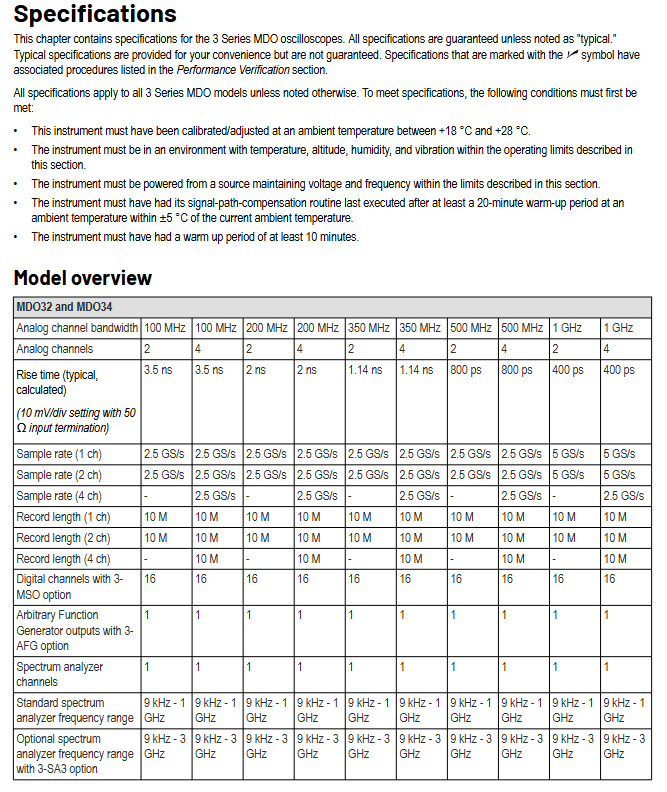
The 3 series MDO oscilloscopes are divided into two categories: MDO32 (2-channel analog) and MDO34 (4-channel analog), with the same core architecture: "analog channel+digital channel (3-MSO option)+arbitrary function generator (3-AFG option)+spectrum analyzer" four in one, supporting synchronous observation of mixed domain signals (such as analog voltage+digital logic+RF signal).
Model Analog Channel Number Digital Channel Number (3-MSO) AFG Output (3-AFG) Spectrometer Channel Special Design
MDO32 2, 16, 1, 1 front panel with Aux In (external trigger)
MDO34 4 Road 16 Road 1 Road 1 Road No Aux In
2. Analog channel specifications (core measurement capability)
The analog channel is the foundation of an oscilloscope, and its parameters directly determine the voltage, bandwidth, and sampling accuracy. The document uses a large number of tables to clarify the differences between different bandwidth models (100MHz/200MHz/350MHz/500MHz/1GHz):
(1) Input and coupling characteristics
Input coupling: Supports AC and DC coupling, with a lower limit frequency of<10Hz (1M Ω) for AC coupling. When using a 10X probe, the lower limit is reduced by 10 times (<1Hz);
Input impedance: optional 1M Ω (± 1%, typical capacitance 13pF ± 2pF) or 50 Ω (± 1%), 1M Ω is suitable for high impedance signals (such as sensor output), and 50 Ω is suitable for RF/high-speed signals (matching transmission line impedance);
Maximum input voltage:
1M Ω DC coupling: 300VRMS (installation category II), derating at 20dB/decade for 4.5MHz-45MHz, derating at 14dB for 45MHz-450MHz, 5VRMS for>450MHz;
50 Ω: 5VRMS (peak value ≤± 20V, distortion factor DF ≤ 6.25%), although there is overvoltage protection, the pulse signal may damage the terminal resistance due to "detection delay".
(2) Bandwidth and sampling capability
Bandwidth: Bandwidth is strongly correlated with "vertical gear (V/div)", taking the 1GHz model as an example:
10mV/div-1V/div:DC-1.00GHz;
5mV/div-9.98mV/div:DC-500MHz;
2mV/div-4.98mV/div:DC-350MHz;
1mV/div-1.99mV/div:DC-150MHz。
Sampling rate:
1-2 channels enabled: up to 5GS/s (1GHz model), 2.5GS/s (≤ 500MHz model);
3-4 channels enabled: up to 2.5GS/s (all models);
The sampling rate varies with time/div, such as 2.5GS/s for 1ns/div and 100S/s for 1000s/div.
Record length: 1K-10M optional, with a maximum of 10M for 1 channel and 10M still supported for 4 channels, meeting the requirements for long-term signal acquisition (such as recording 2ms of signal at 10M point @ 5GS/s).
(3) Vertical accuracy index
DC gain accuracy:
1mV/div: ± 2.5%, with an additional 0.1% for every ℃ above 30 ℃;
2mV/div: ± 2.0%, with an additional 0.1% for every ℃ above 30 ℃;
5mV/div and above: ± 1.5%, with an additional 0.1% for every ℃ above 30 ℃.
DC balance: measures the signal offset at zero input, under 50 Ω DC coupling:
1mV/div:0.5div;
2mV/div:0.25div;
10mV/div and above: 0.2div;
When the temperature is above 40 ℃, an additional 0.01div is added for each ℃.
Noise level: Sampling mode, 50 Ω full bandwidth, 100mV/div gear:
1GHz model: 1.98mV (typical), 3.1mV (guaranteed);
100MHz model: 1.38mV (typical), 2.85mV (guaranteed).
3. Digital channel specifications (3-MSO option)
When configuring the 3-MSO option, the instrument supports 16 digital channels (D0-D15), suitable for synchronous observation of digital logic signals (such as FPGA, MCU pins):
Input characteristics: Input impedance 101k Ω (typical), input capacitance 8pF (typical), minimum signal 500mVpp, maximum signal+30V/-20V;
Timing accuracy: Skew (offset) between channels ≤ 500ps, minimum timing resolution of 2ns, minimum detectable pulse of 2.0ns (P6316 probe is required, and all 8 grounded channels are connected);
Threshold voltage: Range -15V -+25V, accuracy ± [130mV+3% x threshold setting] (SPC needs to be executed).
4. Arbitrary Function Generator (AFG, 3-AFG Options)
Built in 1 AFG, supporting 13 waveforms, can be used as a signal source to output excitation signals:
Waveform and Parameters:
Sine wave: frequency 0.1Hz-50MHz, amplitude 10mVpp-2.5Vpp (50 Ω), 20mVpp-5Vpp (1M Ω);
Square wave: frequency 0.1Hz-25MHz, duty cycle 10% -90%, minimum pulse width 10ns, rise/fall time 5ns (10% -90%);
Arbitrary wave: sampling rate of 250MS/s, recording length of 128k samples;
Accuracy index:
Frequency accuracy: ± 130ppm when ≤ 10kHz, ± 50ppm when>10kHz;
Amplitude accuracy: ± [1.5% x peak to peak value+1.5% x DC offset+1mV] (1kHz);
DC offset range: ± 1.25V (50 Ω), ± 2.5V (1M Ω), accuracy ± [1.5% x offset+1mV].
5. Specification of Spectrum Analyzer
Built in 1-channel spectrum analyzer, supporting RF signal analysis, standard frequency range 9kHz-1GHz, 3-SA3 option extended to 3GHz:
Frequency and bandwidth:
Resolution bandwidth (RBW): 20Hz-150MHz, adjusted in a 1-2-3-5 sequence, with Kaiser window ranging from 30Hz-150MHz;
Center frequency error: ± 10ppm (including aging, calibration, temperature stability, 1-year validity period);
Noise and distortion:
Display average noise level (DANL):<-136dBm/Hz at 5MHz-2GHz (guaranteed),<-140dBm/Hz (typical);
Harmonic distortion:<-55dBc (guaranteed),<-60dBc (typical) when 2nd harmonic>100MHz;
Input capability: Maximum continuous power+20dBm (0.1W), DC maximum ± 40V, pulse power+45dBm (32W,<10 μ s pulse width,<1% duty cycle).
6. Other key specifications (ensuring overall availability)
Display: 11.6-inch TFT capacitive touch screen, 1920 × 1080 resolution, 16.77 million colors, brightness of 450cd/m ² (new screen full brightness), supports touch operations (such as dragging cursor, switching menu);
I/O interface:
Ethernet: RJ-45, 10/100Mb/s, used for remote control and data transmission;
USB: 2 USB 2.0 hosts on the front panel (connected to USB flash drives and mice), 1 USB 2.0 host and 1 USB device on the back panel (supporting USBTMC);
HDMI: 19 pins, used for external display;
GPIB: Requires TEK-USB-488 adapter (optional), supports IEEE 488.2 protocol;
Environment and Machinery:
Working temperature -10 ℃ -+55 ℃, non working temperature -40 ℃ -+71 ℃;
Weight: MDO32 at 1GHz is about 5.26kg, MDO34 at 1GHz is about 5.31kg, with a soft shell (SC3) content of+1.81kg;
Dimensions: Height 252mm x Width 370mm x Depth 148.6mm.
Performance verification process (verifying whether the instrument meets the standards)
Performance validation is the core chapter of the document, which includes over 20 tests covering both analog and digital channels AFG、 All core functions such as spectrum analyzer must be strictly executed according to the process to ensure reliable results.
1. Preparation before verification (basic conditions)
Instrument preheating and compensation: The instrument needs to be continuously powered on for 10 minutes to achieve thermal stability; Afterwards, execute "Signal Path Compensation (SPC)" - path: Utility → Calibration → Run SPC, taking 5-15 minutes per channel. If the ambient temperature changes by more than 5 ℃, SPC needs to be re executed.
Equipment connection and calibration:
The oscilloscope and all testing equipment (such as DC voltage sources and power meters) must be connected to the "same AC circuit" to avoid testing errors caused by ground offsets between different circuits; If unsure, it can be connected through a common ground power strip;
Before testing, it is necessary to calibrate the "signal source accuracy", such as verifying the DC voltage source output with a high-precision DMM (such as Tektronix DMM4040) and verifying the frequency of the sine wave generator with a frequency counter.
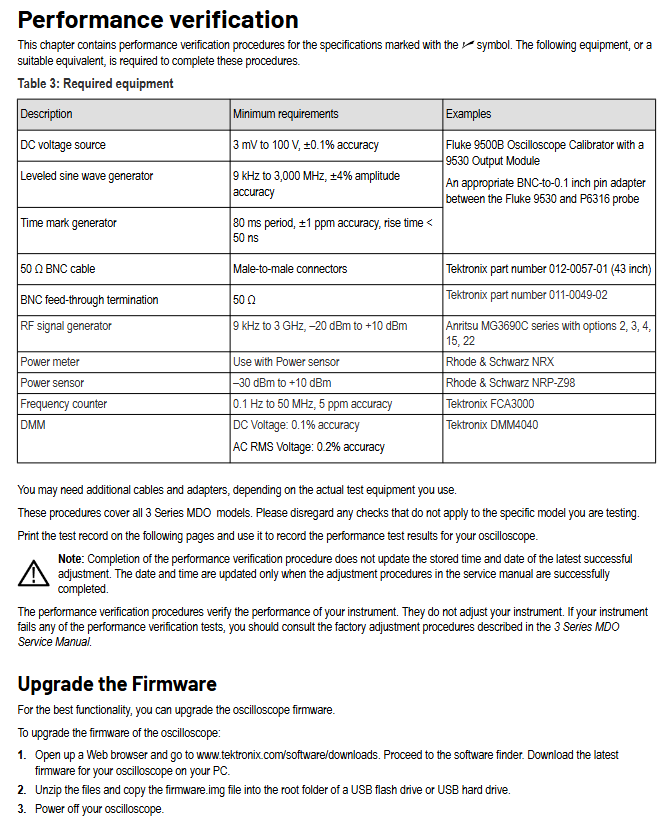
List of required equipment (Table 3): The document specifies the "minimum requirements" to avoid invalid test results due to insufficient equipment accuracy. The core equipment is as follows:
Equipment Name Minimum Requirements Example Model Usage
DC voltage source 3mV-100V, ± 0.1% accuracy Fluke 9500B (equipped with 9530 module) provides DC excitation, tests gain and offset accuracy
Level sine wave generator 9kHz-3000MHz, ± 4% amplitude accuracy Anritsu MG3690C provides AC excitation, tests bandwidth and noise
Time stamp generator with 80ms cycle, ± 1ppm accuracy, rise time<50ns - test sampling rate, delay accuracy
Power meter+sensor sensor range -30dBm -+10dBm Rohde&Schwarz NRX+NRP-Z98 testing spectrometer amplitude accuracy
Frequency counter 0.1Hz-50MHz, 5ppm accuracy Tektronix FCA3000 testing AFG, DVM frequency accuracy
Auxiliary accessories: 50 Ω BNC cable, 50 Ω straight through terminal Tektronix 012-0057-01 matching impedance to reduce signal reflection
2. Core testing projects and detailed processes
(1) Basic testing: Self check and SPC (to verify that the instrument hardware is functioning properly)
System diagnosis (self-test):
Disconnect all probes and cables, and reset the instrument by pressing the "Default Setup" button on the front panel;
Touch "Utility" → "Self Test" → "Run Self Test", wait for 5-10 minutes (including hardware, software, and interface testing);
After self inspection is completed, confirm that all items are "Passed"; If it fails, record the failure item (such as' RF channel not responding ') and contact Tektronix support.
Signal Path Compensation (SPC):
After passing the self-test, press "Default Setup", touch "Utility" → "Calibration" → "Run SPC";
During the compensation process, the instrument cannot be operated. After completion, confirm "SPC Status=Passed";
SPC is a prerequisite for all subsequent accuracy tests, and failure to pass cannot guarantee the validity of the test results.
(2) Simulation channel key testing (core function verification)
① Input terminal testing (verifying impedance accuracy)
Test purpose: To confirm whether the 1M Ω/50 Ω input impedance is within the qualified range, and to avoid signal attenuation/reflection caused by impedance mismatch.
Testing process:
Connect a DC voltage source (such as Fluke 9500B) to channel 1, with the voltage source set to "1M Ω output impedance";
Press "Default Setup" for the instrument, set channel 1 to a vertical gear of 10mV/div and a termination impedance of 1M Ω;
Measure the input impedance of channel 1 using a voltage source, and record the value within the range of 990k Ω to 1.01M Ω;
Switch the vertical gear to 100mV/div, repeat the measurement, and the impedance still needs to be between 990k Ω and 1.01M Ω;
Switch the termination impedance of the instrument to 50 Ω, set the output impedance of the voltage source to 50 Ω, repeat the test, and the impedance should be between 49.5 Ω and 50.5 Ω;
Repeat the above steps for all channels (MDO32 tests 1-2 channels, MDO34 tests 1-4 channels).
② DC balance test (verifying zero input offset)
Test objective: To measure the "offset of the signal at zero input", as excessive offset can lead to measurement errors in DC small signals.
Testing process:
Connect channel 1 to a 50 Ω BNC direct terminal (no signal input), press "Default Setup";
Channel 1 setting: Vertical gear 1mV/div, termination impedance 50 Ω, bandwidth limit 20MHz, acquisition mode "Average (16 waveform)";
Touch "Measure" → "Amplitude" → "Mean", add mean measurement, and record mean voltage;
Convert the average voltage to "div" (div=voltage/vertical gear), which should be within the range of -0.5div -+0.5div;
Switch the vertical gear to 2mV/div (allowed -0.25div -+0.25div), 10mV/div (allowed -0.2div -+0.25div), and repeat the measurement;
Switch bandwidth limit to 250MHz, Full, terminate impedance to 1M Ω, repeat test;
Repeat the above steps for all channels.
③ Simulated bandwidth test (verifying frequency response)
Test objective: To confirm whether the "-3dB bandwidth" of the instrument meets the standard at different vertical gears, as insufficient bandwidth can cause high-speed signal distortion.
Testing process (using 1GHz model as an example):
Connect the level sine wave generator to channel 1, with an output impedance of 50 Ω and a termination impedance of 50 Ω for instrument channel 1;
Instrument settings: vertical gear 10mV/div, acquisition mode "Sample", horizontal gear 4ns/div;
The generator outputs a 10MHz, 8divpp signal (i.e. 80mVpp), and records the "Vin pp" (peak to peak measurement value);
Adjust the generator frequency to "1GHz" (the maximum bandwidth frequency corresponding to 10mV/div) and record "Vbw pp";
Calculate the gain as Vbw-pp/Vin pp, which should be ≥ 0.707 (-3dB point);
Switch the vertical gear to 5mV/div (maximum bandwidth frequency 500MHz), 2mV/div (350MHz), 1mV/div (150MHz), and repeat the test;
Repeat the above steps for all channels.
④ DC gain accuracy test (to verify the accuracy of DC signal amplification)
Test purpose: To confirm whether the instrument's "amplification ratio" for DC signals is accurate, as excessive gain error can lead to inaccurate voltage measurement.
Testing process:
Connect the DC voltage source to channel 1, with an output impedance of 1M Ω for the voltage source, a termination impedance of 1M Ω for instrument channel 1, and a bandwidth limit of 20MHz;
Instrument settings: Vertical gear 1mV/div, acquisition mode "Average (16 waveform)", trigger source "AC Line";
Voltage source output -3.5mV (Vnegative), record the mean measurement value "Vnegative measured";
Voltage source output+3.5mV (Vpositive), record the mean measurement value "Vpositive measured";
Calculate Vdiff=| Vnegative measured - Vpositive measured |, expected Vdiff=7mV (1mV/div x 7div);
Calculate gain accuracy=(Vdiff-7mV)/7mV) × 100%, within the range of -2.5% -+2.5%;
Switch the vertical gear to 2mV/div (allowed -2.0% -+2.0%), 5mV/div (allowed -1.5% -+1.5%), and repeat the test;
Repeat the above steps for all channels.
(3) AFG testing (verifying signal source accuracy)
① AFG frequency accuracy test
Testing process:
Connect the AFG output to the frequency counter, press "Default Setup" on the instrument, and touch "AFG";
AFG setting: waveform "sine wave", amplitude 2.5Vpp, load impedance 50 Ω, frequency 10kHz;
Read the frequency counter value within the range of 9.9987kHz-10.0013kHz (± 130ppm);
Switch the frequency to 50MHz (>10kHz, allowing ± 50ppm, i.e. 49.9975MHz-5.0025MHz) and repeat the test;
Switch the waveform to "square wave" with frequencies of 25kHz (± 130ppm allowed) and 25MHz (± 50ppm allowed), and repeat the test.
② AFG amplitude accuracy test
Testing process:
Connect AFG output to DMM, with a 50 Ω terminal in the middle string, and set "AC RMS measurement" in DMM;
AFG setting: waveform "square wave", frequency 1kHz, load impedance 50 Ω, amplitude 20mVpp;
To read the DMM value, it needs to be within the range of 9.35mV-10.65mV (± 1.5%+1mV);
Switch the amplitude to 1Vpp (allowing 490.5mV-509.5mV) and repeat the test.
(4) Spectrum analyzer testing (to verify RF analysis capability)
① Display Average Noise Level (DANL) Test
Test purpose: To measure the "inherent noise level" of the spectrometer, the lower the DANL, the better it can detect weak RF signals.
Testing process:
Connect the RF input to a 50 Ω terminal (no signal), press "Default Setup" on the instrument, and touch "RF";
RF settings: Trace "Average", detection mode "Average", reference level -15dBm, RBW Auto;
Set frequency range: 9kHz-50kHz, touch "Cursors" → "Marker", move the marker to "highest noise point", record DANL, need to be<-109dBm/Hz;
Switch the frequency range to 50kHz-5MHz (<-126dBm/Hz) and 5MHz-2GHz (<-136dBm/Hz), and repeat the test.
② Residual Stray Response Test
Test purpose: To confirm whether the "spurious signal without input" of the spectrum analyzer is within the qualified range, and excessive spurious will interfere with RF signal detection.
Testing process:
RF input connected to 50 Ω terminal, set reference level -15dBm, RBW 100kHz;
The frequency range is 9kHz-50kHz, and for observing stray signals, it is required to be<-78dBm;
Switch the frequency range to 50kHz-5MHz (<-78dBm), 5MHz-2GHz (<-78dBm,<-76dBm required at 1.25GHz), 2GHz-3GHz (<-78dBm,<-62dBm required at 2.5GHz), and record all excessive stray signals.
3. Test records and result processing
Test Record: The document provides a "Test Record" form (110 pages in total), which needs to be printed and filled in with the "lower limit value, test result, and upper limit value" for each test. For input terminal testing, the impedance value of "channel 1 1M Ω 10mV/div" needs to be recorded, and for DC balance testing, the "div" value needs to be recorded as evidence of instrument performance.
Result judgment and processing:
If the test result is within the range of "lower limit upper limit", it is judged as "Passed";
If it fails, first review the "operation steps, equipment settings" (such as whether SPC is executed and impedance is matched) to eliminate human errors;
If the operation is confirmed to be correct but still fails, the performance verification process "does not provide adjustment function", and it is necessary to refer to the "3 Series MDO Service Manual" to perform "factory calibration" (such as adjusting the analog channel gain resistance and AFG frequency reference); If calibration still fails, contact Tektronix for repair (North America 1-800-833-9200).
Test records and subsequent processing
Test record: The document provides a detailed table to record the "lower limit value test result upper limit value" for each test, which needs to be printed and filled in;
Result processing: Performance verification only judges whether it meets the standard, without adjusting the instrument; If the test fails, refer to the "3 Series MDO Service Manual" to perform factory calibration;
Calibration cycle: The validity period of the reference frequency error (± 10ppm) is 1 year, and it is recommended to calibrate once a year.
- OMRON
- ABB
- General Electric
- EMERSON
- Honeywell
- HIMA
- ALSTOM
- Rolls-Royce
- MOTOROLA
- Rockwell
- Siemens
- Woodward
- YOKOGAWA
- FOXBORO
- KOLLMORGEN
- MOOG
- KB
- YAMAHA
- BENDER
- TEKTRONIX
- Westinghouse
- AMAT
- AB
- XYCOM
- Yaskawa
- B&R
- Schneider
- KONGSBERG
- NI
- WATLOW
- ProSoft
- SEW
- ADVANCED
- Reliance
- TRICONEX
- METSO
- MAN
- Advantest
- STUDER
- DANAHER MOTION
- Bently
- Galil
- EATON
- MOLEX
- DEIF
- B&W
- ZYGO
- Aerotech
- DANFOSS
- Beijer
- Moxa
- Rexroth
- Johnson
- WAGO
- TOSHIBA
- BMCM
- SMC
- HITACHI
- HIRSCHMANN
- Application field
- XP POWER
- CTI
- TRICON
- STOBER
- Thinklogical
- Horner Automation
- Meggitt
- Fanuc
- Baldor
- SHINKAWA
- Other Brands
- UniOP
- KUKA
- Iba
- Beckhoff
- ADLINK
-
 SIGMATEK PC321K Industrial Computer
 -
 SIGMATEK MDP 102-1 SLIDES Power Module
 -
 SIGMATEK TAE-151 12-200-151 Light Terminal
 -
 SIGMATEK CP102 20-004-102P6995B HMI Panel
 -
 SIGMATEK CAM-123 12-017-123-C Analog Mixing Module
 -
 SIGMATEK DCC041 DIAS Compact Controller
 -
 SIGMATEK DVI021 and DKL015 DIAS Power Module
 -
 SIGMATEK SDD340-46 SDD Series Servo Drive
 -
 SIGMATEK Robotdrive L6 02220-7997 Engel Drive
 -
 SIGMATEK AKM63M-ANCNGBB0 4.38kW PM Servomotor
 -
 Sigmatek SDD 310 SLIDES-Drive SDD310-4O
 -
 Sigmatek SDD335-23K Drive VARAN Interface 14kVA
 -
 Sigmatek TAE1922-K Touch Display Unit
 -
 Sigmatek DIAS DCP 643 CPU Module DKL003
 -
 Sumitomo CNH-4105Y-43 NSNP Gear Reducer
 -
 Sumitomo CHHP-4160Y-35-213T Inline Gear Reducer
 -
 Sumitomo CNHM02-6090YA-87 NSNP Gear Motor
 -
 Sumitomo CNVXS-6100Y-43 NSNP Gear Reducer
 -
 Sumitomo CNHM2609511 Gear Motor
 -
 Sumitomo CHVM3-6130-B-35 Gear Motor
 -
 Sumitomo HW0389042-A Industrial Component
 -
 Sumitomo F2CF-W55-ZG05-64 Gear Reducer
 -
 Sumitomo CHH-6165Y-13 Inline Gear Reducer
 -
 Sumitomo CNVM3-6125C-EP-6 Cyclo Gear Motor
 -
 Sumitomo RNYX-1320Y-20 Gear Reducer
 -
Sumitomo XFCG111-43/24/165 Control Component
-
 Sumitomo LHYJ-3A105K-Y3-102 Gear Reducer
 -
 Sumitomo CNFM02-6095DA-B-121 TC-FX/FB-02A Motor
 -
 Sumitomo CNHJ-4105DAY-289 NSNP Gear Reducer
 -
 Sumitomo LHYJS-4C145Y-Y1-112 NSNB Gear Reducer
 -
 Radiator 2060351111 Komatsu Sumitomo Linkbelt
 -
 Sumitomo BL3-09B-35MEHDK6 Gearbox ANFJ-L30
 -
 Sumitomo Truninger 8H1-150 Internal Gear Pump
 -
Sumitomo RNFMS01-25R-B-150 200V NSNP Gearmotor
-
Sumitomo CHHBJN1HA-6135Y-29 Inline Reducer
-
Sumitomo EHYMS5-B6125YA-Y3-74 NSNB Reducer
-
 Sumitomo Eaton H-050AA2F-J Orbit Motor
 -
Sumitomo TC-FXVP Motor 0.75kW 4P 400V N-80M
-
 Sumitomo XFCG111-87/24130 Industrial Control Component
 -
 Sumitomo AF3122-030 Inverter 30kW 3Ph 200V
 -
 Sumitomo QT42-25FS-B Internal Gear Pump
 -
 Sumitomo F2CS-A35-ZG09-59 Speed Reducer
 -
 Sumitomo CNHM05-6090-B-29 Gear Motor
 -
 Sumitomo CHHJ-6145Y-29-210T Gear Reducer
 -
 Sumitomo E3P-20-2.2-S1450-E Hydraulic Pump
 -
 Sumitomo RNYMS1-1420C-AV-20 Right Angle Gear Motor
 -
 Sumitomo SR101 SRKG101-76-40-060 Reamer Head
 -
Sumitomo RNYM05-1220-25/UBAABB Gear Motor
-
 Optidrive E3 Sumitomo GHB-36 Vector Inverter Motor
 -
Sumitomo CNH-614HY-35 UNMP Gear Reducer
-
 Sumitomo CNH-612HY-6 SM-Cyclo Gearmotor
 -
 Sumitomo HF3214-A75 Electric Motor
 -
 Sumitomo CNVM02-6100-B-59 NSMP Gear Reducer
 -
 Sumitomo CNHJ4105Y35 NSNP Gear Reducer
 -
 Sumitomo CHH6165Y-29 NSNB Gear Reducer
 -
Sumitomo RNYM1-1420-25 Hyponic Gear Motor
-
 Sumitomo T600C Industrial Control Unit
 -
 Sumitomo LHH-4A115-K2-28 NSNB Gear Reducer
 -
 Sumitomo RNYM02-1220-AV-20 Speed Reducer
 -
 Sumitomo CHHS-6140Y-SB-17 Gear Motor
 -
 Sumitomo Heavy Industries SSE-100A-RM Drive Unit
 -
Sumitomo PA228771 CNHM2-6100YB-EP-8 Gear Motor
-
 Sumitomo RNYM02-1231-B-50 Speed Reducer
 -
Sumitomo CNFM1H-6090-6 Induction Motor
-
 Sumitomo CHH-614HY-11 Gear Reducer
 -
Sumitomo F4C-D25-ZG01-41 Speed Reducer
-
Sumitomo PA224280 CNHM1-6095YC-EP-21 Gear Motor
-
Sumitomo KHYJB4115K185145TC Gear Motor
-
 Sumitomo LHYJS-3A105Y-Y1-179 NSNB Gearmotor
 -
 Sumitomo AF3102-022 BN AC Driver
 -
 Sumitomo SG75M-H Operator Panel
 -
 Sumitomo NT2014-2A2 NSNP Control Unit
 -
Sumitomo RNYMS03-1320-B-60 Gear with Motor
-
Sumitomo F90L/4 F90L4 Drive Motor
-
Sumitomo TC-FX NSMP Motor Unit
-
Sumitomo RNYM05-1210-7 NSMP Gearmotor
-
Sumitomo Fine Cyclo F2CFS-C45-59 Gearbox
-
Sumitomo Heavy Industries SSE-50A Industrial Unit
-
 Sumitomo CHH-6130Y-17 NSNB Gear Reducer
 -
 Sumitomo UMC556000-02 Control Unit
 -
 Sumitomo CHHJ-4155Y-87 Inline Gear Box
 -
 Sumitomo ANFXS-P120F-M30GLD-5 NSNP Reducer
 -
Sumitomo CNHJ-6095Y-17 NSNP Gear Reducer
-
Sumitomo H-3115 17:1 USNT Gear Reducer
-
Sumitomo CHH 6135Y USNTC02 Gear Reducer
-
 Sumitomo JA450918A2 45JA918A Cylinder Head
 -
 Sumitomo SD4SGS-ACB-02C-110-54 Solenoid Valve
 -
Sumitomo CNVMS02-6100DAYA-231 NSMD Gear Reducer
-
Sumitomo CHH4135Y8 NSMD Inline Gear Reducer
-
Sumitomo PA020201 CNH-6125Y-87 Worm Gear Reducer
-
 Sumitomo Connectivity 8100-2730 Connector
 -
Sumitomo CNHJ-6120Y-87 PA021857 NSNB Gear Reducer
-
Sumitomo RNYM02-1330-B-100 Induction Gear Motor
-
 Sumitomo JA762913AC Operator Interface Keypad
 -
 Sumitomo CQT51-100FV-S1262J-A Coolant Pump
 -
Sumitomo PA225389 CNHM1-6095YC-EP-6 Gear Motor
-
Sumitomo CHHJ-4130Y-43 NSNB Gear Reducer
-
Sumitomo RNYJ-1520Y-12 NSNB Gear Reducer
-
Sumitomo HC1480-29.00 NSMD Inline Gear Reducer
-
 Sumitomo MC-550 MCU UMC550000AEG01
 -
 Sumitomo CNVM1H-6125YA-B-87 Gear Reducer
 -
Sumitomo SD4GS-ACB-02B-110-54 Solenoid Valve
-
Sumitomo HCS79310 Main Motor Assembly
-
Sumitomo JA762913AC Operator Interface Keypad
-
Sumitomo CNHJ-6125Y-8 In Line Reducer
-
 Sumitomo X120D30303T-01 Driver
 -
Sumitomo H1Y203-25-F7000 Shaft Mount Reducer
-
 Sumitomo Type-35SE Fiber Fusion Splicer Kit
 -
Sumitomo F2CS-T655-171 Cyclo Drive Gearbox
-
 Sumitomo F80 Adsorber RX19ZT6124
 -
 Sumitomo MC-550 MCU UMC550000AKG01
 -
 Sumitomo Drive FCS-A65G-59 Speed Reducer
 -
 Sumitomo SRA81-56-BM50-140 Modular Reamer Holder
 -
Sumitomo CNHM05-6100YA-59 Gear Motor
-
 DEMAG Sumitomo Ergocontrol NC4 100 V7 Control Unit
 -
Sumitomo HMV02-207 Cyclo Drive Induction Motor
-
 SUN-EH Sumitomo Z4-22172-12 Ozone Power Unit
 -
Sumitomo AF-500 AF502-2A2 Transistor Inverter
-
 Sumitomo T-82C+ Core Alignment Fusion Splicer
 -
Sumitomo P741F6002B Circuit Board
-
 Sumitomo AS-3211 Injection Molding Motherboard
 -
 Yaskawa SGMGH-13Q5A-OM11 Servo Motor with Sumitomo F3CS-A25G-59 Gear
 -
 Sumitomo SH120-5 Final Drive Track Travel Motor
 -
 Sumitomo AS-3345 Circuit Board
 -
 Sumitomo AF300S-1A5-E Transistor Inverter 1.5kW
 -
 Sumitomo Type-Q101-CA SM MM Fiber Fusion Splicer
 -
 Sumitomo SH50 NIV Operator Panel
 -
Sumitomo RNFM-009-17L-B-120-N4FCZ843 AC Gear Motor


