
Rockwell Automation ICS AADvance Controller
Core objective: Define SIF safety application standards (mandatory) and recommendations to ensure that the system meets and maintains the required Safety Integrity Level (SIL), with a maximum support for SIL 3.
Rockwell Automation ICS AADvance Controller
Basic Information and Usage Standards
1. Scope of application and core objectives
Applicable products: AADvance controller series (T9100/T9110 processor modules, T9401/2 digital input modules, etc.) and supporting software (AADvance Workbench 1.4/2.1, AADvance Robust SIS Workstation 2.00), supporting system version 2.011.
Core objective: Define SIF safety application standards (mandatory) and recommendations to ensure that the system meets and maintains the required Safety Integrity Level (SIL), with a maximum support for SIL 3.
2. Key usage requirements
Personnel qualifications: Installation, configuration, operation and maintenance operations must be carried out by professionally trained personnel who are familiar with relevant regulations (such as IEC 61508, NFPA series standards).
Responsibility statement: If the device is used in a manner that does not comply with the manufacturer's regulations, the protective function of the device may become ineffective; Rockwell is not responsible for indirect/consequential damages, and the examples in the manual are for illustration only and do not represent actual application guarantees.
System core features and authentication
1. Core functions and security design
Application scenarios: Suitable for safety critical scenarios such as emergency shutdown (ESD), fire and gas detection, rotating machinery control, burner management, etc., while supporting non safety but business critical control requirements.
Security Capability:
Both fail safe and fault tolerant architectures are supported, and fault tolerance can be realized through two module (1oo2D) or three module (2oo3D) configurations.
Built in comprehensive diagnostic function, capable of detecting hardware/software faults. The faulty module needs to be replaced within the mean time to repair (MTTR) to avoid a decrease in SIL level.
Supports two configurations: "Power Loss Trip (DTT)" and "Power On Action (ETA)", and the number of modules needs to be selected based on SIL level and demand rate (high/low) (see Table 1).
2. Module configuration and SIL compliance requirements
Minimum module configuration for different application scenarios (simplified version of Table 1):
Application type, number of input modules, number of processor modules, number of output modules
SIL 2/3, Low/high demand, DTT 1 2 1
SIL 2, High demand, ETA 2 2 2
SIL 3, High demand, ETA 2 2 2
Note: The single channel digital output module includes a series switch. The DTT scenario supports SIL 3, while the ETA scenario only supports SIL 2; There are no three module output configuration options.
3. International certification and compliance standards
Functional safety certification: Compliant with IEC 61508 SIL 3, certified by an independent certification body.
Hazardous environment certification:
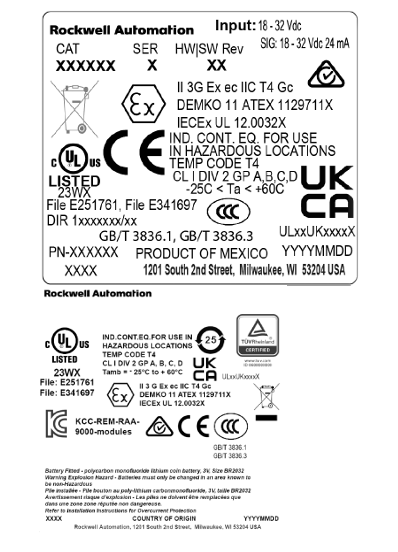
North America: Class I, Division 2, Groups A-D (UL 61010-2-201, CSA C22.2 standard).
Europe/UK: ATEX (DEMKO 11 ATEX 1129711X, Ex ec IIC T4 Gc), UKCA (UL24UKEX2993).
International: IECEx (certificate number IECEx UL 12.0032X).
Other compliance: Complies with industry standards such as EN 50156 (furnace control), EN 54 (fire alarm), NFPA 85/86/87 (boilers/ovens/fluid heaters), etc.
Safety lifecycle and management system
1. Safety lifecycle stages
The full lifecycle defined by IEC 61508 must be followed, with core stages including:
Scope definition: Clearly define system boundaries, interfaces (with processes/third-party equipment), and environmental requirements (such as temperature and power).
Hazard and Risk Analysis: Identify hazardous events, trigger sequences, and risk levels as inputs for safety requirements.
System Design and Engineering: Divide system architecture, define security requirement levels for each component, and refine hardware/software design.
Integration and Verification: The application is integrated with the controller to test and verify whether SIF meets SIL requirements (such as response time and fault handling).
Operation and Maintenance: Develop an operation/maintenance plan to ensure the SIL level is maintained during operation; Changes must be strictly controlled, and suspensions must follow safety procedures.
2. Requirements for Safety Management System
Policy and Planning: Functional safety policies need to be developed to clarify measures, responsibilities, and record management (including change control) for each stage of the lifecycle.
Personnel capability: Personnel qualifications need to be evaluated, including engineering experience, functional safety knowledge, regulatory familiarity, etc. Higher qualification requirements are required for high-risk scenarios.
Functional Safety Assessment (FSA): Led by senior personnel independent of the project, it reviews whether the entire lifecycle work meets the requirements.
System Architecture Design (SIL 2/3)
1. SIL 2 architecture
Fault safety architecture: single input (1oo1D), dual processor (1oo1D degraded), single output (1oo1D), triggering a safe state in case of a fault.
Fault tolerant input architecture: dual/triple input (1oo2D/2oo3D), dual processors, single output. When a single input module fails, it will operate in a degraded state while still maintaining safety functions.
High demand architecture: dual input, dual processor, dual output, ensuring that faulty modules are replaced within MTTR to avoid SIF shutdown.
2. SIL 3 architecture
Fault safe I/O+fault-tolerant processor: single input/output, dual/triple processor (1oo2D/2oo3D), downgraded in case of processor failure, dual fault triggers safe state.
Fault tolerant I/O architecture: dual input/output, dual processors, both input/output modules support 1oo2D degradation, suitable for high safety requirements scenarios.
TMR architecture: three inputs, three processors (2oo3D), dual outputs, with the strongest fault tolerance. A single module failure does not affect system operation. When there are two failures, it will be downgraded, and when there are three failures, it will trigger a safe state.
3. Secure network communication
SNCP protocol: SIL 3 certified "Black Channel" protocol, supports Ethernet transmission of secure data, achieves data exchange between controllers through "variable binding", and can be configured as single network (fail safe) or dual network (fault-tolerant).
Peer to Peer communication: Supports SIL 3 data transmission between AADdistance and Trusted controllers, based on master-slave mode, and recommends using redundant networks to ensure availability.
Installation and environmental requirements
1. Non hazardous environment
Environmental conditions: temperature -25 ° C~+60 ° C, pollution level ≤ 2 (IEC 60664-1, only non-conductive pollution, occasional condensation); The burner management application requires an enclosure protection level of IP40 (indoor)/IP54 (outdoor).
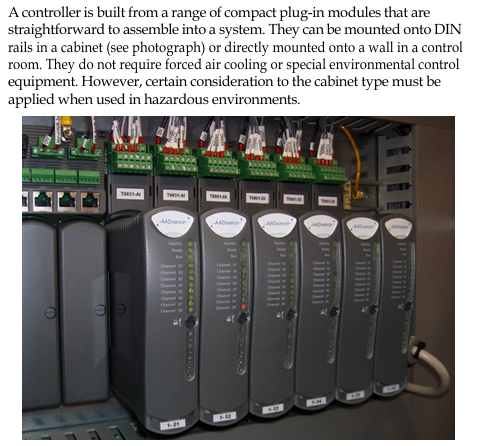
Installation requirements: The module should be installed vertically (ensuring natural heat dissipation), DIN rail or wall mounted, without the need for forced air cooling.
2. Hazardous environment
Special requirements:
The enclosure protection level is ≥ IP54 (IEC 60079-0/7) and must be marked with "Do not open when powered on".
Grounding wire cross-sectional area ≥ 3.31mm ², wire temperature rating ≥ 85 ° C, only supports vertical installation.
The temperature range is the same as non hazardous environments, and the pollution level is ≤ 2.
Operations and Security Assurance
1. Key daily maintenance items
Fault handling: When the processor/input/output module fails, it needs to be replaced within MTTR; If not replaced in a timely manner, the relevant SIF needs to be shut down (unless there are compensatory measures in the SRS document).
Calibration and testing: Regularly calibrate sensors/actuators, test SIF response time (≤ 1/2 of process safety time PST), and archive test records.
Backup and Update: Regularly backup system configuration (AADvance Workbench/SIS Workstation project) and test backup effectiveness; Firmware updates require the use of the ControlFLASH tool.
2. System security measures
Network security: it is forbidden to connect to the unprotected Internet; Computers need to have firewalls, antivirus software, and password protection enabled; The software license USB key needs to be properly kept.
Port security: Some Ethernet ports (such as TCP 1132, UDP 2010) are open by default, and unused ports need to be closed through a firewall (refer to the configuration guide).
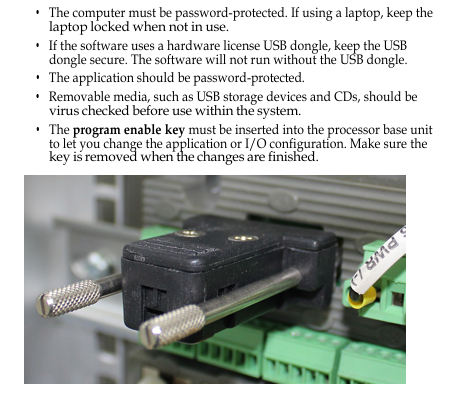
Program Security: The application requires password protection, and the controller needs to insert the "Program Enable Key" to modify the configuration; It is prohibited to force I/O points during operation, and it is recommended to use the program's "override" logic for maintenance.
Supporting documents and resources
1. Key related documents
Document Name Usage Description
AADvance Controller System Build Manual (ICSTT-RM448) System Assembly, Startup, and Operation Verification
AADvance PFH and PFDavg Data (ICSTT-RM449) Fault Probability (PFH/PFDavg) Data and Calculation Example
AADvance Troubleshooting and Maintenance Manual (ICSTT-RM406) System Maintenance, Troubleshooting, and Repair
2. Support channels
Technical support: Get help through rok.auto/support, register an account to subscribe to product security notifications.
Document download: Download the latest manuals and firmware from Rockwell Literature Library (rok.auto/iterative) or Product Compatibility and Download Center (rok.auto/pcdc).
Key Terminology (Glossary Simplified)
SIL (Safety Integrity Level): Safety Integrity Level, levels 1-4, with SIL 3 being the highest level supported by the manual.
PST (Process Safety Time): The maximum time for triggering a hazardous event when a hazardous state exists and there is no protection. The controller defaults to PST=2500ms and needs to be adjusted based on sensor/actuator delay.
MTTR (Mean Time To Repair): The average time to repair, during which faulty modules need to be replaced to maintain SIL.
1oo2D/2oo3D: Fault tolerant configuration, 1oo2D (2 out of 1 with diagnosis), 2oo3D (3 out of 2 with diagnosis).
- OMRON
- ABB
- General Electric
- EMERSON
- Honeywell
- HIMA
- ALSTOM
- Rolls-Royce
- MOTOROLA
- Rockwell
- Siemens
- Woodward
- YOKOGAWA
- FOXBORO
- KOLLMORGEN
- MOOG
- KB
- YAMAHA
- BENDER
- TEKTRONIX
- Westinghouse
- AMAT
- AB
- XYCOM
- Yaskawa
- B&R
- Schneider
- KONGSBERG
- NI
- WATLOW
- ProSoft
- SEW
- ADVANCED
- Reliance
- TRICONEX
- METSO
- MAN
- Advantest
- STUDER
- DANAHER MOTION
- Bently
- Galil
- EATON
- MOLEX
- DEIF
- B&W
- ZYGO
- Aerotech
- DANFOSS
- Beijer
- Moxa
- Rexroth
- Johnson
- WAGO
- TOSHIBA
- BMCM
- SMC
- HITACHI
- HIRSCHMANN
- Application field
- XP POWER
- CTI
- TRICON
- STOBER
- Thinklogical
- Horner Automation
- Meggitt
- Fanuc
- Baldor
- SHINKAWA
- Other Brands
- UniOP
- KUKA
- Iba
- Beckhoff
- ADLINK
-
 SIGMATEK 0332.554.03 Board 371071000154
 -
 SIGMATEK 12-250-021 Base Plate Back Panel CM5V020
 -
 SIGMATEK DM162 S-DIAS Digital Mix Module
 -
 DEMAG ERGOTECH 061 381 66 Sigmatek 9842.243.02 Circuit Board
 -
 SIGMATEK CP313-1 PLC Module
 -
 Sigmatek ETV0551-2 VARAN Touch Terminal
 -
 Sigmatek SDM 081 FS S-Dias Safety Module
 -
 DEMAG 05-250-023 Ergotech Motherboard with Sigmatek TMS012
 -
Sigmatek CM5V020 12-250-023-K Wiring Base
-
 Sigma Tek 5000B-37 Attitude Gyro Indicator
 -
 Sigmatek SDD120-2 DIAS Drive
 -
 Sigmatek CME221 Memory Module
 -
 Sigmatek DCP640 DIAS Central Unit
 -
 Sigmatek STO040 Safety Output Module
 -
 Sigmatek CET281 Control Panel
 -
 Sigmatek CIPC LX800 Demag NC5 CPU
 -
 Sigmatek DKL093 05-024-093 Terminal Module
 -
 Sigmatek AI088 20-009-088 Analog Input Module
 -
 Sigmatek CAI888 Analog Input Module
 -
 SIGMATEK CCA021 12-025-021 Analog Output Module
 -
SIGMATEK 1104.579.05 Control Module
-
SIGMATEK SDI100 Digital Input Module
-
 SIGMATEK C-IPC 256MB LX800 Compact Dias
 -
 SIGMATEK 9423.090.02 Control Module
 -
SIGMATEK C-IPC 256 Power Supply 148498
-
 SIGMATEK CAI025 Analog Input Module
 -
 SIGMATEK CTO166 Digital Output Module
 -
 SIGMATEK CP112 20-004-112 Processor Module
 -
SIGMATEK CAI887 12-009-887 Safety Module
-
 Sigma-Tek 4000B-31 Directional Gyro 1U262-002-42
 -
Sigmatek C-IPC 256MB LX800 IPC Controller
-
Sigmatek C-IPC 01-450-031 Industrial PC LX800
-
Sigmatek C-IPC 256 Industrial PC Controller
-
Sigmatek CCP-531 PLC Processor Module
-
Sigmatek CDI163 Digital Input Module
-
 Sigmatek ETV0501 VARAN Terminal 12-230-0501
 -
 Sigmatek CTMS020 C-DIAS Technology Module
 -
 Sigmatek CIV512 VARAN Switch Module
 -
 Sigmatek HU011 20-080-011 Interface Module
 -
 SIGMATEK SLIDES DAM 124 Module
 -
 SIGMATEK C-IPC 161 01-450-161L Industrial PC
 -
SIGMATEK C-IPC 128MB VIA 733MHz 01-450-024-K
-
 SIGMATEK 12-780-012 R8-IPC Geode LX800 Module
 -
SIGMATEK CAM124 Analog Module
-
 SIGMATEK S1 032-8AF61-R4 EZ Servo Motor
 -
 SIGMATEK CTO163 Digital Output Module
 -
 SIGMATEK CCP082 12-004-082 Processor Module
 -
 SIGMATEK CRCH081 C-DIAS Temperature Module
 -
 SIGMATEK PC322-K 01-310-322-K Industrial PC
 -
SIGMATEK SDD310-2 Servo Drive
-
 SIGMATEK AI084 Analog Input Module
 -
SIGMATEK CRCH081 12-752-081 Temperature Module
-
Sigma-Tek 5000L-4 Attitude Gyro 1U284-001-3
-
 SIGMATEK CM5V020 12-250-023-K Wiring Module
 -
Sigma-Tek 4000H-6 Directional Gyro IU262-035-7
-
 SIGMATEK Dias DCP160 05-004-160 Processor Module
 -
SIGMATEK 0147.395.02 Control Module
-
SIGMATEK A1084 Control Module
-
SIGMATEK DI200 20-006-2000 Digital Input Module
-
Sigmatek DNC115 Encoder Module
-
 Sigmatek DAM122 05-017-122 Analog Module
 -
Sigmatek 9802.289.01 Control Board TA71 Display
-
Sigmatek TO127 20-007-127 Digital Output Module
-
Sigmatek DNC031 05-011-031 Digital Module
-
Sigmatek VI022 20-003-022 Interface Module
-
Sigmatek CAI085 Analog Input Module
-
 Sigmatek CP111 S-DIAS CPU Module
 -
 Sigmatek CTMS030 Krauss Maffei Module
 -
 Sigmatek CAM123 Control Module
 -
 Sigmatek TAE732-P 01-240-732-P Touch Display Unit
 -
Sigmatek MDM021 Digital Mixed Module
-
Sigmatek DCP642 DIAS Central Unit
-
 Sigmatek CST022 12-014-022 C-DIAS Module
 -
 Sigmatek SRO021 20-893-021 Safety Relay Output
 -
 Krauss Maffei MC5 Control System Sigmatek
 -
 Sigmatek DC061 Module 18-24VDC 300mA
 -
 Herrmann EVT0855 Ultrasonic Welder Touch Panel
 -
Sigmatek CIV521 Control Module 1.4A 2W
-
 Sigmatek DDI61 05-006-161 Digital Input Module
 -
SIGMATEK ETT312-E Touch Terminal 01-230-312
-
Cessna S3326-1 Sigma Tek 5000B-67 Gyro 1U149-015-9
-
SIGMATEK PS101 Power Supply Module
-
SIGMATEK 0332.554.03 Control Module 371071000154
-
 SIGMATEK ETT312-E Touch Terminal 01-230-312
 -
SIGMATEK CDM163 Control Module
-
 SIGMATEK VSV046 16-023-046 Module
 -
SIGMATEK AM221 20-017-221 Analog Module
-
SIGMATEK CTS051 12-053-051 Control Module
-
SIGMATEK AM221 20-017-221 Analog Module
-
Sigmatek CSDI161 12-891-161 Safety Input Module
-
Sigma Tek 4000C-1 Directional Gyro Indicator
-
Sigmatek ETV0501 12-230-0501 VARAN Terminal
-
Sigmatek DDM165 SLIDES Module
-
 Sigmatek N100 20-011-100 Control Module
 -
Sigmatek AKM54K-ANC2R-B0 PM Servo Motor
-
Sigmatek CTO166 Digital Output Module
-
Sigmatek CP212-K 20-004-212-K CPU Module
-
Sigmatek CDI161 Digital Input Module
-
Sigmatek DCC080 05-700-080-2 Control Module
-
 SIGMATEK SCP011 S-DIAS Safety CPU
 -
SIGMATEK SCP011 S-DIAS Safety CPU
-
SIGMATEK SRO022 Relay Output Module
-
SIGMATEK MDD 121 Drive Axis Module
-
SIGMATEK DSI021 SLIDES Siemens Interface
-
SIGMATEK DIAS DCP161 Module 05-004-161
-
 Sigmatek ETT312 Built-in Touch Terminal
 -
SIGMATEK DCP 643 DIAS Controller System
-
SIGMATEK CIO021 Multi I/O Module
-
SIGMATEK CTMS020 Control Module
-
 Sigmatek CME 221 Memory Module
 -
Sigmatek 0420.615.01 Control Board
-
Sigmatek CP111 20-004-111 CPU Module
-
Sigmatek 9405.065.03 Control Board
-
Sigmatek ETEK 01-450-032-K C-IPC 256MB Industrial PC
-
Sigmatek CTO163 12-007-163 Safety Output Module
-
Sigmatek TO081 20-007-081 Digital Output Module
-
 Sigmatek SI021 20-022-021 Safety Input Module
 -
Sigmatek 05-052-014 Control Module HW 1.0
-
Sigmatek TO127 20-007-127 Digital Output Module
-
Sigmatek SV141 20-023-141 VARAN Splitter
-
 SIGMATEK CIV513 C-DIAS VARAN Control Module
 -
Sigmatek DCP 642 SLIDES Control Module with DKL002
-
Sigma-Tek 5000B-36 Attitude Gyro
-
SIGMATEK 01-450-024 C-IPC Industrial Computer
-
SIGMATEK CP102 S-DIAS Processor Module
-
Sigmatek CRCH081 12-752-081 PLC Module
-
SIGMATEK SDD340-46 Series Drive
-
SIGMATEK TAE731 Touch Display Unit


