
ABB AO2000-LS25 Laser Analysts User Manual
ABB AO2000-LS25 Laser Analysts User Manual
Product Overview
Core positioning: ABB AO2000-LS25 is a modular laser gas analyzer that operates in conjunction with the AO2000 integrated analysis system. It is based on tunable diode laser absorption spectroscopy (TDLAS) technology to measure gas concentration and only detects free molecules in the gas, insensitive to bound molecules.
Composition structure:
Unit Name Core Component Function Function
The transmitter unit temperature stable diode laser, collimating optical lens group, and main electronic equipment emit laser to complete laser wavelength scanning and basic light intensity measurement
The receiver unit focuses on the lens, photodetector, and electronic device at the receiving end to receive the laser absorbed by the gas, converts the optical signal into an electrical signal, and transmits it to the transmitter unit
The voltage conversion module of the power supply unit (100-240V AC to 24V DC) provides stable power supply for the transmitter and receiver, and supports direct connection to 24V DC
Protection and explosion prevention:
Conventional protection: The protection level of the transmitter and receiver units is IP66, and the standard optical window withstand voltage reaches 5 bar (absolute pressure).
Explosion proof version:
Class I Division 2 version: CSA certified, suitable for Groups A, B, C, D environments, temperature code T4, operating temperature -20~+55 ℃.
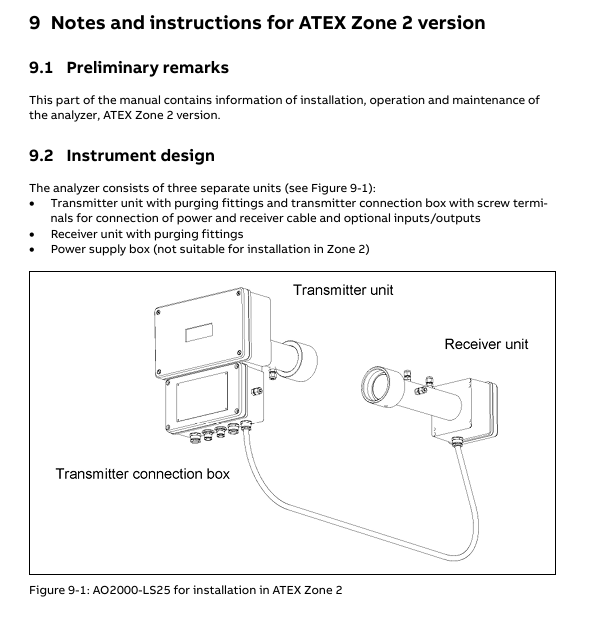
ATEX Zone 2 version: ATEX certified, certification number Presafe 16 ATEX 8621X, II 3 G Ex nA nC IIC T5 (special application T4), operating temperature -20~+55 ℃.
Key technical parameters
Description of specific indicators for parameter categories
The measurement objects CO, CO ₂, H ₂ O, NO, NO ₂, SO ₂, O ₂, CH ₄, etc. support multi-component selection and can measure up to 2 components simultaneously
Measurement accuracy ± 1% full scale based on TDLAS technology and harmonic analysis to achieve high-precision measurement
Response speed<1 second can quickly track dynamic changes in gas concentration
Operating environment temperature: -20~+50 ℃; Pressure: 1-10 bar ABS suitable for complex industrial working conditions
Laser classification O ₂ measurement is Class 1M, others are Class 1 in accordance with IEC 60825-1 standard, laser is near-infrared light (700-2400nm)
Power supply specification input: 110V-380V AC; Output: 24V DC power supply unit outputs 24V DC, transmitter unit inputs 18-36V DC
Physical characteristics: Weight of 3.6kg, warranty period of 1 year. Lightweight design with clear after-sales support
Installation and commissioning process
preliminary preparation
Tool requirements: 2 M16 open-end wrenches, 1 5mm hex wrench, 1 2.5mm flathead screwdriver, 1 PC (386 and above).
Measurement point requirements: At least 5 times the diameter of the straight pipe section is required before the measurement point, and at least 2 times the diameter of the straight pipe section is required after the measurement point; The transmitter and receiver units need to reserve operating space, and at least 1 meter of space should be reserved outside the flange of the receiver unit.
Flanges and Openings: Two pairs of perforations with a diameter of at least 50mm need to be opened on the pipeline/chimney, using DN50/PN10 standard flanges (inner diameter 50mm, outer diameter 165mm), with a flange angle tolerance of ± 1.5 °, and alignment tolerances that meet the requirements of DN50 flange δ min ≥ 40mm and DN80 flange δ min ≥ 55mm.
Cable requirements:
Special requirements for maximum length of cable type
The receiver cable is 150m long and cannot be replaced or modified at will (within ± 20m)
Ensure that all three sets of power cables are connected for a 100m power cable to ensure even current flow
Ethernet cable 100m outdoor use requires acid and UV resistance, supporting 10/100Base-T protocol
Service PC cable 10m standard length 3m, can be extended to about 10m
Installation steps
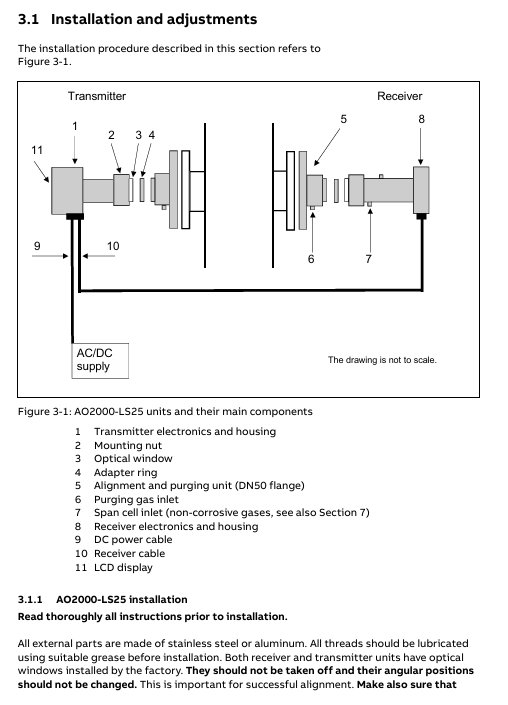
Install the alignment and blowing unit (DN50 flange) of the transmitter/receiver onto the process flange with 4 M16 × 60 bolts to ensure even compression of the O-ring.
Connect the blowing gas (instrument air or nitrogen), with a flange blowing flow rate of approximately 20-50 l/min, and a transmitter/receiver unit blowing flow rate of<0.5 l/min.
Install the window adapter ring (aligning with the positioning pin) and connect the transmitter/receiver unit to the adapter ring, paying attention to installing the O-ring (the transmitter side O-ring needs to be lubricated, while the adapter ring side O-ring is not lubricated).
Connect the cables of each unit: the receiver cable connects the transmitter and receiver, and the power cable connects the power unit and transmitter. If an external 4-20mA temperature and pressure sensor is required, it can be connected to the corresponding terminal of the power unit or transmitter.
Debugging and alignment
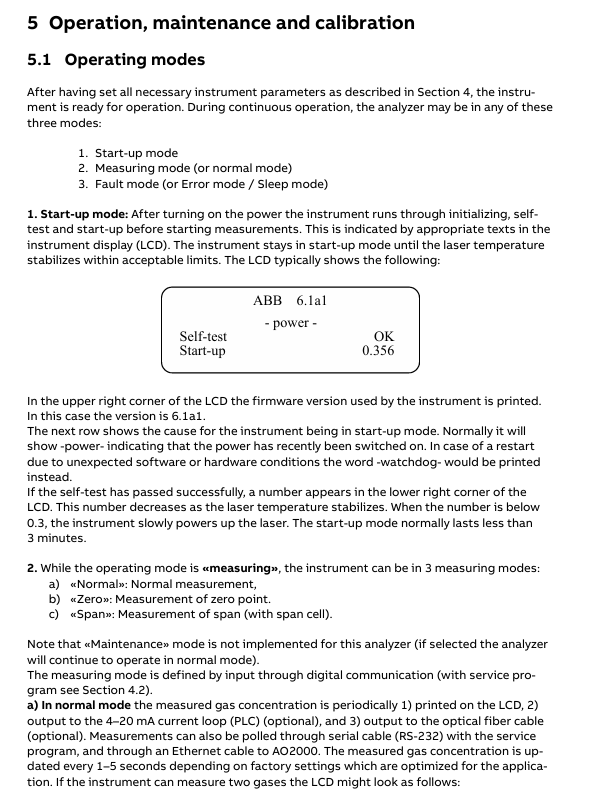
Startup process: After connecting the power, the instrument enters the startup mode (about 5 minutes), and the LCD displays the firmware version, self-test status, and laser temperature stability progress. If the "Laser line up error" is displayed after startup, alignment is required.
Alignment operation:
Remove the adapter ring of the transmitter/receiver and install the red laser calibration fixture.
Adjust the M16 adjustment screw on the transmitter side flange, align the laser beam with the center of the receiver side opening, and lock the locking screw.
Move the calibration fixture to the receiver side and repeat step 2 to align with the center of the opening on the transmitter side.
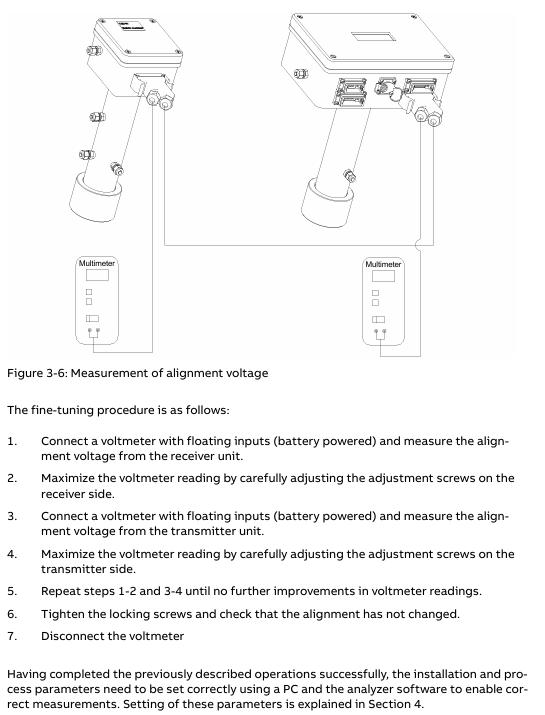
Connect the alignment interface of the transmitter/receiver with a voltmeter (voltage range 0V~-3V), fine tune the flange to maximize the voltage, and ensure that the transmission rate is between 90% -100% (low dust condition).
Software operation and parameter configuration
Software composition
Built in program: integrated into the CPU board, responsible for laser temperature control, signal acquisition, concentration calculation, and self checking, without the need for user operation.
Service program: Running on Windows system, connected to instruments via RS-232 or Ethernet, used for installation, configuration, calibration, troubleshooting, supporting user mode (simplified interface) and advanced mode (full functionality, password required).
Core function operation
Parameter configuration (via the "Measurement configuration" menu):
Temperature and pressure settings: Fixed value, 4-20mA input, internal sensor or spectral measurement (temperature only) can be selected, pressure unit is bar abs (gauge pressure needs to be converted: P (abs)=1.013+P (gauge)), temperature unit is ℃ (Fahrenheit conversion: T (℃)=(T (℉) -32)/1.8).
Optical Path: Set the "Optical Path Length (Gas)" (usually the diameter of the pipeline) and "Optical Path Length (Flange)" (only required when there is a target gas inside the flange). The factory preset "Optical Path Length (inside the transmitter/receiver)" cannot be modified arbitrarily.
Concentration averaging: Set the average number of times (N), and the average time Tavg=N × Tprim (Tprim is the single measurement time, 1-4 seconds, depending on the gas type).
Calibration operation (via the "Calibrate instrument" menu):
Calibration mode applicable scenario operation requirements
PROPORTIONAL's daily calibration and process gas calibration do not require temperature and pressure control, only adjusting calibration constants. It can calibrate a single gas separately and supports automatic calibration of associated gases
GLOBAL laser parameter drift, stable temperature and pressure environment (recommended 1.013bar, 23 ℃) after replacing core components, using standard gas and test cell, password authorization required
Recommended calibration gas concentrations: HF (50-500ppm, PTFE pool), HCl (15-200ppm), CO (0.5-5% vol or 50-500ppm), NO (500-5000ppm), etc.
Data log and fault viewing:
Log function: Set the sampling interval (minimum 2 seconds) through the "Log reads" menu, record parameters such as concentration, transmission rate, temperature and pressure, and support automatic generation of new files by date.
Fault viewing: The "View error log" menu displays fault/warning information (including activation/deactivation time), and can save fault logs and system logs for diagnosis. Common faults include "Low transmission" (cleaning window) and "Laser line up error" (realigning).
Maintenance and troubleshooting
routine maintenance
Regular inspection: Check the transmission rate daily, test the response with standard gas every 3 months (for at least 10 minutes), and calibrate every 3-12 months.
Window cleaning: When the transmission rate is too low, use non abrasive cleaning agents/solvents to clean the optical window. If the window has cracks, it needs to be replaced (pay attention to maintaining the original angle).
Blowing optimization: The flange blowing flow rate can be adjusted according to "blowing flow rate=1/10 process gas flow rate", and the blowing effect can be verified by observing the concentration change after turning off the blowing for 30-60 seconds.
Common faults and solutions
Analysis of the causes of fault information and solutions
Low transmission (warning) Optical window contamination, transmitter/receiver alignment deviation. Clean the optical window and re align the laser
Laser line up error: The laser beam did not reach the detector and the optical path was obstructed. Check for any obstacles in the optical path, clean the window, and realign it
PLC T-read error: Temperature sensor current exceeds the range (<0.3mA or>23.7mA). Check the sensor wiring or switch to a fixed temperature setting
Low laser temp. (Error) Laser temperature adjustment malfunction, laser supercooling check transmitter heat dissipation. If it is not overheated, it may be a hardware failure. Contact after-sales service
EEPROM error: Internal memory failure. Upload backup settings file. If it occurs repeatedly, contact after-sales service
Key issue
Question 1: What are the core differences between the two calibration modes (PROPORTIONAL and GLOBAL) of ABB AO2000-LS25 laser analyzer, and which scenarios are they applicable to?
Answer: The core differences between the two calibration modes are reflected in the calibration objects, operational requirements, and applicable scenarios:
Calibration object: The PROPORTIONAL mode only adjusts the "calibration constant" and optimizes it based on the proportional relationship between the measured concentration and the standard concentration; Adjust the "calibration constant" and "linewidth parameter" simultaneously in GLOBAL mode, taking into account the reference measurement of absorbed linewidth.
Operation requirements: PROPORTIONAL mode does not require temperature and pressure environment control, does not require a password, and can be directly performed on the process site. It supports individual calibration of a single gas or automatic calibration of associated gases; GLOBAL mode requires stable temperature and pressure conditions (recommended 1.013bar, 23 ℃), uses standard gases and test cells, and requires advanced mode passwords (applied to ABB or distributors), making it more difficult to operate.
Applicable scenarios: PROPORTIONAL mode is suitable for daily calibration and adjustment when the deviation of process gas concentration is small (such as deviation<2-3%); GLOBAL mode is suitable for scenarios where laser spectral characteristics drift (such as after long-term use), core components such as laser modules/motherboards are replaced, or calibration effectiveness needs to be ensured over a wide temperature and pressure range.
Question 2: What are the key requirements for flange installation and purging system settings when installing ABB AO2000-LS25 laser analyzer, and what problems may arise if they are not met?
answer:
Key requirements for flange installation:
Flange specifications: DN50/PN10 standard flanges (inner diameter 50mm, outer diameter 165mm) are required. The diameter of the pipe/chimney opening should be at least 50mm, and the flange should be installed with perforations (in the diameter direction).
Tolerance requirements: The perpendicularity tolerance between the flange and the pipeline is ± 1.5 °, and the alignment tolerance must meet the requirements of DN50 flange δ min ≥ 40mm and DN80 flange δ min ≥ 55mm (where δ is the distance between parallel lines at the center of the flange).
Sealing requirements: During installation, it is necessary to ensure that the large O-ring between the flange and the alignment unit is evenly compressed, and the four M16 bolts need to be tightened evenly.
Consequences of failure to meet: Deviation in verticality or alignment can cause the laser to fail to align, resulting in a "Laser line up error"; Poor sealing of O-rings can lead to process gas leakage, contamination of optical windows, or pose safety risks.
Key requirements for setting up the blowing system:
Flange blowing: Use dry and clean instrument air (compliant with ISO 8573.1 Class 2-3, oil mist content ≤ 0.5mg/m ³) or nitrogen, with a flow rate of approximately 20-50 l/min and a recommended flow rate of 1/10 of the process gas flow rate.
Purging of transmitter/receiver unit: It should only be turned on under specific working conditions (such as high dust and corrosive environments), using nitrogen gas (to avoid damaging internal optical components with oil/water in the instrument air), with a flow rate of<0.5 l/min, to prevent excessive pressure inside the unit.
Failure to meet the consequences: Insufficient flange blowing flow will cause dust to deposit in the optical window, resulting in a decrease in transmission rate (warning of "Low transmission" appears); Excessive air or flow during unit blowing can damage internal optical components, affect measurement accuracy, and even lead to instrument failure.
- OMRON
- ABB
- General Electric
- EMERSON
- Honeywell
- HIMA
- ALSTOM
- Rolls-Royce
- MOTOROLA
- Rockwell
- Siemens
- Woodward
- YOKOGAWA
- FOXBORO
- KOLLMORGEN
- MOOG
- KB
- YAMAHA
- BENDER
- TEKTRONIX
- Westinghouse
- AMAT
- AB
- XYCOM
- Yaskawa
- B&R
- Schneider
- KONGSBERG
- NI
- WATLOW
- ProSoft
- SEW
- ADVANCED
- Reliance
- TRICONEX
- METSO
- MAN
- Advantest
- STUDER
- DANAHER MOTION
- Bently
- Galil
- EATON
- MOLEX
- DEIF
- B&W
- ZYGO
- Aerotech
- DANFOSS
- Beijer
- Moxa
- Rexroth
- Johnson
- WAGO
- TOSHIBA
- BMCM
- SMC
- HITACHI
- HIRSCHMANN
- Application field
- XP POWER
- CTI
- TRICON
- STOBER
- Thinklogical
- Horner Automation
- Meggitt
- Fanuc
- Baldor
- SHINKAWA
- Other Brands
- UniOP
- KUKA
- Iba
- Beckhoff
- ADLINK
-
 SIGMATEK SDD340-46 SDD Series Servo Drive
 -
 SIGMATEK Robotdrive L6 02220-7997 Engel Drive
 -
 SIGMATEK AKM63M-ANCNGBB0 4.38kW PM Servomotor
 -
 Sigmatek SDD 310 SLIDES-Drive SDD310-4O
 -
 Sigmatek SDD335-23K Drive VARAN Interface 14kVA
 -
 Sigmatek TAE1922-K Touch Display Unit
 -
 Sigmatek DIAS DCP 643 CPU Module DKL003
 -
 Sumitomo CNH-4105Y-43 NSNP Gear Reducer
 -
 Sumitomo CHHP-4160Y-35-213T Inline Gear Reducer
 -
 Sumitomo CNHM02-6090YA-87 NSNP Gear Motor
 -
 Sumitomo CNVXS-6100Y-43 NSNP Gear Reducer
 -
 Sumitomo CNHM2609511 Gear Motor
 -
 Sumitomo CHVM3-6130-B-35 Gear Motor
 -
 Sumitomo HW0389042-A Industrial Component
 -
 Sumitomo F2CF-W55-ZG05-64 Gear Reducer
 -
 Sumitomo CHH-6165Y-13 Inline Gear Reducer
 -
 Sumitomo CNVM3-6125C-EP-6 Cyclo Gear Motor
 -
 Sumitomo RNYX-1320Y-20 Gear Reducer
 -
Sumitomo XFCG111-43/24/165 Control Component
-
 Sumitomo LHYJ-3A105K-Y3-102 Gear Reducer
 -
 Sumitomo CNFM02-6095DA-B-121 TC-FX/FB-02A Motor
 -
 Sumitomo CNHJ-4105DAY-289 NSNP Gear Reducer
 -
 Sumitomo LHYJS-4C145Y-Y1-112 NSNB Gear Reducer
 -
 Radiator 2060351111 Komatsu Sumitomo Linkbelt
 -
 Sumitomo BL3-09B-35MEHDK6 Gearbox ANFJ-L30
 -
 Sumitomo Truninger 8H1-150 Internal Gear Pump
 -
Sumitomo RNFMS01-25R-B-150 200V NSNP Gearmotor
-
Sumitomo CHHBJN1HA-6135Y-29 Inline Reducer
-
Sumitomo EHYMS5-B6125YA-Y3-74 NSNB Reducer
-
 Sumitomo Eaton H-050AA2F-J Orbit Motor
 -
Sumitomo TC-FXVP Motor 0.75kW 4P 400V N-80M
-
 Sumitomo XFCG111-87/24130 Industrial Control Component
 -
 Sumitomo AF3122-030 Inverter 30kW 3Ph 200V
 -
 Sumitomo QT42-25FS-B Internal Gear Pump
 -
 Sumitomo F2CS-A35-ZG09-59 Speed Reducer
 -
 Sumitomo CNHM05-6090-B-29 Gear Motor
 -
 Sumitomo CHHJ-6145Y-29-210T Gear Reducer
 -
 Sumitomo E3P-20-2.2-S1450-E Hydraulic Pump
 -
 Sumitomo RNYMS1-1420C-AV-20 Right Angle Gear Motor
 -
 Sumitomo SR101 SRKG101-76-40-060 Reamer Head
 -
Sumitomo RNYM05-1220-25/UBAABB Gear Motor
-
 Optidrive E3 Sumitomo GHB-36 Vector Inverter Motor
 -
Sumitomo CNH-614HY-35 UNMP Gear Reducer
-
 Sumitomo CNH-612HY-6 SM-Cyclo Gearmotor
 -
 Sumitomo HF3214-A75 Electric Motor
 -
 Sumitomo CNVM02-6100-B-59 NSMP Gear Reducer
 -
 Sumitomo CNHJ4105Y35 NSNP Gear Reducer
 -
 Sumitomo CHH6165Y-29 NSNB Gear Reducer
 -
Sumitomo RNYM1-1420-25 Hyponic Gear Motor
-
 Sumitomo T600C Industrial Control Unit
 -
 Sumitomo LHH-4A115-K2-28 NSNB Gear Reducer
 -
 Sumitomo RNYM02-1220-AV-20 Speed Reducer
 -
 Sumitomo CHHS-6140Y-SB-17 Gear Motor
 -
 Sumitomo Heavy Industries SSE-100A-RM Drive Unit
 -
Sumitomo PA228771 CNHM2-6100YB-EP-8 Gear Motor
-
 Sumitomo RNYM02-1231-B-50 Speed Reducer
 -
Sumitomo CNFM1H-6090-6 Induction Motor
-
 Sumitomo CHH-614HY-11 Gear Reducer
 -
Sumitomo F4C-D25-ZG01-41 Speed Reducer
-
Sumitomo PA224280 CNHM1-6095YC-EP-21 Gear Motor
-
Sumitomo KHYJB4115K185145TC Gear Motor
-
 Sumitomo LHYJS-3A105Y-Y1-179 NSNB Gearmotor
 -
 Sumitomo AF3102-022 BN AC Driver
 -
 Sumitomo SG75M-H Operator Panel
 -
 Sumitomo NT2014-2A2 NSNP Control Unit
 -
Sumitomo RNYMS03-1320-B-60 Gear with Motor
-
Sumitomo F90L/4 F90L4 Drive Motor
-
Sumitomo TC-FX NSMP Motor Unit
-
Sumitomo RNYM05-1210-7 NSMP Gearmotor
-
Sumitomo Fine Cyclo F2CFS-C45-59 Gearbox
-
Sumitomo Heavy Industries SSE-50A Industrial Unit
-
 Sumitomo CHH-6130Y-17 NSNB Gear Reducer
 -
 Sumitomo UMC556000-02 Control Unit
 -
 Sumitomo CHHJ-4155Y-87 Inline Gear Box
 -
 Sumitomo ANFXS-P120F-M30GLD-5 NSNP Reducer
 -
Sumitomo CNHJ-6095Y-17 NSNP Gear Reducer
-
Sumitomo H-3115 17:1 USNT Gear Reducer
-
Sumitomo CHH 6135Y USNTC02 Gear Reducer
-
 Sumitomo JA450918A2 45JA918A Cylinder Head
 -
 Sumitomo SD4SGS-ACB-02C-110-54 Solenoid Valve
 -
Sumitomo CNVMS02-6100DAYA-231 NSMD Gear Reducer
-
Sumitomo CHH4135Y8 NSMD Inline Gear Reducer
-
Sumitomo PA020201 CNH-6125Y-87 Worm Gear Reducer
-
 Sumitomo Connectivity 8100-2730 Connector
 -
Sumitomo CNHJ-6120Y-87 PA021857 NSNB Gear Reducer
-
Sumitomo RNYM02-1330-B-100 Induction Gear Motor
-
 Sumitomo JA762913AC Operator Interface Keypad
 -
 Sumitomo CQT51-100FV-S1262J-A Coolant Pump
 -
Sumitomo PA225389 CNHM1-6095YC-EP-6 Gear Motor
-
Sumitomo CHHJ-4130Y-43 NSNB Gear Reducer
-
Sumitomo RNYJ-1520Y-12 NSNB Gear Reducer
-
Sumitomo HC1480-29.00 NSMD Inline Gear Reducer
-
 Sumitomo MC-550 MCU UMC550000AEG01
 -
 Sumitomo CNVM1H-6125YA-B-87 Gear Reducer
 -
Sumitomo SD4GS-ACB-02B-110-54 Solenoid Valve
-
Sumitomo HCS79310 Main Motor Assembly
-
Sumitomo JA762913AC Operator Interface Keypad
-
Sumitomo CNHJ-6125Y-8 In Line Reducer
-
 Sumitomo X120D30303T-01 Driver
 -
Sumitomo H1Y203-25-F7000 Shaft Mount Reducer
-
 Sumitomo Type-35SE Fiber Fusion Splicer Kit
 -
Sumitomo F2CS-T655-171 Cyclo Drive Gearbox
-
 Sumitomo F80 Adsorber RX19ZT6124
 -
 Sumitomo MC-550 MCU UMC550000AKG01
 -
 Sumitomo Drive FCS-A65G-59 Speed Reducer
 -
 Sumitomo SRA81-56-BM50-140 Modular Reamer Holder
 -
Sumitomo CNHM05-6100YA-59 Gear Motor
-
 DEMAG Sumitomo Ergocontrol NC4 100 V7 Control Unit
 -
Sumitomo HMV02-207 Cyclo Drive Induction Motor
-
 SUN-EH Sumitomo Z4-22172-12 Ozone Power Unit
 -
Sumitomo AF-500 AF502-2A2 Transistor Inverter
-
 Sumitomo T-82C+ Core Alignment Fusion Splicer
 -
Sumitomo P741F6002B Circuit Board
-
 Sumitomo AS-3211 Injection Molding Motherboard
 -
 Yaskawa SGMGH-13Q5A-OM11 Servo Motor with Sumitomo F3CS-A25G-59 Gear
 -
 Sumitomo SH120-5 Final Drive Track Travel Motor
 -
 Sumitomo AS-3345 Circuit Board
 -
 Sumitomo AF300S-1A5-E Transistor Inverter 1.5kW
 -
 Sumitomo Type-Q101-CA SM MM Fiber Fusion Splicer
 -
 Sumitomo SH50 NIV Operator Panel
 -
Sumitomo RNFM-009-17L-B-120-N4FCZ843 AC Gear Motor
-
 Sumitomo ULC100011-01 LNR Act Driver
 -
Sumitomo SD35E OI Operator Panel
-
 Sumitomo SR44 SRKG44-32-18-030 Reamer Head
 -
 Sumitomo T.SBXH1.5-20PD LN Modulator
 -
 Sumitomo FB10B-4F Brake F Class DC180V
 -
Isuzu 3LB1 Cylinder Head for Sumitomo Loaders
-
 Sumitomo 6 Hand Hydraulic Valve


