
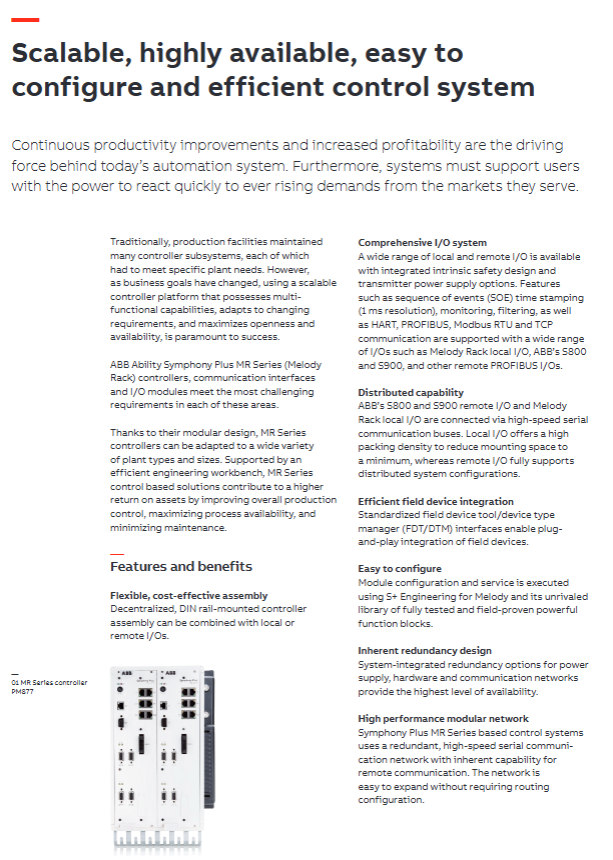
ABB Ability™ Symphony® Plus MR Series
Adaptability: Modular design supports full-scale deployment from small and medium-sized devices to large and complex factories, compatible with local/remote I/O hybrid configurations, and can be expanded as needed;
Reliability: The inherent redundancy design runs through the entire process of power supply, communication, and hardware, meeting the 24/7 continuous operation requirements of critical task scenarios such as power generation and chemical engineering;
Convenience: Through the unified engineering software S+Engineering, configuration, debugging, and maintenance are integrated, supporting online expansion and hot plugging, reducing operation and maintenance complexity;
Compatibility: Following the concept of "evolution without exclusion", seamlessly compatible with the old Melody series systems, protecting user capital and technological investment;
Security: Compliant with Network Security Standards (DSAC), supports industrial grade protocol encryption and access control, and adapts to modern industrial network security requirements.
PROFIBUS DP supports DPV0 (Basic I/O Switching), DPV1 (Alarm/Diagnostic), and DPV2 (Clock Synchronization/Events);
Transmission rate of 9.6kbit/s~12Mbit/s for connecting S800/S900 remote I/O and PROFIBUS devices
Modbus Modbus RTU (extended through CCF module);
Modbus TCP (onboard, 128 servers/16 slaves) third-party device integration (such as instruments, frequency converters)
IEC 61850 is supported through extended interface cards;
Support GOOSE message and MMS service for intelligent electrical device (IED) interconnection, adapting to the needs of the power industry
HART integrated into analog I/O module;
Supports HART 7.0 protocol, bidirectional communication for intelligent instrument configuration and diagnosis
Installation and deployment features
1. Installation method and physical specifications
MR Series supports flexible and diverse installation methods, adapting to different factory layouts and space requirements:
Installation types: DIN rail installation, cabinet installation, 19 inch rack installation. The three methods can be mixed and used in the same project;
Physical specifications:
The module height is uniformly 7 units (approximately 126mm), and the front panel width is divided into 8 rack units (approximately 144mm) or 16 rack units (approximately 288mm);
Both the controller and I/O module adopt a compact design, and the local I/O module has high integration, which can significantly reduce the space occupied by the cabinet;
Protection and environmental adaptability:
Module protection level IP20, suitable for installation inside control cabinets;
Working temperature range -20 ° C~+60 ° C, humidity 5%~95% (non condensing), suitable for high temperature and high humidity industrial environments;
Wiring design:
The on-site cables are connected through standardized terminal units, which support redundant configurations;
The module and terminal unit are connected by plug-in connection, and module replacement does not require disconnecting the on-site cables, achieving "disturbance free maintenance".
2. Deployment Mode and Scalability
The MR Series supports multiple deployment modes, allowing for flexible selection based on factory size and layout
Centralized deployment: The controller and local I/O modules are centrally installed in the central control cabinet, suitable for small and medium-sized devices with simple wiring;
Distributed deployment: The controller is installed in the central control cabinet, and the remote I/O module is deployed in the on-site control cabinet, connected through Fnet or PROFIBUS, reducing the length and cost of on-site cables;
Hybrid deployment: Combining centralized and distributed advantages, key I/O is centrally deployed, decentralized I/O is remotely deployed, and it is suitable for large and complex factories;
Scalability:
A single control station can expand up to 8 local I/O interfaces;
The control network can connect up to 32 control stations and support cross regional collaborative control;
Online scalability: Supports adding I/O modules or control stations during system operation without the need for downtime.
Engineering and Operations Tools
1. Core engineering software: S+Engineering for Melody
S+Engineering for Melody is the unified engineering workbench of MR Series, which adopts a client/server architecture and supports full lifecycle engineering and operation management. Its core functions are as follows:
(1) Configuration and programming functions
Graphic programming: Supports IEC 61131-3 standard programming languages (functional block diagram FBD, ladder diagram LD, sequential functional diagram SFC, etc.), with built-in industry-specific functional block libraries that have been verified on site (such as boiler control in the power generation industry and batch control in the chemical industry);
System configuration: Visualize configuration controller, I/O module, communication network, automatically generate configuration files, support configuration template reuse;
Equipment integration: Implement on-site device "plug and play" integration through FDT/DTM interface, supporting batch configuration and diagnosis of HART and PROFIBUS devices;
Version control: Built in version management function, supporting version comparison, rollback, audit tracking of configuration files, facilitating multi-user collaboration and change management.
(2) Debugging and operation functions
Offline engineering: supports offline configuration and simulation debugging, and can verify control logic without connecting on-site devices;
Remote Access: Supports remote access to controllers and I/O modules through network operations, enabling remote debugging, fault diagnosis, and firmware upgrades;
Fault diagnosis: Real time collection of diagnostic information from controllers, I/O modules, and communication networks, automatic reporting of fault alarms, and providing fault location guidance;
Data Management: Supports importing/exporting configuration data (compatible with CSV, XML, and other formats) for easy data backup and migration;
Online operation: supports online modification of control logic, online expansion of I/O modules, and uninterrupted firmware download to ensure production continuity.
- OMRON
- ABB
- General Electric
- EMERSON
- Honeywell
- HIMA
- ALSTOM
- Rolls-Royce
- MOTOROLA
- Rockwell
- Siemens
- Woodward
- YOKOGAWA
- FOXBORO
- KOLLMORGEN
- MOOG
- KB
- YAMAHA
- BENDER
- TEKTRONIX
- Westinghouse
- AMAT
- AB
- XYCOM
- Yaskawa
- B&R
- Schneider
- KONGSBERG
- NI
- WATLOW
- ProSoft
- SEW
- ADVANCED
- Reliance
- TRICONEX
- METSO
- MAN
- Advantest
- STUDER
- DANAHER MOTION
- Bently
- Galil
- EATON
- MOLEX
- DEIF
- B&W
- ZYGO
- Aerotech
- DANFOSS
- Beijer
- Moxa
- Rexroth
- Johnson
- WAGO
- TOSHIBA
- BMCM
- SMC
- HITACHI
- HIRSCHMANN
- Application field
- XP POWER
- CTI
- TRICON
- STOBER
- Thinklogical
- Horner Automation
- Meggitt
- Fanuc
- Baldor
- SHINKAWA
- Other Brands
- UniOP
- KUKA
- Iba
- Beckhoff
- ADLINK
-
 Sigmatek MDD111-1 DIAS Drive Axis Module
 -
 Sigmatek DKL042 05-024-042 Terminal Module
 -
 Sigmatek DM822 Control Module
 -
 Sigmatek CDM167 12-008-167-O Module
 -
 Sigmatek TAE151 Touch Display Unit
 -
 Sigmatek DCC041 SLIDES Module 05-700-041-D
 -
 Sigmatek AKM65M-ANC2GBB0 PM Servo Motor
 -
 Sigmatek ETT221 01-230-221 Operator Terminal
 -
 Sigmatek SLIDES DAM 124 Analog Module
 -
Sigmatek AKM31C-ANCNGBB0 Servo Motor
-
 Mannesmann Demag Sigmatek CP626 Central Unit
 -
 SIGMATEK 0332.554.03 Board 371071000154
 -
 SIGMATEK 12-250-021 Base Plate Back Panel CM5V020
 -
 SIGMATEK DM162 S-DIAS Digital Mix Module
 -
 DEMAG ERGOTECH 061 381 66 Sigmatek 9842.243.02 Circuit Board
 -
 SIGMATEK CP313-1 PLC Module
 -
Sigmatek ETV0551-2 VARAN Touch Terminal
-
 Sigmatek SDM 081 FS S-Dias Safety Module
 -
 DEMAG 05-250-023 Ergotech Motherboard with Sigmatek TMS012
 -
Sigmatek CM5V020 12-250-023-K Wiring Base
-
 Sigma Tek 5000B-37 Attitude Gyro Indicator
 -
 Sigmatek SDD120-2 DIAS Drive
 -
 Sigmatek CME221 Memory Module
 -
 Sigmatek DCP640 DIAS Central Unit
 -
 Sigmatek STO040 Safety Output Module
 -
Sigmatek CET281 Control Panel
-
 Sigmatek CIPC LX800 Demag NC5 CPU
 -
 Sigmatek DKL093 05-024-093 Terminal Module
 -
 Sigmatek AI088 20-009-088 Analog Input Module
 -
Sigmatek CAI888 Analog Input Module
-
SIGMATEK CCA021 12-025-021 Analog Output Module
-
SIGMATEK 1104.579.05 Control Module
-
SIGMATEK SDI100 Digital Input Module
-
 SIGMATEK C-IPC 256MB LX800 Compact Dias
 -
 SIGMATEK 9423.090.02 Control Module
 -
SIGMATEK C-IPC 256 Power Supply 148498
-
 SIGMATEK CAI025 Analog Input Module
 -
 SIGMATEK CTO166 Digital Output Module
 -
 SIGMATEK CP112 20-004-112 Processor Module
 -
SIGMATEK CAI887 12-009-887 Safety Module
-
 Sigma-Tek 4000B-31 Directional Gyro 1U262-002-42
 -
Sigmatek C-IPC 256MB LX800 IPC Controller
-
Sigmatek C-IPC 01-450-031 Industrial PC LX800
-
Sigmatek C-IPC 256 Industrial PC Controller
-
Sigmatek CCP-531 PLC Processor Module
-
Sigmatek CDI163 Digital Input Module
-
 Sigmatek ETV0501 VARAN Terminal 12-230-0501
 -
 Sigmatek CTMS020 C-DIAS Technology Module
 -
 Sigmatek CIV512 VARAN Switch Module
 -
 Sigmatek HU011 20-080-011 Interface Module
 -
SIGMATEK SLIDES DAM 124 Module
-
 SIGMATEK C-IPC 161 01-450-161L Industrial PC
 -
SIGMATEK C-IPC 128MB VIA 733MHz 01-450-024-K
-
 SIGMATEK 12-780-012 R8-IPC Geode LX800 Module
 -
SIGMATEK CAM124 Analog Module
-
 SIGMATEK S1 032-8AF61-R4 EZ Servo Motor
 -
 SIGMATEK CTO163 Digital Output Module
 -
 SIGMATEK CCP082 12-004-082 Processor Module
 -
 SIGMATEK CRCH081 C-DIAS Temperature Module
 -
 SIGMATEK PC322-K 01-310-322-K Industrial PC
 -
SIGMATEK SDD310-2 Servo Drive
-
 SIGMATEK AI084 Analog Input Module
 -
SIGMATEK CRCH081 12-752-081 Temperature Module
-
Sigma-Tek 5000L-4 Attitude Gyro 1U284-001-3
-
 SIGMATEK CM5V020 12-250-023-K Wiring Module
 -
Sigma-Tek 4000H-6 Directional Gyro IU262-035-7
-
 SIGMATEK Dias DCP160 05-004-160 Processor Module
 -
SIGMATEK 0147.395.02 Control Module
-
SIGMATEK A1084 Control Module
-
SIGMATEK DI200 20-006-2000 Digital Input Module
-
Sigmatek DNC115 Encoder Module
-
 Sigmatek DAM122 05-017-122 Analog Module
 -
Sigmatek 9802.289.01 Control Board TA71 Display
-
Sigmatek TO127 20-007-127 Digital Output Module
-
Sigmatek DNC031 05-011-031 Digital Module
-
Sigmatek VI022 20-003-022 Interface Module
-
Sigmatek CAI085 Analog Input Module
-
 Sigmatek CP111 S-DIAS CPU Module
 -
Sigmatek CTMS030 Krauss Maffei Module
-
 Sigmatek CAM123 Control Module
 -
 Sigmatek TAE732-P 01-240-732-P Touch Display Unit
 -
Sigmatek MDM021 Digital Mixed Module
-
Sigmatek DCP642 DIAS Central Unit
-
 Sigmatek CST022 12-014-022 C-DIAS Module
 -
 Sigmatek SRO021 20-893-021 Safety Relay Output
 -
 Krauss Maffei MC5 Control System Sigmatek
 -
 Sigmatek DC061 Module 18-24VDC 300mA
 -
 Herrmann EVT0855 Ultrasonic Welder Touch Panel
 -
Sigmatek CIV521 Control Module 1.4A 2W
-
Sigmatek DDI61 05-006-161 Digital Input Module
-
SIGMATEK ETT312-E Touch Terminal 01-230-312
-
Cessna S3326-1 Sigma Tek 5000B-67 Gyro 1U149-015-9
-
SIGMATEK PS101 Power Supply Module
-
SIGMATEK 0332.554.03 Control Module 371071000154
-
 SIGMATEK ETT312-E Touch Terminal 01-230-312
 -
SIGMATEK CDM163 Control Module
-
 SIGMATEK VSV046 16-023-046 Module
 -
SIGMATEK AM221 20-017-221 Analog Module
-
SIGMATEK CTS051 12-053-051 Control Module
-
SIGMATEK AM221 20-017-221 Analog Module
-
Sigmatek CSDI161 12-891-161 Safety Input Module
-
Sigma Tek 4000C-1 Directional Gyro Indicator
-
Sigmatek ETV0501 12-230-0501 VARAN Terminal
-
Sigmatek DDM165 SLIDES Module
-
Sigmatek N100 20-011-100 Control Module
-
Sigmatek AKM54K-ANC2R-B0 PM Servo Motor
-
Sigmatek CTO166 Digital Output Module
-
Sigmatek CP212-K 20-004-212-K CPU Module
-
Sigmatek CDI161 Digital Input Module
-
Sigmatek DCC080 05-700-080-2 Control Module
-
 SIGMATEK SCP011 S-DIAS Safety CPU
 -
SIGMATEK SCP011 S-DIAS Safety CPU
-
SIGMATEK SRO022 Relay Output Module
-
SIGMATEK MDD 121 Drive Axis Module
-
SIGMATEK DSI021 SLIDES Siemens Interface
-
SIGMATEK DIAS DCP161 Module 05-004-161
-
 Sigmatek ETT312 Built-in Touch Terminal
 -
SIGMATEK DCP 643 DIAS Controller System
-
SIGMATEK CIO021 Multi I/O Module
-
SIGMATEK CTMS020 Control Module
-
 Sigmatek CME 221 Memory Module
 -
Sigmatek 0420.615.01 Control Board
-
Sigmatek CP111 20-004-111 CPU Module
-
Sigmatek 9405.065.03 Control Board
-
Sigmatek ETEK 01-450-032-K C-IPC 256MB Industrial PC
-
Sigmatek CTO163 12-007-163 Safety Output Module
-
Sigmatek TO081 20-007-081 Digital Output Module
-
 Sigmatek SI021 20-022-021 Safety Input Module


