
YOKOGAWA CONTROL FUNCTIONS OF CENTUM CS 1000
Core design concept:
Integrate the validated high-quality control functions of the CENTUM CS series to ensure control reliability
Strengthen communication capabilities with various subsystems such as programmable logic controllers (PLCs)
Simplify engineering processes, improve on-site equipment compatibility, and reduce application development and maintenance costs through innovative technologies
YOKOGAWA CONTROL FUNCTIONS OF CENTUM CS 1000
Product Overview
Product positioning: Yokogawa is a distributed control system (DCS) developed for small and medium-sized factories, with the core goal of reducing the total cost of ownership (TCO) for users while balancing high functionality and maintainability
Core design concept:
Integrate the validated high-quality control functions of the CENTUM CS series to ensure control reliability
Strengthen communication capabilities with various subsystems such as programmable logic controllers (PLCs)
Simplify engineering processes, improve on-site equipment compatibility, and reduce application development and maintenance costs through innovative technologies
Core functional configuration
(1) Control Function Architecture
Function category, specific content, and function
The minimum control algorithm unit of the basic control component function block (PID controller, selector, etc.) is used to assemble basic control applications
Expand control functions to adjust control blocks, sequence control blocks, SFC blocks, calculation blocks, panel blocks, cover adjustment control, sequence control, batch control and other diverse requirements
Auxiliary management function unit monitoring function is grouped according to process units to manage function blocks, simplifying control and monitoring operations
Input/output function process, I/O implementation, and signal input/output of general sensors and actuators
Input/output function communication I/O achieves signal transmission through universal communication interfaces such as RS-232C
Status prompt function sequence message, alarm real-time feedback system operation status and abnormal information
(2) Reliability Design
Adopting a synchronous hot standby system and continuing the on-site validated FCS reliability design of the CENTUM CS series
Core advantage: In case of sudden CPU failure during operation, the control can seamlessly switch to the backup CPU without interrupting the control action, especially suitable for batch production processes guided by sequence control
Engineering Efficiency Optimization: FCS Template
(1) Design background
The control application is composed of multiple functional blocks, which occupy different internal resources and CPU loads
FCS memory is limited, and if functional blocks are combined in an unordered manner, professional personnel need to estimate resources and load, which is difficult
(2) Template advantages and classification
Core value: Preset database templates according to user expectations for application scenarios, automatically allocate FCS database resources reasonably, and strictly control CPU load to not exceed the limit
Template types: covering three typical application scenarios of regulation control, sequence control, and monitoring, users can directly choose, greatly simplifying the engineering design process
On site communication flexibility design
(1) Core pain point resolution
To address the issues of dispersed on-site control equipment and diverse data types and communication interfaces, two measures are taken to achieve flexible adaptation:
Specific measures to achieve advantages
Separation of Communication Function and Control Application: 1. Data obtained through communication is stored in the "Communication I/O Area"
2. Control the application to access the area through relative addresses or custom tags
3. The system automatically recognizes data types (integers, floating points, etc.) without the need to modify control applications due to communication protocol changes, reducing engineering complexity
C programming adaptation protocol 1. Develop ready-made communication packages for commonly used protocols
2. Special protocols can be encoded in C language to achieve compatibility with multiple universal communication interfaces and protocols, and adapt to different field devices
Innovative virtual testing function: simulator system
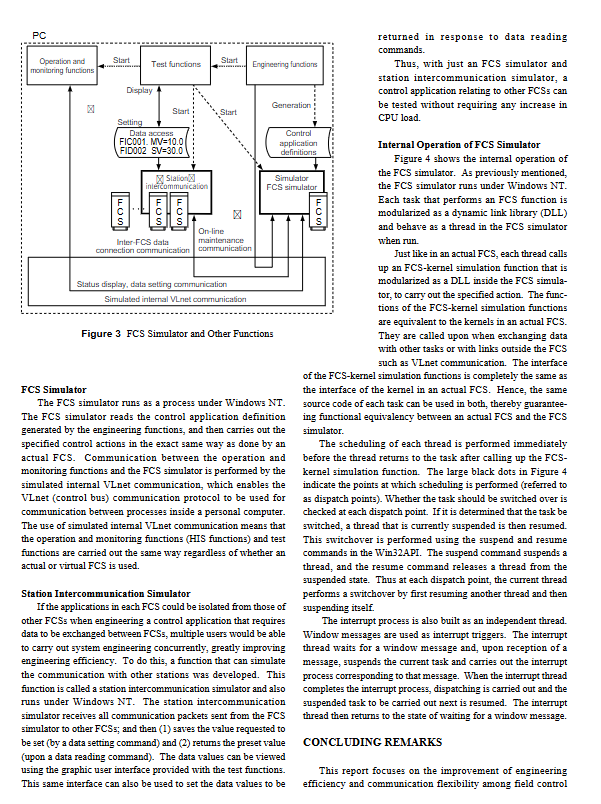
(1) FCS simulator
Operating environment: Windows NT operating system
Core function: Read the control application definitions generated by engineering functions, fully simulate the control actions of actual FCS
Communication mechanism: By simulating internal VLnet communication to achieve interaction with operation monitoring and testing functions, the operation logic is consistent with the actual FCS
Core value: Testing and inspection of control applications can be completed without the need for actual FCS hardware, reducing the cost of building engineering environments
(2) Inter station communication simulator
Design objective: To support control application testing for data exchange between multiple FCS
Working Principle:
Receive all communication data packets sent by the FCS simulator to other FCS
Save the request value of the data setting command and return the preset value when responding to the data reading command
Support viewing and setting return data through a graphical interface
Advantages: Multiple users can carry out system engineering in parallel, improving efficiency without increasing CPU load
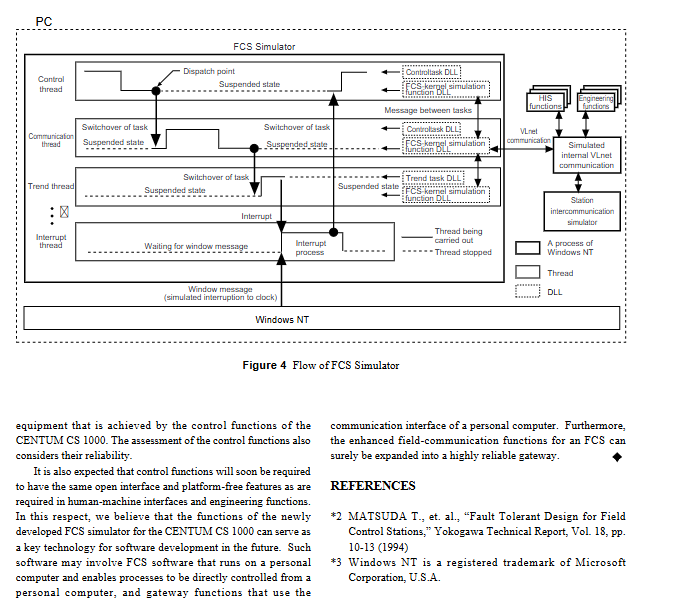
(3) Internal operating mechanism of FCS simulator
Modular design: Each FCS functional task is encapsulated as a dynamic link library (DLL) and runs as a thread at runtime
Kernel adaptation: The FCS kernel simulation function is completely consistent with the actual FCS kernel interface, ensuring source code reuse and functional equivalence
Scheduling mechanism: After a thread calls the kernel simulation function, it triggers scheduling (scheduling point) and switches threads through the suspend/resume command of the Win32 API
Interrupt handling: An independent interrupt thread, triggered by a window message, pauses the current task when interrupted, and resumes scheduling after processing is completed
Summary and Future Prospects
Core achievement: Through FCS templates, flexible communication design, and virtual testing capabilities, we have achieved a unified improvement in engineering efficiency, enhanced adaptability of on-site equipment, and high reliability
Future direction: Plan to further expand open interfaces and cross platform features, extend FCS simulator technology to scenarios such as PC direct control processes and gateway function development, and strengthen the gateway application potential of on-site communication functions
Key issues
Question 1: Through which designs does the CENTUM CS 1000 reduce total cost of ownership (TCO)? Please explain from three dimensions: engineering, hardware, and maintenance.
Answer: 1 Engineering dimension: Provide FCS templates (regulation control, sequence control, monitoring), automatically allocate resources, control CPU load, simplify design process; Innovative FCS simulators and inter station communication simulators can complete application testing without actual hardware, reducing the cost of building engineering environments. 2. Hardware dimension: Integrating mature control functions and enhanced communication capabilities of the CENTUM CS series, without the need for additional dedicated communication modules, reducing hardware procurement costs. 3. Maintenance dimension: The communication function is separated from the control application, and there is no need to modify the control application when the protocol is changed; The synchronous hot standby system ensures uninterrupted control in case of CPU failure, reduces downtime maintenance losses, and overall improves system maintainability.
Question 2: How does CENTUM CS 1000 solve the problem of diversified communication of on-site control equipment? What are the advantages of its communication architecture?
Answer: Solution: 1 Adopting a "communication function and control application separation" architecture, communication data is stored in a separate "communication I/O area", and control applications access it through addresses or tags to automatically identify data types. Protocol changes do not affect control applications; 2. Provide commonly used protocol communication packages, special protocols support C language encoding adaptation, and are compatible with multiple interfaces and protocols. Advantages of Communication Architecture: 1 Strong flexibility, adaptable to dispersed and diverse on-site control equipment; 2. High stability, separate design reduces the impact of single module failure on the overall system; 3. Good scalability, supporting quick adaptation when adding or replacing on-site devices in the later stage.
Question 3: How do the FCS simulator and inter station communication simulator of CENTUM CS 1000 work together to achieve full process coverage of virtual testing?
Answer: Collaborative process: 1 Preliminary preparation: Generate control application definitions through engineering functions and import them into the FCS simulator; 2. Single FCS testing: The FCS simulator runs on the Windows NT system, simulating actual FCS control actions, and verifying the control logic of a single FCS by simulating internal VLnet communication and operation monitoring functions, as well as testing function interactions; 3. Multi FCS interaction test: Enable inter station communication simulator, receive cross FCS communication data packets sent by the target FCS simulator, save setting requests or return preset data, simulate data interaction between multiple FCS; 4. Result verification: View data status and set return values through a graphical interface to complete the full scenario testing of the control application. Core value: It can cover the entire process of testing from single FCS to multi FCS collaboration without the need for actual FCS hardware and multiple device networking, greatly improving engineering efficiency and reducing testing costs.
- OMRON
- ABB
- General Electric
- EMERSON
- Honeywell
- HIMA
- ALSTOM
- Rolls-Royce
- MOTOROLA
- Rockwell
- Siemens
- Woodward
- YOKOGAWA
- FOXBORO
- KOLLMORGEN
- MOOG
- KB
- YAMAHA
- BENDER
- TEKTRONIX
- Westinghouse
- AMAT
- AB
- XYCOM
- Yaskawa
- B&R
- Schneider
- KONGSBERG
- NI
- WATLOW
- ProSoft
- SEW
- ADVANCED
- Reliance
- TRICONEX
- METSO
- MAN
- Advantest
- STUDER
- DANAHER MOTION
- Bently
- Galil
- EATON
- MOLEX
- DEIF
- B&W
- ZYGO
- Aerotech
- DANFOSS
- Beijer
- Moxa
- Rexroth
- Johnson
- WAGO
- TOSHIBA
- BMCM
- SMC
- HITACHI
- HIRSCHMANN
- Application field
- XP POWER
- CTI
- TRICON
- STOBER
- Thinklogical
- Horner Automation
- Meggitt
- Fanuc
- Baldor
- SHINKAWA
- Other Brands
- UniOP
- KUKA
- Iba
- Beckhoff
- ADLINK
-
 Bonfiglioli ISMET LCVT050 DK308/50 Line Reactor
 -
 Bonfiglioli C 22 2 F GR063 Gearbox
 -
 Bonfiglioli C31 3 P P63 PV V5 Reducer
 -
 Bonfiglioli CM-485 T Communication Module
 -
 Bonfiglioli W75UF1D30P90B5 Gearbox
 -
 Bonfiglioli BN63 B4 VF49 Gearmotor 0.18kW
 -
 Bonfiglioli ACT 400-004 FA Frequency Inverter
 -
 Bonfiglioli W110U100P90B5B3 Worm Gearbox
 -
 Bonfiglioli SYN10 T 400 05 AF Inverter
 -
 Bonfiglioli MP080.1.4.15.16.40.80.100 Gearbox
 -
Bonfiglioli SYN10S Inverter
-
 Bonfiglioli VF44L2P160 Gearmotor
 -
Bonfiglioli W 86 U 40 P90 B5 B3 Gear Reducer
-
 Bonfiglioli BTD5-1870-05-400 Servomotor
 -
 Bonfiglioli MP 080 2 2C Gearbox with BLDC Motor
 -
 Bonfiglioli MP080.1.10 Planetary Gearbox
 -
 Bonfiglioli C212PHS Reducer
 -
 Bonfiglioli MVF 49F1 Gearbox with ICME T71B4
 -
 Bonfiglioli VF 49 v P71 B5 Gearbox
 -
Bonfiglioli VF 44 P1 Gearmotor
-
 Bonfiglioli C 22 2 NP 6.1 Helical Gearbox
 -
Bonfiglioli F203 316.9 Gearbox with Kaiser Motor
-
 Bonfiglioli SYN10 S 220 07 AF Frequency Inverter
 -
Bonfiglioli 301L251.8-HC-P90 Gearbox 1/51.8
-
 Bonfiglioli ACT401-25A Frequency Inverter
 -
 Bonfiglioli W75 U D30 30 P90B14 B3 Worm Drive
 -
 Bonfiglioli 830G2310M-307638 Motor
 -
 Bonfiglioli C112-P-P90 Inline Gearbox i=6.2
 -
Bonfiglioli SYN10-S-220-03-AF AC Drive
-
 Bonfiglioli VFR49 A HS Worm Drive i=180 B3
 -
Bonfiglioli ACT 401-29 A AC VFD Drive 22kW
-
 Bonfiglioli VF49PIP63B14 Gearbox
 -
 Bonfiglioli ANG 410-18 2 FA Inverter
 -
 Bonfiglioli GVX2000-7.5-T Converter
 -
 Bonfiglioli EM-ENC-02-24 Optical Module
 -
 Bonfiglioli ACT 401-33 A VFD Drive
 -
 Bonfiglioli MVF 49F1 Gearbox with ICME T71B4
 -
 Bonfiglioli BN112M4 Motor
 -
Bonfiglioli MP080.1.7 Planetary Gearbox
-
 Bonfiglioli VF-EP 49 BN-71-B2 Gearmotor
 -
 Bonfiglioli W75UD3010P80B14B3 Gear Reducer
 -
Bonfiglioli W 110 U 100 P80 B5 B3 Worm Gearbox
-
Bonfiglioli ACT 201-11 FA Frequency Inverter 1.5kW
-
Bonfiglioli MP080380STDISS5 Planetary Gearbox
-
 Bonfiglioli ACU 210-05 1 FA Frequency Inverter
 -
 Bonfiglioli BN63B4 Electric Motor 265 460V
 -
Bonfiglioli BN 63 C 2 Electric Motor
-
Bonfiglioli 12.502.410 BCLP 40XDSM Assembly
-
Bonfiglioli ACU401-13FA Frequency Inverter
-
Bonfiglioli MP 130.2.20.15.16.40.80.100 Gearbox
-
Bonfiglioli VF49N60HSB3 Gearbox
-
 Bonfiglioli VF30P Gearbox
 -
Bonfiglioli ACU410-31A5 Inverter
-
 Bonfiglioli 301L251.8 Gearbox
 -
Bonfiglioli 8XNC63040004 Electric Motor
-
Bonfiglioli VF30F115P63B14B3 Gearbox
-
 Bonfiglioli RAN 28/DA HS Right Angle Gear Unit
 -
 Bonfiglioli 300L220.1PCP90E Gear Unit
 -
Bonfiglioli BN90LA4 Motor
-
Bonfiglioli KG2001030 Gear Unit
-
 Bonfiglioli VF44F135P71B14B3 with VF30 Combination
 -
Bonfiglioli W63 U P90B5 B3 Gear Motor 10:1
-
Bonfiglioli W75 U D30 15 P90 B5 B3 Gearbox
-
 Bonfiglioli B310 DC Motor 600W 3000rpm
 -
Bonfiglioli W 110 U 100 P80 B5 B3 Gearbox
-
 Bonfiglioli VF44P120P71B5B3 Worm Gearbox
 -
 Bonfiglioli BN 71 B 2 Gearmotor VF44 F1 P71B14
 -
 Bonfiglioli 2E130136140005 Assembly Reference
 -
Bonfiglioli KE0702030 Gearbox
-
Bonfiglioli ACT400-004A Frequency Inverter
-
 Bonfiglioli W110 UFC1 P100 B14 B6 Gearbox
 -
 Bonfiglioli Vectron ZBA400-010FC Inverter
 -
 Bonfiglioli 700C-1H Final Drive Motor
 -
Bonfiglioli VF 86 P Gearbox
-
Bonfiglioli W63 U 15 Gearbox
-
 Bonfiglioli VF/W30/63U450P63B14B3 Gearbox
 -
 Bonfiglioli BN 63 A 2 Gear Motor
 -
Bonfiglioli BN 63B 4 Motor
-
 Bonfiglioli VF44P17 Gearmotor
 -
Bonfiglioli T56BN/4 Asynchronous Motor
-
Bonfiglioli W63UF1P90B5 Worm Gearbox
-
Bonfiglioli ACU401-13FA Frequency Inverter
-
Bonfiglioli W63UFC1P90B5 Worm Gearbox
-
Bonfiglioli W75 1/50 D30 Speed Reducer
-
 Bonfiglioli KG2401180 Non Standard Gearbox
 -
Bonfiglioli ACU 201 07 FA Frequency Inverter
-
 Bonfiglioli RAN25SA1HSB3 Gear Unit
 -
Bonfiglioli SPL400 17F Industrial Drive 3.7kW
-
Bonfiglioli VF63P124P71B14B3 Worm Gearbox
-
Bonfiglioli W63U64P71B5B3 Worm Gearbox
-
Bonfiglioli BN90LA4FD Motor
-
Bonfiglioli ANG 410-33 6A Inverter
-
 Bonfiglioli CM-CAN 149-650-034 179-675 140 Communication Module
 -
Bonfiglioli WR110U120P90B5B3 Gearbox
-
Bonfiglioli C 112 F S05 Gearmotor with Pump
-
 Bonfiglioli C50 2P P100 Gear Reducer
 -
 Bonfiglioli ACT 401-31A Inverter 30kW
 -
 Bonfiglioli A102UH25S1PV Gearmotor
 -
Bonfiglioli ACT 201-05 FA Inverter
-
Bonfiglioli AGL402-21 3FA Inverter
-
Bonfiglioli VF49 V 71B14 Gearbox with ESA 6S 12 Motor
-
Bonfiglioli GVX2002-22-T Inverter 22kW
-
Bonfiglioli BN63A2 Electric Motor
-
Bonfiglioli EM I/O-03 I/O Module
-
Bonfiglioli C112 U P63 Inline Gearbox
-
Bonfiglioli BRA 400-075 BF2 Brake Chopper
-
Bonfiglioli VF49 P1 HSRB Worm Gearbox
-
Bonfiglioli GVX2000-18.5-T Inverter
-
Bonfiglioli BMD 118 14 3000 400 165 24 K 67 TC1 Drive
-
Bonfiglioli WR 86 U 120 P80 B5 V5 Gearbox
-
 Bonfiglioli W110U56P100B5B3 Gear Reducer
 -
Bonfiglioli A202 UR 35.4 Bevel Gearbox
-
Bonfiglioli ACU 401-26A Inverter
-
 Bonfiglioli BN 71 B 4 Motor
 -
 Bonfiglioli Vectron BTD5-1870-05-400 Servo Motor
 -
Bonfiglioli BE 80B 4 Motor with C122PP80 Gear
-
Bonfiglioli TR160225STD130ACD Gear Unit
-
Bonfiglioli W 63 U 24 P71 Gearbox
-
Bonfiglioli Trasmital KYB MHKAYABAKTMAGA050VP34 Hydraulic Track Drive
-
Bonfiglioli EM-ABS-01 Encoder Module
-
Bonfiglioli RPS Log 100 Data Logging Module
-
Bonfiglioli VF49P1P71B14 Gearbox
-
Bonfiglioli W86U Right Angle Gear Reducer
-
Bonfiglioli W63 U P71B5 Gear Reducer
-
Bonfiglioli W63UP90B5 Gearmotor
-
 Bonfiglioli VER/S 400-150 Inverter
 -
Bonfiglioli F202 H30 P80 Gearbox
-
Bonfiglioli W75UD307P90B14 Gearbox


