
Woodward DSLC Digital Synchronizer and Load Controller: Installation, Operation, and Troubleshooting Guide
This article provides a detailed introduction to various aspects of the DSLC control system, from basic functions to installation specifications, from configuration adjustments to troubleshooting, providing a comprehensive reference guide for engineering and technical personnel. In practical applications, it is recommended to refer to this manual and relevant technical documents based on the specific system characteristics and operating environment to ensure the best performance and longest service life of the system.
Woodward DSLC Digital Synchronizer and Load Controller: Installation, Operation, and Troubleshooting Guide
In today's industrial and commercial power systems, synchronous grid connection and load control of generator sets are key links to ensure the stability and efficiency of power supply. Woodward Corporation's DSLC ™ As an advanced microprocessor control system, Digital Synchronizer and Load Control provides a complete synchronization, parallel connection, loading, and unloading solution for three-phase generator sets. This article will provide a comprehensive reference guide for engineers and technicians by delving into the technical characteristics, installation points, operating methods, and troubleshooting strategies of the system.
1、 Overview of DSLC Control System
1.1 Product Features and Application Scope
The DSLC control system is a generator load controller designed specifically for use with Woodward speed control and automatic voltage regulators. The system adopts digital signal processing technology, significantly improving synchronization accuracy and load measurement accuracy, and can maintain excellent performance even in the case of waveform distortion.
The main functions include:
Optional phase matching or slip frequency synchronization function, with voltage matching and automatic dead bus closure capability
Automatic generator loading and unloading, achieving undisturbed load transfer
Control capability for sag, base load, and isochronous load
Process control functions such as cogeneration, import and export control, pressure control, etc
Implement equal time load distribution with other units equipped with DSLC control
Reactive Power/Power Factor Control (Full Function Model)
Built in diagnostic function
Multi functional adjustable high and low limit alarm and load switch
Digital communication networks support load distribution, reactive power/power factor distribution
Complete setup, metering, and diagnostic functions are achieved through a handheld programmer
Reverse power relay protection
1.2 System composition and specifications
The DSLC control system can be divided into full function models and simplified function models based on their functions, with the latter not including reactive power/power factor control and process control functions. The system supports multiple wiring configurations, including 120V/240V star wiring and 120V/240V open delta wiring, to accommodate different switchgear configurations.
Electrical specifications:
Control power supply: 18-40 VDC, 18W, 1A maximum
Synchronizer input: 45-66 Hz, with different voltage ranges according to PT configuration
Voltage detection input: three-phase, 45-66 Hz, accuracy 0.1% of full range
Current input: 0-5A RMS, maximum 7A RMS, accuracy 0.1% of full scale
Discrete input: 18-40 VDC, 10mA typical value
Relay drive output: 18-40 VDC, 200mA surge current capability
Environmental specifications:
Working temperature: -40 to+70 ° C
Storage temperature: -55 to+105 ° C
Humidity: 95% at 38 ° C
Mechanical vibration: 2.5G, 24-2000Hz
Electromagnetic compatibility: Complies with ANSI/IEEE C37.90.2 standard
2、 Installation and wiring specifications
2.1 Installation location selection
When selecting the installation location for DSLC controllers, the following factors should be considered:
Avoid direct exposure to water or environments prone to condensation
Ensure that the working temperature is within the range of -40 to+70 ° C
Provide sufficient ventilation and cooling space to shield radiant heat sources
Stay away from high voltage and high current equipment
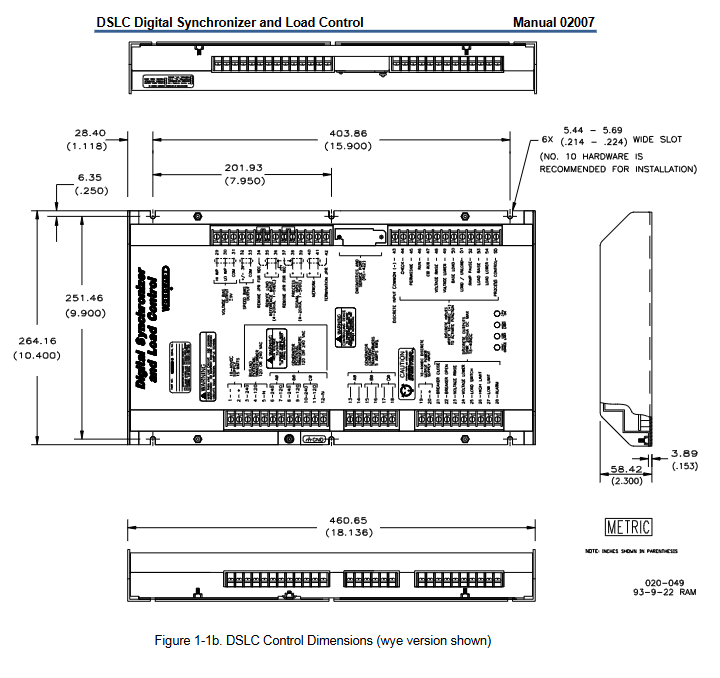
Reserve front maintenance space
Prevent objects from falling onto the terminal position
The chassis must be grounded to ensure safety and shielding
Do not install on the engine
2.2 Key points of electrical connection
Power connection:
Using an 18-40VDC low impedance power supply with a power of 18W
Negative terminal 1, positive terminal 2
Avoid sharing power cords with other devices
The length of the power cord should be as short as possible
Power on at least 15 seconds before expected use to ensure control completes power on diagnosis
Shielding wiring requirements:
All shielded cables must be twisted pair
Do not attempt to tin the braided shielding layer
The signal line should be shielded to prevent picking up stray signals from adjacent devices
The exposed wires outside the shielding layer should be as short as possible, not exceeding 50mm
The other end of the shielding layer must remain open and insulated from other conductors
The cable shielding layer should be connected to the chassis ground, with the input end only grounded at the control end and the output end grounded at the speed control and voltage regulator ends
2.3 Connection specifications for transformers
Voltage Transformer (PT) Connection:
The busbar and generator should use the same voltage transformer
Bus phase A must correspond to generator A connected to the load sensor
The phase sequence of the busbar must correspond to the phase sequence of the generator to ensure the normal operation of the synchronizer
Select the correct PT wiring method (star or open delta) based on the configuration of the switchgear
Current Transformer (CT) Connection:
The CT connection must be correct, and the corresponding phase CT and PT must be connected to the same phase terminal controlled by DSLC
It is necessary to observe the correct polarity
Provide 5A RMS full load current for optimal system performance
There is a risk of fatal electric shock if any wires connected to the generator CT terminal are disconnected while the engine is running
3、 System configuration and calibration
3.1 Use of Handheld Programmer
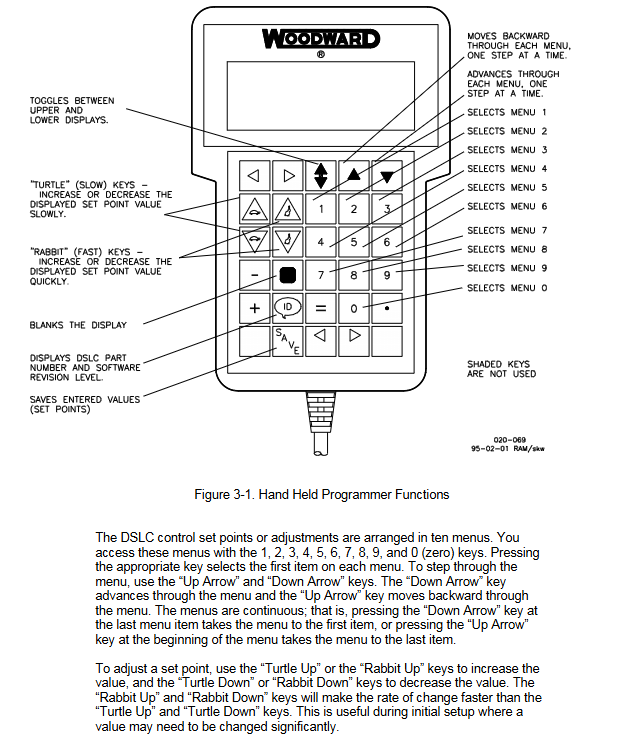
A handheld programmer is a small computer terminal that connects to the DSLC control RS-422 diagnostic and service port. Its main functions include:
After completing the power on self-test, press the ID key to display the control software part number and revision level
Four line backlit LCD display screen, capable of viewing two functions or menu items simultaneously
Access ten settings menus through numeric keys 1-0
Use the 'up/down arrow' keys to navigate through the menu
Use the "Turtle" key (slow) and the "Rabbit" key (fast) to adjust the set value
Press the 'Save' button to store the set values in the EEPROM memory
3.2 Detailed explanation of menu system
Menu 1- Synchronizer Settings:
Contains 16 parameters including synchronization gain, stability, slip frequency reference, voltage matching, and dead bus closure, used to optimize synchronization performance.
Menu 2- Load Control:
Contains 30 parameters including load control gain, stability, mode selection, rated load, base load, unloading trip, etc., used for precise control of generator load.
Menu 3- Process Control (Full Function Model):
Contains 16 parameters including process control gain, stability, dead zone, reference value, etc., used for process control applications.
Menu 4- Reactive Power/Power Factor Control (Full Function Model):
Contains 17 parameters including control mode, gain, stability, rated reactive power, reference value, etc., used for reactive power or power factor control.
Menu 5- Configuration:
Contains 9 parameters including PT winding ratio, CT rated value, PT voltage input, system frequency, etc., used for basic system configuration.
Menu 6- Calibration:
It includes 13 calibration items such as process input, remote input, speed bias output, and voltage bias output to ensure measurement accuracy.
Menu 7- Generator Electrical Parameters:
Provide 20 real-time monitoring parameters including active power, apparent power, reactive power, power factor, and voltage and current of each phase.
Menu 8- Control Status Monitor:
Display 13 status information including synchronizer mode, load control mode, load reference, process reference, etc.
Menu 9- Discrete Input/Output:
Display the status of all switch inputs and relay outputs, with a total of 25 monitoring points.
Menu 0- Diagnosis:
Provide 14 diagnostic information including diagnostic results, ROM checksum, number of active DSLCs, and network error statistics.
3.3 Initial setup program
Pre startup setup steps:
Connect the handheld programmer to provide power supply for DSLC control
Verify that the diagnostic result (menu 0) is 49, indicating that it has passed the self-test
Select menu 5, set the configuration key to 49, and configure basic parameters
Set all parameters of synchronizer menu 1 according to the worksheet
Set all parameters of load control menu 2 and initially use proportional load control mode
Set all parameters of process control menu 3 (if used)
Set all parameters of reactive power/power factor control menu 4 and initially disable this function
4、 Adjustment and optimization
4.1 Synchronizer Adjustment
Phase matching synchronizer settings:
Set the slip frequency reference to 0.0Hz and select phase matching
Turn off the synchronizer check mode switch
Adjust synchronous gain to achieve stable frequency control
Verify the performance of the synchronizer under different operating conditions
Slip frequency synchronizer setting:
Complete phase matching synchronizer setup
Set the required slip frequency reference value
Adjust synchronization gain and stability to achieve smooth phase rotation
Verify the performance of the synchronizer under various operating conditions
Voltage matching adjustment:
For voltage regulators using MOP: Adjust the voltage ramp time and verify the voltage matching function
For direct voltage bias input: adjust the voltage range potentiometer and set the desired voltage range
Set voltage high and low limits and alarm function
4.2 Load Control Adjustment
Proportional base load control setting:
Set the load control gain to 0.25
Carefully set the engine speed to achieve synchronous speed
Close the base load switch contactor, open the load/unload and process contactors
Select the synchronizer operation mode to connect the generator in parallel with the busbar
Verify load stability and control performance
Integral based load control setting:
Complete proportional load control settings
Set the load control mode to integral
Adjust load control gain, stability, and derivative parameters
Verify control stability under various load conditions
Timed load distribution adjustment:
Verify that the rated load setting is correct
Check that the number of DSLCs in the activity matches the number of installations
Set the load distribution gain to 0.72
Verify load distribution performance
4.3 Process Control Adjustment
Set process control gain, stability, derivative, dead zone, and filter parameters
Select direct or indirect control actions based on process characteristics
Set process reference values
Adjust dynamic parameters to achieve stable process control
Set process high and low limit values and alarm functions
4.4 Reactive Power/Power Factor Control Adjustment
Verify that voltage matching adjustment has been completed
Set reactive power/power factor gain and stability parameters
Set rated reactive power and reference value
Adjust and control dynamic parameters
Set power factor dead zone to reduce response to minor changes
Enable voltage fine-tuning function (if necessary)
5、 Network Communication and Remote Monitoring
5.1 LonWorks Network Configuration
The DSLC control system uses Echelon's LonWorks technology for inter device communication, supporting load distribution, reactive power/power factor distribution, and dead bus closure permission management.
Network specifications:
Data rate: 1.25 Mbps
Network isolation: 1000Vrms (60 seconds) at 60Hz, 277Vrms (continuous)
Common mode range: 277Vrms
Electrostatic discharge: 15kV
Maximum number of nodes per bus: 64 (0 to+70 ° C), 32 (-20 to+85 ° C), 20 (-40 to+85 ° C)
Network bus length: 500m (-20 to+85 ° C), 150m (-40 to+85 ° C)
Maximum stub length: 300mm (-40 to+85 ° C), 600mm (0 to+70 ° C)
Network terminal: Terminals need to be installed on both ends of the network
Wiring requirements:
Use the recommended shielded twisted pair cable
Ensure that the bus length is less than 500m
The length of the stub is less than 300mm
Less than 32 network devices
Minimize exposed wires outside the shielding layer
Verify the shielding continuity of the entire network
Grounding shielding layer at the center position
Install terminals only on both ends of the network
Avoid wiring together with power cords or other high electrical noise circuits
5.2 Remote monitoring function
The DSLC control system provides complete remote monitoring functions through the LonWorks network, including:
Electrical parameter output:
Real time data such as voltage, current, power, and power factor are provided through three data structures (ELEC-PARAOUT1, OUT2, OUT3) with an update rate of 1 second.
Remote control input:
Net_demote_in: Network remote load or process control reference input
Net_decess_in: Network input from LonWorks compatible process transmitters
Net_iscrete_in: Network input from remote sequencer
Discrete input/output states:
The status of all switch inputs and relay outputs can be monitored through the network.
6、 Troubleshooting and Maintenance
6.1 Common problem diagnosis
Unit unable to power on:
Check the+24V power supply
Ensure the correct polarity of the power supply
Check if the software PROM is installed correctly
Unstable load control:
Check phase current and voltage calibration
Adjust the rated speed of the speed control unit
Change the load control mode
Unstable process control mode:
Ensure that the load control is set to proportional control
Dynamically adjust the process control again
Unstable reactive power/power factor control mode:
Dynamically adjust reactive power/power factor control again
Remove cross current compensation from the voltage regulator circuit
Incorrect load allocation during waiting:
Check if the rated load setting is correct
Adjust the rated speed of the speed control unit
6.2 Network Troubleshooting
The number of DSLCs in the activity is incorrect:
Check if all DSLC controlled network addresses are unique
Verify whether the network cabling complies with specifications
Check the impact of each DSLC control on the network one by one
Network communication error:
Check if the network cabling installation complies with the specifications
Verify if the network is overloaded
Check if there are any equipment malfunctions affecting network communication
6.3 Service Options
Woodward offers a variety of product and service options:
OEM and packager support: Obtain services through original equipment manufacturers or device packagers
Woodward Business Partner Support: Obtain services through a global network of independent business partners
Factory repair options: including replacement/exchange, uniform rate repair, and uniform rate remanufacturing
Return to equipment maintenance:
Contact the full-service distributor in advance to obtain return authorization and shipping instructions
Attach a label containing complete information when transporting goods
Packaging control equipment according to specifications to prevent transportation damage
7、 Safety precautions
7.1 Warning and Notice
Important definition:
Danger: Indicates a dangerous situation that, if not avoided, may result in death or serious injury
Warning: Indicates a dangerous situation that, if not avoided, may result in death or serious injury
Attention: Indicates a dangerous situation, which may result in minor or moderate injury if not avoided
Notice: Indicates the potential danger of property damage
Important: Specify operation prompts or maintenance suggestions
Key safety requirements:
Engines, turbines, or other types of prime movers should be equipped with overspeed shutdown devices
The overspeed shutdown device must be completely independent of the prime mover control system
Prepare for emergency shutdown when starting the engine, turbine, or other prime mover
Always wear appropriate personal protective equipment
Turn off the charging device before disconnecting the battery to prevent damage to the control system
7.2 Prevention of Electrostatic Discharge
Static electricity prevention measures:
Discharge body static electricity before handling control equipment
Avoid using plastic, vinyl and foam around printed circuit boards
Do not touch the components or conductors on the printed circuit board with your hands or conductive devices
Wear cotton or cotton blend materials as much as possible to reduce static electricity accumulation
- OMRON
- ABB
- General Electric
- EMERSON
- Honeywell
- HIMA
- ALSTOM
- Rolls-Royce
- MOTOROLA
- Rockwell
- Siemens
- Woodward
- YOKOGAWA
- FOXBORO
- KOLLMORGEN
- MOOG
- KB
- YAMAHA
- BENDER
- TEKTRONIX
- Westinghouse
- AMAT
- AB
- XYCOM
- Yaskawa
- B&R
- Schneider
- KONGSBERG
- NI
- WATLOW
- ProSoft
- SEW
- ADVANCED
- Reliance
- TRICONEX
- METSO
- MAN
- Advantest
- STUDER
- DANAHER MOTION
- Bently
- Galil
- EATON
- MOLEX
- DEIF
- B&W
- ZYGO
- Aerotech
- DANFOSS
- Beijer
- Moxa
- Rexroth
- Johnson
- WAGO
- TOSHIBA
- BMCM
- SMC
- HITACHI
- HIRSCHMANN
- Application field
- XP POWER
- CTI
- TRICON
- STOBER
- Thinklogical
- Horner Automation
- Meggitt
- Fanuc
- Baldor
- SHINKAWA
- Other Brands
- UniOP
- KUKA
- Iba
- Beckhoff
- ADLINK
-
 MICRO INNOVATION GF1-10TVB-100 Touch Panel
 -
 MICRO INNOVATION AG WINBLOC CAN-4AI/UI Analog Input Module
 -
 MICRO INNOVATION AG WINBLOC CAN-32DO/0.5A-P-2x16 Output Module
 -
 MICRO INNOVATION AG CAN-32DI/P-2X16 8551224182 Input Module
 -
 MICRO INNOVATION MK2-230/232-57 Circuit Board 85 28 200000
 -
 MICRO INNOVATION CAN-BRIDGE 8551224177 CAN Bridge
 -
 Micro Innovation MC2-430-10TVB-1-10 Panel 24VDC
 -
 MICRO INNOVATION MC2-432-57CQB-1-10 HMI Panel
 -
MICRO INNOVATION AG CAN-BRIDGE 85 51 224177 CAN Bridge
-
 MICRO INNOVATION CAN-4AI/UI Analog Input Module
 -
MICRO INNOVATION CAN-32DI/P-2X16 Input Module
-
 SIGMATEK MDD111 09-404-111 Drive Module
 -
 SIGMATEK DVI021 Display Interface Module
 -
 SIGMATEK 00-450-024 C-IPC Processor
 -
 SIGMATEK MDD-111 MDD111 Drive Module
 -
 SIGMATEK ICA011 20-102-011 Interface Module
 -
 SIGMATEK 01-250-010-D NC4Kompakt Control Module
 -
 SIGMATEK CRIF081 12-751-081 Interface Module
 -
 SIGMATEK S1026-8AF61-R4E-Z57 Drive Module
 -
 SIGMATEK 9305.081.02 9227.082.00 Control Module
 -
 Sigma Tek 5000B-36 Attitude Indicator
 -
 SIGMATEK CEZ201 12-051-201-O Counter Module
 -
 SIGMATEK DPS001 Power Supply Module
 -
 SIGMATEK 994 395 01z Via Interface Module
 -
 SIGMATEK PC411-K 01-310-411-K Industrial PC
 -
 SIGMATEK 9816.324.00 Demag NC4 Keyboard
 -
 SIGMATEK ET261 90010C-71 Operator Terminal
 -
 SIGMATEK DDI 164 05-006-164 Input Module
 -
 SIGMATEK CCP 082 C-DIAS Processor Module
 -
SIGMATEK CEZ201 12-051-201-O PLC Module
-
SIGMATEK MDD 1111 06178867 Drive Module
-
SIGMATEK S1 073-6AC61-RE-Y08-Z Drive Module
-
SIGMATEK MDD 111 Drive Module MDD111
-
 SIGMATEK CSDI161 Safety Module 12-891-161
 -
SIGMATEK C-IPC Processor 01-450-024
-
 SIGMATEK DIAS DAM122 Analog Mixing Module
 -
Sigma Tek 5000B-36 Attitude Gyro Indicator
-
 SIGMATEK TMS012 Motherboard Module 05-250-012-T
 -
 SIGMATEK CCP-531 PLC Module
 -
SIGMATEK DIAS DNC4 I/O Module 05-250-011
-
 SIGMATEK AI088 Analog Input Module
 -
 SIGMATEK CEZ201 Counter Module
 -
SIGMATEK CIC011 Industrial Computer Module
-
 SIGMATEK MDM021 Motor Drive Module
 -
 SIGMATEK DTO163 Digital Output Module
 -
SIGMA-TEK 5000B-36 Attitude Gyro
-
SIGMATEK DM161 Digital Input Module
-
SIGMATEK CCP-531 PLC Control Panel
-
 SIGMATEK HZS773 Touch Terminal Operator Panel
 -
SIGMATEK MDP101 3 KVA 45-65Hz Driver
-
 SIGMATEK ETV1251 Touch Panel 12-230-1251
 -
SIGMATEK CIO021 Safety Module 12-013-021
-
Sigma Tek 4000H-5 Directional Gyro
-
 SIGMATEK TAE531 I/O Module 01-240-531
 -
 SIGMATEK DAI081 Input Module 05-009-081
 -
 SIGMATEK DCP640 Drive Control Module
 -
 SIGMATEK DCP643 Slides Module A6-29
 -
SIGMATEK SCP011 Safety Module 20-890-011
-
SIGMATEK DDM 164-D Slides Module
-
 SIGMATEK C-IPC Processor 146267
 -
SIGMATEK ET3200 Display Screen
-
SIGMATEK CEZ221 C-DIAS Mixing Module
-
 SIGMATEK SDD120-2 DIAS Servo Drive
 -
SIGMATEK DIP011 05-058-011 Module
-
 Sigmatek DEC181 I/O Module
 -
SIGMATEK DCP640 DIAS Central Unit
-
SIGMATEK 00-450-024 C-IPC Industrial Computer
-
SIGMATEK AKM32C-ANCNR-B0 Servomotor
-
SIGMATEK DVI021 DIAS Power Module
-
SIGMATEK CTS051 12-053-051 Control Module
-
 SIGMATEK CTS022 Control Module
 -
 Sigmatek 01-250-010-D NC4Kompakt V2.1 Module
 -
 SIGMATEK Control Keyboard 01-285-042 Interface
 -
 SIGMATEK TO081 20-007-081 Digital Output Module
 -
 Sigmatek AKM73Q-ANCNGBB0 7.07kW Servo Motor
 -
Sigmatek DIP012 Demag 07024165 Processor Module
-
 SIGMATEK PC 411 Injection Molding Controller
 -
SIGMATEK CEZ201 12-051-201-O Processor Module
-
 SIGMATEK VI021 20-003-021 Digital Input Module
 -
SIGMATEK Computer C-IPC 144904 Industrial PC
-
 SIGMATEK 9307.083.01 9305.081.02 Industrial Module
 -
 SIGMATEK AI075 Analog Input Module
 -
 SIGMATEK HGT834-W Teaching Pendant
 -
Sigmatek CDI161 Digital Input Module
-
 SIGMATEK HGT834 Teaching Pendant
 -
 SIGMATEK CEZ201 12-051-201-O Module
 -
SIGMATEK Demag 9617.067.03 9708.244.00 Module
-
 SIGMATEK SCP010 Safety CPU Module
 -
SIGMATEK N100 20-011-100 Module
-
 SIGMATEK CNC 031 Positioning Output Module
 -
 Sigmatek 01-355-016 Control Module
 -
 Sigmatek MDM021 Digital Mixed Module
 -
Sigmatek DAI411 05-020-411 Analog Module
-
Attitude Gyro 1U367-232-2 Aircraft Instrument
-
 Sigma-Tek 5000B-36 Attitude Gyro 23-501-06-16
 -
Sigmatek HGT834-W Injection Molding Teach Pendant
-
Sigma Tek 5000EG Attitude Gyro 1U670-003-12
-
Sigmatek HGT834-W Teach Pendant
-
Sigmatek DEE011 05-068-011 Module
-
Sigmatek DIAS DCP643 Central Processing Unit
-
Sigmatek MDD111-1 DIAS Drive Axis Module
-
 Sigmatek DKL042 05-024-042 Terminal Module
 -
Sigmatek DM822 Control Module
-
Sigmatek CDM167 12-008-167-O Module
-
Sigmatek TAE151 Touch Display Unit
-
 Sigmatek DCC041 SLIDES Module 05-700-041-D
 -
Sigmatek AKM65M-ANC2GBB0 PM Servo Motor
-
Sigmatek ETT221 01-230-221 Operator Terminal
-
Sigmatek SLIDES DAM 124 Analog Module
-
Sigmatek AKM31C-ANCNGBB0 Servo Motor
-
Mannesmann Demag Sigmatek CP626 Central Unit
-
SIGMATEK 0332.554.03 Board 371071000154
-
 SIGMATEK 12-250-021 Base Plate Back Panel CM5V020
 -
SIGMATEK DM162 S-DIAS Digital Mix Module
-
DEMAG ERGOTECH 061 381 66 Sigmatek 9842.243.02 Circuit Board
-
 SIGMATEK CP313-1 PLC Module
 -
Sigmatek ETV0551-2 VARAN Touch Terminal
-
 Sigmatek SDM 081 FS S-Dias Safety Module
 -
 DEMAG 05-250-023 Ergotech Motherboard with Sigmatek TMS012
 -
Sigmatek CM5V020 12-250-023-K Wiring Base
-
Sigma Tek 5000B-37 Attitude Gyro Indicator
-
Sigmatek SDD120-2 DIAS Drive
-
 Sigmatek CME221 Memory Module
 -
Sigmatek DCP640 DIAS Central Unit
-
 Sigmatek STO040 Safety Output Module
 -
Sigmatek CET281 Control Panel
-
Sigmatek CIPC LX800 Demag NC5 CPU
-
Sigmatek DKL093 05-024-093 Terminal Module


