
WESTINGHOUSE E-Series MCCB (Molded Case Circuit Breaker)
Product positioning: The E-series molded case circuit breaker (MCCB) is the core product in its power transmission and distribution field, designed specifically for industrial and civilian power distribution systems. Its core function is to achieve overload protection and short circuit protection of the circuit, ensuring the safety of electrical equipment and lines.
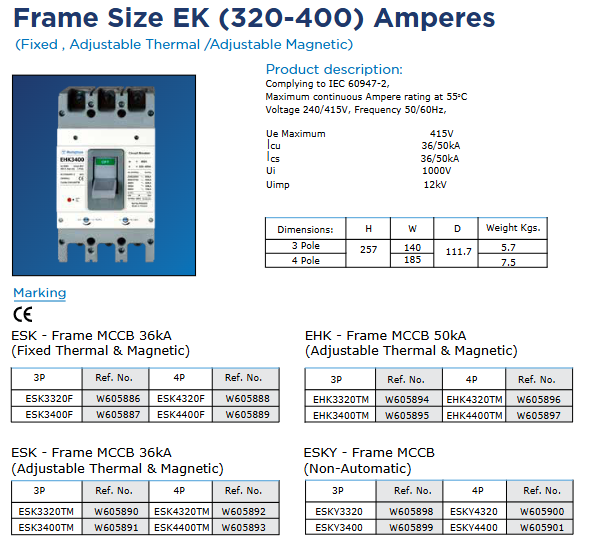
ESK 36kA Adjustable Thermal Magnetic Release (TM) Thermal Release 0.8-1.0In, Magnetic Release 5-10In, Flexible Adaptation 320A、400A、500A、630A ESK3320TM(W605890) ESK4630TM(W605909)
ESK 36kA Electronic Release (E) Electronic Adjustment, High Accuracy, Stable Protection Characteristics 500A, 630A ESK3500E (W607452) ESK4630E (W610439)
EHK 50kA Adjustable Thermal Magnetic Release (TM) High Breaking Capacity+Adjustable Parameters, Suitable for Large Equipment Power Distribution 320A、400A、500A、630A EHK3320TM(W605894) EHK4630TM(W605913)
EHK 50kA electronic release (E) high breaking and high-precision electronic release, suitable for precision industrial systems 500A、630A EHK3500E(W607454) EHK4630E(W610441)
ESKY - Non Automatic Manual Control, No Automatic Protection, Suitable for Special Control Scenarios 320A、400A、500A、630A ESKY3320(W605898) ESKY4630(W605917)
Types and protection characteristics of trip units
The trip unit is the core of the circuit breaker, responsible for detecting circuit abnormalities and triggering tripping. The E series provides three types of trips to meet different precision and scenario requirements, and the protection characteristics are clearly defined by the time current curve:
(1) Detailed explanation of types of trip units
Fixed Thermal&Magnetic Release
Working principle: The thermal trip element (bimetallic strip) detects overload current, slowly heats up and deforms to trigger tripping (delayed protection); Magnetic release element (electromagnet) detects short-circuit current and instantly generates suction force to trigger tripping (instantaneous protection).
Advantages: Simple structure, high reliability, low cost, no need for power supply, suitable for general scenarios without special adjustment requirements for paired protection parameters.
Adjustable Thermal&Magnetic Release
Adjustment range: Thermal trip (overload protection) 0.8-1.0In, the overload threshold can be fine tuned according to the circuit load characteristics; Magnetic release (short-circuit protection) 5-10In, adaptable to different short-circuit current levels.
Advantages: Strong universality, able to flexibly match different load types (such as motors, lighting, power equipment), and is the main release type of the E series.
Electronic Adjustable Release
Core features: By detecting current through electronic components, the adjustment accuracy is higher (with an error of ± 2%), and the protection characteristics can be subdivided (such as long delay, short delay, instantaneous), only available in EK frame 500-630A models.
Advantages: More comprehensive protection functions, suitable for precision equipment and industrial automation systems with high protection accuracy requirements.
(2) Time current curve characteristics
Circuit breakers of different current levels have clear time current curves to ensure the accuracy and coordination of protection actions:
EJ framework 200-250A (ESJ, EHJ series):
Overload protection (delay): When the rated current is 1.3 times, the tripping time is about 10-30 minutes; When the rated current is 4 times, the tripping time is about 2-6 minutes.
Short circuit protection (instantaneous): maximum instantaneous tripping current 2500 ± 500A, total breaking time ≤ 0.05 seconds.
EK framework 315-400A (ESK, EHK series):
Overload protection (delay): When the rated current is 1.3 times, the tripping time is about 14-30 minutes; When the rated current is 6 times, the tripping time is about 4-10 minutes.
Short circuit protection (instantaneous): instantaneous tripping current 6-10In (± 20%), total breaking time ≤ 0.05 seconds.
EK frame 500-630A (ESK, EHK series):
Overload protection (delay): When the rated current is 1.3 times, the tripping time is about 14-30 minutes; When the rated current is 6 times, the tripping time is about 4-10 minutes.
Short circuit protection (instantaneous): instantaneous tripping current 6-10In (± 20%), total breaking time ≤ 0.05 seconds.
Optional attachments and extended features
The E series supports multiple accessory extensions, which can be flexibly matched according to control and monitoring needs to enhance the functionality and adaptability of circuit breakers
Shunt Trip: Receive external control signals (such as fire linkage and remote commands) to achieve remote tripping and adapt to scenarios that require centralized control.
Under Voltage: When the circuit voltage is lower than the set value, it automatically trips to protect voltage sensitive equipment (such as precision instruments and motors).
Aux. Contacts: Used to provide feedback on the on/off status of circuit breakers (such as "closed" and "tripped" signals), compatible with automated monitoring systems.
Trip Alarm Contacts: When the circuit breaker trips due to overload or short circuit, an alarm signal is issued to facilitate troubleshooting and maintenance.
Application scenarios and selection suggestions
(1) Core application areas
In the field of industrial production: power distribution protection for factory workshops, industrial plants, and production lines, overload and short circuit protection for equipment such as motors, pumps, and fans. The EK frame 320-630A series is recommended (EHK sub series is preferred, with high breaking capacity more suitable for industrial scenarios).
- OMRON
- ABB
- General Electric
- EMERSON
- Honeywell
- HIMA
- ALSTOM
- Rolls-Royce
- MOTOROLA
- Rockwell
- Siemens
- Woodward
- YOKOGAWA
- FOXBORO
- KOLLMORGEN
- MOOG
- KB
- YAMAHA
- BENDER
- TEKTRONIX
- Westinghouse
- AMAT
- AB
- XYCOM
- Yaskawa
- B&R
- Schneider
- KONGSBERG
- NI
- WATLOW
- ProSoft
- SEW
- ADVANCED
- Reliance
- TRICONEX
- METSO
- MAN
- Advantest
- STUDER
- DANAHER MOTION
- Bently
- Galil
- EATON
- MOLEX
- DEIF
- B&W
- ZYGO
- Aerotech
- DANFOSS
- Beijer
- Moxa
- Rexroth
- Johnson
- WAGO
- TOSHIBA
- BMCM
- SMC
- HITACHI
- HIRSCHMANN
- Application field
- XP POWER
- CTI
- TRICON
- STOBER
- Thinklogical
- Horner Automation
- Meggitt
- Fanuc
- Baldor
- SHINKAWA
- Other Brands
- UniOP
- KUKA
- Iba
- Beckhoff
- ADLINK
-
 Sigmatek MDD111-1 DIAS Drive Axis Module
 -
 Sigmatek DKL042 05-024-042 Terminal Module
 -
 Sigmatek DM822 Control Module
 -
 Sigmatek CDM167 12-008-167-O Module
 -
 Sigmatek TAE151 Touch Display Unit
 -
 Sigmatek DCC041 SLIDES Module 05-700-041-D
 -
 Sigmatek AKM65M-ANC2GBB0 PM Servo Motor
 -
 Sigmatek ETT221 01-230-221 Operator Terminal
 -
 Sigmatek SLIDES DAM 124 Analog Module
 -
Sigmatek AKM31C-ANCNGBB0 Servo Motor
-
 Mannesmann Demag Sigmatek CP626 Central Unit
 -
 SIGMATEK 0332.554.03 Board 371071000154
 -
 SIGMATEK 12-250-021 Base Plate Back Panel CM5V020
 -
 SIGMATEK DM162 S-DIAS Digital Mix Module
 -
 DEMAG ERGOTECH 061 381 66 Sigmatek 9842.243.02 Circuit Board
 -
 SIGMATEK CP313-1 PLC Module
 -
Sigmatek ETV0551-2 VARAN Touch Terminal
-
 Sigmatek SDM 081 FS S-Dias Safety Module
 -
 DEMAG 05-250-023 Ergotech Motherboard with Sigmatek TMS012
 -
Sigmatek CM5V020 12-250-023-K Wiring Base
-
 Sigma Tek 5000B-37 Attitude Gyro Indicator
 -
 Sigmatek SDD120-2 DIAS Drive
 -
 Sigmatek CME221 Memory Module
 -
 Sigmatek DCP640 DIAS Central Unit
 -
 Sigmatek STO040 Safety Output Module
 -
Sigmatek CET281 Control Panel
-
 Sigmatek CIPC LX800 Demag NC5 CPU
 -
 Sigmatek DKL093 05-024-093 Terminal Module
 -
 Sigmatek AI088 20-009-088 Analog Input Module
 -
Sigmatek CAI888 Analog Input Module
-
SIGMATEK CCA021 12-025-021 Analog Output Module
-
SIGMATEK 1104.579.05 Control Module
-
SIGMATEK SDI100 Digital Input Module
-
 SIGMATEK C-IPC 256MB LX800 Compact Dias
 -
 SIGMATEK 9423.090.02 Control Module
 -
SIGMATEK C-IPC 256 Power Supply 148498
-
 SIGMATEK CAI025 Analog Input Module
 -
 SIGMATEK CTO166 Digital Output Module
 -
 SIGMATEK CP112 20-004-112 Processor Module
 -
SIGMATEK CAI887 12-009-887 Safety Module
-
 Sigma-Tek 4000B-31 Directional Gyro 1U262-002-42
 -
Sigmatek C-IPC 256MB LX800 IPC Controller
-
Sigmatek C-IPC 01-450-031 Industrial PC LX800
-
Sigmatek C-IPC 256 Industrial PC Controller
-
Sigmatek CCP-531 PLC Processor Module
-
Sigmatek CDI163 Digital Input Module
-
 Sigmatek ETV0501 VARAN Terminal 12-230-0501
 -
 Sigmatek CTMS020 C-DIAS Technology Module
 -
 Sigmatek CIV512 VARAN Switch Module
 -
 Sigmatek HU011 20-080-011 Interface Module
 -
SIGMATEK SLIDES DAM 124 Module
-
 SIGMATEK C-IPC 161 01-450-161L Industrial PC
 -
SIGMATEK C-IPC 128MB VIA 733MHz 01-450-024-K
-
 SIGMATEK 12-780-012 R8-IPC Geode LX800 Module
 -
SIGMATEK CAM124 Analog Module
-
 SIGMATEK S1 032-8AF61-R4 EZ Servo Motor
 -
 SIGMATEK CTO163 Digital Output Module
 -
 SIGMATEK CCP082 12-004-082 Processor Module
 -
 SIGMATEK CRCH081 C-DIAS Temperature Module
 -
 SIGMATEK PC322-K 01-310-322-K Industrial PC
 -
SIGMATEK SDD310-2 Servo Drive
-
 SIGMATEK AI084 Analog Input Module
 -
SIGMATEK CRCH081 12-752-081 Temperature Module
-
Sigma-Tek 5000L-4 Attitude Gyro 1U284-001-3
-
 SIGMATEK CM5V020 12-250-023-K Wiring Module
 -
Sigma-Tek 4000H-6 Directional Gyro IU262-035-7
-
 SIGMATEK Dias DCP160 05-004-160 Processor Module
 -
SIGMATEK 0147.395.02 Control Module
-
SIGMATEK A1084 Control Module
-
SIGMATEK DI200 20-006-2000 Digital Input Module
-
Sigmatek DNC115 Encoder Module
-
 Sigmatek DAM122 05-017-122 Analog Module
 -
Sigmatek 9802.289.01 Control Board TA71 Display
-
Sigmatek TO127 20-007-127 Digital Output Module
-
Sigmatek DNC031 05-011-031 Digital Module
-
Sigmatek VI022 20-003-022 Interface Module
-
Sigmatek CAI085 Analog Input Module
-
 Sigmatek CP111 S-DIAS CPU Module
 -
Sigmatek CTMS030 Krauss Maffei Module
-
 Sigmatek CAM123 Control Module
 -
 Sigmatek TAE732-P 01-240-732-P Touch Display Unit
 -
Sigmatek MDM021 Digital Mixed Module
-
Sigmatek DCP642 DIAS Central Unit
-
 Sigmatek CST022 12-014-022 C-DIAS Module
 -
 Sigmatek SRO021 20-893-021 Safety Relay Output
 -
 Krauss Maffei MC5 Control System Sigmatek
 -
 Sigmatek DC061 Module 18-24VDC 300mA
 -
 Herrmann EVT0855 Ultrasonic Welder Touch Panel
 -
Sigmatek CIV521 Control Module 1.4A 2W
-
Sigmatek DDI61 05-006-161 Digital Input Module
-
SIGMATEK ETT312-E Touch Terminal 01-230-312
-
Cessna S3326-1 Sigma Tek 5000B-67 Gyro 1U149-015-9
-
SIGMATEK PS101 Power Supply Module
-
SIGMATEK 0332.554.03 Control Module 371071000154
-
 SIGMATEK ETT312-E Touch Terminal 01-230-312
 -
SIGMATEK CDM163 Control Module
-
 SIGMATEK VSV046 16-023-046 Module
 -
SIGMATEK AM221 20-017-221 Analog Module
-
SIGMATEK CTS051 12-053-051 Control Module
-
SIGMATEK AM221 20-017-221 Analog Module
-
Sigmatek CSDI161 12-891-161 Safety Input Module
-
Sigma Tek 4000C-1 Directional Gyro Indicator
-
Sigmatek ETV0501 12-230-0501 VARAN Terminal
-
Sigmatek DDM165 SLIDES Module
-
Sigmatek N100 20-011-100 Control Module
-
Sigmatek AKM54K-ANC2R-B0 PM Servo Motor
-
Sigmatek CTO166 Digital Output Module
-
Sigmatek CP212-K 20-004-212-K CPU Module
-
Sigmatek CDI161 Digital Input Module
-
Sigmatek DCC080 05-700-080-2 Control Module
-
 SIGMATEK SCP011 S-DIAS Safety CPU
 -
SIGMATEK SCP011 S-DIAS Safety CPU
-
SIGMATEK SRO022 Relay Output Module
-
SIGMATEK MDD 121 Drive Axis Module
-
SIGMATEK DSI021 SLIDES Siemens Interface
-
SIGMATEK DIAS DCP161 Module 05-004-161
-
 Sigmatek ETT312 Built-in Touch Terminal
 -
SIGMATEK DCP 643 DIAS Controller System
-
SIGMATEK CIO021 Multi I/O Module
-
SIGMATEK CTMS020 Control Module
-
 Sigmatek CME 221 Memory Module
 -
Sigmatek 0420.615.01 Control Board
-
Sigmatek CP111 20-004-111 CPU Module
-
Sigmatek 9405.065.03 Control Board
-
Sigmatek ETEK 01-450-032-K C-IPC 256MB Industrial PC
-
Sigmatek CTO163 12-007-163 Safety Output Module
-
Sigmatek TO081 20-007-081 Digital Output Module
-
 Sigmatek SI021 20-022-021 Safety Input Module


