
ABB IGCT Technology: A Revolutionary Breakthrough in High Voltage Inverters
To solve this dilemma, ABB Switzerland is exploring a new research and development path aimed at integrating the high-power advantages of IGBT with the core strengths of GTO, ultimately developing GCT (Gate Commutated Thyristor) and further developing it into IGCT, becoming an ideal alternative technology for GTO.
ABB IGCT Technology: A Revolutionary Breakthrough in High Voltage Inverters
Background and original intention of technology research and development
The development of power semiconductors has always been aimed at pursuing the "ideal switch", which requires the characteristics of low pass state and commutation loss, high commutation frequency, and simple driving circuit. In the low-voltage field, the technological iteration from transistors and Darlington transistors to IGBT (Insulated Gate Bipolar Transistor) has achieved significant results. However, in the medium to high voltage field, the long-term dependence on GTO (Gate Turn Off Thyristor) poses problems such as complex control and limited performance.
To solve this dilemma, ABB Switzerland is exploring a new research and development path aimed at integrating the high-power advantages of IGBT with the core strengths of GTO, ultimately developing GCT (Gate Commutated Thyristor) and further developing it into IGCT, becoming an ideal alternative technology for GTO.
Principles and Breakthroughs of IGCT Core Technology
(1) Core improvement of GCT: solving GTO control problems
GTO has serious control issues and requires an unstable transition zone where both anode voltage and cathode current act simultaneously during shutdown, relying on buffer circuits for support. GCT breaks through this limitation through "hard drive" technology:
The rate of change of gate current reaches µ
(far exceeding GTO's 50 A/µ s), it can switch the current from the cathode to the gate before there is a significant change in the charge distribution between the gate and anode.
Directly switch the device from thyristor mode to transistor mode, with stable and fast turn off process, no need for buffer circuit, and performance close to IGBT.
(2) The Four Key Development Steps of IGCT Converter
Low inductance drive design
To avoid the GCT entering the unstable working zone, the cathode current needs to be turned off within 1 µ s, and the leakage inductance of the gate circuit corresponding to the 3kA GCT should be ≤ 6nH (only 1/50 of the conventional value of GTO).
Low inductance is achieved through a multi-layer connection between the coaxial device connection structure and the driving power output, while using a gate voltage of -20V to balance reliability and cost-effectiveness.
Optimize silicon wafer technology
Hard drive technology allows GCT silicon wafers to be designed thinner without compromising on switch characteristics, combined with plasma engineering technology, significantly reducing losses (compared to GTO of the same specification, the commutation loss is similar but the on state loss is lower).
High integration and linear scaling of current
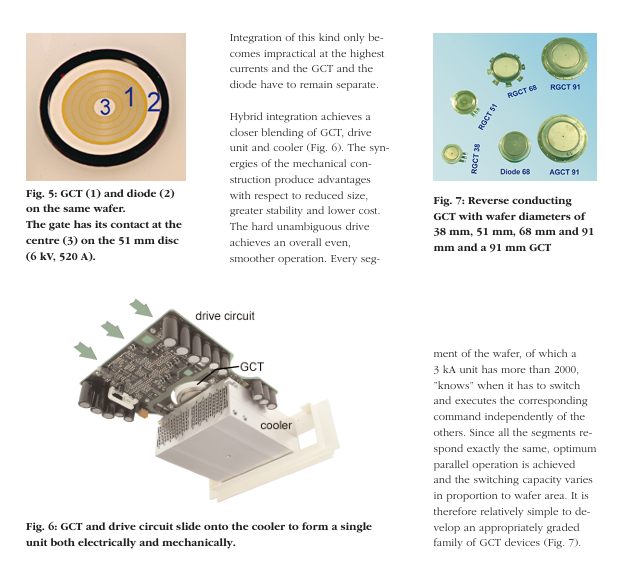
Integration is divided into two levels: one is single-chip integration (integrating anti parallel diodes and GCTs on the same silicon wafer to reduce diode stacking and high current connections); The second is hybrid integration (integrating GCT, driving unit, and cooler to reduce volume, improve stability, and lower costs).
Each unit of the silicon wafer (3kA devices containing over 2000 units) synchronously responds to switch instructions, achieving optimal parallel operation. The current capacity is linearly related to the silicon wafer area, making it easy to develop multi specification GCT series (such as devices with silicon wafer diameters of 38mm, 51mm, 68mm, and 91mm).
Simplify circuit complexity
No buffering capacitors, diodes, and resistors are required for GTO converters, only the current rise rate when GCT is turned on needs to be limited (as high-voltage silicon diodes are slower than low-voltage IGBT diodes).
By adopting a new high current circuit, all phases of the inverter can be connected to the same DC bus, which is comparable in cost to conventional IGBT converters.
(3) Modular design and high-voltage adaptation
Modular component system: In response to the diverse application requirements and small batch size of high-power converters, IGCT adopts modular design, which can cover a power range of 250kW to 100MW through unit series connection and adapt to different scenarios.
Pressure contact technology: Traditional module technology is difficult to handle high voltage and high current. IGCT adopts an improved pressure contact technology, which integrates the driving unit, power semiconductor, and cooler into a single functional unit. It replaces expensive chip parallel arrays with optimized silicon wafers in standard packaging, simplifies manufacturing, reduces costs, and is easy to maintain.
Performance advantages and application cases of IGCT converters
(1) Core performance advantages
Category specific advantages
Component characteristics include high rated voltage, low turn-on and commutation losses, high commutation frequency (intermittent up to 7kHz, average 500Hz for three-point converters, equivalent two-point 2kHz), high silicon wafer utilization, uniform current distribution, linear correlation between current capacity and silicon wafer area, and easy modeling
Circuit design includes a three-phase shared DC bus, a central dI/dt limiter with integrated clamping, simple intermediate circuit connection, safety and reliability under extreme working conditions, and a simple driving circuit (directly coupled with switch signals, no dV/dt or dI/dt regulation circuit required, dual line low-power power supply)
Overall performance with few and no special components, modular mechanical structure, single-chip integration even under high fixed values, high compatibility between power semiconductor control system cooler, stable and easy to center pressure contact technology, easy maintenance, efficiency exceeding 98%, high reliability (MTBF>6 years), small size and light weight, clear interface definition, support for high-power and reliable series operation, and series redundancy design to enhance reliability
(2) Typical application cases
100MW Bremen railway system interconnection device: put into operation in 1996, with 288 IGCTs running without faults, verifying the high reliability and series ease of use of IGCTs.
High dynamic application scenarios: such as uninterruptible power supply (NBPS), traction inverters, etc. Taking the ABB ACS1000 series medium voltage inverter as an example (launched in 1997 with a research and development cycle of only 2 years), it adopts a three-point IGCT inverter and a sine wave output filter, supports direct torque control (DTC), adapts to 2.3kV-4.16kV voltage and 315kW-5MW power range, and can be used for the transformation of existing non speed regulating motors. The debugging difficulty is comparable to that of low-voltage ACS600.
1.5MW air-cooled three-phase phase module: with a commutation frequency of 1050Hz, suitable for high-frequency demand scenarios.
Technological Development History and Future Prospects
(1) Development History (Key Nodes from 1993 to 2003)
1993: Hard drive GTO technology began;
In 1995, 3kA/4.5kV GCT was launched;
In 1997, 6kV/1kA reverse conducting diode (without buffer circuit) and transparent emitter technology were implemented, and the ACS1000 series inverter was launched;
Follow up: Gradually develop 4.5kV/6kA (91mm silicon wafer) GCT and 250A-4kA GCT series, achieve improvements such as integrated coolers and modular driver units, and expand application scenarios.
(2) Future prospects
IGCT technology has firmly established itself in the medium and high voltage field in just a few years, combining the advantages of GTO and IGBT to overcome their shortcomings. With excellent performance, reliability, and cost-effectiveness, IGCT will continue to expand high-power application scenarios and become one of the core technologies of medium and high voltage converters, further promoting the efficient and miniaturized development of the power electronics field.
Possible models that may be used
S-073N 3BHB009884R0021
S-093N 3BHB009885R0021
3ASC25H705/-7
HVC-02B
5SGY35L4510
XTB750B01
751010R0815
SA811F
TP830
CI857K01
PPC902CE101
CI858K01 3BSE018135R1
PM820-1
PM820-2
PM825-1
TC820-1
SD802F
EI802F
AM801F
AM811F
UCD240A101
- OMRON
- ABB
- General Electric
- EMERSON
- Honeywell
- HIMA
- ALSTOM
- Rolls-Royce
- MOTOROLA
- Rockwell
- Siemens
- Woodward
- YOKOGAWA
- FOXBORO
- KOLLMORGEN
- MOOG
- KB
- YAMAHA
- BENDER
- TEKTRONIX
- Westinghouse
- AMAT
- AB
- XYCOM
- Yaskawa
- B&R
- Schneider
- KONGSBERG
- NI
- WATLOW
- ProSoft
- SEW
- ADVANCED
- Reliance
- TRICONEX
- METSO
- MAN
- Advantest
- STUDER
- DANAHER MOTION
- Bently
- Galil
- EATON
- MOLEX
- DEIF
- B&W
- ZYGO
- Aerotech
- DANFOSS
- Beijer
- Moxa
- Rexroth
- Johnson
- WAGO
- TOSHIBA
- BMCM
- SMC
- HITACHI
- HIRSCHMANN
- Application field
- XP POWER
- CTI
- TRICON
- STOBER
- Thinklogical
- Horner Automation
- Meggitt
- Fanuc
- Baldor
- SHINKAWA
- Other Brands
- UniOP
- KUKA
- Iba
- Beckhoff
- ADLINK
-
 Sigmatek SE051 Network Splitter Module
 -
 Sigmatek CIO011 C-DIAS I O Module
 -
 Sigmatek SE051 Ethernet Splitter
 -
 Sigmatek CCL911 CD Processor Module
 -
 Sigmatek SDD310-4 DIAS Drive 14kVA
 -
Sigmatek CTMS020 C-DIAS Technology Module
-
 Sigmatek CTMS020 CD Technology Module
 -
 Sigmatek CTO167 C-SLIDES Digital Output Module
 -
 Sigmatek C-IPC 152 Industrial PC
 -
 Sigmatek SDD310-4 SLIDES Drive 310
 -
 SIGMATEK MDP 102-1 DIAS Power Module
 -
 SIGMATEK SCP111 S-DIAS Safety CPU Industrial
 -
 SIGMATEK CAO081 Analog Output Module
 -
 SIGMATEK DCC080L Control Module
 -
 SIGMATEK MDP101-1 Power Module
 -
 SIGMATEK SCP111 S-DIAS Safety CPU
 -
 SIGMATEK PC325-K Industrial PC
 -
 SIGMATEK ETT 731 Operator Terminal
 -
 SIGMATEK DSV011 SLIDES Hub Module 05-023-011
 -
SIGMATEK 12-780-012 R8-IPC Industrial Computer
-
 Sigmatek SE051 Ethernet Splitter
 -
 Sigmatek DAI 883 DIAS Analog Module
 -
 Sigma Tek 4000B-30 Directional Gyro
 -
 Sigmatek CP112 S-DIAS Processor Module
 -
 Sigmatek SDD310 DIAS Drive
 -
 Sigmatek SDD120-23 DIAS Drive 14kVA
 -
Sigmatek C-IPC 152 Industrial PC
-
 Sigmatek CIV513 VARAN Control Module
 -
Sigmatek DCP 082 Processor Module
-
 Sigmatek C-IPC Industrial PC 01-450-023 GEB
 -
 SIGMATEK PC572 Operating Terminal
 -
 SIGMATEK DCC041 DIAS Compact Controller HW 6.10
 -
SIGMATEK C-IPC 152 1GB Celeron M440 Controller
-
 SIGMATEK 01-310-322-K PC322-K Industrial PC
 -
SIGMATEK TAE732-P Touch Screen Operator Panel
-
SIGMATEK 01-018-100 Control Module
-
SIGMATEK DDI-164 Digital Input Module
-
 Sigma-Tek 5000B-36 Artificial Horizon
 -
 SIGMATEK 12-780-012 R8-IPC Geode LX800 Computer
 -
SIGMATEK CTMS 020 Servo Drive
-
 Sigmatek MDD121-1 Controller
 -
 Sigmatek ETV1021-L VARAN Terminal
 -
Sigmatek DST022 DIAS Module
-
Sigmatek CCP512-K C-Dias Processor Module
-
 Sigmatek SRO 021 Relay Output Module
 -
 Sigmatek SDI 101 Digital Input Module
 -
 Sigmatek IPC 221 Industrial PC
 -
Sigmatek DNC-305 Digital Input Module
-
 Sigmatek SDD335 DIAS Drive
 -
Sigmatek C-IPC Industrial Controller
-
 SIGMATEK 01-450-031 C-IPC 256MB LX800 Computer
 -
SIGMATEK SDD310-3 DIAS Drive 310
-
 SIGMATEK DSV011 SLIDES Hub Module 05-023-011
 -
SIGMATEK CNC031 CD Analog Module 12-011-031
-
 SIGMATEK 01-450-031 C-IPC 256MB LX800
 -
SIGMATEK 01-450-026 C-IPC VIA 733MHz Controller
-
 SIGMATEK DCP-643 DIAS CPU Module with DKL-003
 -
 SIGMATEK MDD111-L DIAS Drive Axis Module
 -
SIGMATEK SDD310-23-L DIAS Drive 310
-
 SIGMATEK Viscotec ETV0551 Touch Panel
 -
 SIGMATEK PC321K Industrial Computer
 -
SIGMATEK MDP 102-1 SLIDES Power Module
-
 SIGMATEK TAE-151 12-200-151 Light Terminal
 -
SIGMATEK CP102 20-004-102P6995B HMI Panel
-
 SIGMATEK CAM-123 12-017-123-C Analog Mixing Module
 -
SIGMATEK DCC041 DIAS Compact Controller
-
SIGMATEK DVI021 and DKL015 DIAS Power Module
-
 SIGMATEK SDD340-46 SDD Series Servo Drive
 -
 SIGMATEK Robotdrive L6 02220-7997 Engel Drive
 -
 SIGMATEK AKM63M-ANCNGBB0 4.38kW PM Servomotor
 -
 Sigmatek SDD 310 SLIDES-Drive SDD310-4O
 -
 Sigmatek SDD335-23K Drive VARAN Interface 14kVA
 -
 Sigmatek TAE1922-K Touch Display Unit
 -
 Sigmatek DIAS DCP 643 CPU Module DKL003
 -
 Sumitomo CNH-4105Y-43 NSNP Gear Reducer
 -
 Sumitomo CHHP-4160Y-35-213T Inline Gear Reducer
 -
 Sumitomo CNHM02-6090YA-87 NSNP Gear Motor
 -
 Sumitomo CNVXS-6100Y-43 NSNP Gear Reducer
 -
 Sumitomo CNHM2609511 Gear Motor
 -
 Sumitomo CHVM3-6130-B-35 Gear Motor
 -
 Sumitomo HW0389042-A Industrial Component
 -
 Sumitomo F2CF-W55-ZG05-64 Gear Reducer
 -
 Sumitomo CHH-6165Y-13 Inline Gear Reducer
 -
 Sumitomo CNVM3-6125C-EP-6 Cyclo Gear Motor
 -
 Sumitomo RNYX-1320Y-20 Gear Reducer
 -
Sumitomo XFCG111-43/24/165 Control Component
-
 Sumitomo LHYJ-3A105K-Y3-102 Gear Reducer
 -
 Sumitomo CNFM02-6095DA-B-121 TC-FX/FB-02A Motor
 -
 Sumitomo CNHJ-4105DAY-289 NSNP Gear Reducer
 -
 Sumitomo LHYJS-4C145Y-Y1-112 NSNB Gear Reducer
 -
 Radiator 2060351111 Komatsu Sumitomo Linkbelt
 -
 Sumitomo BL3-09B-35MEHDK6 Gearbox ANFJ-L30
 -
 Sumitomo Truninger 8H1-150 Internal Gear Pump
 -
Sumitomo RNFMS01-25R-B-150 200V NSNP Gearmotor
-
Sumitomo CHHBJN1HA-6135Y-29 Inline Reducer
-
Sumitomo EHYMS5-B6125YA-Y3-74 NSNB Reducer
-
 Sumitomo Eaton H-050AA2F-J Orbit Motor
 -
Sumitomo TC-FXVP Motor 0.75kW 4P 400V N-80M
-
 Sumitomo XFCG111-87/24130 Industrial Control Component
 -
 Sumitomo AF3122-030 Inverter 30kW 3Ph 200V
 -
 Sumitomo QT42-25FS-B Internal Gear Pump
 -
 Sumitomo F2CS-A35-ZG09-59 Speed Reducer
 -
 Sumitomo CNHM05-6090-B-29 Gear Motor
 -
 Sumitomo CHHJ-6145Y-29-210T Gear Reducer
 -
 Sumitomo E3P-20-2.2-S1450-E Hydraulic Pump
 -
 Sumitomo RNYMS1-1420C-AV-20 Right Angle Gear Motor
 -
 Sumitomo SR101 SRKG101-76-40-060 Reamer Head
 -
Sumitomo RNYM05-1220-25/UBAABB Gear Motor
-
 Optidrive E3 Sumitomo GHB-36 Vector Inverter Motor
 -
Sumitomo CNH-614HY-35 UNMP Gear Reducer
-
 Sumitomo CNH-612HY-6 SM-Cyclo Gearmotor
 -
 Sumitomo HF3214-A75 Electric Motor
 -
 Sumitomo CNVM02-6100-B-59 NSMP Gear Reducer
 -
 Sumitomo CNHJ4105Y35 NSNP Gear Reducer
 -
 Sumitomo CHH6165Y-29 NSNB Gear Reducer
 -
Sumitomo RNYM1-1420-25 Hyponic Gear Motor
-
 Sumitomo T600C Industrial Control Unit
 -
 Sumitomo LHH-4A115-K2-28 NSNB Gear Reducer
 -
 Sumitomo RNYM02-1220-AV-20 Speed Reducer
 -
 Sumitomo CHHS-6140Y-SB-17 Gear Motor
 -
 Sumitomo Heavy Industries SSE-100A-RM Drive Unit
 -
Sumitomo PA228771 CNHM2-6100YB-EP-8 Gear Motor
-
 Sumitomo RNYM02-1231-B-50 Speed Reducer
 -
Sumitomo CNFM1H-6090-6 Induction Motor
-
 Sumitomo CHH-614HY-11 Gear Reducer
 -
Sumitomo F4C-D25-ZG01-41 Speed Reducer
-
Sumitomo PA224280 CNHM1-6095YC-EP-21 Gear Motor
-
Sumitomo KHYJB4115K185145TC Gear Motor


