
Woodward MicroNet ™ Analysis and Application of Simplex and Plus Digital Control Systems
This article is based on the complete content of Woodward's official product manual 26166V1 (revised version V, released in August 2024), aiming to provide in-depth technical analysis, configuration guidelines, and application recommendations to help engineers, technicians, and system integrators fully understand and efficiently apply the control system.
Woodward MicroNet ™ Analysis and Application of Simplex and Plus Digital Control Systems
Introduction
Woodward MicroNet ™ Digital control system is a high-performance and high reliability solution for industrial power control field. This series of products is widely used for precise control and protection of power devices such as gas turbines, steam turbines, diesel engines, and water turbines. The MicroNet Simplex and MicroNet Plus control systems covered in this manual have flexible configuration options that support diverse requirements ranging from simple applications to complex redundant systems. As one of Woodward's core products, the MicroNet platform is renowned in the fields of energy, marine, and industrial automation for its outstanding real-time performance, modular design, and extensive support for industrial communication protocols.
This article is based on the complete content of Woodward's official product manual 26166V1 (revised version V, released in August 2024), aiming to provide in-depth technical analysis, configuration guidelines, and application recommendations to help engineers, technicians, and system integrators fully understand and efficiently apply the control system.
1、 System Overview and Product Architecture
1.1 MicroNet Control System Family
MicroNet Simplex and MicroNet Plus are digital controllers based on 32-bit microprocessors that can be programmed to adapt to various application scenarios. The control system provides comprehensive functions such as high-speed control, system sequence control, auxiliary system control, surge control, monitoring and alarm, and station control. This platform provides Simplex, Redundancy, and Triple Modular Redundancy (TMR) configurations, and this manual mainly covers Simplex and Redundancy configurations.
The system adopts Woodward's unique rate group structure to ensure that control functions can execute deterministically according to the rate group defined by the application engineer. The critical control loop can complete processing within 5 milliseconds, while secondary code is assigned to slower rate groups. This structure ensures that the dynamic characteristics of the system will not change due to the addition of additional code, and the control always has certainty and predictability.
1.2 System Configuration and Compatibility
The MicroNet platform is built around the VME chassis and CPU modules, with the CPU module located in the first active slot of the VME chassis and all I/O modules inserted into the remaining slots. The MicroNet Plus chassis supports single CPU operation and dual CPU redundancy operation, with each chassis capable of accommodating up to 14 VME slots. The system can be expanded to multiple chassis using copper or fiber optic cables to meet additional I/O requirements.
The environmental specifications and compatibility information of the system are detailed in the corresponding appendix of Volume 2 of this manual, while information on non preferred and obsolete modules is included in Volume 3.
2、 Detailed explanation of MicroNet Plus system
2.1 Redundant Configuration
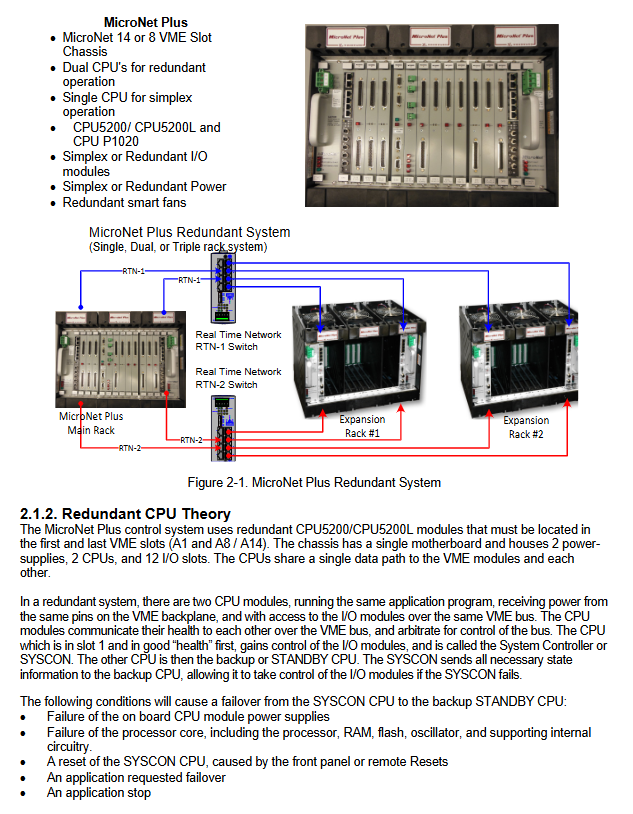
The MicroNet Plus control system provides a complete redundancy solution, achieving high availability through dual CPU modules. In a redundant system, two CPU modules run the same application, share access to I/O modules, and communicate with each other through the VME bus. A CPU module with good health becomes the system controller (SYSCON), while another one serves as a backup (STANDBY). When the main CPU fails, the backup CPU can seamlessly take over control.
The system supports multiple redundant configuration options:
Fully redundant: Both the host rack and expansion rack use redundant CPUs and RTN modules
Partial redundancy: Main CPU redundancy, expansion rack can use single RTN or redundant RTN
Simplex configuration: Single CPU operation, expansion rack using single RTN module
2.2 Power Supply System
The MicroNet Plus chassis uses two load sharing power modules to provide redundant power supply for the motherboard, CPU, and I/O modules. The power module has a dual slot width and is located in the PS1 and PS2 slots at both ends of the chassis. The system supports three power input specifications: low voltage (24 Vdc input), high voltage (110 Vac/dc input), and high voltage 220 Vac input versions.
The power module is equipped with four LED indicator lights, which respectively display information such as power status, input faults, overheating, and power faults, making it easy to diagnose quickly. The system design follows the safety requirements of Class I and Division 2 areas and requires the use of delay fuses or circuit breakers that comply with local regulations.
2.3 I/O module and on-site connection
Each I/O module is connected to the field terminal module (FTM) through a front panel connector, which is used to connect field wiring. For the communication module, there is no need for FTM, and the cable is directly connected to the front panel of the communication module.
The system provides two levels of redundancy:
Sensor level redundancy: Connect two external input devices to two independent input channels
Module level redundancy: Connect two external input devices to two independent I/O modules
Output redundancy can be achieved by adding external relays, and for actuator output, a dual coil actuator can be used to ensure continuous operation in the event of a single point fault.
3、 Detailed Explanation of Chassis Configuration
3.1 14 slot chassis
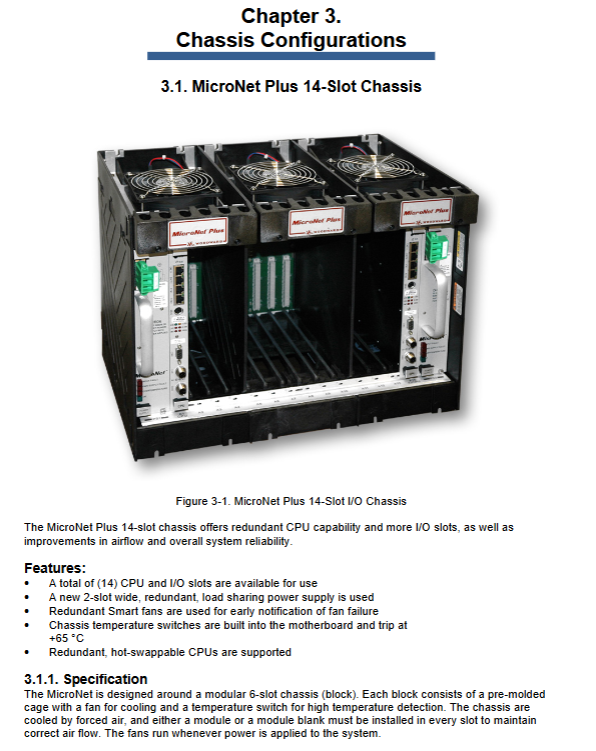
The MicroNet Plus 14 slot chassis provides redundant CPU capability and more I/O slots, while improving airflow and system reliability. The chassis adopts a modular design, with each module containing a pre formed cage, cooling fan, and high-temperature detection temperature switch. The chassis has a total of 14 CPU and I/O slots available for use.
The main features include:
New dual slot wide redundant load sharing power supply
Redundant intelligent fans can provide early notification of fan failures
The motherboard has a built-in temperature switch with a trigger point of 65 ° C ± 3 ° C
Support redundant hot swappable CPUs
3.2 8-slot chassis
The MicroNet Plus 8-slot chassis also provides redundant CPU capability and more I/O slots, adopting similar design concepts and technical features as the 14 slot chassis. The chassis has a total of 8 CPU and I/O slots available for use, and also features redundant intelligent fans and temperature monitoring functions.
4、 Analysis of CPU module technology
4.1 CPU P1020 module
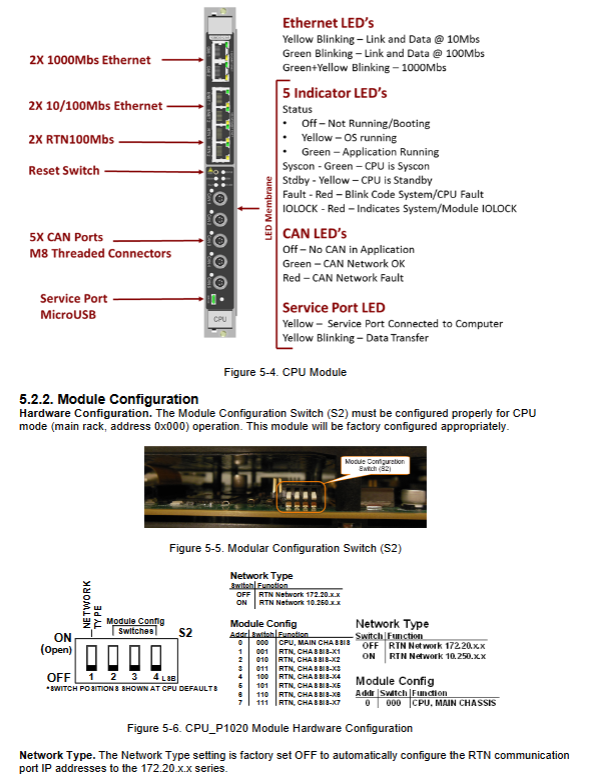
The CPU P1020 module is based on an 800 MHz dual core processor, equipped with 512 MB RAM and 768 MB flash memory, and supports multiple communication peripherals, including 4 Ethernet ports (2 1000 Mbps, 2 100 Mbps), 2 real-time network ports, 1 service port, and 5 CAN ports.
This module supports both simplex and redundant operation modes, designed specifically for working environments in the industrial market from 0 ° C to+55 ° C. The module supports hot swapping, but it should be reset before removal to ensure elegant system failover.
4.2 PowerPC CPU 5200 module
The PowerPC CP5200 module uses the Motorola MPC5200 processor, equipped with 128 MB DDR RAM and 64 MB flash memory, and supports multiple communication peripherals, including 2 Ethernet ports, 2 real-time network ports, 1 serial port, 1 service port, and 2 CAN ports.
This module is designed for extreme industrial environments ranging from -40 to+85 ° C, with built-in FPGA providing VME bus master/slave functionality and other functions required for redundant systems.
5、 Communication module and network topology
5.1 Remote RTN module
The Remote Real Time Network (RTN) module is designed for rack expansion, with the main function of collecting local I/O module data and communicating with the host rack CPU, while providing redundant fault switching control for the rack. The RTN module supports simplex and redundant systems, and each RTN expansion chassis installs a remote RTN module in the first slot (CPU1).
5.2 SIO module
The SIO (Serial Input/Output) intelligent enhancement module provides four serial communication ports and interfaces with the VME bus. Module manages four serial ports: Port 1 and Port 2 are RS-232 ports; Ports 3 and 4 support RS-232, RS-422, or RS-485 communication protocols. The module has two LEDs (running and faulty) and no switch.
6、 Discrete I/O module
6.1 48/24 Discrete Combination Module
The HDDIO module provides 48 optically isolated discrete inputs and 24 discrete outputs, without calibration, and can be directly replaced with modules of the same model. This module supports two types of FTM I/O configurations:
Configuration 1: A 48/24 discrete FTM is connected to the HDDIO module via two high-density analog/discrete cables, and then connected to a 32 channel relay module or two 16 channel relay modules via low-density discrete cables.
Configuration 2: Two 24/12 discrete FTMs (DIN rail mounted) are connected to the HDDIO module via two high-density analog/discrete cables.
6.2 48 channel discrete input module
Each 48 channel discrete input module is connected to two independent FTMs through two low-density discrete cables. The module provides discrete signal inputs for 48 independent switch or relay contact points, which are optically isolated from other parts of the MicroNet control circuit.
6.3 64 channel discrete output module
The 64 channel discrete output module can independently control 64 outputs and operate according to commands from the CPU module. The module has no potentiometer and does not require calibration. It can be directly replaced with modules of the same model. This module can be connected to two 32 channel relay modules, four 16 channel relay modules, or a combination of both types.
7、 Analog I/O module
7.1 Intelligent Enhancement Module for Speed Sensor
This module provides four speed inputs, factory configured as MPU or Eddy inputs. The module has no potentiometer and does not require calibration. It can be directly replaced with modules of the same model. The speed input configuration depends on the module material number.
7.2 24/8 Simulated Intelligent Enhancement Module
This module provides 24 analog inputs and 8 4-20 mA outputs, without potentiometers or calibration, and can be directly replaced with modules of the same model. The module offers three different configurations, and all 4-20 mA analog inputs can be used with two-wire ungrounded (loop powered) transmitters or isolated (self powered) transmitters.
7.3 Speed/Analog IO Combination Intelligent Enhancement Module
This module provides four speed inputs (configurable as MPU, Prox, or Eddy inputs in GAP applications) as well as 12 analog inputs and 4 4-20 mA outputs. The analog input can be configured as 0-5VDC voltage mode or 4-20mA current mode in GAP applications.
8、 Safety regulations and compliance
The MicroNet digital control system follows strict safety standards and regulatory requirements:
8.1 European Compliance
CE mark: The product complies with the relevant EU directive requirements
RoHS: Compliant with Directive 2011/65/EU requirements
EMC Directive: Compliant with the 2014/30/EU Electromagnetic Compatibility Directive
Low Voltage Directive: Compliant with the 2014/35/EU Low Voltage Equipment Directive
ATEX Directive: Compliant with the 2014/34/EU Directive on Equipment for Potential Explosive Environments
8.2 North American Compliance
CSA certification: applicable to Class I, Division 2, Groups A, B, C, and D areas, with a maximum ambient temperature of 55 ° C
8.3 Classification Society Certification
American Bureau of Shipping (ABS): Complies with steel vessel code requirements
Lloyd's Register (LR): Complies with LR type approval test specifications
DNV/GL: Complies with standard certification requirements
9、 Installation and Maintenance Guide
9.1 Installation precautions
The MicroNet digital control system must be installed in a metal enclosure or cabinet to meet EMC directive requirements. Please refer to section 15 of manual 26166V2 for installation location and specific cabinet construction requirements.
The system grounding requirements are strict, and the grounding leakage current exceeds 3.5 mA. Before supplying power to the MicroNet control device, it is necessary to verify that the PE terminal is connected. Fixed wiring installation is required, and the main power circuit should be blown correctly according to national standards. It is recommended to use European T-type fuses.
9.2 Electrostatic discharge protection
The electronic control device contains electrostatic sensitive components, and the following precautions should be taken to prevent damage:
Release body static electricity before handling control devices
Avoid using plastic, vinyl and foam around printed circuit boards
Do not touch the components or conductors on the printed circuit board with your hands or conductive devices
9.3 Fault diagnosis and troubleshooting
The system provides comprehensive diagnostic functions, which can monitor system status, view fault codes, and configure network settings through AppManager software. Each module is equipped with LED indicator lights to display module status and fault information, making it easy to quickly locate and solve problems.
10、 Technological development trends and application prospects
With the advancement of Industry 4.0 and digital transformation, MicroNet digital control systems continue to evolve and integrate new technologies to meet more stringent industrial application requirements
10.1 Intelligent Upgrade
The new generation MicroNet control system has strengthened support for condition monitoring and predictive maintenance, helping users optimize equipment performance and reduce unexpected downtime by integrating more advanced diagnostic algorithms and data analysis functions.
10.2 Communication Protocol Extension
The system continues to expand its support for modern industrial communication protocols, including OPC UA, MQTT, and higher-level Ethernet protocols, ensuring seamless integration with factory information systems.
10.3 Network Security Enhancement
Faced with increasingly severe industrial network security challenges, Woodward continuously strengthens the security features of MicroNet control systems, including secure boot, communication encryption, and access control functions.
- OMRON
- ABB
- General Electric
- EMERSON
- Honeywell
- HIMA
- ALSTOM
- Rolls-Royce
- MOTOROLA
- Rockwell
- Siemens
- Woodward
- YOKOGAWA
- FOXBORO
- KOLLMORGEN
- MOOG
- KB
- YAMAHA
- BENDER
- TEKTRONIX
- Westinghouse
- AMAT
- AB
- XYCOM
- Yaskawa
- B&R
- Schneider
- KONGSBERG
- NI
- WATLOW
- ProSoft
- SEW
- ADVANCED
- Reliance
- TRICONEX
- METSO
- MAN
- Advantest
- STUDER
- DANAHER MOTION
- Bently
- Galil
- EATON
- MOLEX
- DEIF
- B&W
- ZYGO
- Aerotech
- DANFOSS
- Beijer
- Moxa
- Rexroth
- Johnson
- WAGO
- TOSHIBA
- BMCM
- SMC
- HITACHI
- HIRSCHMANN
- Application field
- XP POWER
- CTI
- TRICON
- STOBER
- Thinklogical
- Horner Automation
- Meggitt
- Fanuc
- Baldor
- SHINKAWA
- Other Brands
- UniOP
- KUKA
- Iba
- Beckhoff
- ADLINK
-
 Micro Innovation GF1-10TVA-100 Touch Panel
 -
 Micro Innovation GSO-57EQD-000 Operator Panel
 -
 Micro Innovation XN-2AI-U Analog Input Module
 -
 Micro Innovation CAN-4AI/UI Analog Input Module
 -
 Micro Innovation ZSB-1.5/8-S/S/-/PE Base Terminal
 -
Micro Innovation AG XVH-340-57CAN-1-10 HMI Panel
-
 Micro Innovation GSO-57EQD-000 Micro Panel
 -
 Micro Innovation XN-2AI-PT/NI-2/3 Input Module
 -
 Micro Innovation AG GF0-57SQD-000 Display Panel
 -
 MICRO INNOVATION AG XN-16DI-24VDC-P Input Module
 -
 Micro Innovation XN-2AI-PT/NI-2/3 Input Module
 -
 Micro Innovation MC2-442-57CQB-1-2G Display Panel
 -
 Micro Innovation XN-16DO-24VDC-0.5A-P Module
 -
 Micro Design MC200PROFI Programmable Module
 -
Micro Innovation XV-252-57MPN-1-10 Micro Panel
-
 Micro Innovation CAN-4AI/UI Analog Input Module
 -
Micro Innovation GT1-MPI-A000 Panel
-
Micro Innovation MC2-440-10TVB-1-21 Display Panel
-
Micro Innovation XVS-430-57MPI-1-1S 6" HMI
-
Micro Innovation XV-442-57CQB-1-1AB Monitor
-
 Micro Innovation ZSB-1.5/8-S/S/-/PE Base Terminal
 -
Micro Design 895A Microfiche Reader
-
 MICRO INNOVATION XNE-8DI-24VDC-P Input Module 8550100794
 -
MICRO INNOVATION MICRO PANEL GF0-10CVD-002
-
 Micro Innovation XN-PLC-CANopen Controller 85 50 274124
 -
Micro Innovation Display Panel GS0-57E0D-000
-
MICRO INNOVATION CAN-32DI/P2X16 Input Module
-
MICRO INNOVATION XN-2DO-R-NO Relay Output Module
-
MICRO INNOVATION XNE-16DI-24VDC-P Input Module
-
Micro Innovation AG XN-2AI-U Analog Input Module
-
Micro Innovation XN-BR-24DC-D Power Supply
-
Micro Innovation MH2-342-57EIB-1-20 Panel
-
Micro Innovation XV-252-57MPN-1-10 Micro Panel
-
 Micro Innovation Display Card EIB2-TP
 -
 Micro Innovation XV-252-57MPN-1-10 6" HMI
 -
 Micro Innovation XN-B3T-SBC 16x DO Base Module
 -
Micro Innovation XVH-330-57MPI-1-10 Panel
-
Micro Innovation XN-BR-24VDC-D Power Module
-
 Micro Innovation EIB2-TP EIB2TP Module
 -
Micro Innovation GF0-10CVD-100 Touch Panel
-
MICRO INNOVATION XV-230-57CNN-1-10 HMI-PLC
-
MICRO INNOVATION XN-2DO-R-CO Relay Output Module
-
KMK MICRO INNOVATION GS2-90EMD-000 Micro Panel
-
 Micro Innovation XN-2AO-U Analog Output Module
 -
 Micro Innovation XN-1AO-I Analog Output Module
 -
 Micro Innovation CAN-32DI/P-2x16 Rack Module
 -
Eaton Micro Innovation MC2-440-10TVB-1-11 HMI
-
Micro Innovation AG CAN Bridge 8551224177
-
 Micro Innovation XN-2AI-I Analog Input Module Set
 -
Micro Innovation XN-4DI-24VDC-P Input Module
-
 Micro Innovation Winbloc CAN-16DO/0.5A-PK Module
 -
Micro Innovation Micro Panel GFO-10SVD-002 HMI
-
 Micro Innovation CAN-24DI/8DO/0.5A-PK Module
 -
 Micro Innovation DP-24DI/8DO/0.5A-PK I/O Module
 -
 Weidmuller Micro Innovation CAN-BRIDGE ZSFA 1,5R
 -
Micro Innovation CAN-3AI/1AO-UI Profibus Module
-
 Micro Innovation PDP-TP Profibus DP Module
 -
Micro Innovation CAN-3AI/1AO-UI Analog Module
-
 Micro Innovation MC2-430-12TSB-10 HMI Panel
 -
Micro Innovation XNE-8DO-24VDC-0.5A-P I/O Module
-
MICRO INNOVATION AG WINBLOC CAN-32DI/P-2x16 85 51 224182
-
 MICRO INNOVATION AG WINBLOC CAN-4AO/UI 85 51 224195
 -
Micro Innovation Xv-252-57cnn-1-10 HMI Panel
-
Micro Innovation XN Basis XN-S4T-SBBS-CJ 225200
-
Micro Innovation GF1-10TVD-100 Micro Panel
-
Micro Innovation XN-B3T-SBC 16-Fold DO Base Module
-
MICRO INNOVATION AG WINBLOC CAN-3AI/1AO-UI 85 51 224192
-
KMK Micro Innovation GS2-90EMD-000 Micro Panel
-
Micro Innovation MC2-430-10TVB-1-10 PanelView Terminal 24VDC
-
 Micro Innovation XNE-8DO-24VDC-0.5A-P I/O Module 8550100795
 -
MICRO INNOVATION GF1-10TVB-100 Touch Panel
-
MICRO INNOVATION AG WINBLOC CAN-4AI/UI Analog Input Module
-
MICRO INNOVATION AG WINBLOC CAN-32DO/0.5A-P-2x16 Output Module
-
MICRO INNOVATION AG CAN-32DI/P-2X16 8551224182 Input Module
-
 MICRO INNOVATION MK2-230/232-57 Circuit Board 85 28 200000
 -
 MICRO INNOVATION CAN-BRIDGE 8551224177 CAN Bridge
 -
Micro Innovation MC2-430-10TVB-1-10 Panel 24VDC
-
MICRO INNOVATION MC2-432-57CQB-1-10 HMI Panel
-
MICRO INNOVATION AG CAN-BRIDGE 85 51 224177 CAN Bridge
-
MICRO INNOVATION CAN-4AI/UI Analog Input Module
-
MICRO INNOVATION CAN-32DI/P-2X16 Input Module
-
 SIGMATEK MDD111 09-404-111 Drive Module
 -
 SIGMATEK DVI021 Display Interface Module
 -
 SIGMATEK 00-450-024 C-IPC Processor
 -
 SIGMATEK MDD-111 MDD111 Drive Module
 -
 SIGMATEK ICA011 20-102-011 Interface Module
 -
 SIGMATEK 01-250-010-D NC4Kompakt Control Module
 -
 SIGMATEK CRIF081 12-751-081 Interface Module
 -
 SIGMATEK S1026-8AF61-R4E-Z57 Drive Module
 -
 SIGMATEK 9305.081.02 9227.082.00 Control Module
 -
 Sigma Tek 5000B-36 Attitude Indicator
 -
 SIGMATEK CEZ201 12-051-201-O Counter Module
 -
 SIGMATEK DPS001 Power Supply Module
 -
 SIGMATEK 994 395 01z Via Interface Module
 -
 SIGMATEK PC411-K 01-310-411-K Industrial PC
 -
 SIGMATEK 9816.324.00 Demag NC4 Keyboard
 -
 SIGMATEK ET261 90010C-71 Operator Terminal
 -
 SIGMATEK DDI 164 05-006-164 Input Module
 -
 SIGMATEK CCP 082 C-DIAS Processor Module
 -
SIGMATEK CEZ201 12-051-201-O PLC Module
-
SIGMATEK MDD 1111 06178867 Drive Module
-
SIGMATEK S1 073-6AC61-RE-Y08-Z Drive Module
-
SIGMATEK MDD 111 Drive Module MDD111
-
 SIGMATEK CSDI161 Safety Module 12-891-161
 -
SIGMATEK C-IPC Processor 01-450-024
-
 SIGMATEK DIAS DAM122 Analog Mixing Module
 -
Sigma Tek 5000B-36 Attitude Gyro Indicator
-
 SIGMATEK TMS012 Motherboard Module 05-250-012-T
 -
 SIGMATEK CCP-531 PLC Module
 -
SIGMATEK DIAS DNC4 I/O Module 05-250-011
-
 SIGMATEK AI088 Analog Input Module
 -
 SIGMATEK CEZ201 Counter Module
 -
SIGMATEK CIC011 Industrial Computer Module
-
 SIGMATEK MDM021 Motor Drive Module
 -
 SIGMATEK DTO163 Digital Output Module
 -
SIGMA-TEK 5000B-36 Attitude Gyro
-
SIGMATEK DM161 Digital Input Module
-
SIGMATEK CCP-531 PLC Control Panel
-
 SIGMATEK HZS773 Touch Terminal Operator Panel
 -
SIGMATEK MDP101 3 KVA 45-65Hz Driver
-
 SIGMATEK ETV1251 Touch Panel 12-230-1251
 -
SIGMATEK CIO021 Safety Module 12-013-021
-
Sigma Tek 4000H-5 Directional Gyro
-
 SIGMATEK TAE531 I/O Module 01-240-531
 -
 SIGMATEK DAI081 Input Module 05-009-081
 -
 SIGMATEK DCP640 Drive Control Module
 -
 SIGMATEK DCP643 Slides Module A6-29
 -
SIGMATEK SCP011 Safety Module 20-890-011


