
YOKOGAWA OpreX Control and Safety System CENTUM VP Integrated Production Control System
System: Yokogawa Oprex Control and Safety System
Manufacturer: Yokogawa Electric Corporation
Core positioning: Yokogawa's most advanced integrated production control platform, which has undergone more than 40 years of technological evolution, aims to create value with customers through "process collaborative innovation" and meet the needs of digital transformation and integration of new technologies (such as IoT) in multiple industries
YOKOGAWA CENTUM VP Distributed Control System
Basic and Product Positioning
Product Name: CENTUM VP Distributed Control System (DCS)
System: Yokogawa Oprex Control and Safety System
Manufacturer: Yokogawa Electric Corporation
Core positioning: Yokogawa's most advanced integrated production control platform, which has undergone more than 40 years of technological evolution, aims to create value with customers through "process collaborative innovation" and meet the needs of digital transformation and integration of new technologies (such as IoT) in multiple industries
Core value proposition: customer-centric, possessing five core characteristics of reliability, scalability, flexibility, strength, and ease of use, balancing safety performance and operational efficiency, achieving cost reduction and efficiency improvement throughout the entire lifecycle and long-term stable operation
Core advantages of the system and customer value
Advantage Category Key Features Customer Value
Standardization of engineering efficiency, modular engineering, flexible I/O binding, Automation Design Suite eliminate duplicate work, shorten project duration, reduce change impact, and lower installation costs
Intuitive HMI operation experience, integrated alarm management, dedicated operation keyboard, AOG solution to avoid information overload, improve decision-making speed, reduce operational errors, and lower operator stress
System reliability with dual redundancy design (FCS, power supply, I/O, etc.), online maintenance, seamless fault switching to ensure 24/7 continuous operation, reduce downtime, and improve production stability
Lifecycle assurance includes backward compatibility, online upgrades, third-party system migration, maximizing the value of existing assets through a global service network, reducing upgrade costs, and providing long-term technical support
Security protection includes ISASecure EDSA certification, Vnet/IP secure network, endpoint security services to resist network attacks, compliance with industry security standards, and ensuring production and data security
Detailed explanation of the core functional modules of the system
(1) Operation module: Focus on efficient and intuitive operation
Integrated Management: Integrating the three major goals of production excellence, safety excellence, and asset excellence, optimizing data management through cognitive vision integration, HIS (Human Machine Interface Station) can uniformly display alarm information from DCS, ProSafe RS, and PRM systems, achieving seamless cross system operation
Human Machine Interface (HMI):
Design philosophy: Putting people first, based on ergonomics, adapting color matching to environmental lighting, optimizing contrast, and ensuring high visibility of data
Flexible configuration: supports multi screen display and custom windows, can group commonly used functions through "My Favorites", and quickly call past interfaces through "Window History"
Advanced Services: AOG (Advanced Operating Graphics) solution, designed by certified consultants based on human factors and knowledge engineering to enhance anomaly detection efficiency and decision-making speed in PCS graphics
Specialized operation keyboard: provides two types of simultaneous operation for single circuit and eight circuit, optimized function key layout, supports one click calling of graphics or control circuits, and helps operators quickly respond to process changes
Virtualization technology: decoupling system software from physical hardware, supporting software reuse and smooth hardware migration, shortening migration and testing time, and reducing maintenance difficulty
(2) Control module: ensuring high availability and stable control
High availability design:
Dual redundancy architecture: The FCS processor module, power supply, I/O module, and I/O network are all designed with dual redundancy. The primary and backup processors run synchronously, seamlessly switching in case of failure to ensure uninterrupted control
Online maintenance: supports FCS application logic and parameter online modification, fault modules can be replaced online without downtime, and does not affect the production process
Core Control Unit (FCS): independently developed and manufactured by Yokogawa, with powerful processing capabilities and large capacity application storage, fully adapted to advanced on-site digital technology, ensuring control efficiency and stability
Control network (Vnet/IP):
Technical specifications: Compliant with IEEE802.3 Ethernet standard, with a transmission rate of 1Gbps, supporting both star and ring topologies
Core advantage: It combines openness and security, does not affect the transmission of process control data, ensures HIS updates data every second, and adapts to projects of different sizes and complexities
I/O module selection:
N-IO (Network I/O): The next generation of software can configure intelligent I/O, with a single module supporting AI/AO/DI/DO signals. Signal type software configuration is achieved through adapters, reducing installation delays and eliminating the need for traditional wiring grouping, saving space and cost. It can be deployed as a remote I/O module
FIO (Field Network I/O): Classified by process signal type, it can be connected to field equipment through pressure clamp terminal blocks, dedicated terminal boards, or MIL cables
Other options: RIO (Remote I/O) module, RIO system upgrade I/O module, supports maximizing the use of existing assets to quickly upgrade the system
(3) Engineering module: Accelerating project delivery and quality improvement
Core Engineering Environment: Automation Design Suite
Full lifecycle management: Record the engineering history from design, debugging to operation, ensuring data integrity during system expansion, software and hardware changes
Modular engineering: Encapsulate process loops, alarm design, graphics, etc. into standard modules that can be downloaded, shared, and reused across enterprises, saving resources
Change management: Implement version based engineering changes through ModPacks, automatically document and detect project inconsistencies, and reduce risks
Flexible I/O binding:
Core advantage: Supports software grouping and N-IO universal channels, allowing remote modification of I/O types and module controller connections, significantly reducing the impact of later design changes
Project value: Achieve early delivery of I/O cabinets, detect and solve problems early on site, combine with FieldMate Validator debugging tool, support system independent circuit debugging, and shorten project duration
Agile project execution: Compared to traditional project processes, modular design and flexible I/O binding are used to reduce rework and waste, improve project quality and delivery efficiency
(4) Sustainable Plant: Ensuring Long Term Value
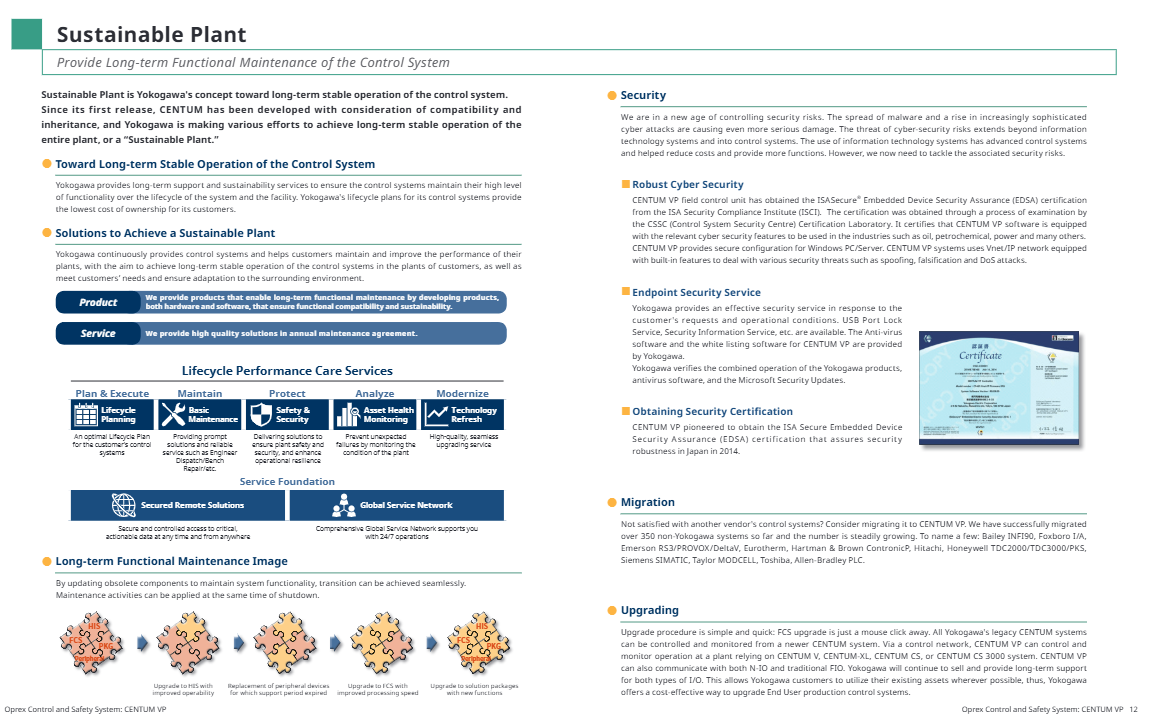
Lifecycle Services: Yokogawa provides full lifecycle support such as online upgrades, patch updates, migration services, and security solutions. Through deep collaboration with customers, it ensures sustainable investment returns for control system assets
Compatibility and Migration:
Backward compatibility: All Yokogawa legacy CENTUM systems (such as CENTUM V, CENTUM-XL, CENTUM CS, etc.) can be controlled and monitored by CENTUM VP to maximize the value of existing assets
Third party migration: Over 350 non Yokogawa systems (such as Bailey INFI90, Honeywell TDC2000/3000, Siemens SIMATIC, etc.) have been successfully migrated, with a simple migration process
Network security protection:
Security certification: CENTUM VP on-site control unit obtained ISASecure certification ® EDSA (Embedded Device Security Assurance) certification meets the security requirements of industries such as petroleum, petrochemical, and power
Security features: Built in anti spoofing, anti tampering, and anti DoS attack functions for Vnet/IP networks, supporting Windows PC/Server security configuration
Security services: Provide USB port locking, security information services, antivirus software, whitelist software, etc., to verify the compatibility of products with antivirus software, Microsoft security updates, etc
Long term stable operation: Through component updates, peripheral replacements, FCS upgrades, and other methods, the system seamlessly transitions, and maintenance activities can be synchronized with factory shutdowns to ensure long-term functional availability
System architecture and core components
(1) Hardware components
Component Name English Abbreviation Core Function
Human machine interface station HIS operator control and monitoring interface, supporting multi screen display and dedicated keyboard
Engineering station ENG system configuration, programming, debugging, and maintenance, equipped with a complete engineering kit
On site control station FCS system core control unit, dual redundancy design, independently developed and manufactured
Unified gateway station/general subsystem gateway UGS/GSGW implementation for interface and control with STARDOM or third-party subsystems
Bus converter BCV connects multiple control network domains and is compatible with the previous generation CENTUM system
(2) Network and Communication
Control network: Vnet/IP (1Gbps, redundant design, star/ring topology)
Digital fieldbus: supports FOUNDATION ™ fieldbus、HART、PROFINET、PROFIBUS-DP、DeviceNet、Modbus、Modbus/TCP、EtherNet/IP wait
(3) Key software suite
Alarm Management System: Compliant with ISA 18.2 and EEMUA # 191 standards, supports Six Sigma DMAIC method, provides historical data analysis, automatic alarm reduction, event sequence management, and avoids alarm proliferation
Factory Resource Manager (PRM): Collaborate with intelligent on-site devices to remotely monitor asset status, predict equipment failures (such as valve jamming and pulse line blockage) through built-in diagnostic functions, and optimize preventive maintenance plans
Unified Alarm and Status Server (UACS): Complies with IEC 62682 (Ed1, 2014)/ISA18.2-2016 standards to standardize alarm management
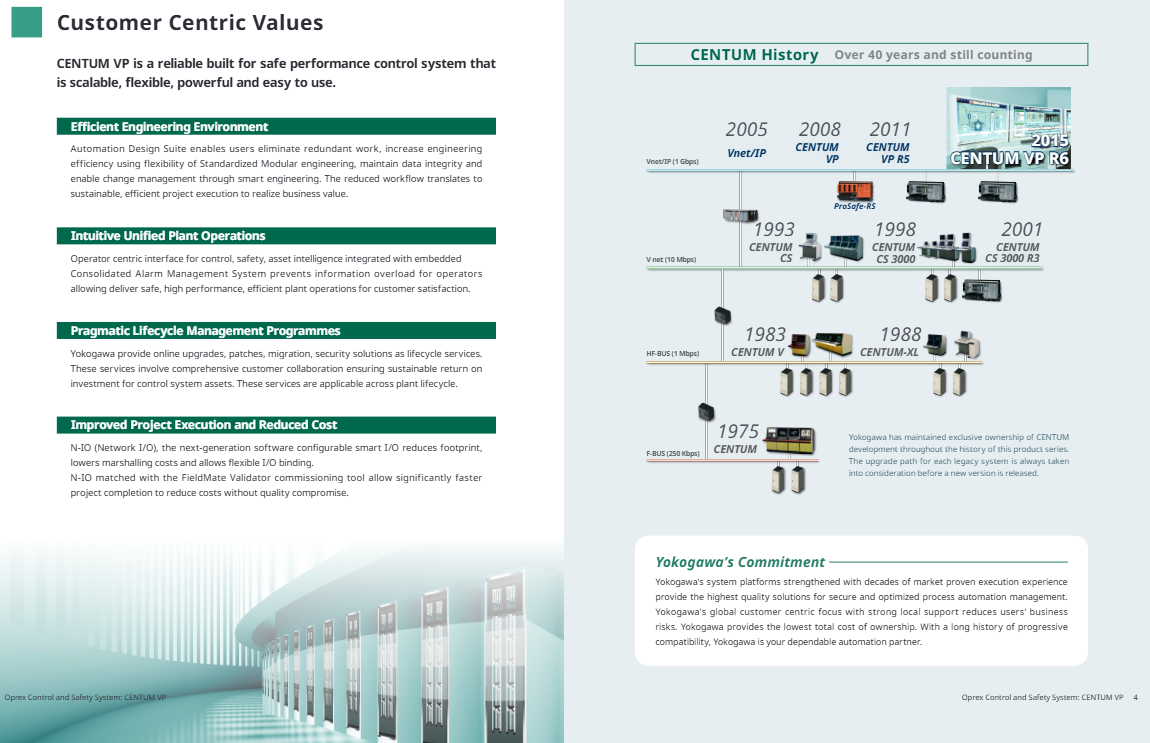
Product History and Evolution
The Yokogawa CENTUM series has undergone more than 40 years of development and has always adhered to independent research and development to ensure the upgrade compatibility of various generations of systems. The key milestones are as follows:
Year Product Version Key Developments
1983 CENTUM V Series First Product
1988 CENTUM-XL Technology Iteration Upgrade
1993 CENTUM CS New Generation Control System
1998 CENTUM CS 3000 Enhanced Features and Compatibility
2001 CENTUM CS 3000 R3 Version Update and Optimization
2008 CENTUM VP R5 VP Series First, Equipped with Vnet/IP
2011 CENTUM VP officially launched CENTUM VP
2015 CENTUM VP R6 version upgrade with enhanced functionality
Key issues
Question 1: What are the core reliability design and I/O module selection advantages of the CENTUM VP system, and which core pain points can be solved in industrial scenarios?
Answer: The core reliability design is reflected in the dual redundancy architecture (FCS processor, power supply, I/O module, network full redundancy) and online maintenance function. In case of failure, seamless switching between primary and backup is supported, and online module replacement and logic parameter modification are supported. This can solve the pain points of "high downtime loss" and "maintenance affecting production" in industrial scenarios; Advantages of I/O module selection: ① N-IO modules support software configuration of multiple types of signals (AI/AO/DI/DO), without the need for traditional grouping, saving space and cost, and adapting to design changes; ② The FIO module is classified by signal type and compatible with multiple connection methods; ③ The RIO module supports the reuse and upgrade of existing assets, which can solve pain points such as long installation cycles, difficult adaptation to changes, and asset waste, and meet the flexible deployment needs of different scenarios.
Question 2: What are the core optimization measures of CENTUM VP in terms of engineering efficiency and operational experience, and what direct value can it bring to customers?
Answer: Engineering efficiency optimization measures: ① Adopting modular engineering design (Automation Design Suite), standard modules can be reused to reduce repetitive work; ② Flexible I/O binding supports remote configuration modification, I/O cabinets are delivered in advance, and early debugging is achieved by combining FieldMate Validator; ③ The change management function automatically documents and detects inconsistencies, reducing project risks. Optimization measures for operating experience: ① Ergonomic HMI, multi screen support, high visibility display, integrated alarm management; ② AOG solution optimization operation graphic design; ③ Specialized operation keyboard (single circuit/eight circuit) for one key operation. Direct value: Shorten project duration by more than 30% and reduce installation and change costs on the engineering side; The operating end reduces operator errors, improves abnormal response speed, and achieves "cost reduction and efficiency improvement" and "safe and efficient operation".
Question 3: What are the compatibility and network security capabilities of CENTUM VP, and why can it meet the long-term stable operation needs of multiple industries?
Answer: In terms of compatibility: ① It is backward compatible with all Yokogawa legacy CENTUM systems (such as CENTUM V, CS 3000, etc.), which can directly control and monitor old systems, maximizing the value of existing assets; ② Support 350+third-party system migrations (such as Honeywell TDC, Siemens SIMATIC, etc.), with a simple migration process. In terms of network security protection: ① Obtained ISASecure EDSA certification, meeting the security requirements of industries such as petroleum and petrochemical; ② Vnet/IP network has built-in anti spoofing, anti tampering, and anti DoS attack functions; ③ Provide endpoint protection such as USB locking, antivirus software, and security information services. The core reason for ensuring long-term stable operation is: ① Compatibility guarantee "smooth upgrade" to avoid high costs of overall system replacement; ② Dual redundancy design and online maintenance reduce downtime; ③ Full lifecycle services (upgrades, maintenance, migration) and continuous support provided by the global service network; ④ Strict security measures are implemented to resist industrial network attacks and ensure the long-term reliable operation of the system.
- OMRON
- ABB
- General Electric
- EMERSON
- Honeywell
- HIMA
- ALSTOM
- Rolls-Royce
- MOTOROLA
- Rockwell
- Siemens
- Woodward
- YOKOGAWA
- FOXBORO
- KOLLMORGEN
- MOOG
- KB
- YAMAHA
- BENDER
- TEKTRONIX
- Westinghouse
- AMAT
- AB
- XYCOM
- Yaskawa
- B&R
- Schneider
- KONGSBERG
- NI
- WATLOW
- ProSoft
- SEW
- ADVANCED
- Reliance
- TRICONEX
- METSO
- MAN
- Advantest
- STUDER
- DANAHER MOTION
- Bently
- Galil
- EATON
- MOLEX
- DEIF
- B&W
- ZYGO
- Aerotech
- DANFOSS
- Beijer
- Moxa
- Rexroth
- Johnson
- WAGO
- TOSHIBA
- BMCM
- SMC
- HITACHI
- HIRSCHMANN
- Application field
- XP POWER
- CTI
- TRICON
- STOBER
- Thinklogical
- Horner Automation
- Meggitt
- Fanuc
- Baldor
- SHINKAWA
- Other Brands
- UniOP
- KUKA
- Iba
- Beckhoff
- ADLINK
-
 Bonfiglioli ISMET LCVT050 DK308/50 Line Reactor
 -
 Bonfiglioli C 22 2 F GR063 Gearbox
 -
 Bonfiglioli C31 3 P P63 PV V5 Reducer
 -
 Bonfiglioli CM-485 T Communication Module
 -
 Bonfiglioli W75UF1D30P90B5 Gearbox
 -
 Bonfiglioli BN63 B4 VF49 Gearmotor 0.18kW
 -
 Bonfiglioli ACT 400-004 FA Frequency Inverter
 -
 Bonfiglioli W110U100P90B5B3 Worm Gearbox
 -
 Bonfiglioli SYN10 T 400 05 AF Inverter
 -
 Bonfiglioli MP080.1.4.15.16.40.80.100 Gearbox
 -
Bonfiglioli SYN10S Inverter
-
 Bonfiglioli VF44L2P160 Gearmotor
 -
Bonfiglioli W 86 U 40 P90 B5 B3 Gear Reducer
-
 Bonfiglioli BTD5-1870-05-400 Servomotor
 -
 Bonfiglioli MP 080 2 2C Gearbox with BLDC Motor
 -
 Bonfiglioli MP080.1.10 Planetary Gearbox
 -
 Bonfiglioli C212PHS Reducer
 -
 Bonfiglioli MVF 49F1 Gearbox with ICME T71B4
 -
 Bonfiglioli VF 49 v P71 B5 Gearbox
 -
Bonfiglioli VF 44 P1 Gearmotor
-
 Bonfiglioli C 22 2 NP 6.1 Helical Gearbox
 -
Bonfiglioli F203 316.9 Gearbox with Kaiser Motor
-
 Bonfiglioli SYN10 S 220 07 AF Frequency Inverter
 -
Bonfiglioli 301L251.8-HC-P90 Gearbox 1/51.8
-
 Bonfiglioli ACT401-25A Frequency Inverter
 -
 Bonfiglioli W75 U D30 30 P90B14 B3 Worm Drive
 -
 Bonfiglioli 830G2310M-307638 Motor
 -
 Bonfiglioli C112-P-P90 Inline Gearbox i=6.2
 -
Bonfiglioli SYN10-S-220-03-AF AC Drive
-
 Bonfiglioli VFR49 A HS Worm Drive i=180 B3
 -
Bonfiglioli ACT 401-29 A AC VFD Drive 22kW
-
 Bonfiglioli VF49PIP63B14 Gearbox
 -
 Bonfiglioli ANG 410-18 2 FA Inverter
 -
 Bonfiglioli GVX2000-7.5-T Converter
 -
 Bonfiglioli EM-ENC-02-24 Optical Module
 -
 Bonfiglioli ACT 401-33 A VFD Drive
 -
 Bonfiglioli MVF 49F1 Gearbox with ICME T71B4
 -
 Bonfiglioli BN112M4 Motor
 -
Bonfiglioli MP080.1.7 Planetary Gearbox
-
 Bonfiglioli VF-EP 49 BN-71-B2 Gearmotor
 -
 Bonfiglioli W75UD3010P80B14B3 Gear Reducer
 -
Bonfiglioli W 110 U 100 P80 B5 B3 Worm Gearbox
-
Bonfiglioli ACT 201-11 FA Frequency Inverter 1.5kW
-
Bonfiglioli MP080380STDISS5 Planetary Gearbox
-
 Bonfiglioli ACU 210-05 1 FA Frequency Inverter
 -
 Bonfiglioli BN63B4 Electric Motor 265 460V
 -
Bonfiglioli BN 63 C 2 Electric Motor
-
Bonfiglioli 12.502.410 BCLP 40XDSM Assembly
-
Bonfiglioli ACU401-13FA Frequency Inverter
-
Bonfiglioli MP 130.2.20.15.16.40.80.100 Gearbox
-
Bonfiglioli VF49N60HSB3 Gearbox
-
 Bonfiglioli VF30P Gearbox
 -
Bonfiglioli ACU410-31A5 Inverter
-
 Bonfiglioli 301L251.8 Gearbox
 -
Bonfiglioli 8XNC63040004 Electric Motor
-
Bonfiglioli VF30F115P63B14B3 Gearbox
-
 Bonfiglioli RAN 28/DA HS Right Angle Gear Unit
 -
 Bonfiglioli 300L220.1PCP90E Gear Unit
 -
Bonfiglioli BN90LA4 Motor
-
Bonfiglioli KG2001030 Gear Unit
-
 Bonfiglioli VF44F135P71B14B3 with VF30 Combination
 -
Bonfiglioli W63 U P90B5 B3 Gear Motor 10:1
-
Bonfiglioli W75 U D30 15 P90 B5 B3 Gearbox
-
 Bonfiglioli B310 DC Motor 600W 3000rpm
 -
Bonfiglioli W 110 U 100 P80 B5 B3 Gearbox
-
 Bonfiglioli VF44P120P71B5B3 Worm Gearbox
 -
 Bonfiglioli BN 71 B 2 Gearmotor VF44 F1 P71B14
 -
 Bonfiglioli 2E130136140005 Assembly Reference
 -
Bonfiglioli KE0702030 Gearbox
-
Bonfiglioli ACT400-004A Frequency Inverter
-
 Bonfiglioli W110 UFC1 P100 B14 B6 Gearbox
 -
 Bonfiglioli Vectron ZBA400-010FC Inverter
 -
 Bonfiglioli 700C-1H Final Drive Motor
 -
Bonfiglioli VF 86 P Gearbox
-
Bonfiglioli W63 U 15 Gearbox
-
 Bonfiglioli VF/W30/63U450P63B14B3 Gearbox
 -
 Bonfiglioli BN 63 A 2 Gear Motor
 -
Bonfiglioli BN 63B 4 Motor
-
 Bonfiglioli VF44P17 Gearmotor
 -
Bonfiglioli T56BN/4 Asynchronous Motor
-
Bonfiglioli W63UF1P90B5 Worm Gearbox
-
Bonfiglioli ACU401-13FA Frequency Inverter
-
Bonfiglioli W63UFC1P90B5 Worm Gearbox
-
Bonfiglioli W75 1/50 D30 Speed Reducer
-
 Bonfiglioli KG2401180 Non Standard Gearbox
 -
Bonfiglioli ACU 201 07 FA Frequency Inverter
-
 Bonfiglioli RAN25SA1HSB3 Gear Unit
 -
Bonfiglioli SPL400 17F Industrial Drive 3.7kW
-
Bonfiglioli VF63P124P71B14B3 Worm Gearbox
-
Bonfiglioli W63U64P71B5B3 Worm Gearbox
-
Bonfiglioli BN90LA4FD Motor
-
Bonfiglioli ANG 410-33 6A Inverter
-
 Bonfiglioli CM-CAN 149-650-034 179-675 140 Communication Module
 -
Bonfiglioli WR110U120P90B5B3 Gearbox
-
Bonfiglioli C 112 F S05 Gearmotor with Pump
-
 Bonfiglioli C50 2P P100 Gear Reducer
 -
 Bonfiglioli ACT 401-31A Inverter 30kW
 -
 Bonfiglioli A102UH25S1PV Gearmotor
 -
Bonfiglioli ACT 201-05 FA Inverter
-
Bonfiglioli AGL402-21 3FA Inverter
-
Bonfiglioli VF49 V 71B14 Gearbox with ESA 6S 12 Motor
-
Bonfiglioli GVX2002-22-T Inverter 22kW
-
Bonfiglioli BN63A2 Electric Motor
-
Bonfiglioli EM I/O-03 I/O Module
-
Bonfiglioli C112 U P63 Inline Gearbox
-
Bonfiglioli BRA 400-075 BF2 Brake Chopper
-
Bonfiglioli VF49 P1 HSRB Worm Gearbox
-
Bonfiglioli GVX2000-18.5-T Inverter
-
Bonfiglioli BMD 118 14 3000 400 165 24 K 67 TC1 Drive
-
Bonfiglioli WR 86 U 120 P80 B5 V5 Gearbox
-
 Bonfiglioli W110U56P100B5B3 Gear Reducer
 -
Bonfiglioli A202 UR 35.4 Bevel Gearbox
-
Bonfiglioli ACU 401-26A Inverter
-
 Bonfiglioli BN 71 B 4 Motor
 -
 Bonfiglioli Vectron BTD5-1870-05-400 Servo Motor
 -
Bonfiglioli BE 80B 4 Motor with C122PP80 Gear
-
Bonfiglioli TR160225STD130ACD Gear Unit
-
Bonfiglioli W 63 U 24 P71 Gearbox
-
Bonfiglioli Trasmital KYB MHKAYABAKTMAGA050VP34 Hydraulic Track Drive
-
Bonfiglioli EM-ABS-01 Encoder Module
-
Bonfiglioli RPS Log 100 Data Logging Module
-
Bonfiglioli VF49P1P71B14 Gearbox
-
Bonfiglioli W86U Right Angle Gear Reducer
-
Bonfiglioli W63 U P71B5 Gear Reducer
-
Bonfiglioli W63UP90B5 Gearmotor
-
 Bonfiglioli VER/S 400-150 Inverter
 -
Bonfiglioli F202 H30 P80 Gearbox
-
Bonfiglioli W75UD307P90B14 Gearbox


