
WESTINGHOUSE Three Phase Induction Motors
WESTINGHOUSE Three Phase Induction Motors
Product positioning and core values
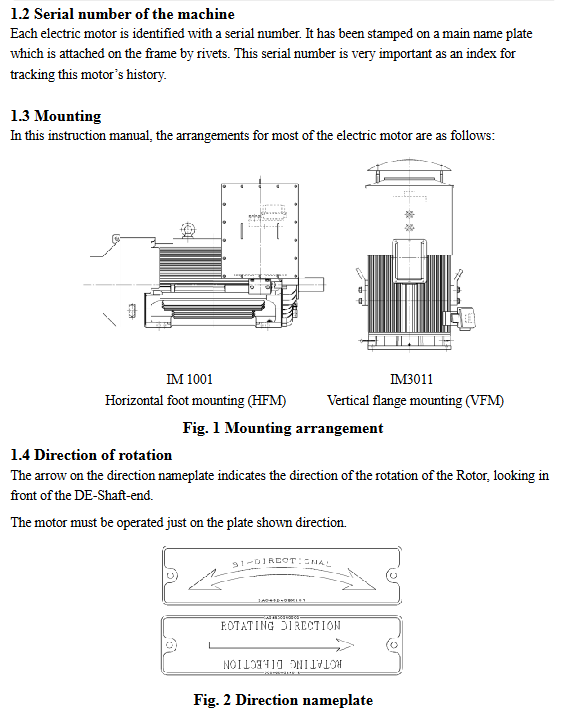
The large cast iron frame three-phase induction motor (IEC 280/NEMA 444 and above specifications) launched by TECO Westinghouse is the core power equipment for industrial heavy-duty scenarios, designed specifically for large-scale mechanical drive in industries such as steel, chemical, mining, and power. The product has the core advantages of "high rigidity, high reliability, and strong load adaptability". It adopts a cast iron frame structure and supports various installation methods such as horizontal feet and vertical flanges. It is compatible with transmission forms such as couplings, belts, and gears, and can stably drive heavy-duty equipment such as pumps, fans, compressors, and crushers. Its core value lies in ensuring long-term stable operation in complex industrial environments such as -20~+40 ℃, high humidity, and high dust through "strict manufacturing standards, perfect protection systems, and scientific operation and maintenance norms". At the same time, with precise installation and maintenance requirements, it maximizes the service life of equipment and reduces the risk of industrial production interruption.
Overview of Product Core Technical Parameters
(1) Basic specifications and installation parameters
Framework and Structure: Large cast iron frame with IEC 280 (corresponding to NEMA 444) and above, fully enclosed (TEFC) or semi enclosed (TENV) protective structure, excellent dust and moisture resistance.
Installation method:
Core types: Horizontal Foot Installation (HFM), Vertical Flange Installation (VFM), supporting customized methods such as vertical hollow shaft and end face installation.
Transmission adaptation: compatible with coupling transmission (rigid/flexible), belt transmission (flat belt/V-belt), chain/gear transmission, to meet different equipment connection needs.
Physical and installation dimensions:
The cast iron frame has strong rigidity and can withstand the weight of the motor and the thrust load during operation. The spacing between the bottom bolt holes is standardized and suitable for industrial universal bases.
Key installation tolerances: Coupling installation end face runout ≤ 0.05mm, shaft diameter tolerance according to H6 standard to ensure transmission accuracy.
(2) Electrical and Environmental Parameters
Parameter category specific specifications
Insulation and resistance: Random winding insulation resistance ≥ 5M Ω, formed winding ≥ 100M Ω (calibrated at 40 ℃, measured with a 500VDC megohmmeter); Insulation level F, allowable temperature rise of 105K
Voltage and frequency: The rated voltage is configured according to the order (commonly 380V, 6kV, 10kV), and the voltage fluctuation is allowed to be ± 10%; Rated frequency 50/60Hz, allowable fluctuation ± 5%
Environmental adaptability working temperature: -20~+40 ℃; Storage temperature: -20~+70 ℃;
Humidity: Fully enclosed models ≤ 95% RH (non condensing), semi enclosed models ≤ 80% RH;
Altitude: ≤ 1000m (for use at altitudes exceeding 1000m, a 10% reduction in capacity is required for every 1000m increase);
Vibration tolerance: ≤ 3.8mm/s during operation, ≤ 2.5mm/s during storage
Protection configuration winding overheating protection: alarm threshold 140 ℃, trip threshold 155 ℃;
Bearing temperature protection: sliding bearing alarm 90 ℃, trip 95 ℃, rolling bearing alarm 95 ℃, trip 105 ℃;
Other protections: overload protection (1.15 times rated current, 1-hour trip), single-phase operation protection, ground fault protection
(3) Run restriction parameters
Start frequency: Up to 2 consecutive starts in cold state (motor temperature ≤ ambient temperature+10 ℃), with an interval of ≥ 5 minutes between each start; Hot state (shutdown after operation) only allows one start, and another start requires cooling for 30-60 minutes (60 minutes at full load and 30 minutes at no load).
Starting current: When starting directly, the starting current is 6-8 times the rated current. It is recommended to configure a soft starter or star delta starter device to reduce grid impact.
Load requirements: During operation, the three-phase current imbalance should not exceed ± 5%. Long term loads should not exceed 110% of the rated power, and short-term overloads (≤ 15 minutes) should not exceed 120%.
Key process specifications for the entire lifecycle
(1) Receiving and Inspection Process
1. Core steps of arrival acceptance
Appearance and packaging inspection: The outer packaging is not damaged or deformed. After opening the box, check that the key parts such as the cast iron frame, end cover, and shaft extension of the motor are not bumped, scratched, or corroded. The fan cover and junction box are intact and undamaged.
Parameter and identification verification: The rated power, voltage, frequency, speed, insulation level, protection level and other parameters on the motor nameplate are consistent with the order; The directional arrow, grounding label, and wiring terminal label are clear and accurate.
Attachment and document verification: The supporting accessories (anchor bolts, couplings, wiring terminals, sealing rings) are complete; The product manual, certificate of conformity, testing report, maintenance manual and other technical documents are complete.
Key function verification: Manually rotate the motor shaft, rotating flexibly without any jamming or abnormal noise; Check that the wiring terminals of auxiliary equipment such as heaters, temperature detectors (PT100/PTC), and vibration sensors are intact and the parameters are compliant.
2. Exception handling
If any transportation damage is found (such as deformation of the frame or bending of the shaft), immediately take photos and record them, synchronize with the carrier and manufacturer, and initiate the claim process.
If the parameters do not match the order or the attachments are missing, please contact the manufacturer in a timely manner to coordinate replacement or supplementation. Unauthorized modification and use are prohibited.
(2) Storage Management Standards
1. Storage environment requirements
The storage site should be clean, dry, and well ventilated, with a temperature controlled between 10-50 ℃ and a relative humidity of ≤ 60%. It should be kept away from heat sources, cold sources, or corrosion sources such as boilers, cold storage, and chemical warehouses.
The motor should be placed on a wooden tray or metal bracket, at least 10cm above the ground, to avoid direct contact with the ground and moisture; Reserve a passage of ≥ 50cm around for ventilation and inspection.
Do not stack heavy or sharp objects in the storage area to avoid colliding with the motor; Avoid storing in strong vibration environments (such as near air compressors) to prevent bearing corrosion or loose windings.
2. Moisture prevention and protective measures
Moisture proof treatment: Activate the built-in space heater of the motor (powered according to the voltage indicated on the nameplate), or place a 25-40W built-in incandescent lamp in the junction box to maintain the internal temperature of the motor 3 ℃ higher than the dew point of the environment, to prevent winding condensation and moisture.
Bearing protection: Manually rotate the motor shaft 3-5 times a month to evenly distribute the lubricating grease and prevent corrosion of the bearing raceway; Long term storage (≥ 3 months) requires the addition of specialized lubricating grease (ExxonMobil Polyrex EM).
Electrical protection: The junction box is sealed properly, and the terminals are coated with rust proof grease; If the motor is equipped with a water cooling system, it is necessary to drain the accumulated water in the pipeline to prevent frost cracking or internal corrosion in winter.
3. Regular inspection and maintenance
Perform insulation resistance testing (using a 500VDC megohmmeter) every 3 months and record the test data. If the insulation resistance is lower than the standard value (random winding<5M Ω/formed winding<100M Ω), drying treatment (using hot air drying or low-voltage electrification drying) is required.
Verify the accuracy of temperature detectors and vibration sensors every 6 months, check the working status of heaters, and ensure the normal operation of auxiliary equipment.
Additional measures for long-term storage (≥ 6 months): Remove external connecting components such as couplings, lift the electric brush (if it is a wound rotor motor), apply anti rust oil to the shaft extension end and wrap it with a protective cover; Regularly inspect the surface coating of the motor, and promptly touch up the paint if rust appears.
(3) Installation and commissioning specifications
1. Preparation before installation
Foundation and base requirements: The installation foundation should be made of reinforced concrete structure, with strength meeting the load requirements during motor operation (bearing capacity ≥ 3 times the weight of the motor), and the levelness error of the foundation plane should be ≤ 0.04mm/m.
Using a rigid bottom plate or common base, cushioning pads (such as rubber cushioning pads or spring shock absorbers) are placed between the bottom plate and the foundation to reduce vibration transmission; The anchor bolts should use high-strength bolts (grade ≥ 8.8) and reserve secondary grouting holes.
Preparation of tools and materials: Prepare installation tools and consumables such as dial gauges, level gauges, torque wrenches, grouting materials (epoxy resin or fine aggregate concrete), terminal blocks, insulation tape, etc.
2. Core installation steps
Motor fixation: Place the motor on the base plate, adjust the levelness (measured with a spirit level, with longitudinal and transverse levelness errors ≤ 0.04mm/m), insert the anchor bolts and pre tighten them, then perform secondary grouting. After the grouting material strength reaches the design requirements (usually ≥ 7 days), tighten the anchor bolts according to the specified torque (recommended torque values refer to the motor manual).
Transmission connection installation:
Coupling transmission: Choose a rigid or flexible coupling that matches the motor shaft diameter, and use a dial gauge to check the coaxiality and parallelism during installation. When the speed is less than 2500rpm, the coaxiality error is ≤ 0.04mm (rigid coupling)/≤ 0.05mm (flexible coupling), and the parallelism error is ≤ 0.03mm. Reserve 1-2.4mm gap at the coupling end to avoid collision during operation.
Belt drive: The diameter of the pulley should meet the minimum recommended diameter of the motor (such as the minimum diameter of the V-pulley for a 45kW 4P motor ≥ 265mm), and the end face runout of the pulley after installation should be ≤ 0.1mm. The center distance of the pulley should be adjusted according to the length of the belt, and the tension of the belt should be moderate (press the midpoint of the belt, and the sinking amount should be 1%~2% of the length of the leather belt) to avoid slipping or excessive stress.
Electrical wiring:
Recheck the insulation resistance of the winding before wiring to ensure it meets the standard; Connect the wires according to the wiring diagram inside the motor junction box. The cross-section of the power cable should match the rated current (copper core cable ≥ 1.5mm ²/kW), and the wiring terminals should be tightly pressed to avoid virtual connection and heat generation.
The motor casing must be reliably grounded with a grounding resistance of ≤ 4 Ω; If the motor is a high-voltage model (6kV/10kV), it should be wired according to the high-voltage electrical regulations and equipped with insulation covers and warning signs.
Check the phase sequence to ensure that the motor direction is consistent with the equipment requirements (confirmed through jog testing, if the direction is opposite, swap any two-phase power supply wiring).
3. Debugging and trial operation
Pre startup inspection:
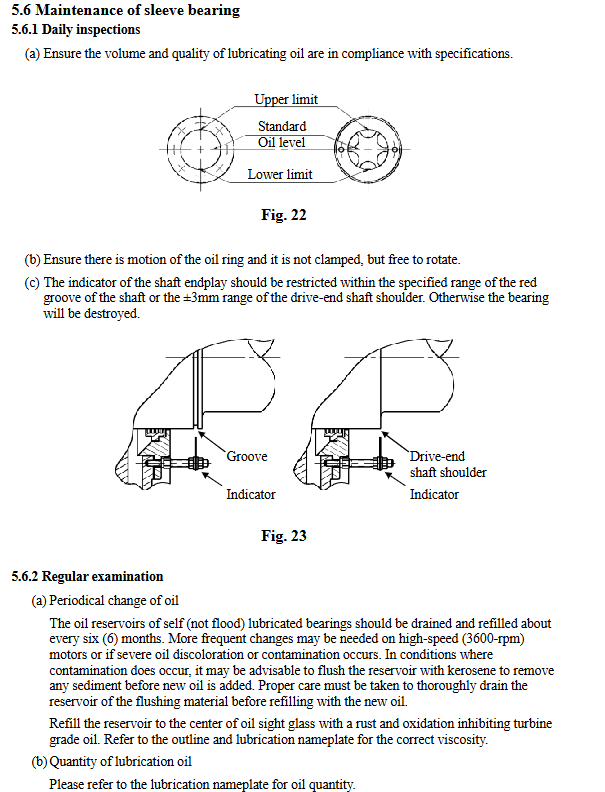
Mechanical inspection: Rotate the motor shaft again to confirm that there is no jamming; Check the tightness of the coupling bolts and pulleys, and ensure that the fan cover is securely installed; The oil level of the sliding bearing is at the center of the oil gauge, and the oil ring rotates smoothly.
Electrical inspection: The power supply voltage is stable (fluctuation ≤ ± 5%), and the protector parameters are set correctly (overload protection current 1.15 times rated current, trip time 1 hour); The wiring of auxiliary equipment such as heaters and temperature detectors is correct and working properly.
Auxiliary system inspection: The water inlet temperature of the water-cooled motor is controlled at 5-30 ℃, the water pressure is 0.2-0.4MPa, and there is no leakage; Start the cooling fan of the forced ventilation motor 15 minutes in advance to ensure normal heat dissipation.
Trial operation:
No load test run: Start the motor and run it without load for 30-60 minutes. Monitor the three-phase current (unbalance degree ≤± 5%), bearing temperature (≤ 70 ℃), vibration value (≤ 2.8mm/s), and ensure no abnormal noise, oil leakage, or burning smell.
Load test run: Gradually increase the load (by 20% of the rated load each time, stabilize for 30 minutes, and then increase again) until reaching the rated load, and continue running for 2-4 hours; Monitor winding temperature (≤ 105 ℃), bearing temperature (sliding bearings ≤ 90 ℃, rolling bearings ≤ 95 ℃), vibration value (≤ 3.8mm/s), and all parameters must be within the allowable range.
Debugging records: Detailed records of voltage, current, temperature, vibration and other data during the trial operation process, forming a debugging report as a reference for subsequent maintenance.
(4) Operation and Operating Standards
1. Key points for daily operation
Before starting the motor, it is necessary to confirm that the equipment load has been disconnected or is in a light load state to avoid heavy load starting; Observe the starting current during startup. If the startup time is too long (more than 10 seconds) or the starting current is abnormally high, immediately stop the machine for troubleshooting.
During operation, real-time monitoring of parameters such as three-phase current, voltage, winding temperature, bearing temperature, vibration value, etc. is carried out through the control cabinet display screen or on-site instruments. If any abnormalities are found (such as sudden increase in current, temperature exceeding the standard, and intensified vibration), the load should be immediately reduced or the machine should be stopped for inspection.
It is prohibited to disassemble fan covers, junction boxes, and other components while the motor is running. It is also forbidden to wipe the running motor with a damp cloth to avoid electric shock or burns.
After the motor stops, wait for the speed to completely drop to zero before performing load switching or maintenance operations; Frequent start stop is prohibited (in accordance with the frequency limit) to avoid overheating of the winding.
2. Handling of special working conditions
When the voltage fluctuation of the power grid exceeds ± 10%, it is necessary to reduce the load in a timely manner to avoid motor overheating; If the voltage continues to be abnormal, stop the machine and wait for the power grid to return to normal.
When the ambient temperature exceeds 40 ℃, the load should be reduced (by 10% for every 5 ℃ increase), and ventilation and heat dissipation should be strengthened; When the ambient temperature is below -20 ℃, the motor needs to be preheated (heated by a heater for 30-60 minutes) before starting to avoid lubricating oil solidification.
When there is slight abnormal noise or vibration in the motor, immediately investigate the cause (such as loose coupling, uneven belt tension, lack of bearing grease), prohibit operation with faults, and prevent the fault from expanding.
Core maintenance and upkeep system
(1) Maintenance cycle and core projects
Maintenance cycle, maintenance level, core project operation points
Daily inspection of oil level, leakage monitoring, and visual inspection. The sliding bearing oil level is at the center of the oil gauge and there is no dripping; There is no dust accumulation on the surface of the motor, and the fan is running normally
Weekly routine inspection of bolt tightening, coupling status, current monitoring anchor bolts, coupling bolts, and junction box bolts for no looseness; Three phase current balance, no abnormal fluctuations
Monthly focus on checking filter cleanliness, belt tension adjustment, vibration detection, cleaning of bearing lubricating oil filters, and cooling fan filters; Adjust the belt tension and replace the aging belt; Vibration value ≤ 3.8mm/s
Quarterly intermediate maintenance insulation resistance testing, bearing grease repair, winding cleaning insulation resistance ≥ 5M Ω; grease repair according to bearing model (such as 6310 bearing with 40g, 22218 bearing with 120g); Compressed air (≤ 4kg/cm ²) to clean the dust on the surface of the winding
Every six months, advanced maintenance oil replacement, end cover sealing inspection, heater calibration, sliding bearing replacement, rust and oxidation suppression turbine oil (ISO VG32/VG68); Check the sealing ring of the end cap and replace it if it ages; Verify the working status of the heater
Annual in-depth maintenance of vibration analysis, re alignment of couplings, and evaluation of winding insulation professional instruments for vibration spectrum analysis to identify potential faults; Re check the coaxiality of the coupling, and adjust if the deviation exceeds the standard; Evaluate the insulation status of the winding and perform drying treatment if necessary
Open the cover every 2 years to check the status of the coil, detect bearing wear, and measure rotor clearance. Open the end cover and inspect the stator coil for discoloration, aging, and looseness; Detect bearing wear (radial clearance ≤ 0.1mm); Measure air gap (uniformity error ≤ 10%)
Disassemble and maintain the rotor guide bar inspection, stator core inspection, and bearing replacement every 4 years. Disassemble the motor and check that there is no looseness or cracking at the welding point between the rotor guide bar and the end ring; Check whether the stator core is corroded or deformed; Replace the rolling bearings and re grind the sliding bearings
(2) Core component maintenance details
1. Winding maintenance
Cleaning: Use compressed air (pressure ≤ 4kg/cm ²) to blow the dust on the surface of the winding from the inside out. If there is oil stains, wipe them with alcohol or neutral cleaner. Do not use chlorine containing solvents (such as acetone) to avoid corroding the insulation layer.
Insulation testing: Use a 500VDC megohmmeter to measure the insulation resistance of the winding every quarter. Before measurement, disconnect auxiliary equipment such as heaters and temperature detectors, and discharge after measurement; If the insulation resistance is lower than the standard value, use hot air drying (temperature 60-80 ℃, continuous for 24-48 hours) or low-voltage electrification drying (apply 10%~20% of the rated voltage, continuous for 12-24 hours).
Moisture protection: When the motor is idle for more than one month, activate the space heater to maintain the winding temperature 3 ℃ above the dew point; Before restarting after a long-term shutdown, insulation resistance testing must be conducted to meet the standard before starting.
2. Bearing maintenance
Lubricant selection: ExxonMobil Polyrex EM grease is used by default for rolling bearings, and mixing different brands and types of grease is prohibited; Sliding bearings use rust proof oxidation inhibiting turbine oil, 2-pole motors use ISO VG32, and 6-pole and above motors use ISO VG68.
Guidelines for fat supplementation and replacement:
Rolling bearing grease cycle: 63XX series 1500-3000 hours, 222XX series 300-1000 hours; Under belt drive, high temperature environment (≥ 40 ℃) or dust environment, the grease replenishment cycle is halved.
Lubricating amount: Calculated based on the inner diameter of the bearing, 5-10g of grease should be added every 10mm inner diameter (such as 40g for 6310 bearing and 120g for 6318 bearing) to avoid excessive grease filling and bearing heating.
Greasing operation: Clean the oil drain hole on the bearing end cover before greasing, grease it during operation, run it without load for 10-30 minutes after greasing, drain the old grease, and then tighten the oil drain hole bolt.
Wear detection: Monitor the vibration value of the bearing through a vibration sensor. If the vibration value exceeds 3.8mm/s or the bearing temperature continues to rise (rolling bearings>95 ℃, sliding bearings>90 ℃), the machine should be stopped to check the wear condition of the bearing, and the bearing should be replaced if necessary.
3. Maintenance of transmission system
Coupling maintenance: Check the tightening of coupling bolts every month, and tighten them promptly if they are loose; Check the rubber pads (flexible couplings) or elastomers of the coupling every six months, and replace them immediately if aging or cracking occurs; Re check the coaxiality of the coupling every year, and adjust if the deviation exceeds the standard.
Belt drive maintenance: Check the belt tension every week. If there is slippage or abnormal noise, adjust the center distance or replace the belt in a timely manner; Check the wear of the pulley every 3 months. If the wear depth of the groove exceeds 2mm, replace the pulley; It is prohibited to mix belts of different specifications and brands.
(3) Common troubleshooting and solutions
Common causes and troubleshooting steps for fault phenomena
Unable to start (no movement) due to power failure, broken wiring, blown fuses, tripped protectors, and rotor jamming. 1. Check the power switch and fuses, and replace them with matching fuses if they are blown; 2. Check the wiring terminals and repair broken or disconnected wires; 3. Reset the protector and investigate the cause of the trip (such as overload, short circuit); 4. Manually rotate the motor shaft. If it is stuck, check whether the coupling is stuck or the bearing is damaged. If necessary, disassemble and repair it
Immediately trip the winding for short circuit/grounding, single-phase operation, overload, and incorrect protector parameter settings after startup. 1. Use a megohmmeter to check the insulation resistance of the winding. If there is a short circuit or grounding, disassemble the motor and repair the winding; 2. Check if the three-phase power supply is missing phase and repair the broken wire; 3. Reduce the load and ensure that the load does not exceed the rated power; 4. Adjust the parameters of the protector (overload current 1.15 times rated current)
Overheating during operation (winding temperature>105 ℃), overload, ventilation blockage, environmental temperature exceeding the standard, three-phase current imbalance, winding insulation aging 1. Reduce the load to ensure that the load is within the rated range; 2. Clean the dust from the cooling fan and heat sink to ensure smooth ventilation; 3. Improve environmental heat dissipation (such as adding ventilation equipment); 4. Check the voltage of the three-phase power supply and repair the fault that caused the current imbalance; 5. Check the insulation of the winding, and replace the winding if it has aged
Insufficient lubrication due to high temperature/abnormal noise of bearings, deterioration of lubricating grease, improper installation, bearing wear, and entry of foreign objects. 1. Supplement or replace qualified lubricating grease; 2. Recheck the coaxiality of the coupling and adjust it to the allowable range; 3. Disassemble the bearing and check for wear. If the raceway or ball bearings are worn or corroded, replace the bearing; 4. Clean the bearing end cover, remove foreign objects, and replace the sealing ring
Vibration exceeding the standard (>3.8mm/s), rotor imbalance, insufficient foundation stiffness, coupling eccentricity, and uneven belt tension. 1. Perform dynamic balance correction on the rotor; 2. Strengthen the installation foundation and add shock-absorbing pads; 3. Adjust the coaxiality of the coupling and tighten the foundation bolts; 4. Adjust the belt tension and replace worn pulleys
Recycling and compliant disposal
(1) Scrap judgment criteria
The cast iron frame of the motor is severely deformed and cracked, and cannot be repaired;
The stator winding is burnt and aged, and the repair cost exceeds 50% of the price of a new motor;
The rotor guide bar is loose or broken, and the unevenness of the air gap exceeds 10%;
The bearing is severely worn, the shaft is bent and deformed, and cannot be corrected;
The motor has been in operation for over 15 years, with frequent malfunctions and high maintenance costs.
(2) Recycling and disposal process
1. Material classification and recycling
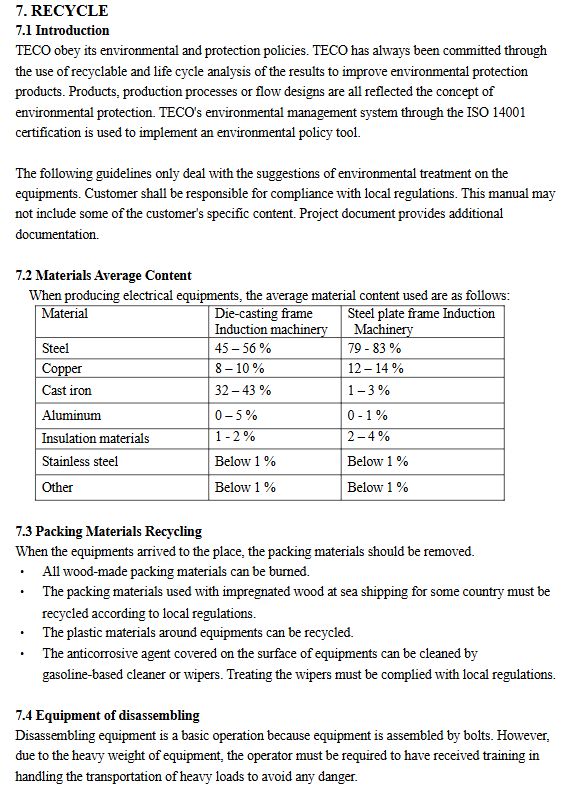
Cast iron components such as cast iron frames, end caps, and bottom plates, as well as steel components such as steel fan covers and anchor bolts, are classified and disassembled before being handed over to professional recycling institutions for recycling and reuse;
The copper wires in the stator winding should be disassembled and recycled separately to avoid mixing with other metals;
Insulation materials (such as winding insulation paper, coil binding tape), rubber sealing rings, belts and other non-metallic materials are classified as recyclable and non recyclable, and non recyclable parts are disposed of as general industrial solid waste.
2. Hazardous waste disposal
Waste lubricating grease in motor bearings and waste lubricating oil in sliding bearings are classified as hazardous waste and need to be collected in specialized sealed containers. They should be handed over to qualified hazardous waste treatment institutions for compliant disposal, and it is prohibited to discharge or dump them indiscriminately;
If the motor is a permanent magnet motor, it needs to be heated to 300 ℃ for demagnetization treatment before recycling to avoid strong magnetic fields interfering with electronic devices or causing harm to the human body.
3. Compliance requirements
The recycling and disposal process must comply with local environmental regulations, retain recycling vouchers and disposal contracts, and ensure traceability throughout the entire process;
It is prohibited to dismantle or burn the motor without authorization to avoid environmental pollution or safety accidents.
- OMRON
- ABB
- General Electric
- EMERSON
- Honeywell
- HIMA
- ALSTOM
- Rolls-Royce
- MOTOROLA
- Rockwell
- Siemens
- Woodward
- YOKOGAWA
- FOXBORO
- KOLLMORGEN
- MOOG
- KB
- YAMAHA
- BENDER
- TEKTRONIX
- Westinghouse
- AMAT
- AB
- XYCOM
- Yaskawa
- B&R
- Schneider
- KONGSBERG
- NI
- WATLOW
- ProSoft
- SEW
- ADVANCED
- Reliance
- TRICONEX
- METSO
- MAN
- Advantest
- STUDER
- DANAHER MOTION
- Bently
- Galil
- EATON
- MOLEX
- DEIF
- B&W
- ZYGO
- Aerotech
- DANFOSS
- Beijer
- Moxa
- Rexroth
- Johnson
- WAGO
- TOSHIBA
- BMCM
- SMC
- HITACHI
- HIRSCHMANN
- Application field
- XP POWER
- CTI
- TRICON
- STOBER
- Thinklogical
- Horner Automation
- Meggitt
- Fanuc
- Baldor
- SHINKAWA
- Other Brands
- UniOP
- KUKA
- Iba
- Beckhoff
- ADLINK
-
 Sigmatek MDD111-1 DIAS Drive Axis Module
 -
 Sigmatek DKL042 05-024-042 Terminal Module
 -
 Sigmatek DM822 Control Module
 -
 Sigmatek CDM167 12-008-167-O Module
 -
 Sigmatek TAE151 Touch Display Unit
 -
 Sigmatek DCC041 SLIDES Module 05-700-041-D
 -
 Sigmatek AKM65M-ANC2GBB0 PM Servo Motor
 -
 Sigmatek ETT221 01-230-221 Operator Terminal
 -
 Sigmatek SLIDES DAM 124 Analog Module
 -
Sigmatek AKM31C-ANCNGBB0 Servo Motor
-
 Mannesmann Demag Sigmatek CP626 Central Unit
 -
 SIGMATEK 0332.554.03 Board 371071000154
 -
 SIGMATEK 12-250-021 Base Plate Back Panel CM5V020
 -
 SIGMATEK DM162 S-DIAS Digital Mix Module
 -
 DEMAG ERGOTECH 061 381 66 Sigmatek 9842.243.02 Circuit Board
 -
 SIGMATEK CP313-1 PLC Module
 -
Sigmatek ETV0551-2 VARAN Touch Terminal
-
 Sigmatek SDM 081 FS S-Dias Safety Module
 -
 DEMAG 05-250-023 Ergotech Motherboard with Sigmatek TMS012
 -
Sigmatek CM5V020 12-250-023-K Wiring Base
-
 Sigma Tek 5000B-37 Attitude Gyro Indicator
 -
 Sigmatek SDD120-2 DIAS Drive
 -
 Sigmatek CME221 Memory Module
 -
 Sigmatek DCP640 DIAS Central Unit
 -
 Sigmatek STO040 Safety Output Module
 -
Sigmatek CET281 Control Panel
-
 Sigmatek CIPC LX800 Demag NC5 CPU
 -
 Sigmatek DKL093 05-024-093 Terminal Module
 -
 Sigmatek AI088 20-009-088 Analog Input Module
 -
Sigmatek CAI888 Analog Input Module
-
SIGMATEK CCA021 12-025-021 Analog Output Module
-
SIGMATEK 1104.579.05 Control Module
-
SIGMATEK SDI100 Digital Input Module
-
 SIGMATEK C-IPC 256MB LX800 Compact Dias
 -
 SIGMATEK 9423.090.02 Control Module
 -
SIGMATEK C-IPC 256 Power Supply 148498
-
 SIGMATEK CAI025 Analog Input Module
 -
 SIGMATEK CTO166 Digital Output Module
 -
 SIGMATEK CP112 20-004-112 Processor Module
 -
SIGMATEK CAI887 12-009-887 Safety Module
-
 Sigma-Tek 4000B-31 Directional Gyro 1U262-002-42
 -
Sigmatek C-IPC 256MB LX800 IPC Controller
-
Sigmatek C-IPC 01-450-031 Industrial PC LX800
-
Sigmatek C-IPC 256 Industrial PC Controller
-
Sigmatek CCP-531 PLC Processor Module
-
Sigmatek CDI163 Digital Input Module
-
 Sigmatek ETV0501 VARAN Terminal 12-230-0501
 -
 Sigmatek CTMS020 C-DIAS Technology Module
 -
 Sigmatek CIV512 VARAN Switch Module
 -
 Sigmatek HU011 20-080-011 Interface Module
 -
SIGMATEK SLIDES DAM 124 Module
-
 SIGMATEK C-IPC 161 01-450-161L Industrial PC
 -
SIGMATEK C-IPC 128MB VIA 733MHz 01-450-024-K
-
 SIGMATEK 12-780-012 R8-IPC Geode LX800 Module
 -
SIGMATEK CAM124 Analog Module
-
 SIGMATEK S1 032-8AF61-R4 EZ Servo Motor
 -
 SIGMATEK CTO163 Digital Output Module
 -
 SIGMATEK CCP082 12-004-082 Processor Module
 -
 SIGMATEK CRCH081 C-DIAS Temperature Module
 -
 SIGMATEK PC322-K 01-310-322-K Industrial PC
 -
SIGMATEK SDD310-2 Servo Drive
-
 SIGMATEK AI084 Analog Input Module
 -
SIGMATEK CRCH081 12-752-081 Temperature Module
-
Sigma-Tek 5000L-4 Attitude Gyro 1U284-001-3
-
 SIGMATEK CM5V020 12-250-023-K Wiring Module
 -
Sigma-Tek 4000H-6 Directional Gyro IU262-035-7
-
 SIGMATEK Dias DCP160 05-004-160 Processor Module
 -
SIGMATEK 0147.395.02 Control Module
-
SIGMATEK A1084 Control Module
-
SIGMATEK DI200 20-006-2000 Digital Input Module
-
Sigmatek DNC115 Encoder Module
-
 Sigmatek DAM122 05-017-122 Analog Module
 -
Sigmatek 9802.289.01 Control Board TA71 Display
-
Sigmatek TO127 20-007-127 Digital Output Module
-
Sigmatek DNC031 05-011-031 Digital Module
-
Sigmatek VI022 20-003-022 Interface Module
-
Sigmatek CAI085 Analog Input Module
-
 Sigmatek CP111 S-DIAS CPU Module
 -
Sigmatek CTMS030 Krauss Maffei Module
-
 Sigmatek CAM123 Control Module
 -
 Sigmatek TAE732-P 01-240-732-P Touch Display Unit
 -
Sigmatek MDM021 Digital Mixed Module
-
Sigmatek DCP642 DIAS Central Unit
-
 Sigmatek CST022 12-014-022 C-DIAS Module
 -
 Sigmatek SRO021 20-893-021 Safety Relay Output
 -
 Krauss Maffei MC5 Control System Sigmatek
 -
 Sigmatek DC061 Module 18-24VDC 300mA
 -
 Herrmann EVT0855 Ultrasonic Welder Touch Panel
 -
Sigmatek CIV521 Control Module 1.4A 2W
-
Sigmatek DDI61 05-006-161 Digital Input Module
-
SIGMATEK ETT312-E Touch Terminal 01-230-312
-
Cessna S3326-1 Sigma Tek 5000B-67 Gyro 1U149-015-9
-
SIGMATEK PS101 Power Supply Module
-
SIGMATEK 0332.554.03 Control Module 371071000154
-
 SIGMATEK ETT312-E Touch Terminal 01-230-312
 -
SIGMATEK CDM163 Control Module
-
 SIGMATEK VSV046 16-023-046 Module
 -
SIGMATEK AM221 20-017-221 Analog Module
-
SIGMATEK CTS051 12-053-051 Control Module
-
SIGMATEK AM221 20-017-221 Analog Module
-
Sigmatek CSDI161 12-891-161 Safety Input Module
-
Sigma Tek 4000C-1 Directional Gyro Indicator
-
Sigmatek ETV0501 12-230-0501 VARAN Terminal
-
Sigmatek DDM165 SLIDES Module
-
Sigmatek N100 20-011-100 Control Module
-
Sigmatek AKM54K-ANC2R-B0 PM Servo Motor
-
Sigmatek CTO166 Digital Output Module
-
Sigmatek CP212-K 20-004-212-K CPU Module
-
Sigmatek CDI161 Digital Input Module
-
Sigmatek DCC080 05-700-080-2 Control Module
-
 SIGMATEK SCP011 S-DIAS Safety CPU
 -
SIGMATEK SCP011 S-DIAS Safety CPU
-
SIGMATEK SRO022 Relay Output Module
-
SIGMATEK MDD 121 Drive Axis Module
-
SIGMATEK DSI021 SLIDES Siemens Interface
-
SIGMATEK DIAS DCP161 Module 05-004-161
-
 Sigmatek ETT312 Built-in Touch Terminal
 -
SIGMATEK DCP 643 DIAS Controller System
-
SIGMATEK CIO021 Multi I/O Module
-
SIGMATEK CTMS020 Control Module
-
 Sigmatek CME 221 Memory Module
 -
Sigmatek 0420.615.01 Control Board
-
Sigmatek CP111 20-004-111 CPU Module
-
Sigmatek 9405.065.03 Control Board
-
Sigmatek ETEK 01-450-032-K C-IPC 256MB Industrial PC
-
Sigmatek CTO163 12-007-163 Safety Output Module
-
Sigmatek TO081 20-007-081 Digital Output Module
-
 Sigmatek SI021 20-022-021 Safety Input Module


