
TOSHIBA TOSBERT VF-AS3 series
TOSHIBA TOSBERT VF-AS3 series
Product Overview
The Toshiba TOSBERT VF-AS3 series is a high-performance frequency converter designed for industrial scenarios, with a core positioning of precise control of 3-phase motor speed. It is specifically designed for 3-phase induction motors, built-in permanent magnet synchronous motors (IPMSM), and surface permanent magnet synchronous motors (SPMSM) in the general industrial field, and does not support single-phase motor drive. This series, with its wide voltage coverage, dual rated mode adaptation, comprehensive safety protection, and multi protocol communication capabilities, has become the core speed control component of equipment such as conveyors, pumps, fans, cranes, and machine tools.
The product strictly limits its application boundaries and cannot be used in scenarios that have a significant impact on public safety or require special quality control, such as power plants, railways, nuclear power, aerospace, life support, surgical equipment, etc. It is only suitable for motor speed regulation needs in general industrial production. The model naming follows a unified rule, for example, in "VFAS3-6750PC", "VFAS3" is the series identifier, "6" represents the voltage level covering 500V-690V, "750" corresponds to the core capacity code, "P" represents the equipped operation panel, and "C" represents the built-in EMC filter.
Core specifications and performance parameters
(1) Voltage and power coverage range
This series is divided into three categories based on voltage levels, each supporting HD (Heavy Duty, constant torque) and ND (Normal Duty, variable torque) rated modes, adapted to different load characteristics:
Voltage level HD rated mode (constant torque) ND rated mode (variable torque) Capacity labeling Unit Core model example
500V class 1.5kW - 55kW 2.2kW - 75kW kW VFAS3-6022PC(1.5kW)、VFAS3-6750PC(55kW)
600V(575V) class 2HP - 75HP 3HP - 100HP HP VFAS3-6022PC(2HP)、VFAS3-6750PC(75HP)
690V class 2.2kW - 75kW 3kW - 90kW kW VFAS3-6022PC(2.2kW)、VFAS3-6750PC(75kW)
(2) Key performance indicators
1. Control core parameters
Control method: Adopting sine wave PWM control, the output waveform is stable, reducing motor operating losses
Output frequency: Set range from 0.01Hz to 590Hz, default operating range from 0.01Hz to 60Hz, meeting the requirements of low-speed precise control and high-speed operation
Frequency accuracy: ± 0.01% ± 0.022Hz in digital input mode, ± 0.2% in analog input mode (25 ± 10 ℃ environment), industry-leading control accuracy
Frequency resolution: Input 0.1Hz on the operation panel, 0.01Hz for communication commands, and 1/2000 of the highest frequency for analog input (0.03Hz at 60Hz)
Carrier frequency: A1Y base (small capacity model) 1.0kHz -6.0kHz, A2Y base (large capacity model) 1.0kHz -4.9kHz, both default to 2.5kHz, adjustable according to noise and heat dissipation requirements
2. Overload and operational capacity
HD rated mode: 150% overload for 60 seconds, suitable for constant torque loads (such as conveyors, cranes, compressors)
ND rated mode: 120% overload for 60 seconds, suitable for variable torque loads (such as fans, pumps, blowers)
Acceleration/deceleration time: adjustable from 0.01 seconds to 6000 seconds, supporting 4 sets of acceleration/deceleration curve switching, including S-shaped acceleration/deceleration mode to avoid load impact
3. Physical and environmental parameters
Machine base specifications: divided into two categories: A1Y (VFAS3-6022PC~6220PC) and A2Y (VFAS3-6300PC~6750PC), with a weight range of 21.6kg to 57kg
Protection level: IP00 (IEC60529 standard), shell color RAL7016 (dark gray)
Cooling method: forced air cooling, built-in cooling fan designed for a lifespan of 8 years, requiring regular inspection and maintenance
Environmental adaptability:
Working temperature: -15 ℃~+60 ℃ (when the ambient temperature is greater than 50 ℃, it needs to be operated at reduced capacity)
Relative humidity: 5% -95% (without condensation)
Working altitude: ≤ 2000m (when exceeding 1000m, the rated current will decrease by 1% for every 100m increase)
Anti vibration: ≤ 5.9m/s ² (0.6G), frequency range 10Hz-55Hz
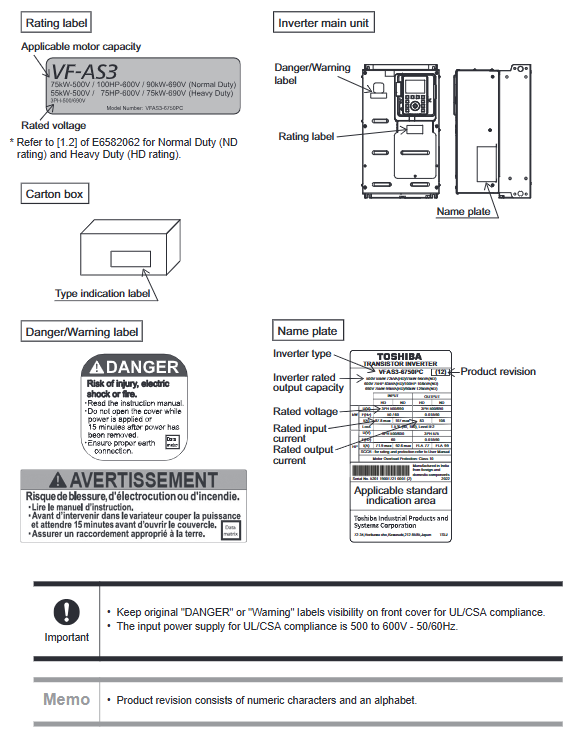
Detailed explanation of core functions and configurations
(1) Control mode and operational functions
1. Diversified control modes
V/f control: supports constant V/f, variable torque V/f, automatic torque boosting, 5-point arbitrary V/f curve setting, adapted to different motor characteristics
Advanced control: Built in vector control, PID control, torque control, supporting torque limitation and torque command input (-10V~+10Vdc)
Special functions: light load high-speed operation (improves motor efficiency under light load), droop function (load balancing when multiple inverters drive the same load), frequency jump (can set 3 jump frequencies to avoid resonance)
2. Run operational functions
Basic operation: forward and reverse control, jog operation (panel or terminal control), coast stop and emergency stop control
Preset speed: 31 preset speeds can be switched through a combination of 5 terminals, supporting quick switching between different working conditions
Automatic functions: automatic acceleration and deceleration, automatic torque increase, regenerative energy suppression control, reducing the difficulty of manual debugging
Fault handling: Supports 10 automatic retry functions, with an adjustable retry waiting time of 0-10 seconds, and fault records can be retained
(2) Interface and Communication System
1. Digital interface
Digital input: 14 programmable terminals (including 6 optional extensions), supporting 204 function assignments, compatible with positive/negative logic, compliant with IEC61131-2 logic type 1
Digital output: 3 programmable terminals (including 2 optional extensions), output capacity 24Vdc/50mA, supporting 262 function assignments
Pulse interface: The digital input terminal [S4] [S5] can receive pulse frequency signals (up to 30kbps), and the digital output terminal [FP] can output pulse signals (up to 30kbps, with a duty cycle of 50%)
2. Simulation interface
Analog input: 5 frequency command inputs (including 2 optional extensions), supporting signal types such as 0~10V, -10V~+10V, 4~20mA, etc. The input impedances are 31.5k Ω (voltage signal) and 250 Ω (current signal), respectively
Analog output: 2 programmable terminals, supporting 0~10V, 0~20mA, 4~20mA outputs, can allocate 54 monitoring parameters (such as frequency, current, voltage)
3. Communication capability
Built in interface:
Ethernet (dual port with switch): Supports EtherNet/IP, Modbus TCP, Webserver, enabling remote monitoring and control
RS485 (2 channels): Supports Toshiba inverter specific protocol Modbus RTU, Adapt to industrial bus networking
Optional extension protocols: PROFINET, DeviceNet, PROFIBUS DP, EtherCAT, CANopen, compatible with mainstream industrial control systems
(3) Security and protection functions
1. Core security design
Safe Torque Off (STO): Compliant with IEC61800-5-2 standard, cutting off the motor torque output does not affect the power supply of the control circuit, ensuring the safety of personnel and equipment
Insulation protection: Built in grounding detection function to avoid the risk of electric shock caused by poor grounding
Operation safety: It is forbidden to disassemble the front cover during operation. When disassembling the front cover and front small cover, the power must be turned off and the capacitor discharge must be confirmed to be completed
2. Comprehensive protection function
Specific functions of protection types
Electrical protection for overcurrent, overvoltage, undervoltage, short circuit (load side), ground fault (load side), input phase loss, output phase loss
Thermal protection for frequency converter overload, motor overload (electronic thermal protection), brake resistor overload, and frequency converter overheating
Mechanical protection stall prevention (during operation/acceleration), over torque protection
Other protective power sources include instantaneous power outages (≥ 15ms), EEPROM failures, RAM failures, and communication errors
Installation and wiring specifications
(1) Installation requirements
1. Installation foundation and space
Installation carrier: It must be fixed on a metal plate and used to assist in heat dissipation. It is prohibited to install it on flammable materials or non-metallic surfaces
Installation space:
Single installation: Reserve ≥ 10cm vertically and ≥ 5cm horizontally
Multiple parallel installations: distance between adjacent inverters ≥ 11mm to avoid hot air backflow
Environmental requirements: Install indoors, away from direct sunlight, corrosive gases, oil mist, metal dust, and avoid locations with severe vibrations
2. Handling and fixing
Transportation specifications: Models weighing ≤ 20kg can be transported by a single person, while models weighing > 20kg require cooperation from two people; VFAS3-6300PC~6750PC (A2Y machine base) needs to be transported by a crane and lifted through the top lifting hole. It is forbidden to grip the front cover or wiring hole during transportation
Fixing method: M5 (A1Y machine base) or M8 (A2Y machine base) screws are used for fixing, with tightening torques of 2.6N · m and 11.8N · m respectively, to ensure a firm installation
(2) Wiring specifications
1. Preparation before wiring
Power off requirement: Before wiring, all input power must be cut off, wait for at least 15 minutes, confirm that the charging light is off, and use a tester with a range of 1400Vdc or above to test the DC main circuit (between PA/+and PC/-) voltage to ensure it is ≤ 45V before operation
Personnel qualifications: Wiring work must be completed by electricians with professional qualifications to avoid accidents caused by incorrect wiring
2. Core wiring requirements
Power wiring: Connect the 3-phase power supply to the [R/L1], [S/L2], and [T/L3] terminals, and the voltage fluctuation should be within the range of -15% to+10% of the rated voltage (± 10% when operating at full load)
Motor wiring: Connect the 3-phase winding of the motor to the [U/T1], [V/T2], and [W/T3] terminals, and ensure that the phase sequence is correct to avoid motor reversal; It is strictly prohibited to directly connect the power supply to the output terminal
Grounding Wiring: The grounding wire must be connected to the [PE] terminal, with specifications not lower than the input/output wire, using a separate grounding method. It is prohibited to share the grounding terminal with the chassis screws or other equipment. The grounding resistance must comply with local electrical standards
Braking resistor wiring: It can only be connected to the [PA/+] and [PB] terminals, and is strictly prohibited from being connected between [PA/+] and [PC/-] to avoid short circuits and fires
Control wire wiring: Shielded wire (cross-sectional area ≥ 0.75mm ²) should be used for the control wire, which should be wired separately from the power wire (spacing ≥ 10cm) to avoid electromagnetic interference; The tightening torque of the terminal screw should comply with the specifications (control terminal about 1.2N · m)
3. Peripheral device configuration
Must be configured:
Short circuit protection device: Molded case circuit breaker (MCCB) or earth leakage circuit breaker (ELCB), installed on the input side of the inverter
Emergency stop device: It needs to be linked with the system and can be stopped by cutting off the power or controlling the signal
Recommended configuration:
Thermal relay (THR): When multiple motors share one inverter, each motor needs to be configured separately
Input reactor: suppresses harmonic interference and improves power factor on the power supply side
Surge absorber: The magnetic contactor (MC) coil side needs to be installed to avoid damage to components caused by surge voltage

Parameter Setting and Operation Guide
(1) Core parameter configuration
1. Basic parameters
Multiple Rating Selection (AUL): The default setting is 600V (575V) HD mode, which can be used to switch voltage levels and rated modes (such as 14=500V ND, 17=690V HD)
Command Selection (CMOd): Terminal control, panel control, Ethernet control, RS485 control, etc. can be selected
Frequency Command Selection (FMOd): Analog input, panel touch wheel, communication command, pulse input, etc. can be selected
Acceleration/deceleration time (ACC/DEC): default 10.0 seconds, adjustable according to load characteristics to avoid start/stop impact
2. Protect parameters
Motor overload protection current (tHrA): set according to the rated current of the motor, with a default value of random capacity variation
Stall prevention level (F601/F185): The default value should be higher than the motor no-load current to avoid frequent triggering of stall protection
Overheating protection: Built in temperature sensor, detects the internal temperature of the inverter, automatically reduces capacity or shuts down when overheating occurs
3. Regional adaptation parameters
Regional settings: Supports parameter presets for 5 regions including Japan, North America, Asia, Europe, and China, covering adaptation values such as frequency and voltage
Basic frequency voltage (vLv/F171, etc.): Different voltage levels correspond to different preset values (e.g. 500V class is 500V, 690V class is 690V)
(2) Operation panel usage
Display function: LCD/LED display screen can display output frequency, current, voltage, torque, fault codes, parameter values, etc., supporting multilingual switching
Monitoring function: It can monitor more than 20 operating parameters in real time, including cumulative operating time, motor overload coefficient, and fault history (including recent multiple fault records)
Parameter operation: supports parameter upload/download, user default parameter saving, parameter reset to factory settings, and can be locked with a password to prevent accidental operation
Applicable scenarios and application value
(1) Core applicable scenarios
Constant torque load scenarios: conveyors, cranes, mixers, compressors, machine tools, etc., adapted to HD rated mode
Variable torque load scenarios: centrifugal fans, centrifugal pumps, blowers, etc., adapted to ND rated mode, with significant energy-saving effects
Precise control scenario: equipment that requires stable speed and precise torque control (such as precision machine tools and packaging machinery)
Distributed control scenario: supports multi protocol communication, can be connected to factory MES system and SCADA system, suitable for automated production lines
(2) Core application value
Strong adaptability: wide voltage and power coverage, dual rated mode switching, compatible with multiple motor types, meeting the needs of different industrial scenarios
Precise control: high frequency accuracy and resolution, multiple control modes to choose from, ensuring equipment stability and product quality
Safe and reliable: With comprehensive safety protection functions and STO safety design, it reduces equipment failures and personnel safety risks
Convenient operation and maintenance: rich monitoring functions, fault recording, and parameter locking, simplifying debugging and maintenance processes
Energy saving and efficient: Reduce load idle losses through precise speed regulation, especially suitable for fan and pump loads, with an energy-saving rate of up to 20%~50%
Precautions and usage restrictions
Power compatibility: cannot be connected to the corner grounding system power supply, the IT system power supply needs to disconnect the grounding capacitor; The power supply voltage must strictly match the rated voltage of the model
Environmental restrictions: It is prohibited to use in environments with flammable, explosive, corrosive gases, and excessive dust to avoid equipment damage or safety accidents
Wiring taboos: It is strictly prohibited to connect the power supply to the output terminal, connect the brake resistor to the wrong terminal, or mix the control line and power line, otherwise it may cause the inverter to burn out or be electrocuted
Operation taboo: Do not control the start and stop of the inverter through the on/off of the input side magnetic contactor. Frequent operation may damage the capacitor and switching elements
Disposal requirements: When disposing of the inverter, it should be treated according to local environmental standards, especially paying attention to the environmentally friendly disposal of built-in capacitors and cooling fans, to avoid polluting the environment
- OMRON
- ABB
- General Electric
- EMERSON
- Honeywell
- HIMA
- ALSTOM
- Rolls-Royce
- MOTOROLA
- Rockwell
- Siemens
- Woodward
- YOKOGAWA
- FOXBORO
- KOLLMORGEN
- MOOG
- KB
- YAMAHA
- BENDER
- TEKTRONIX
- Westinghouse
- AMAT
- AB
- XYCOM
- Yaskawa
- B&R
- Schneider
- KONGSBERG
- NI
- WATLOW
- ProSoft
- SEW
- ADVANCED
- Reliance
- TRICONEX
- METSO
- MAN
- Advantest
- STUDER
- DANAHER MOTION
- Bently
- Galil
- EATON
- MOLEX
- DEIF
- B&W
- ZYGO
- Aerotech
- DANFOSS
- Beijer
- Moxa
- Rexroth
- Johnson
- WAGO
- TOSHIBA
- BMCM
- SMC
- HITACHI
- HIRSCHMANN
- Application field
- XP POWER
- CTI
- TRICON
- STOBER
- Thinklogical
- Horner Automation
- Meggitt
- Fanuc
- Baldor
- SHINKAWA
- Other Brands
- UniOP
- KUKA
- Iba
- Beckhoff
- ADLINK
-
 Sigmatek MDD111-1 DIAS Drive Axis Module
 -
 Sigmatek DKL042 05-024-042 Terminal Module
 -
 Sigmatek DM822 Control Module
 -
 Sigmatek CDM167 12-008-167-O Module
 -
 Sigmatek TAE151 Touch Display Unit
 -
 Sigmatek DCC041 SLIDES Module 05-700-041-D
 -
 Sigmatek AKM65M-ANC2GBB0 PM Servo Motor
 -
 Sigmatek ETT221 01-230-221 Operator Terminal
 -
 Sigmatek SLIDES DAM 124 Analog Module
 -
Sigmatek AKM31C-ANCNGBB0 Servo Motor
-
 Mannesmann Demag Sigmatek CP626 Central Unit
 -
 SIGMATEK 0332.554.03 Board 371071000154
 -
 SIGMATEK 12-250-021 Base Plate Back Panel CM5V020
 -
 SIGMATEK DM162 S-DIAS Digital Mix Module
 -
 DEMAG ERGOTECH 061 381 66 Sigmatek 9842.243.02 Circuit Board
 -
 SIGMATEK CP313-1 PLC Module
 -
Sigmatek ETV0551-2 VARAN Touch Terminal
-
 Sigmatek SDM 081 FS S-Dias Safety Module
 -
 DEMAG 05-250-023 Ergotech Motherboard with Sigmatek TMS012
 -
Sigmatek CM5V020 12-250-023-K Wiring Base
-
 Sigma Tek 5000B-37 Attitude Gyro Indicator
 -
 Sigmatek SDD120-2 DIAS Drive
 -
 Sigmatek CME221 Memory Module
 -
 Sigmatek DCP640 DIAS Central Unit
 -
 Sigmatek STO040 Safety Output Module
 -
Sigmatek CET281 Control Panel
-
 Sigmatek CIPC LX800 Demag NC5 CPU
 -
 Sigmatek DKL093 05-024-093 Terminal Module
 -
 Sigmatek AI088 20-009-088 Analog Input Module
 -
Sigmatek CAI888 Analog Input Module
-
SIGMATEK CCA021 12-025-021 Analog Output Module
-
SIGMATEK 1104.579.05 Control Module
-
SIGMATEK SDI100 Digital Input Module
-
 SIGMATEK C-IPC 256MB LX800 Compact Dias
 -
 SIGMATEK 9423.090.02 Control Module
 -
SIGMATEK C-IPC 256 Power Supply 148498
-
 SIGMATEK CAI025 Analog Input Module
 -
 SIGMATEK CTO166 Digital Output Module
 -
 SIGMATEK CP112 20-004-112 Processor Module
 -
SIGMATEK CAI887 12-009-887 Safety Module
-
 Sigma-Tek 4000B-31 Directional Gyro 1U262-002-42
 -
Sigmatek C-IPC 256MB LX800 IPC Controller
-
Sigmatek C-IPC 01-450-031 Industrial PC LX800
-
Sigmatek C-IPC 256 Industrial PC Controller
-
Sigmatek CCP-531 PLC Processor Module
-
Sigmatek CDI163 Digital Input Module
-
 Sigmatek ETV0501 VARAN Terminal 12-230-0501
 -
 Sigmatek CTMS020 C-DIAS Technology Module
 -
 Sigmatek CIV512 VARAN Switch Module
 -
 Sigmatek HU011 20-080-011 Interface Module
 -
SIGMATEK SLIDES DAM 124 Module
-
 SIGMATEK C-IPC 161 01-450-161L Industrial PC
 -
SIGMATEK C-IPC 128MB VIA 733MHz 01-450-024-K
-
 SIGMATEK 12-780-012 R8-IPC Geode LX800 Module
 -
SIGMATEK CAM124 Analog Module
-
 SIGMATEK S1 032-8AF61-R4 EZ Servo Motor
 -
 SIGMATEK CTO163 Digital Output Module
 -
 SIGMATEK CCP082 12-004-082 Processor Module
 -
 SIGMATEK CRCH081 C-DIAS Temperature Module
 -
 SIGMATEK PC322-K 01-310-322-K Industrial PC
 -
SIGMATEK SDD310-2 Servo Drive
-
 SIGMATEK AI084 Analog Input Module
 -
SIGMATEK CRCH081 12-752-081 Temperature Module
-
Sigma-Tek 5000L-4 Attitude Gyro 1U284-001-3
-
 SIGMATEK CM5V020 12-250-023-K Wiring Module
 -
Sigma-Tek 4000H-6 Directional Gyro IU262-035-7
-
 SIGMATEK Dias DCP160 05-004-160 Processor Module
 -
SIGMATEK 0147.395.02 Control Module
-
SIGMATEK A1084 Control Module
-
SIGMATEK DI200 20-006-2000 Digital Input Module
-
Sigmatek DNC115 Encoder Module
-
 Sigmatek DAM122 05-017-122 Analog Module
 -
Sigmatek 9802.289.01 Control Board TA71 Display
-
Sigmatek TO127 20-007-127 Digital Output Module
-
Sigmatek DNC031 05-011-031 Digital Module
-
Sigmatek VI022 20-003-022 Interface Module
-
Sigmatek CAI085 Analog Input Module
-
 Sigmatek CP111 S-DIAS CPU Module
 -
Sigmatek CTMS030 Krauss Maffei Module
-
 Sigmatek CAM123 Control Module
 -
 Sigmatek TAE732-P 01-240-732-P Touch Display Unit
 -
Sigmatek MDM021 Digital Mixed Module
-
Sigmatek DCP642 DIAS Central Unit
-
 Sigmatek CST022 12-014-022 C-DIAS Module
 -
 Sigmatek SRO021 20-893-021 Safety Relay Output
 -
 Krauss Maffei MC5 Control System Sigmatek
 -
 Sigmatek DC061 Module 18-24VDC 300mA
 -
 Herrmann EVT0855 Ultrasonic Welder Touch Panel
 -
Sigmatek CIV521 Control Module 1.4A 2W
-
Sigmatek DDI61 05-006-161 Digital Input Module
-
SIGMATEK ETT312-E Touch Terminal 01-230-312
-
Cessna S3326-1 Sigma Tek 5000B-67 Gyro 1U149-015-9
-
SIGMATEK PS101 Power Supply Module
-
SIGMATEK 0332.554.03 Control Module 371071000154
-
 SIGMATEK ETT312-E Touch Terminal 01-230-312
 -
SIGMATEK CDM163 Control Module
-
 SIGMATEK VSV046 16-023-046 Module
 -
SIGMATEK AM221 20-017-221 Analog Module
-
SIGMATEK CTS051 12-053-051 Control Module
-
SIGMATEK AM221 20-017-221 Analog Module
-
Sigmatek CSDI161 12-891-161 Safety Input Module
-
Sigma Tek 4000C-1 Directional Gyro Indicator
-
Sigmatek ETV0501 12-230-0501 VARAN Terminal
-
Sigmatek DDM165 SLIDES Module
-
Sigmatek N100 20-011-100 Control Module
-
Sigmatek AKM54K-ANC2R-B0 PM Servo Motor
-
Sigmatek CTO166 Digital Output Module
-
Sigmatek CP212-K 20-004-212-K CPU Module
-
Sigmatek CDI161 Digital Input Module
-
Sigmatek DCC080 05-700-080-2 Control Module
-
 SIGMATEK SCP011 S-DIAS Safety CPU
 -
SIGMATEK SCP011 S-DIAS Safety CPU
-
SIGMATEK SRO022 Relay Output Module
-
SIGMATEK MDD 121 Drive Axis Module
-
SIGMATEK DSI021 SLIDES Siemens Interface
-
SIGMATEK DIAS DCP161 Module 05-004-161
-
 Sigmatek ETT312 Built-in Touch Terminal
 -
SIGMATEK DCP 643 DIAS Controller System
-
SIGMATEK CIO021 Multi I/O Module
-
SIGMATEK CTMS020 Control Module
-
 Sigmatek CME 221 Memory Module
 -
Sigmatek 0420.615.01 Control Board
-
Sigmatek CP111 20-004-111 CPU Module
-
Sigmatek 9405.065.03 Control Board
-
Sigmatek ETEK 01-450-032-K C-IPC 256MB Industrial PC
-
Sigmatek CTO163 12-007-163 Safety Output Module
-
Sigmatek TO081 20-007-081 Digital Output Module
-
 Sigmatek SI021 20-022-021 Safety Input Module


