
WESTINGHOUSE iGen5000 Digital Inverter Generator
WESTINGHOUSE iGen5000 Digital Inverter Generator
Brand positioning and core product values
Westinghouse, as a globally renowned power equipment brand, has launched the iGen5000 digital inverter generator with the core positioning of "high performance, high reliability, easy operation, and multi scenario adaptation". It is a portable power generation device designed specifically for outdoor operations, emergency power supply, RV camping, small projects, and other scenarios. With a strong output of 3900W rated power and 5000W peak power, combined with digital inverter technology and permanent magnet generator design, the product achieves a low total harmonic distortion of ≤ 3%, and its power supply stability is comparable to that of mains power. It can safely drive voltage sensitive equipment such as computers, refrigerators, and air conditioners. Its core value lies in balancing power output and usage costs through "triple start mode, ECO energy-saving mode, and parallel expansion function". At the same time, with multiple safety protections and global certification qualifications (EPA, UL, cUL, CE, RoHS), it has become the preferred solution for home emergency, outdoor operations, and commercial backup power.
Overview of Product Core Technical Parameters
(1) Basic electrical parameters
Power and voltage characteristics:
Rated operating power: 3900W; peak power: 5000W.
Rated voltage: 120V; frequency: 60Hz; phase: single-phase.
Total harmonic distortion (THD): ≤ 3%, pure power supply, suitable for sensitive electronic devices.
Power configuration:
Engine displacement: 224cc; Spark plug model: 97109-F7RTC; Spark plug clearance: 0.60-0.80mm.
Inlet valve clearance: 0.08-0.12mm; exhaust valve clearance: 0.13-0.17mm.
Voltage regulator: digital; AC generator type: permanent magnet type, with higher power generation efficiency.
Fuel and Capacity:
Fuel type: 87-93 unleaded gasoline (ethanol content ≤ 10%, E15/E85 prohibited).
Fuel tank capacity: 3.4 gallons (12.8 liters); Oil capacity: 0.63 US quarts (0.60 liters); Recommended engine oil model: 10W-30 (5W-30 or 10W-40 can be used for extreme temperatures).
Startup mode: Supports remote start (up to 30 meters), electric start, and manual start (Recoil) triple start, suitable for different usage scenarios.
(2) Physical and environmental parameters
Protection and certification: Protection level IP20/NEMA 1, compliant with EPA, UL, cUL, CE, RoHS certification standards.
Size and weight:
Equipped with a retractable handle and transport wheel, it can be pushed by a single person; Double person carrying handle design, convenient for short distance movement.
The weight is about 50-60 pounds (due to slight differences in configuration), the size is compact, and it does not take up too much storage space.
Environmental adaptability:
Working temperature: -10 ℃~+50 ℃ (short-term tolerance -15 ℃~+50 ℃); Storage temperature: -20 ℃~+70 ℃.
Humidity requirement: ≤ 95% RH (no condensation); Maximum ambient temperature: 40 ℃ (104 ° F).
High altitude adaptability: For every 1000 feet (305 meters) increase in altitude, the power output decreases by about 3.5%. For altitudes exceeding 2000 feet (762 meters), a high-altitude carburetor kit (Part # 518913-01) needs to be installed.
Detailed explanation of core functional features
(1) Power Control and Operation Mode
1. Flexible start-up and operation adjustment
Triple start mode:
Remote start: equipped with a wireless remote key, with an effective distance of up to 99 feet (30 meters), no need for close range operation, suitable for emergency scenarios.
Electric start: One click press start, easy to operate, relying on the built-in 12V battery (model 511019) for power supply.
Hand pulled start: Mechanical backup start method, no battery dependence, ensuring that it can still start in extreme situations.
ECO energy-saving mode:
Core principle: Automatically adjust the engine speed according to the load size, reduce the speed when the load is light, and reduce fuel consumption and noise.
Applicable scenarios: Drive continuous light load devices such as computers, lighting fixtures, and mobile phone chargers to extend battery life.
Disabled scenario: When operating in parallel or driving high starting current devices such as air conditioners and water pumps, the ECO mode should be turned off to avoid delayed speed response.
2. Capacity expansion and power management
Parallel operation function: Two generators of the same model can be connected through a dedicated parallel cable (Westinghouse 507PC, purchased separately) to double the total power and meet larger load requirements (such as simultaneously driving multiple high-power devices).
Intelligent power allocation: supports the "high power priority" load access logic. It is recommended to connect the maximum load first after startup, and then add other loads in sequence after the standby motor stabilizes to avoid overload triggering protection.
(2) Operation and display interface
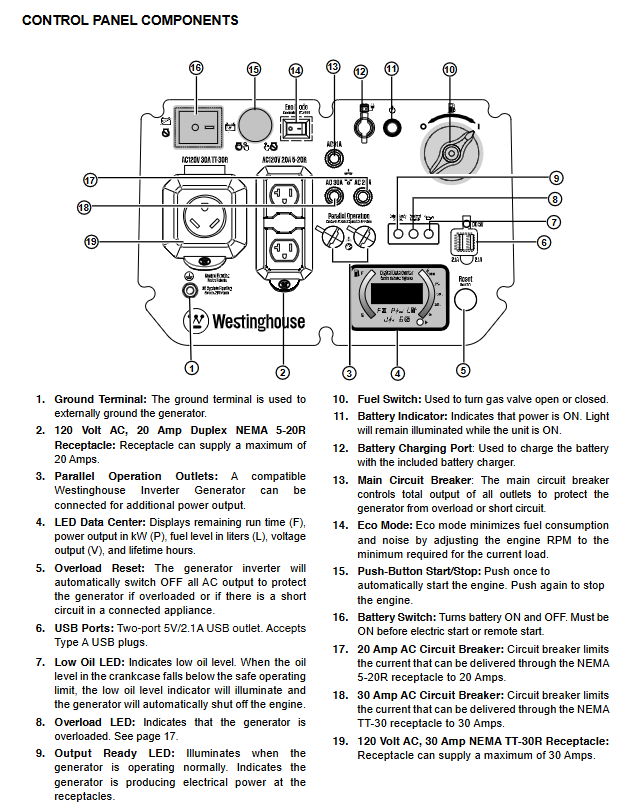
Core configuration of control panel:
Output interfaces: 120V 20A NEMA 5-20R dual socket (2), 120V 30A NEMA TT-30R socket (1), dual USB 5V/2.1A interface, to meet the simultaneous power supply of multiple devices.
Display system: LED digital data center, real-time display of remaining operating time, output power (kW), fuel level (liters), output voltage, and cumulative operating hours, with clear status at a glance.
Control buttons: One click start/stop, ECO mode switch, overload reset button, battery switch. The operation logic is clear and easy for beginners to learn.
Convenient design:
Scalable metal handle+large-sized rubber wheels, easy to move by one person, suitable for outdoor complex terrain.
The fuselage is equipped with independent openings such as fuel filling port, oil filling port, battery inspection cover, etc., and maintenance operations do not require disassembling the entire components.
Safety standards and protection mechanisms
(1) Core safety usage requirements
Usage environment restrictions:
It is strictly prohibited to use it indoors, in garages, basements, crawl spaces, and other enclosed/semi enclosed spaces. It can only be operated outdoors in ventilated areas and must be kept at least 5 feet (1.5 meters) away from doors, windows, and ventilation openings to avoid carbon monoxide poisoning.
Do not use in humid environments (rainy, snowy, or waterlogged areas) to avoid short circuits and electric shocks caused by moisture; Keep hands dry and wear insulated gloves during operation.
A ventilation gap of ≥ 5 feet (1.5 meters) should be reserved around the equipment, away from combustibles (hay, wood, gasoline barrels, etc.), and the exhaust port should face unmanned areas to avoid high temperature exhaust gas causing fires or burns.
Fuel safety regulations:
Before refueling, the machine must be stopped and cooled for at least 5 minutes. Smoking or approaching open flames is prohibited; Fuel should not be overfilled, and expansion space should be reserved (up to the red filling ring in the fuel tank).
Fuel must be stored in approved gasoline containers, away from heat and fire sources; If fuel spills, immediately wipe it clean and wait for the area to dry before starting the equipment.
Prohibit the use of gasoline as a cleaning agent, avoid contact between fuel and skin, and wash hands promptly after operation.
(2) Comprehensive protection function
Protection type triggers condition protection action
Overload protection output current exceeds the rated value or load short circuit automatically cuts off all AC outputs, overload LED red light lights up, and the engine continues to run
Low oil level protection: When the oil level in the crankcase is below the safety threshold, the low oil LED yellow light will turn on, and the engine will automatically stop to avoid damage caused by cylinder pulling
Overcurrent/short circuit protection circuit short circuit or branch current exceeding the standard (20A/30A branch) corresponds to automatic tripping of the branch circuit breaker, and the main circuit breaker (31A) is linked for protection
Overvoltage/undervoltage protection: Abnormal output voltage (overvoltage>132V/undervoltage<108V). Digital regulator intervenes in regulation, and in severe cases, the output is cut off
Ground fault protection equipment shell or line grounding abnormality triggers safe power-off, reducing the risk of electric shock
Overheating protection: If the engine or inverter temperature exceeds the safety threshold, it will automatically reduce power or shut down, and can be restored after cooling down
Operation and usage process
(1) First use preparation
Oil filling: The equipment has not been filled with oil before leaving the factory. It is necessary to use the accompanying 10W-30 oil and funnel to fill the level surface between the "L-H" mark on the dipstick to avoid overfilling or underfilling.
Fuel filling: Use 87-93 unleaded gasoline, clean the area around the fuel tank cap before filling, slowly fill to the red filling ring, and tighten the fuel tank cap until you hear a "click" sound.
Battery connection: Open the battery access cover, connect the pre installed quick connector, ensure that the battery strap is securely fastened, and avoid loosening during transportation.
Equipment positioning: Place in a dry, flat, and ventilated outdoor area, away from doors, windows, and flammable materials, and reserve sufficient ventilation gaps.
(2) Startup and operation steps
Pre start check: Confirm that all loads have been disconnected, the oil level is normal, the fuel is sufficient, and the battery switch is in the "ON" position.
Start operation:
Remote start: Press the "ON" button on the remote control for 1 second, and the device will automatically start. Wait for the "output ready" LED green light to turn on before connecting the load.
Electric start: Press the "Start/Stop" button on the control panel for 2 seconds. After the engine starts, wait for 30 seconds until the speed stabilizes.
Hand pulled start: Slowly pull the rope until resistance is felt, then quickly pull again, and release the rope to naturally retract after starting.
Load connection: According to the principle of "high power priority", first connect large loads such as air conditioning and refrigerator, wait for the equipment to stabilize (engine running smoothly), and then connect small loads in sequence, with a total load not exceeding 3900W.
Operation adjustment: In light load scenarios such as phone charging and lighting fixtures, ECO mode can be activated to reduce fuel consumption and noise; In high load scenarios, ECO mode needs to be turned off to ensure power output.
(3) Shutdown and shutdown process
Disconnect all loads and let the equipment run without load for 3-5 minutes to stabilize the internal temperature.
Press the "Start/Stop" button on the control panel for 1 second or the "OFF" button on the remote control for 1 second to shut down the engine.
Turn off the battery switch (if not in use for a long time, disconnect the battery connector), tighten the fuel tank cap, and clean the surface of the equipment with debris.
If stored for a long time, fuel and engine oil should be handled according to the "Storage Specification" (see "Storage Requirements" below for details).
(4) Parallel operation (expansion requirement)
Prepare two compatible Westinghouse iGen5000 generators, ensuring that both have been shut down and the ECO mode is in the "OFF" position.
Use a dedicated parallel cable (Westinghouse 507PC) to connect the parallel interfaces of two devices, ensuring that the left and right cable connections correspond (building power supply needs to be matched, direct power supply can be ignored).
Start one generator first, wait for the "output ready" LED to light up, then start the second one. After both devices are stable, connect the loads in sequence, and the total load should not exceed the sum of the rated power of the two devices (7800W).
When shutting down, all loads should be disconnected first, then the two generators should be shut down in sequence, and finally the parallel cables should be disconnected.
Maintenance and upkeep standards
(1) Regular maintenance cycle and project
Key operational points for core projects in the maintenance cycle
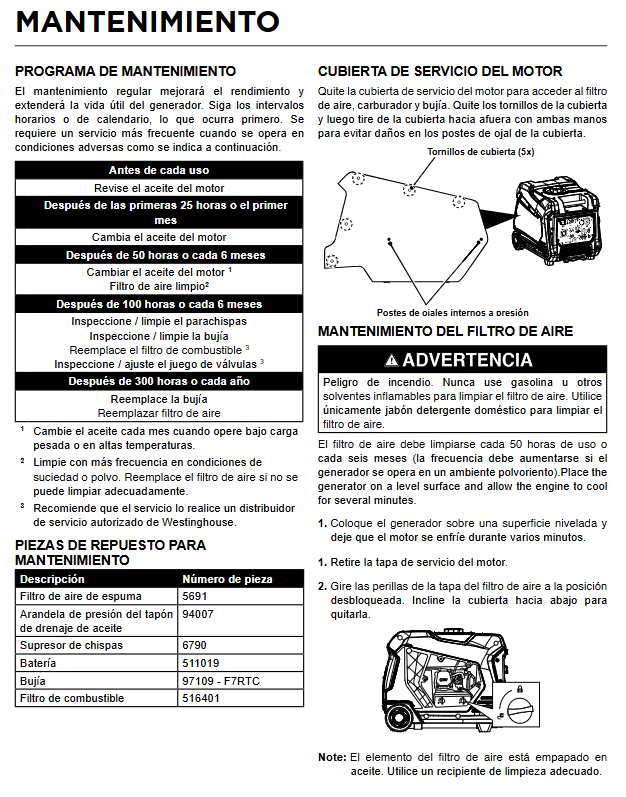
Before each use, check the oil level and place the equipment horizontally. Take out the dipstick and wipe it clean before inserting it (without tightening), and observe that the oil level is between "L-H"
First 25 hours/1 month engine oil change. When the engine is warm, drain the oil, replace the new oil to the dipstick mark, and replace the oil drain bolt washer (Part # 94007)
Every 50 hours/6 months, the cycle of oil change and air filter cleaning in harsh environments (dusty, high temperature) needs to be shortened; Clean the air filter with household detergent, dry it, soak it in oil and squeeze it until there is no excess oil
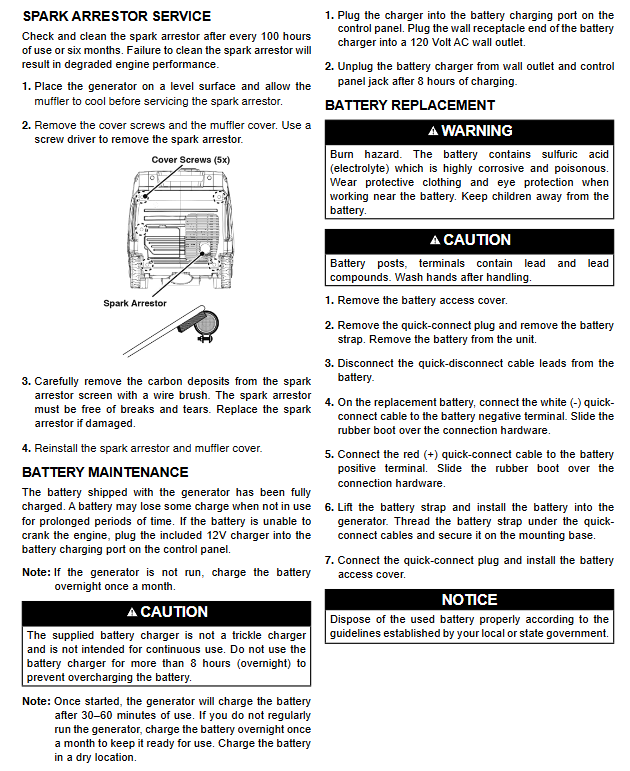
Spark plug maintenance every 100 hours/6 months+spark eliminator cleaning Spark plug cleaning Carbon deposits, check electrode status, adjust gaps if abnormal; Spark eliminator uses a wire brush to clean carbon deposits
Replace spark plug every 300 hours/1 year+replace air filter Replace original spark plug (Part # 97109-F7RTC) and foam air filter (Part # 5691) to ensure smooth air intake
Fuel treatment and battery maintenance before long-term storage, emptying the fuel tank or adding fuel stabilizer, disconnecting the connector after the battery is fully charged, and recharging once a month
(2) Key component maintenance details
1. Maintenance of air filter
Remove the engine service cover, rotate the air filter box knob to unlock it, take out the foam air filter, soak it in warm water+household detergent for cleaning, slowly squeeze (no twisting) until there is no dirt.
After rinsing with clean water, let it air dry naturally in a well ventilated area, then immerse it in clean 10W-30 engine oil and squeeze to remove excess oil (excessive oil can cause smoke during startup).
If the air filter is damaged or cannot be cleaned, replace the original parts (Part # 5691) directly. During installation, ensure that the air filter box is well sealed to prevent dust from entering the engine.
2. Oil change process
Run the equipment for 10 minutes until the oil is warm, then disconnect the spark plug wire from the battery connector after stopping to avoid accidental start-up.
Place the oil pan, remove the oil drain bolt and rubber plug, completely drain the oil, install a new washer and tighten the drain bolt.
Slowly add new oil from the oil filling port, check the dipstick multiple times to ensure that the liquid level is between "L-H" and not too full, and tighten the dipstick and oil inspection cover.
3. Battery maintenance
The device will automatically charge the battery during operation, and the basic power can be restored in 30-60 minutes; When not in use for a long time, use the included charger to charge for 8 hours (no more than 12 hours), and recharge once a month.
Battery replacement: Disconnect the battery connector, loosen the fixing strap, remove the old battery, and connect the new battery (Part # 511019) according to the "red+positive pole, white - negative pole" connection. Put on a rubber protective sleeve to ensure that the fixing strap is securely fastened.
Batteries contain sulfuric acid electrolyte, and protective gloves and goggles should be worn during operation to avoid contact with skin and clothing. Used batteries should be recycled according to local regulations.
Storage requirements and long-term idle handling
(1) Storage Classification and Operating Standards
Storage duration operation requirements core purpose
No special treatment is required for less than one month. Tighten the fuel tank cap, turn off the battery switch, and store in a dry and ventilated place to avoid fuel evaporation and battery depletion
Add fresh gasoline and fuel stabilizer every 2-6 months, empty the carburetor float chamber, wipe the equipment surface, and cover it with a breathable dust cover to prevent fuel deterioration and carburetor blockage
Drain the fuel tank and carburetor float chamber for at least 6 months, inject 1 teaspoon of engine oil into the cylinder, pull the pull rope to the piston compression stroke, and disconnect the battery connector to avoid fuel deposition and internal corrosion
(2) Detailed steps for long-term storage
After the equipment is shut down and cooled down for 30 minutes, open the fuel tank cap, remove the fuel filter, and use a manual fuel pump to empty the remaining fuel in the tank (electric fuel pumps are prohibited).
Remove the engine service cover, locate the carburetor float chamber drain hose, connect the hose end to the container, loosen the drain screw, drain the fuel, and tighten the screw.
Remove the spark plug, inject 1 teaspoon of 10W-30 engine oil into the cylinder, slowly pull the rope several times to evenly cover the cylinder wall with engine oil, and then install the spark plug (without connecting the high-voltage wire).
Clean the dust and debris on the surface of the equipment, close all covers, store in a dry, ventilated area away from heat and fire sources, and cover with a breathable dust cover (plastic sheeting is prohibited).
Common troubleshooting and solutions
Common causes and troubleshooting steps for fault phenomena
Unable to activate battery switch OFF, insufficient fuel, wet/faulty spark plug, low oil level triggering protection. 1. Check the battery switch to ON and replenish fuel; If the low oil LED lights up, wait for 5 minutes to restart after adding engine oil; 3. Remove the spark plug, dry it and check the gap (0.60-0.80mm). If it is damaged, replace it; 4. When the battery runs out of power, start it by hand and charge the battery after starting
Immediately stop the machine after starting, if the oil level is abnormal, the fuel is contaminated, or the air filter is clogged. 1. Check the oil level, if it is insufficient, replenish it, and if it is excessive, discharge it to the standard mark; 2. Drain the deteriorated fuel and add fresh gasoline; 3. Clean or replace the air filter to ensure smooth air intake
No output power overload triggering protection, circuit breaker tripping, load fault 1. Disconnect all loads, press the "overload reset" button, and restart the equipment; 2. Check the branch circuit breaker (20A/30A) and reset it if it trips; 3. Test the load separately, troubleshoot the faulty equipment, and reconnect it
Insufficient power/shaking during operation, poor fuel quality, clogged air filter, and unsuitability for high altitude. 1. Replace with fresh gasoline and add fuel stabilizer; 2. Clean the air filter and replace it if it is severe; 3. Install high-altitude kit and adjust carburetor when altitude>2000 feet
Excessive noise/high fuel consumption ECO mode not activated, engine oil aging, spark plug carbon deposition 1. Activate ECO mode under light load; 2. Change the engine oil periodically; 3. Clean the carbon deposits on the spark plug, adjust the gap or replace it
Application scenarios and selection suggestions
(1) Core application areas
Emergency power supply for households: In the event of a power outage, it supplies power to devices such as refrigerators, air conditioners, lighting, routers, etc. to ensure basic living needs.
Outdoor camping/RV travel: Drive the RV air conditioning, induction cooker, charging equipment, and use ECO mode to reduce noise and enhance the camping experience.
Outdoor homework/small projects: providing power for electric drills, cutting machines, lighting equipment, portable design suitable for mobile scenarios such as construction sites and decoration.
Commercial backup power supply: used in small shops, convenience stores, clinics, and other places as a temporary power supply during power outages to avoid business interruptions.
(2) Key points of selection
Power matching: Based on the total power of the core load, a 20% margin should be reserved (for example, if the total load is 3000W, selecting 3900W rated power is just suitable) to avoid overload.
Scenario adaptation: Outdoor camping prioritizes portability and noise, and can be paired with ECO mode; Emergency power supply should pay attention to start-up speed and reliability, and prioritize remote control/electric start-up.
Expansion requirements: If higher power may be needed in the future, choose models that support parallel operation to avoid duplicate investments.
Maintenance convenience: Prioritize models with easy to purchase accessories and simple maintenance steps. iGen5000 original accessories can be easily obtained through the official website or authorized dealers.
- OMRON
- ABB
- General Electric
- EMERSON
- Honeywell
- HIMA
- ALSTOM
- Rolls-Royce
- MOTOROLA
- Rockwell
- Siemens
- Woodward
- YOKOGAWA
- FOXBORO
- KOLLMORGEN
- MOOG
- KB
- YAMAHA
- BENDER
- TEKTRONIX
- Westinghouse
- AMAT
- AB
- XYCOM
- Yaskawa
- B&R
- Schneider
- KONGSBERG
- NI
- WATLOW
- ProSoft
- SEW
- ADVANCED
- Reliance
- TRICONEX
- METSO
- MAN
- Advantest
- STUDER
- DANAHER MOTION
- Bently
- Galil
- EATON
- MOLEX
- DEIF
- B&W
- ZYGO
- Aerotech
- DANFOSS
- Beijer
- Moxa
- Rexroth
- Johnson
- WAGO
- TOSHIBA
- BMCM
- SMC
- HITACHI
- HIRSCHMANN
- Application field
- XP POWER
- CTI
- TRICON
- STOBER
- Thinklogical
- Horner Automation
- Meggitt
- Fanuc
- Baldor
- SHINKAWA
- Other Brands
- UniOP
- KUKA
- Iba
- Beckhoff
- ADLINK
-
 Sigmatek MDD111-1 DIAS Drive Axis Module
 -
 Sigmatek DKL042 05-024-042 Terminal Module
 -
 Sigmatek DM822 Control Module
 -
 Sigmatek CDM167 12-008-167-O Module
 -
 Sigmatek TAE151 Touch Display Unit
 -
 Sigmatek DCC041 SLIDES Module 05-700-041-D
 -
 Sigmatek AKM65M-ANC2GBB0 PM Servo Motor
 -
 Sigmatek ETT221 01-230-221 Operator Terminal
 -
 Sigmatek SLIDES DAM 124 Analog Module
 -
Sigmatek AKM31C-ANCNGBB0 Servo Motor
-
 Mannesmann Demag Sigmatek CP626 Central Unit
 -
 SIGMATEK 0332.554.03 Board 371071000154
 -
 SIGMATEK 12-250-021 Base Plate Back Panel CM5V020
 -
 SIGMATEK DM162 S-DIAS Digital Mix Module
 -
 DEMAG ERGOTECH 061 381 66 Sigmatek 9842.243.02 Circuit Board
 -
 SIGMATEK CP313-1 PLC Module
 -
Sigmatek ETV0551-2 VARAN Touch Terminal
-
 Sigmatek SDM 081 FS S-Dias Safety Module
 -
 DEMAG 05-250-023 Ergotech Motherboard with Sigmatek TMS012
 -
Sigmatek CM5V020 12-250-023-K Wiring Base
-
 Sigma Tek 5000B-37 Attitude Gyro Indicator
 -
 Sigmatek SDD120-2 DIAS Drive
 -
 Sigmatek CME221 Memory Module
 -
 Sigmatek DCP640 DIAS Central Unit
 -
 Sigmatek STO040 Safety Output Module
 -
Sigmatek CET281 Control Panel
-
 Sigmatek CIPC LX800 Demag NC5 CPU
 -
 Sigmatek DKL093 05-024-093 Terminal Module
 -
 Sigmatek AI088 20-009-088 Analog Input Module
 -
Sigmatek CAI888 Analog Input Module
-
SIGMATEK CCA021 12-025-021 Analog Output Module
-
SIGMATEK 1104.579.05 Control Module
-
SIGMATEK SDI100 Digital Input Module
-
 SIGMATEK C-IPC 256MB LX800 Compact Dias
 -
 SIGMATEK 9423.090.02 Control Module
 -
SIGMATEK C-IPC 256 Power Supply 148498
-
 SIGMATEK CAI025 Analog Input Module
 -
 SIGMATEK CTO166 Digital Output Module
 -
 SIGMATEK CP112 20-004-112 Processor Module
 -
SIGMATEK CAI887 12-009-887 Safety Module
-
 Sigma-Tek 4000B-31 Directional Gyro 1U262-002-42
 -
Sigmatek C-IPC 256MB LX800 IPC Controller
-
Sigmatek C-IPC 01-450-031 Industrial PC LX800
-
Sigmatek C-IPC 256 Industrial PC Controller
-
Sigmatek CCP-531 PLC Processor Module
-
Sigmatek CDI163 Digital Input Module
-
 Sigmatek ETV0501 VARAN Terminal 12-230-0501
 -
 Sigmatek CTMS020 C-DIAS Technology Module
 -
 Sigmatek CIV512 VARAN Switch Module
 -
 Sigmatek HU011 20-080-011 Interface Module
 -
SIGMATEK SLIDES DAM 124 Module
-
 SIGMATEK C-IPC 161 01-450-161L Industrial PC
 -
SIGMATEK C-IPC 128MB VIA 733MHz 01-450-024-K
-
 SIGMATEK 12-780-012 R8-IPC Geode LX800 Module
 -
SIGMATEK CAM124 Analog Module
-
 SIGMATEK S1 032-8AF61-R4 EZ Servo Motor
 -
 SIGMATEK CTO163 Digital Output Module
 -
 SIGMATEK CCP082 12-004-082 Processor Module
 -
 SIGMATEK CRCH081 C-DIAS Temperature Module
 -
 SIGMATEK PC322-K 01-310-322-K Industrial PC
 -
SIGMATEK SDD310-2 Servo Drive
-
 SIGMATEK AI084 Analog Input Module
 -
SIGMATEK CRCH081 12-752-081 Temperature Module
-
Sigma-Tek 5000L-4 Attitude Gyro 1U284-001-3
-
 SIGMATEK CM5V020 12-250-023-K Wiring Module
 -
Sigma-Tek 4000H-6 Directional Gyro IU262-035-7
-
 SIGMATEK Dias DCP160 05-004-160 Processor Module
 -
SIGMATEK 0147.395.02 Control Module
-
SIGMATEK A1084 Control Module
-
SIGMATEK DI200 20-006-2000 Digital Input Module
-
Sigmatek DNC115 Encoder Module
-
 Sigmatek DAM122 05-017-122 Analog Module
 -
Sigmatek 9802.289.01 Control Board TA71 Display
-
Sigmatek TO127 20-007-127 Digital Output Module
-
Sigmatek DNC031 05-011-031 Digital Module
-
Sigmatek VI022 20-003-022 Interface Module
-
Sigmatek CAI085 Analog Input Module
-
 Sigmatek CP111 S-DIAS CPU Module
 -
Sigmatek CTMS030 Krauss Maffei Module
-
 Sigmatek CAM123 Control Module
 -
 Sigmatek TAE732-P 01-240-732-P Touch Display Unit
 -
Sigmatek MDM021 Digital Mixed Module
-
Sigmatek DCP642 DIAS Central Unit
-
 Sigmatek CST022 12-014-022 C-DIAS Module
 -
 Sigmatek SRO021 20-893-021 Safety Relay Output
 -
 Krauss Maffei MC5 Control System Sigmatek
 -
 Sigmatek DC061 Module 18-24VDC 300mA
 -
 Herrmann EVT0855 Ultrasonic Welder Touch Panel
 -
Sigmatek CIV521 Control Module 1.4A 2W
-
Sigmatek DDI61 05-006-161 Digital Input Module
-
SIGMATEK ETT312-E Touch Terminal 01-230-312
-
Cessna S3326-1 Sigma Tek 5000B-67 Gyro 1U149-015-9
-
SIGMATEK PS101 Power Supply Module
-
SIGMATEK 0332.554.03 Control Module 371071000154
-
 SIGMATEK ETT312-E Touch Terminal 01-230-312
 -
SIGMATEK CDM163 Control Module
-
 SIGMATEK VSV046 16-023-046 Module
 -
SIGMATEK AM221 20-017-221 Analog Module
-
SIGMATEK CTS051 12-053-051 Control Module
-
SIGMATEK AM221 20-017-221 Analog Module
-
Sigmatek CSDI161 12-891-161 Safety Input Module
-
Sigma Tek 4000C-1 Directional Gyro Indicator
-
Sigmatek ETV0501 12-230-0501 VARAN Terminal
-
Sigmatek DDM165 SLIDES Module
-
Sigmatek N100 20-011-100 Control Module
-
Sigmatek AKM54K-ANC2R-B0 PM Servo Motor
-
Sigmatek CTO166 Digital Output Module
-
Sigmatek CP212-K 20-004-212-K CPU Module
-
Sigmatek CDI161 Digital Input Module
-
Sigmatek DCC080 05-700-080-2 Control Module
-
 SIGMATEK SCP011 S-DIAS Safety CPU
 -
SIGMATEK SCP011 S-DIAS Safety CPU
-
SIGMATEK SRO022 Relay Output Module
-
SIGMATEK MDD 121 Drive Axis Module
-
SIGMATEK DSI021 SLIDES Siemens Interface
-
SIGMATEK DIAS DCP161 Module 05-004-161
-
 Sigmatek ETT312 Built-in Touch Terminal
 -
SIGMATEK DCP 643 DIAS Controller System
-
SIGMATEK CIO021 Multi I/O Module
-
SIGMATEK CTMS020 Control Module
-
 Sigmatek CME 221 Memory Module
 -
Sigmatek 0420.615.01 Control Board
-
Sigmatek CP111 20-004-111 CPU Module
-
Sigmatek 9405.065.03 Control Board
-
Sigmatek ETEK 01-450-032-K C-IPC 256MB Industrial PC
-
Sigmatek CTO163 12-007-163 Safety Output Module
-
Sigmatek TO081 20-007-081 Digital Output Module
-
 Sigmatek SI021 20-022-021 Safety Input Module


