
YOKOGAWA ZR22G, ZR402G split zirconia oxygen/humidity analyzer
YOKOGAWA ZR22G, ZR402G split zirconia oxygen/humidity analyzer
Product Core Information
(1) Product positioning and application
Core functions: Oxygen concentration measurement (0.01-100 vol% O ₂), high temperature and humidity measurement (0-100 vol% H ₂ O or 0-1.000 kg/kg), supporting combustion efficiency optimization and pollutant emission control.
Application scenarios: Combustion control (energy-saving), high temperature and humidity monitoring (efficiency improvement), as well as CO ₂, SOx, NOx emission reduction (environmental protection) for industrial boilers, heating furnaces, dryers and other equipment.
(2) Core components and model differentiation
1. Core host components
Component model type, core function, key parameters
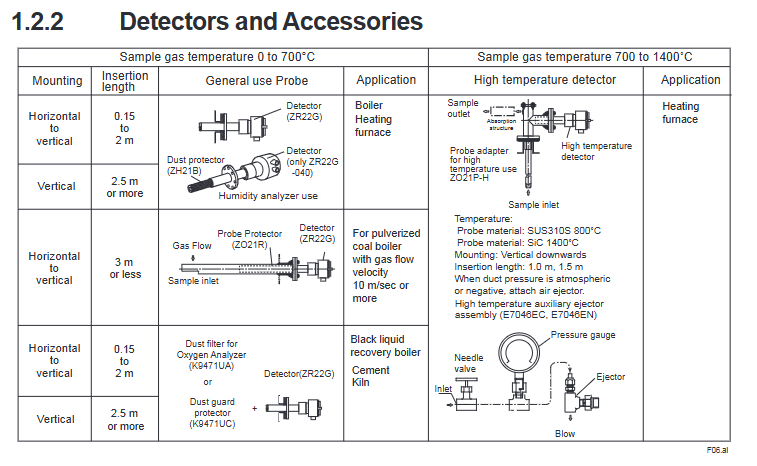
ZR22G detector directly measures oxygen/humidity in sample gas, universal type (sample temperature 0-700 ℃), high temperature type (0.15m probe, matched with ZO21P adapter, 0-1400 ℃); Probe length 0.15-5.4m (humidity analyzer does not include 0.15m)
ZR402G converter signal processing, display and control 320 × 240 point LCD touch screen; Power supply 100-240V AC; Support HART protocol; Output 4-20mA DC signal
2. Key auxiliary equipment
Calibration related: ZA8F flow setting unit (manual calibration), ZR40H automatic calibration unit (timed automatic calibration), ZO21S standard gas unit (simple calibration).
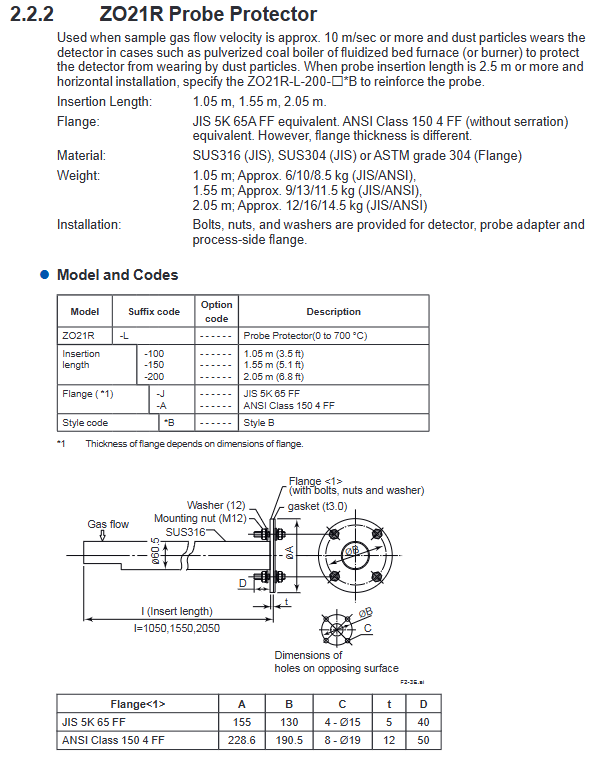
Protection related: ZO21R probe protector (anti dust wear), ZH21A dust protector (only for humidity analyzer), K9471UA detector dust filter (anti-corrosion dust).
High temperature adaptation: ZO21P high temperature probe adapter (compatible with ZR22G high temperature type, capable of withstanding 1400 ℃), E7046EC/EN high temperature auxiliary injector (for negative pressure scenarios).
3. Switching of oxygen/humidity analyzer
Oxygen analyzer: default configuration, ZR402G converter combined with ZR22G detector.
Humidity analyzer: Select the "/HS" option code for ZR402G, only supports specific probe lengths (excluding 0.15m), sample gas pressure limit -5 to 2kPa.
(3) Core technical parameters
Measurement type, measurement range, accuracy index, response time, output signal
Oxygen concentration 0.01-100 vol% O ₂ repeatability ± 0.5% -1% (depending on the range); Linear ± 1% -3% (based on range) 90% response ≤ 5 seconds 4-20mA DC (maximum load 550 Ω)
Humidity (volume fraction) 0-100 vol% H ₂ O repeatability ± 1 vol% H ₂ O (sample gas pressure ≤ 2kPa) - Same oxygen concentration output
Humidity (mixing ratio) 0-1.000 kg/kg - Same oxygen concentration output
System configuration and installation specifications
(1) Three standard system configurations
1. System 1 (Simple Monitoring)
Composition: ZR22G detector+ZR402G converter+ZO21S standard gas unit.
Applicable scenarios: simple scenarios such as small boiler oxygen concentration monitoring and food production humidity monitoring.
Features: No need to fix the reference airway, calibration gas is temporarily connected through a hose, easy to operate.
2. System 2 (Manual Precision Calibration)
Composition: Core components+ZA8F flow setting unit+zero gas cylinder+pressure reducing valve+air setting unit.
Applicable scenarios: Accurate control of oxygen/humidity in large boilers and heating furnaces.
Features: The reference air is clean and dry air (21 vol% O ₂), which supports manual precise adjustment of calibration air flow rate and higher measurement accuracy.
3. System 3 (Automatic Calibration)
Composition: Core components+ZR40H automatic calibration unit+combustible gas detection contacts.
Applicable scenarios: Large industrial furnaces and kilns that require long-term stable operation and reduced manual intervention.
Features: Automatic calibration is performed at preset intervals (up to 255 days), and the heater power is cut off when the combustible gas detection signal is triggered, providing higher safety.
(2) Installation Core Requirements
1. Environmental requirements
Detector: ambient temperature -20-150 ℃, no corrosive gas, no vibration, avoiding radiation heat effects.
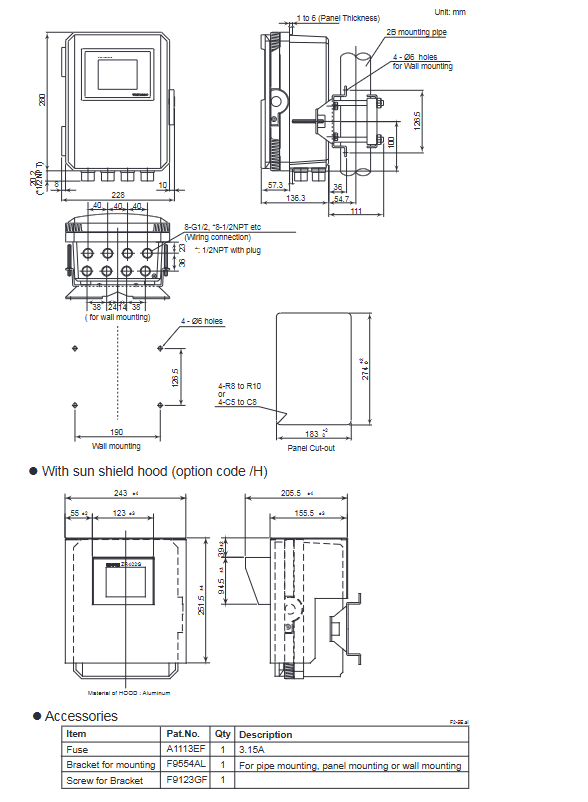
Converter: ambient temperature -20-55 ℃, humidity 0-95% RH (non condensing), away from direct sunlight (optional sunshade).
2. Installation specifications
Probe installation: When the length is ≤ 2m, it can be installed horizontally to vertically, and when it is ≥ 2.5m, it needs to be installed vertically (± 5 °); High temperature SiC probes must be installed vertically.
Flange specifications: Supports JIS, ANSI, DIN and other standards. During installation, it is necessary to ensure that the flange gasket does not block the reference gas outlet (pressure compensation type).
Protective measures: Dust environments require the installation of dust filters/protectors; Suitable probe adapters and injectors are required for high-temperature scenarios.
(3) Wiring specifications
1. Cable requirements
Detector signal: 6-core shielded cable (two-way resistance ≤ 10 Ω); Heater: 2-core cable; Temperature resistance ≥ 80 ℃.
Wiring principle: separate signal cables from power/heater cables to avoid interference; Shielding layer connected to converter FG terminal.
2. Key wiring types
Power and grounding: The converter supplies 100-240V AC power, and the protective grounding resistance is ≤ 100 Ω.
Detector connection: including sensor signal (CELL ±), thermocouple (TC ±), cold junction compensation (CJ ±), heater power supply (HTR) wiring.
External interfaces: analog output (4-20mA), contact input/output (control calibration, alarm, etc.), HART communication (refer to dedicated documentation).
Operation and Calibration Process
(1) Startup process
Pre inspection: Confirm that there is no leakage in the pipeline, the wiring is correct, and the valve status is normal.
Power supply startup: Connect the converter power supply, and the sensor begins to preheat (about 20 minutes, target temperature 750 ℃).
Parameter confirmation: Check the initial parameters such as converter type (oxygen/humidity), detector type, sample gas type (wet/dry gas), output range, etc.
Output inspection: Confirm that the current circuit (4-20mA) and contact I/O function are normal.
(2) Calibration operation (core process)
1. Calibration preparation
Gas requirements: Zero gas (0.95-1.0 vol% O ₂+N ₂), span gas (clean and dry air, dew point ≤ -20 ℃).
Flow setting: Calibrate air flow rate of 600 ± 60 ml/min, reference air flow rate of 800-1000 ml/min.
2. Calibration mode
Applicable scenarios for mode operation mode
Manual calibration is performed by manually controlling the gas valve through the ZO21S/ZA8F unit, and completing the calibration system 1/2 according to the touch screen prompts. Manual intervention is required
Semi automatic calibration of touch panel or touch input startup, completing calibration system 3 according to preset time, reducing manual operation
Automatic calibration is automatically executed at set intervals without the need for manual intervention. System 3 operates continuously for a long time
3. Core calibration steps
Span calibration: Introduce span gas and confirm calibration after the value stabilizes.
Zero calibration: Introduce zero gas and complete the calibration in the same way.
After calibration: Close the calibration gas valve and wait for the output to stabilize (default 10 minutes).
(3) Key parameter settings
1. Output settings
Oxygen analyzer: Set oxygen concentration values corresponding to 4mA (minimum range) and 20mA (maximum range), supporting linear or logarithmic output modes.
Humidity analyzer: Set the humidity (volume fraction or mixing ratio) corresponding to 4mA/20mA, and input the measured gas temperature and pressure to calculate the relative humidity and dew point.
2. Alarm setting
Supports four levels of alarms: high high, high, low, and low low. Alarm thresholds, hysteresis values (0-9.9 vol% O ₂, etc.), and delay times (0-255 seconds) can be set.
Alarm output: 4 contact outputs that can be assigned to alarm, fault, calibration, and other states.
Maintenance and troubleshooting
(1) Regular maintenance
1. Daily maintenance (recommended cycle)
Cleaning: Calibration gas pipeline (anti clogging), detector dust filter (K9471UA).
Inspection: Pipeline leakage, valve status, and cable connection tightness.
2. Regularly replace components
Precautions for component replacement
The zero gas calibration ratio of the sensor component exceeds 100 ± 30%, and the span gas calibration ratio exceeds 0 ± 18%; When the internal resistance of cells significantly increases, the metal O-ring (K9470BJ) and contact (E7042BS) must be replaced simultaneously
Abnormal resistance of heater unit (≤ 90 Ω is normal), unstable heating temperature at 750 ℃, please refer to the dedicated heater manual (IM 11M12A01-21E)
Before replacing the fuse converter with a blown fuse (specification 3.15A, Part No.A1113EF), it is necessary to investigate the short circuit fault
(2) Common faults and solutions
1. Error fault (Error code)
Key points for troubleshooting the causes of error codes and malfunctions
Error 1 Cell voltage fault (<-50mV) Check CELL ± wiring, sensor damage, internal wiring of detector
Error 2: Heater temperature fault (below 730 ℃ or above 780 ℃). Check the heater resistance, thermocouple wiring polarity, and cold end temperature (-25-155 ℃)
Error 3: The A/D converter has malfunctioned and restarted the device. If the error persists, please contact after-sales service
Error 4: Memory failure. Restart the device, but the error still persists. Contact after-sales service for assistance
2. Alarm fault (Alarm code)
Key points for troubleshooting the causes of alarm code faults
Alarm 6 zero calibration coefficient abnormality (exceeding 100 ± 30%) confirms zero gas concentration, calibration gas flow rate, and sensor contamination situation
Abnormal calibration coefficient of Alarm 7 span (exceeding 0 ± 18%) confirms span gas concentration, pipeline leakage, and sensor aging
Alarm 8 calibration stability timeout check calibration air flow rate, pipeline length/diameter, sensor response speed
Alarm 10 Cold End Temperature Abnormal (< -25 ℃ or > 155 ℃) Check the wiring of the cold end sensor and the ambient temperature of the detector
3. Abnormal measurement values
High measurement value (oxygen analyzer): reference gas humidity changes, calibration gas leakage, abnormal increase in sample pressure.
Low measurement value (oxygen analyzer): zero gas leakage, combustible components in sample gas, sensor damage.
Numerical fluctuations: loose wiring, electromagnetic interference, sensor cracks or installation leaks.
Safety and Compliance
(1) Key points for safe operation
Power safety: Confirm that the power supply voltage matches the rated value of the equipment, and disconnect the power before wiring.
High temperature protection: The working temperature of the detector probe reaches 750 ℃, and high-temperature resistant gloves should be worn during maintenance.
Gas safety: Calibration gas/sample gas may be toxic, ventilation or protective mask should be worn during maintenance, and the pipeline should be checked for leaks.
Sensor protection: The sensor is made of ceramic material to avoid impact and pressure, and direct contact with water droplets is prohibited.
(2) Compliance and Disposal
Identification compliance: CE/UKCA certified products must comply with the importer requirements of the corresponding region.
Waste disposal: Equipment must be disposed of in accordance with local environmental regulations; Batteries (lithium manganese dioxide batteries) need to be classified and recycled (EU/UK region).
Document compliance: The copyright of the manual belongs to Yokogawa Electric and cannot be copied or disseminated without permission.
Key accessories and spare parts
(1) Core attachments
Calibration related: Zero gas cylinder (G7001ZC), pressure reducing valve (G7013NF/G7014XF), calibration gas cylinder box (E7044KF).
Pipeline related: check valve (K9292DN/K9292DS), globe valve (L9852CB/G7016XH), pipe joint.
(2) List of commonly used spare parts
Spare part name, part number, and purpose
Sensor Component E7042UD/ZR01A01 Oxygen/Humidity Detection Core Component
Installation and sealing of metal O-ring K9470BJ sensor
Dust filter K9471UA detector dust protection
Fuse A1113EF converter power protection
Contact E7042BS sensor signal transmission
Document association and revision
(1) Related documents
General specification: GS 11M12A01-01E (ZR22G/402G/ZR202G series universal).
HART protocol: IM 11M12A01-51E (specifically for HART communication function).
Integrated device: IM 11M12A01-04E (sensor and analyzer integrated model).
Explosion proof type: IM 11M13A01-02E (specialized for ZR22S explosion-proof detector).
(2) Main revisions in the 18th edition
Add importer information related to CE/UKCA certification.
Revise RoHS compliance standards.
Supplement some flange dimensions and installation details.
- OMRON
- ABB
- General Electric
- EMERSON
- Honeywell
- HIMA
- ALSTOM
- Rolls-Royce
- MOTOROLA
- Rockwell
- Siemens
- Woodward
- YOKOGAWA
- FOXBORO
- KOLLMORGEN
- MOOG
- KB
- YAMAHA
- BENDER
- TEKTRONIX
- Westinghouse
- AMAT
- AB
- XYCOM
- Yaskawa
- B&R
- Schneider
- KONGSBERG
- NI
- WATLOW
- ProSoft
- SEW
- ADVANCED
- Reliance
- TRICONEX
- METSO
- MAN
- Advantest
- STUDER
- DANAHER MOTION
- Bently
- Galil
- EATON
- MOLEX
- DEIF
- B&W
- ZYGO
- Aerotech
- DANFOSS
- Beijer
- Moxa
- Rexroth
- Johnson
- WAGO
- TOSHIBA
- BMCM
- SMC
- HITACHI
- HIRSCHMANN
- Application field
- XP POWER
- CTI
- TRICON
- STOBER
- Thinklogical
- Horner Automation
- Meggitt
- Fanuc
- Baldor
- SHINKAWA
- Other Brands
- UniOP
- KUKA
- Iba
- Beckhoff
- ADLINK
-
 Sigmatek MDD111-1 DIAS Drive Axis Module
 -
 Sigmatek DKL042 05-024-042 Terminal Module
 -
 Sigmatek DM822 Control Module
 -
 Sigmatek CDM167 12-008-167-O Module
 -
 Sigmatek TAE151 Touch Display Unit
 -
 Sigmatek DCC041 SLIDES Module 05-700-041-D
 -
 Sigmatek AKM65M-ANC2GBB0 PM Servo Motor
 -
 Sigmatek ETT221 01-230-221 Operator Terminal
 -
 Sigmatek SLIDES DAM 124 Analog Module
 -
Sigmatek AKM31C-ANCNGBB0 Servo Motor
-
 Mannesmann Demag Sigmatek CP626 Central Unit
 -
 SIGMATEK 0332.554.03 Board 371071000154
 -
 SIGMATEK 12-250-021 Base Plate Back Panel CM5V020
 -
 SIGMATEK DM162 S-DIAS Digital Mix Module
 -
 DEMAG ERGOTECH 061 381 66 Sigmatek 9842.243.02 Circuit Board
 -
 SIGMATEK CP313-1 PLC Module
 -
Sigmatek ETV0551-2 VARAN Touch Terminal
-
 Sigmatek SDM 081 FS S-Dias Safety Module
 -
 DEMAG 05-250-023 Ergotech Motherboard with Sigmatek TMS012
 -
Sigmatek CM5V020 12-250-023-K Wiring Base
-
 Sigma Tek 5000B-37 Attitude Gyro Indicator
 -
 Sigmatek SDD120-2 DIAS Drive
 -
 Sigmatek CME221 Memory Module
 -
 Sigmatek DCP640 DIAS Central Unit
 -
 Sigmatek STO040 Safety Output Module
 -
Sigmatek CET281 Control Panel
-
 Sigmatek CIPC LX800 Demag NC5 CPU
 -
 Sigmatek DKL093 05-024-093 Terminal Module
 -
 Sigmatek AI088 20-009-088 Analog Input Module
 -
Sigmatek CAI888 Analog Input Module
-
SIGMATEK CCA021 12-025-021 Analog Output Module
-
SIGMATEK 1104.579.05 Control Module
-
SIGMATEK SDI100 Digital Input Module
-
 SIGMATEK C-IPC 256MB LX800 Compact Dias
 -
 SIGMATEK 9423.090.02 Control Module
 -
SIGMATEK C-IPC 256 Power Supply 148498
-
 SIGMATEK CAI025 Analog Input Module
 -
 SIGMATEK CTO166 Digital Output Module
 -
 SIGMATEK CP112 20-004-112 Processor Module
 -
SIGMATEK CAI887 12-009-887 Safety Module
-
 Sigma-Tek 4000B-31 Directional Gyro 1U262-002-42
 -
Sigmatek C-IPC 256MB LX800 IPC Controller
-
Sigmatek C-IPC 01-450-031 Industrial PC LX800
-
Sigmatek C-IPC 256 Industrial PC Controller
-
Sigmatek CCP-531 PLC Processor Module
-
Sigmatek CDI163 Digital Input Module
-
 Sigmatek ETV0501 VARAN Terminal 12-230-0501
 -
 Sigmatek CTMS020 C-DIAS Technology Module
 -
 Sigmatek CIV512 VARAN Switch Module
 -
 Sigmatek HU011 20-080-011 Interface Module
 -
SIGMATEK SLIDES DAM 124 Module
-
 SIGMATEK C-IPC 161 01-450-161L Industrial PC
 -
SIGMATEK C-IPC 128MB VIA 733MHz 01-450-024-K
-
 SIGMATEK 12-780-012 R8-IPC Geode LX800 Module
 -
SIGMATEK CAM124 Analog Module
-
 SIGMATEK S1 032-8AF61-R4 EZ Servo Motor
 -
 SIGMATEK CTO163 Digital Output Module
 -
 SIGMATEK CCP082 12-004-082 Processor Module
 -
 SIGMATEK CRCH081 C-DIAS Temperature Module
 -
 SIGMATEK PC322-K 01-310-322-K Industrial PC
 -
SIGMATEK SDD310-2 Servo Drive
-
 SIGMATEK AI084 Analog Input Module
 -
SIGMATEK CRCH081 12-752-081 Temperature Module
-
Sigma-Tek 5000L-4 Attitude Gyro 1U284-001-3
-
 SIGMATEK CM5V020 12-250-023-K Wiring Module
 -
Sigma-Tek 4000H-6 Directional Gyro IU262-035-7
-
 SIGMATEK Dias DCP160 05-004-160 Processor Module
 -
SIGMATEK 0147.395.02 Control Module
-
SIGMATEK A1084 Control Module
-
SIGMATEK DI200 20-006-2000 Digital Input Module
-
Sigmatek DNC115 Encoder Module
-
 Sigmatek DAM122 05-017-122 Analog Module
 -
Sigmatek 9802.289.01 Control Board TA71 Display
-
Sigmatek TO127 20-007-127 Digital Output Module
-
Sigmatek DNC031 05-011-031 Digital Module
-
Sigmatek VI022 20-003-022 Interface Module
-
Sigmatek CAI085 Analog Input Module
-
 Sigmatek CP111 S-DIAS CPU Module
 -
Sigmatek CTMS030 Krauss Maffei Module
-
 Sigmatek CAM123 Control Module
 -
 Sigmatek TAE732-P 01-240-732-P Touch Display Unit
 -
Sigmatek MDM021 Digital Mixed Module
-
Sigmatek DCP642 DIAS Central Unit
-
 Sigmatek CST022 12-014-022 C-DIAS Module
 -
 Sigmatek SRO021 20-893-021 Safety Relay Output
 -
 Krauss Maffei MC5 Control System Sigmatek
 -
 Sigmatek DC061 Module 18-24VDC 300mA
 -
 Herrmann EVT0855 Ultrasonic Welder Touch Panel
 -
Sigmatek CIV521 Control Module 1.4A 2W
-
Sigmatek DDI61 05-006-161 Digital Input Module
-
SIGMATEK ETT312-E Touch Terminal 01-230-312
-
Cessna S3326-1 Sigma Tek 5000B-67 Gyro 1U149-015-9
-
SIGMATEK PS101 Power Supply Module
-
SIGMATEK 0332.554.03 Control Module 371071000154
-
 SIGMATEK ETT312-E Touch Terminal 01-230-312
 -
SIGMATEK CDM163 Control Module
-
 SIGMATEK VSV046 16-023-046 Module
 -
SIGMATEK AM221 20-017-221 Analog Module
-
SIGMATEK CTS051 12-053-051 Control Module
-
SIGMATEK AM221 20-017-221 Analog Module
-
Sigmatek CSDI161 12-891-161 Safety Input Module
-
Sigma Tek 4000C-1 Directional Gyro Indicator
-
Sigmatek ETV0501 12-230-0501 VARAN Terminal
-
Sigmatek DDM165 SLIDES Module
-
Sigmatek N100 20-011-100 Control Module
-
Sigmatek AKM54K-ANC2R-B0 PM Servo Motor
-
Sigmatek CTO166 Digital Output Module
-
Sigmatek CP212-K 20-004-212-K CPU Module
-
Sigmatek CDI161 Digital Input Module
-
Sigmatek DCC080 05-700-080-2 Control Module
-
 SIGMATEK SCP011 S-DIAS Safety CPU
 -
SIGMATEK SCP011 S-DIAS Safety CPU
-
SIGMATEK SRO022 Relay Output Module
-
SIGMATEK MDD 121 Drive Axis Module
-
SIGMATEK DSI021 SLIDES Siemens Interface
-
SIGMATEK DIAS DCP161 Module 05-004-161
-
 Sigmatek ETT312 Built-in Touch Terminal
 -
SIGMATEK DCP 643 DIAS Controller System
-
SIGMATEK CIO021 Multi I/O Module
-
SIGMATEK CTMS020 Control Module
-
 Sigmatek CME 221 Memory Module
 -
Sigmatek 0420.615.01 Control Board
-
Sigmatek CP111 20-004-111 CPU Module
-
Sigmatek 9405.065.03 Control Board
-
Sigmatek ETEK 01-450-032-K C-IPC 256MB Industrial PC
-
Sigmatek CTO163 12-007-163 Safety Output Module
-
Sigmatek TO081 20-007-081 Digital Output Module
-
 Sigmatek SI021 20-022-021 Safety Input Module


