
Woodward easyYgen LS-6XT: A Multi Circuit Breaker Control Solution for Complex Power Management
Woodward easyYgen LS-6XT: A Multi Circuit Breaker Control Solution for Complex Power Management
Introduction
In today's highly dependent industrial and commercial environment on stable electricity, the reliability, flexibility, and intelligent management of power generation systems have become crucial. The easyYgen LS-6XT controller launched by Woodward is an advanced synchronization and protection control device designed to address complex power management challenges. It not only integrates powerful grid disconnection and protection functions, but also ensures high availability of critical power assets through redundant communication architecture and the ability to support large-scale networks. This article will provide a comprehensive and in-depth analysis of LS-6XT from multiple dimensions such as technical specifications, functional features, application architecture, and market positioning, aiming to provide a detailed technical and application reference for system integrators, OEM manufacturers, and end users.
Product Overview and Core Positioning
Woodward easyYgen LS-6XT is defined as a synchronous controller that integrates main network disconnection and protection functions. Its core design goal is to serve application scenarios that require high reliability and complex power management, such as:
Peak Shaving
Import/Export Control of Electricity
Isolated&Utility Parallel
Control of multi-channel mains power supply, bus tie circuit breakers, and generator groups
LS-6XT can seamlessly collaborate with Woodward's easyYgen-3400XT/3500XT series generator set controllers and easyYgen | GC-3400XT unit group controllers to build a hierarchical control system from a single generator set to the entire power plant level. Its redundant bus communication capability (supporting CAN ETH and Eth ETH redundancy) effectively avoids single point failures and significantly improves the availability of the entire power generation system.
The controller adopts a sturdy aluminum powder coating shell, integrates a customizable LED indicator panel, and supports remote operation and monitoring through independent Ethernet connection to Woodward easyYview visualization panel. The hardware design of LS-6XT supports standardization, helping OEM switchgear manufacturers, generator set manufacturers, and system integrators unify hardware platforms in various grid connected or islanded operating applications, reducing costs and complexity.
Detailed explanation of core technical characteristics
1. Strong network and scale support capabilities
LS-6XT demonstrates excellent system scalability:
Up to 64 LS-6XT controllers can work together in a single network.
Can connect up to 32 easyYgen-3400XT/3500XT unit controllers.
It can manage up to 16 GC-3400XT unit group controllers, with each group containing up to 31 generator units.
In an application project, it is possible to control up to 64 circuit breakers on up to 128 bus segments.
This scale support capability enables it to easily handle various applications ranging from small backup power systems to large industrial power plants.
2. Accurate measurement and synchronization function
Three independent true RMS AC measurements: used for system A voltage, system B voltage, and auxiliary voltage respectively to ensure comprehensive monitoring.
High precision measurement: The voltage and current measurement accuracy reaches level 0.5, and the power measurement accuracy reaches level 1.0, meeting the high standard measurement requirements.
Flexible synchronization method: Supports phase matching or slip frequency synchronization, and has voltage matching function to ensure smooth grid connection.
Vector group adjustment: During the synchronization process, the vector group can be adjusted to adapt to different transformer connection methods.
Active synchronization (supported by some models): It can actively control the frequency and voltage of the generator to match the power grid, achieving fast and smooth grid connection.
3. Advanced circuit breaker control and operation mode
Remote selectable circuit breaker switching mode:
Open Transition
Closed Transition (short-term parallel<100ms)
Inter change conversion
Long term parallel operation (Indefinite Parallel)
Support single or dual circuit breaker control logic to adapt to different main wiring schemes.
Generator group circuit breaker (GGB) control facilitates overall scheduling of the unit group.
4. Comprehensive protection function
The LS-6XT is equipped with a variety of protective components, equivalent to multiple ANSI protection codes, including but not limited to:
Overvoltage/undervoltage, overclocking/underflocking protection (59, 27, 81O, 81U)
Voltage imbalance protection (47)
Phase mutation and frequency change rate protection (78, 81- ROCOF)
Synchronization check (25)
Power Direction Protection (32R) - Some models support it
Instantaneous/timed overcurrent protection (50, 51/51V) - supported by some models
Load imbalance protection (46) - supported by some models
Q-V monitoring and time-dependent voltage protection
These protection features can be customized through Flexible Limits to meet the protection needs of specific projects.
5. Intelligent management and communication
Built in power calculation: can calculate active and reactive power, and also supports input from external transmitters.
Load distribution segment control: Optimize load distribution among multiple units.
Automatic date and time synchronization: Automatically synchronize between LS-6XT, unit controller, and group controller to ensure consistency in event recording.
Detailed communication diagnosis: capable of monitoring, visualizing, and troubleshooting the status of all connected devices in the network.
Powerful logic and I/O configuration: Through LogicsManager and AnalogManager tools, users can customize the control logic, analog and digital I/O functions, achieving highly customized automation processes.
Rich communication interfaces:
3 Ethernet interfaces: Supports Modbus TCP slave protocol for remote control and visualization (such as connecting to easyYview).
1 or 2 CAN bus interfaces (depending on model): used to connect expansion I/O boards (such as IKD1) or easyYlite-200 remote indicators, and supports CANopen protocol.
1 RS-485 interface: Supports Modbus RTU slave protocol.
1 USB device interface: used for local configuration and maintenance.
6. Human Computer Interface and Visualization
Support Woodward easyYview visualization panel, providing standard and customizable operation screens.
The front panel integrates 8 configurable LED indicator lights for local alarm and status indication.
Support deep settings through PC using configuration tools.
Integrated real-time clock and event recorder with battery backup for easy fault analysis and system auditing.
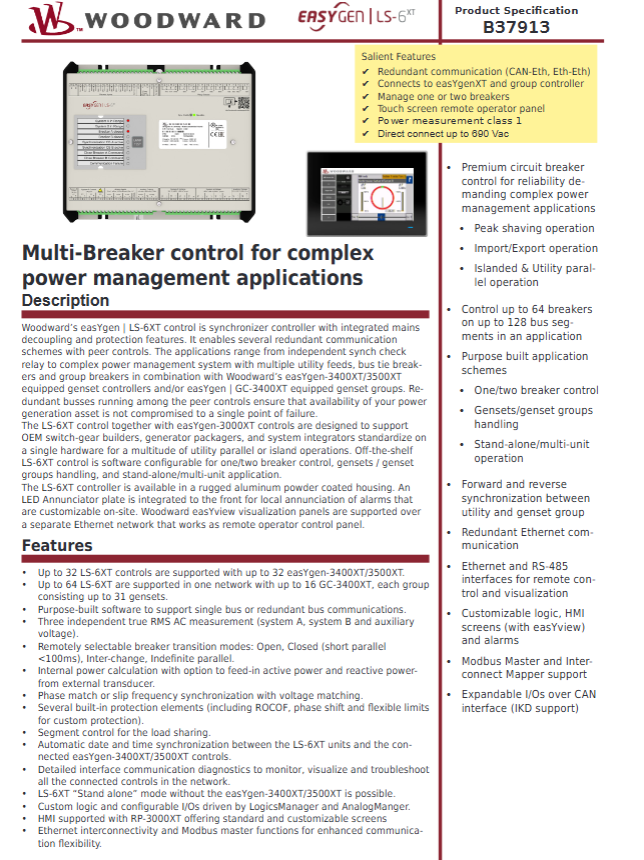
Technical specifications and physical characteristics
According to product specification B37913, the main technical parameters of LS-6XT are as follows:
Power supply: 12/24 Vdc wide range input (8 to 40 Vdc), maximum power consumption of 22W.
Environmental adaptability: Operating temperature -40 to 70 ° C, storage temperature -40 to 80 ° C, humidity 95% non condensing, demonstrating strong industrial environment tolerance.
Voltage input:
Rated voltage range: The software can be configured for Y/∆ connection, supporting systems from 100Vac to 690Vac (e.g. 69/120Vac, 400/690Vac).
Linear measurement range: up to 1.25 times the rated voltage.
Measurement frequency: 50/60Hz (range 30-85Hz).
High impedance input: Input resistance of 2.5M Ω per phase, power consumption<0.15W/phase.
Current input: The software can select 1A or 5A secondary rated value, isolated input.
Linear range of system A: 3 times the rated current.
Linear range of system B: 1.5 times the rated current.
Accuracy: Level 0.5.
I/O capability:
12 discrete inputs (DI): isolated, 8-40VDC, freely configurable functions (such as circuit breaker commands, enable, status feedback, etc.).
12 relay outputs (RO): isolated, AgNi contacts, capacity 2A @ 250Vac or 24Vdc, most can be configured through LogicsManager.
3-channel analog input (AI): isolated, freely scalable, supports 0-1V, 0-2000 Ω, 0/4-20mA signals, 16 bit resolution.
2-channel analog output (AO): isolated, freely scalable, supports ± 10V, ± 20mA, and PWM signals, with a 12 bit resolution.
Mechanical characteristics:
Shell: Installed behind the board, powder coated metal shell, protection level IP20.
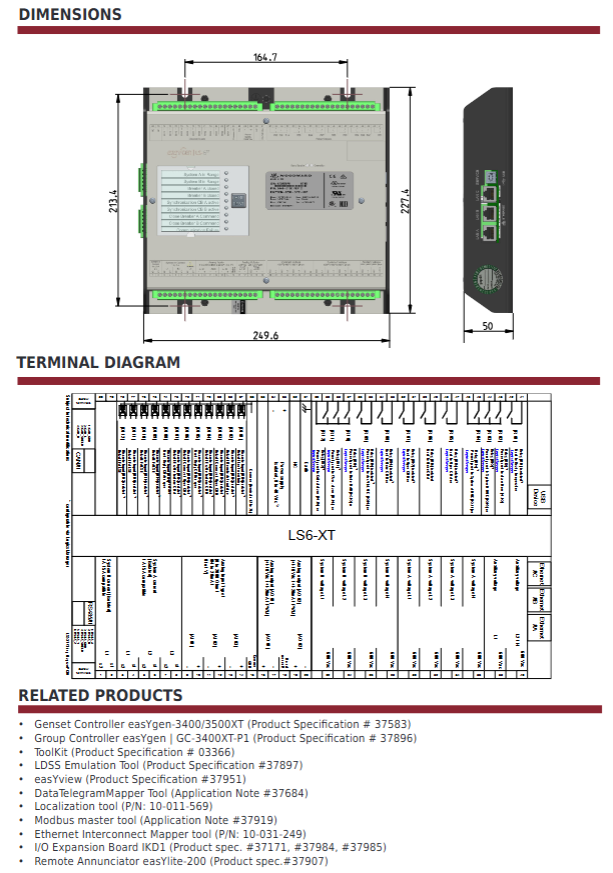
Dimensions: 250mm (width) x 228mm (height) x 50mm (depth).
Weight: Approximately 1.75kg.
Wiring terminal: screw/plug terminal, supports 2.5mm ² wire diameter.
Certification: Compliant with CE, UL, cUL (based on standards 61010-1, 6200-1) and Marine Engineering (LR/ABS) certifications, suitable for various demanding industrial and maritime applications worldwide.
Typical Application Architecture
The schematic diagram in the document clearly depicts the core position of LS-6XT in hierarchical control systems:
Device layer (Layer 1- Genset): consists of multiple generator sets equipped with easyYgen-3400XT/3500XT controllers.
Layer 2- Group: One or more GC-3400XT unit group controllers manage their respective generator groups (up to 31 units/group) and control the group circuit breakers (GCBs).
Layer 3- Plant: The control core consists of multiple LS-6XT controllers. They are interconnected through redundant Ethernet (Eth A, B, C) and CAN bus, and communicate with the lower level group controllers. LS-6XT is responsible for:
Monitor the electrical parameters of System A (usually the power grid or main busbar) and System B (generator side or backup busbar).
Execute synchronous logic to control the bus tie circuit breaker or grid connected circuit breaker.
Implement power exchange management (import/export) between the generator group and the power grid.
Implement protection and control strategies at the factory wide level.
This architecture achieves decentralization of control and centralization of management, ensuring that local failures do not affect the overall situation, and facilitating unified optimization scheduling and energy management.
Model Differences and Selection Guidelines
From the comparison table at the end of the document, it can be seen that LS-6XT mainly offers two packaging models: P1 and P2 (corresponding to LS-612 model). The two remain consistent in most core functions, but the P2 model offers enhanced features:
System B current measurement: P1 is 1 phase, P2 is 3 phases, providing more comprehensive monitoring.
Active synchronization: P2 supports active frequency and voltage control to achieve synchronization, while P1 does not support it.
Enhanced protection function: P2 additionally provides instantaneous overcurrent (50), timed overcurrent (51), and unbalanced load (46) protection.
External I/O expansion capability: Through CANopen, P2 supports up to 32 external digital input/output channels, which is twice that of P1 (16 channels).
Number of CAN interfaces: P2 provides 2 CAN bus interfaces, while P1 only has 1, providing higher connection flexibility.
EasyLite-200 supports: P2 can connect 2 remote indicators of this type.
Therefore, when selecting, for complex applications that require comprehensive three-phase monitoring, active synchronization, higher-level protection, and greater scalability (such as large power plants and backup power sources for critical facilities), the P2 model should be chosen. For single/double circuit breaker synchronization and control applications that require relatively basic requirements and are more cost sensitive, the P1 model is an economical and efficient choice.
Supporting tools and ecosystem
Woodward provides a complete software toolchain for LS-6XT to support configuration, debugging, simulation, and monitoring:
ToolKit: Main configuration software.
LDSS Simulation Tool: A simulation tool used for testing and verifying control logic.
DataTelegramMapper Tool: A tool for mapping data packets.
Modbus Master Tool: Used to configure Modbus Master functionality.
Ethernet Interconnect Mapper Tool: Used to configure communication between Ethernet devices.
Localization Tool: Localization tool.
I/O Expansion Board IKD1: Used to expand digital and analog I/O points.
Remote Annunciator easyYlite-200: Economical remote status/alarm indicator panel.
These tools, together with the LS-6XT hardware, form a powerful, open, and easily integrated ecosystem, greatly reducing the difficulty of engineering implementation and maintenance.
Market advantages and summary
The Woodward easyYgen LS-6XT controller stands out in the fiercely competitive power control market, mainly due to the following core advantages:
Excellent reliability and redundancy design: The hardware is sturdy and durable, the communication network is redundant, eliminating single point of failure, and meeting the highest requirements for critical power supply applications.
Unparalleled scalability and flexibility: Supports networking up to 64 controllers and hundreds of generator sets, and can be flexibly configured through software to adapt to various power grid architectures ranging from simple to extremely complex.
Highly integrated and intelligent functionality: Integrating synchronization, protection, measurement, circuit breaker control, power management, and custom logic into a single device reduces the number of system components and improves integration and intelligence levels.
Open communication and easy integration: Supports multiple standard industrial protocols (Modbus TCP/RTU, CANopen) and provides rich APIs and configuration tools for easy integration with third-party SCADA, DCS, or energy management systems.
Global Certification and Support Network: Possessing CE, UL, cUL, and classification society certifications, and supported by Woodward's global sales and technical support network, ensuring smooth implementation and operation of projects anywhere in the world.
- OMRON
- ABB
- General Electric
- EMERSON
- Honeywell
- HIMA
- ALSTOM
- Rolls-Royce
- MOTOROLA
- Rockwell
- Siemens
- Woodward
- YOKOGAWA
- FOXBORO
- KOLLMORGEN
- MOOG
- KB
- YAMAHA
- BENDER
- TEKTRONIX
- Westinghouse
- AMAT
- AB
- XYCOM
- Yaskawa
- B&R
- Schneider
- KONGSBERG
- NI
- WATLOW
- ProSoft
- SEW
- ADVANCED
- Reliance
- TRICONEX
- METSO
- MAN
- Advantest
- STUDER
- DANAHER MOTION
- Bently
- Galil
- EATON
- MOLEX
- DEIF
- B&W
- ZYGO
- Aerotech
- DANFOSS
- Beijer
- Moxa
- Rexroth
- Johnson
- WAGO
- TOSHIBA
- BMCM
- SMC
- HITACHI
- HIRSCHMANN
- Application field
- XP POWER
- CTI
- TRICON
- STOBER
- Thinklogical
- Horner Automation
- Meggitt
- Fanuc
- Baldor
- SHINKAWA
- Other Brands
- UniOP
- KUKA
- Iba
- Beckhoff
- ADLINK
-
 MICRO INNOVATION MK2-230/232-57 Circuit Board 85 28 200000
 -
 MICRO INNOVATION CAN-BRIDGE 8551224177 CAN Bridge
 -
 Micro Innovation MC2-430-10TVB-1-10 Panel 24VDC
 -
 MICRO INNOVATION MC2-432-57CQB-1-10 HMI Panel
 -
 MICRO INNOVATION AG CAN-BRIDGE 85 51 224177 CAN Bridge
 -
 MICRO INNOVATION CAN-4AI/UI Analog Input Module
 -
MICRO INNOVATION CAN-32DI/P-2X16 Input Module
-
 SIGMATEK MDD111 09-404-111 Drive Module
 -
 SIGMATEK DVI021 Display Interface Module
 -
 SIGMATEK 00-450-024 C-IPC Processor
 -
 SIGMATEK MDD-111 MDD111 Drive Module
 -
 SIGMATEK ICA011 20-102-011 Interface Module
 -
 SIGMATEK 01-250-010-D NC4Kompakt Control Module
 -
 SIGMATEK CRIF081 12-751-081 Interface Module
 -
 SIGMATEK S1026-8AF61-R4E-Z57 Drive Module
 -
 SIGMATEK 9305.081.02 9227.082.00 Control Module
 -
 Sigma Tek 5000B-36 Attitude Indicator
 -
 SIGMATEK CEZ201 12-051-201-O Counter Module
 -
 SIGMATEK DPS001 Power Supply Module
 -
 SIGMATEK 994 395 01z Via Interface Module
 -
 SIGMATEK PC411-K 01-310-411-K Industrial PC
 -
 SIGMATEK 9816.324.00 Demag NC4 Keyboard
 -
 SIGMATEK ET261 90010C-71 Operator Terminal
 -
 SIGMATEK DDI 164 05-006-164 Input Module
 -
 SIGMATEK CCP 082 C-DIAS Processor Module
 -
SIGMATEK CEZ201 12-051-201-O PLC Module
-
SIGMATEK MDD 1111 06178867 Drive Module
-
SIGMATEK S1 073-6AC61-RE-Y08-Z Drive Module
-
SIGMATEK MDD 111 Drive Module MDD111
-
 SIGMATEK CSDI161 Safety Module 12-891-161
 -
SIGMATEK C-IPC Processor 01-450-024
-
 SIGMATEK DIAS DAM122 Analog Mixing Module
 -
Sigma Tek 5000B-36 Attitude Gyro Indicator
-
 SIGMATEK TMS012 Motherboard Module 05-250-012-T
 -
 SIGMATEK CCP-531 PLC Module
 -
SIGMATEK DIAS DNC4 I/O Module 05-250-011
-
 SIGMATEK AI088 Analog Input Module
 -
 SIGMATEK CEZ201 Counter Module
 -
SIGMATEK CIC011 Industrial Computer Module
-
 SIGMATEK MDM021 Motor Drive Module
 -
 SIGMATEK DTO163 Digital Output Module
 -
SIGMA-TEK 5000B-36 Attitude Gyro
-
SIGMATEK DM161 Digital Input Module
-
SIGMATEK CCP-531 PLC Control Panel
-
 SIGMATEK HZS773 Touch Terminal Operator Panel
 -
SIGMATEK MDP101 3 KVA 45-65Hz Driver
-
 SIGMATEK ETV1251 Touch Panel 12-230-1251
 -
SIGMATEK CIO021 Safety Module 12-013-021
-
Sigma Tek 4000H-5 Directional Gyro
-
 SIGMATEK TAE531 I/O Module 01-240-531
 -
 SIGMATEK DAI081 Input Module 05-009-081
 -
 SIGMATEK DCP640 Drive Control Module
 -
 SIGMATEK DCP643 Slides Module A6-29
 -
SIGMATEK SCP011 Safety Module 20-890-011
-
SIGMATEK DDM 164-D Slides Module
-
 SIGMATEK C-IPC Processor 146267
 -
SIGMATEK ET3200 Display Screen
-
SIGMATEK CEZ221 C-DIAS Mixing Module
-
 SIGMATEK SDD120-2 DIAS Servo Drive
 -
SIGMATEK DIP011 05-058-011 Module
-
 Sigmatek DEC181 I/O Module
 -
SIGMATEK DCP640 DIAS Central Unit
-
SIGMATEK 00-450-024 C-IPC Industrial Computer
-
SIGMATEK AKM32C-ANCNR-B0 Servomotor
-
SIGMATEK DVI021 DIAS Power Module
-
SIGMATEK CTS051 12-053-051 Control Module
-
 SIGMATEK CTS022 Control Module
 -
 Sigmatek 01-250-010-D NC4Kompakt V2.1 Module
 -
 SIGMATEK Control Keyboard 01-285-042 Interface
 -
 SIGMATEK TO081 20-007-081 Digital Output Module
 -
 Sigmatek AKM73Q-ANCNGBB0 7.07kW Servo Motor
 -
Sigmatek DIP012 Demag 07024165 Processor Module
-
 SIGMATEK PC 411 Injection Molding Controller
 -
SIGMATEK CEZ201 12-051-201-O Processor Module
-
 SIGMATEK VI021 20-003-021 Digital Input Module
 -
SIGMATEK Computer C-IPC 144904 Industrial PC
-
 SIGMATEK 9307.083.01 9305.081.02 Industrial Module
 -
 SIGMATEK AI075 Analog Input Module
 -
 SIGMATEK HGT834-W Teaching Pendant
 -
Sigmatek CDI161 Digital Input Module
-
 SIGMATEK HGT834 Teaching Pendant
 -
 SIGMATEK CEZ201 12-051-201-O Module
 -
SIGMATEK Demag 9617.067.03 9708.244.00 Module
-
 SIGMATEK SCP010 Safety CPU Module
 -
SIGMATEK N100 20-011-100 Module
-
 SIGMATEK CNC 031 Positioning Output Module
 -
 Sigmatek 01-355-016 Control Module
 -
 Sigmatek MDM021 Digital Mixed Module
 -
Sigmatek DAI411 05-020-411 Analog Module
-
Attitude Gyro 1U367-232-2 Aircraft Instrument
-
 Sigma-Tek 5000B-36 Attitude Gyro 23-501-06-16
 -
Sigmatek HGT834-W Injection Molding Teach Pendant
-
Sigma Tek 5000EG Attitude Gyro 1U670-003-12
-
Sigmatek HGT834-W Teach Pendant
-
Sigmatek DEE011 05-068-011 Module
-
Sigmatek DIAS DCP643 Central Processing Unit
-
Sigmatek MDD111-1 DIAS Drive Axis Module
-
 Sigmatek DKL042 05-024-042 Terminal Module
 -
Sigmatek DM822 Control Module
-
Sigmatek CDM167 12-008-167-O Module
-
Sigmatek TAE151 Touch Display Unit
-
 Sigmatek DCC041 SLIDES Module 05-700-041-D
 -
Sigmatek AKM65M-ANC2GBB0 PM Servo Motor
-
Sigmatek ETT221 01-230-221 Operator Terminal
-
Sigmatek SLIDES DAM 124 Analog Module
-
Sigmatek AKM31C-ANCNGBB0 Servo Motor
-
Mannesmann Demag Sigmatek CP626 Central Unit
-
SIGMATEK 0332.554.03 Board 371071000154
-
 SIGMATEK 12-250-021 Base Plate Back Panel CM5V020
 -
SIGMATEK DM162 S-DIAS Digital Mix Module
-
DEMAG ERGOTECH 061 381 66 Sigmatek 9842.243.02 Circuit Board
-
 SIGMATEK CP313-1 PLC Module
 -
Sigmatek ETV0551-2 VARAN Touch Terminal
-
 Sigmatek SDM 081 FS S-Dias Safety Module
 -
 DEMAG 05-250-023 Ergotech Motherboard with Sigmatek TMS012
 -
Sigmatek CM5V020 12-250-023-K Wiring Base
-
Sigma Tek 5000B-37 Attitude Gyro Indicator
-
Sigmatek SDD120-2 DIAS Drive
-
 Sigmatek CME221 Memory Module
 -
Sigmatek DCP640 DIAS Central Unit
-
 Sigmatek STO040 Safety Output Module
 -
Sigmatek CET281 Control Panel
-
Sigmatek CIPC LX800 Demag NC5 CPU
-
Sigmatek DKL093 05-024-093 Terminal Module
-
Sigmatek AI088 20-009-088 Analog Input Module
-
Sigmatek CAI888 Analog Input Module
-
SIGMATEK CCA021 12-025-021 Analog Output Module
-
SIGMATEK 1104.579.05 Control Module


