
BENDER ISOMETER® iso685(W)-D/-S Insulation Monitoring Device
BENDER ISOMETER® iso685(W)-D/-S Insulation Monitoring Device
Product Overview
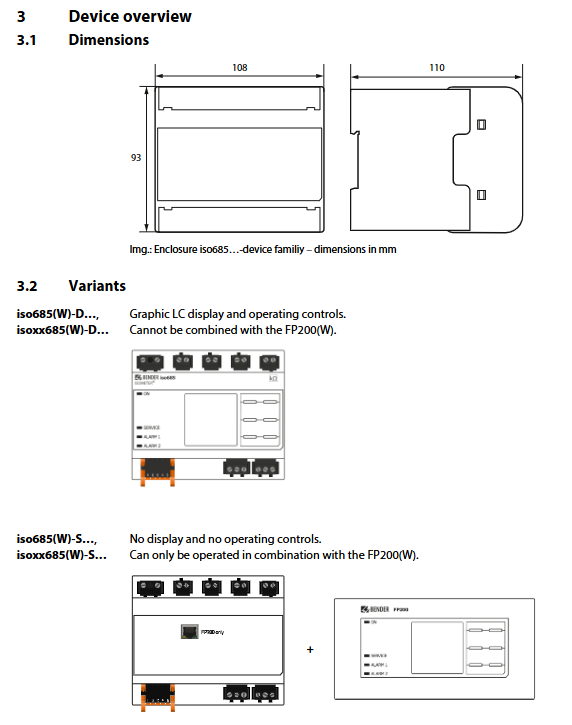
ISOMETER ® Iso685 (W) - D/- S is a professional insulation monitoring equipment developed by Bender, a German company, specifically designed for IT systems (ungrounded AC/DC systems). Its core mission is to detect insulation faults in a timely manner by monitoring key parameters such as insulation resistance and DC offset voltage, avoiding risks such as electric shock and equipment damage. The product is divided into two variants: D-type (integrated graphic LC display and operation buttons) and S-type (no display/buttons, required to be used with FP200 (W) front-end panel), both supporting AC/DC/3 (N) AC system monitoring. With coupling equipment, the rated voltage monitoring range can be extended to 12 kV, meeting the needs of industrial scenarios with different voltage levels.
The product complies with international standards such as IEC 61557-8 and DIN EN 61557-8, and has high reliability and anti-interference ability. It is suitable for various scenarios such as industrial production lines, emergency power supply systems, and ship power, and is one of the core equipment to ensure the safe operation of the power system.
Core functions and features
(1) Monitoring and measurement functions
Insulation resistance monitoring
Measurement range: 0.1 k Ω~20 M Ω, alarm response value can be independently set within 1 k Ω~10 M Ω (ALARM1/ALARM2).
Preset response values: Factory default ALARM1=40 k Ω, ALARM2=10 k Ω, supports custom adjustment.
Measurement accuracy: ± 15% (minimum ± 1 k Ω), in accordance with the requirements of IEC 61557-8 standard.
Dual alarm mechanism: When the insulation resistance is lower than the corresponding response value, the relay action and LED indication are triggered, supporting fault memory (maintaining the alarm state until manual reset).
Multi parameter collaborative monitoring
DC offset voltage monitoring: A DC alarm threshold of 20 V~1 kV can be set to avoid the impact of DC components on the system.
System leakage capacitance monitoring: measurement range 0~1000 μ F, accuracy ± 10% (minimum ± 10 μ F), equipment automatically adapts to capacitance changes.
Connection monitoring: Real time monitoring of the connection status of the measurement line to avoid monitoring failure caused by line disconnection.
The multi measurement profile adaptation device provides 7 measurement profiles, which can be flexibly selected according to the system type to optimize measurement speed and accuracy:
Profile type applicable scenario key parameters
Power circuits - Conventional constant frequency systems with voltages ranging from 0 to 690 V (AC)/0 to 1000 V (DC) and capacitors ranging from 0 to 150 μ F
Control circuits: Low voltage sensitive control system measures voltage ± 10 V, voltage 0-230 V (AC/DC)
Generator monitoring rapid measurement, frequency 50-60 Hz, capacitance 0-5 μ F
High capacitance systems such as ships have a capacitance of 0~1000 μ F and a voltage of 0~690 V (AC)/0~1000 V (DC)
Variable frequency converter>10 Hz (inverter>10 Hz) 10~460 Hz Variable frequency system capacitance 0~20 μ F, voltage 0~690 V (AC)/0~1000 V (DC)
Frequency converter<10 Hz (inverter<10 Hz) 0.1~10 Hz Low frequency system capacitance 0~20 μ F, voltage 0~690 V (AC)/0~1000 V (DC)
Customer specific special needs scenarios are defaulted to be consistent with the power circuit profile and support Bender customization
(2) Display and storage functions
Graphic display: equipped with a 127 × 127 pixel graphic LC display screen, real-time display of insulation resistance, alarm status, signal quality and other information, supporting multilingual switching (including English, German, etc.).
Historical memory: It can store 1023 alarm/fault information, each record containing date, time, fault type, and measurement value, and data will not be lost after power failure (continuous fault memory mode).
Trend analysis: The isoGraph function can graphically display the insulation resistance change trends for 1 hour, 1 day, 1 week, 1 month, and 1 year, facilitating fault tracing and system status prediction.
(3) Communication and Control Interface
The device supports multiple communication methods to achieve local and remote control:
Interface type communication protocol/functional key parameters
Ethernet (ETH) Modbus TCP, BCOM, Web Server 10/100 Mbit/s, supports DHCP/static IP, up to 5 TCP connections
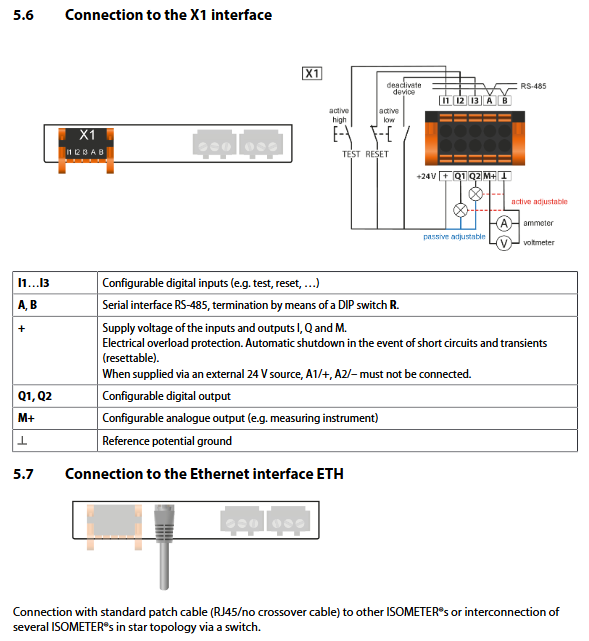
RS-485 (X1 interface) BS bus, Modbus RTU, isoData baud rate 9.6 kBd~115 kBd, transmission distance ≤ 1200 m
X1 multifunctional I/O digital input (3 channels), digital output (2 channels), analog output (1 channel), analog output supports signals such as 0~20 mA/4~20 mA/0~10 V, etc
Relay output 2 conversion contacts (K1/K2) support N/C/N/O mode, AC-13 class 230 V/5 A, electrical life 10000 times
(4) Safety and operational assurance
Safety protection: Terminal protection level IP20 (external)/IP30 (internal components), shell flame retardant level UL94 V-0, with overvoltage and overcurrent protection.
Operation protection: Supports 4-digit password protection (0000~9999) to prevent unauthorized parameter modification; Continuous self-test function, automatically detects internal circuits, measurement circuits, and connection status after startup.
Convenient operation: Parameter setting, alarm reset, and self detection can be achieved through buttons such as MENU/TEST/RESET, and support remote parameter modification on web servers (with write permission enabled).
Model specifications and ordering information
(1) Core model parameters
Model Equipment Type Power Supply Voltage Protection Enhancement (Option W) Product Number
Iso685-D with display/button AC/DC 24~240 V No B91067010
Iso685W-D with display/button AC/DC 24~240 V (-40~+70 ℃, anti vibration) B91067010W
Iso685-S+FP200 no display+panel AC/DC 24~240 V No B91067210
Iso685W-S+FP200W without display+panel AC/DC 24~240 V is B91067210W
(2) Key components and coupling equipment
Basic accessories:
Mechanical accessories (terminal cover+mounting clip): B91067903
Screw Terminal Kit: B91067901
Push in terminal kit: B91067902
Front panel (FP200/FP200W): B91067904/B91067904W
Coupling equipment (extended voltage range):
Coupling device model applicable system voltage product number
AGH150W-4 3(N)AC 0~1150 V、DC 0~1760 V B98018006
AGH520S AC/3(N)AC 0~7200 V B913055
AGH204S-4 AC 0~1650 V (with rectifier 0~1300 V) B914013
AGH676S-4 AC 12 kV B913055
Key technical parameters
(1) Power supply and environmental parameters
Project Standard Version W Enhanced Version
Supply voltage range AC/DC 24~240 V (± 30%/± 15% tolerance) same as standard version
Power consumption ≤ 12 W (DC), ≤ 21 VA (AC 50/60 Hz) Same as standard version
Working temperature -25~+55 ℃ -40~+70 ℃ (UL application -40~+65 ℃)
Storage/transportation temperature -40~+70 ℃/-40~+85 ℃ Same as standard version
Protection level: internal IP30, terminal IP20, same standard version
Shell dimensions (width x height x depth) 108 mm x 93 mm x 110 mm as per standard version
Weight<390 g, same as standard version
(2) Measurement system parameters
Measurement parameter range accuracy
Insulation resistance 0.1 k Ω~20 M Ω± 15% (minimum ± 1 k Ω)
AC system voltage 0~690 V (RMS) ± 5% (minimum ± 5 V)
DC system voltage 0~1000 V ± 5% (minimum ± 5 V)
System frequency 0.1~460 Hz ± 1% (minimum ± 0.1 Hz)
Leakage capacitance 0~1000 μ F ± 10% (minimum ± 10 μ F)
DC offset voltage 20 V~1 kV-
Working principle and debugging process
(1) Basic workflow
After the device is connected to the power supply, it automatically starts self detection (15-20 seconds) to detect the internal circuit, measurement circuit, and grounding connection.
After passing the self-test, enter the normal monitoring mode and continuously collect parameters such as system insulation resistance and leakage capacitance.
When the insulation resistance is lower than the set response value, the response delay is activated (can be set to 0-300 seconds), and the corresponding alarm relay and LED indicator are triggered after the delay is over.
After troubleshooting, the parameters are restored to the release value (response value+25% hysteresis), the release delay is initiated, and the relay is reset after completion; When the fault memory is activated, the RESET button needs to be manually pressed to reset.
(2) Debugging process
Initial debugging: Connect the device → Connect the power supply → Run the debugging wizard (set language, date and time, system type, measurement profile, alarm response value) → Perform functional testing (simulate faults through grounding resistance).
Password configuration: Set a 4-digit password in the device menu, and verify it before modifying parameters.
Remote configuration: remotely read measurement values and modify parameters (with write permission enabled) through a web server (input device IP) or Modbus RTU protocol.
Typical application scenarios
Industrial power system: Monitor the insulation status of generators, frequency converters, and transformers to prevent equipment failures caused by insulation degradation.
Emergency power supply system: Insulation monitoring of backup power sources such as UPS and diesel generators to ensure the safety of power supply in emergency situations.
High capacitance scenario: For large leakage capacitance systems such as ships and rail transit, monitoring accuracy is optimized through "high capacitance" measurement profiles.
Low voltage control system: Insulation protection for industrial automation control circuits to prevent damage to sensitive components due to insulation faults.
Medium and high voltage expansion: Equipped with AGH series coupling equipment, monitor the insulation status of medium and high voltage IT systems such as 6 kV and 12 kV.
- OMRON
- ABB
- General Electric
- EMERSON
- Honeywell
- HIMA
- ALSTOM
- Rolls-Royce
- MOTOROLA
- Rockwell
- Siemens
- Woodward
- YOKOGAWA
- FOXBORO
- KOLLMORGEN
- MOOG
- KB
- YAMAHA
- BENDER
- TEKTRONIX
- Westinghouse
- AMAT
- AB
- XYCOM
- Yaskawa
- B&R
- Schneider
- KONGSBERG
- NI
- WATLOW
- ProSoft
- SEW
- ADVANCED
- Reliance
- TRICONEX
- METSO
- MAN
- Advantest
- STUDER
- DANAHER MOTION
- Bently
- Galil
- EATON
- MOLEX
- DEIF
- B&W
- ZYGO
- Aerotech
- DANFOSS
- Beijer
- Moxa
- Rexroth
- Johnson
- WAGO
- TOSHIBA
- BMCM
- SMC
- HITACHI
- HIRSCHMANN
- Application field
- XP POWER
- CTI
- TRICON
- STOBER
- Thinklogical
- Horner Automation
- Meggitt
- Fanuc
- Baldor
- SHINKAWA
- Other Brands
- UniOP
- KUKA
- Iba
- Beckhoff
- ADLINK
-
 Sigmatek MDD111-1 DIAS Drive Axis Module
 -
 Sigmatek DKL042 05-024-042 Terminal Module
 -
 Sigmatek DM822 Control Module
 -
 Sigmatek CDM167 12-008-167-O Module
 -
 Sigmatek TAE151 Touch Display Unit
 -
 Sigmatek DCC041 SLIDES Module 05-700-041-D
 -
 Sigmatek AKM65M-ANC2GBB0 PM Servo Motor
 -
 Sigmatek ETT221 01-230-221 Operator Terminal
 -
 Sigmatek SLIDES DAM 124 Analog Module
 -
Sigmatek AKM31C-ANCNGBB0 Servo Motor
-
 Mannesmann Demag Sigmatek CP626 Central Unit
 -
 SIGMATEK 0332.554.03 Board 371071000154
 -
 SIGMATEK 12-250-021 Base Plate Back Panel CM5V020
 -
 SIGMATEK DM162 S-DIAS Digital Mix Module
 -
 DEMAG ERGOTECH 061 381 66 Sigmatek 9842.243.02 Circuit Board
 -
 SIGMATEK CP313-1 PLC Module
 -
Sigmatek ETV0551-2 VARAN Touch Terminal
-
 Sigmatek SDM 081 FS S-Dias Safety Module
 -
 DEMAG 05-250-023 Ergotech Motherboard with Sigmatek TMS012
 -
Sigmatek CM5V020 12-250-023-K Wiring Base
-
 Sigma Tek 5000B-37 Attitude Gyro Indicator
 -
 Sigmatek SDD120-2 DIAS Drive
 -
 Sigmatek CME221 Memory Module
 -
 Sigmatek DCP640 DIAS Central Unit
 -
 Sigmatek STO040 Safety Output Module
 -
Sigmatek CET281 Control Panel
-
 Sigmatek CIPC LX800 Demag NC5 CPU
 -
 Sigmatek DKL093 05-024-093 Terminal Module
 -
 Sigmatek AI088 20-009-088 Analog Input Module
 -
Sigmatek CAI888 Analog Input Module
-
SIGMATEK CCA021 12-025-021 Analog Output Module
-
SIGMATEK 1104.579.05 Control Module
-
SIGMATEK SDI100 Digital Input Module
-
 SIGMATEK C-IPC 256MB LX800 Compact Dias
 -
 SIGMATEK 9423.090.02 Control Module
 -
SIGMATEK C-IPC 256 Power Supply 148498
-
 SIGMATEK CAI025 Analog Input Module
 -
 SIGMATEK CTO166 Digital Output Module
 -
 SIGMATEK CP112 20-004-112 Processor Module
 -
SIGMATEK CAI887 12-009-887 Safety Module
-
 Sigma-Tek 4000B-31 Directional Gyro 1U262-002-42
 -
Sigmatek C-IPC 256MB LX800 IPC Controller
-
Sigmatek C-IPC 01-450-031 Industrial PC LX800
-
Sigmatek C-IPC 256 Industrial PC Controller
-
Sigmatek CCP-531 PLC Processor Module
-
Sigmatek CDI163 Digital Input Module
-
 Sigmatek ETV0501 VARAN Terminal 12-230-0501
 -
 Sigmatek CTMS020 C-DIAS Technology Module
 -
 Sigmatek CIV512 VARAN Switch Module
 -
 Sigmatek HU011 20-080-011 Interface Module
 -
SIGMATEK SLIDES DAM 124 Module
-
 SIGMATEK C-IPC 161 01-450-161L Industrial PC
 -
SIGMATEK C-IPC 128MB VIA 733MHz 01-450-024-K
-
 SIGMATEK 12-780-012 R8-IPC Geode LX800 Module
 -
SIGMATEK CAM124 Analog Module
-
 SIGMATEK S1 032-8AF61-R4 EZ Servo Motor
 -
 SIGMATEK CTO163 Digital Output Module
 -
 SIGMATEK CCP082 12-004-082 Processor Module
 -
 SIGMATEK CRCH081 C-DIAS Temperature Module
 -
 SIGMATEK PC322-K 01-310-322-K Industrial PC
 -
SIGMATEK SDD310-2 Servo Drive
-
 SIGMATEK AI084 Analog Input Module
 -
SIGMATEK CRCH081 12-752-081 Temperature Module
-
Sigma-Tek 5000L-4 Attitude Gyro 1U284-001-3
-
 SIGMATEK CM5V020 12-250-023-K Wiring Module
 -
Sigma-Tek 4000H-6 Directional Gyro IU262-035-7
-
 SIGMATEK Dias DCP160 05-004-160 Processor Module
 -
SIGMATEK 0147.395.02 Control Module
-
SIGMATEK A1084 Control Module
-
SIGMATEK DI200 20-006-2000 Digital Input Module
-
Sigmatek DNC115 Encoder Module
-
 Sigmatek DAM122 05-017-122 Analog Module
 -
Sigmatek 9802.289.01 Control Board TA71 Display
-
Sigmatek TO127 20-007-127 Digital Output Module
-
Sigmatek DNC031 05-011-031 Digital Module
-
Sigmatek VI022 20-003-022 Interface Module
-
Sigmatek CAI085 Analog Input Module
-
 Sigmatek CP111 S-DIAS CPU Module
 -
Sigmatek CTMS030 Krauss Maffei Module
-
 Sigmatek CAM123 Control Module
 -
 Sigmatek TAE732-P 01-240-732-P Touch Display Unit
 -
Sigmatek MDM021 Digital Mixed Module
-
Sigmatek DCP642 DIAS Central Unit
-
 Sigmatek CST022 12-014-022 C-DIAS Module
 -
 Sigmatek SRO021 20-893-021 Safety Relay Output
 -
 Krauss Maffei MC5 Control System Sigmatek
 -
 Sigmatek DC061 Module 18-24VDC 300mA
 -
 Herrmann EVT0855 Ultrasonic Welder Touch Panel
 -
Sigmatek CIV521 Control Module 1.4A 2W
-
Sigmatek DDI61 05-006-161 Digital Input Module
-
SIGMATEK ETT312-E Touch Terminal 01-230-312
-
Cessna S3326-1 Sigma Tek 5000B-67 Gyro 1U149-015-9
-
SIGMATEK PS101 Power Supply Module
-
SIGMATEK 0332.554.03 Control Module 371071000154
-
 SIGMATEK ETT312-E Touch Terminal 01-230-312
 -
SIGMATEK CDM163 Control Module
-
 SIGMATEK VSV046 16-023-046 Module
 -
SIGMATEK AM221 20-017-221 Analog Module
-
SIGMATEK CTS051 12-053-051 Control Module
-
SIGMATEK AM221 20-017-221 Analog Module
-
Sigmatek CSDI161 12-891-161 Safety Input Module
-
Sigma Tek 4000C-1 Directional Gyro Indicator
-
Sigmatek ETV0501 12-230-0501 VARAN Terminal
-
Sigmatek DDM165 SLIDES Module
-
Sigmatek N100 20-011-100 Control Module
-
Sigmatek AKM54K-ANC2R-B0 PM Servo Motor
-
Sigmatek CTO166 Digital Output Module
-
Sigmatek CP212-K 20-004-212-K CPU Module
-
Sigmatek CDI161 Digital Input Module
-
Sigmatek DCC080 05-700-080-2 Control Module
-
 SIGMATEK SCP011 S-DIAS Safety CPU
 -
SIGMATEK SCP011 S-DIAS Safety CPU
-
SIGMATEK SRO022 Relay Output Module
-
SIGMATEK MDD 121 Drive Axis Module
-
SIGMATEK DSI021 SLIDES Siemens Interface
-
SIGMATEK DIAS DCP161 Module 05-004-161
-
 Sigmatek ETT312 Built-in Touch Terminal
 -
SIGMATEK DCP 643 DIAS Controller System
-
SIGMATEK CIO021 Multi I/O Module
-
SIGMATEK CTMS020 Control Module
-
 Sigmatek CME 221 Memory Module
 -
Sigmatek 0420.615.01 Control Board
-
Sigmatek CP111 20-004-111 CPU Module
-
Sigmatek 9405.065.03 Control Board
-
Sigmatek ETEK 01-450-032-K C-IPC 256MB Industrial PC
-
Sigmatek CTO163 12-007-163 Safety Output Module
-
Sigmatek TO081 20-007-081 Digital Output Module
-
 Sigmatek SI021 20-022-021 Safety Input Module


