
Yaskawa CP-9200SH Controller
Core advantages:
Modular structure, supporting flexible expansion;
Multi axis control capability, capable of controlling up to 224 axes;
Compatible with multiple communication protocols and I/O modules;
Support hot plugging for easy maintenance;
Equipped with comprehensive debugging and fault diagnosis functions.
Yaskawa CP-9200SH Controller
Core positioning and advantages of the product
Positioning: Yaskawa CP-9200SH is a high-end industrial controller that integrates sequential control and motion control, designed specifically for industrial machinery that requires high-speed synchronous operation.
Core advantages:
Modular structure, supporting flexible expansion;
Multi axis control capability, capable of controlling up to 224 axes;
Compatible with multiple communication protocols and I/O modules;
Support hot plugging for easy maintenance;
Equipped with comprehensive debugging and fault diagnosis functions.
Detailed explanation of hardware system
1. Core components and module types
(1) Basic module
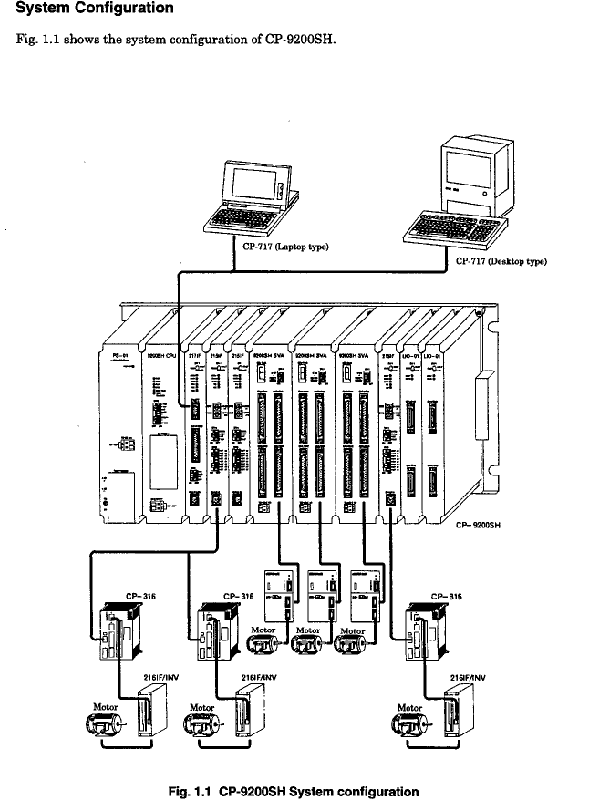
CPU module: 32-bit processor, optional 1MB/2MB program memory, supports dual CPU configuration, has self diagnosis, program execution control and other functions, and displays the running status through LED indicator lights.
Power module: including PS-01 (100VAC/DC), PS-02 (200VAC), and PS-03 (24VDC) models, with power consumption ≤ 150W, providing power interruption detection function.
Sports module:
SVA module: controls up to 4 axes, supports position/speed/torque control, and also has counter function.
PO-01 module: pulse train output type, capable of controlling up to 4 axes, supporting functions such as positioning and zero point return.
SVB module: MECHATROLINK digital output type, capable of controlling up to 14 axes, with 16 modules expandable to 224 axes.
(2) Optional modules
Communication module: Supports CP-213/215/216/217/218/225/2500 protocol and Ethernet, covering interfaces such as RS-232/RS-422/485.
I/O modules: including LIO-01 (32 DI/DO points each), DI-01 (64 point input), DO-01 (64 point output), AI-01 (8-point analog input), AO-01 (4-point analog output), etc.
Expansion modules: EXIOIF (Installation Base Expansion), 2000IOIF (2000 Series I/O Connection), 820IF (CP-820 Local Connection), etc.
(3) Installation base
MB-01 (Long Type): Can install up to 14 modules (excluding power module) and supports single/multiple CPU configurations.
MB-03 (short type): can install up to 8 modules (excluding power module), suitable for scenarios with fewer modules.
2. Key hardware parameters
Environmental parameters: Operating temperature 0-55 ℃ (24-hour average ≤ 50 ℃), vibration resistance meets JIS B 3502 standard.
Grounding requirement: protective grounding (Class 3, ≤ 100 Ω).
Weight: MB-01 with full configuration 5400g, MB-03 with full configuration 3400g.
Module lifespan: At an average ambient temperature of 40 ℃, the module lifespan is 10 years.
3. CP-215 repeater
Used to extend the transmission distance of CP-215/216, supporting twisted pair, coaxial cable, fiber optic and other media, including TT (twisted pair to coaxial), TC (twisted pair to coaxial), TP (twisted pair to plastic fiber), TS2/TS5 (twisted pair to quartz fiber) and other models, with a maximum transmission distance of up to 5km.
Software and programming functions
1. Programming Fundamentals
Programming language: Supports ladder diagrams and SFC language.
Programming tool: Control Pack CP-717 (desktop/laptop), supports program editing, downloading, and debugging.
Program structure: Adopting a hierarchical structure of parent, child, and grandson layers, supporting up to 64 drawings.
2. Core functions
(1) Control function
Motion control: position/speed/torque control, electronic cam, electronic shaft synchronization, positioning, zero return, interpolation feed, etc.
Counting function: reversible counting, interval counting, frequency measurement, hardware position locking.
(2) Communication function
Supports CP-213/215/216/217/218/225/2500 protocol, with Ethernet transmission speed of 10Mbps.
Support third-party communication protocols such as MEMOBU, MELSEC, OMRON, etc., and adapt to different brands of devices.
(3) Debugging and monitoring
Data tracking: Up to 4 sets of 16 data, 32k words of memory, supporting display of lists or trend charts.
Fault tracking: up to 500 fault definitions, recording the time of fault occurrence/recovery and related information.
3. Register and Data Types
Register types: including system registers (S), data registers (M), input registers (I), output registers (O), constant registers (C), etc.
Data types: Supports bit type (B), integer type (W), double length integer (L), real type (F), and address type (A) to meet different computational requirements.
Installation and wiring specifications
1. Installation requirements
Installation location: Avoid direct sunlight, high temperature and humidity, dust, corrosive gases, and vibration impact environments.
Module installation: The power module is located on the left, and the CPU module is located in slot 0/1. The module fastening screws need to be tightened to prevent loosening.
Distance requirement: Maintain sufficient distance from high-voltage equipment, with a distance of ≥ 200mm between I/O lines and power lines to avoid noise interference.
2. Wiring specifications
(1) Power wiring
The power module needs to be connected to the rated voltage, and PS-01/02/03 correspond to different voltage ranges. The wiring should be independent to avoid mixing with other circuits.
Grounding treatment: The FG terminal needs to be grounded separately to avoid sharing with high current grounding, and the grounding resistance should be ≤ 100 Ω.
(2) I/O and transmission wiring
I/O wiring: Use shielded wires to avoid laying them in the same conduit as power lines, and separate the wiring of analog and digital signals.
Transmission wiring: Different communication protocols correspond to different cable types (such as CP-215 using twisted pair), and matching resistors need to be installed at the terminals. The transmission distance must comply with specifications (such as a maximum of 170m at 4Mbps).
3. Hot plugging process
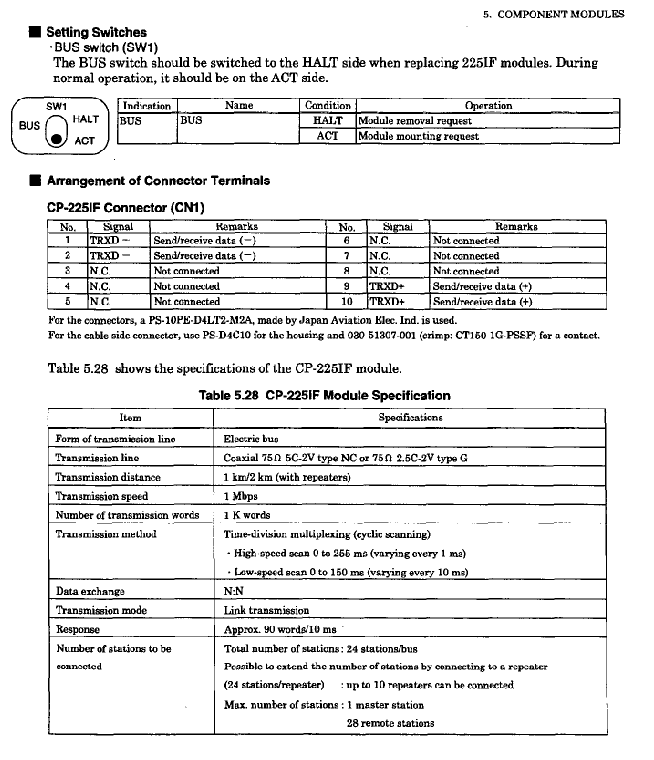
Support live replacement of some modules. The process is: set the BUS switch to HALT → confirm that the RMV LED is on → remove the module → install the new module in HALT mode → tighten the screws → switch the BUS switch to ACT → confirm that the RUN LED is on.

Operation and running process
1. Operation mode
Online operation mode: Execute user programs and I/O operations, RDY and RUN LEDs light up, ALM and ERR LEDs turn off when there are no faults.
Offline stop mode: Program stops, output reset, RUN or RDY LED off, trigger scenarios include no scan time set, program memory not initialized, serious faults, etc.
2. Start the process
Module installation and battery connection (CPU battery needs to be connected separately).
CPU memory initialization (set through DIP switch).
Connect the CP-717 programming tool.
Load the user program.
Start running and perform self diagnosis (including memory, ROM, CPU function diagnosis).
3. Power interruption handling
Instantaneous interruption (≤ 10ms): The device continues to operate.
Short term interruption (10ms Ns): After resetting in continuous startup mode, it continues to run. In new startup mode, it performs self diagnosis and restarts.
Long term interrupt (≥ Ns): After resetting, start according to the set mode.
Fault diagnosis and maintenance
1. Fault diagnosis method
LED indicator light: Determine the fault type based on the on/off/flashing status of RDY, RUN, ALM, ERR, BAT ALM and other LEDs (such as ERR flashing twice as RAM error).
System registers: Query fault details through registers such as SW00040 (CPU status), SW00041 (error message), SW00200 (I/O error count), etc.
Fault classification: serious fault (program stopped), alarm (program continues, ALM LED on).
2. Common fault handling
Power supply error: Check the voltage range, wiring, and terminal screws.
Communication error: Check wiring, terminal resistance, and protocol settings.
Program error: Use CP-717 to troubleshoot program logic and register addresses.
Battery alarm: When BAT ALM lights up, replace the lithium battery (ER6VC) and backup data before replacement.
3. Key points of daily maintenance
Regular inspection: tighten screws, clean modules, and check wiring integrity.
Battery maintenance: Replace the battery in a timely manner before its lifespan expires to avoid data loss.
Module replacement: Non hot swappable modules need to be powered off for replacement, and configuration consistency needs to be confirmed after replacement.
User Program Design
1. Drawing (DWG) type
Including DWG. A (startup drawing), DWG. I (interrupt handling drawing), DWG. H (high-speed scanning drawing), DWG. L (low-speed scanning drawing), supporting hierarchical calling.
Up to 64 drawings, with a maximum of 500 steps per drawing, supporting sub drawing and sub drawing extensions.
2. Function design
System standard functions: 11 preset functions (such as TRACE data tracking, FTRC-RD fault reading).
User defined functions: up to 500, supporting input/output parameter definitions, and can be called across drawings.
3. Symbol and Register Management
Supports direct register number specification or symbol specification (up to 8 characters), with symbols that can be linked upwards (parent symbol referenced by child image).
Automatic register allocation: Some registers support automatic numbering, simplifying the programming process.
- OMRON
- ABB
- General Electric
- EMERSON
- Honeywell
- HIMA
- ALSTOM
- Rolls-Royce
- MOTOROLA
- Rockwell
- Siemens
- Woodward
- YOKOGAWA
- FOXBORO
- KOLLMORGEN
- MOOG
- KB
- YAMAHA
- BENDER
- TEKTRONIX
- Westinghouse
- AMAT
- AB
- XYCOM
- Yaskawa
- B&R
- Schneider
- KONGSBERG
- NI
- WATLOW
- ProSoft
- SEW
- ADVANCED
- Reliance
- TRICONEX
- METSO
- MAN
- Advantest
- STUDER
- DANAHER MOTION
- Bently
- Galil
- EATON
- MOLEX
- DEIF
- B&W
- ZYGO
- Aerotech
- DANFOSS
- Beijer
- Moxa
- Rexroth
- Johnson
- WAGO
- TOSHIBA
- BMCM
- SMC
- HITACHI
- HIRSCHMANN
- Application field
- XP POWER
- CTI
- TRICON
- STOBER
- Thinklogical
- Horner Automation
- Meggitt
- Fanuc
- Baldor
- SHINKAWA
- Other Brands
- UniOP
- KUKA
- Iba
- Beckhoff
- ADLINK
-
 Sigmatek MDD111-1 DIAS Drive Axis Module
 -
 Sigmatek DKL042 05-024-042 Terminal Module
 -
 Sigmatek DM822 Control Module
 -
 Sigmatek CDM167 12-008-167-O Module
 -
 Sigmatek TAE151 Touch Display Unit
 -
 Sigmatek DCC041 SLIDES Module 05-700-041-D
 -
 Sigmatek AKM65M-ANC2GBB0 PM Servo Motor
 -
 Sigmatek ETT221 01-230-221 Operator Terminal
 -
 Sigmatek SLIDES DAM 124 Analog Module
 -
Sigmatek AKM31C-ANCNGBB0 Servo Motor
-
 Mannesmann Demag Sigmatek CP626 Central Unit
 -
 SIGMATEK 0332.554.03 Board 371071000154
 -
 SIGMATEK 12-250-021 Base Plate Back Panel CM5V020
 -
 SIGMATEK DM162 S-DIAS Digital Mix Module
 -
 DEMAG ERGOTECH 061 381 66 Sigmatek 9842.243.02 Circuit Board
 -
 SIGMATEK CP313-1 PLC Module
 -
Sigmatek ETV0551-2 VARAN Touch Terminal
-
 Sigmatek SDM 081 FS S-Dias Safety Module
 -
 DEMAG 05-250-023 Ergotech Motherboard with Sigmatek TMS012
 -
Sigmatek CM5V020 12-250-023-K Wiring Base
-
 Sigma Tek 5000B-37 Attitude Gyro Indicator
 -
 Sigmatek SDD120-2 DIAS Drive
 -
 Sigmatek CME221 Memory Module
 -
 Sigmatek DCP640 DIAS Central Unit
 -
 Sigmatek STO040 Safety Output Module
 -
Sigmatek CET281 Control Panel
-
 Sigmatek CIPC LX800 Demag NC5 CPU
 -
 Sigmatek DKL093 05-024-093 Terminal Module
 -
 Sigmatek AI088 20-009-088 Analog Input Module
 -
Sigmatek CAI888 Analog Input Module
-
SIGMATEK CCA021 12-025-021 Analog Output Module
-
SIGMATEK 1104.579.05 Control Module
-
SIGMATEK SDI100 Digital Input Module
-
 SIGMATEK C-IPC 256MB LX800 Compact Dias
 -
 SIGMATEK 9423.090.02 Control Module
 -
SIGMATEK C-IPC 256 Power Supply 148498
-
 SIGMATEK CAI025 Analog Input Module
 -
 SIGMATEK CTO166 Digital Output Module
 -
 SIGMATEK CP112 20-004-112 Processor Module
 -
SIGMATEK CAI887 12-009-887 Safety Module
-
 Sigma-Tek 4000B-31 Directional Gyro 1U262-002-42
 -
Sigmatek C-IPC 256MB LX800 IPC Controller
-
Sigmatek C-IPC 01-450-031 Industrial PC LX800
-
Sigmatek C-IPC 256 Industrial PC Controller
-
Sigmatek CCP-531 PLC Processor Module
-
Sigmatek CDI163 Digital Input Module
-
 Sigmatek ETV0501 VARAN Terminal 12-230-0501
 -
 Sigmatek CTMS020 C-DIAS Technology Module
 -
 Sigmatek CIV512 VARAN Switch Module
 -
 Sigmatek HU011 20-080-011 Interface Module
 -
SIGMATEK SLIDES DAM 124 Module
-
 SIGMATEK C-IPC 161 01-450-161L Industrial PC
 -
SIGMATEK C-IPC 128MB VIA 733MHz 01-450-024-K
-
 SIGMATEK 12-780-012 R8-IPC Geode LX800 Module
 -
SIGMATEK CAM124 Analog Module
-
 SIGMATEK S1 032-8AF61-R4 EZ Servo Motor
 -
 SIGMATEK CTO163 Digital Output Module
 -
 SIGMATEK CCP082 12-004-082 Processor Module
 -
 SIGMATEK CRCH081 C-DIAS Temperature Module
 -
 SIGMATEK PC322-K 01-310-322-K Industrial PC
 -
SIGMATEK SDD310-2 Servo Drive
-
 SIGMATEK AI084 Analog Input Module
 -
SIGMATEK CRCH081 12-752-081 Temperature Module
-
Sigma-Tek 5000L-4 Attitude Gyro 1U284-001-3
-
 SIGMATEK CM5V020 12-250-023-K Wiring Module
 -
Sigma-Tek 4000H-6 Directional Gyro IU262-035-7
-
 SIGMATEK Dias DCP160 05-004-160 Processor Module
 -
SIGMATEK 0147.395.02 Control Module
-
SIGMATEK A1084 Control Module
-
SIGMATEK DI200 20-006-2000 Digital Input Module
-
Sigmatek DNC115 Encoder Module
-
 Sigmatek DAM122 05-017-122 Analog Module
 -
Sigmatek 9802.289.01 Control Board TA71 Display
-
Sigmatek TO127 20-007-127 Digital Output Module
-
Sigmatek DNC031 05-011-031 Digital Module
-
Sigmatek VI022 20-003-022 Interface Module
-
Sigmatek CAI085 Analog Input Module
-
 Sigmatek CP111 S-DIAS CPU Module
 -
Sigmatek CTMS030 Krauss Maffei Module
-
 Sigmatek CAM123 Control Module
 -
 Sigmatek TAE732-P 01-240-732-P Touch Display Unit
 -
Sigmatek MDM021 Digital Mixed Module
-
Sigmatek DCP642 DIAS Central Unit
-
 Sigmatek CST022 12-014-022 C-DIAS Module
 -
 Sigmatek SRO021 20-893-021 Safety Relay Output
 -
 Krauss Maffei MC5 Control System Sigmatek
 -
 Sigmatek DC061 Module 18-24VDC 300mA
 -
 Herrmann EVT0855 Ultrasonic Welder Touch Panel
 -
Sigmatek CIV521 Control Module 1.4A 2W
-
Sigmatek DDI61 05-006-161 Digital Input Module
-
SIGMATEK ETT312-E Touch Terminal 01-230-312
-
Cessna S3326-1 Sigma Tek 5000B-67 Gyro 1U149-015-9
-
SIGMATEK PS101 Power Supply Module
-
SIGMATEK 0332.554.03 Control Module 371071000154
-
 SIGMATEK ETT312-E Touch Terminal 01-230-312
 -
SIGMATEK CDM163 Control Module
-
 SIGMATEK VSV046 16-023-046 Module
 -
SIGMATEK AM221 20-017-221 Analog Module
-
SIGMATEK CTS051 12-053-051 Control Module
-
SIGMATEK AM221 20-017-221 Analog Module
-
Sigmatek CSDI161 12-891-161 Safety Input Module
-
Sigma Tek 4000C-1 Directional Gyro Indicator
-
Sigmatek ETV0501 12-230-0501 VARAN Terminal
-
Sigmatek DDM165 SLIDES Module
-
Sigmatek N100 20-011-100 Control Module
-
Sigmatek AKM54K-ANC2R-B0 PM Servo Motor
-
Sigmatek CTO166 Digital Output Module
-
Sigmatek CP212-K 20-004-212-K CPU Module
-
Sigmatek CDI161 Digital Input Module
-
Sigmatek DCC080 05-700-080-2 Control Module
-
 SIGMATEK SCP011 S-DIAS Safety CPU
 -
SIGMATEK SCP011 S-DIAS Safety CPU
-
SIGMATEK SRO022 Relay Output Module
-
SIGMATEK MDD 121 Drive Axis Module
-
SIGMATEK DSI021 SLIDES Siemens Interface
-
SIGMATEK DIAS DCP161 Module 05-004-161
-
 Sigmatek ETT312 Built-in Touch Terminal
 -
SIGMATEK DCP 643 DIAS Controller System
-
SIGMATEK CIO021 Multi I/O Module
-
SIGMATEK CTMS020 Control Module
-
 Sigmatek CME 221 Memory Module
 -
Sigmatek 0420.615.01 Control Board
-
Sigmatek CP111 20-004-111 CPU Module
-
Sigmatek 9405.065.03 Control Board
-
Sigmatek ETEK 01-450-032-K C-IPC 256MB Industrial PC
-
Sigmatek CTO163 12-007-163 Safety Output Module
-
Sigmatek TO081 20-007-081 Digital Output Module
-
 Sigmatek SI021 20-022-021 Safety Input Module


