
YOKOGAWA FFCS COMPACT CONTROL STATION IN CENTUM CS3000 R3
YOKOGAWA FFCS COMPACT CONTROL STATION IN CENTUM CS3000 R3
In the course of developing CENTUM CS3000 R3 Revision 3.04, we also developed a new FFCS field control station which has achieved compact size and high reliability. The processor cards, being compact yet high performance, utilize field-proven “Pair & Spare” technology deployed in large-scale control systems, resulting in the implementation of sophisticated control functions and high reliability equivalent to the existing controllers designed for large-scale control systems. The FFCS is designed to be the same overall size as the existing “uXL” control unit, which enables easy replacement of the control unit without any changes. Moreover, CPU nodes, processor modules, ESB coupler modules, and Vnet coupler modules have been newly developed for the FFCS. Especially, SEN bus (Serial Exchange Nest bus), which is a high-speed serial bus designed to suit the program copy and data equalization between dual redundant processor modules, has been developed as a new technology for data communication.
INTRODUCTION
YOKOGAWA Electric has been using Pair & Spare method as a reliability-enhancing technology for its line of distributed reliability-enhancing technology for its line of distributed control systems (DCS) since the release of the CENTUM CS in 1993. As a result, the system has achieved an availability factor of seven 9’s (99.99999%) for the record of operation to date. Under the basic concept “continually adopt new functions with assured function continuity”, the CENTUM CS3000 R3 is being constantly improved through ongoing development and by introducing the latest technologies. Also strictly adhering to this basic stance for CENTUM CS R3 Revision 3.04, we have developed the FFCS compact field control station (Figure 1), which provides both the advanced control functions and high reliability levels required for DCSs, for use with small- to medium-scale systems. This article introduces the FFCS.
SYSTEM CONFIGURATION
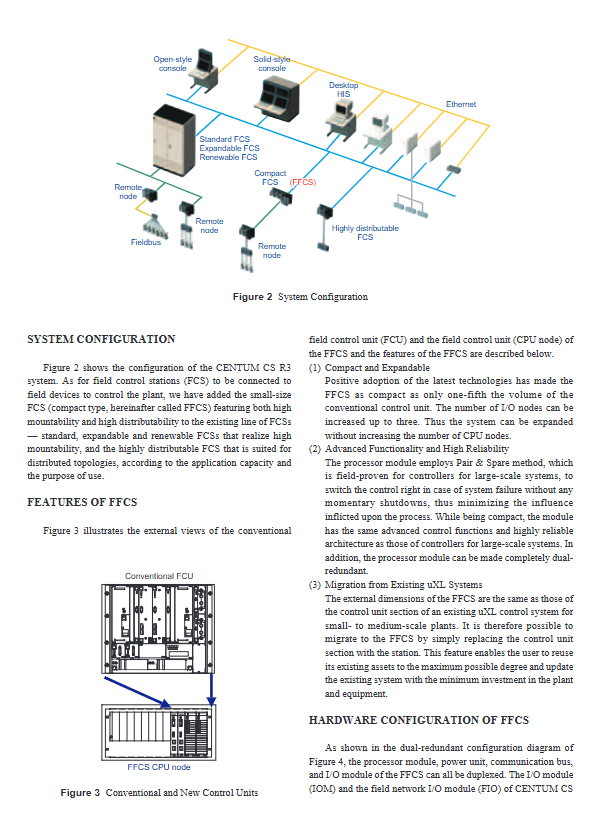
Figure 2 shows the configuration of the CENTUM CS R3 system. As for field control stations (FCS) to be connected to field devices to control the plant, we have added the small-size FCS (compact type, hereinafter called FFCS) featuring both high mountability and high distributability to the existing line of FCSs — standard, expandable and renewable FCSs that realize high mountability, and the highly distributable FCS that is suited for distributed topologies, according to the application capacity and the purpose of use.
FEATURES OF FFCS
Figure 3 illustrates the external views of the conventional field control unit (FCU) and the field control unit (CPU node) of the FFCS and the features of the FFCS are described below.
(1) Compact and Expandable
Positive adoption of the latest technologies has made the FFCS as compact as only one-fifth the volume of the conventional control unit. The number of I/O nodes can be increased up to three. Thus the system can be expanded without increasing the number of CPU nodes.
(2) Advanced Functionality and High Reliability
The processor module employs Pair & Spare method, which is field-proven for controllers for large-scale systems, to switch the control right in case of system failure without any momentary shutdowns, thus minimizing the influence inflicted upon the process. While being compact, the module has the same advanced control functions and highly reliable architecture as those of controllers for large-scale systems. In addition, the processor module can be made completely dualredundant.
(3) Migration from Existing uXL Systems
The external dimensions of the FFCS are the same as those of the control unit section of an existing uXL control system for small- to medium-scale plants. It is therefore possible to migrate to the FFCS by simply replacing the control unit section with the station. This feature enables the user to reuse its existing assets to the maximum possible degree and update the existing system with the minimum investment in the plant and equipment.
HARDWARE CONFIGURATION OF FFCS
As shown in the dual-redundant configuration diagram of Figure 4, the processor module, power unit, communication bus, and I/O module of the FFCS can all be duplexed. The I/O module (IOM) and the field network I/O module (FIO) of CENTUM CS R3 have been made common to each other. This section focuses on the hardware of the newly developed CPU node.
CPU Node
A maximum of eight IOMs can be installed in the CPU node, allowing the CPU node to operate alone as the minimum system of the FFCS.
A maximum of three extension nodes (direct-coupling and remote nodes) can be connected to the CPU node. When connecting the CPU node and direct-coupling node, an ESB bus coupler module (EC401) is installed in the IOM section of the CPU node and an ESB bus slave interface module (SB401) is installed in the extension node. When using the remote node in place of the extension node, an ER bus master interface module (EB401) is installed in the IOM section of the CPU node or directcoupling node.
Processor Module (CP401)
Figure 5 shows the dual-redundant configuration of the processor modules. The dual-redundant processor modules employ the field-proven Pair & Spare method. Each processor module comprises two MPUs, where the MPUs perform the same control computations and the computation results are crosschecked by the collators to detect transient errors. With the dual redundancy of processor modules, the transfer of the control right in case of system failure and the continuation of control are accomplished without any momentary shutdown, achieving high degrees of system availability.
Figure 6 shows the external view of the processor module. The module has been changed in shape from the conventional card-like form to a modular form in which the internal assembly is encapsulated in a molded housing. For the internal hardware configuration, we reused the hardware assets, i.e., the processor card (CP345) and SB bus interface card (SB301) of the industryproven CENTUM CS3000, and incorporated them into a single module, while maintaining the software compatibility as much as possible. Equipped with the microprocessor which is field-proven as has been used for the industry-proven CP345 processor card, the processor module makes it possible to build scalable systems by using the same system software for small- to medium-scale plants and large-scale plants as well.
In order to mount the CP345 and SB301 on a single module (i.e., to achieve downsizing), we actively adopted a programmable device in a fine-pitched multi-pin ball grid array (BGA) as a largescale integration component, chip capacitors and resistors of 1005 size as small-size components, and new elemental technologies, including build-up boards for densely mounting such components.
The processor module contains a battery pack in order to back up the main memory in case of power failure. However, taking environmental protection into consideration, the conventional nickel-cadmium batteries have been abandoned and replaced with nickel-hydrogen batteries.
SEN Bus
We have also developed the SEN bus for program copying and data equalization between the processor modules. Table 1 shows the specifications of the SEN bus in brief.
Traditionally, data exchange between the processor modules has been performed using a parallel transmission method. In the case of the SEN bus however, the method has been replaced with the point-to-point high-speed serial transmission method to reduce the mounting area and the number of signal lines to onetenth those of the conventional bus. Since the LVDS (EIA/TIA644 standard) method featuring small signal amplitudes has been adopted for the bus signal levels, radiation noise has been reduced and power consumption has also been dramatically reduced. From the point of view of high reliability, we added an errordetecting code and made it possible to connect/disconnect the module with the line electrified. The SEN bus is provided with error-detecting functions, such as constantly performing selfdiagnoses using idle frames even in the absence of bus access requests. From a software point of view, the SEN bus inherits exactly the same interface as that of the existing backplane bus.
Thus the FFCS features a design in which users need not be conscious of the SEN bus.
ESB Bus Coupler Module (EC401)
We have also developed the ESB bus coupler module (EC401) designed to connect the direct-coupling node to the CPU node. The module has one port for the ESB bus to communicate with the ESB bus interface module (SB401). By installing two units of the module, it is possible to support for the dual redundancy of the ESB bus.
V-net Coupler Unit
The FFCS employs the field-proven V-net as the control bus. The V-net coupler unit is equipped with a V-net data link control section and physical layer interface to provide signal isolation and level conversion for the V-net.
CONCLUSION
Yokogawa Electric's DCSs have evolved through the positive adoption of new technologies in line with market requirements (performance, functionality, and capacity increase). We have increased the capacity and functionality of FCSs' control units in harmony with improvements in semiconductor integration technology and enhancements in microprocessor performance. Since the amount of data for equalization between the dualredundant processors has increased significantly, the conventional transfer capacity will no longer suffice.
We have retrofitted the backplane bus which has not been changed since the release of the CENTUM CS. In addition, we have developed the SEN bus (high-speed serial bus) for data equalization between the dual-redundant processor modules of the FFCS. The technical progress of the SEN bus holds promise for the bus to become even faster in future. Consequently, it will become possible to further enhance the functionality and performance of FCSs.
REFERENCES
(1) Matsuda Toshihiko, Sano Hideo, Soggo Sadatoshi, Hazama Meguru, “Fault Tolerant Design for Field Control Stations”, Yokogawa Technical Report , Vol. 18, 1994, pp. 10-13
(2) Komiya Hiroyoshi, Akai Hajime, Matsuda Toshihiko, Nishida Jun, “Fault Tolerance of Distributed Process Control Systems”, The Institute of Electronics—Information and Communication Engineers Technical Research Report, Vol. 97, No. 98, 1997, pp. 35-40 (in Japanese)
(3) Kato Eiji, Nakamoto Eiji, Matsuda Toshihiko, “Features of Field Control Station Hardware”, Yokogawa Technical Report, No. 26, 1999, pp. 6-9
* CENTUM and uXL are registered trademarks of Yokogawa Electric Corporation. The names of companies and products that appear in this document are the trademarks or registered trademarks of the respective holders.
- OMRON
- ABB
- General Electric
- EMERSON
- Honeywell
- HIMA
- ALSTOM
- Rolls-Royce
- MOTOROLA
- Rockwell
- Siemens
- Woodward
- YOKOGAWA
- FOXBORO
- KOLLMORGEN
- MOOG
- KB
- YAMAHA
- BENDER
- TEKTRONIX
- Westinghouse
- AMAT
- AB
- XYCOM
- Yaskawa
- B&R
- Schneider
- KONGSBERG
- NI
- WATLOW
- ProSoft
- SEW
- ADVANCED
- Reliance
- TRICONEX
- METSO
- MAN
- Advantest
- STUDER
- DANAHER MOTION
- Bently
- Galil
- EATON
- MOLEX
- DEIF
- B&W
- ZYGO
- Aerotech
- DANFOSS
- Beijer
- Moxa
- Rexroth
- Johnson
- WAGO
- TOSHIBA
- BMCM
- SMC
- HITACHI
- HIRSCHMANN
- Application field
- XP POWER
- CTI
- TRICON
- STOBER
- Thinklogical
- Horner Automation
- Meggitt
- Fanuc
- Baldor
- SHINKAWA
- Other Brands
- UniOP
- KUKA
- Iba
- Beckhoff
- ADLINK
-
 VALMET PMB 2R 16 Slot Backplane PCB Card
 -
 NELES VALMET A413135 AOU 4 Output Module
 -
 Metso Valmet A413345 FPU Power Unit
 -
 VALMET A413171 PIC Module
 -
 VALMET A413620 Repeater Module
 -
 Valmet M851521 Memory Card
 -
 Valmet DIFF-EL 140 M1 Transmitter
 -
 Valmet A413064 DMU Module
 -
 Valmet IOP371 I/O Bus Extender Module
 -
 Valmet Cooking Liquor Measurement 3400 Model 3417H
 -
 Metso Valmet A413043 CPU Module – Industrial Processor
 -
 Valmet BIU4 M851221 Binary Input Module
 -
 Valmet PMB 1S CPU SCU Rack Module
 -
 Valmet A413248 Controller Module
 -
 Valmet PDP601 Distributed Processing Unit
 -
 VALMET M851004 M2 CPU Printed Circuit Board Module
 -
 Metso Valmet A413045 Ver.05 CPU Module
 -
 Valmet A413181 Ver.05 PLU1 Board
 -
 Lyngso Valmet ATB16 Controller Board
 -
 VALMET AIU 16 Analog Input Unit 545100-3A/3B
 -
 VALMET PUD 10 B Power Supply PCB Rack Module
 -
 Valmet MS-50V/120V Bearing Unit
 -
 Valmet PDP603 Distributed Processing Unit – DPU Module
 -
 Valmet A413110 TIU Board – Terminal Interface Unit
 -
 Valmet S420154 I/O Backplane PCB – Printed Circuit Board
 -
 Valmet A413173 Industrial Control Module
 -
 Valmet A413044 CPU Module
 -
Valmet A4IU1 Analog I/O Module
-
 Valmet A413325 IPU Power Unit – PLC Module
 -
 Valmet M851002 CPU Module – Central Processing Unit
 -
 Valmet PUD10B Power Supply Board
 -
Valmet K00990 Master CPU Electronic Assy
-
 Valmet Metso IOP345 Input Module
 -
 Metso Automation T545215 Board
 -
Valmet Metso IOP304 Input Module
-
 Valmet 542844-6A SCU Module
 -
 Metso A413043 Ver.11 Valmet CPU Module
 -
Valmet Automation BIU 8A Input Module
-
Metso A413044 Ver05 Valmet CPU Module
-
 VALMET 542821-5A Control System Rack Module
 -
 Metso A413005 Ver.04 Valmet CPU Module
 -
 Valmet M851207 AIU16 Card
 -
Valmet BIU8 Binary Input Unit
-
 VALMET 547070-2B CPU Printed Circuit Board Module
 -
 Valmet Automation A413325 Power Module
 -
 VALMET AUTOMATION A413135 AOU4 Module
 -
 VALMET ACU A413165 Model 9 Analog Controller
 -
 VALMET AUTOMATION A413511-02 Slot Rack with I/O Backplane
 -
 Valmet A413148 BIE 4 Rev 08 Board
 -
 Valmet ATB16-4 Controller Board
 -
 Neles Automation BOR82 A413292 Processor Module
 -
 Valmet A413015 NCU Module – Network Control Unit
 -
 Valmet AIU 16 Analog Input Unit – M8512071
 -
 Metso Valmet A413091 GDU Board
 -
 Valmet M851565 Damatic Main Keyboard
 -
 Metso A413082 CPU Module
 -
 Valmet A403037 GDC – Graphics Display Controller
 -
Valmet A413076 FBC Board
-
Valmet A413015 NCU Module – Network Control Unit
-
Valmet A413082 CPU Module
-
 VALMET AUTOMATION A413620 Fieldbus Repeater
 -
 Valmet Metso IOP341R Positioner Module
 -
 Metso A413082 Ver.04 CPU Module
 -
 Valmet Metso MCA FT250/10 10 Inch Sensor
 -
 Valmet N0542 ABMB Printed Circuit Board
 -
 Valmet A413000 Ver.07 CPU Module
 -
Valmet A413061 Ver.05 DMU Module
-
 Valmet M851241 M1 BCU Binary Input Module
 -
Valmet Automation NCU A413015 Circuit Board
-
Valmet A413046 Ver.06 CPU Module
-
 Valmet A651B001 Panel Mount Keyboard
 -
 Valmet IQ Scanner A418080R Basis Weight Detector Head
 -
Metso Valmet A413370 ESU Ethernet SCSI Unit
-
 Valmet A413340 FPU Power Supply Unit
 -
 Valmet SKF GE 400/600 Spherical Plain Bearing
 -
 Valmet SCU PCB Card 542844-7B – System Control Unit
 -
Valmet A413075 FBU Fieldbus Controller Module
-
 Valmet A413171 PIC Card Binary Output
 -
Valmet A413002 Ver.05 CPU
-
 Valmet ABMB PCB Card – Industrial Control Board
 -
 Valmet PMB 2R 542821-4A PCB Card
 -
Metso Valmet A413001 CPU Module
-
 Metso Valmet A413050 RSU 6 Serial Controller Unit
 -
 Valmet ABMB MT241 Input Mother Board
 -
 Valmet DAMATIC M851565 Keyboard
 -
 Valmet A413075 Ver05 FBC Board
 -
 VALMET K14891 FLEXI-U Operating Terminal
 -
VALMET AUTOMATION MKB2 DAMATIC Keyboard
-
 Valmet Metso Consistency Transmitter Smart Pulp M1 RL Blade
 -
VALMET AUTOMATION A413230 ECU Module
-
 Beckhoff EP9224-0037 - 4-Channel Power Distribution Box EtherCAT
 -
 Beckhoff CX2900-0026 - Solid State Flash Memory Card 20GB CFast
 -
 Beckhoff BK7500 - SERCOS Interface Fieldbus Bus Coupler Terminal
 -
 Beckhoff Ep2328-0002 - 4-Channel Input 4-Channel Output EtherCAT Box IP67
 -
 Beckhoff CX1020-0111 - Controller Kit Combo Interface Modules
 -
 B&R X20AI2237 - X20 System Analog Input Interface Module
 -
 Beckhoff CP2221-0010 - Multi-Touch Built-In Panel PC Touchscreen
 -
 Beckhoff CX1500-M310 - Fieldbus Master Interface Module 24V
 -
 Beckhoff CX2100-0904 - Power Charging Module Smart UPS Extension
 -
 Beckhoff CP3918-0000 - Multi-Touch Control Panel 18.5-Inch Monitor
 -
 Beckhoff CP2915-0000 - 15-Inch Multi-Touch Built-In Control Panel
 -
 Beckhoff CP7037-1027 - HMI Industrial Control Panel Built-In PC
 -
 Beckhoff EL3152 - 2-Channel Analog Input Terminal 4-20mA EtherCAT
 -
 Beckhoff CP6607-0000-0020 - 5.7-Inch Built-In Panel PC HMI Touch
 -
 Beckhoff EJ1809-0000 - 16-Channel Digital Input Pluggable Signal Level Terminal
 -
 Beckhoff AM8563-0N10-0000 - Synchronous Servo Motor
 -
 Beckhoff AX2006-S60600-520 - Compact Servo Drive Inverter
 -
 Beckhoff AM8053-0K20-0000 - Servo Motor with Planetary Gearbox AG3210
 -
 Beckhoff AM8042-0FH1-0000 - Synchronous Servo Motor
 -
 Rexroth R911338600 - IndraControl V HMI Terminal Beckhoff PCI Card FC9002
 -
 Beckhoff AX5125-0000 - 3 Phase Industrial Servo Drive 1000Hz
 -
 Beckhoff EP2328-0002 - 4-Channel Digital Input 4-Channel Output EtherCAT Box
 -
 B&R 7CP476-02 - System 2005 RTD CPU Module 3IF681.86 Interface
 -
 Beckhoff AX8620-0000-0000 - Power Supply Module Axis Drive System
 -
 Beckhoff CX1010-0111 - PLC Module CPU Controller 24V
 -
 Beckhoff AM8043-0H10-0000 - Synchronous Servo Motor
 -
 Beckhoff C6240-1009 - Control Cabinet Industrial PC Mainframe
 -
 Beckhoff BX8000-0000 - Bus Terminal Controller HW 4.4 Standalone
 -
 Beckhoff CP7721-1089-0020 - 12.1-Inch Touch Screen HMI Panel PC
 -
 Beckhoff CP7132-0001 - Industrial Built-In Panel PC Screen
 -
 Beckhoff CP2912-0010 - Multi-Touch Built-In Control Panel Display
 -
 Beckhoff CP2915-0000 - 15-Inch Multi-Touch Built-In Control Panel
 -
 Beckhoff AM8532-1EN0-0000 - Synchronous Servo Motor
 -
 Beckhoff AX5203-0000 - 2-Channel Digital Compact Servo Drive
 -
 Beckhoff CX2020-0141 - Embedded PC Core CPU Module
 -
 Beckhoff CP6832-0002-0010 - Built-In Industrial Control Panel Display
 -
 Beckhoff CX5020-0112 - Embedded PC CPU Control Module
 -
 Beckhoff CX5140-0175 - 4GB Embedded PC CPU Unit 24V


