
YOKOGAWA STARDOM FCN-100/FCJ Migration Technology
YOKOGAWA STARDOM FCN-100/FCJ Migration Technology
Migration core principles and limitations
(1) Core migration logic
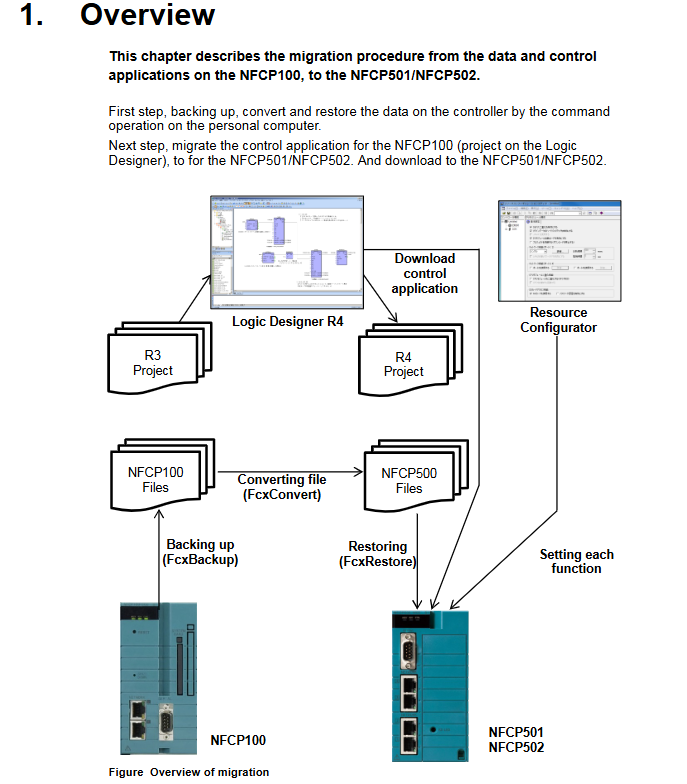
The essence of migration is the process of "adaptation transformation deployment" of source device configuration and application:
Data level: Backup the configuration data (resource configuration, system files) of NFCP100/NFJT100, convert it to NFCP500 compatible format, and then restore it to the target device;
Application level: Upgrade the control projects (R1-R4 versions) in Logic Designer, adapt them to PLC/processor types, recompile and download them to the target device;
Special configuration: Field bus definition and Duolet application need to be separately adapted to the hardware interface and system file format of the target device.
(2) Key Limitations and Rules
Data compatibility:
The FcxConvert command only supports NFCP100 backup file conversion, NFJT100 backup files cannot be converted, and I/O definitions and DUONUS.PRP files need to be reset;
When expanding the hold data area, the hold data saved by NFCP100 cannot be used for NFCP500 and needs to be reconfigured;
Control applications, launch projects, and source files that do not participate in FcxConvert conversion need to be compiled and downloaded separately through Logic Designer.
License restriction: The source device license cannot be migrated to FCN-500, and the CPU module of the target device must be pre bundled with the required license.
IP address inheritance: When restoring converted data, the target device's IP address will automatically inherit the source device's IP address. If modification is required, it needs to be adjusted through the Resource Configurator after recovery.
Hardware interface adaptation: The COM2 port of FCJ needs to be migrated to the RS-232C communication module, and the port name in the application needs to be changed from "COM2" to the module configuration name (such as "RS02").
Detailed explanation of core migration tools and commands
(1) Command line tool functions and usage
Complete syntax and key instructions for the core functions of tool commands
FcxBackup backup source device (NFCP100/NFJT100) data FcxBackup - all - u<username>- p<password><hostname/IP>1. The "- all" parameter requires R3.10+version, and the "- u/- p" parameter requires R4.10+version;
2. Generate a "BACKUP" folder containing data files, resource configuration, DUONUS.PRP, etc;
3. Example: FcxBackup all - u user01- p abc123 192.168.0.1
FcxConvert converts NFCP100 backup files to the target device format FcxConvert.exe - t<NFCP501/NFCP502>- i<source folder>- o<target folder>1. The source folder defaults to "ACKUP", and the target folder needs to be customized (such as "ACKUP_CFCP501");
2. After conversion, the target folder needs to be renamed as "ACKUP" before it can be used for recovery;
3. Example: FcxConvert.exe - t NFCP501- i BackUP - o BackUP_CFCP501
FcxRestore restores the converted data to the target device FcxRestore<hostname/IP>1. Before restoring, it is necessary to clear the hold data in the SRAM of the target device (in conjunction with FcxSaveRetain-c);
2. Example: FcxRestore 192.168.0.1
FcxSaveRetain saves/clears hold data FcxSaveRetain-c<hostname/IP>1. Only use the "- c" parameter during migration (clear SRAM hold data);
2. Ensure that the backup data is correctly mapped to the target device SRAM;
3. Example: FcxSaveRetain - c 192.168.0.1
(2) Tool acquisition and directory structure
Acquisition steps:
Insert R4.20+version system DVD ROM;
Select "DVD Contents" and double-click on "FCN/FCJ Basic Software Package" (FCN-500 corresponds to Pkg.NFCP500. exe in the Pkg.NFCP500 folder);
Specify the installation folder (such as "C: temp"), extract it, and generate the tool files.
Typical directory structure:
plaintext
C:temp
⊙ - NFCP500 # Core Tools Folder
│∝ - FcxBackup.exe # Backup Command
│∝ - FcxConvert.exe # Conversion Command
│└ - FcxRestore.exe # Restore Command
└ - FCXTOOL # Auxiliary Tools Folder
∝ - FcxSaveRetain.bat # Keep Data Processing Batch Processing
└ - save_record. txt # Configuration file
Control the core rules for application migration
(1) PLC type matches processor type
PLC type processor type migration operation (without expanding the hold data area) migration operation (expanding the hold data area) applicable scenarios
IPC40 FCX/FCX_A can be directly recompiled without modifying the project reconstruction resources (PLC=IPC40, processor=FCX_B/FCX_C)+compiling the original configuration of NFCP100, which needs to be expanded to maintain data
IPC32/IPC33- Rebuilding Resources (PLC changed to IPC40)+Copying Configuration (tasks/variables/labels, etc.)+Compiling Rebuilding Resources (PLC=IPC40, processor=FCX_B)+Copying Configuration+Compiling Low Version PLC Type Adaptation Target Device
SH_40- Rebuilding Resources (PLC changed to IPC_40)+Compilation - SH_40 Type Compatibility Upgrade
(2) Processor type description
Processor type applicable to device core characteristics
FCX NFJT100/NFCP100 does not support modules such as NFLF111/NFGS813
FCX_A NFCP100 supports modules such as NFLF111/NFGS813
FCX_B NFCP501/NFCP502 Extended version of FCX_A for maintaining data area
FCX_C NFCP501/NFCP502 supports 3 or more expansion units+NFLF111 and other modules, with device label expansion versions
(3) Project upgrade and compilation
Version compatibility: R1-R3 version projects are automatically converted to R4 format when opened with Logic Designer R4, and cannot be backward compatible with lower version tools after conversion;
Key points of resource reconstruction:
Copy the task definition, global variable definition, device label variable definition, software wiring definition, etc. of the original project;
Configure target device parameters (such as IP address, communication port);
If using a user library, you need to copy the. mwt file and the folder with the same name to "C: YOKOGAWA FCN-FCJ LogicDesigner Libraries", compile and register it;
Download requirements: Perform offline downloads (including controlling applications, launching projects, source files), ensuring that the target device is in online mode.
Detailed process of two migration modes
(1) Mode 1: migrate directly to the target device (complete the whole process on site)
Applicable scenarios: on-site downtime allowed, no need for prior verification, no complex field bus configuration
Core steps (10 steps)
Key precautions for step-by-step operation content
A1 obtains the installation folder of the conversion tool without spaces, and after decompression, confirms the integrity of the tool
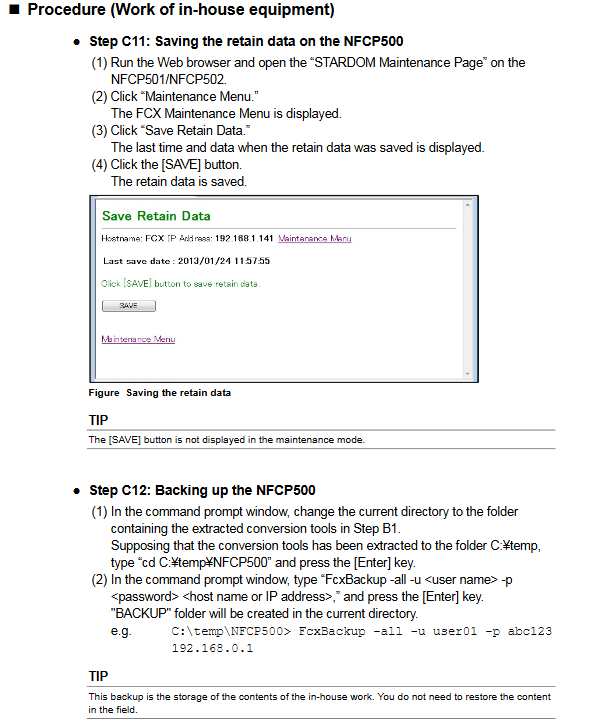
A2 Save NFCP100 Keep Data Login STARDOM Maintenance Page → Maintenance Menu → Save Retain Data → Click [SAVE]; No [SAVE] button in maintenance mode
Switch the command line of A3 backup NFCP100 data to the tool directory, execute the FcxBackup command, and generate the "ACKUP" folder
A4 Convert backup file (NFJT100 skip) Execute the FcxConvert command, rename the destination folder to "ACKUP"
Replace the CPU module with A5, remove the NFCP100, and transfer the Ethernet/RS-232-C cable (connect the Ethernet to the original 1/2 port); The new NFCP500 requires setting the IP address through the Resource Configurator first
A6 target device switches to maintenance mode, logs in to Maintenance Page → Reboot → Reboot (Maintenance Mode) → Confirm startup mode
To restore data to NFCP500, first execute FcxSaveRetain-c to clear and hold the data, and then execute the FcxRestore command; Switch to online mode after recovery
A8 configuration NFCP500 exclusive features can be set through the Resource Configurator: Duolet function, CPU dual machine hot standby, NFCP502 3/4 Ethernet port, SD card, SNTP server, NFJT100 migration I/O definition
A9 Download Control Application Logic Designer R4 Open Project → Compile → Offline Download to Target Device
A10 executes APC (dual machine hot standby scenario) by inserting the standby side CPU module (of the same model and software version) → the resource configurator starts APC (manually executed when automatic start is disabled)
(2) Mode 2: Pre migration verification of internal equipment+on-site replacement
Applicable scenarios: sensitive on-site downtime, complex configuration (including field bus/Duolet applications), and the need to troubleshoot issues in advance
Core process (divided into three stages)
Stage 1: On site preparation (3 steps)
Step operation content output
B1 requires R4.20+tools to be installed on both the on-site and internal engineering PCs for obtaining conversion tools
B2 Save NFCP100 Keep data in the same mode Step A2 Keep data file
B3 backup NFCP100 data in the same mode, A3 step "Backup" folder
Stage 2: Internal device verification (7 steps)
Key points for verifying the operation content of steps
B4 Convert backup files (NFJT100 skip) in the same mode. A4 Step: Convert the "BackUP" folder after the conversion
B5 Configure internal NFCP500 new device with IP, switch to maintenance mode device ready (maintenance mode)
B6 restores data to internal NFCP500 in the same mode. A7 steps successfully restore data without any errors
B7 configuration exclusive functions in the same mode, A8 step function configuration takes effect
B8 download control application in the same mode. A9 steps: successful application download
B9 Verification Function Hardware (Communication, Dual Machine Hot Standby), Control Application Running Normal Verification Report
B10 optional: Backup internal NFCP500 data by executing the FcxBackup command, archive the verified configuration, and internally verify the backup file
Stage 3: On site replacement (steps 4-6)
Scenario step operation content
Internal and on-site I/O configurations are different B11-B16 B11: replace CPU module; B12: Switch maintenance mode; B13: Data recovery; B14: Configure exclusive functions; B15: Download applications; B16: Execute APC (dual machine)
Internal and on-site I/O configurations are the same C11-C14 C11: Save internal NFCP500 to maintain data; C12: Backup internal device data; C13: Replace CPU module; C14: Execute APC (dual machine)
Special Configuration Migration Adaptation
(1) Field bus definition migration (NFLF111/NFLP121/NFLC121 modules)
Core logic: The field bus definition is bound to the engineering PC and needs to be migrated from the source device engineering PC to the target device engineering PC
operating steps
File preparation: Copy the configuration file from the source PC (FOUNDATION field bus: CF/DD file; PROFIBUS: GSD file; CANopen: EDS file);
Define migration:
Same PC upgrade: No need to export/import, definition information is already stored on the PC;
New PC project: Source PC → Resource Configurator export definition → New PC import definition → Download to target device;
Special adaptation: When using FF engineering tools before R2.20, it is necessary to first convert them to FF Configurator format (refer to TI 34P02Q55-01E).
(2) Duolet (Java) application migration
1. System file editing
In the converted DUONUS.PRP file, a "#" comment will be added before JavaStart and AdditionalClassPath. After recovery, the "#" should be removed to activate the application;
Editor's reference: "B 2.4.2 Editing System Setting Files" in IM 34P02Q01-01E.
2. Project migration
Step operation content
1. Rename CallJavac.bat in the project folder to CallJavac.bat.old, and Ftp2Fcx.bat to Ftp2Fcx.bat.old
Copy CallJavac.bat, CallJavac_Fcn500.bat, and Ftp2Fcx.bat from the "Project Template" directory of the tool installation directory to the project folder
3. Edit Ftp2Fcx.bat, configure the target device IP, package name included in the JAR package, and JAR file name
Execute CallJavac.bat or CallJavac_Fcn500.bat to confirm the generation of the Duolet application
5. Note: The deprecated method of IEC control data access class cannot be used for FCN-500
- OMRON
- ABB
- General Electric
- EMERSON
- Honeywell
- HIMA
- ALSTOM
- Rolls-Royce
- MOTOROLA
- Rockwell
- Siemens
- Woodward
- YOKOGAWA
- FOXBORO
- KOLLMORGEN
- MOOG
- KB
- YAMAHA
- BENDER
- TEKTRONIX
- Westinghouse
- AMAT
- AB
- XYCOM
- Yaskawa
- B&R
- Schneider
- KONGSBERG
- NI
- WATLOW
- ProSoft
- SEW
- ADVANCED
- Reliance
- TRICONEX
- METSO
- MAN
- Advantest
- STUDER
- DANAHER MOTION
- Bently
- Galil
- EATON
- MOLEX
- DEIF
- B&W
- ZYGO
- Aerotech
- DANFOSS
- Beijer
- Moxa
- Rexroth
- Johnson
- WAGO
- TOSHIBA
- BMCM
- SMC
- HITACHI
- HIRSCHMANN
- Application field
- XP POWER
- CTI
- TRICON
- STOBER
- Thinklogical
- Horner Automation
- Meggitt
- Fanuc
- Baldor
- SHINKAWA
- Other Brands
- UniOP
- KUKA
- Iba
- Beckhoff
- ADLINK
-
 Sigmatek MDD111-1 DIAS Drive Axis Module
 -
 Sigmatek DKL042 05-024-042 Terminal Module
 -
 Sigmatek DM822 Control Module
 -
 Sigmatek CDM167 12-008-167-O Module
 -
 Sigmatek TAE151 Touch Display Unit
 -
 Sigmatek DCC041 SLIDES Module 05-700-041-D
 -
 Sigmatek AKM65M-ANC2GBB0 PM Servo Motor
 -
 Sigmatek ETT221 01-230-221 Operator Terminal
 -
 Sigmatek SLIDES DAM 124 Analog Module
 -
Sigmatek AKM31C-ANCNGBB0 Servo Motor
-
 Mannesmann Demag Sigmatek CP626 Central Unit
 -
 SIGMATEK 0332.554.03 Board 371071000154
 -
 SIGMATEK 12-250-021 Base Plate Back Panel CM5V020
 -
 SIGMATEK DM162 S-DIAS Digital Mix Module
 -
 DEMAG ERGOTECH 061 381 66 Sigmatek 9842.243.02 Circuit Board
 -
 SIGMATEK CP313-1 PLC Module
 -
Sigmatek ETV0551-2 VARAN Touch Terminal
-
 Sigmatek SDM 081 FS S-Dias Safety Module
 -
 DEMAG 05-250-023 Ergotech Motherboard with Sigmatek TMS012
 -
Sigmatek CM5V020 12-250-023-K Wiring Base
-
 Sigma Tek 5000B-37 Attitude Gyro Indicator
 -
 Sigmatek SDD120-2 DIAS Drive
 -
 Sigmatek CME221 Memory Module
 -
 Sigmatek DCP640 DIAS Central Unit
 -
 Sigmatek STO040 Safety Output Module
 -
Sigmatek CET281 Control Panel
-
 Sigmatek CIPC LX800 Demag NC5 CPU
 -
 Sigmatek DKL093 05-024-093 Terminal Module
 -
 Sigmatek AI088 20-009-088 Analog Input Module
 -
Sigmatek CAI888 Analog Input Module
-
SIGMATEK CCA021 12-025-021 Analog Output Module
-
SIGMATEK 1104.579.05 Control Module
-
SIGMATEK SDI100 Digital Input Module
-
 SIGMATEK C-IPC 256MB LX800 Compact Dias
 -
 SIGMATEK 9423.090.02 Control Module
 -
SIGMATEK C-IPC 256 Power Supply 148498
-
 SIGMATEK CAI025 Analog Input Module
 -
 SIGMATEK CTO166 Digital Output Module
 -
 SIGMATEK CP112 20-004-112 Processor Module
 -
SIGMATEK CAI887 12-009-887 Safety Module
-
 Sigma-Tek 4000B-31 Directional Gyro 1U262-002-42
 -
Sigmatek C-IPC 256MB LX800 IPC Controller
-
Sigmatek C-IPC 01-450-031 Industrial PC LX800
-
Sigmatek C-IPC 256 Industrial PC Controller
-
Sigmatek CCP-531 PLC Processor Module
-
Sigmatek CDI163 Digital Input Module
-
 Sigmatek ETV0501 VARAN Terminal 12-230-0501
 -
 Sigmatek CTMS020 C-DIAS Technology Module
 -
 Sigmatek CIV512 VARAN Switch Module
 -
 Sigmatek HU011 20-080-011 Interface Module
 -
SIGMATEK SLIDES DAM 124 Module
-
 SIGMATEK C-IPC 161 01-450-161L Industrial PC
 -
SIGMATEK C-IPC 128MB VIA 733MHz 01-450-024-K
-
 SIGMATEK 12-780-012 R8-IPC Geode LX800 Module
 -
SIGMATEK CAM124 Analog Module
-
 SIGMATEK S1 032-8AF61-R4 EZ Servo Motor
 -
 SIGMATEK CTO163 Digital Output Module
 -
 SIGMATEK CCP082 12-004-082 Processor Module
 -
 SIGMATEK CRCH081 C-DIAS Temperature Module
 -
 SIGMATEK PC322-K 01-310-322-K Industrial PC
 -
SIGMATEK SDD310-2 Servo Drive
-
 SIGMATEK AI084 Analog Input Module
 -
SIGMATEK CRCH081 12-752-081 Temperature Module
-
Sigma-Tek 5000L-4 Attitude Gyro 1U284-001-3
-
 SIGMATEK CM5V020 12-250-023-K Wiring Module
 -
Sigma-Tek 4000H-6 Directional Gyro IU262-035-7
-
 SIGMATEK Dias DCP160 05-004-160 Processor Module
 -
SIGMATEK 0147.395.02 Control Module
-
SIGMATEK A1084 Control Module
-
SIGMATEK DI200 20-006-2000 Digital Input Module
-
Sigmatek DNC115 Encoder Module
-
 Sigmatek DAM122 05-017-122 Analog Module
 -
Sigmatek 9802.289.01 Control Board TA71 Display
-
Sigmatek TO127 20-007-127 Digital Output Module
-
Sigmatek DNC031 05-011-031 Digital Module
-
Sigmatek VI022 20-003-022 Interface Module
-
Sigmatek CAI085 Analog Input Module
-
 Sigmatek CP111 S-DIAS CPU Module
 -
Sigmatek CTMS030 Krauss Maffei Module
-
 Sigmatek CAM123 Control Module
 -
 Sigmatek TAE732-P 01-240-732-P Touch Display Unit
 -
Sigmatek MDM021 Digital Mixed Module
-
Sigmatek DCP642 DIAS Central Unit
-
 Sigmatek CST022 12-014-022 C-DIAS Module
 -
 Sigmatek SRO021 20-893-021 Safety Relay Output
 -
 Krauss Maffei MC5 Control System Sigmatek
 -
 Sigmatek DC061 Module 18-24VDC 300mA
 -
 Herrmann EVT0855 Ultrasonic Welder Touch Panel
 -
Sigmatek CIV521 Control Module 1.4A 2W
-
Sigmatek DDI61 05-006-161 Digital Input Module
-
SIGMATEK ETT312-E Touch Terminal 01-230-312
-
Cessna S3326-1 Sigma Tek 5000B-67 Gyro 1U149-015-9
-
SIGMATEK PS101 Power Supply Module
-
SIGMATEK 0332.554.03 Control Module 371071000154
-
 SIGMATEK ETT312-E Touch Terminal 01-230-312
 -
SIGMATEK CDM163 Control Module
-
 SIGMATEK VSV046 16-023-046 Module
 -
SIGMATEK AM221 20-017-221 Analog Module
-
SIGMATEK CTS051 12-053-051 Control Module
-
SIGMATEK AM221 20-017-221 Analog Module
-
Sigmatek CSDI161 12-891-161 Safety Input Module
-
Sigma Tek 4000C-1 Directional Gyro Indicator
-
Sigmatek ETV0501 12-230-0501 VARAN Terminal
-
Sigmatek DDM165 SLIDES Module
-
Sigmatek N100 20-011-100 Control Module
-
Sigmatek AKM54K-ANC2R-B0 PM Servo Motor
-
Sigmatek CTO166 Digital Output Module
-
Sigmatek CP212-K 20-004-212-K CPU Module
-
Sigmatek CDI161 Digital Input Module
-
Sigmatek DCC080 05-700-080-2 Control Module
-
 SIGMATEK SCP011 S-DIAS Safety CPU
 -
SIGMATEK SCP011 S-DIAS Safety CPU
-
SIGMATEK SRO022 Relay Output Module
-
SIGMATEK MDD 121 Drive Axis Module
-
SIGMATEK DSI021 SLIDES Siemens Interface
-
SIGMATEK DIAS DCP161 Module 05-004-161
-
 Sigmatek ETT312 Built-in Touch Terminal
 -
SIGMATEK DCP 643 DIAS Controller System
-
SIGMATEK CIO021 Multi I/O Module
-
SIGMATEK CTMS020 Control Module
-
 Sigmatek CME 221 Memory Module
 -
Sigmatek 0420.615.01 Control Board
-
Sigmatek CP111 20-004-111 CPU Module
-
Sigmatek 9405.065.03 Control Board
-
Sigmatek ETEK 01-450-032-K C-IPC 256MB Industrial PC
-
Sigmatek CTO163 12-007-163 Safety Output Module
-
Sigmatek TO081 20-007-081 Digital Output Module
-
 Sigmatek SI021 20-022-021 Safety Input Module


