
YOKOGAWA FU24 pH/ORP Composite Sensor with Pressure Compensation (IM 12B06J03-03EN-P)
YOKOGAWA FU24 pH/ORP Composite Sensor with Pressure Compensation (IM 12B06J03-03EN-P)
Product positioning and core features
1. Core positioning
FU24 is a composite sensor that integrates pH, ORP (oxidation-reduction potential), rH (relative hydrogen activity), and temperature measurements. It uses a patented bellows system to achieve pressure compensation and maintain stable measurement in pressure fluctuation environments. It also supports full angle safety (including inversion) and is suitable for harsh industrial scenarios.
2. Core advantages
Pressure compensation: The patented bellows system can balance the internal and external pressures in real time, avoiding the impact of process pressure fluctuations on sensor life. It supports 0-10 bar (gauge pressure) and -0.99 bar (negative pressure), and there is no risk of liquid leakage during sudden pressure changes;
Multi parameter integration: achieve pH (0-14), ORP (-1500~+1500 mV), rH (0-100), and temperature (-10~105 ℃) measurement in a single installation, reducing installation space and cost;
Durable design: The main material is PPS 40GF (glass fiber reinforced polyphenylene sulfide), which is resistant to chemical corrosion; The measuring end adopts G-type glass (pH electrode) and AR type glass (reference tube), suitable for various harsh media;
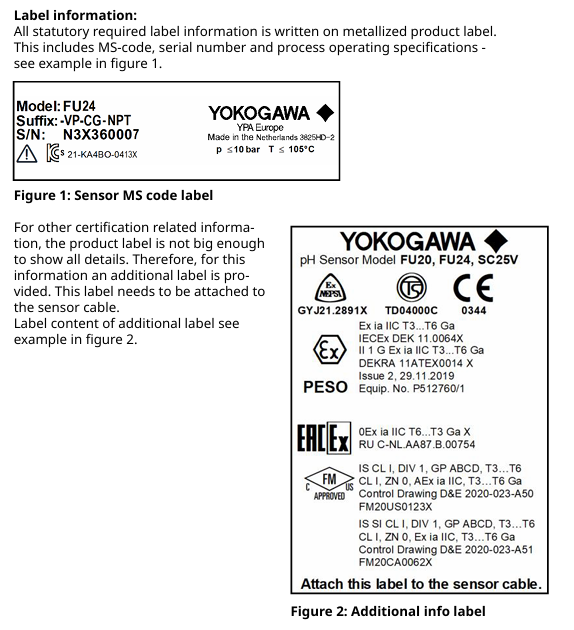
Explosion proof safety: certified by multiple national explosion prevention certifications such as ATEX, IECEx, FM, NEPSI, etc., intrinsic safety type (Ex ia IIC T3~T6 Ga), can be used in hazardous areas such as Class I Div.1/Zone 0;
Intelligent adaptation: We offer models with fixed cables (5m/10m) or Vario Pin connectors (VP without ID chip/VS with ID chip). The VS model can be paired with the SA11-P1 intelligent adapter for data storage and quick replacement.
Detailed explanation of technical specifications
1. Basic measurement parameters
Parameter category specification details
The pH measurement range is 0-14 pH, the asymmetric potential is 8 ± 15 mV, the slope is ≥ 96% of the theoretical value (25 ℃), and the response time t ₉₀<15 seconds (pH 7 → 4 step);
ORP/rH measurement ORP range -1500~+1500 mV, rH range 0~100, using solid platinum electrode, reference system is Ag/AgCl (3.3M KCl);
Temperature measurement with built-in Pt1000 sensor (compliant with IEC 751), dome type -10~105 ℃ (response time t ₉₀<1 minute), flat type 15~105 ℃ (response time t ₉₀<4 minutes);
Environmental adaptability protection level IP67, process temperature -10~105 ℃ (dome type), 15~105 ℃ (flat type), medium conductivity needs to be greater than 10 μ S/cm;
The main material of the mechanical performance is PPS 40GF, and the contact medium components include Viton (O-ring/bellows), PTFE (reference junction), and platinum (grounding pin); The maximum tightening torque is 7.5 Nm, and the interface is a 1-inch NPT thread;
2. Explosion proof and compliance certification
FU24 has passed the global multi regional explosion-proof and safety certification, with the following core certification parameters:
Certification standard explosion-proof level key parameters applicable areas
ATEX/IECEx Ex ia IIC T3~T6 Ga Ui=18 VDC, Ii=170 mA, Pi=400 mW EU and IECEx member states
FM (US/Canada) Class I Div.1/Zone 0, Ex ia IIC Temperature Class T3 (-40~105 ℃)~T6 (-40~40 ℃) US, Canada
NEPSI (China) Ex ia IIC T3~T6 Ga Certificate No. GYJ21.2891X China
Other certifications PESO (India), KCs (South Korea), EAC Ex (Russia) based on ATEX/IECEx certification endorsement for India, South Korea, Russia, etc
3. Model classification
According to the differences in connection methods and functions, FU24 is divided into the following models, with clear suffix code meanings:
Core characteristics of model suffix classification
FU24-05/-10 fixed cable type cable length 5m/10m, directly connected to transmitter (such as FLX21/PH202S series), without ID chip;
FU24-VP Vario Pin 8-pin connector without ID chip, requires WU10/WE10 cable to connect analog transmitter, without sensor information storage function;
FU24-VS Vario Pin with ID chip 8-pin connector (including ID chip), can be paired with SA11-P1 smart adapter, stores sensor calibration data, supports hot swapping;
Suffix - T1/- GC temperature sensor and region-T1: Pt1000, compatible with global certifications such as ATEX/FM/NEPSI; -GC: Compatible with Korean KCs certification;
Suffix - NPT/- FSM measuring end type - NPT: dome type (wear-resistant, suitable for media containing particles); -FSM: Flat type (self-cleaning, suitable for viscous media);
Installation and wiring process
1. Installation preparation
(1) Site selection requirements
Ensure that the measurement points represent the true state of the process medium, avoiding dead zones, bubble accumulation, or low flow rates (recommended flow rate of 0.1~1 m/s);
The ambient temperature should meet the explosion-proof level requirements (such as T6 level -40~40 ℃, T3 level -40~105 ℃), and avoid direct sunlight or severe vibration;
If the conductivity of the medium is greater than 10 μ S/cm, an electrolyte (such as KCl) needs to be added to ensure measurement stability.
(2) Pre installation inspection
After unpacking, confirm that the sensor model and serial number are consistent with the order, check that the cables/connectors are not damaged, and that the measuring end's "wet pocket" (transport protective fluid) is intact;
Remove the 'wet pocket' and rinse the measuring end with deionized water to avoid residual protective solution affecting the measurement; It is recommended to recalibrate before first use (factory calibration data can be found in the QIC certificate).
2. Installation steps
(1) Installation method
Support pipeline installation, immersion installation, and bypass circuit installation. The core steps are as follows:
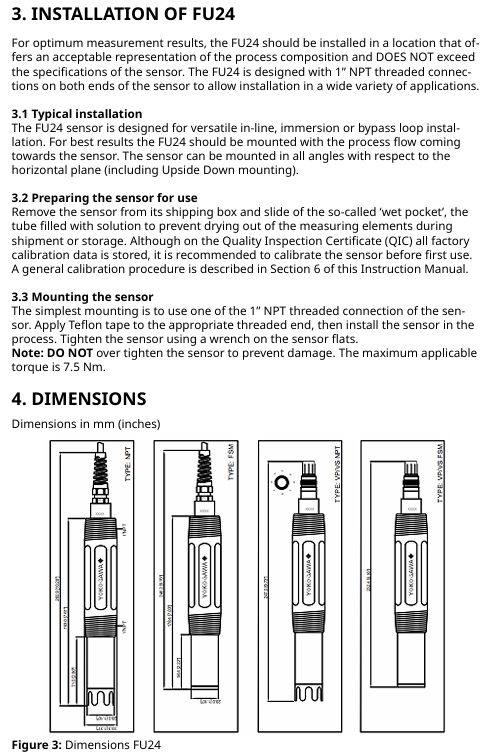
Thread sealing: Wrap polytetrafluoroethylene tape around the 1-inch NPT thread end (to avoid covering the thread end and prevent contamination of the medium);
Fixed sensor: Use a wrench to clamp onto the flat surface of the sensor body and tighten with a maximum torque of 7.5 Nm to avoid over tightening and damaging the threads;
Angle adaptation: It can be installed at any angle (including inversion), and it is recommended that the medium flow direction be towards the measuring end to reduce bubble adhesion.
(2) Wiring specifications
According to the differences in models, the wiring methods are divided into two categories: fixed cables and Vario Pin connectors:
Wiring Type Wiring Requirements
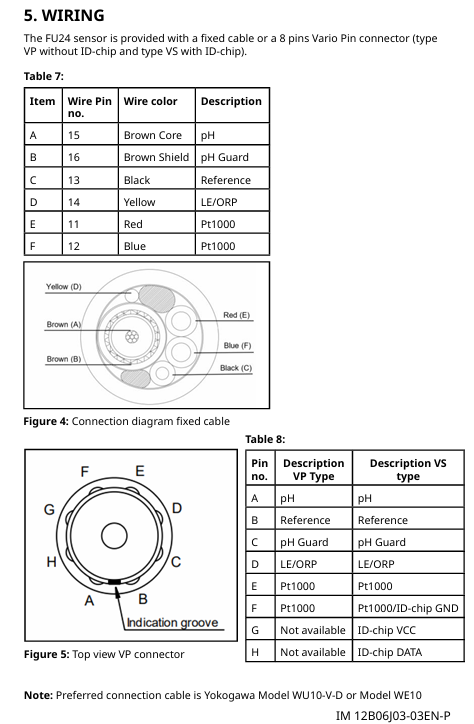
Fixed cable - brown (core wire): pH signal;
-Brown (shielding layer): pH shielding;
-Black: reference electrode;
-Yellow: LE/ORP signal;
-Red/Blue: Pt1000 temperature sensor;
-The shielding layer needs to be grounded at one end (transmitter side) to avoid interference;
Vario Pin Connector - VP Type (No ID Chip): 8-pin interface, A-pH, B-reference, C-pH shielded D-LE/ORP、E/F-Pt1000;
-VS type (with ID chip): additional G-ID chip power supply, H-ID chip data, requires SA11-P1 adapter;
Calibration and maintenance
1. Calibration process
(1) PH calibration (two-point calibration method)
IEC standard buffer solutions (pH 4.01, 6.87, 9.18) are required, and the steps are as follows:
Cleaning the sensor: Soak it in a 5% hydrochloric acid solution for 5 minutes to remove surface dirt, and then rinse it clean with deionized water;
The first point of calibration: immerse the sensor in pH 6.87 buffer solution, wait for the reading to stabilize, and then perform "zero calibration" according to the transmitter manual;
Second point calibration: Select a buffer solution based on the pH range of the process (4.01 for acidity and 9.18 for alkalinity), repeat step 2 to perform "slope calibration";
Verification and reset: After calibration, rinse with deionized water and immerse in buffer solution again to verify that the error is ≤ 0.02 pH. After confirmation, reinstall the process pipeline.
(2) ORP/rH calibration
Use Chinhydron standard solution (1g/200mL buffer), core steps:
Choose a buffer solution with a pH close to the process pH (such as pH 4.01 or 6.87), dissolve the quinone hydroquinone powder until saturated;
Immerse the sensor in a standard solution, wait for the reading to stabilize, and manually input the theoretical value according to the transmitter manual (such as ORP=96 mV, rH=23.6 at pH 6.87);
The calibration error should be ≤ ± 10 mV, otherwise the ORP electrode needs to be cleaned (wipe the platinum surface with a soft cloth) and recalibrated.
2. Daily maintenance
(1) Regular cleaning
Choose a cleaning solution based on the type of medium contamination, only clean the measuring end (to avoid damaging the cable/connector):
Scale/Hydroxide: Soak in 5% hydrochloric acid for 10 minutes and rinse with deionized water;
Oil stains/organic matter: Clean with hot water and neutral detergent. Stubborn stains can be gently wiped with a small amount of calcium carbonate powder;
Protein residue: Soak in hydrochloric acid solution containing gastric protease (10g gastric protease+8.5mL concentrated hydrochloric acid/1L water) for 30 minutes;
Reference end blockage: Immerse the sensor in 3M KCl solution at 70 ℃, cool naturally to room temperature, and restore the conductivity of the reference junction.
(2) Replacement of vulnerable parts
O-ring/bellows: Check every 6-12 months. If aging or cracking occurs, replace with Viton material spare parts to avoid leakage;
Cable/connector: If damaged, replace the original WU10/WE10 cable to ensure that the explosion-proof performance is not compromised.
Troubleshooting and spare parts
1. Common faults and solutions
Possible causes and solutions for the fault phenomenon
PH reading drift is large. 1. Reference junction blockage; 2. Electrode contamination; 3. The buffer solution has expired; 1. Use 3M KCl solution to regenerate the reference end; 2. Clean the electrodes according to the type of medium; 3. Replace with fresh buffer solution;
ORP reading unresponsive 1. Platinum electrode surface oxidation; 2. Poor cable contact; 3. The medium has no redox activity; 1. Gently sand the platinum surface with sandpaper; 2. Check if the cable wiring is loose; 3. Confirm whether the process medium is suitable for ORP measurement;
Abnormal temperature reading: 1. Pt1000 cable open circuit; 2. The temperature compensation setting of the transmitter is incorrect; 1. Use a multimeter to measure the resistance of Pt1000 (approximately 1000 Ω at 25 ℃), and replace the cable if there is a circuit break; 2. Confirm that the temperature sensor type of the transmitter is Pt1000;
Explosion proof certification failure: 1. Cable damage; 2. Replace non original spare parts; 3. Installation does not meet the requirements of the control diagram; 1. Replace the original factory cable; 2. Only use Yokogawa certified spare parts; 3. Reinstall according to the D&E 2020-023-A50/A51 control diagram;
2. Key spare parts list
Spare parts model, purpose, applicable scenarios
K1521JA/JB sensor installation bracket JA (stainless steel) JB(PVDF), Compatible with FF20-S3/F3 series mounting components, 1-inch NPT interface;
K1520BA~BE pH buffer solutions BA (4.01+6.87+9.18, 3 × 0.5L), BC (4.01 separately), etc., comply with IEC standards;
WU10-V-D-XX Vario Pin cable XX is length (2/5/10m), suitable for VP/VS type sensors, connected to transmitters;
The SA11-P1 smart adapter is only compatible with VS type sensors, stores calibration data, and supports HART communication;
BA11 active junction box is used for remote installation of VS type sensors, achieving signal amplification and anti-interference;
Chemical compatibility and compliance
1. Material compatibility
The chemical compatibility of the sensor's contact medium components needs to match the process medium, and the tolerance range of the core material is as follows:
Material resistant medium taboo medium
PPS 40GF (main body) mostly contains acid, alkali, salt solutions (such as 50% sulfuric acid, 40% sodium hydroxide), strong oxidizing media (such as fuming nitric acid), and halogenated hydrocarbons;
Viton (seal) mineral oil, most organic solvents ketones, amines, low molecular weight esters;
PTFE (reference end) has no significant contraindications for almost all chemical media (except for molten alkali metals);
Glass (measuring end) weak acid, neutral medium hydrofluoric acid (concentration>40%), concentrated alkali (>50%);
2. Compliance requirements
RoHS compliance: compliant with EU Directive 2011/65/EU, restricting harmful substances such as lead and cadmium;
WEEE compliance: As a component of industrial fixed equipment, it needs to be recycled and disposed of in accordance with national regulations (such as the EU WEEE Directive);
Installation compliance: Installation in hazardous areas must comply with local electrical codes (such as NFPA 70 in the United States and CEC CSA22.1 in Canada), with a grounding resistance of ≤ 1 Ω.
- OMRON
- ABB
- General Electric
- EMERSON
- Honeywell
- HIMA
- ALSTOM
- Rolls-Royce
- MOTOROLA
- Rockwell
- Siemens
- Woodward
- YOKOGAWA
- FOXBORO
- KOLLMORGEN
- MOOG
- KB
- YAMAHA
- BENDER
- TEKTRONIX
- Westinghouse
- AMAT
- AB
- XYCOM
- Yaskawa
- B&R
- Schneider
- KONGSBERG
- NI
- WATLOW
- ProSoft
- SEW
- ADVANCED
- Reliance
- TRICONEX
- METSO
- MAN
- Advantest
- STUDER
- DANAHER MOTION
- Bently
- Galil
- EATON
- MOLEX
- DEIF
- B&W
- ZYGO
- Aerotech
- DANFOSS
- Beijer
- Moxa
- Rexroth
- Johnson
- WAGO
- TOSHIBA
- BMCM
- SMC
- HITACHI
- HIRSCHMANN
- Application field
- XP POWER
- CTI
- TRICON
- STOBER
- Thinklogical
- Horner Automation
- Meggitt
- Fanuc
- Baldor
- SHINKAWA
- Other Brands
- UniOP
- KUKA
- Iba
- Beckhoff
- ADLINK
-
 Micro Innovation GF1-10TVD-100 Micro Panel
 -
 Micro Innovation XN-B3T-SBC 16-Fold DO Base Module
 -
 MICRO INNOVATION AG WINBLOC CAN-3AI/1AO-UI 85 51 224192
 -
 KMK Micro Innovation GS2-90EMD-000 Micro Panel
 -
 Micro Innovation MC2-430-10TVB-1-10 PanelView Terminal 24VDC
 -
 Micro Innovation XNE-8DO-24VDC-0.5A-P I/O Module 8550100795
 -
 MICRO INNOVATION GF1-10TVB-100 Touch Panel
 -
MICRO INNOVATION AG WINBLOC CAN-4AI/UI Analog Input Module
-
 MICRO INNOVATION AG WINBLOC CAN-32DO/0.5A-P-2x16 Output Module
 -
 MICRO INNOVATION AG CAN-32DI/P-2X16 8551224182 Input Module
 -
 MICRO INNOVATION MK2-230/232-57 Circuit Board 85 28 200000
 -
 MICRO INNOVATION CAN-BRIDGE 8551224177 CAN Bridge
 -
 Micro Innovation MC2-430-10TVB-1-10 Panel 24VDC
 -
MICRO INNOVATION MC2-432-57CQB-1-10 HMI Panel
-
MICRO INNOVATION AG CAN-BRIDGE 85 51 224177 CAN Bridge
-
 MICRO INNOVATION CAN-4AI/UI Analog Input Module
 -
MICRO INNOVATION CAN-32DI/P-2X16 Input Module
-
 SIGMATEK MDD111 09-404-111 Drive Module
 -
 SIGMATEK DVI021 Display Interface Module
 -
 SIGMATEK 00-450-024 C-IPC Processor
 -
 SIGMATEK MDD-111 MDD111 Drive Module
 -
 SIGMATEK ICA011 20-102-011 Interface Module
 -
 SIGMATEK 01-250-010-D NC4Kompakt Control Module
 -
 SIGMATEK CRIF081 12-751-081 Interface Module
 -
 SIGMATEK S1026-8AF61-R4E-Z57 Drive Module
 -
 SIGMATEK 9305.081.02 9227.082.00 Control Module
 -
 Sigma Tek 5000B-36 Attitude Indicator
 -
 SIGMATEK CEZ201 12-051-201-O Counter Module
 -
 SIGMATEK DPS001 Power Supply Module
 -
 SIGMATEK 994 395 01z Via Interface Module
 -
 SIGMATEK PC411-K 01-310-411-K Industrial PC
 -
 SIGMATEK 9816.324.00 Demag NC4 Keyboard
 -
 SIGMATEK ET261 90010C-71 Operator Terminal
 -
 SIGMATEK DDI 164 05-006-164 Input Module
 -
 SIGMATEK CCP 082 C-DIAS Processor Module
 -
SIGMATEK CEZ201 12-051-201-O PLC Module
-
SIGMATEK MDD 1111 06178867 Drive Module
-
SIGMATEK S1 073-6AC61-RE-Y08-Z Drive Module
-
SIGMATEK MDD 111 Drive Module MDD111
-
 SIGMATEK CSDI161 Safety Module 12-891-161
 -
SIGMATEK C-IPC Processor 01-450-024
-
 SIGMATEK DIAS DAM122 Analog Mixing Module
 -
Sigma Tek 5000B-36 Attitude Gyro Indicator
-
 SIGMATEK TMS012 Motherboard Module 05-250-012-T
 -
 SIGMATEK CCP-531 PLC Module
 -
SIGMATEK DIAS DNC4 I/O Module 05-250-011
-
 SIGMATEK AI088 Analog Input Module
 -
 SIGMATEK CEZ201 Counter Module
 -
SIGMATEK CIC011 Industrial Computer Module
-
 SIGMATEK MDM021 Motor Drive Module
 -
 SIGMATEK DTO163 Digital Output Module
 -
SIGMA-TEK 5000B-36 Attitude Gyro
-
SIGMATEK DM161 Digital Input Module
-
SIGMATEK CCP-531 PLC Control Panel
-
 SIGMATEK HZS773 Touch Terminal Operator Panel
 -
SIGMATEK MDP101 3 KVA 45-65Hz Driver
-
 SIGMATEK ETV1251 Touch Panel 12-230-1251
 -
SIGMATEK CIO021 Safety Module 12-013-021
-
Sigma Tek 4000H-5 Directional Gyro
-
 SIGMATEK TAE531 I/O Module 01-240-531
 -
 SIGMATEK DAI081 Input Module 05-009-081
 -
 SIGMATEK DCP640 Drive Control Module
 -
 SIGMATEK DCP643 Slides Module A6-29
 -
SIGMATEK SCP011 Safety Module 20-890-011
-
SIGMATEK DDM 164-D Slides Module
-
 SIGMATEK C-IPC Processor 146267
 -
SIGMATEK ET3200 Display Screen
-
SIGMATEK CEZ221 C-DIAS Mixing Module
-
 SIGMATEK SDD120-2 DIAS Servo Drive
 -
SIGMATEK DIP011 05-058-011 Module
-
 Sigmatek DEC181 I/O Module
 -
SIGMATEK DCP640 DIAS Central Unit
-
SIGMATEK 00-450-024 C-IPC Industrial Computer
-
SIGMATEK AKM32C-ANCNR-B0 Servomotor
-
SIGMATEK DVI021 DIAS Power Module
-
SIGMATEK CTS051 12-053-051 Control Module
-
 SIGMATEK CTS022 Control Module
 -
 Sigmatek 01-250-010-D NC4Kompakt V2.1 Module
 -
 SIGMATEK Control Keyboard 01-285-042 Interface
 -
 SIGMATEK TO081 20-007-081 Digital Output Module
 -
 Sigmatek AKM73Q-ANCNGBB0 7.07kW Servo Motor
 -
Sigmatek DIP012 Demag 07024165 Processor Module
-
 SIGMATEK PC 411 Injection Molding Controller
 -
SIGMATEK CEZ201 12-051-201-O Processor Module
-
 SIGMATEK VI021 20-003-021 Digital Input Module
 -
SIGMATEK Computer C-IPC 144904 Industrial PC
-
 SIGMATEK 9307.083.01 9305.081.02 Industrial Module
 -
 SIGMATEK AI075 Analog Input Module
 -
 SIGMATEK HGT834-W Teaching Pendant
 -
Sigmatek CDI161 Digital Input Module
-
 SIGMATEK HGT834 Teaching Pendant
 -
 SIGMATEK CEZ201 12-051-201-O Module
 -
SIGMATEK Demag 9617.067.03 9708.244.00 Module
-
 SIGMATEK SCP010 Safety CPU Module
 -
SIGMATEK N100 20-011-100 Module
-
 SIGMATEK CNC 031 Positioning Output Module
 -
 Sigmatek 01-355-016 Control Module
 -
 Sigmatek MDM021 Digital Mixed Module
 -
Sigmatek DAI411 05-020-411 Analog Module
-
Attitude Gyro 1U367-232-2 Aircraft Instrument
-
 Sigma-Tek 5000B-36 Attitude Gyro 23-501-06-16
 -
Sigmatek HGT834-W Injection Molding Teach Pendant
-
Sigma Tek 5000EG Attitude Gyro 1U670-003-12
-
Sigmatek HGT834-W Teach Pendant
-
Sigmatek DEE011 05-068-011 Module
-
Sigmatek DIAS DCP643 Central Processing Unit
-
Sigmatek MDD111-1 DIAS Drive Axis Module
-
 Sigmatek DKL042 05-024-042 Terminal Module
 -
Sigmatek DM822 Control Module
-
Sigmatek CDM167 12-008-167-O Module
-
Sigmatek TAE151 Touch Display Unit
-
 Sigmatek DCC041 SLIDES Module 05-700-041-D
 -
Sigmatek AKM65M-ANC2GBB0 PM Servo Motor
-
Sigmatek ETT221 01-230-221 Operator Terminal
-
Sigmatek SLIDES DAM 124 Analog Module
-
Sigmatek AKM31C-ANCNGBB0 Servo Motor
-
Mannesmann Demag Sigmatek CP626 Central Unit
-
SIGMATEK 0332.554.03 Board 371071000154
-
 SIGMATEK 12-250-021 Base Plate Back Panel CM5V020
 -
SIGMATEK DM162 S-DIAS Digital Mix Module
-
DEMAG ERGOTECH 061 381 66 Sigmatek 9842.243.02 Circuit Board
-
 SIGMATEK CP313-1 PLC Module
 -
Sigmatek ETV0551-2 VARAN Touch Terminal
-
 Sigmatek SDM 081 FS S-Dias Safety Module
 -
 DEMAG 05-250-023 Ergotech Motherboard with Sigmatek TMS012
 -
Sigmatek CM5V020 12-250-023-K Wiring Base
-
Sigma Tek 5000B-37 Attitude Gyro Indicator
-
Sigmatek SDD120-2 DIAS Drive


