
BENDER ISOMETER ® Iso685 series
BENDER ISOMETER ® Iso685 series
Product Overview
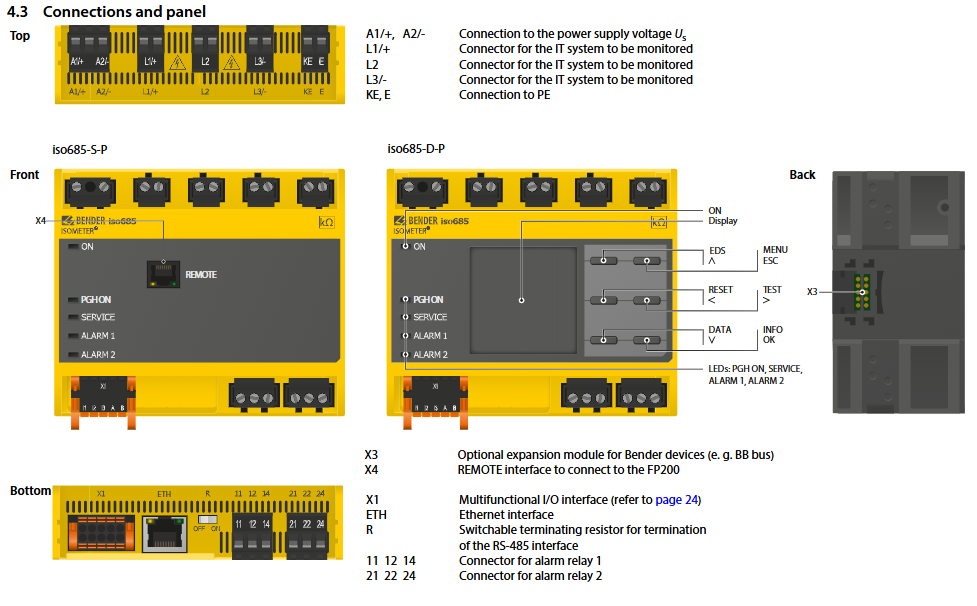
ISOMETER ® The iso685 series is an integrated insulation monitoring and fault location device developed by Bender, a German company. It is designed specifically for IT systems (ungrounded systems), with the core mission of real-time monitoring of insulation resistance, DC offset voltage, and other parameters. Combined with EDS (Insulation Fault Locator), it achieves accurate fault location and avoids the risk of electric shock and equipment damage. The product is divided into D-type (integrated display/button) and S-type (no display, requiring FP200 panel). The W-enhanced type has higher anti vibration and anti temperature performance (-40~+70 ℃), suitable for complex scenarios such as industrial automation and ship power, and complies with international standards such as IEC 61557-8.
Core parameters and physical characteristics
Category specific parameters
Dimensions: Width 108mm, Height 93mm, Depth 110mm
Weight < 510g (excluding accessories)
Power supply requirements: AC/DC 24~240 V (tolerance -30%~+15%), frequency 50~400 Hz
Environmental adaptability standard type: working -25~+55 ℃, storage -40~+70 ℃; W-type: working -40~+70 ℃
Protection level terminal IP20, internal components IP40
Installation method: DIN rail installation (compliant with IEC 60715), screw installation (3 x M4 screws)
Adaptation system and measurement profile
(1) Scope of adaptation system
System type Voltage range Frequency range Maximum leakage capacitance
AC system 0~690 V (RMS) 0.1~460 Hz 0~1000 μ F (by profile)
DC system 0~1000 V -0~1000 μ F (according to profile)
3 (N) AC system 0~690 V (RMS) 50~60 Hz 0~150 μ F (power circuit profile)
(2) 6 measurement profiles
Profile type applicable scenario key parameters
Conventional constant frequency systems for power circuits measure a voltage of ± 50 V and a leakage capacitance of 0-150 μ F
Control circuits - Low voltage sensitive systems - Measurement voltage ± 10 V, voltage ≤ 230 V
Generator monitoring rapid measurement, frequency 50-60 Hz, leakage capacitance 0-5 μ F
Leakage capacitance of large capacitance systems such as ships with high capacitance ranging from 0 to 1000 μ F
Inverter>10 Hz (Inverter>10 Hz) 10~460 Hz Frequency conversion system leakage capacitance 0~20 μ F
Inverter<10 Hz (0.1~10 Hz) Low frequency system leakage capacitance 0~20 μ F
Detailed explanation of core functions
(1) Insulation monitoring function
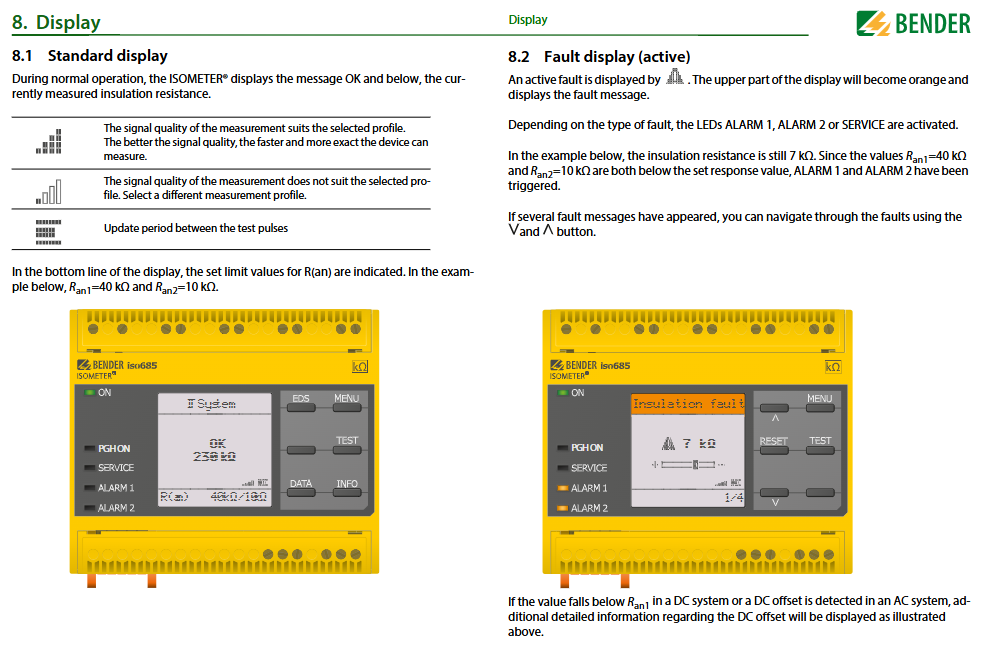
Dual alarm setting: The response values of ALARM1 (warning) and ALARM2 (main alarm) can be independently set between 1 k Ω and 10 M Ω, with default values of 40 k Ω and 10 k Ω, respectively. It supports 25% hysteresis to prevent false alarms.
Connection monitoring: Real time detection of L1/+, L2, L3/- line connections and PE grounding status, triggering sound and light alarms in case of abnormalities.
Data storage: The historical memory can store 1023 alarm/fault information, including date and timestamp, and cache for 3 days after power failure.
IsoGraph trend chart: supports visualization of insulation resistance changes by hour/day/week/month/year, with up to 100 measurement points.
(2) Insulation fault location (EDS function)
Compatible with EDS devices: Supports EDS440-S/L (positioning current 2~10 mA), EDS441-S/L (positioning current 0.2~1 mA), and can connect up to 21 EDSs (255 channels).
Positioning mode:
Manual mode: Continuous positioning, manual stop required;
Automatic mode: ALARM2 triggers and automatically starts, with a cyclic interruption for insulation measurement;
Cycle mode: ALARM2 triggers and starts one cycle before stopping.
Key parameters: The positioning current can be set to 1/1.8/2.5/5/10/25/50 mA, and the response value I Δ L (main alarm) is 200 μ A~10 mA.
(3) ISOnet system isolation
Function: Through Ethernet, multiple devices (≤ 20) can collaborate to ensure that only one device actively measures at a time, while the rest are isolated and in standby mode.
Configuration requirements: BCOM system name and subsystem address should be consistent, device address should be unique, and support automatic skipping of faulty devices.
Interface and Communication
Interface type communication protocol/functional key parameters
Ethernet (ETH) Modbus TCP, BCOM, Web Server 10/100 Mbit/s, up to 5 TCP connections
RS-485 (X1 interface) BS bus, Modbus RTU baud rate 9.6 kBd, transmission distance ≤ 1200 m
X1 multifunctional I/O digital input (3 channels), digital output (2 channels), analog output (1 channel), analog output supports 0~20 mA/0~10 V and other signals
BB bus Bender internal device communication can connect up to 2 EDS44... - S devices without additional power supply
Web server remote parameter setting and data reading support Chrome/Firefox/Edge browsers, with write permission enabled
Operation and debugging process
(1) Basic debugging steps
Equipment installation: Choose the installation method, fix the equipment, and ensure the terminal spacing (horizontal 0mm, up and down 20mm);
Parameter configuration: Set language, date and time, system type, measurement profile, alarm response value, EDS mode, and positioning current through the debugging wizard;
EDS configuration: Scan EDS channel → Activate target channel → Set group parameters (CT type, response value, etc.);
Functional testing: Simulate insulation faults through grounding resistance to verify the accuracy of alarm triggering and fault location;
Operation monitoring: Check the standard display (insulation resistance+signal quality) and trace the data through isoGraph or historical memory.
(2) Alarm and fault handling
Alarm type triggering condition processing method
ALARM1 insulation resistance<Ran1 (default 40 k Ω) Observe the system status and troubleshoot if necessary
ALARM2 insulation resistance<Ran2 (default 10 k Ω), initiate EDS positioning, eliminate the fault, and reset
Check L1/+~L3/- wiring and PE connection for disconnection of faulty circuit or poor grounding of PE
EDS channel malfunction CT connection abnormality or channel not activated Rescan channel, check CT wiring
Maintenance and safety regulations
(1) Daily maintenance
No need for regular oil changes (sealed gearbox), if the cover is opened for maintenance, Mobil needs to be added ® 634 synthetic oil;
Regularly check the BS bus terminal resistance (120 Ω) to ensure stable communication;
Clean the display panel and terminals, ensure clear labeling and stickers, and replace worn parts in a timely manner.
(2) Safety regulations
Only professional personnel are allowed to install and debug. Before operation, the power must be turned off and the system must be confirmed to be out of power;
Power supply requires connection to a 24-240 V GFCI protection circuit, and modification of plugs/cables is prohibited;
When locating faults, avoid positioning current interference with sensitive components (such as PLC), and match the system tolerance value;
Only one device is allowed to actively measure in the coupled IT system, and the rest are isolated through ISOnet or digital input.
Ordering information and accessories
Product Model Description Product Number
Iso685-D-P with display/buttons, standard B91067030
Iso685W-D-P with display/buttons, W enhanced B91067030W
Iso685-S-P+FP200 without display+panel, standard type B91067230
EDS440-L-4 Insulation Fault Locator (2~10 mA) B91080202
EDS441-S-1 Insulation Fault Locator (0.2~1 mA) B91080204
Mechanical accessory terminal cover+installation clip B91067903
- OMRON
- ABB
- General Electric
- EMERSON
- Honeywell
- HIMA
- ALSTOM
- Rolls-Royce
- MOTOROLA
- Rockwell
- Siemens
- Woodward
- YOKOGAWA
- FOXBORO
- KOLLMORGEN
- MOOG
- KB
- YAMAHA
- BENDER
- TEKTRONIX
- Westinghouse
- AMAT
- AB
- XYCOM
- Yaskawa
- B&R
- Schneider
- KONGSBERG
- NI
- WATLOW
- ProSoft
- SEW
- ADVANCED
- Reliance
- TRICONEX
- METSO
- MAN
- Advantest
- STUDER
- DANAHER MOTION
- Bently
- Galil
- EATON
- MOLEX
- DEIF
- B&W
- ZYGO
- Aerotech
- DANFOSS
- Beijer
- Moxa
- Rexroth
- Johnson
- WAGO
- TOSHIBA
- BMCM
- SMC
- HITACHI
- HIRSCHMANN
- Application field
- XP POWER
- CTI
- TRICON
- STOBER
- Thinklogical
- Horner Automation
- Meggitt
- Fanuc
- Baldor
- SHINKAWA
- Other Brands
- UniOP
- KUKA
- Iba
- Beckhoff
- ADLINK
-
 Sigmatek MDD111-1 DIAS Drive Axis Module
 -
 Sigmatek DKL042 05-024-042 Terminal Module
 -
 Sigmatek DM822 Control Module
 -
 Sigmatek CDM167 12-008-167-O Module
 -
 Sigmatek TAE151 Touch Display Unit
 -
 Sigmatek DCC041 SLIDES Module 05-700-041-D
 -
 Sigmatek AKM65M-ANC2GBB0 PM Servo Motor
 -
 Sigmatek ETT221 01-230-221 Operator Terminal
 -
 Sigmatek SLIDES DAM 124 Analog Module
 -
Sigmatek AKM31C-ANCNGBB0 Servo Motor
-
 Mannesmann Demag Sigmatek CP626 Central Unit
 -
 SIGMATEK 0332.554.03 Board 371071000154
 -
 SIGMATEK 12-250-021 Base Plate Back Panel CM5V020
 -
 SIGMATEK DM162 S-DIAS Digital Mix Module
 -
 DEMAG ERGOTECH 061 381 66 Sigmatek 9842.243.02 Circuit Board
 -
 SIGMATEK CP313-1 PLC Module
 -
Sigmatek ETV0551-2 VARAN Touch Terminal
-
 Sigmatek SDM 081 FS S-Dias Safety Module
 -
 DEMAG 05-250-023 Ergotech Motherboard with Sigmatek TMS012
 -
Sigmatek CM5V020 12-250-023-K Wiring Base
-
 Sigma Tek 5000B-37 Attitude Gyro Indicator
 -
 Sigmatek SDD120-2 DIAS Drive
 -
 Sigmatek CME221 Memory Module
 -
 Sigmatek DCP640 DIAS Central Unit
 -
 Sigmatek STO040 Safety Output Module
 -
Sigmatek CET281 Control Panel
-
 Sigmatek CIPC LX800 Demag NC5 CPU
 -
 Sigmatek DKL093 05-024-093 Terminal Module
 -
 Sigmatek AI088 20-009-088 Analog Input Module
 -
Sigmatek CAI888 Analog Input Module
-
SIGMATEK CCA021 12-025-021 Analog Output Module
-
SIGMATEK 1104.579.05 Control Module
-
SIGMATEK SDI100 Digital Input Module
-
 SIGMATEK C-IPC 256MB LX800 Compact Dias
 -
 SIGMATEK 9423.090.02 Control Module
 -
SIGMATEK C-IPC 256 Power Supply 148498
-
 SIGMATEK CAI025 Analog Input Module
 -
 SIGMATEK CTO166 Digital Output Module
 -
 SIGMATEK CP112 20-004-112 Processor Module
 -
SIGMATEK CAI887 12-009-887 Safety Module
-
 Sigma-Tek 4000B-31 Directional Gyro 1U262-002-42
 -
Sigmatek C-IPC 256MB LX800 IPC Controller
-
Sigmatek C-IPC 01-450-031 Industrial PC LX800
-
Sigmatek C-IPC 256 Industrial PC Controller
-
Sigmatek CCP-531 PLC Processor Module
-
Sigmatek CDI163 Digital Input Module
-
 Sigmatek ETV0501 VARAN Terminal 12-230-0501
 -
 Sigmatek CTMS020 C-DIAS Technology Module
 -
 Sigmatek CIV512 VARAN Switch Module
 -
 Sigmatek HU011 20-080-011 Interface Module
 -
SIGMATEK SLIDES DAM 124 Module
-
 SIGMATEK C-IPC 161 01-450-161L Industrial PC
 -
SIGMATEK C-IPC 128MB VIA 733MHz 01-450-024-K
-
 SIGMATEK 12-780-012 R8-IPC Geode LX800 Module
 -
SIGMATEK CAM124 Analog Module
-
 SIGMATEK S1 032-8AF61-R4 EZ Servo Motor
 -
 SIGMATEK CTO163 Digital Output Module
 -
 SIGMATEK CCP082 12-004-082 Processor Module
 -
 SIGMATEK CRCH081 C-DIAS Temperature Module
 -
 SIGMATEK PC322-K 01-310-322-K Industrial PC
 -
SIGMATEK SDD310-2 Servo Drive
-
 SIGMATEK AI084 Analog Input Module
 -
SIGMATEK CRCH081 12-752-081 Temperature Module
-
Sigma-Tek 5000L-4 Attitude Gyro 1U284-001-3
-
 SIGMATEK CM5V020 12-250-023-K Wiring Module
 -
Sigma-Tek 4000H-6 Directional Gyro IU262-035-7
-
 SIGMATEK Dias DCP160 05-004-160 Processor Module
 -
SIGMATEK 0147.395.02 Control Module
-
SIGMATEK A1084 Control Module
-
SIGMATEK DI200 20-006-2000 Digital Input Module
-
Sigmatek DNC115 Encoder Module
-
 Sigmatek DAM122 05-017-122 Analog Module
 -
Sigmatek 9802.289.01 Control Board TA71 Display
-
Sigmatek TO127 20-007-127 Digital Output Module
-
Sigmatek DNC031 05-011-031 Digital Module
-
Sigmatek VI022 20-003-022 Interface Module
-
Sigmatek CAI085 Analog Input Module
-
 Sigmatek CP111 S-DIAS CPU Module
 -
Sigmatek CTMS030 Krauss Maffei Module
-
 Sigmatek CAM123 Control Module
 -
 Sigmatek TAE732-P 01-240-732-P Touch Display Unit
 -
Sigmatek MDM021 Digital Mixed Module
-
Sigmatek DCP642 DIAS Central Unit
-
 Sigmatek CST022 12-014-022 C-DIAS Module
 -
 Sigmatek SRO021 20-893-021 Safety Relay Output
 -
 Krauss Maffei MC5 Control System Sigmatek
 -
 Sigmatek DC061 Module 18-24VDC 300mA
 -
 Herrmann EVT0855 Ultrasonic Welder Touch Panel
 -
Sigmatek CIV521 Control Module 1.4A 2W
-
Sigmatek DDI61 05-006-161 Digital Input Module
-
SIGMATEK ETT312-E Touch Terminal 01-230-312
-
Cessna S3326-1 Sigma Tek 5000B-67 Gyro 1U149-015-9
-
SIGMATEK PS101 Power Supply Module
-
SIGMATEK 0332.554.03 Control Module 371071000154
-
 SIGMATEK ETT312-E Touch Terminal 01-230-312
 -
SIGMATEK CDM163 Control Module
-
 SIGMATEK VSV046 16-023-046 Module
 -
SIGMATEK AM221 20-017-221 Analog Module
-
SIGMATEK CTS051 12-053-051 Control Module
-
SIGMATEK AM221 20-017-221 Analog Module
-
Sigmatek CSDI161 12-891-161 Safety Input Module
-
Sigma Tek 4000C-1 Directional Gyro Indicator
-
Sigmatek ETV0501 12-230-0501 VARAN Terminal
-
Sigmatek DDM165 SLIDES Module
-
Sigmatek N100 20-011-100 Control Module
-
Sigmatek AKM54K-ANC2R-B0 PM Servo Motor
-
Sigmatek CTO166 Digital Output Module
-
Sigmatek CP212-K 20-004-212-K CPU Module
-
Sigmatek CDI161 Digital Input Module
-
Sigmatek DCC080 05-700-080-2 Control Module
-
 SIGMATEK SCP011 S-DIAS Safety CPU
 -
SIGMATEK SCP011 S-DIAS Safety CPU
-
SIGMATEK SRO022 Relay Output Module
-
SIGMATEK MDD 121 Drive Axis Module
-
SIGMATEK DSI021 SLIDES Siemens Interface
-
SIGMATEK DIAS DCP161 Module 05-004-161
-
 Sigmatek ETT312 Built-in Touch Terminal
 -
SIGMATEK DCP 643 DIAS Controller System
-
SIGMATEK CIO021 Multi I/O Module
-
SIGMATEK CTMS020 Control Module
-
 Sigmatek CME 221 Memory Module
 -
Sigmatek 0420.615.01 Control Board
-
Sigmatek CP111 20-004-111 CPU Module
-
Sigmatek 9405.065.03 Control Board
-
Sigmatek ETEK 01-450-032-K C-IPC 256MB Industrial PC
-
Sigmatek CTO163 12-007-163 Safety Output Module
-
Sigmatek TO081 20-007-081 Digital Output Module
-
 Sigmatek SI021 20-022-021 Safety Input Module


