
Emerson DeltaV M Series Virtual I/O Module 2 (VIM2)
Emerson DeltaV M Series Virtual I/O Module 2 (VIM2)
Basic Overview
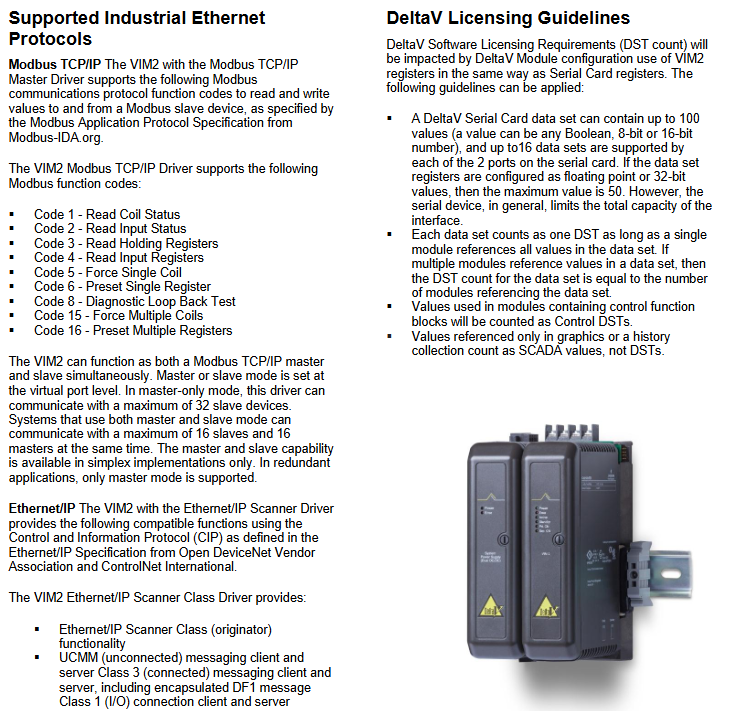
The DeltaV M Series Virtual I/O Module 2 (VIM2) is an industrial grade I/O simulation and integration device launched by Emerson Process Management. It has two core functions: one is to work with MYNAH Technologies' MiMiMiC simulation software to achieve non-invasive simulation of DeltaV M Series I/O cards and digital bus field devices, supporting comprehensive testing of control strategies and system configurations; The second is to serve as an integrated platform for high-speed Ethernet I/O devices, driven by Modbus TCP/IP or Ethernet/IP protocols, to achieve signal reading and writing between the DeltaV system and devices (such as PLCs, motor control centers, weighing instruments, etc.) in the factory Ethernet I/O network. Its design is compatible with the DeltaV system architecture and can be seamlessly integrated into existing control networks.
Core advantages
(1) Non invasive DeltaV I/O simulation capability
Comprehensive simulation support: It can perform non-invasive simulation on all DeltaV M-series I/O modules (including traditional I/O, Foundation fieldbus, Profibus DP, DeviceNet, ASi bus, and serial cards) without modifying control strategies to complete DeltaV configuration testing; Simultaneously supporting simulation of all DeltaV digital buses and Foundation fieldbus function blocks, it can verify the effectiveness of fieldbus control configuration.
Efficient simulation performance: A single controller can simulate up to 64 DeltaV I/O modules, with fast and efficient simulation execution speed, which can make the DeltaV controller mistakenly believe that it is communicating with real I/O, ensuring that the test results are close to the actual operating scenario; It also supports I/O automatic detection and precise testing of controller load, providing data support for system optimization.
Supporting simulation software: It needs to be used in conjunction with MYNAH's MiMiC simulation software (software needs to be purchased separately). This software can provide dynamic simulation function for DeltaV system software acceptance testing and operator training - through simulation I/O and on-site equipment, simulate the real reaction of the process to the control system output signal, and the simulation I/O driver updates are synchronized with the MiMiC software version and can be quickly upgraded through the simulation network.
(2) Powerful Ethernet I/O integration capability
High capacity device access: A single VIM2 can simulate 4 DeltaV serial cards, supporting 128 serial card datasets for 32 network devices in single-mode configuration and 16 devices in redundant configuration. Ethernet communication is efficient and stable, meeting the large-scale equipment integration requirements of factories.
Flexible network configuration: supports user-defined IP addresses and can adapt to almost all factory network architectures (requiring the same IP subnet as Ethernet I/O devices); Simultaneously supporting 1:1 redundant configuration - by adding a second VIM2 to form a redundant pair, simulating 4 pairs of redundant DeltaV serial cards, the main and backup cards automatically switch (consistent with the switching logic of DeltaV serial cards), and the operator can obtain switching notifications through the display interface or manually control the switching in DeltaV Diagnostics.
Multi protocol compatibility: Supports two mainstream industrial Ethernet protocols and adapts to different device types:
Modbus TCP/IP: As a master, it supports 9 types of function codes, including reading coil status (Code1) and writing multiple registers (Code16). It can function as both a master and slave (up to 32 slave stations or 16 master stations+16 slave stations are supported in single-mode mode; only the master station is supported in redundant mode, up to 16 slave stations are supported).
Ethernet/IP: As a scanner (initiator), it supports CIP protocol functions such as UCMM (connectionless) messages, Class 3 (connected) messages, and Class 1 (I/O) connections, and is compatible with the Ethernet/IP specifications defined by the Open DeviceNet Vendor Association.
(3) Usability and system compatibility
Seamless DeltaV Integration: The VIM2 is recognized by the DeltaV M series controller as four DeltaV serial cards. During debugging, serial dataset configuration can be completed through the DeltaV Explorer (consistent with conventional serial card configuration). Ethernet I/O signals can be directly used for the DeltaV control module, displayed on the DeltaV Operate graphical interface, or stored in the DeltaV historical database without the need for additional interface development.
Intuitive configuration tool: Comes with the VIMNet Explorer application (integrated with DeltaV v12 and above, or provided with MYNAH driver), supports "plug and play" configuration - completes VIM2 debugging, primary and backup redundancy settings, and Ethernet I/O network parameter configuration (such as IP address, subnet mask, gateway, device node address, etc.) through graphical drag and drop operations. It also supports driver firmware upgrades and type replacements (only supports loading one Ethernet I/O driver at a time).
Modular and flexible installation: Adopting the same installation method as the DeltaV controller, it can be installed in the controller slot of a 2-wide horizontal carrier or a 4-wide vertical carrier (located on the left side of the DeltaV controller), using standard DeltaV power supply. The design is durable and can operate stably for a long time.
Details of Function Implementation
(1) Implementation of I/O simulation function
Hardware coordination: The VIM2 hardware preloads the I/O simulation driver and communicates with the MiMiC software through the simulation network. After disconnecting the real I/O card from the control system, the MiMiC driver directly writes simulation signals to the I/O subsystem of the DeltaV controller.
Simulation data management: A single simulated process controller corresponds to one MiMiC dataset, and a MiMiMiC server can support up to 32 datasets (ports). Each dataset can accommodate 4000 MiMiMiC simulation labels, meeting the requirements of large-scale process simulation.
Technical Support: Technical support for I/O simulation drivers and MiMiC software is provided by MYNAH Technologies and requires separate contact with the supplier for service.
(2) Implementation of Ethernet I/O Integration Function
Drivers and configurations: Ethernet I/O drivers (such as Modbus TCP/IP master drivers, Ethernet/IP scanner drivers, etc.) need to be purchased separately from MYNAH. After loading the drivers, the DeltaV controller can automatically detect the debugged VIM2 (serial cards identified as slots 57-60 or 61-64 in single-mode configuration, and redundant pairs identified as slots 57-64 in redundant configuration).
Redundancy mechanism: The redundant VIM2 needs to be installed on independent 2-wide carriers, equipped with independent power supplies, and monitored for the status of the main and backup devices through dedicated redundant link cables (included in the redundancy kit) - the main VIM2 continuously communicates with industrial Ethernet devices, while the backup VIM2 sends intermittent signals to maintain communication integrity and ensure uninterrupted switching between the main and backup devices.
Configuration tool requirements: VIMNet Explorer needs to run on a workstation connected to the Ethernet I/O network (which can be a DeltaV workstation with a third network card or a non DeltaV workstation), support Windows XP/7 system, and complete connection configuration through the RJ45 Ethernet interface at the bottom of VIM2.
Hardware specifications
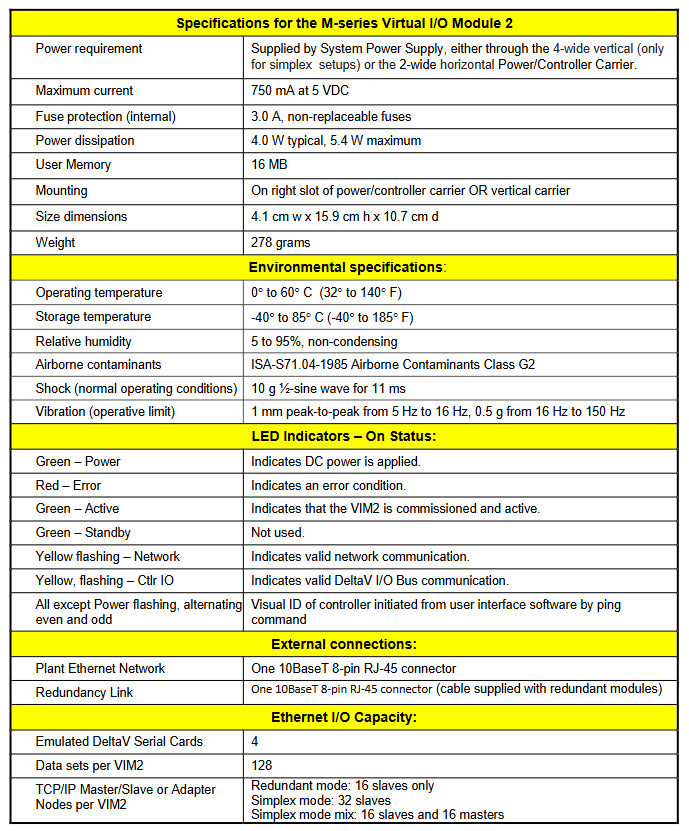
Category specific parameters
The power requirement is supplied by the DeltaV system power supply, supporting 2-wide horizontal carriers or 4-wide vertical carriers (single-mode configuration only)
Electrical protection built-in 3.0A non replaceable fuse, maximum current 750mA (5VDC)
Typical power consumption of 4.0W, maximum value of 5.4W
Storage and Size: User Memory 16MB; Size: 4.1cm (width) x 15.9cm (height) x 10.7cm (depth), Weight: 278g
Installation method: Install in the right slot (horizontal carrier) or vertical carrier of the power/controller carrier
Environmental parameters: Operating temperature: 0 ° C~60 ° C (32 ° F~140 ° F), Storage temperature: -40 ° C~85 ° C (-40 ° F~185 ° F); Relative humidity ranging from 5% to 95% (without condensation); The air pollutant level complies with ISA-S71.04-1985 G2 level; Shock resistance (normal operation): 10g half sine wave, continuous for 11ms; Vibration resistance (working limit): 1mm peak to peak value at 5Hz~16Hz, 0.5g at 16Hz~150Hz
LED indicator light - green (power): indicates connection to DC power supply
-Red (Error): Indicates the existence of an error status
-Green (Active): indicates that VIM2 has been debugged and is in an active state
-Green (Standby): Not used
-Yellow flashing (Network): indicates normal network communication
-Yellow flashing (Ctlr IO): indicates that DeltaV I/O bus communication is normal
-Alternating flashing (parity) except for the power light: device recognition triggered by the ping command on the user interface software
External Interface - Factory Ethernet: 1 10BaseT 8-pin RJ-45 connector
-Redundant link: 1 10BaseT 8-pin RJ-45 connector (redundant kit includes dedicated cable)
Ethernet I/O Capacity - Analog DeltaV Serial Card: 4
-Number of datasets: 128 per unit
-Number of device nodes: 32 single mode slave stations (or 16 master+16 slave stations), redundant 16 slave stations
DeltaV Authorization and Configuration Rules
DST counting rule: The DeltaV software authorization requirement (DST counting) for the VIM2 register is consistent with the serial card register - a single DeltaV serial card dataset can contain up to 100 values (Boolean, 8-bit/16 bit values), and if it is a floating-point or 32-bit value, it can contain up to 50 values; If a single dataset is referenced by only one module, it is counted as one DST; If referenced by multiple modules, the DST count is equal to the number of referenced modules.
DST type differentiation: The numerical count used to control the function block is "Control DST", and the numerical count used only for graphic display or historical data acquisition is SCADA value, not included in DST count.
Ordering and matching requirements
(1) VIM2 and redundant package
M-Series Virtual I/O Module 2 (Single Mode) VE4026 Single VIM2 Device, requires separate carrier and power supply
Redundant M-series Virtual I/O Module 2 VE4027 includes 2 VIM2 devices and 1 redundant link cable
(2) Supporting products that need to be purchased separately
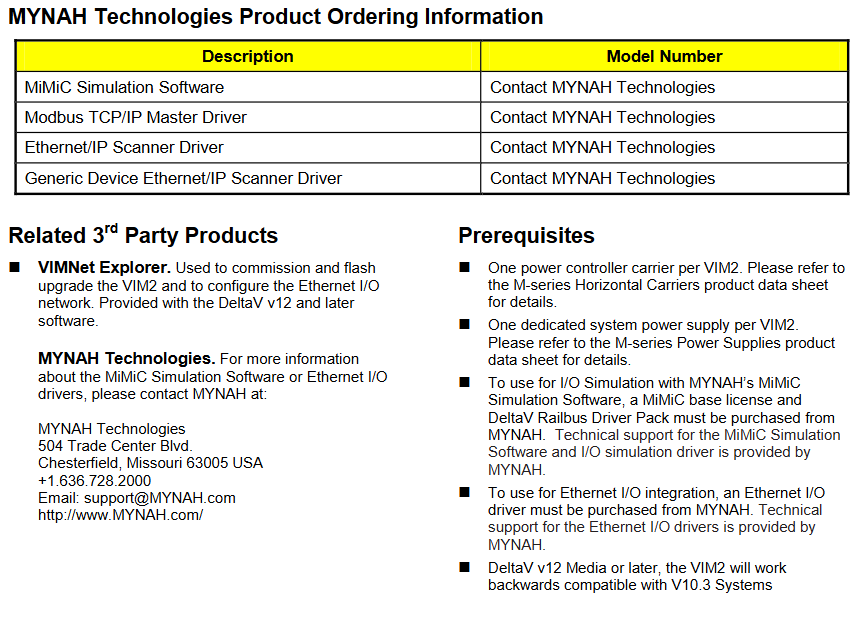
MiMiC simulation software MYNAH Technologies is used for I/O simulation and requires the purchase of both MiMiC basic license and DeltaV Railbus driver package
Modbus TCP/IP Master Driver MYNAH Technologies for Ethernet I/O Integration (Modbus Protocol)
Ethernet/IP scanner driver MYNAH Technologies for Ethernet I/O integration (Ethernet/IP protocol)
Universal Ethernet/IP scanner driver MYNAH Technologies adapts to non-standard Ethernet/IP devices
(3) Installation and software prerequisites
Hardware support: Each VIM2 requires one power/controller carrier (refer to the M-series horizontal carrier data sheet) and one dedicated DeltaV system power supply (refer to the M-series power supply data sheet).
Software version: Supports DeltaV v10.3 and above, and recommends using DeltaV v12 and above (VIMNet Explorer tool provided with this version of software).
Technical Support: The VIM2 hardware is supported by Emerson, while the technical support for MiMiC simulation software and Ethernet I/O drivers is provided by MYNAH Technologies
- OMRON
- ABB
- General Electric
- EMERSON
- Honeywell
- HIMA
- ALSTOM
- Rolls-Royce
- MOTOROLA
- Rockwell
- Siemens
- Woodward
- YOKOGAWA
- FOXBORO
- KOLLMORGEN
- MOOG
- KB
- YAMAHA
- BENDER
- TEKTRONIX
- Westinghouse
- AMAT
- AB
- XYCOM
- Yaskawa
- B&R
- Schneider
- KONGSBERG
- NI
- WATLOW
- ProSoft
- SEW
- ADVANCED
- Reliance
- TRICONEX
- METSO
- MAN
- Advantest
- STUDER
- DANAHER MOTION
- Bently
- Galil
- EATON
- MOLEX
- DEIF
- B&W
- ZYGO
- Aerotech
- DANFOSS
- Beijer
- Moxa
- Rexroth
- Johnson
- WAGO
- TOSHIBA
- BMCM
- SMC
- HITACHI
- HIRSCHMANN
- Application field
- XP POWER
- CTI
- TRICON
- STOBER
- Thinklogical
- Horner Automation
- Meggitt
- Fanuc
- Baldor
- SHINKAWA
- Other Brands
- UniOP
- KUKA
- Iba
- Beckhoff
- ADLINK
-
 VMIC HSDA 332-000111 Scanning Analog-to-Digital Converter Module
 -
 GE VMIC VMIVME1150B VME Module
 -
 FANUC VMIVME3128 VME Digital I/O Board
 -
 GE Fanuc VMIVME-7697-350 VMEbus Single Board Computer
 -
 GE Fanuc VMIVME-4150 PLC Board
 -
 FANUC VMIVME-1160A VMEbus Module
 -
 GE Fanuc VMIVME-4116 VMEbus CPU Processor Controller
 -
 FANUC VMIVME-9300 VMEbus Module
 -
 VMIVME-7589A Pentium VMEbus CPU Board
 -
 GE Fanuc VMIPCI-7767-13100 PCI Board
 -
 GE Fanuc VMIVME-4140 VMEbus Module
 -
 IS415UCVGH1A VME Controller Card
 -
 VMIC VMIVME-1150 VME Circuit Board
 -
 VMIC VMIVME7589 Processor Board
 -
 FANUC VMIVME-2200 VME Circuit Board
 -
 IS215UCVEH2A VME Controller Card
 -
VMIC VMIVME-7589A-446 VMEbus CPU SBC
-
 VMIC VMIVME-7658-330 VME Single Board Computer
 -
 VMIC SEMIVISION OPAL VMEbus CPU Module with VMIVME-7588
 -
GE Fanuc VMIVME-4140 VME Module
-
 Abaco VMIVME 2532A 32-Bit High-Voltage Digital I/O Board – VMEbus
 -
 VMIC VMIVME 100-Pin VME Bus I/O Cables
 -
 VMIC ASSY 11994R13 VMEbus Module
 -
 GE Fanuc VMIVME 1182 VMEbus Input Board – 332-011182-030A
 -
VMIC VMIVME-7589 VMEbus Module with VMIVME-7434
-
 VMIC VMIVME-7588-787 Single Board Computer – 332-250236
 -
 VMIC 7487A VMEbus CPU Board – 332-107487-033 H
 -
 FANUC VMIVME-3125 VMEbus Analog Input Board
 -
 VMIC VMIVME 6015 VMEbus Board – 332-006015-000
 -
 VMIC ASSY 11993R2 VMEbus Module
 -
 Cisco 2851 Router with VMIC2-1MFT-T1/E1 Module
 -
 Applied Materials VMIC 7505 800MHz CPCI SBC
 -
VMIVME-2534-046D 32-Bit High-Voltage Digital I/O Board
-
 VMIC 5530M Optical Extender PCB Board
 -
 GE VMIC XVB602 Control Module
 -
 VMIVME-6005-020 Octal ARINC-429 Controller
 -
 VMIC VMI PCI 3322 Board
 -
 FANUC VMIVME-7487 VME Processor Board
 -
 VMIC 332-800576-000A VMIACC 0576 Module
 -
 VMIC VMIVME-7805-231000 VME Board
 -
 ABACO VMIC VMICBL-000-F3-102 Reflective Memory Cable
 -
 VMIC 332-000131-B VMIVME PCB Card
 -
VMIC 320-250236 with VMIVME-7588 Processor Board
-
 VMIC ASSY 12149 Module
 -
 FANUC VMIC VMIVME5010 I/O PCB Board
 -
 VMIC VMIVME-7698-345 VME Single Board Computer
 -
IS215UCVEH2A VME Controller Card
-
 VMIC VMIVME-7658-330 VME Single Board Computer
 -
 VMIC VMIPCI-5790-000 Dual-Channel Ultra160 SCSI Adapter
 -
 VMIC VMICPCI-7756-460 Single Board Computer
 -
 VMIVME-4920 Dual Channel Digital Converter Board – VMEbus
 -
GE Fanuc VMIVME-4140 VMEbus Module
-
 VMIC VMIPMC-7440 PMC Sound Card
 -
 VMIC PCI 4320 VMEbus Board-333-854320-000
 -
VMIC VMIVME 5530S VMEbus Interface Module
-
 FANUC 332-999995-000 VMEbus PCB Assembly
 -
FANUC VMIVME-4116-030 VMEbus Module
-
VMIC VMIVME-7658-330 VMEbus Single Board Computer
-
VMIC VME-2532A VMIVME2532A-413 Digital I/O Board
-
 VMIC VMIVME-7696-650 VMEbus Processor Board
 -
VMIC VMIVME-7487A Mainframe Board
-
 GE Fanuc VMIVME-2120-175 Digital Output Board
 -
 Abaco VMIVME-4125A-000 System Test Calibration Board
 -
 VMIC VMICPCI-5579 Reflective Memory PCI Board
 -
 FANUC A860-2000-X003 Encoder Interface Module
 -
FANUC 332-999992-000 VME Module
-
 VMIC VMIVME-7698 VME Module
 -
FANUC A860-2000-X003 Encoder Interface Module
-
 VMIC 333-657755-000 B LSC-3 4201 Board
 -
VMIVME-9304 CPU Board with NEC FGA-002A Interface Chip
-
VMIC VMIVME-7805 VMEbus Board – VMIVME-7805-234001
-
VMIC 332-000131-000M01 VMIVME PCB Card
-
 FANUC GE VMIC VMIVME 2510B Digital I/O Board
 -
 VMIC VMIPMC-5795-000 PMC Ultra160 SCSI Adapter
 -
GE Fanuc VMIVME 5588 High-Speed Reflective Memory Board
-
 VMIC VMIVME 4132 VMEbus Analog Output Board
 -
 VMIC VMIVME-3418 8-Channel Strain Gauge and RTD Board
 -
 VMIC VMIPMC-5797-000 Ultra320 SCSI Host Bus Adapter
 -
 VMIC VMIACC 0562 Accessory Module
 -
Abaco VMIVME 4116 8-Channel 16-Bit Analog Output Board
-
 VMIC VMIVME 4512 Analog I/O Board – 332-004512-300
 -
 VMIC VMIVME 4120 VMEbus Circuit Board – 332-004120
 -
 VMIC VMIVME-3801-100C Analog-to-Digital Converter Module
 -
IS215UCVEH2AE VME Controller Card
-
 FANUC 333-00DMA0-000 VME Module
 -
GE Fanuc VMIVME-5588-200 High-Speed Reflective Memory Card
-
VMIC VMIVME-7696-650 VMEbus Single-Board Computer
-
 GE Fanuc VMIVME-5532S VMEbus Fiber-Optic Repeater Link
 -
 VMIC GE EV-DIO-01 Control Board
 -
 Abaco VMIVME-7751 Pentium III VME Single Board Computer
 -
 PMC-5565PIORC-110000 128MB Reflective Memory Card
 -
 Abaco VMIVME-5565-010000 Reflective Memory Board
 -
 VMIC VMIPMC-5565 Reflective Memory PMC Module
 -
 VMIC VMIVME 5504 Slave VME Module
 -
 VMIC VMIVME-5740-12000 VMEbus Hard Drive Module
 -
 VMIC VMIVME-7751 VMEbus Processor Module
 -
VMIC VMIVME-7588 CPU Module
-
 VMIC 332-000132 VMIVME PCB Card
 -
 GE Fanuc VMIVME-4514A Analog I/O Board
 -
 Abaco VMIVME-2528-000 128-Bit TTL Digital I/O
 -
 VMIC VMIVME 4514 Scanning Analog I/O Board
 -
 VMIPCI 5588-101 High Speed Fiber Optic Reflective Memory Card
 -
 VMIC VMIVME-1228 VMEbus Board
 -
 VMIC VMIVME-7455 CD-ROM Drive Module
 -
 VMIC VMIACC 0577 Compact PCI Board
 -
IS415UCVGH1A VME Controller Card
-
 VMICPMC-5664 VME PMC Dual Fiber Card
 -
VMIVME1128 128-Bit High-Voltage Digital Output Board
-
VMIC VMIVME-2170A VMEbus PCB Board
-
VMIC 332-015565-010L VME Module
-
 VMIC VMICPCI-7612-470 Single Board Computer
 -
 VMIC EV-CNT/01 Control Board
 -
 VMIC VMIVME 1181 VMEbus Input Board – 333-001181-000 A
 -
VMIC VMIVME-1150 VMEbus Module
-
 VMIC VMIVME-5576 VMEbus Module
 -
 VMIC VMIVME-4150 VMEbus Module
 -
 VMIC VMIOMAX-8001B PLC Rack
 -
 VMIC VMIVME 2128 High-Voltage Digital Output Board
 -
VMIC VMIVME-1111 64-Bit High-Voltage Digital Input Board
-
GE Fanuc VMIVME 1182 VMEbus Input Board – 332-011182-060C
-
 VMIC VMIVME-7696 VMEbus PC Board
 -
 VMIC VMIVME-7686 VMEbus Module
 -
 GE VMIVME-7486 VME PCB Board
 -
VMIC VMIVME-7740-840 Processor Module
-
 VMIC VMIACC BT01 REV 0 Transition Board
 -
 Abaco VMIPCI-5576-001 Fiber-Optic Reflective Memory Card
 -
 GE IS215UCVGH1A VME Controller Card
 -
VMIVME 7671-421000 VME Module


