
How to install Hirschmann MS20/MS30 series industrial Ethernet switches?
How to install Hirschmann MS20/MS30 series industrial Ethernet switches?
Overview
The installation user manual for Hirschmann MS20/MS30 series industrial Ethernet switches (Release 14 03/2023 version) covers four major modules: equipment overview, safety specifications, installation process, basic configuration, maintenance, and technical parameters. It provides detailed instructions on the hardware composition of the equipment (basic module, media module, SFP transceiver, etc.), installation steps (DIN rail installation, wiring, DIP switch configuration), safety compliance requirements (ATEX, IECEx and other hazardous environment certifications), and technical parameters (power supply range of 18-60V DC, working temperature -40 ℃~+70 ℃, port type supporting 10/100/1000Mbit/s twisted pair/fiber ports). It also offers a global technical support channel to provide comprehensive guidance for equipment deployment and operation in industrial scenarios.
Preparation before installation( ✅ Complete one and check one
Inspection item operation content verification standard remarks
1. Check the integrity of the packaging: basic module x 1, terminal block (4-pin x 2/6-pin x 1), label x 1, installation manual x 1. There are no missing or damaged items during transportation (such as shell deformation or port damage). If accessories are missing, contact the supplier for replacement
2. Equipment model matching confirmation: The product code is consistent with the requirements (key verification: number of ports, temperature range, power supply range). The 6th and 7th digits of the code are equal to the required number of ports (08/16/24); 10th position=temperature range (S/T/E); 11th position=Power supply range (A/C/E) Example: MS30-1602-T-C-H corresponds to 16 100Mbps+2 1G, -40~70 ℃, 18-60V DC
3. Installation environment confirmation: 1. Environmental temperature: meets the equipment temperature level (S: 0~60 ℃; T/E:-40~70℃); 2. Installation location: well ventilated, with a reserved space of ≥ 10cm above and below; 3. Hazardous environment: If it is an explosion-proof scenario, the equipment needs to be labeled with ATEX/IECEx. The environment should be free of condensation and strong electromagnetic interference; Dangerous environments must meet Class I Division 2/ATEX 2G requirements and avoid installation near heat sources (such as frequency converters) or areas with high dust
4. Essential tools and materials preparation: Phillips screwdriver, crimping pliers, wire stripping pliers; Materials: Cat5e and above twisted pair cables, fiber optic jumpers (matching port types), copper wires (≥ 1.5mm ²), and cable tie wires that meet specifications (75 ℃ copper wires); The type of fiber optic jumper is the same as SFP (such as LC single-mode jumper with SM SFP). Explosion proof tools are required for hazardous environments
5. Power supply preparation: Confirm that the power supply meets the requirements: 1 Voltage range (A: 18-32V DC; C/E: 18-60V DC); 2. Redundant power supply requires 2 independent power sources; 3. Class 2 power supplies with overcurrent protection (compliant with equipment fuse specification: 5A) are required in North America. DC power supplies need to distinguish between positive and negative poles, while AC power supplies need to be isolated and grounded
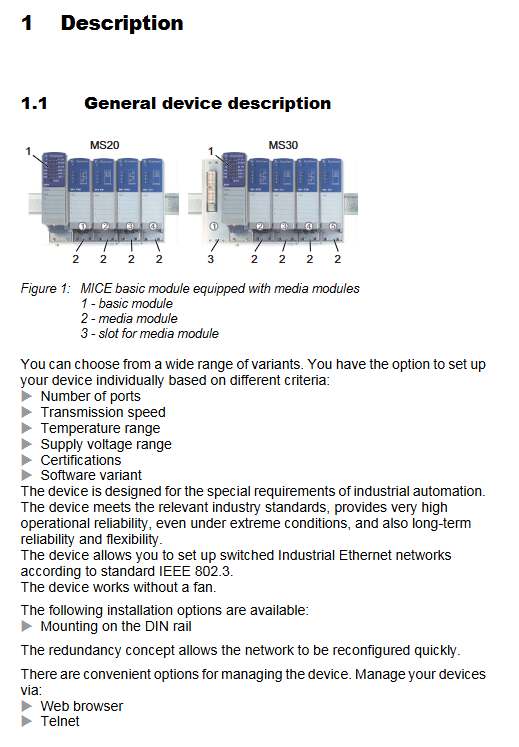
Hardware installation process (operated in sequence)
(1) Installation of media module/SFP transceiver
Common errors in step operation content verification standards
1. Remove the protective cap of the media module/SFP. The protective cap should not be damaged, and the port should be free of dust/metal debris. It is forbidden to touch the end face of the fiber optic port with hands
Align the basic module slot and insert the media module. Tighten the four corner screws to fully secure the module buckle. If the screws are not loose, install the module in the order of "left to right" to avoid slot misalignment
3 SFP transceivers are inserted into the gigabit slot, and the locking buckle makes a "click" sound when closed, making it difficult to easily remove. Only Hirschmann original SFP is used (third-party SFP may not be compatible)
(2) DIN rail installation
Step operation content verification standard safety precautions
1. Slide the top buckle of the device to a 35mm DIN rail (compliant with DIN EN 60715) and ensure that the buckle fully fits the rail without any looseness. The rail should be securely fixed to prevent the device from shaking
Press the bottom lock of the device and confirm that the device is fixed. Pull the device firmly without displacement. During installation, avoid squeezing the port and terminal block
(3) Grounding operation
Key requirements for step operation content verification standards
1. Choose grounding method: ① DIN rail grounding (priority); ② Special grounding screw grounding resistance ≤ 4 Ω. In hazardous environments, dual grounding (rail+screw) is required
If using screws for grounding, connect the grounding wire (with the same specifications as the power supply wire) and ensure that the grounding wire is not loose and in good contact with the shell. The grounding wire should not be laid in the same bundle as the power wire
(4) DIP switch configuration (selected by application scenario)
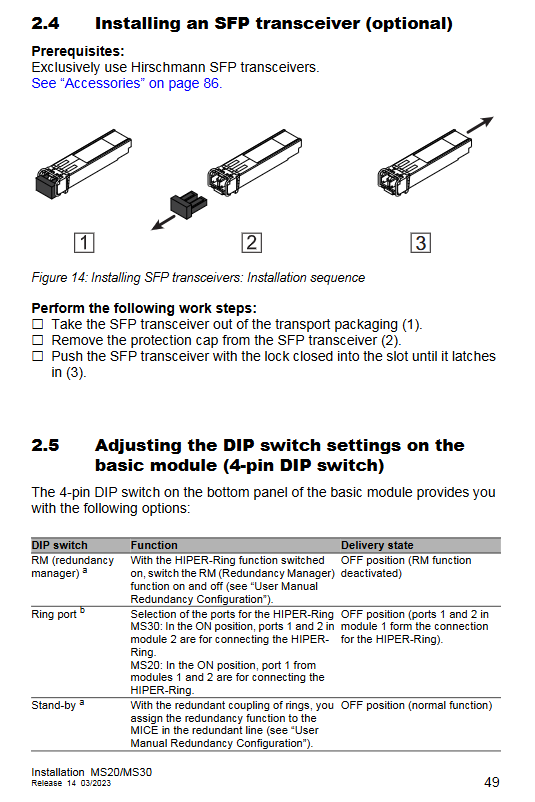
Application scenario 4-pin DIP switch setting (MS20/MS30 basic module) 3-pin DIP switch setting (MS20/MS30-... E...) verification standard
Normal scenario (no redundancy/coupling) 1 (RM): OFF; 2(Ring port):OFF; 3(Stand-by):OFF; 4 (configuration priority): OFF 1 (RM): OFF; 2(Ring port):OFF; 3 (Stand by): Turn the OFF switch to the corresponding position and there is no half turn state
HIPER Ring Redundancy (Ring Network) 1 (RM): ON; 2 (Ring port): OFF/ON (according to ring port requirements); 3(Stand-by):OFF; 4 (configuration priority): OFF 1 (RM): ON; 2(Ring port):OFF/ON; 3 (Stand by): OFF ring port selection: OFF=module 1 port 1-2; ON=Module 2 Port 1-2
Redundant coupling (dual switch) 1 (RM): OFF; 2(Ring port):OFF; 3(Stand-by):ON; 4 (configuration priority): OFF 1 (RM): OFF; 2(Ring port):OFF; 3 (Stand by): ON coupling port automatic allocation: MS20=module 1 port 3 (control)/4 (coupling); MS30=Module 2 Port 3/4
Software configuration priority 1-3: set as needed; 4 (configuration priority): ON 1-3: set as needed; Three key full ON=software configuration software configuration priority higher than DIP switch, suitable for flexible adjustment of scenarios
Wiring operation (power+signal+data)
(1) Power wiring (of utmost importance, avoid reverse connection)
Terminal type wiring steps verification standard safety precautions
4-pin terminal (MS20/MS30-... A.../C...) 1. Peel off the insulation layer of the wire (about 6mm); 2. P1 terminal: 1=+24V, 2=0V; P2 terminal: 1=+24V, 2=0V; 3-4=Signal contact 1. Positive and negative poles are not reversed; 2. The wire is tightly pressed without looseness; When using redundant power supply, P1/P2 should be grounded to the negative pole when connected to different DC power sources; Shielded wires are required for hazardous environments
6-pin terminal (MS20/MS30-... E...) 1.1=+24V (P1), 6=+24V (P2); 2=signal contact 1, 5=signal contact 2; 3-4=0V 1. There is no short circuit between the power supply and signal contacts; 2. The 0V terminal is connected together and well grounded. The 6-pin terminal integrates power and signal, and needs to be wired according to the pin definition
(2) Signal contact wiring (optional)
Step operation content verification standard purpose
The signal contact (3-4 pins) is connected to external monitoring equipment (such as PLC input). The contact is a potential free relay, which is in a normal closed state and an alarm when disconnected. It is used for remote monitoring equipment faults (such as power interruption, port link faults)
(3) Data cable wiring
Port type wiring steps verification standard remarks
Twisted pair port (RJ45/M12) 1. Peel off the insulation layer of the twisted pair (about 10mm) and press the wire according to T568B standard; 2. Insert the RJ45/M12 connector and tighten the nut. 1. The wire sequence is correct (orange white orange green white blue blue blue white green brown); 2. Wireless crosstalk, securely crimped PoE ports require 4 pairs of twisted pair cables to avoid using 2 pairs of cables
Fiber optic port (LC/ST/DSC) 1. Clean the fiber optic jumper end face (using specialized cleaning paper); 2. Insert the fiber optic port and tighten the nut (ST) or clamp (LC). 1. The end face should be free of stains/scratches; 2. After insertion, there should be no looseness, and gently pulling should not detach. It is forbidden to look directly at the fiber optic port (to avoid laser damage to the eyes)
AUI port (Sub-D 15 pin) is connected to the AUI cable according to the pin definition (1=shield, 2=output, 3=input, 6=GND, 13=12V). The shielding layer is well grounded and the pins are not connected incorrectly. It is only used for connecting 10Mbit/s devices and needs to be matched with an AUI transceiver
Final inspection before power on( ✅ Select all options to power on)
Verification standard for inspection item operation content
1. Wiring review: 1. The positive and negative terminals of the power supply are not reversed; 2. The data cable sequence is correct and there are no short circuits; 3. The grounding is good. Use a multimeter to measure the power terminal: there is no short circuit between the positive and negative poles; Twisted pair cable has no abnormal conductivity
2. Verify the DIP switch position again according to the application scenario, and ensure that the switch is fully turned to the ON/OFF position without any looseness
3. Equipment status: 1. The shell is not damaged; 2. The port is not blocked by foreign objects; 3. Install the media module/SFP in place, tighten the module screws, and close the SFP latch
4. Environmental safety: 1. Hazardous environment: well ventilated and free of flammable and explosive gases; 2. Ordinary environment: no condensation, no water accumulation, hazardous environment must meet explosion-proof level requirements
Power on and functional verification (operated in sequence)
Steps, operation content, normal status, abnormal handling
1. Power on and connect the power supply (for redundant power supply, connect P1 first, then P2). 1. P1/P2 LED green light is always on; 2. RUN LED flashes green (system starts, about 60 seconds). If P1/P2 LED does not light up, check the power supply voltage/wiring
2. System startup verification waits for the RUN LED to turn green and remain on, indicating that the system is ready; Flashing=Starting; Not lit=system failure startup failure (RUN LED not lit), still abnormal after power failure and restart, contact technical support
3. Port status verification 1. Connect terminal devices (such as PCs/switches); 2. Press the "SELECT" button for ≥ 2 seconds to switch to the "L/D" mode. The port LED green light remains on, indicating link establishment; Flashing=No link for data transmission (LED not lit): Check cable/terminal device port
4. Redundancy function verification (if HIPER Ring is configured) 1. After the ring network connection is completed, the RM LED green light remains on; 2. Disconnect one ring link, RM LED turns yellow and stays on, RM LED green=redundant ready; Yellow light=Redundant activation (link failure) No redundant switching: Check ring port configuration/DIP switch position
5. Initial login verification: 1. Log in to the device through V.24/WEB; 2. Successfully logged in by entering the default account (admin/private), but the system prompts that changing password login failed: check IP configuration (default DHCP get) or password input error
Common troubleshooting (quickly locate by phenomenon)
Possible causes of malfunction, troubleshooting steps, and solutions
1. P1/P2 LED does not light up after power on. 1. The power supply voltage exceeds the range; 2. Connect the positive and negative poles of the power supply in reverse; 3. Poor terminal contact; 4. Power failure: 1. Measure the power supply voltage with a multimeter (must comply with 18-32/60V DC); 2. Check the terminal wiring and re tighten it; 3. Replace the power supply for testing. 1. Adjust the power supply voltage to the compliant range; 2. Correct the positive and negative wiring; 3. Replace the faulty power supply
2. RUN LED flashes and then goes out. 1. System startup failed; 2. Hardware failure (such as media module not installed properly) 1. Reinstall the media module/SFP after power failure; 2. Disconnect all external connections, keep only the power supply, power on for testing. 1. Ensure that the module is installed properly; 2. Still failed, contact technical support to return to the factory for maintenance
3. Port without link (LED not lit) 1. Data cable failure; 2. Terminal device port failure; 3. The port is disabled; 4. Automatic negotiation shutdown: 1. Replace the cable for testing; 2. Connect to other terminal device ports; 3. Enable ports through CLI/WEB; 4. Confirm that the automatic negotiation of the port has been activated. 1. Replace the qualified cable; 2. Repair terminal device ports; 3. Enable port: CLI command "no shutdown interface<port>"
4. Redundancy function not effective (RM LED not lit) 1. DIP switch RM key not turned ON; 2. Ring port configuration error; 3. The ring network is not closed. 1. Check the position of the DIP switch RM key; 2. Confirm that the ring ports are two consecutive ports (such as module 1 ports 1-2); 3. Check the ring network connection to ensure it is closed. 1. Turn the RM key to ON. 2. Reconfigure the ring port; 3. Closed loop network link
5. Unable to log in to device 1. IP address acquisition failed (DHCP not responding); 2. Password error; 3. Disable WEB/Telnet services. 1. Manually configure IP (CLI command "network parms<IP><subnet mask><gateway>"); 2. Restore default password (via System Monitor); 3. Enable WEB/Telnet (CLI command "ip http server" "transport input telnet") 1. Ensure that the device is on the same network segment as the PC; 2. Change the default password immediately after restoring it; 3. Enable management services
6. PoE port is not powered (terminal device does not start) 1. PoE module is not powered; 2. The terminal device does not comply with IEEE 802.3af; 3. The PoE port is disabled. 1. Check the external power supply (48V DC) of the PoE module; 2. Confirm that the terminal device is PoE Class 0-3; 3. Enable PoE port through WEB 1. Connect the PoE module for power supply; 2. Replace terminal devices that meet the standards; 3. Enable PoE port: WEB path "Basic Settings → PoE → Port Enable"
7. There is no data transmission at the fiber optic port. 1. The type of fiber optic jumper does not match (multimode/single-mode hybrid); 2. Fiber end face contamination; 3. Transmission distance exceeds the limit. 1. Confirm that the SFP and jumper types are consistent (MM SFP with multimode jumper); 2. Clean the end face with specialized cleaning paper; 3. Check the transmission distance (e.g. maximum 25km for SM SFP). 1. Replace the matching fiber optic jumper; 2. Clean the end face; 3. Shorten transmission distance or replace long-distance SFP
Closing work after installation completion
Operation Item Operation Content Remarks
1. Label pasting: Paste the filled in labels (device name, IP address, MAC address) onto the front of the device with clear and visible labels for easy maintenance in the future
2. Cable organization uses zip ties to secure cables, avoiding cable pulling on terminals/ports. Explosion proof zip ties are required in hazardous environments, and cables should be routed away from power lines
3. Configuration saving: 1. After completing basic configurations such as IP/ports; 2. Configure not to save through WEB "Basic Settings → Load/Save → Save to Device" or CLI command "Copy Running config startup config", which will be lost after power failure
4. Document retention: Archive and retain installation manuals, product codes, and IP configuration information for easy troubleshooting and maintenance in the future

- OMRON
- ABB
- General Electric
- EMERSON
- Honeywell
- HIMA
- ALSTOM
- Rolls-Royce
- MOTOROLA
- Rockwell
- Siemens
- Woodward
- YOKOGAWA
- FOXBORO
- KOLLMORGEN
- MOOG
- KB
- YAMAHA
- BENDER
- TEKTRONIX
- Westinghouse
- AMAT
- AB
- XYCOM
- Yaskawa
- B&R
- Schneider
- KONGSBERG
- NI
- WATLOW
- ProSoft
- SEW
- ADVANCED
- Reliance
- TRICONEX
- METSO
- MAN
- Advantest
- STUDER
- DANAHER MOTION
- Bently
- Galil
- EATON
- MOLEX
- DEIF
- B&W
- ZYGO
- Aerotech
- DANFOSS
- Beijer
- Moxa
- Rexroth
- Johnson
- WAGO
- TOSHIBA
- BMCM
- SMC
- HITACHI
- HIRSCHMANN
- Application field
- XP POWER
- CTI
- TRICON
- STOBER
- Thinklogical
- Horner Automation
- Meggitt
- Fanuc
- Baldor
- SHINKAWA
- Other Brands
- UniOP
- KUKA
- Iba
- Beckhoff
- ADLINK
-
 Sigmatek MDD111-1 DIAS Drive Axis Module
 -
 Sigmatek DKL042 05-024-042 Terminal Module
 -
 Sigmatek DM822 Control Module
 -
 Sigmatek CDM167 12-008-167-O Module
 -
 Sigmatek TAE151 Touch Display Unit
 -
 Sigmatek DCC041 SLIDES Module 05-700-041-D
 -
 Sigmatek AKM65M-ANC2GBB0 PM Servo Motor
 -
 Sigmatek ETT221 01-230-221 Operator Terminal
 -
 Sigmatek SLIDES DAM 124 Analog Module
 -
Sigmatek AKM31C-ANCNGBB0 Servo Motor
-
 Mannesmann Demag Sigmatek CP626 Central Unit
 -
 SIGMATEK 0332.554.03 Board 371071000154
 -
 SIGMATEK 12-250-021 Base Plate Back Panel CM5V020
 -
 SIGMATEK DM162 S-DIAS Digital Mix Module
 -
 DEMAG ERGOTECH 061 381 66 Sigmatek 9842.243.02 Circuit Board
 -
 SIGMATEK CP313-1 PLC Module
 -
Sigmatek ETV0551-2 VARAN Touch Terminal
-
 Sigmatek SDM 081 FS S-Dias Safety Module
 -
 DEMAG 05-250-023 Ergotech Motherboard with Sigmatek TMS012
 -
Sigmatek CM5V020 12-250-023-K Wiring Base
-
 Sigma Tek 5000B-37 Attitude Gyro Indicator
 -
 Sigmatek SDD120-2 DIAS Drive
 -
 Sigmatek CME221 Memory Module
 -
 Sigmatek DCP640 DIAS Central Unit
 -
 Sigmatek STO040 Safety Output Module
 -
Sigmatek CET281 Control Panel
-
 Sigmatek CIPC LX800 Demag NC5 CPU
 -
 Sigmatek DKL093 05-024-093 Terminal Module
 -
 Sigmatek AI088 20-009-088 Analog Input Module
 -
Sigmatek CAI888 Analog Input Module
-
SIGMATEK CCA021 12-025-021 Analog Output Module
-
SIGMATEK 1104.579.05 Control Module
-
SIGMATEK SDI100 Digital Input Module
-
 SIGMATEK C-IPC 256MB LX800 Compact Dias
 -
 SIGMATEK 9423.090.02 Control Module
 -
SIGMATEK C-IPC 256 Power Supply 148498
-
 SIGMATEK CAI025 Analog Input Module
 -
 SIGMATEK CTO166 Digital Output Module
 -
 SIGMATEK CP112 20-004-112 Processor Module
 -
SIGMATEK CAI887 12-009-887 Safety Module
-
 Sigma-Tek 4000B-31 Directional Gyro 1U262-002-42
 -
Sigmatek C-IPC 256MB LX800 IPC Controller
-
Sigmatek C-IPC 01-450-031 Industrial PC LX800
-
Sigmatek C-IPC 256 Industrial PC Controller
-
Sigmatek CCP-531 PLC Processor Module
-
Sigmatek CDI163 Digital Input Module
-
 Sigmatek ETV0501 VARAN Terminal 12-230-0501
 -
 Sigmatek CTMS020 C-DIAS Technology Module
 -
 Sigmatek CIV512 VARAN Switch Module
 -
 Sigmatek HU011 20-080-011 Interface Module
 -
SIGMATEK SLIDES DAM 124 Module
-
 SIGMATEK C-IPC 161 01-450-161L Industrial PC
 -
SIGMATEK C-IPC 128MB VIA 733MHz 01-450-024-K
-
 SIGMATEK 12-780-012 R8-IPC Geode LX800 Module
 -
SIGMATEK CAM124 Analog Module
-
 SIGMATEK S1 032-8AF61-R4 EZ Servo Motor
 -
 SIGMATEK CTO163 Digital Output Module
 -
 SIGMATEK CCP082 12-004-082 Processor Module
 -
 SIGMATEK CRCH081 C-DIAS Temperature Module
 -
 SIGMATEK PC322-K 01-310-322-K Industrial PC
 -
SIGMATEK SDD310-2 Servo Drive
-
 SIGMATEK AI084 Analog Input Module
 -
SIGMATEK CRCH081 12-752-081 Temperature Module
-
Sigma-Tek 5000L-4 Attitude Gyro 1U284-001-3
-
 SIGMATEK CM5V020 12-250-023-K Wiring Module
 -
Sigma-Tek 4000H-6 Directional Gyro IU262-035-7
-
 SIGMATEK Dias DCP160 05-004-160 Processor Module
 -
SIGMATEK 0147.395.02 Control Module
-
SIGMATEK A1084 Control Module
-
SIGMATEK DI200 20-006-2000 Digital Input Module
-
Sigmatek DNC115 Encoder Module
-
 Sigmatek DAM122 05-017-122 Analog Module
 -
Sigmatek 9802.289.01 Control Board TA71 Display
-
Sigmatek TO127 20-007-127 Digital Output Module
-
Sigmatek DNC031 05-011-031 Digital Module
-
Sigmatek VI022 20-003-022 Interface Module
-
Sigmatek CAI085 Analog Input Module
-
 Sigmatek CP111 S-DIAS CPU Module
 -
Sigmatek CTMS030 Krauss Maffei Module
-
 Sigmatek CAM123 Control Module
 -
 Sigmatek TAE732-P 01-240-732-P Touch Display Unit
 -
Sigmatek MDM021 Digital Mixed Module
-
Sigmatek DCP642 DIAS Central Unit
-
 Sigmatek CST022 12-014-022 C-DIAS Module
 -
 Sigmatek SRO021 20-893-021 Safety Relay Output
 -
 Krauss Maffei MC5 Control System Sigmatek
 -
 Sigmatek DC061 Module 18-24VDC 300mA
 -
 Herrmann EVT0855 Ultrasonic Welder Touch Panel
 -
Sigmatek CIV521 Control Module 1.4A 2W
-
Sigmatek DDI61 05-006-161 Digital Input Module
-
SIGMATEK ETT312-E Touch Terminal 01-230-312
-
Cessna S3326-1 Sigma Tek 5000B-67 Gyro 1U149-015-9
-
SIGMATEK PS101 Power Supply Module
-
SIGMATEK 0332.554.03 Control Module 371071000154
-
 SIGMATEK ETT312-E Touch Terminal 01-230-312
 -
SIGMATEK CDM163 Control Module
-
 SIGMATEK VSV046 16-023-046 Module
 -
SIGMATEK AM221 20-017-221 Analog Module
-
SIGMATEK CTS051 12-053-051 Control Module
-
SIGMATEK AM221 20-017-221 Analog Module
-
Sigmatek CSDI161 12-891-161 Safety Input Module
-
Sigma Tek 4000C-1 Directional Gyro Indicator
-
Sigmatek ETV0501 12-230-0501 VARAN Terminal
-
Sigmatek DDM165 SLIDES Module
-
Sigmatek N100 20-011-100 Control Module
-
Sigmatek AKM54K-ANC2R-B0 PM Servo Motor
-
Sigmatek CTO166 Digital Output Module
-
Sigmatek CP212-K 20-004-212-K CPU Module
-
Sigmatek CDI161 Digital Input Module
-
Sigmatek DCC080 05-700-080-2 Control Module
-
 SIGMATEK SCP011 S-DIAS Safety CPU
 -
SIGMATEK SCP011 S-DIAS Safety CPU
-
SIGMATEK SRO022 Relay Output Module
-
SIGMATEK MDD 121 Drive Axis Module
-
SIGMATEK DSI021 SLIDES Siemens Interface
-
SIGMATEK DIAS DCP161 Module 05-004-161
-
 Sigmatek ETT312 Built-in Touch Terminal
 -
SIGMATEK DCP 643 DIAS Controller System
-
SIGMATEK CIO021 Multi I/O Module
-
SIGMATEK CTMS020 Control Module
-
 Sigmatek CME 221 Memory Module
 -
Sigmatek 0420.615.01 Control Board
-
Sigmatek CP111 20-004-111 CPU Module
-
Sigmatek 9405.065.03 Control Board
-
Sigmatek ETEK 01-450-032-K C-IPC 256MB Industrial PC
-
Sigmatek CTO163 12-007-163 Safety Output Module
-
Sigmatek TO081 20-007-081 Digital Output Module
-
 Sigmatek SI021 20-022-021 Safety Input Module


