
YASKAWA SGMCS series direct drive servo motor
YASKAWA SGMCS series direct drive servo motor
Core positioning
The YASKAWA SGMCS series directly drives servo motors and SGDS/SGDH series servo amplifiers, providing full process guidance for high-precision industrial equipment design. The core focus is on the three major advantages of high torque, high precision, and no backlash of gearless direct drive technology, covering product lineup, technical parameters, system configuration, wiring specifications, peripheral equipment selection, and order reference in detail. It is suitable for high-precision application scenarios such as semiconductor manufacturing, LCD panel production, electronic component assembly, and IC testing, helping engineers achieve equipment miniaturization, high performance, and low maintenance design.
Product System and Model Interpretation
(1) Servo motor (SGMCS series)
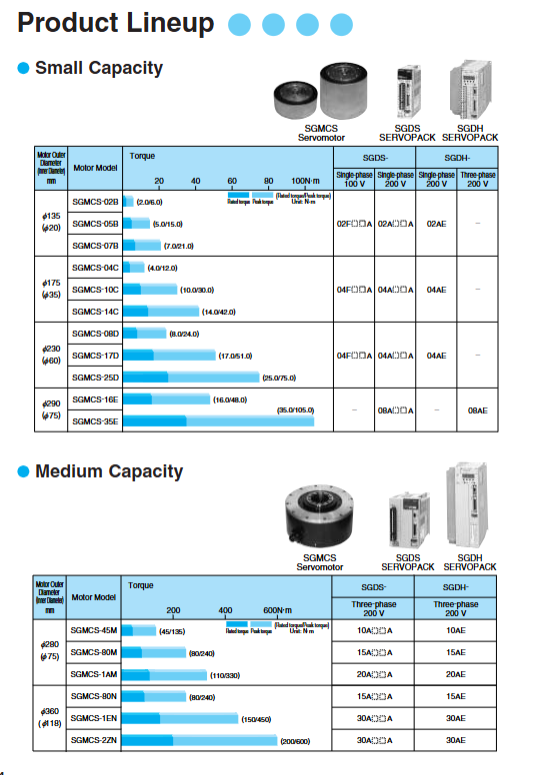
1. Product classification and core specifications
Capacity level, outer diameter specification (mm), model series, rated torque (N · m), peak torque (N · m), rated speed (min ⁻¹), maximum speed (min ⁻¹), rotor moment of inertia (kg · m ² × 10 ⁴)
Small Capacity 135 (Type B) 02B/05B/07B 2.0/5.0/7.0 6.0/15.0/21.0 200 500 28/51/77
175 (Type C) 04C/10C/14C 4.0/10.0/14.0 12.0/30.0/42.0 200-300 300-500 77/140/220
230 (D-type) 08D/17D/25D 8.0/17.0/25.0 24.0/51.0/75.0 150-200 250-500 285/510/750
290 (Type E) 16E/35E 16.0/35.0 48.0/105.0 150-200 250-500 930/1430
Medium capacity 280 (M-type) 45M/80M/1AM 45.0/80.0/110.0 135.0/240.0/330.0 150 300 388/627/865
360 (N-type) 80N/1EN/2ZN 80.0/150.0/200.0 240.0/450.0/600.0 150 250-300 1360/2470/3060
2. Model coding rules (taking SGMCS-04C3C11 as an example)
SGMCS: Identification of Direct Drive Servo Motor Series
04: Rated torque 4N · m
C: Motor outer diameter specifications (B=135mm, C=175mm, D=230mm, E=290mm, M=280mm, N=360mm)
3: Encoder type (3=20 bit absolute type (standard), D=20 bit incremental type (optional))
C: Installation flange specifications (1=no brake+drive end C-face, 3=no brake+non drive end C-face, 4=no brake+side outlet)
11: Design version number
3. Key characteristics
Accuracy configuration: 20 bit absolute encoder (standard), resolution 1048576 P/R, absolute accuracy ± 15 seconds, repeat positioning accuracy ± 1.3 seconds
Structural design: Fully enclosed self cooling (IP protection level), hollow shaft structure (compatible with wiring/piping), lightweight aluminum alloy shell
Environmental adaptation: working temperature 0-40 ℃, storage temperature -20-70 ℃, relative humidity 20% -80% (no condensation), vibration level V15
Electrical characteristics: Insulation level A (small capacity)/F (medium capacity), insulation resistance ≥ 10M Ω (500VDC), withstand voltage 1500VAC/1 minute
(2) Servo amplifier (SGDS/SGDH series)
1. Product classification and adaptation scope
Amplifier series power supply specifications, motor capacity, continuous output current (Arms), maximum output current (Arms), control mode, core functions
SGDS single-phase 100VAC small capacity (B/C/D type) 2.1-2.8 6.5-8.5 position/speed/torque control electronic gear, encoder frequency division, basic I/O control
Single phase 200VAC small capacity (B/C/D/E type) 2.1-11.6 6.5-28.0 Position/Speed/Torque Control Electronic Gear, Regenerative Resistance Connection, Fault Alarm
SGDH single-phase/three-phase 200VAC full capacity (B/C/D/E/M/N type) 2.1-24.8 6.2-56.0 position/speed/torque control (extended function) self-tuning, harmonic suppression, RS422 communication
2. Model coding rules (taking SGDS-02A01A as an example)
SGDS/SGDH: Identification of servo amplifier series (SGDH supports extended functions)
02: Maximum adaptive motor capacity (02=0.2kW, 04=0.4kW, 08=0.75kW, etc.)
A/F: Supply voltage (A=200VAC, F=100VAC)
01: Interface Specification (01=Standard Type: Analog Voltage/Pulse Reference)
A: Design version number
Core technical parameters and performance advantages
(1) Key performance indicators
Performance category specific parameter notes
Torque characteristics Rated torque: 2-200N · m; Peak torque: 6-600N · m Medium capacity models support long-term constant torque output
Speed characteristics Rated speed: 150-200min ⁻¹; Maximum speed: 250-500min ⁻¹ Low speed and high torque characteristics, no reduction mechanism required
Absolute positioning accuracy ± 15 seconds, repeated positioning accuracy ± 1.3 seconds, no gear backlash, and a 30% increase in positioning response speed
Control accuracy speed control range 1:5000, load regulation rate ± 0.01% (rated speed) suitable for high-precision speed/position control scenarios
Dynamic response rated angular acceleration of 170-1280 rad/s ² for quick start stop, reducing equipment cycle time
(2) Core technological advantages
Gearless direct drive design: eliminates backlash and slippage issues in gear transmission, improves positioning accuracy by over 50%, while reducing mechanical wear and maintenance without lubrication
High resolution encoding: 20 bit absolute encoder (1048576 P/R), supports multi turn data recording, meets micrometer level positioning requirements
Compact structure and layout: The motor is directly coupled with the load, saving installation space for the gearbox and reducing equipment volume by 20% -30%
Low noise and low-noise operation: No gear meshing noise, operating noise ≤ 60dB, suitable for low-noise environments such as clean rooms and laboratories
Multiple protection mechanisms: The motor side supports over temperature and over current protection; The amplifier side supports 10+protection functions such as overvoltage, undervoltage, overload, encoder error, etc
System configuration and wiring specifications
(1) System composition architecture
The complete system should include: SGMCS servo motor+SGDS/SGDH servo amplifier+peripheral devices (circuit breakers, filters, contactors, etc.)+connecting cables (power/SGMCS servo motor+SGDS/SGDH servo amplifier+peripheral devices (circuit breakers, filters, contactors, etc.)+connecting cables (power/encoders/I/O)
Power supply circuit: three-phase/single-phase power supply → MCCB (molded case circuit breaker) → noise filter → electromagnetic contactor → servo amplifier main circuit terminal
Control circuit: host controller → servo amplifier CN1 (I/O signal) → servo motor CN2 (encoder signal)
Auxiliary circuit: Regenerative resistor (optional), DC reactor (harmonic suppression), surge absorber
(2) Key wiring requirements
1. Main circuit wiring (power circuit)
Terminal definitions: amplifier L1/L2/L3 (power input), U/V/W (motor output), B1/B2 (regenerative resistor), FG (ground)
Cable specifications: AWG20 (0.5mm ²) for small capacity motors, AWG16 (1.25mm ²) for medium capacity motors, grounding cable cross-section ≥ 2.0mm ²
Grounding requirements: independent grounding, grounding resistance ≤ 100 Ω (200V system), motor FG terminal directly connected to amplifier FG terminal
2. Control circuit wiring (signal circuit)
Connector signal type core terminal functional wiring specification
CN1 (amplifier) I/O signal speed reference (V-REF), torque reference (T-REF), position pulse (PULS/IGN), servo ON (/S-ON) shielded twisted pair, with a maximum length of 3m and a distance of ≥ 30cm from the power cable
CN2 (amplifier) encoder signal encoder power supply (PG5V/PG0V), serial data (PS//PS), frame grounding (FG) shielded twisted pair, up to 50m, shielding layer single ended grounding (amplifier side)
Motor side connector power signal U/V/W (phase line), FG (chassis grounding) dedicated power cable (JZSP-CMM series), to avoid loose joints
3. Typical wiring diagram example
Single phase 200V system (SGDS amplifier+small capacity motor): L1/L2 connected to single-phase power supply, B1/B2 connected to regenerative resistor, CN1 connected to control signal, CN2 connected to encoder, motor U/V/W corresponding to amplifier output
Three phase 200V system (SGDH amplifier+medium capacity motor): L1/L2/L3 connected to three-phase power supply, 1/2 terminal connected to DC reactor, other interfaces consistent with single-phase system
(3) Selection of peripheral devices
Recommended equipment types, applicable scenarios, core parameters
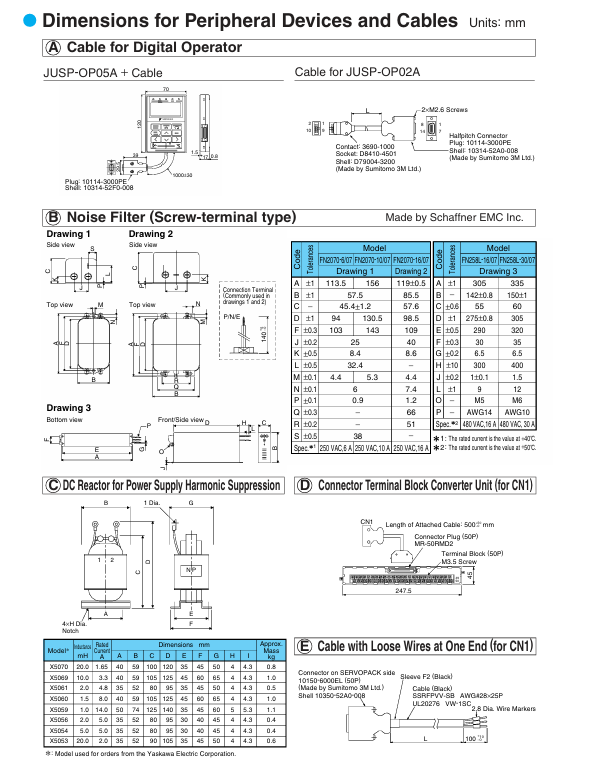
Noise filter FN2070-6/07 (single-phase) suppresses power side electromagnetic interference 250VAC, 6A, insertion loss ≥ 25dB
FN258L-16/07 (three-phase) three-phase system harmonic suppression 480VAC, 16A, insertion loss ≥ 30dB
DC reactor X5054 (SGDS) reduces input current harmonic inductance by 5.0mH and rated current by 5.0A
X5059 (SGDH) three-phase system harmonic suppression inductor 1.0mH, rated current 14.0A
Electromagnetic contactor HI-11J (20A) controls the power on/off of amplifier 250VAC, 20A, with surge absorber
Digital operator JUSP-OP05A (SGDS) amplifier parameter configuration/monitoring 1m connection line, supports parameter upload and download
JUSP-OP02A-2 (SGDH) extension function debugging supports self-tuning and alarm traceability
Selection process and order reference
(1) Selection steps
Clear requirements: Determine load torque, speed, positioning accuracy, installation space, and power supply type (single-phase/three-phase)
Motor selection: Match the outer diameter and model of the motor according to the torque speed requirements (refer to the torque speed characteristic curve)
Amplifier selection: Choose SGDS/SGDH series according to motor capacity and power supply type to ensure that the output current covers the motor requirements
Peripheral device matching: Select circuit breakers, filters, and reactors based on amplifier power, and choose dedicated cables according to wiring length
Parameter confirmation: Check the ratio of motor moment of inertia to load moment of inertia (recommended ≤ 10:1) to ensure dynamic response performance
(2) Motor amplifier adaptation table
Motor model compatible with SGDS amplifier compatible with SGDH amplifier power supply type
SGMCS-02B/05B/07B 02F/02A 02AE single-phase 100V/200V
SGMCS-04C/10C/14C 04F/04A 04AE single-phase 100V/200V
SGMCS-08D/17D/25D 04F/04A 04AE single-phase 200V
SGMCS-16E/35E 08A 08AE single-phase 200V
SGMCS-45M/80M/1AM -10AE/15AE/20AE Three phase 200V
SGMCS-80N/1EN/2ZN-15AE/30AE three-phase 200V
(3) Selection of specialized cables
Recommended cable types, applicable scenarios, length specifications
Motor power cable JZSP-CMM60-03 small capacity motor (B/C/D type) 3/5/10/15/20m
JZSP-CMM00-03 Medium Capacity Motor (M/N Type) 3/5/10/15/20m
Encoder cable JZSP-CMP60-05 small capacity motor encoder connection 5/10/15/20m
JZSP-CMP00-03 Medium Capacity Motor Encoder Connection 3/5/10/15/20m
I/O signal cable JZSP-CSI01-1 (SGDS) amplifier and controller connection 1/2/3m
JZSP-CKI01-1 (SGDH) Extended I/O Signal Connection 1/2/3m
Key points for installation and maintenance
(1) Mechanical installation specifications
Installation direction: Vertical installation (amplifier), horizontal fixing of motor flange surface to avoid tilting and stress
Spacing requirement: Reserve ≥ 30mm heat dissipation space around the amplifier, and the flatness of the coupling surface between the motor and the load should be ≤ 0.02mm
Fixed screws: Use high-strength screws of grade 10.9 and tighten them according to the torque requirements of the model (M4: 3.6N · m, M5: 7.8N · m, M6: 14.7N · m)
(2) Maintenance cycle and matters
Daily maintenance: Clean the dust on the surface of the motor, check that the cables are not damaged and the joints are not loose
Regular inspection: Measure the insulation resistance of the motor (≥ 10M Ω) every 6 months, and check the stability of the encoder signal annually
Component replacement: amplifier cooling fan (4-5 years), electrolytic capacitor (7-8 years), motor bearings (5000 hours or 5 years)
Troubleshooting: When an alarm occurs, first disconnect the power and check the wiring. Then, read the alarm code through the operator and troubleshoot the cause according to the manual
Application scenarios and advantages adaptation
(1) Core application areas
Semiconductor manufacturing equipment: wafer handling robotic arm, chip inspection platform
Electronic assembly equipment: SMT machine, soldering machine, precision dispensing machine
Testing and measuring equipment: IC testing handler, optical testing platform
LCD panel equipment: panel handling, polarizer bonding, laser cutting
(2) Advantages of scene adaptation
High precision positioning scenario: Backless design meets ± 1 μ m positioning requirements, suitable for chip packaging and precision bonding
Low noise environment: No gear meshing noise, suitable for clean rooms and laboratory equipment
High torque and low-speed scenario: Directly drive the load without the need for a gearbox, suitable for heavy-duty workbenches and rotating indexing discs
Miniaturization design: Compact structure reduces equipment volume, suitable for automation equipment with limited space
- OMRON
- ABB
- General Electric
- EMERSON
- Honeywell
- HIMA
- ALSTOM
- Rolls-Royce
- MOTOROLA
- Rockwell
- Siemens
- Woodward
- YOKOGAWA
- FOXBORO
- KOLLMORGEN
- MOOG
- KB
- YAMAHA
- BENDER
- TEKTRONIX
- Westinghouse
- AMAT
- AB
- XYCOM
- Yaskawa
- B&R
- Schneider
- KONGSBERG
- NI
- WATLOW
- ProSoft
- SEW
- ADVANCED
- Reliance
- TRICONEX
- METSO
- MAN
- Advantest
- STUDER
- DANAHER MOTION
- Bently
- Galil
- EATON
- MOLEX
- DEIF
- B&W
- ZYGO
- Aerotech
- DANFOSS
- Beijer
- Moxa
- Rexroth
- Johnson
- WAGO
- TOSHIBA
- BMCM
- SMC
- HITACHI
- HIRSCHMANN
- Application field
- XP POWER
- CTI
- TRICON
- STOBER
- Thinklogical
- Horner Automation
- Meggitt
- Fanuc
- Baldor
- SHINKAWA
- Other Brands
- UniOP
- KUKA
- Iba
- Beckhoff
- ADLINK
-
 Sigmatek MDD111-1 DIAS Drive Axis Module
 -
 Sigmatek DKL042 05-024-042 Terminal Module
 -
 Sigmatek DM822 Control Module
 -
 Sigmatek CDM167 12-008-167-O Module
 -
 Sigmatek TAE151 Touch Display Unit
 -
 Sigmatek DCC041 SLIDES Module 05-700-041-D
 -
 Sigmatek AKM65M-ANC2GBB0 PM Servo Motor
 -
 Sigmatek ETT221 01-230-221 Operator Terminal
 -
 Sigmatek SLIDES DAM 124 Analog Module
 -
Sigmatek AKM31C-ANCNGBB0 Servo Motor
-
 Mannesmann Demag Sigmatek CP626 Central Unit
 -
 SIGMATEK 0332.554.03 Board 371071000154
 -
 SIGMATEK 12-250-021 Base Plate Back Panel CM5V020
 -
 SIGMATEK DM162 S-DIAS Digital Mix Module
 -
 DEMAG ERGOTECH 061 381 66 Sigmatek 9842.243.02 Circuit Board
 -
 SIGMATEK CP313-1 PLC Module
 -
Sigmatek ETV0551-2 VARAN Touch Terminal
-
 Sigmatek SDM 081 FS S-Dias Safety Module
 -
 DEMAG 05-250-023 Ergotech Motherboard with Sigmatek TMS012
 -
Sigmatek CM5V020 12-250-023-K Wiring Base
-
 Sigma Tek 5000B-37 Attitude Gyro Indicator
 -
 Sigmatek SDD120-2 DIAS Drive
 -
 Sigmatek CME221 Memory Module
 -
 Sigmatek DCP640 DIAS Central Unit
 -
 Sigmatek STO040 Safety Output Module
 -
Sigmatek CET281 Control Panel
-
 Sigmatek CIPC LX800 Demag NC5 CPU
 -
 Sigmatek DKL093 05-024-093 Terminal Module
 -
 Sigmatek AI088 20-009-088 Analog Input Module
 -
Sigmatek CAI888 Analog Input Module
-
SIGMATEK CCA021 12-025-021 Analog Output Module
-
SIGMATEK 1104.579.05 Control Module
-
SIGMATEK SDI100 Digital Input Module
-
 SIGMATEK C-IPC 256MB LX800 Compact Dias
 -
 SIGMATEK 9423.090.02 Control Module
 -
SIGMATEK C-IPC 256 Power Supply 148498
-
 SIGMATEK CAI025 Analog Input Module
 -
 SIGMATEK CTO166 Digital Output Module
 -
 SIGMATEK CP112 20-004-112 Processor Module
 -
SIGMATEK CAI887 12-009-887 Safety Module
-
 Sigma-Tek 4000B-31 Directional Gyro 1U262-002-42
 -
Sigmatek C-IPC 256MB LX800 IPC Controller
-
Sigmatek C-IPC 01-450-031 Industrial PC LX800
-
Sigmatek C-IPC 256 Industrial PC Controller
-
Sigmatek CCP-531 PLC Processor Module
-
Sigmatek CDI163 Digital Input Module
-
 Sigmatek ETV0501 VARAN Terminal 12-230-0501
 -
 Sigmatek CTMS020 C-DIAS Technology Module
 -
 Sigmatek CIV512 VARAN Switch Module
 -
 Sigmatek HU011 20-080-011 Interface Module
 -
SIGMATEK SLIDES DAM 124 Module
-
 SIGMATEK C-IPC 161 01-450-161L Industrial PC
 -
SIGMATEK C-IPC 128MB VIA 733MHz 01-450-024-K
-
 SIGMATEK 12-780-012 R8-IPC Geode LX800 Module
 -
SIGMATEK CAM124 Analog Module
-
 SIGMATEK S1 032-8AF61-R4 EZ Servo Motor
 -
 SIGMATEK CTO163 Digital Output Module
 -
 SIGMATEK CCP082 12-004-082 Processor Module
 -
 SIGMATEK CRCH081 C-DIAS Temperature Module
 -
 SIGMATEK PC322-K 01-310-322-K Industrial PC
 -
SIGMATEK SDD310-2 Servo Drive
-
 SIGMATEK AI084 Analog Input Module
 -
SIGMATEK CRCH081 12-752-081 Temperature Module
-
Sigma-Tek 5000L-4 Attitude Gyro 1U284-001-3
-
 SIGMATEK CM5V020 12-250-023-K Wiring Module
 -
Sigma-Tek 4000H-6 Directional Gyro IU262-035-7
-
 SIGMATEK Dias DCP160 05-004-160 Processor Module
 -
SIGMATEK 0147.395.02 Control Module
-
SIGMATEK A1084 Control Module
-
SIGMATEK DI200 20-006-2000 Digital Input Module
-
Sigmatek DNC115 Encoder Module
-
 Sigmatek DAM122 05-017-122 Analog Module
 -
Sigmatek 9802.289.01 Control Board TA71 Display
-
Sigmatek TO127 20-007-127 Digital Output Module
-
Sigmatek DNC031 05-011-031 Digital Module
-
Sigmatek VI022 20-003-022 Interface Module
-
Sigmatek CAI085 Analog Input Module
-
 Sigmatek CP111 S-DIAS CPU Module
 -
Sigmatek CTMS030 Krauss Maffei Module
-
 Sigmatek CAM123 Control Module
 -
 Sigmatek TAE732-P 01-240-732-P Touch Display Unit
 -
Sigmatek MDM021 Digital Mixed Module
-
Sigmatek DCP642 DIAS Central Unit
-
 Sigmatek CST022 12-014-022 C-DIAS Module
 -
 Sigmatek SRO021 20-893-021 Safety Relay Output
 -
 Krauss Maffei MC5 Control System Sigmatek
 -
 Sigmatek DC061 Module 18-24VDC 300mA
 -
 Herrmann EVT0855 Ultrasonic Welder Touch Panel
 -
Sigmatek CIV521 Control Module 1.4A 2W
-
Sigmatek DDI61 05-006-161 Digital Input Module
-
SIGMATEK ETT312-E Touch Terminal 01-230-312
-
Cessna S3326-1 Sigma Tek 5000B-67 Gyro 1U149-015-9
-
SIGMATEK PS101 Power Supply Module
-
SIGMATEK 0332.554.03 Control Module 371071000154
-
 SIGMATEK ETT312-E Touch Terminal 01-230-312
 -
SIGMATEK CDM163 Control Module
-
 SIGMATEK VSV046 16-023-046 Module
 -
SIGMATEK AM221 20-017-221 Analog Module
-
SIGMATEK CTS051 12-053-051 Control Module
-
SIGMATEK AM221 20-017-221 Analog Module
-
Sigmatek CSDI161 12-891-161 Safety Input Module
-
Sigma Tek 4000C-1 Directional Gyro Indicator
-
Sigmatek ETV0501 12-230-0501 VARAN Terminal
-
Sigmatek DDM165 SLIDES Module
-
Sigmatek N100 20-011-100 Control Module
-
Sigmatek AKM54K-ANC2R-B0 PM Servo Motor
-
Sigmatek CTO166 Digital Output Module
-
Sigmatek CP212-K 20-004-212-K CPU Module
-
Sigmatek CDI161 Digital Input Module
-
Sigmatek DCC080 05-700-080-2 Control Module
-
 SIGMATEK SCP011 S-DIAS Safety CPU
 -
SIGMATEK SCP011 S-DIAS Safety CPU
-
SIGMATEK SRO022 Relay Output Module
-
SIGMATEK MDD 121 Drive Axis Module
-
SIGMATEK DSI021 SLIDES Siemens Interface
-
SIGMATEK DIAS DCP161 Module 05-004-161
-
 Sigmatek ETT312 Built-in Touch Terminal
 -
SIGMATEK DCP 643 DIAS Controller System
-
SIGMATEK CIO021 Multi I/O Module
-
SIGMATEK CTMS020 Control Module
-
 Sigmatek CME 221 Memory Module
 -
Sigmatek 0420.615.01 Control Board
-
Sigmatek CP111 20-004-111 CPU Module
-
Sigmatek 9405.065.03 Control Board
-
Sigmatek ETEK 01-450-032-K C-IPC 256MB Industrial PC
-
Sigmatek CTO163 12-007-163 Safety Output Module
-
Sigmatek TO081 20-007-081 Digital Output Module
-
 Sigmatek SI021 20-022-021 Safety Input Module


