
BENDER LINETRAXX ® VMD420 Three phase Voltage Frequency Monitor
BENDER LINETRAXX ® VMD420 Three phase Voltage Frequency Monitor
Product Overview
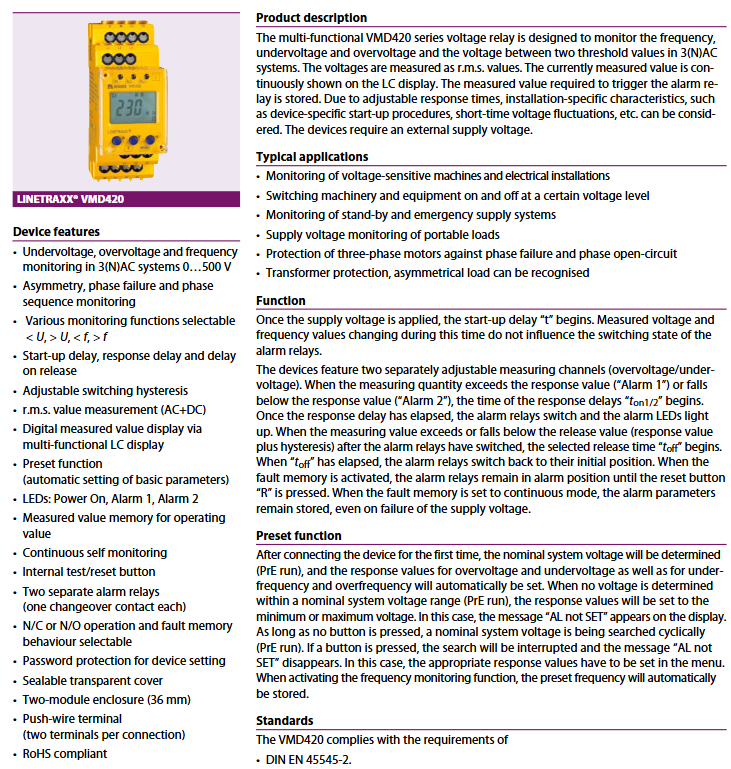
LINETRAXX ® VMD420 is a multifunctional voltage frequency monitor launched by BENDER, designed specifically for 3 (N) AC systems. Its core is used to monitor voltage (under voltage, over voltage), frequency (under frequency, over frequency), and phase related parameters (phase sequence, phase loss, asymmetry). The measurement voltage range covers 0... 500 V (L-L)/0... 288 V (L-N), and the frequency range is 15... 460 Hz. It adopts true RMS (AC+DC) measurement method to ensure data accuracy. The product complies with CE, DIN EN 45545-2, and IEC series standards, with high reliability and industrial grade protection performance, suitable for various electrical safety monitoring scenarios.
Core functions and features
(1) Comprehensive monitoring function
Voltage monitoring: It can simultaneously achieve undervoltage (U<) and overvoltage (U>) monitoring, with a monitoring range of AC 6... 500 V (3AC system, L-L wiring) or AC 6... 288 V (3 (N) AC system, L-N wiring), with a voltage setting resolution of 1 V, which can meet high-precision monitoring requirements. The device has a built-in preset function that automatically configures response values for different rated voltage systems: in the 3AC system, when the rated voltage Un is 400 V, the undervoltage preset value is 340 V (0.85Un) and the overvoltage preset value is 440 V (1.1Un); In the 3 (N) AC system, when Un is 230 V, the preset undervoltage value is 196 V and the preset overvoltage value is 253 V, without the need for manual configuration.
Frequency monitoring: Supports under frequency (<f) and over frequency (>f) monitoring, with a frequency setting range of 10... 500 Hz, where the resolution of the 10.0... 99.9 Hz interval is 0.1 Hz and the resolution of the 100... 500 Hz interval is 1 Hz, ensuring accurate capture of frequency fluctuations. The preset function is also applicable to frequency monitoring, with corresponding underfrequency and overfrequency preset values configured for rated frequencies of 16.7 Hz, 50 Hz, 60 Hz, and 400 Hz (such as 50 Hz corresponding to underfrequency of 49 Hz and overfrequency of 51 Hz), suitable for different power supply scenarios.
Phase related monitoring: including phase sequence, phase loss, and voltage asymmetry monitoring. Phase sequence monitoring supports recognition of two rotation directions: clockwise and counterclockwise. It is set to off by default and can be turned on according to actual system requirements; Phase loss is indirectly identified through voltage asymmetry threshold. When the three-phase voltage asymmetry exceeds the set value, an alarm is triggered; The asymmetric monitoring range is 5... 30%, and the factory defaults to 30%. It can be adjusted according to the system load characteristics to effectively prevent equipment damage caused by three-phase imbalance.
Measurement accuracy: The relative error of voltage measurement at 50/60 Hz power frequency is only ± 1.5% (± 2 digits), and the relative error within a wide frequency range of 15... 460 Hz is ± 3% (± 2 digits); The relative error of frequency measurement within the range of 15... 460 Hz is only ± 0.2% (± 1 digit), and high-precision measurement ensures the accuracy of alarm triggering, avoiding false alarms or missed alarms.
(2) Flexible time parameter configuration
Start delay (t): Set the range to 0... 300 seconds, with the factory default of 0 seconds. This function can avoid false alarms caused by unstable voltage and frequency during the device's power on start-up phase, and adapt to electrical characteristic fluctuations during the device's start-up process.
Response delay (ton1/2): Adjustable for two alarm channels, with a range of 0... 300 seconds and a default of 0 seconds. The delay time can be set according to the short-term fluctuations in on-site voltage and frequency, filtering out instantaneous interference signals and ensuring the reliability of alarm triggering.
Release delay (toff): Set the range from 0 to 300 seconds, with a default of 0.5 seconds. When the monitoring parameters return to the normal range (response value ± hysteresis), the device will not immediately reset, but will switch back to the initial state after a release delay to prevent frequent relay actions caused by repeated parameter fluctuations.
Action and recovery speed: The action time of voltage signal is ≤ 140 ms, and the action time of frequency signal is ≤ 335 ms, with rapid response and the ability to capture faults and trigger protection in a timely manner; The equipment recovery time is ≤ 300 ms, and after troubleshooting, it can quickly restore normal monitoring status.
(3) Display and storage functions
Display module: equipped with a multifunctional non luminous LC display screen, which can display the current measured voltage and frequency values in real time (display range 0... 500 V), and can also display device setting parameters, alarm status and other information. The interface is simple and intuitive, making it easy to view on site.
Storage function: equipped with running value memory function, which can record key parameters of the device during normal operation; Historical Memory (HiS) can store the measurement values at the first alarm, providing data support for troubleshooting; Fault memory supports three modes: on, off, and on. It is enabled by default. When set to continuous mode, even if the power supply is interrupted, the alarm parameters will still be retained, and historical fault information can be viewed after power supply is restored.
(4) Safety and operational assurance
Protection mechanism: The device supports password protection function, with a password range of 0... 999. It is disabled by default and can prevent unauthorized personnel from modifying device parameters when enabled; Equipped with a sealed transparent cover, it can protect the internal operating components, facilitate the viewing of equipment status, and meet the requirements of dust prevention and misoperation prevention; Equipped with continuous self-monitoring function, it can detect the working status of the equipment in real time. If there is a fault, it will be promptly reported through alarm lights and relays.
Operation buttons: including three core buttons: Test (T), Reset (R), and Menu (MENU). The functional reuse design balances convenience and integration:
Test key (T): Short press to switch the display of measurement values, and the menu can switch options up or modify parameters; Long press (>1.5 s) to activate the self-test function.
Reset button (R): Short press to switch the display of measurement values, and the menu can be used to switch down options or modify parameters; Long press (>1.5 s) to clear stored alarm records.
MENU: Short press to confirm, used to confirm the displayed measurement values or modified parameters; Long press (>1.5 s) to call up the menu system; Long press the ESC function (>1.5 seconds) to abort the current operation or return to the previous menu.
Indicator light status: Power light (ON, green): Always on when power supply is normal, flashing when system fault alarm is triggered; Alarm lights (AL1, AL2, yellow): keep on when triggered by corresponding alarm relays K1 and K2, and flash when the system fails; The indicator light status can quickly determine the working status and alarm situation of the equipment.
(5) Alarm output configuration
The equipment is equipped with two independent alarm relays (K1, K2), each designed with a single conversion contact, supporting switching between normally closed (N/C) or normally open (N/O) operating modes to meet different control circuit requirements.
The configurable monitoring types of relays include: Err, U<, U>, Asy, Hz<, Hz>, PHS, and S.AL. The factory default configuration is:
K1: Overvoltage (U>), asymmetry (Asy), normally open (N/O) mode.
K2: Under voltage (U<), asymmetric (Asy), normally closed (N/C) mode.
The electrical life of the relay reaches 10000 cycles, and the contact parameters comply with the IEC 60947-5-1 standard. The rated parameters under different usage categories are as follows:
Usage category: Rated voltage, rated current
AC-13 230 V 5 A
AC-14 230 V 3 A
DC-12 24 V 1 A
DC-12 110 V 0.2 A
DC-12 220 V 0.1 A
The minimum contact load is 1 mA when AC/DC ≥ 10 V, ensuring reliable operation in low load scenarios.
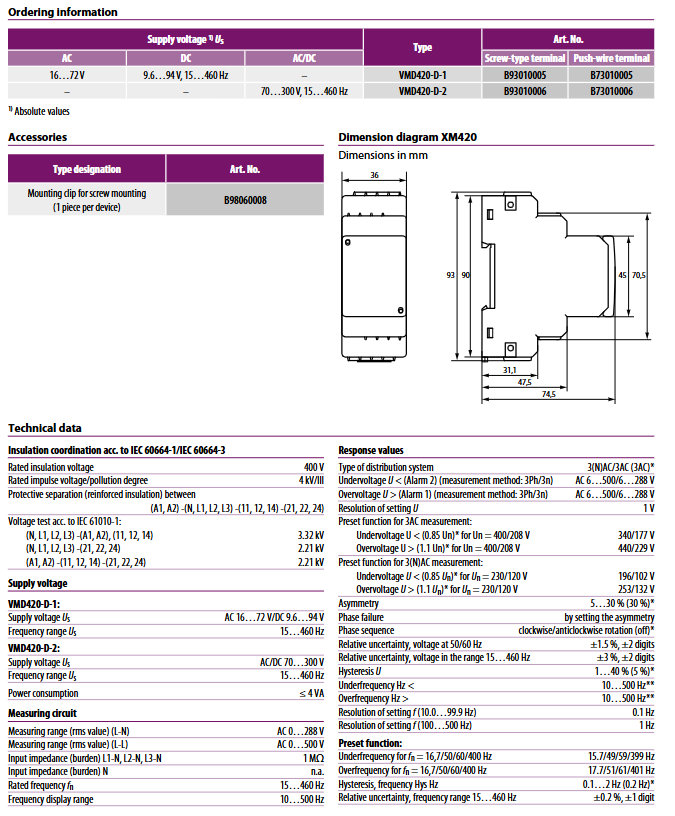
Model specifications and ordering information
(1) Core model parameters
The equipment is divided into two core models according to the power supply voltage, and each model provides two wiring options: screw terminals and push in terminals. The specific parameters are as follows:
Model Supply Voltage (Us) Frequency Range Terminal Type Product Number (Art. No.)
VMD420-D-1 AC 16... 72 V/DC 9.6... 94 V 15... 460 Hz screw terminal B93010005
Push in terminal B73010005
VMD420-D-2 AC/DC 70... 300 V 15... 460 Hz screw terminal B93010006
Push in terminal B73010006
Note: The power supply voltage is the absolute rated value, and actual use should be within the specified range to avoid overvoltage or undervoltage operation.
(2) Accessory information
Accessory Name Usage Product Number (Art. No.)
Fixed clamp for screw installation (1 per device) used for fixing equipment screws B98060008
Key technical parameters
(1) Insulation and voltage resistance performance
Project parameter specifications
Rated insulation voltage 400 V
Rated impulse voltage/pollution level 4 kV/III
Protective isolation (strengthened insulation) between A1, A2 and N, L1, L2, L3, 11, 12, 14, 21, 22, 24
Voltage withstand test (IEC 61010-1) (N, L1, L2, L3) and (A1, A2), (11,12,14): 3.32 kV
(N, L1, L2, L3) and (21,22,24): 2.21 kV
(A1, A2) and (11,12,14), (21,22,24): 2.21 kV
(2) Power supply and power consumption
Model Supply Voltage Range Frequency Range Power Consumption
VMD420-D-1 AC 16…72 V / DC 9.6…94 V 15…460 Hz ≤ 4 VA
VMD420-D-2 AC/DC 70…300 V 15…460 Hz ≤ 4 VA
(3) Measure circuit parameters
Project parameter specifications
Measurement range (true RMS) - L-N AC 0... 288 V
Measurement range (true RMS) - L-L AC 0... 500 V
Input impedance (L1-N, L2-N, L3-N) 1 M Ω
Input impedance (N line) None (n.a.)
Rated frequency (fn) 15... 460 Hz
Frequency display range 10... 500 Hz
(4) Environment and EMC Performance
Electromagnetic compatibility (EMC): Complies with EN 61326-1 standard, has strong resistance to electromagnetic interference, and is suitable for complex industrial electromagnetic environments.
Temperature range:
Working temperature: -25...+55 ℃
Transportation temperature: -25...+70 ℃
Storage temperature: -25...+55 ℃
Classification of climatic conditions (IEC 60721):
Fixed use (3K23): no condensation, no icing
Transportation (2K11, 1K22)
Long term storage (1K12)
Classification of mechanical conditions (IEC 60721):
Fixed use (3M11)
Transportation (2M4)
Long term storage (1M12)
Optional version (Option "W"): Designed for special climate environments, allowing condensation and freezing during fixed use (climate classification 3K23), mechanical condition classification 3M12, suitable for extreme scenarios such as high humidity and low temperature.
(5) Wiring parameters
The device supports two wiring methods: screw terminals and push in terminals. The specific wiring requirements are as follows:
Screw terminal:
Rigid wire: 0.2... 4 mm ² (AWG 24... 12)
Flexible wire: 0.2... 2.5 mm ² (AWG 24... 14)
Two rigid/flexible wires with the same cross-section: 0.2... 1.5 mm ² (AWG 24... 16)
Wire stripping length: 8-9 mm
Tightening torque of terminal screw: 0.5... 0.6 Nm
Push in terminal:
Rigid wire: 0.2... 2.5 mm ² (AWG 24... 14)
Flexible wire without cold press joint: 0.75... 2.5 mm ² (AWG 19... 14)
Flexible wire with cold press joint: 0.2... 1.5 mm ² (AWG 24... 16)
Wire stripping length: 10mm
Terminal opening force: 50 N
Test opening diameter: 2.1 mm
(6) Other physical and installation parameters
Project parameter specifications
Continuous operation in working mode
Installation method at any position (guide rail/screw)
Protection level (internal components/terminals) IP30/IP20 (DIN EN 60529)
Shell material polycarbonate
Flame retardant grade UL94 V-0
Rail installation standard IEC 60715
Screw installation requirements: 2 x M4 screws+fixing clip
Shell dimensions (width x height x depth) 36 mm x 93 mm x 90 mm
Weight ≤ 150 g
Working principle
(1) Basic workflow
After the device is connected to the external power supply voltage (A1, A2 terminals), the start delay (t) starts timing. During this stage, fluctuations in voltage and frequency will not affect the switching status of the alarm relay, ensuring stable device startup.
After the startup delay is over, the device enters the normal monitoring state, collects the voltage and frequency signals of the monitored system through terminals L1, L2, L3, and N, and calculates the true effective value and related parameters in real time.
When the monitoring parameters exceed (or fall below) the set response value, the response delay (ton1/2) of the corresponding alarm channel is activated; If the parameter remains in an over limit state during the response delay period, the corresponding alarm relay (K1/K2) will activate and the corresponding alarm light (AL1/AL2) will light up after the response delay ends.
After the alarm is triggered, if the monitoring parameters return to the release value (response value ± switching delay), the release delay (toff) will be activated; After the release delay is completed, the alarm relay resets and the alarm light goes out.
If the fault memory function is enabled, the alarm relay will remain in the alarm state until the reset button (R) is pressed to clear the alarm; If set to continuous fault memory mode, the alarm state will still be retained even if the power supply is interrupted.
(2) Preset function (PrE run)
After the device is first connected to the power supply, it automatically starts the preset function, detects the rated voltage (Un) of the system, and automatically configures the response values for undervoltage, overvoltage, underfrequency, and overclocking based on the detection results.
If no effective rated voltage is detected during the preset process (beyond the normal voltage range), the device will set the response value to the minimum or maximum limit value, and the display screen will show "AL not SET".
When no button is pressed, the device will cycle to search for the rated voltage (continuous PrE run); If any button is pressed, the search process will be interrupted and the "AL not SET" prompt will disappear. At this time, the response parameters need to be manually configured through the menu.
When the frequency monitoring function is enabled, the preset function will automatically store the rated frequency of the current system and configure the corresponding underfrequency and overfrequency response values.
(3) Line protection requirements
According to the IEC 60364-4-43 standard, it is recommended to install 6A fuses for overcurrent protection in the equipment circuit; If the equipment is powered by the IT system, fuses need to be installed on both power lines to ensure power supply safety.
Typical application scenarios
Voltage sensitive equipment monitoring: used for power supply circuits of precision instruments, PLC controllers, industrial automation equipment, and other equipment that are sensitive to voltage fluctuations. Real time monitoring of voltage and frequency changes to avoid equipment damage or data loss caused by undervoltage, overvoltage, and frequency abnormalities.
Mechanical equipment start stop control: Based on the set voltage threshold, automatically control the start stop of machinery and production equipment. For example, when the power supply voltage returns to the normal range and stabilizes for a period of time, the equipment will automatically start; When the voltage is abnormal, promptly cut off the power supply of the equipment to protect it from impact.
Backup/Emergency Power Supply System Monitoring: Monitor the output voltage and frequency of backup power supply systems such as UPS power supply and diesel generators to ensure stable and reliable power supply after the backup power supply is started, ensuring the continuous operation of critical loads such as emergency lighting, fire equipment, and data centers.
Three phase motor protection: For equipment such as three-phase asynchronous motors, monitor the phase sequence, phase loss, and voltage asymmetry to prevent motor reversal due to phase sequence errors, or motor overheating or burnout due to phase loss or three-phase imbalance, thereby extending the service life of the motor.
Transformer protection: By monitoring the asymmetry of the secondary voltage of the transformer, identifying the asymmetric load state of the transformer, avoiding local overheating and increased losses caused by load imbalance, and ensuring the safe and stable operation of the transformer.
Portable load power supply monitoring: used for power supply circuits of portable loads such as mobile devices and temporary construction equipment, to monitor the stability of power supply voltage, timely detect power supply faults, and prevent equipment damage due to power supply problems in outdoor or temporary scenarios.
- OMRON
- ABB
- General Electric
- EMERSON
- Honeywell
- HIMA
- ALSTOM
- Rolls-Royce
- MOTOROLA
- Rockwell
- Siemens
- Woodward
- YOKOGAWA
- FOXBORO
- KOLLMORGEN
- MOOG
- KB
- YAMAHA
- BENDER
- TEKTRONIX
- Westinghouse
- AMAT
- AB
- XYCOM
- Yaskawa
- B&R
- Schneider
- KONGSBERG
- NI
- WATLOW
- ProSoft
- SEW
- ADVANCED
- Reliance
- TRICONEX
- METSO
- MAN
- Advantest
- STUDER
- DANAHER MOTION
- Bently
- Galil
- EATON
- MOLEX
- DEIF
- B&W
- ZYGO
- Aerotech
- DANFOSS
- Beijer
- Moxa
- Rexroth
- Johnson
- WAGO
- TOSHIBA
- BMCM
- SMC
- HITACHI
- HIRSCHMANN
- Application field
- XP POWER
- CTI
- TRICON
- STOBER
- Thinklogical
- Horner Automation
- Meggitt
- Fanuc
- Baldor
- SHINKAWA
- Other Brands
- UniOP
- KUKA
- Iba
- Beckhoff
- ADLINK
-
 Sigmatek MDD111-1 DIAS Drive Axis Module
 -
 Sigmatek DKL042 05-024-042 Terminal Module
 -
 Sigmatek DM822 Control Module
 -
 Sigmatek CDM167 12-008-167-O Module
 -
 Sigmatek TAE151 Touch Display Unit
 -
 Sigmatek DCC041 SLIDES Module 05-700-041-D
 -
 Sigmatek AKM65M-ANC2GBB0 PM Servo Motor
 -
 Sigmatek ETT221 01-230-221 Operator Terminal
 -
 Sigmatek SLIDES DAM 124 Analog Module
 -
Sigmatek AKM31C-ANCNGBB0 Servo Motor
-
 Mannesmann Demag Sigmatek CP626 Central Unit
 -
 SIGMATEK 0332.554.03 Board 371071000154
 -
 SIGMATEK 12-250-021 Base Plate Back Panel CM5V020
 -
 SIGMATEK DM162 S-DIAS Digital Mix Module
 -
 DEMAG ERGOTECH 061 381 66 Sigmatek 9842.243.02 Circuit Board
 -
 SIGMATEK CP313-1 PLC Module
 -
Sigmatek ETV0551-2 VARAN Touch Terminal
-
 Sigmatek SDM 081 FS S-Dias Safety Module
 -
 DEMAG 05-250-023 Ergotech Motherboard with Sigmatek TMS012
 -
Sigmatek CM5V020 12-250-023-K Wiring Base
-
 Sigma Tek 5000B-37 Attitude Gyro Indicator
 -
 Sigmatek SDD120-2 DIAS Drive
 -
 Sigmatek CME221 Memory Module
 -
 Sigmatek DCP640 DIAS Central Unit
 -
 Sigmatek STO040 Safety Output Module
 -
Sigmatek CET281 Control Panel
-
 Sigmatek CIPC LX800 Demag NC5 CPU
 -
 Sigmatek DKL093 05-024-093 Terminal Module
 -
 Sigmatek AI088 20-009-088 Analog Input Module
 -
Sigmatek CAI888 Analog Input Module
-
SIGMATEK CCA021 12-025-021 Analog Output Module
-
SIGMATEK 1104.579.05 Control Module
-
SIGMATEK SDI100 Digital Input Module
-
 SIGMATEK C-IPC 256MB LX800 Compact Dias
 -
 SIGMATEK 9423.090.02 Control Module
 -
SIGMATEK C-IPC 256 Power Supply 148498
-
 SIGMATEK CAI025 Analog Input Module
 -
 SIGMATEK CTO166 Digital Output Module
 -
 SIGMATEK CP112 20-004-112 Processor Module
 -
SIGMATEK CAI887 12-009-887 Safety Module
-
 Sigma-Tek 4000B-31 Directional Gyro 1U262-002-42
 -
Sigmatek C-IPC 256MB LX800 IPC Controller
-
Sigmatek C-IPC 01-450-031 Industrial PC LX800
-
Sigmatek C-IPC 256 Industrial PC Controller
-
Sigmatek CCP-531 PLC Processor Module
-
Sigmatek CDI163 Digital Input Module
-
 Sigmatek ETV0501 VARAN Terminal 12-230-0501
 -
 Sigmatek CTMS020 C-DIAS Technology Module
 -
 Sigmatek CIV512 VARAN Switch Module
 -
 Sigmatek HU011 20-080-011 Interface Module
 -
SIGMATEK SLIDES DAM 124 Module
-
 SIGMATEK C-IPC 161 01-450-161L Industrial PC
 -
SIGMATEK C-IPC 128MB VIA 733MHz 01-450-024-K
-
 SIGMATEK 12-780-012 R8-IPC Geode LX800 Module
 -
SIGMATEK CAM124 Analog Module
-
 SIGMATEK S1 032-8AF61-R4 EZ Servo Motor
 -
 SIGMATEK CTO163 Digital Output Module
 -
 SIGMATEK CCP082 12-004-082 Processor Module
 -
 SIGMATEK CRCH081 C-DIAS Temperature Module
 -
 SIGMATEK PC322-K 01-310-322-K Industrial PC
 -
SIGMATEK SDD310-2 Servo Drive
-
 SIGMATEK AI084 Analog Input Module
 -
SIGMATEK CRCH081 12-752-081 Temperature Module
-
Sigma-Tek 5000L-4 Attitude Gyro 1U284-001-3
-
 SIGMATEK CM5V020 12-250-023-K Wiring Module
 -
Sigma-Tek 4000H-6 Directional Gyro IU262-035-7
-
 SIGMATEK Dias DCP160 05-004-160 Processor Module
 -
SIGMATEK 0147.395.02 Control Module
-
SIGMATEK A1084 Control Module
-
SIGMATEK DI200 20-006-2000 Digital Input Module
-
Sigmatek DNC115 Encoder Module
-
 Sigmatek DAM122 05-017-122 Analog Module
 -
Sigmatek 9802.289.01 Control Board TA71 Display
-
Sigmatek TO127 20-007-127 Digital Output Module
-
Sigmatek DNC031 05-011-031 Digital Module
-
Sigmatek VI022 20-003-022 Interface Module
-
Sigmatek CAI085 Analog Input Module
-
 Sigmatek CP111 S-DIAS CPU Module
 -
Sigmatek CTMS030 Krauss Maffei Module
-
 Sigmatek CAM123 Control Module
 -
 Sigmatek TAE732-P 01-240-732-P Touch Display Unit
 -
Sigmatek MDM021 Digital Mixed Module
-
Sigmatek DCP642 DIAS Central Unit
-
 Sigmatek CST022 12-014-022 C-DIAS Module
 -
 Sigmatek SRO021 20-893-021 Safety Relay Output
 -
 Krauss Maffei MC5 Control System Sigmatek
 -
 Sigmatek DC061 Module 18-24VDC 300mA
 -
 Herrmann EVT0855 Ultrasonic Welder Touch Panel
 -
Sigmatek CIV521 Control Module 1.4A 2W
-
Sigmatek DDI61 05-006-161 Digital Input Module
-
SIGMATEK ETT312-E Touch Terminal 01-230-312
-
Cessna S3326-1 Sigma Tek 5000B-67 Gyro 1U149-015-9
-
SIGMATEK PS101 Power Supply Module
-
SIGMATEK 0332.554.03 Control Module 371071000154
-
 SIGMATEK ETT312-E Touch Terminal 01-230-312
 -
SIGMATEK CDM163 Control Module
-
 SIGMATEK VSV046 16-023-046 Module
 -
SIGMATEK AM221 20-017-221 Analog Module
-
SIGMATEK CTS051 12-053-051 Control Module
-
SIGMATEK AM221 20-017-221 Analog Module
-
Sigmatek CSDI161 12-891-161 Safety Input Module
-
Sigma Tek 4000C-1 Directional Gyro Indicator
-
Sigmatek ETV0501 12-230-0501 VARAN Terminal
-
Sigmatek DDM165 SLIDES Module
-
Sigmatek N100 20-011-100 Control Module
-
Sigmatek AKM54K-ANC2R-B0 PM Servo Motor
-
Sigmatek CTO166 Digital Output Module
-
Sigmatek CP212-K 20-004-212-K CPU Module
-
Sigmatek CDI161 Digital Input Module
-
Sigmatek DCC080 05-700-080-2 Control Module
-
 SIGMATEK SCP011 S-DIAS Safety CPU
 -
SIGMATEK SCP011 S-DIAS Safety CPU
-
SIGMATEK SRO022 Relay Output Module
-
SIGMATEK MDD 121 Drive Axis Module
-
SIGMATEK DSI021 SLIDES Siemens Interface
-
SIGMATEK DIAS DCP161 Module 05-004-161
-
 Sigmatek ETT312 Built-in Touch Terminal
 -
SIGMATEK DCP 643 DIAS Controller System
-
SIGMATEK CIO021 Multi I/O Module
-
SIGMATEK CTMS020 Control Module
-
 Sigmatek CME 221 Memory Module
 -
Sigmatek 0420.615.01 Control Board
-
Sigmatek CP111 20-004-111 CPU Module
-
Sigmatek 9405.065.03 Control Board
-
Sigmatek ETEK 01-450-032-K C-IPC 256MB Industrial PC
-
Sigmatek CTO163 12-007-163 Safety Output Module
-
Sigmatek TO081 20-007-081 Digital Output Module
-
 Sigmatek SI021 20-022-021 Safety Input Module


