
WESTINGHOUSE eVinci ™ Micro reactor
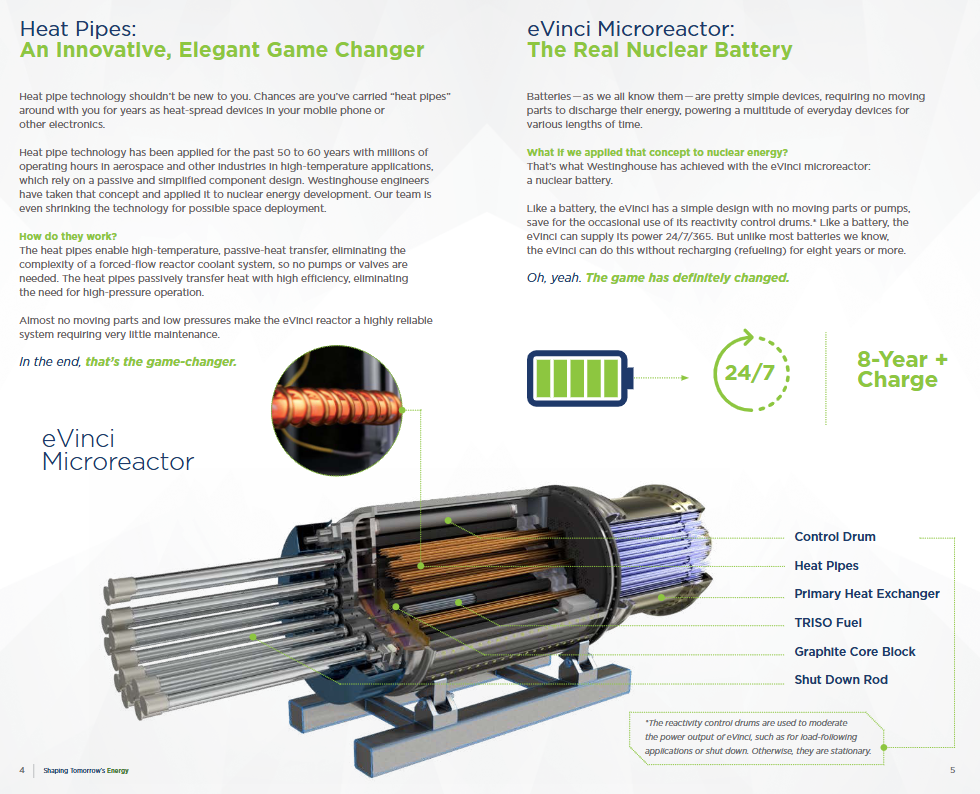
Core technology: With heat pipe technology as the core, this technology has been applied in the fields of aerospace and electronic equipment for 50-60 years, with millions of hours of operating experience; Through passive and efficient heat transfer, there is no need for forced flow cooling systems, completely eliminating moving parts such as pumps and valves, simplifying system complexity.
WESTINGHOUSE eVinci ™ Micro reactor
Product Overview and Core Technologies
Product positioning: Westinghouse eVinci ™ Micro reactors are "nuclear energy cells" developed based on mature heat pipe technology, aimed at addressing the global demand for innovative, transportable, safe, and reliable zero carbon energy, and filling the energy supply gap in remote areas and special scenarios.
Core technology: With heat pipe technology as the core, this technology has been applied in the fields of aerospace and electronic equipment for 50-60 years, with millions of hours of operating experience; Through passive and efficient heat transfer, there is no need for forced flow cooling systems, completely eliminating moving parts such as pumps and valves, simplifying system complexity.
Core components: TRISO solid fuel, graphite pellets, heat pipes, main heat exchanger, reactivity control drum (power regulation/shutdown), shutdown rods, with no additional moving parts in the overall design.
Key parameters and core characteristics
Category specific specifications
Capacity parameter power generation capacity: 5 MWe; Thermal capacity:~6MWhth
Operating cycle of over 8 years at full power without the need for material replacement
Design features: no moving parts, passive heat transfer, no high-pressure operation, solid fuel technology
Construction and deployment of full factory assembly, ground construction, railway/barge transportation, rapid deployment, and scalability
Built in strong security features, no high risks associated with traditional nuclear power, supporting deployment in city centers/campuses
Environmentally friendly zero carbon emissions, replacing diesel generators and reducing carbon footprint
Only a small number of personnel are needed for operation and maintenance on site, with extremely low maintenance requirements
Analysis of Core Advantages
Innovation and Efficiency: Heat pipe technology simplifies traditional reactor systems, eliminates complex components such as pumps and valves, and achieves high passive heat transfer efficiency without the need for high-pressure operation, reducing the risk of failure.
Transportable deployment: After the entire factory assembly is completed, it can be transported by railway or barge without complex on-site construction, and can be quickly deployed in areas without power grid coverage.
Ultimate safety: Using solid-state TRISO fuel and graphite pellets, there is no high pressure or large demand for cooling water resources. The passive safety system minimizes the risk of accidents and is suitable for sensitive scenarios such as cities and campuses.
Reliable and Durable: Designed with no moving parts to enhance stability, it can operate continuously in harsh environments, with 24/7 uninterrupted power supply and no need for material replacement for over 8 years, reducing maintenance costs.
Environmental Collaboration: Zero carbon power generation can provide regional heating and seamlessly collaborate with renewable energy sources such as wind, solar, and hydropower to help decarbonize the energy structure.
Core application scenarios
Scenario type, specific scenario application value
Replace diesel generators in remote/special off grid communities, mines, military bases, and oil and gas operation areas to solve fuel transportation problems and provide stable zero carbon electricity
Research universities in institutional settings provide electricity and regional heating to support decarbonization; Provide a platform for nuclear technology research and talent cultivation
Renewable energy supporting renewable energy in energy synergy scenarios compensates for the intermittent shortcomings of wind and solar energy, and builds a stable zero carbon energy system
Deployment and Regulatory Progress
Deployment advantages: Ground construction does not require complex underground engineering, rapid deployment and support for large-scale expansion, on-site operation, maintenance, and security only require a small number of personnel.
Regulatory status: Actively promoting regulatory approvals in the United States and Canada, laying the foundation for subsequent commercial deployment.
Value added: In addition to electricity supply, it can provide process heat for regional heating, helping remote communities and institutions achieve sustainable economic development.
Key issue
Question 1 (Technological Innovation): eVinci ™ What is the core technological innovation of microreactors? What are the simplifications compared to traditional reactors?
Answer: The core technological innovation is passive heat transfer technology for heat pipes. Compared to traditional reactors, simplification is reflected in three aspects: ① Eliminating the forced cooling system, eliminating the need for moving parts such as pumps and valves, and relying on heat pipes to achieve efficient passive heat transfer; ② No high voltage operation requirements, reducing system complexity and safety risks; ③ Adopting solid-state TRISO fuel and graphite core block design to replace traditional liquid fuel systems, further simplifying the structure and improving safety.
Question 2 (Application Adaptation): eVinci ™ Why are micro reactors suitable for remote areas and university settings? What are the core adaptation advantages?
Answer: The core advantages of adapting to remote areas are: ① transportability (full factory assembly, railway/barge transportation), which solves the problem of fuel transportation in remote areas; ② 8 years without the need for material replacement, reducing the frequency of operation and maintenance; ③ Replace diesel generators, achieve zero carbon power supply, and adapt to scenarios without grid coverage. The core advantages of adapting to university scenarios are: ① integrated supply of zero carbon electricity and regional heating, helping to decarbonize campuses; ② Mature and secure technology, deployable in campus environments; ③ Provide research and talent development platforms for nuclear technology, energy science, and other fields, in line with the needs of research-oriented universities.
Question 3 (Sustainability and Collaboration): eVinci ™ What is the role of microreactors in decarbonization process? How to collaborate with renewable energy?
Answer: Decarbonization effect: ① Zero carbon emissions, replacing fossil fuels such as diesel and coal for power generation, reducing carbon footprint; ② Adapt to remote areas and special scenarios, filling the deployment gap of traditional zero carbon energy (wind/photovoltaic); ③ Provide additional functions such as regional heating to expand zero carbon application scenarios. Collaborative approach with renewable energy: ① Compensate for the intermittent defects of wind and solar energy, provide 24/7 continuous power supply, and ensure the stability of the energy system; ② It can be quickly deployed and expanded, flexibly matched according to the installed capacity of renewable energy, and build an energy structure that is "zero carbon oriented, collaborative and complementary".
- OMRON
- ABB
- General Electric
- EMERSON
- Honeywell
- HIMA
- ALSTOM
- Rolls-Royce
- MOTOROLA
- Rockwell
- Siemens
- Woodward
- YOKOGAWA
- FOXBORO
- KOLLMORGEN
- MOOG
- KB
- YAMAHA
- BENDER
- TEKTRONIX
- Westinghouse
- AMAT
- AB
- XYCOM
- Yaskawa
- B&R
- Schneider
- KONGSBERG
- NI
- WATLOW
- ProSoft
- SEW
- ADVANCED
- Reliance
- TRICONEX
- METSO
- MAN
- Advantest
- STUDER
- DANAHER MOTION
- Bently
- Galil
- EATON
- MOLEX
- DEIF
- B&W
- ZYGO
- Aerotech
- DANFOSS
- Beijer
- Moxa
- Rexroth
- Johnson
- WAGO
- TOSHIBA
- BMCM
- SMC
- HITACHI
- HIRSCHMANN
- Application field
- XP POWER
- CTI
- TRICON
- STOBER
- Thinklogical
- Horner Automation
- Meggitt
- Fanuc
- Baldor
- SHINKAWA
- Other Brands
- UniOP
- KUKA
- Iba
- Beckhoff
- ADLINK
-
 Sigmatek MDD111-1 DIAS Drive Axis Module
 -
 Sigmatek DKL042 05-024-042 Terminal Module
 -
 Sigmatek DM822 Control Module
 -
 Sigmatek CDM167 12-008-167-O Module
 -
 Sigmatek TAE151 Touch Display Unit
 -
 Sigmatek DCC041 SLIDES Module 05-700-041-D
 -
 Sigmatek AKM65M-ANC2GBB0 PM Servo Motor
 -
 Sigmatek ETT221 01-230-221 Operator Terminal
 -
 Sigmatek SLIDES DAM 124 Analog Module
 -
Sigmatek AKM31C-ANCNGBB0 Servo Motor
-
 Mannesmann Demag Sigmatek CP626 Central Unit
 -
 SIGMATEK 0332.554.03 Board 371071000154
 -
 SIGMATEK 12-250-021 Base Plate Back Panel CM5V020
 -
 SIGMATEK DM162 S-DIAS Digital Mix Module
 -
 DEMAG ERGOTECH 061 381 66 Sigmatek 9842.243.02 Circuit Board
 -
 SIGMATEK CP313-1 PLC Module
 -
Sigmatek ETV0551-2 VARAN Touch Terminal
-
 Sigmatek SDM 081 FS S-Dias Safety Module
 -
 DEMAG 05-250-023 Ergotech Motherboard with Sigmatek TMS012
 -
Sigmatek CM5V020 12-250-023-K Wiring Base
-
 Sigma Tek 5000B-37 Attitude Gyro Indicator
 -
 Sigmatek SDD120-2 DIAS Drive
 -
 Sigmatek CME221 Memory Module
 -
 Sigmatek DCP640 DIAS Central Unit
 -
 Sigmatek STO040 Safety Output Module
 -
Sigmatek CET281 Control Panel
-
 Sigmatek CIPC LX800 Demag NC5 CPU
 -
 Sigmatek DKL093 05-024-093 Terminal Module
 -
 Sigmatek AI088 20-009-088 Analog Input Module
 -
Sigmatek CAI888 Analog Input Module
-
SIGMATEK CCA021 12-025-021 Analog Output Module
-
SIGMATEK 1104.579.05 Control Module
-
SIGMATEK SDI100 Digital Input Module
-
 SIGMATEK C-IPC 256MB LX800 Compact Dias
 -
 SIGMATEK 9423.090.02 Control Module
 -
SIGMATEK C-IPC 256 Power Supply 148498
-
 SIGMATEK CAI025 Analog Input Module
 -
 SIGMATEK CTO166 Digital Output Module
 -
 SIGMATEK CP112 20-004-112 Processor Module
 -
SIGMATEK CAI887 12-009-887 Safety Module
-
 Sigma-Tek 4000B-31 Directional Gyro 1U262-002-42
 -
Sigmatek C-IPC 256MB LX800 IPC Controller
-
Sigmatek C-IPC 01-450-031 Industrial PC LX800
-
Sigmatek C-IPC 256 Industrial PC Controller
-
Sigmatek CCP-531 PLC Processor Module
-
Sigmatek CDI163 Digital Input Module
-
 Sigmatek ETV0501 VARAN Terminal 12-230-0501
 -
 Sigmatek CTMS020 C-DIAS Technology Module
 -
 Sigmatek CIV512 VARAN Switch Module
 -
 Sigmatek HU011 20-080-011 Interface Module
 -
SIGMATEK SLIDES DAM 124 Module
-
 SIGMATEK C-IPC 161 01-450-161L Industrial PC
 -
SIGMATEK C-IPC 128MB VIA 733MHz 01-450-024-K
-
 SIGMATEK 12-780-012 R8-IPC Geode LX800 Module
 -
SIGMATEK CAM124 Analog Module
-
 SIGMATEK S1 032-8AF61-R4 EZ Servo Motor
 -
 SIGMATEK CTO163 Digital Output Module
 -
 SIGMATEK CCP082 12-004-082 Processor Module
 -
 SIGMATEK CRCH081 C-DIAS Temperature Module
 -
 SIGMATEK PC322-K 01-310-322-K Industrial PC
 -
SIGMATEK SDD310-2 Servo Drive
-
 SIGMATEK AI084 Analog Input Module
 -
SIGMATEK CRCH081 12-752-081 Temperature Module
-
Sigma-Tek 5000L-4 Attitude Gyro 1U284-001-3
-
 SIGMATEK CM5V020 12-250-023-K Wiring Module
 -
Sigma-Tek 4000H-6 Directional Gyro IU262-035-7
-
 SIGMATEK Dias DCP160 05-004-160 Processor Module
 -
SIGMATEK 0147.395.02 Control Module
-
SIGMATEK A1084 Control Module
-
SIGMATEK DI200 20-006-2000 Digital Input Module
-
Sigmatek DNC115 Encoder Module
-
 Sigmatek DAM122 05-017-122 Analog Module
 -
Sigmatek 9802.289.01 Control Board TA71 Display
-
Sigmatek TO127 20-007-127 Digital Output Module
-
Sigmatek DNC031 05-011-031 Digital Module
-
Sigmatek VI022 20-003-022 Interface Module
-
Sigmatek CAI085 Analog Input Module
-
 Sigmatek CP111 S-DIAS CPU Module
 -
Sigmatek CTMS030 Krauss Maffei Module
-
 Sigmatek CAM123 Control Module
 -
 Sigmatek TAE732-P 01-240-732-P Touch Display Unit
 -
Sigmatek MDM021 Digital Mixed Module
-
Sigmatek DCP642 DIAS Central Unit
-
 Sigmatek CST022 12-014-022 C-DIAS Module
 -
 Sigmatek SRO021 20-893-021 Safety Relay Output
 -
 Krauss Maffei MC5 Control System Sigmatek
 -
 Sigmatek DC061 Module 18-24VDC 300mA
 -
 Herrmann EVT0855 Ultrasonic Welder Touch Panel
 -
Sigmatek CIV521 Control Module 1.4A 2W
-
Sigmatek DDI61 05-006-161 Digital Input Module
-
SIGMATEK ETT312-E Touch Terminal 01-230-312
-
Cessna S3326-1 Sigma Tek 5000B-67 Gyro 1U149-015-9
-
SIGMATEK PS101 Power Supply Module
-
SIGMATEK 0332.554.03 Control Module 371071000154
-
 SIGMATEK ETT312-E Touch Terminal 01-230-312
 -
SIGMATEK CDM163 Control Module
-
 SIGMATEK VSV046 16-023-046 Module
 -
SIGMATEK AM221 20-017-221 Analog Module
-
SIGMATEK CTS051 12-053-051 Control Module
-
SIGMATEK AM221 20-017-221 Analog Module
-
Sigmatek CSDI161 12-891-161 Safety Input Module
-
Sigma Tek 4000C-1 Directional Gyro Indicator
-
Sigmatek ETV0501 12-230-0501 VARAN Terminal
-
Sigmatek DDM165 SLIDES Module
-
Sigmatek N100 20-011-100 Control Module
-
Sigmatek AKM54K-ANC2R-B0 PM Servo Motor
-
Sigmatek CTO166 Digital Output Module
-
Sigmatek CP212-K 20-004-212-K CPU Module
-
Sigmatek CDI161 Digital Input Module
-
Sigmatek DCC080 05-700-080-2 Control Module
-
 SIGMATEK SCP011 S-DIAS Safety CPU
 -
SIGMATEK SCP011 S-DIAS Safety CPU
-
SIGMATEK SRO022 Relay Output Module
-
SIGMATEK MDD 121 Drive Axis Module
-
SIGMATEK DSI021 SLIDES Siemens Interface
-
SIGMATEK DIAS DCP161 Module 05-004-161
-
 Sigmatek ETT312 Built-in Touch Terminal
 -
SIGMATEK DCP 643 DIAS Controller System
-
SIGMATEK CIO021 Multi I/O Module
-
SIGMATEK CTMS020 Control Module
-
 Sigmatek CME 221 Memory Module
 -
Sigmatek 0420.615.01 Control Board
-
Sigmatek CP111 20-004-111 CPU Module
-
Sigmatek 9405.065.03 Control Board
-
Sigmatek ETEK 01-450-032-K C-IPC 256MB Industrial PC
-
Sigmatek CTO163 12-007-163 Safety Output Module
-
Sigmatek TO081 20-007-081 Digital Output Module
-
 Sigmatek SI021 20-022-021 Safety Input Module


