
YOKOGAWA FFCS COMPACT CONTROL STATION IN CENTUM CS3000 R3
YOKOGAWA FFCS COMPACT CONTROL STATION IN CENTUM CS3000 R3
In the course of developing CENTUM CS3000 R3 Revision 3.04, we also developed a new FFCS field control station which has achieved compact size and high reliability. The processor cards, being compact yet high performance, utilize field-proven “Pair & Spare” technology deployed in large-scale control systems, resulting in the implementation of sophisticated control functions and high reliability equivalent to the existing controllers designed for large-scale control systems. The FFCS is designed to be the same overall size as the existing “uXL” control unit, which enables easy replacement of the control unit without any changes. Moreover, CPU nodes, processor modules, ESB coupler modules, and Vnet coupler modules have been newly developed for the FFCS. Especially, SEN bus (Serial Exchange Nest bus), which is a high-speed serial bus designed to suit the program copy and data equalization between dual redundant processor modules, has been developed as a new technology for data communication.
INTRODUCTION
YOKOGAWA Electric has been using Pair & Spare method as a reliability-enhancing technology for its line of distributed reliability-enhancing technology for its line of distributed control systems (DCS) since the release of the CENTUM CS in 1993. As a result, the system has achieved an availability factor of seven 9’s (99.99999%) for the record of operation to date. Under the basic concept “continually adopt new functions with assured function continuity”, the CENTUM CS3000 R3 is being constantly improved through ongoing development and by introducing the latest technologies. Also strictly adhering to this basic stance for CENTUM CS R3 Revision 3.04, we have developed the FFCS compact field control station (Figure 1), which provides both the advanced control functions and high reliability levels required for DCSs, for use with small- to medium-scale systems. This article introduces the FFCS.
SYSTEM CONFIGURATION
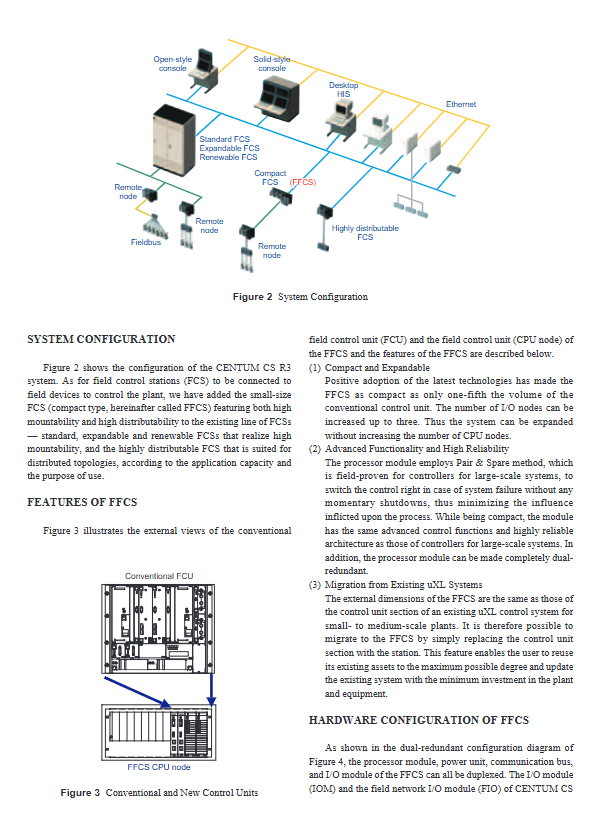
Figure 2 shows the configuration of the CENTUM CS R3 system. As for field control stations (FCS) to be connected to field devices to control the plant, we have added the small-size FCS (compact type, hereinafter called FFCS) featuring both high mountability and high distributability to the existing line of FCSs — standard, expandable and renewable FCSs that realize high mountability, and the highly distributable FCS that is suited for distributed topologies, according to the application capacity and the purpose of use.
FEATURES OF FFCS
Figure 3 illustrates the external views of the conventional field control unit (FCU) and the field control unit (CPU node) of the FFCS and the features of the FFCS are described below.
(1) Compact and Expandable
Positive adoption of the latest technologies has made the FFCS as compact as only one-fifth the volume of the conventional control unit. The number of I/O nodes can be increased up to three. Thus the system can be expanded without increasing the number of CPU nodes.
(2) Advanced Functionality and High Reliability
The processor module employs Pair & Spare method, which is field-proven for controllers for large-scale systems, to switch the control right in case of system failure without any momentary shutdowns, thus minimizing the influence inflicted upon the process. While being compact, the module has the same advanced control functions and highly reliable architecture as those of controllers for large-scale systems. In addition, the processor module can be made completely dualredundant.
(3) Migration from Existing uXL Systems
The external dimensions of the FFCS are the same as those of the control unit section of an existing uXL control system for small- to medium-scale plants. It is therefore possible to migrate to the FFCS by simply replacing the control unit section with the station. This feature enables the user to reuse its existing assets to the maximum possible degree and update the existing system with the minimum investment in the plant and equipment.
HARDWARE CONFIGURATION OF FFCS
As shown in the dual-redundant configuration diagram of Figure 4, the processor module, power unit, communication bus, and I/O module of the FFCS can all be duplexed. The I/O module (IOM) and the field network I/O module (FIO) of CENTUM CS R3 have been made common to each other. This section focuses on the hardware of the newly developed CPU node.
CPU Node
A maximum of eight IOMs can be installed in the CPU node, allowing the CPU node to operate alone as the minimum system of the FFCS.
A maximum of three extension nodes (direct-coupling and remote nodes) can be connected to the CPU node. When connecting the CPU node and direct-coupling node, an ESB bus coupler module (EC401) is installed in the IOM section of the CPU node and an ESB bus slave interface module (SB401) is installed in the extension node. When using the remote node in place of the extension node, an ER bus master interface module (EB401) is installed in the IOM section of the CPU node or directcoupling node.
Processor Module (CP401)
Figure 5 shows the dual-redundant configuration of the processor modules. The dual-redundant processor modules employ the field-proven Pair & Spare method. Each processor module comprises two MPUs, where the MPUs perform the same control computations and the computation results are crosschecked by the collators to detect transient errors. With the dual redundancy of processor modules, the transfer of the control right in case of system failure and the continuation of control are accomplished without any momentary shutdown, achieving high degrees of system availability.
- OMRON
- ABB
- General Electric
- EMERSON
- Honeywell
- HIMA
- ALSTOM
- Rolls-Royce
- MOTOROLA
- Rockwell
- Siemens
- Woodward
- YOKOGAWA
- FOXBORO
- KOLLMORGEN
- MOOG
- KB
- YAMAHA
- BENDER
- TEKTRONIX
- Westinghouse
- AMAT
- AB
- XYCOM
- Yaskawa
- B&R
- Schneider
- KONGSBERG
- NI
- WATLOW
- ProSoft
- SEW
- ADVANCED
- Reliance
- TRICONEX
- METSO
- MAN
- Advantest
- STUDER
- DANAHER MOTION
- Bently
- Galil
- EATON
- MOLEX
- DEIF
- B&W
- ZYGO
- Aerotech
- DANFOSS
- Beijer
- Moxa
- Rexroth
- Johnson
- WAGO
- TOSHIBA
- BMCM
- SMC
- HITACHI
- HIRSCHMANN
- Application field
- XP POWER
- CTI
- TRICON
- STOBER
- Thinklogical
- Horner Automation
- Meggitt
- Fanuc
- Baldor
- SHINKAWA
- Other Brands
- UniOP
- KUKA
- Iba
- Beckhoff
- ADLINK
-
 Sigmatek MDD111-1 DIAS Drive Axis Module
 -
 Sigmatek DKL042 05-024-042 Terminal Module
 -
 Sigmatek DM822 Control Module
 -
 Sigmatek CDM167 12-008-167-O Module
 -
 Sigmatek TAE151 Touch Display Unit
 -
 Sigmatek DCC041 SLIDES Module 05-700-041-D
 -
 Sigmatek AKM65M-ANC2GBB0 PM Servo Motor
 -
 Sigmatek ETT221 01-230-221 Operator Terminal
 -
 Sigmatek SLIDES DAM 124 Analog Module
 -
Sigmatek AKM31C-ANCNGBB0 Servo Motor
-
 Mannesmann Demag Sigmatek CP626 Central Unit
 -
 SIGMATEK 0332.554.03 Board 371071000154
 -
 SIGMATEK 12-250-021 Base Plate Back Panel CM5V020
 -
 SIGMATEK DM162 S-DIAS Digital Mix Module
 -
 DEMAG ERGOTECH 061 381 66 Sigmatek 9842.243.02 Circuit Board
 -
 SIGMATEK CP313-1 PLC Module
 -
Sigmatek ETV0551-2 VARAN Touch Terminal
-
 Sigmatek SDM 081 FS S-Dias Safety Module
 -
 DEMAG 05-250-023 Ergotech Motherboard with Sigmatek TMS012
 -
Sigmatek CM5V020 12-250-023-K Wiring Base
-
 Sigma Tek 5000B-37 Attitude Gyro Indicator
 -
 Sigmatek SDD120-2 DIAS Drive
 -
 Sigmatek CME221 Memory Module
 -
 Sigmatek DCP640 DIAS Central Unit
 -
 Sigmatek STO040 Safety Output Module
 -
Sigmatek CET281 Control Panel
-
 Sigmatek CIPC LX800 Demag NC5 CPU
 -
 Sigmatek DKL093 05-024-093 Terminal Module
 -
 Sigmatek AI088 20-009-088 Analog Input Module
 -
Sigmatek CAI888 Analog Input Module
-
SIGMATEK CCA021 12-025-021 Analog Output Module
-
SIGMATEK 1104.579.05 Control Module
-
SIGMATEK SDI100 Digital Input Module
-
 SIGMATEK C-IPC 256MB LX800 Compact Dias
 -
 SIGMATEK 9423.090.02 Control Module
 -
SIGMATEK C-IPC 256 Power Supply 148498
-
 SIGMATEK CAI025 Analog Input Module
 -
 SIGMATEK CTO166 Digital Output Module
 -
 SIGMATEK CP112 20-004-112 Processor Module
 -
SIGMATEK CAI887 12-009-887 Safety Module
-
 Sigma-Tek 4000B-31 Directional Gyro 1U262-002-42
 -
Sigmatek C-IPC 256MB LX800 IPC Controller
-
Sigmatek C-IPC 01-450-031 Industrial PC LX800
-
Sigmatek C-IPC 256 Industrial PC Controller
-
Sigmatek CCP-531 PLC Processor Module
-
Sigmatek CDI163 Digital Input Module
-
 Sigmatek ETV0501 VARAN Terminal 12-230-0501
 -
 Sigmatek CTMS020 C-DIAS Technology Module
 -
 Sigmatek CIV512 VARAN Switch Module
 -
 Sigmatek HU011 20-080-011 Interface Module
 -
SIGMATEK SLIDES DAM 124 Module
-
 SIGMATEK C-IPC 161 01-450-161L Industrial PC
 -
SIGMATEK C-IPC 128MB VIA 733MHz 01-450-024-K
-
 SIGMATEK 12-780-012 R8-IPC Geode LX800 Module
 -
SIGMATEK CAM124 Analog Module
-
 SIGMATEK S1 032-8AF61-R4 EZ Servo Motor
 -
 SIGMATEK CTO163 Digital Output Module
 -
 SIGMATEK CCP082 12-004-082 Processor Module
 -
 SIGMATEK CRCH081 C-DIAS Temperature Module
 -
 SIGMATEK PC322-K 01-310-322-K Industrial PC
 -
SIGMATEK SDD310-2 Servo Drive
-
 SIGMATEK AI084 Analog Input Module
 -
SIGMATEK CRCH081 12-752-081 Temperature Module
-
Sigma-Tek 5000L-4 Attitude Gyro 1U284-001-3
-
 SIGMATEK CM5V020 12-250-023-K Wiring Module
 -
Sigma-Tek 4000H-6 Directional Gyro IU262-035-7
-
 SIGMATEK Dias DCP160 05-004-160 Processor Module
 -
SIGMATEK 0147.395.02 Control Module
-
SIGMATEK A1084 Control Module
-
SIGMATEK DI200 20-006-2000 Digital Input Module
-
Sigmatek DNC115 Encoder Module
-
 Sigmatek DAM122 05-017-122 Analog Module
 -
Sigmatek 9802.289.01 Control Board TA71 Display
-
Sigmatek TO127 20-007-127 Digital Output Module
-
Sigmatek DNC031 05-011-031 Digital Module
-
Sigmatek VI022 20-003-022 Interface Module
-
Sigmatek CAI085 Analog Input Module
-
 Sigmatek CP111 S-DIAS CPU Module
 -
Sigmatek CTMS030 Krauss Maffei Module
-
 Sigmatek CAM123 Control Module
 -
 Sigmatek TAE732-P 01-240-732-P Touch Display Unit
 -
Sigmatek MDM021 Digital Mixed Module
-
Sigmatek DCP642 DIAS Central Unit
-
 Sigmatek CST022 12-014-022 C-DIAS Module
 -
 Sigmatek SRO021 20-893-021 Safety Relay Output
 -
 Krauss Maffei MC5 Control System Sigmatek
 -
 Sigmatek DC061 Module 18-24VDC 300mA
 -
 Herrmann EVT0855 Ultrasonic Welder Touch Panel
 -
Sigmatek CIV521 Control Module 1.4A 2W
-
Sigmatek DDI61 05-006-161 Digital Input Module
-
SIGMATEK ETT312-E Touch Terminal 01-230-312
-
Cessna S3326-1 Sigma Tek 5000B-67 Gyro 1U149-015-9
-
SIGMATEK PS101 Power Supply Module
-
SIGMATEK 0332.554.03 Control Module 371071000154
-
 SIGMATEK ETT312-E Touch Terminal 01-230-312
 -
SIGMATEK CDM163 Control Module
-
 SIGMATEK VSV046 16-023-046 Module
 -
SIGMATEK AM221 20-017-221 Analog Module
-
SIGMATEK CTS051 12-053-051 Control Module
-
SIGMATEK AM221 20-017-221 Analog Module
-
Sigmatek CSDI161 12-891-161 Safety Input Module
-
Sigma Tek 4000C-1 Directional Gyro Indicator
-
Sigmatek ETV0501 12-230-0501 VARAN Terminal
-
Sigmatek DDM165 SLIDES Module
-
Sigmatek N100 20-011-100 Control Module
-
Sigmatek AKM54K-ANC2R-B0 PM Servo Motor
-
Sigmatek CTO166 Digital Output Module
-
Sigmatek CP212-K 20-004-212-K CPU Module
-
Sigmatek CDI161 Digital Input Module
-
Sigmatek DCC080 05-700-080-2 Control Module
-
 SIGMATEK SCP011 S-DIAS Safety CPU
 -
SIGMATEK SCP011 S-DIAS Safety CPU
-
SIGMATEK SRO022 Relay Output Module
-
SIGMATEK MDD 121 Drive Axis Module
-
SIGMATEK DSI021 SLIDES Siemens Interface
-
SIGMATEK DIAS DCP161 Module 05-004-161
-
 Sigmatek ETT312 Built-in Touch Terminal
 -
SIGMATEK DCP 643 DIAS Controller System
-
SIGMATEK CIO021 Multi I/O Module
-
SIGMATEK CTMS020 Control Module
-
 Sigmatek CME 221 Memory Module
 -
Sigmatek 0420.615.01 Control Board
-
Sigmatek CP111 20-004-111 CPU Module
-
Sigmatek 9405.065.03 Control Board
-
Sigmatek ETEK 01-450-032-K C-IPC 256MB Industrial PC
-
Sigmatek CTO163 12-007-163 Safety Output Module
-
Sigmatek TO081 20-007-081 Digital Output Module
-
 Sigmatek SI021 20-022-021 Safety Input Module


