
Foxboro Evo ™ Compact 200 Series I/O subsystem of the system
Core function: Provides analog measurement, digital sensing, analog/discrete control capabilities, supporting continuous, batch, and discrete control solutions
Compatibility: Fully compatible with existing I/A Series ® The system's 200 Series I/O devices and traditional 100 Series I/O devices support upgrading and replacing existing standard 200 Series subsystems
Core value: Distributed deployment reduces on-site wiring, trunking, and conduit installation costs, and adapts to the flexible deployment needs of industrial scenarios
Foxboro Evo ™ Compact 200 Series I/O subsystem of the system
System core positioning and compatibility
Product ownership: Foxboro Evo ™ Compact 200 Series I/O subsystem for process automation systems, launched by Schneider Electric
Core function: Provides analog measurement, digital sensing, analog/discrete control capabilities, supporting continuous, batch, and discrete control solutions
Compatibility: Fully compatible with existing I/A Series ® The system's 200 Series I/O devices and traditional 100 Series I/O devices support upgrading and replacing existing standard 200 Series subsystems
Core value: Distributed deployment reduces on-site wiring, trunking, and conduit installation costs, and adapts to the flexible deployment needs of industrial scenarios
Core Components and Classification
Component type, key product, core function, key parameters
Control processor FCP280 200/100 Series FBMs control interface, supporting 4 HDLC buses and up to 128 FBMs
FCP270 is compatible with dual baud rates (2Mbps/268Kbps) and requires FBI100 to adapt to 100 Series. It supports 32 200 Series FBMs without FEM100
ZCP270 is compatible with 100 Series racks and supports up to 128 FBMs per module through FCMs communication
Fieldbus Modules (FBMs) Analog Input Class FBM201 (0-20mA), FBM214b (HART) ® Input channel isolation/differential isolation, 8-32 channels
Analog output class FBM215 (HART) ® Output), FBM237 (redundant 0-20mA) and other fail safe configurations (hold/fallback), 4-8 channels
Discrete I/O class FBM217 (32 channel input), FBM219 (24DI+8DO) and other group isolation/channel isolation, 8-32 channels
Hybrid I/O classes such as FBM227 (analog+discrete) and FBM247 (current/voltage/pulse) support HART ®、 Multi signal type adaptation
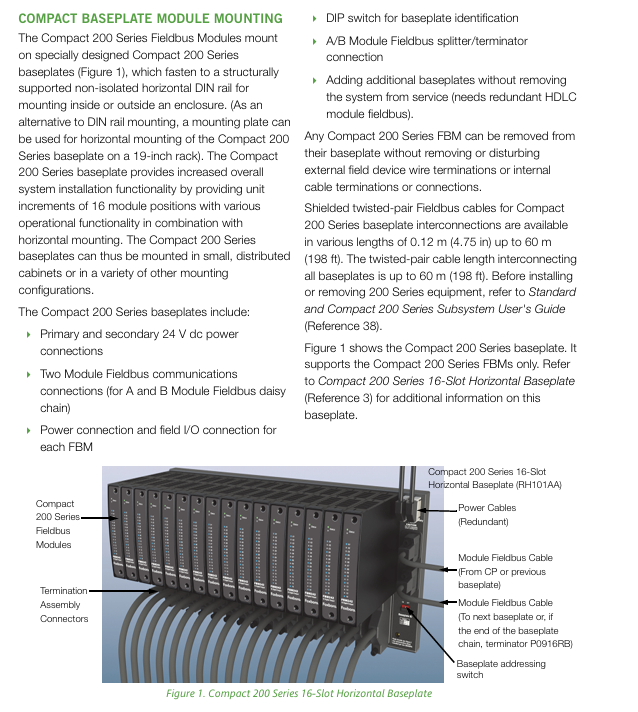
Auxiliary component base plate 16 slot horizontal base plate (RH101AA) supports 16 FBMs, DIN rail/19 inch rack installation
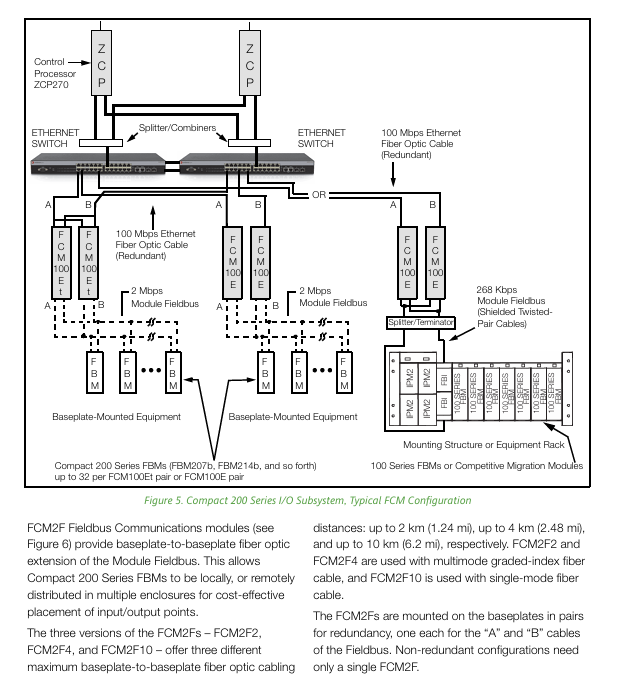
Communication module FCM100E/Et (fiber to bus conversion), FCM2F (fiber extension) FCM2F supports up to 10km single-mode fiber
Isolator FBI200 extends bus distance to 305m, isolation filtering
Shell G/K series G13/G14 (system/terminal shell), K13/K14 IP43/54 protection, suitable for ordinary/harsh environments
Key technical characteristics and advantages
performance
The analog input adopts SigmaDelta fast integration ADC, with an update speed of up to 25ms, suitable for high-speed regulation and control
Built in configurable moving average filter effectively removes electromagnetic noise
System communication speed: 100Mbps Ethernet (control network), 2Mbps/268Kbps HDLC module bus
Reliability Design
Integrating logic functions into a single ASIC chip reduces the number, volume, heat dissipation, and cost of components
Single module availability 0.999974 (redundant power supply+2-hour MTTR), redundant module availability 0.9999964
Optional redundancy: power supply, control network FCMs、 Control processors, module bus cables, and some FBMs
Deployment flexibility
Compact size: 1 16 slot compact base plate+16 FBMs space<2 standard 200 Series base plates+16 standard FBMs
Installation method: Horizontal DIN rail installation or 19 inch rack installation, supporting distributed small cabinet deployment
Cable length: shielded twisted pair 0.12-60m, fiber optic extension up to 20km (2 pairs of FCM2F10)
environmental adaptability
Pollution protection: Class G3 (ISA S71.04), suitable for harsh industrial pollution environments
Working temperature: FBMs up to 60 ℃ (140 ° F)
Safety certifications: UL (US Canada), ATEX (Explosion proof), CE (Low Voltage/EMC/ATEX Directive), RoHS compliance
System configuration and upgrade requirements
configuration scheme
Pure compact chassis configuration: only using Compact 200 Series chassis
Mixed configuration: Compact mixed with standard 200 Series baseboard (supports compact in front/back)
Maximum scale: Up to 32 FBMs per single bottom chain, 4 bottom chains supported per FCP280
Upgrade requirements
Space requirement: The installation location should have sufficient horizontal DIN rails
Power Requirements: Supports FPS480-24/FPS400-24/FPS220-24/FPS120-24 power supplies
Cooling requirement: 1 fan tray is required for every 2 adjacent compact baseboards (1 for each baseboard when deployed separately)
Cable replacement: The terminal cable of the standard 200 Series FBMs needs to be replaced with a Compact series adapter cable
Electrical and safety regulations
Grounding requirements: comply with IEC 61000-5-1/5-2 standard (or regional equivalent standard)
Power configuration: 24V DC power supply, supports single/redundant power distribution, triggers icon color change, system alarm, and print notification in case of power failure
Isolation level: FBMs support channel isolation, differential isolation, and group isolation, with some terminal components (TA) providing additional channel isolation
Wiring characteristics: FBMs are hot swappable and do not affect external field device wiring and internal cable connections
Key questions and answers
Question 1: What are the core advantages of the Compact 200 Series I/O subsystem? What scenarios are applicable?
Answer: The core advantages are concentrated in three points: ① High reliability and availability, achieved through ASIC integrated design with high availability of single module 0.999974 and redundant module 0.9999964, suitable for continuous operation requirements; ② Flexible deployment and compact design, with a volume only half of the standard 200 Series, supporting distributed DIN rail/rack installation, reducing wiring costs; ③ Strong environmental adaptability and compatibility, Class G3 pollution protection, 60 ℃ high temperature tolerance, and compatibility with existing 100/200 Series I/O devices, supporting seamless system upgrades. Applicable scenarios include: continuous/batch/discrete control tasks in industrial sites, harsh polluted environments (such as chemical and metallurgical industries), large factories that require remote distributed deployment, and existing I/A Series ® System upgrade project.
Question 2: What are the core components of this subsystem? What are the differences in the carrying capacity of FBMs with different control processors?
Answer: The core components include: ① Control processor (FCP280/FCP270/ZCP270); ② 20+FBMs (analog/digital/hybrid I/O types); ③ 16 slot horizontal bottom plate, FBI200 isolator, FCM communication module; ④ G/K series protective casing and terminal components (TA). The differences in the carrying capacity of FBMs among different processors are as follows:
FCP280: Supports up to 128 200 Series FBMs, or 128 (100+200 Series) hybrid FBMs (up to 64 for 100 Series);
FCP270: Up to 32 200 Series FBMs without FEM100, up to 128 with FEM100, and up to 64 with 100 Series;
ZCP270: Supports up to 128 FBMs (100/200 Series) through FCM100E, with a single FCM100Et pair supporting 32 FBMs.
Question 3: What are the components of the system's redundant configuration? What is the cable length limit during deployment?
Answer: ① Redundant configuration coverage: power supply, control network, FCMs (communication modules), control processors, module bus cables, and some FBMs (such as FBM216b/FBM218); Redundant design can avoid single point failures and ensure the continuous operation of critical process circuits. ② Cable length limit:
Shielded twisted pair cable (module bus/backplane interconnection): 0.12-60m (single segment), total length of the entire 2Mbps HDLC bus ≤ 60m (including FBI200 connection);
Fiber optic cables (FCM2F series): FCM2F2 (2km), FCM2F4 (4km), FCM2F10 (10km), 2 pairs of FCM2F10 can be extended up to 20km;
Terminal Assembly (TA) and Base Plate Connection Cable: 0.5-30m.
Question 2: What are the core components of this subsystem? What are the differences in the carrying capacity of FBMs with different control processors?
Answer: The core components include: ① Control processor (FCP280/FCP270/ZCP270); ② 20+FBMs (analog/digital/hybrid I/O types); ③ 16 slot horizontal bottom plate, FBI200 isolator, FCM communication module; ④ G/K series protective casing and terminal components (TA). The differences in the carrying capacity of FBMs among different processors are as follows:
FCP280: Supports up to 128 200 Series FBMs, or 128 (100+200 Series) hybrid FBMs (up to 64 for 100 Series);
FCP270: Up to 32 200 Series FBMs without FEM100, up to 128 with FEM100, and up to 64 with 100 Series;
ZCP270: Supports up to 128 FBMs (100/200 Series) through FCM100E, with a single FCM100Et pair supporting 32 FBMs.
Question 3: What are the components of the system's redundant configuration? What is the cable length limit during deployment?
Answer: ① Redundant configuration coverage: power supply, control network, FCMs (communication modules), control processors, module bus cables, and some FBMs (such as FBM216b/FBM218); Redundant design can avoid single point failures and ensure the continuous operation of critical process circuits. ② Cable length limit:
Shielded twisted pair cable (module bus/backplane interconnection): 0.12-60m (single segment), total length of the entire 2Mbps HDLC bus ≤ 60m (including FBI200 connection);
Fiber optic cables (FCM2F series): FCM2F2 (2km), FCM2F4 (4km), FCM2F10 (10km), 2 pairs of FCM2F10 can be extended up to 20km;
Terminal Assembly (TA) and Base Plate Connection Cable: 0.5-30m.
- OMRON
- ABB
- General Electric
- EMERSON
- Honeywell
- HIMA
- ALSTOM
- Rolls-Royce
- MOTOROLA
- Rockwell
- Siemens
- Woodward
- YOKOGAWA
- FOXBORO
- KOLLMORGEN
- MOOG
- KB
- YAMAHA
- BENDER
- TEKTRONIX
- Westinghouse
- AMAT
- AB
- XYCOM
- Yaskawa
- B&R
- Schneider
- KONGSBERG
- NI
- WATLOW
- ProSoft
- SEW
- ADVANCED
- Reliance
- TRICONEX
- METSO
- MAN
- Advantest
- STUDER
- DANAHER MOTION
- Bently
- Galil
- EATON
- MOLEX
- DEIF
- B&W
- ZYGO
- Aerotech
- DANFOSS
- Beijer
- Moxa
- Rexroth
- Johnson
- WAGO
- TOSHIBA
- BMCM
- SMC
- HITACHI
- HIRSCHMANN
- Application field
- XP POWER
- CTI
- TRICON
- STOBER
- Thinklogical
- Horner Automation
- Meggitt
- Fanuc
- Baldor
- SHINKAWA
- Other Brands
- UniOP
- KUKA
- Iba
- Beckhoff
- ADLINK
-
 Sigmatek MDD111-1 DIAS Drive Axis Module
 -
 Sigmatek DKL042 05-024-042 Terminal Module
 -
 Sigmatek DM822 Control Module
 -
 Sigmatek CDM167 12-008-167-O Module
 -
 Sigmatek TAE151 Touch Display Unit
 -
 Sigmatek DCC041 SLIDES Module 05-700-041-D
 -
 Sigmatek AKM65M-ANC2GBB0 PM Servo Motor
 -
 Sigmatek ETT221 01-230-221 Operator Terminal
 -
 Sigmatek SLIDES DAM 124 Analog Module
 -
Sigmatek AKM31C-ANCNGBB0 Servo Motor
-
 Mannesmann Demag Sigmatek CP626 Central Unit
 -
 SIGMATEK 0332.554.03 Board 371071000154
 -
 SIGMATEK 12-250-021 Base Plate Back Panel CM5V020
 -
 SIGMATEK DM162 S-DIAS Digital Mix Module
 -
 DEMAG ERGOTECH 061 381 66 Sigmatek 9842.243.02 Circuit Board
 -
 SIGMATEK CP313-1 PLC Module
 -
Sigmatek ETV0551-2 VARAN Touch Terminal
-
 Sigmatek SDM 081 FS S-Dias Safety Module
 -
 DEMAG 05-250-023 Ergotech Motherboard with Sigmatek TMS012
 -
Sigmatek CM5V020 12-250-023-K Wiring Base
-
 Sigma Tek 5000B-37 Attitude Gyro Indicator
 -
 Sigmatek SDD120-2 DIAS Drive
 -
 Sigmatek CME221 Memory Module
 -
 Sigmatek DCP640 DIAS Central Unit
 -
 Sigmatek STO040 Safety Output Module
 -
Sigmatek CET281 Control Panel
-
 Sigmatek CIPC LX800 Demag NC5 CPU
 -
 Sigmatek DKL093 05-024-093 Terminal Module
 -
 Sigmatek AI088 20-009-088 Analog Input Module
 -
Sigmatek CAI888 Analog Input Module
-
SIGMATEK CCA021 12-025-021 Analog Output Module
-
SIGMATEK 1104.579.05 Control Module
-
SIGMATEK SDI100 Digital Input Module
-
 SIGMATEK C-IPC 256MB LX800 Compact Dias
 -
 SIGMATEK 9423.090.02 Control Module
 -
SIGMATEK C-IPC 256 Power Supply 148498
-
 SIGMATEK CAI025 Analog Input Module
 -
 SIGMATEK CTO166 Digital Output Module
 -
 SIGMATEK CP112 20-004-112 Processor Module
 -
SIGMATEK CAI887 12-009-887 Safety Module
-
 Sigma-Tek 4000B-31 Directional Gyro 1U262-002-42
 -
Sigmatek C-IPC 256MB LX800 IPC Controller
-
Sigmatek C-IPC 01-450-031 Industrial PC LX800
-
Sigmatek C-IPC 256 Industrial PC Controller
-
Sigmatek CCP-531 PLC Processor Module
-
Sigmatek CDI163 Digital Input Module
-
 Sigmatek ETV0501 VARAN Terminal 12-230-0501
 -
 Sigmatek CTMS020 C-DIAS Technology Module
 -
 Sigmatek CIV512 VARAN Switch Module
 -
 Sigmatek HU011 20-080-011 Interface Module
 -
SIGMATEK SLIDES DAM 124 Module
-
 SIGMATEK C-IPC 161 01-450-161L Industrial PC
 -
SIGMATEK C-IPC 128MB VIA 733MHz 01-450-024-K
-
 SIGMATEK 12-780-012 R8-IPC Geode LX800 Module
 -
SIGMATEK CAM124 Analog Module
-
 SIGMATEK S1 032-8AF61-R4 EZ Servo Motor
 -
 SIGMATEK CTO163 Digital Output Module
 -
 SIGMATEK CCP082 12-004-082 Processor Module
 -
 SIGMATEK CRCH081 C-DIAS Temperature Module
 -
 SIGMATEK PC322-K 01-310-322-K Industrial PC
 -
SIGMATEK SDD310-2 Servo Drive
-
 SIGMATEK AI084 Analog Input Module
 -
SIGMATEK CRCH081 12-752-081 Temperature Module
-
Sigma-Tek 5000L-4 Attitude Gyro 1U284-001-3
-
 SIGMATEK CM5V020 12-250-023-K Wiring Module
 -
Sigma-Tek 4000H-6 Directional Gyro IU262-035-7
-
 SIGMATEK Dias DCP160 05-004-160 Processor Module
 -
SIGMATEK 0147.395.02 Control Module
-
SIGMATEK A1084 Control Module
-
SIGMATEK DI200 20-006-2000 Digital Input Module
-
Sigmatek DNC115 Encoder Module
-
 Sigmatek DAM122 05-017-122 Analog Module
 -
Sigmatek 9802.289.01 Control Board TA71 Display
-
Sigmatek TO127 20-007-127 Digital Output Module
-
Sigmatek DNC031 05-011-031 Digital Module
-
Sigmatek VI022 20-003-022 Interface Module
-
Sigmatek CAI085 Analog Input Module
-
 Sigmatek CP111 S-DIAS CPU Module
 -
Sigmatek CTMS030 Krauss Maffei Module
-
 Sigmatek CAM123 Control Module
 -
 Sigmatek TAE732-P 01-240-732-P Touch Display Unit
 -
Sigmatek MDM021 Digital Mixed Module
-
Sigmatek DCP642 DIAS Central Unit
-
 Sigmatek CST022 12-014-022 C-DIAS Module
 -
 Sigmatek SRO021 20-893-021 Safety Relay Output
 -
 Krauss Maffei MC5 Control System Sigmatek
 -
 Sigmatek DC061 Module 18-24VDC 300mA
 -
 Herrmann EVT0855 Ultrasonic Welder Touch Panel
 -
Sigmatek CIV521 Control Module 1.4A 2W
-
Sigmatek DDI61 05-006-161 Digital Input Module
-
SIGMATEK ETT312-E Touch Terminal 01-230-312
-
Cessna S3326-1 Sigma Tek 5000B-67 Gyro 1U149-015-9
-
SIGMATEK PS101 Power Supply Module
-
SIGMATEK 0332.554.03 Control Module 371071000154
-
 SIGMATEK ETT312-E Touch Terminal 01-230-312
 -
SIGMATEK CDM163 Control Module
-
 SIGMATEK VSV046 16-023-046 Module
 -
SIGMATEK AM221 20-017-221 Analog Module
-
SIGMATEK CTS051 12-053-051 Control Module
-
SIGMATEK AM221 20-017-221 Analog Module
-
Sigmatek CSDI161 12-891-161 Safety Input Module
-
Sigma Tek 4000C-1 Directional Gyro Indicator
-
Sigmatek ETV0501 12-230-0501 VARAN Terminal
-
Sigmatek DDM165 SLIDES Module
-
Sigmatek N100 20-011-100 Control Module
-
Sigmatek AKM54K-ANC2R-B0 PM Servo Motor
-
Sigmatek CTO166 Digital Output Module
-
Sigmatek CP212-K 20-004-212-K CPU Module
-
Sigmatek CDI161 Digital Input Module
-
Sigmatek DCC080 05-700-080-2 Control Module
-
 SIGMATEK SCP011 S-DIAS Safety CPU
 -
SIGMATEK SCP011 S-DIAS Safety CPU
-
SIGMATEK SRO022 Relay Output Module
-
SIGMATEK MDD 121 Drive Axis Module
-
SIGMATEK DSI021 SLIDES Siemens Interface
-
SIGMATEK DIAS DCP161 Module 05-004-161
-
 Sigmatek ETT312 Built-in Touch Terminal
 -
SIGMATEK DCP 643 DIAS Controller System
-
SIGMATEK CIO021 Multi I/O Module
-
SIGMATEK CTMS020 Control Module
-
 Sigmatek CME 221 Memory Module
 -
Sigmatek 0420.615.01 Control Board
-
Sigmatek CP111 20-004-111 CPU Module
-
Sigmatek 9405.065.03 Control Board
-
Sigmatek ETEK 01-450-032-K C-IPC 256MB Industrial PC
-
Sigmatek CTO163 12-007-163 Safety Output Module
-
Sigmatek TO081 20-007-081 Digital Output Module
-
 Sigmatek SI021 20-022-021 Safety Input Module


