
YASKAWA GA500 series AC micro frequency converter
Model identification: CIPR-GA50Cxxxxxxxx, core specifications are classified as follows:
Voltage level, input type, power range, key parameters
200V single-phase 0.1-4.0 kW Max
200V C three-phase 0.1-22kW speed control range 1:40~1:100
400V level three-phase 0.37-30 kW protection level IP20/UL open type
Core features: Supports 5 control modes, compatible with induction motors, PM motors (including IPM/SPM), and synchronous reluctance motors (SynRM), with functions such as automatic tuning, energy saving, and dynamic braking.
Control signal: External control signals (such as limit switches, PLC commands) can respond normally.
Standard compliance and safety requirements
1. Main compliance standards
(1) EU CE certification
Applicable directives: Low Voltage Directive (LVD 2014/35/EU), Electromagnetic Compatibility Directive (EMC 2014/30/EU), Machinery Directive (MD 2006/42/EC);
Compliance requirements:
LVD: Complies with EN 61800-5-1:2007, insulation class II, overvoltage category III;
EMC: The built-in filter model must meet EN 61800-3:2004/A1:2012 standards for radiation and conducted disturbances;
MD: Cooperate with safety circuits (such as Safe Disable) to achieve PL e (Cat. III) safety level.
(2) UL certification in the United States and Canada
Applicable standards: UL 61800-5-1, Canadian Electrical Code (CEC);
Compliance requirements:
Branch circuit protection: designated semiconductor fuses (such as FWH-25A14F for B001 and FWH-200B for 4060) must be used;
Control circuit: UL certified Class 2 power supply is required, and the wire is NEC Class 1 conductor;
Motor protection: Electronic thermal protection must comply with NEC standards, and external thermal overload relays are required when driving multiple motors.
(3) Chinese standards
RoHS compliance: restrict six hazardous substances including lead, mercury, cadmium, etc., provide a list of hazardous substances and recycling labels;
Safety standard: Complies with GB/T 12668.2-2013 (Variable Speed Electrical Transmission Systems).
2. Core security requirements
(1) Electrical safety
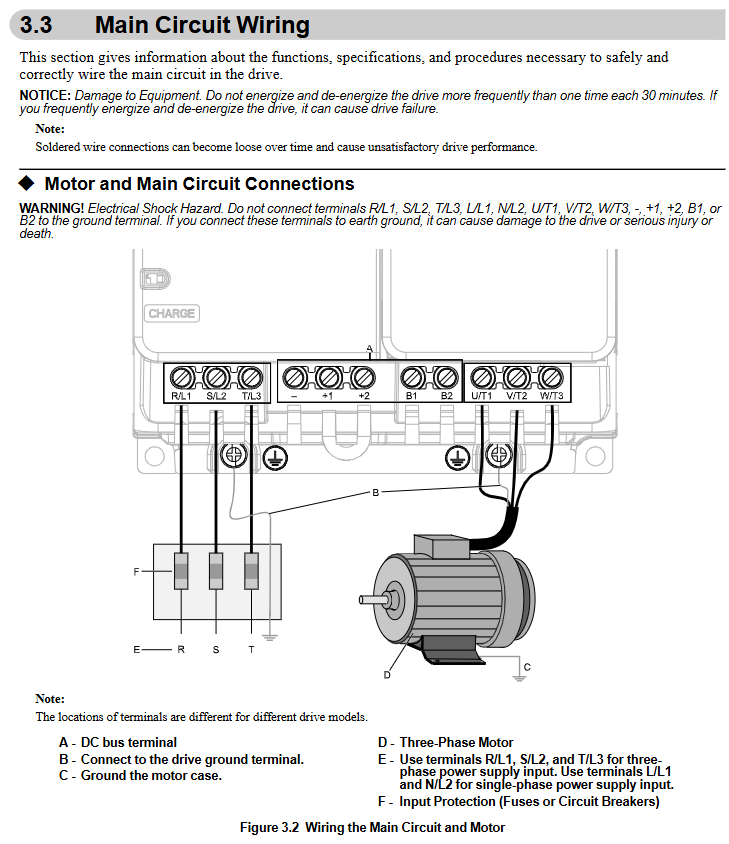
Power off operation: Before wiring and maintenance, all power sources must be disconnected, and the capacitor must be discharged (the indicator light is off and the voltage is ≤ 50Vdc), waiting for at least 5 minutes;
Grounding requirements: The protective grounding wire must be firmly connected, virtual connection is prohibited, and it should not be shared with high current equipment such as welding machines for grounding;
Leakage protection: Drivers with built-in EMC filters may experience leakage currents exceeding 3.5mA, requiring the use of Type B RCM/RCD.
(2) Mechanical safety
Installation protection: The driver should be fixed on non combustible materials such as metal, and it is forbidden to cover the ventilation openings. There should be no flammable materials around;
Operation protection: Before testing and running, personnel and obstacles around the equipment need to be removed, and components such as couplings and shaft keys need to be installed;
Emergency stop: An emergency stop circuit must be configured independently of the driver to ensure that the power can be quickly cut off in case of a malfunction.
(3) Functional safety
Safe Disable function: Safe torque shutdown is achieved through H1, H2, and HC terminals, using Source mode with a wiring length of ≤ 30m;
Prevent sudden startup: The 3-wire control system needs to set A1-03=3330 and b1-17=0 to avoid automatic startup after power on;
Fault reset: After the fault occurs, it is necessary to first investigate the cause (such as overload, short circuit) before resetting. It is forbidden to force a reset directly.
Operation and maintenance
1. Network communication
(1) Supporting protocols and configurations
Core protocol: MEMOBU/Modbus (RS-485 interface), supports master-slave architecture, can communicate with PLC, touch screen and other devices;
Communication parameters: maximum baud rate of 115.2kbps, data format of 8-bit data bits+1-bit stop bit+no checksum (configurable);
Terminal resistor: The last driver in the network needs to enable the built-in 120 Ω terminal resistor through DIP switch S2 to reduce signal reflection.
(2) Communication function
Data exchange: capable of reading driver operating parameters (output frequency, current, voltage), modifying control parameters, and receiving external control commands;
Fault reporting: When the drive fails, the fault code can be actively reported through the communication protocol for remote diagnosis;
Multi machine linkage: supports networking of multiple drivers to achieve synchronous control (such as multi motor linkage in assembly lines).
2. Troubleshooting
(1) Fault classification and handling principles
Fault types: serious faults (such as overvoltage ov, overcurrent oC, motor overload oL1), minor faults/alarms (such as undervoltage UV, overheating OH), parameter errors (such as incorrect oPE parameter range);
Processing procedure:
Record fault codes (read through keyboard or communication);
Power off for cooling, check wiring (main circuit phase sequence, control circuit signal);
Verify parameters (motor parameters, protection parameters, control mode);
Test the load (whether it is stuck or overloaded);
If unable to troubleshoot, contact YASKAWA technical support.
(2) Common troubleshooting solutions
Fault code, fault cause, and solution
OV decelerates too quickly, brake resistor fault, high grid voltage prolongs deceleration time (C1-02), check the wiring and resistance of the brake resistor, and detect the grid voltage
Overload of oL1 motor, incorrect motor parameter settings, poor cooling to reduce load, re-enter motor nameplate parameters, clean drive ventilation port
- OMRON
- ABB
- General Electric
- EMERSON
- Honeywell
- HIMA
- ALSTOM
- Rolls-Royce
- MOTOROLA
- Rockwell
- Siemens
- Woodward
- YOKOGAWA
- FOXBORO
- KOLLMORGEN
- MOOG
- KB
- YAMAHA
- BENDER
- TEKTRONIX
- Westinghouse
- AMAT
- AB
- XYCOM
- Yaskawa
- B&R
- Schneider
- KONGSBERG
- NI
- WATLOW
- ProSoft
- SEW
- ADVANCED
- Reliance
- TRICONEX
- METSO
- MAN
- Advantest
- STUDER
- DANAHER MOTION
- Bently
- Galil
- EATON
- MOLEX
- DEIF
- B&W
- ZYGO
- Aerotech
- DANFOSS
- Beijer
- Moxa
- Rexroth
- Johnson
- WAGO
- TOSHIBA
- BMCM
- SMC
- HITACHI
- HIRSCHMANN
- Application field
- XP POWER
- CTI
- TRICON
- STOBER
- Thinklogical
- Horner Automation
- Meggitt
- Fanuc
- Baldor
- SHINKAWA
- Other Brands
- UniOP
- KUKA
- Iba
- Beckhoff
- ADLINK
-
 Metso Valmet BIU4 A413146 Binary Input Unit
 -
 Valmet AIU-8 Simulateur Board 421522-1a Analog Simulator
 -
 Valmet BIU8A Binary Input Unit 542803-3B M851222 M1
 -
Valmet IQ Web Color DH Photoelectric Sensor A418182 2.04
-
Valmet A413200 AIU-8 Simulator Board 191151 421522-1A
-
 Valmet Automation SCU M851006 System Control Unit Module
 -
 Valmet 857565/851565 Damatic Keyboard IP40 5V Operator Interface
 -
 Valmet A413077 FBC2 Module Rev 06 Field Bus Controller
 -
 Valmet DMU 2 PCB Module 545142-3A DM Data Management Unit
 -
 Valmet AIU16T PCB Card M851208 Analog Input Module
 -
 Valmet A413181 PLU Board
 -
 Valmet m851006 SCU Module
 -
 Valmet Metso 181226 Digital Input Module
 -
 Valmet AIU16T Analog Input Module - 16-Channel 65421466-2B MT924 V1.3
 -
 Valmet WIN3136875 Slide Clutch
 -
Metso Valmet TIU61 A413111 Temperature Input Unit
-
 Valmet MC12S Slitter Motor
 -
 Valmet A413139 AOH4 Board - Analog Output High Module
 -
 Valmet A409001 BIU85 Board
 -
Valmet A413063 DMU Board
-
 Valmet A413325 IPU I/O Power Unit
 -
 Valmet M851004 M2 CPU Module
 -
Valmet IOP345 Digital Input Module
-
 Metso Valmet A413215 Communication Board
 -
 Valmet DIFF-EL 80 M1 Transmitter
 -
 Valmet A413001 CPU Module
 -
 Valmet M899520 TDC-2 Module
 -
Valmet A409001 BIU85 Board
-
 Metso Valmet A413005 CPU Module
 -
 VALMET PUD 10 B Process Automation Rack with CPU SCU Module
 -
Valmet A413091 GDU1 Board
-
VALMET M851006 M2 SCU Module
-
 Lyngso Valmet Marine 990.896.000 Position Loop Card
 -
 Valmet Cooking Liquor Measurement 3417H
 -
 VALMET ABMB MT831 PCB Card
 -
Valmet Automation A413325 IPU I/O Power Unit
-
 Valmet Metso Consistency Transmitter Smart Pulp M2
 -
 VALMET METSO A413274 Connection Module
 -
 VALMET PI33S1KSA02RSA-ELI26 Switch
 -
 VALMET ND9103HN-CE07-K05 Intelligent Valve Controller
 -
VALMET PMB 2R 16 Slot Backplane PCB Card
-
NELES VALMET A413135 AOU 4 Output Module
-
 Metso Valmet A413345 FPU Power Unit
 -
VALMET A413171 PIC Module
-
 VALMET A413620 Repeater Module
 -
 Valmet M851521 Memory Card
 -
 Valmet DIFF-EL 140 M1 Transmitter
 -
 Valmet A413064 DMU Module
 -
 Valmet IOP371 I/O Bus Extender Module
 -
Valmet Cooking Liquor Measurement 3400 Model 3417H
-
 Metso Valmet A413043 CPU Module – Industrial Processor
 -
 Valmet BIU4 M851221 Binary Input Module
 -
 Valmet PMB 1S CPU SCU Rack Module
 -
 Valmet A413248 Controller Module
 -
 Valmet PDP601 Distributed Processing Unit
 -
 VALMET M851004 M2 CPU Printed Circuit Board Module
 -
 Metso Valmet A413045 Ver.05 CPU Module
 -
 Valmet A413181 Ver.05 PLU1 Board
 -
 Lyngso Valmet ATB16 Controller Board
 -
VALMET AIU 16 Analog Input Unit 545100-3A/3B
-
 VALMET PUD 10 B Power Supply PCB Rack Module
 -
 Valmet MS-50V/120V Bearing Unit
 -
Valmet PDP603 Distributed Processing Unit – DPU Module
-
Valmet A413110 TIU Board – Terminal Interface Unit
-
 Valmet S420154 I/O Backplane PCB – Printed Circuit Board
 -
 Valmet A413173 Industrial Control Module
 -
 Valmet A413044 CPU Module
 -
Valmet A4IU1 Analog I/O Module
-
 Valmet A413325 IPU Power Unit – PLC Module
 -
 Valmet M851002 CPU Module – Central Processing Unit
 -
 Valmet PUD10B Power Supply Board
 -
Valmet K00990 Master CPU Electronic Assy
-
Valmet Metso IOP345 Input Module
-
 Metso Automation T545215 Board
 -
Valmet Metso IOP304 Input Module
-
Valmet 542844-6A SCU Module
-
 Metso A413043 Ver.11 Valmet CPU Module
 -
Valmet Automation BIU 8A Input Module
-
Metso A413044 Ver05 Valmet CPU Module
-
 VALMET 542821-5A Control System Rack Module
 -
 Metso A413005 Ver.04 Valmet CPU Module
 -
 Valmet M851207 AIU16 Card
 -
Valmet BIU8 Binary Input Unit
-
 VALMET 547070-2B CPU Printed Circuit Board Module
 -
 Valmet Automation A413325 Power Module
 -
 VALMET AUTOMATION A413135 AOU4 Module
 -
 VALMET ACU A413165 Model 9 Analog Controller
 -
 VALMET AUTOMATION A413511-02 Slot Rack with I/O Backplane
 -
 Valmet A413148 BIE 4 Rev 08 Board
 -
 Valmet ATB16-4 Controller Board
 -
 Neles Automation BOR82 A413292 Processor Module
 -
 Valmet A413015 NCU Module – Network Control Unit
 -
 Valmet AIU 16 Analog Input Unit – M8512071
 -
 Metso Valmet A413091 GDU Board
 -
Valmet M851565 Damatic Main Keyboard
-
Metso A413082 CPU Module
-
 Valmet A403037 GDC – Graphics Display Controller
 -
Valmet A413076 FBC Board
-
Valmet A413015 NCU Module – Network Control Unit
-
Valmet A413082 CPU Module
-
 VALMET AUTOMATION A413620 Fieldbus Repeater
 -
 Valmet Metso IOP341R Positioner Module
 -
 Metso A413082 Ver.04 CPU Module
 -
 Valmet Metso MCA FT250/10 10 Inch Sensor
 -
 Valmet N0542 ABMB Printed Circuit Board
 -
 Valmet A413000 Ver.07 CPU Module
 -
Valmet A413061 Ver.05 DMU Module
-
 Valmet M851241 M1 BCU Binary Input Module
 -
Valmet Automation NCU A413015 Circuit Board
-
Valmet A413046 Ver.06 CPU Module
-
 Valmet A651B001 Panel Mount Keyboard
 -
Valmet IQ Scanner A418080R Basis Weight Detector Head
-
Metso Valmet A413370 ESU Ethernet SCSI Unit
-
 Valmet A413340 FPU Power Supply Unit
 -
 Valmet SKF GE 400/600 Spherical Plain Bearing
 -
Valmet SCU PCB Card 542844-7B – System Control Unit
-
Valmet A413075 FBU Fieldbus Controller Module
-
 Valmet A413171 PIC Card Binary Output
 -
Valmet A413002 Ver.05 CPU
-
 Valmet ABMB PCB Card – Industrial Control Board
 -
 Valmet PMB 2R 542821-4A PCB Card
 -
Metso Valmet A413001 CPU Module
-
 Metso Valmet A413050 RSU 6 Serial Controller Unit
 -
 Valmet ABMB MT241 Input Mother Board
 -
 Valmet DAMATIC M851565 Keyboard
 -
 Valmet A413075 Ver05 FBC Board
 -
 VALMET K14891 FLEXI-U Operating Terminal
 -
VALMET AUTOMATION MKB2 DAMATIC Keyboard


