
How to install the YAMAHA RCX40 four axis robot controller?
How to install the YAMAHA RCX40 four axis robot controller?
System configuration and hardware parameters
1. Core hardware composition
Controller host: Supports up to 4 axis controls, including POWER, SRV, and ERR status indicator lights, compatible with most YAMAHA robot models.
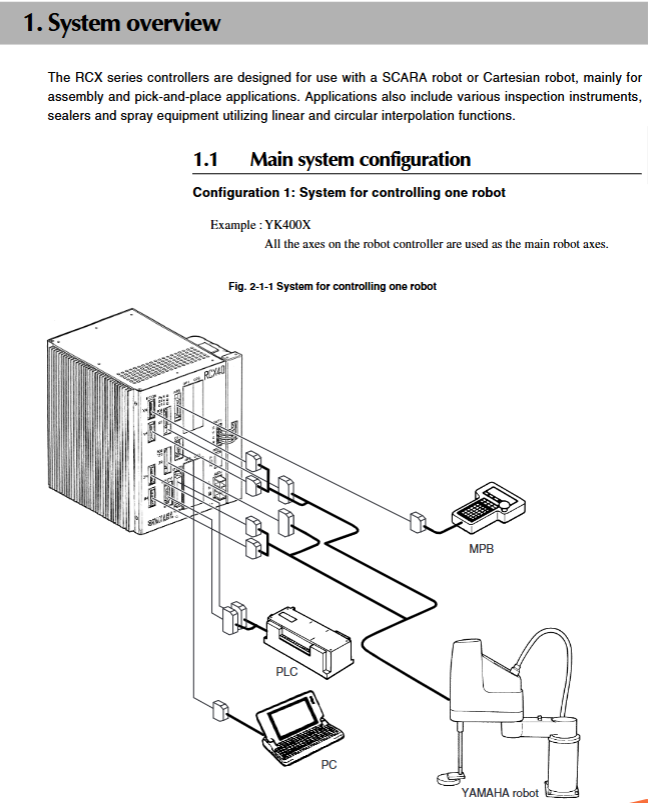
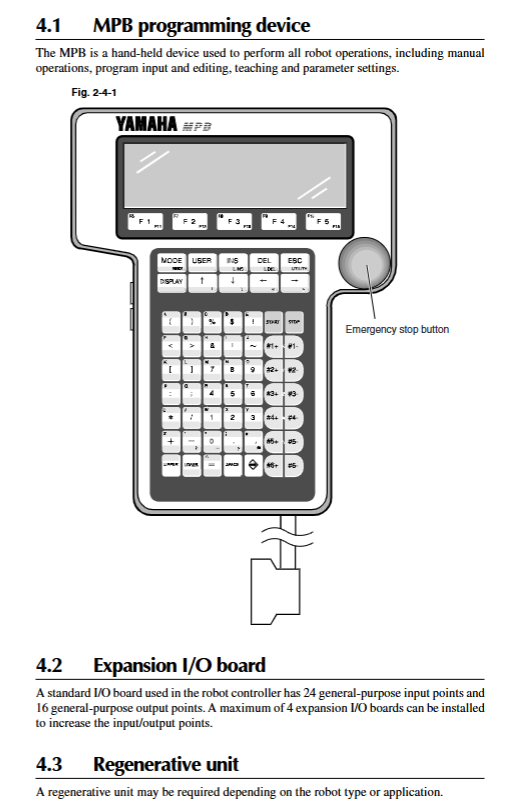
Optional devices: MPB handheld programmer (including emergency stop button), expansion I/O board (up to 4 pieces), regeneration unit (configured as needed).
Cable specification: X-CA 011 system cable (LIYCY-TP 18 × 2 × 0.25 mm ²), available in lengths of 8m/15m/30m, used to connect the host and external devices.
2. Interface configuration details
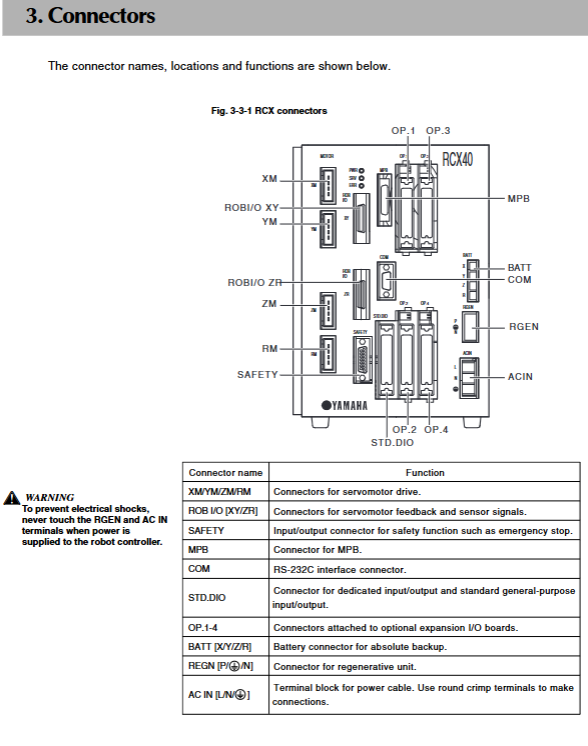
(1) STD. DIO interface
Input signal: 10 dedicated inputs, 16 universal inputs, supporting NPN/PNP specifications;
Output signal: 11 dedicated outputs and 8 universal outputs. The universal output is the open collector electrode output of Darlington transistor, with a maximum output current of 100mA/channel.
(2) SAFETY I/O interface
Specialized processing of emergency stop inputs, enable switch signals, and other safety related I/O must be connected according to specifications to ensure reliable triggering of emergency stop functions.
(3) Communication and power interface
RS-232C interface: supports data communication with the upper computer, with configurable parameters (baud rate 4800-57600bps, supports XON/XOFF or RTS/CTS stream control);
Power interface: The main power supply is AC200-230V single-phase, with an allowable voltage fluctuation range of -15%~+20%, and the auxiliary power supply is 24VDC;
Other interfaces: COM interface (D-SUB 9P female head), BATT battery interface, RGEN regeneration unit interface, etc.
3. Power supply and load specifications
Main power supply: AC200-230V single-phase, requiring external residual current circuit breakers and circuit protectors. It is recommended to use medium slow response circuit protectors (RCX40 recommended rated current 20A);
Load adaptation: resistive load up to 600 Ω, inductive load up to 1mH, capacitive load up to 100 µ F;
Power capacity: Depending on the robot model and number of axes, the power requirement is 600VA-2500VA (e.g. YK400X requires 1000VA, 4-axis Cartesian robot requires a maximum of 2500VA).
Core functions and operating modes
1. Core functional features
(1) Multitasking and Programming Functionality
Multi task parallelism: Up to 8 tasks can be run simultaneously, supporting priority settings. Low priority tasks are paused when high priority tasks are running, supporting I/O parallel processing and interrupt processing to improve overall system efficiency;
Programming Language: Equipped with BASIC like advanced robot language, compatible with industrial robot programming standards SLIM(Standard Language for Industrial Manipulators), Implement fast program execution through compilation, with a maximum of 9999 lines per program and support for storing 100 programs.
(2) Motion control function
Arch motion: can freely set the spatial motion path for picking and placing work, effectively reducing cycle time;
3D CP control: supports 3D interpolation control for linear and circular motion, suitable for complex trajectory requirements;
Manual and automatic motion: Supports PTP (point-to-point), LINEAR (linear), ARCH (arc) motion modes, manual speed can be adjusted step by step or fine tuned, and automatic speed range is 1% -100%.
(3) Data management and communication functions
Data storage: supports editing and storage of point data (0-4000 point numbers), tray definitions, shift coordinates, and hand definitions, and supports data backup to internal Flash ROM or external devices;
Communication function: The RS-232C interface supports online command execution and data transmission, and can be interconnected with most computers with RS-232C ports;
Extended I/O support: Up to 4 expansion I/O boards can be installed, increasing the number of input and output points and adapting to complex industrial scene requirements.
2. Detailed explanation of operating modes
(1) Basic operating mode
Mode Name Core Function Applicable Scenarios
AUTO mode program automatic execution, task switching, speed adjustment (1% -100%), breakpoint setting, point trajectory execution for batch production, program automation running
MANUAL mode robot manual movement, point data teaching/editing, absolute reset, coordinate setting robot debugging, new task point teaching
Program creation/editing/compilation, directory management, user function key registration, program development and modification in GRAM mode
SYSTEM mode parameter configuration (robot/axis/communication parameters), system initialization, initial installation of fault diagnosis controller or system parameter adjustment
Service mode: Maintenance operations within the safety fence, with robot speed limited to below 3% of maximum speed for equipment maintenance and troubleshooting
(2) Other auxiliary modes
UTILITY mode: used for emergency stop cancellation, motor power and servo switch, execution level setting and other maintenance operations;
MONITOR mode: Real time monitoring of I/O status and task status, supporting viewing of signal status such as DI/DO/MO/SI/SO;
DI/DO Monitor mode: Triggered by the PLAY key, it can be overlaid and displayed on the normal operation interface without affecting the operation of the robot.
Installation process and key requirements
1. Preparation before installation
Open box inspection: The equipment is a high-precision device, and before opening the box, it is necessary to check that the packaging box is not severely damaged. After opening the box, check whether the accessories (including MPB programmer, cables, terminal covers, etc.) are complete;
Installation environment: Adequate heat dissipation space should be reserved (top/side ≥ 50mm, rear ≥ 30mm), away from oil, water, vibration sources, and high temperature environments, to avoid blocking the Rear panel fan.
2. Core installation steps
(1) Mechanical installation
Installation method: Supports 4 installation methods, including using rubber feet, front/rear/side installation L-shaped brackets (standard accessories), which need to be installed on a horizontal plane and are not allowed to be placed sideways or upside down;
Handling requirements: Use hand carts and other tools to handle, avoid collision with the front connector of the controller, and prevent damage to the internal PC board.
(2) Electrical connection
Power connection: Connect according to the AC200-230V single-phase specification, with the live wire (L), neutral wire (N), and ground wire connected separately, and the ground wire must be reliably grounded;
Robot cable connection: XM, YM, ROB I/O XY connectors correspond to 1-2 axes, ZM, RM, ROB I/O ZR connectors correspond to 3-4 axes, and must maintain a distance of ≥ 100mm from the power line to avoid confusion of connectors;
Other connections: The MPB programmer needs to be correctly connected to the MPB interface, and if not connected, the MPB terminal needs to be inserted; The absolute battery needs to be connected before the robot cable is connected to avoid origin detection errors.
(3) Wiring specifications
Cable separation: Control lines, communication cables, and robot cables need to be separated from power lines with a spacing of ≥ 100mm, and bundling is prohibited;
Protective measures: The cable should be threaded or fixed to avoid pulling or pulling. When disconnecting the cable, hold the connector instead of the cable itself;
Anti interference: The wiring of electromagnetic contactors, induction motors, and other equipment should be kept away from the controller cables to avoid being laid in the same pipe. If necessary, noise filters and ferrite cores should be installed.
3. Check after installation
Cable connection inspection: Ensure that all connectors are securely plugged in without bent pins or cable damage;
Emergency stop signal check: Confirm that the emergency stop input signal is connected normally and the SAFETY connector is short circuited as required;
Power on test: After power on, observe that the PWR and SRV indicator lights are on and the ERR indicator light is off. If there are no abnormal error reports, the installation is qualified.
Detailed explanation of programming and motion control
1. Core programming operations
(1) Program editing function
Editing mode: Supports switching between Insert and Overwrite modes, allowing for operations such as current insertion, character/line deletion, copy/cut/paste, etc;
Program management: supports program creation, renaming, deletion, and property modification (RW/RO), and can automatically create sample programs (FUTURE programs) for customizing user function keys;
Compilation function: After program editing, the target file needs to be compiled. During the compilation process, syntax errors will be detected, and error messages will be displayed synchronously on the MPB screen.
(2) User Function Key Registration
Define function key functions through the FUTURE program, supporting the allocation of programming mode (P_F series) and manual mode (M-F series) functions;
Example functions include I/O signal control, quick call of motion instructions, etc., supporting up to 15 customizable function keys.
2. Motion control operation
(1) Manual movement and demonstration
Manual movement: Control the movement of each axis through the Jog key, support switching between pulse (joint coordinate) and millimeter (Cartesian coordinate) units, speed can be adjusted step by step through VEL+/- key or 1% precision fine adjustment through VEL++/- key;
Point data teaching: supports direct teaching (manually moving the robot when the servo is turned off) and Jog teaching (moving it with buttons when the servo is turned on), automatically stores teaching data to the specified point number, and supports point annotation editing and copying.
(2) Automatic motion and trajectory control
Program execution: Start the program in AUTO mode, support single step execution (STEP), skip execution (SKIP), breakpoint setting (BREAK), can switch tasks and programs, and adjust motion speed;
Trajectory mode: Supports PTP (point-to-point), ARCH (arc), and LINEAR (linear) interpolation motion. The point trajectory function can verify the actual motion effect of specified point data, and the trajectory speed is 1/10 of the automatic speed.
(3) Coordinate and parameter settings
Standard coordinate setting: SCARA robots need to set standard coordinates and support three methods: 4-point teaching, 3-point teaching, and simple teaching;
Displacement coordinates and hand definition: Supports up to 10 displacement coordinate settings, which can limit the robot's operating area; 4 hand definition settings, suitable for motion compensation in different tool installation scenarios.
Maintenance and fault diagnosis
1. Key points of daily maintenance
(1) Regular maintenance project
Battery maintenance: The absolute battery life is about 1.5 years. B3 battery takes 48 hours to fully charge, B4 battery takes 96 hours, and if the voltage is below 3.5V, it needs to be replaced and recharged;
Verification testing: Conduct verification testing every 10 years, refer to the security manual HI 801 003 E;
Data backup: Regularly backup programs, point data, and parameters to internal Flash ROM or external devices to avoid data loss.
(2) Maintain safety requirements
Before maintenance, cut off all power sources and wait for at least 30 minutes to avoid burns or electric shock caused by high-temperature components and high-voltage circuits;
It is prohibited to disassemble or modify the controller. If parts need to be replaced, please contact YAMAHA or an authorized dealer.
2. Fault diagnosis mechanism
(1) Error messages and historical queries
Supports up to 500 error history storage records, including error codes, occurrence times, and error descriptions, which can be obtained through MPB or RS-232C interfaces;
Common types of errors include abnormal power supply, communication failure, motor overload, absolute reset failure, low battery voltage, etc.
(2) Self diagnostic function
Controller self-test: Perform controller checks in SYSTEM>DIAGNOS mode to detect hardware and system status;
Battery voltage detection: The absolute battery voltage of each axis can be viewed, with a normal range of 3.50-4.3V;
System error details: Display detailed information about serious software errors (error code, occurrence time, related parameters).
(3) Common fault handling
Emergency stop trigger: First, release the emergency stop button, cancel the emergency stop flag in UTILITY mode, and then turn on the motor power;
Incomplete origin: Absolute reset is required, supporting single axis reset and full axis reset. Origin detection methods include marking method, end of travel method, and sensor method;
Communication failure: Check if the RS-232C interface parameters (baud rate, data bits, parity bits) match and if the cable connection is reliable.
Compliance and Disposal Standards
1. Certification and Compliance
Compliant with CE certification related directives (Machinery Directive, Low Voltage Directive, EMC Directive), operating in SAFE mode by default;
Program and Data Storage: We do not guarantee that the internal storage data will remain permanently unchanged and needs to be backed up regularly. YAMAHA is not responsible for any industrial property conflicts caused by the content of the manual.
2. Abandonment and disposal
When disposing of products, they should be treated as industrial waste and are prohibited from being discarded indiscriminately;
The disposal of batteries must comply with local regulations and handle lithium manganese dioxide batteries.
Key question answer
How to ensure the operational safety of RCX40 controller?
The core security mechanism includes graded warning (Warning/CAUTION/NOTE), hardware security design (emergency stop terminals, interlock circuits), wiring and installation protection (line spacing ≥ 100mm, reliable grounding), environmental restrictions (non explosion proof environment, temperature and humidity control);
Operators need to receive professional training and are strictly prohibited from staying within the robot's range of motion. They should regularly check the emergency stop function and safety interlock circuit.
What are the core differences and applicable scenarios of different operating modes?
AUTO mode: Program execution automatically, suitable for mass production;
MANUAL mode: manual movement and demonstration, suitable for debugging and setting up new tasks;
Program mode: Program editing and management, suitable for program development;
SYSTEM mode: parameter configuration and system maintenance, suitable for first-time installation or parameter adjustment;
Service mode: Maintenance within the safety fence, with a speed limit of less than 3%, suitable for equipment maintenance.
How to achieve reliable communication between the controller and external devices?
Connect to the upper computer through the RS-232C interface, configure matching parameters such as baud rate (4800-57600bps), data bits, parity bits, etc., and support XON/XOFF or RTS/CTS stream control;
Realize signal interaction with peripheral devices (sensors, actuators) through STD. DIO interface, correctly wire according to NPN/PNP specifications, ensure reliable signal transmission, and avoid cable interference.
- OMRON
- ABB
- General Electric
- EMERSON
- Honeywell
- HIMA
- ALSTOM
- Rolls-Royce
- MOTOROLA
- Rockwell
- Siemens
- Woodward
- YOKOGAWA
- FOXBORO
- KOLLMORGEN
- MOOG
- KB
- YAMAHA
- BENDER
- TEKTRONIX
- Westinghouse
- AMAT
- AB
- XYCOM
- Yaskawa
- B&R
- Schneider
- KONGSBERG
- NI
- WATLOW
- ProSoft
- SEW
- ADVANCED
- Reliance
- TRICONEX
- METSO
- MAN
- Advantest
- STUDER
- DANAHER MOTION
- Bently
- Galil
- EATON
- MOLEX
- DEIF
- B&W
- ZYGO
- Aerotech
- DANFOSS
- Beijer
- Moxa
- Rexroth
- Johnson
- WAGO
- TOSHIBA
- BMCM
- SMC
- HITACHI
- HIRSCHMANN
- Application field
- XP POWER
- CTI
- TRICON
- STOBER
- Thinklogical
- Horner Automation
- Meggitt
- Fanuc
- Baldor
- SHINKAWA
- Other Brands
- UniOP
- KUKA
- Iba
- Beckhoff
- ADLINK
-
 Micro Innovation GF1-10TVA-100 Touch Panel
 -
 Micro Innovation GSO-57EQD-000 Operator Panel
 -
 Micro Innovation XN-2AI-U Analog Input Module
 -
 Micro Innovation CAN-4AI/UI Analog Input Module
 -
 Micro Innovation ZSB-1.5/8-S/S/-/PE Base Terminal
 -
Micro Innovation AG XVH-340-57CAN-1-10 HMI Panel
-
 Micro Innovation GSO-57EQD-000 Micro Panel
 -
 Micro Innovation XN-2AI-PT/NI-2/3 Input Module
 -
 Micro Innovation AG GF0-57SQD-000 Display Panel
 -
 MICRO INNOVATION AG XN-16DI-24VDC-P Input Module
 -
 Micro Innovation XN-2AI-PT/NI-2/3 Input Module
 -
 Micro Innovation MC2-442-57CQB-1-2G Display Panel
 -
 Micro Innovation XN-16DO-24VDC-0.5A-P Module
 -
 Micro Design MC200PROFI Programmable Module
 -
Micro Innovation XV-252-57MPN-1-10 Micro Panel
-
 Micro Innovation CAN-4AI/UI Analog Input Module
 -
Micro Innovation GT1-MPI-A000 Panel
-
Micro Innovation MC2-440-10TVB-1-21 Display Panel
-
Micro Innovation XVS-430-57MPI-1-1S 6" HMI
-
Micro Innovation XV-442-57CQB-1-1AB Monitor
-
 Micro Innovation ZSB-1.5/8-S/S/-/PE Base Terminal
 -
Micro Design 895A Microfiche Reader
-
 MICRO INNOVATION XNE-8DI-24VDC-P Input Module 8550100794
 -
MICRO INNOVATION MICRO PANEL GF0-10CVD-002
-
 Micro Innovation XN-PLC-CANopen Controller 85 50 274124
 -
Micro Innovation Display Panel GS0-57E0D-000
-
MICRO INNOVATION CAN-32DI/P2X16 Input Module
-
MICRO INNOVATION XN-2DO-R-NO Relay Output Module
-
MICRO INNOVATION XNE-16DI-24VDC-P Input Module
-
Micro Innovation AG XN-2AI-U Analog Input Module
-
Micro Innovation XN-BR-24DC-D Power Supply
-
Micro Innovation MH2-342-57EIB-1-20 Panel
-
Micro Innovation XV-252-57MPN-1-10 Micro Panel
-
 Micro Innovation Display Card EIB2-TP
 -
 Micro Innovation XV-252-57MPN-1-10 6" HMI
 -
 Micro Innovation XN-B3T-SBC 16x DO Base Module
 -
Micro Innovation XVH-330-57MPI-1-10 Panel
-
Micro Innovation XN-BR-24VDC-D Power Module
-
 Micro Innovation EIB2-TP EIB2TP Module
 -
Micro Innovation GF0-10CVD-100 Touch Panel
-
MICRO INNOVATION XV-230-57CNN-1-10 HMI-PLC
-
MICRO INNOVATION XN-2DO-R-CO Relay Output Module
-
KMK MICRO INNOVATION GS2-90EMD-000 Micro Panel
-
 Micro Innovation XN-2AO-U Analog Output Module
 -
 Micro Innovation XN-1AO-I Analog Output Module
 -
 Micro Innovation CAN-32DI/P-2x16 Rack Module
 -
Eaton Micro Innovation MC2-440-10TVB-1-11 HMI
-
Micro Innovation AG CAN Bridge 8551224177
-
 Micro Innovation XN-2AI-I Analog Input Module Set
 -
Micro Innovation XN-4DI-24VDC-P Input Module
-
 Micro Innovation Winbloc CAN-16DO/0.5A-PK Module
 -
Micro Innovation Micro Panel GFO-10SVD-002 HMI
-
 Micro Innovation CAN-24DI/8DO/0.5A-PK Module
 -
 Micro Innovation DP-24DI/8DO/0.5A-PK I/O Module
 -
 Weidmuller Micro Innovation CAN-BRIDGE ZSFA 1,5R
 -
Micro Innovation CAN-3AI/1AO-UI Profibus Module
-
 Micro Innovation PDP-TP Profibus DP Module
 -
Micro Innovation CAN-3AI/1AO-UI Analog Module
-
 Micro Innovation MC2-430-12TSB-10 HMI Panel
 -
Micro Innovation XNE-8DO-24VDC-0.5A-P I/O Module
-
MICRO INNOVATION AG WINBLOC CAN-32DI/P-2x16 85 51 224182
-
 MICRO INNOVATION AG WINBLOC CAN-4AO/UI 85 51 224195
 -
Micro Innovation Xv-252-57cnn-1-10 HMI Panel
-
Micro Innovation XN Basis XN-S4T-SBBS-CJ 225200
-
Micro Innovation GF1-10TVD-100 Micro Panel
-
Micro Innovation XN-B3T-SBC 16-Fold DO Base Module
-
MICRO INNOVATION AG WINBLOC CAN-3AI/1AO-UI 85 51 224192
-
KMK Micro Innovation GS2-90EMD-000 Micro Panel
-
Micro Innovation MC2-430-10TVB-1-10 PanelView Terminal 24VDC
-
 Micro Innovation XNE-8DO-24VDC-0.5A-P I/O Module 8550100795
 -
MICRO INNOVATION GF1-10TVB-100 Touch Panel
-
MICRO INNOVATION AG WINBLOC CAN-4AI/UI Analog Input Module
-
MICRO INNOVATION AG WINBLOC CAN-32DO/0.5A-P-2x16 Output Module
-
MICRO INNOVATION AG CAN-32DI/P-2X16 8551224182 Input Module
-
 MICRO INNOVATION MK2-230/232-57 Circuit Board 85 28 200000
 -
 MICRO INNOVATION CAN-BRIDGE 8551224177 CAN Bridge
 -
Micro Innovation MC2-430-10TVB-1-10 Panel 24VDC
-
MICRO INNOVATION MC2-432-57CQB-1-10 HMI Panel
-
MICRO INNOVATION AG CAN-BRIDGE 85 51 224177 CAN Bridge
-
MICRO INNOVATION CAN-4AI/UI Analog Input Module
-
MICRO INNOVATION CAN-32DI/P-2X16 Input Module
-
 SIGMATEK MDD111 09-404-111 Drive Module
 -
 SIGMATEK DVI021 Display Interface Module
 -
 SIGMATEK 00-450-024 C-IPC Processor
 -
 SIGMATEK MDD-111 MDD111 Drive Module
 -
 SIGMATEK ICA011 20-102-011 Interface Module
 -
 SIGMATEK 01-250-010-D NC4Kompakt Control Module
 -
 SIGMATEK CRIF081 12-751-081 Interface Module
 -
 SIGMATEK S1026-8AF61-R4E-Z57 Drive Module
 -
 SIGMATEK 9305.081.02 9227.082.00 Control Module
 -
 Sigma Tek 5000B-36 Attitude Indicator
 -
 SIGMATEK CEZ201 12-051-201-O Counter Module
 -
 SIGMATEK DPS001 Power Supply Module
 -
 SIGMATEK 994 395 01z Via Interface Module
 -
 SIGMATEK PC411-K 01-310-411-K Industrial PC
 -
 SIGMATEK 9816.324.00 Demag NC4 Keyboard
 -
 SIGMATEK ET261 90010C-71 Operator Terminal
 -
 SIGMATEK DDI 164 05-006-164 Input Module
 -
 SIGMATEK CCP 082 C-DIAS Processor Module
 -
SIGMATEK CEZ201 12-051-201-O PLC Module
-
SIGMATEK MDD 1111 06178867 Drive Module
-
SIGMATEK S1 073-6AC61-RE-Y08-Z Drive Module
-
SIGMATEK MDD 111 Drive Module MDD111
-
 SIGMATEK CSDI161 Safety Module 12-891-161
 -
SIGMATEK C-IPC Processor 01-450-024
-
 SIGMATEK DIAS DAM122 Analog Mixing Module
 -
Sigma Tek 5000B-36 Attitude Gyro Indicator
-
 SIGMATEK TMS012 Motherboard Module 05-250-012-T
 -
 SIGMATEK CCP-531 PLC Module
 -
SIGMATEK DIAS DNC4 I/O Module 05-250-011
-
 SIGMATEK AI088 Analog Input Module
 -
 SIGMATEK CEZ201 Counter Module
 -
SIGMATEK CIC011 Industrial Computer Module
-
 SIGMATEK MDM021 Motor Drive Module
 -
 SIGMATEK DTO163 Digital Output Module
 -
SIGMA-TEK 5000B-36 Attitude Gyro
-
SIGMATEK DM161 Digital Input Module
-
SIGMATEK CCP-531 PLC Control Panel
-
 SIGMATEK HZS773 Touch Terminal Operator Panel
 -
SIGMATEK MDP101 3 KVA 45-65Hz Driver
-
 SIGMATEK ETV1251 Touch Panel 12-230-1251
 -
SIGMATEK CIO021 Safety Module 12-013-021
-
Sigma Tek 4000H-5 Directional Gyro
-
 SIGMATEK TAE531 I/O Module 01-240-531
 -
 SIGMATEK DAI081 Input Module 05-009-081
 -
 SIGMATEK DCP640 Drive Control Module
 -
 SIGMATEK DCP643 Slides Module A6-29
 -
SIGMATEK SCP011 Safety Module 20-890-011


