
YASKAWA S-7 series linear servo
YASKAWA S-7 series linear servo
Detailed explanation of product basic information
1. Product classification and model system
(1) Product series division
Series Structure Type Core Characteristics Thrust Range (Rated) Speed Range (Maximum) Applicable Scenarios
SGLG ironless low inertia, silent operation, no cogging effect 12.5-750N, 4.0-5.0 meters/second high-speed reciprocating motion, precision positioning equipment (such as chip packaging machines)
SGLF F-type iron core with high thrust density, supporting self cooling/water cooling 25-2520N 4.0-5.0 meters/second medium to heavy-duty automation equipment (such as conveyor belts, stamping machines)
SGLT T-shaped iron core with high thrust, high rigidity, strong anti-interference ability 130-2000N 2.5-4.8 m/s heavy-duty machine tools, large production lines (such as CNC machine tool spindles)
(2) Model coding rules
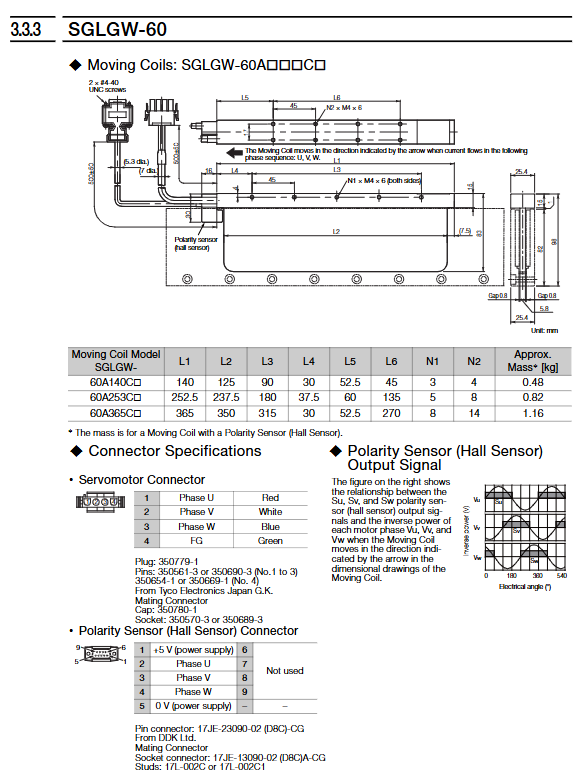
Taking SGLFW2-30A070AS1 as an example, the encoding meanings of each segment are as follows:
SGL: Identification of ∑ -7 series linear servo motors;
F: Structural type (F-type iron core);
W2: Component type (rotor);
30: Magnet height (30mm);
A: Supply voltage (200VAC);
070: length of rotor (70mm);
One:
S: Sensor configuration (with polarity sensor+thermal protector);
1: Cooling array
2. Core technical parameters
(1) General parameters
Power supply specifications: Unified at 200VAC (single-phase/three-phase compatible), insulation level B, insulation resistance ≥ 10M Ω (500VDC), withstand voltage 1500VAC/1 minute;
Environmental adaptability: working temperature 0-40 ℃ (no freezing), relative humidity 20% -80% RH (no condensation), altitude ≤ 1000m, protection level IP00;
Mechanical performance: Vibration acceleration ≤ 49m/s ² (in three directions), impact acceleration ≤ 196m/s ² (twice), gap between magnetic track and rotor 0.8-1.4mm (0.5-1.2mm with magnetic cover).
(2) Key performance parameters (typical models)
Series model: Rated thrust, maximum thrust, rated speed, maximum speed, mass of rotor
SGLG SGLGW-40A253C 93N latitude 280 degrees north 2.0 meters/second 5.0 meters/second 0.6 kilograms
SGLF SGLFW2-90A380A 1120N 3360N 4.0 m/s 4.0 m/s 10.1 kg
SGLT SGLTW-50A320H 900N 1800N 2.0 m/s 3.1 m/s 11 kg
3. Core components and accessories
Sensors: polarity sensor (Hall sensor, used for position detection), thermal protector (to prevent motor overheating);
Encoder: compatible with Heidenhain, Renishaw, Mitutoyo and other brands, supports incremental/absolute, with a maximum signal resolution of 1/4096 pitch;
Cables: servo main circuit cables (JZSP-CLN series), encoder cables (JZSP-CLL series), sensor cables (JZSP-CL2L series);
Auxiliary components: Serial conversion unit (JZDP series, converting encoder signals to servo amplifiers), braking resistor, water cooling pipeline (only for water cooling models).
Detailed Explanation of Selection Calculation
1. Core formula and steps for selection
(1) Basic parameter collection
Key parameters such as load mass (mW), worktable mass (mT), motor rotor mass (mM), target speed (v), acceleration time (t ₐ), deceleration time (td), friction coefficient (μ), and external force (F) need to be clearly defined.
(2) Core Strength Calculation
Steady state thrust (force required for uniform load operation):
F L=9.8×M×(m W+m T+m M)+F
Acceleration thrust (force required during load acceleration phase):
F P=(m W+m T+m M)× t onev+F L
Deceleration thrust (force required during load deceleration phase):
F S=(m W+m T+m M)× t dv−F L
Effective thrust (average thrust during cyclic operation):
F RMS= tF P two⋅t one+F L two⋅t C+F S two⋅t d(t is the total time of the cycle, t_C is the uniform speed time)
(3) Selection verification criteria
Acceleration thrust ≤ maximum motor thrust × 0.9;
Deceleration thrust ≤ maximum motor thrust × 0.9;
Effective thrust ≤ motor rated thrust × 0.9;
The total load mass (mW+mT) is ≤ the maximum allowable load of the motor (to be combined with the configuration of the braking resistor).
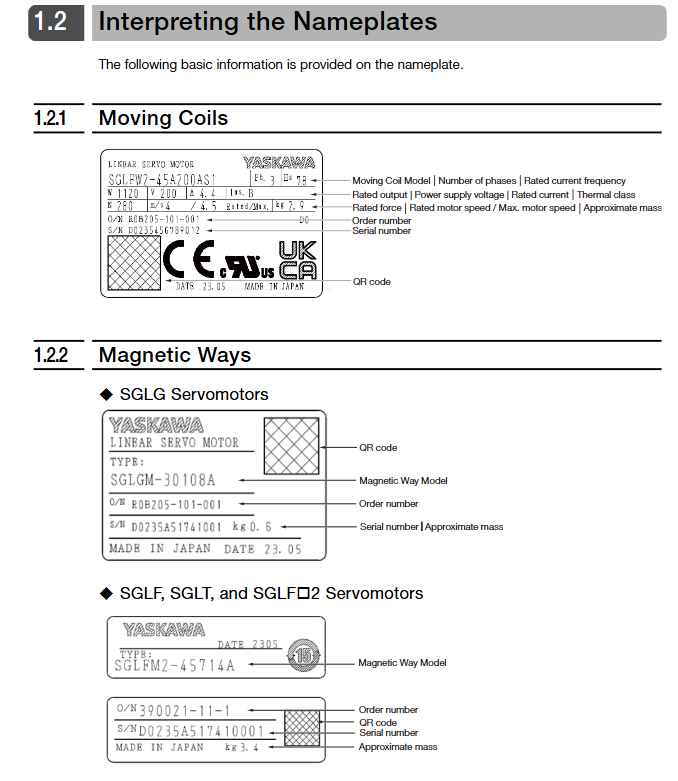
2. Selection Example (Taking SGLGW-60A253C as an Example)
Known conditions: load mass of 1kg, worktable mass of 2kg, rotor mass of 0.82kg, speed of 2m/s, acceleration time of 0.02s, friction coefficient of 0.2, external force of 0N;
Calculation results: Steady state thrust of 7.5N, acceleration thrust of 389.5N, effective thrust of 108.3N;
Verification: The maximum thrust of the motor is 440N × 0.9=396N (≥ 389.5N), and the rated thrust is 140N × 0.9=126N (≥ 108.3N). The selection is qualified.
Installation specifications (mechanical+electrical)
1. Mechanical installation specifications
(1) Installation environment requirements
Environmental restrictions: Indoor use, no corrosive gases (such as hydrogen sulfide), explosive gases, no strong magnetic field interference (away from electromagnets and large transformers);
Strong magnetic protection: The magnetic track contains neodymium iron boron strong permanent magnets and should be kept away from electronic medical equipment such as pacemakers (safety distance ≥ 1m). Non magnetic tools (brass, stainless steel) should be used during operation to avoid magnetic substances (nails, wrenches) from approaching and causing compression injuries;
Cleaning requirements: The installation area should be free of dust and metal shavings, and lubricating oil should not be applied to the surface of the magnetic track.
(2) Magnetic track installation operation
Positioning and fixation:
Single segment magnetic track: placed on the equipment positioning platform, with the reference mark (4mm diameter pit) facing the equipment, fixed with a 10.9 grade hex socket screw, tightening torque 3.6-41.5N · m (according to the model: SGLG uses M4 screws, torque 3.6-5.0N · m; SGLT uses M8 screws, torque 29.7-41.5N · m);
Multi segment magnetic track: The distance between adjacent magnetic tracks should be ≥ 30mm, aligned with reference marks, and the gap at the connection should be ≤ 0.1mm to avoid thrust fluctuations.
Gap calibration: The gap between the magnetic track and the rotor should be uniform, measured with a non-magnetic feeler gauge, with an error of ≤± 0.3mm (SGLG series gap 0.8 ± 0.3mm, SGLT series gap 1.0 ± 0.3mm).
(3) Assembly process of moving parts
Preprocessing: Check for cracks in the rotor winding and plastic casing, and ensure that the polarity sensor plug is not damaged;
Fixed rotor: Fix the rotor to the workbench with M4-M8 level screws, with a screw fit length of ≥ 4mm and a tightening torque of 2.4-20N · m (SGLG uses M4 screws with a torque of 2.4N · m; SGLF uses M8 screws with a torque of 20N · m);
Approaching the magnetic track: Slowly move the worktable to bring the rotor closer to the magnetic track, and monitor for any frictional noise during the process;
Gap verification: Insert a 0.8-1.4mm non-magnetic feeler gauge into the gap between the rotor and the magnetic track to ensure uniform clearance throughout the entire stroke;
Cable fixation: The movable cable is fixed in the direction of the worktable movement, with a bending radius of ≥ 15mm (cable diameter<8mm) or ≥ cable diameter × 3 (cable diameter>8mm), to avoid pulling and causing breakage.
(4) Special requirements for water-cooled models (SGLFW2-90A series)
Cooling medium: Deionized water, pH 6.8-8.0, conductivity ≤ 30mS/m, chloride ion content ≤ 50mg/L, no oil stains or impurities;
Flow and pressure: rated flow rate 4L/min, maximum flow rate 6L/min, working pressure ≤ 0.5MPa, instantaneous pressure ≤ 1.0MPa;
Pipeline installation:
Pipeline material: stainless steel or corrosion-resistant plastic, with Rc1/8 tapered pipe thread joints, wrapped with sealing tape to prevent water leakage;
Filtering and protection: Install a ≥ 0.5mm impurity filter at the inlet, and keep the pipeline away from high-temperature components (such as motor windings);
Maintenance requirement: Drain the accumulated water in the pipeline during long-term shutdown to avoid icing damage.
2. Electrical installation specifications
(1) Wiring sequence and principles
Wiring sequence: First connect the servo main circuit cable (U/V/W/FG), then connect the encoder cable, and finally connect the sensor cable (polarity sensor/thermal protector). Live wiring is prohibited;
Grounding requirements:
Ground resistance of servo amplifier: 400V level ≤ 10 Ω, 200V level ≤ 100 Ω;
Motor grounding: The FG terminal is connected to the protective grounding of the equipment, and the cross-section of the grounding wire is ≥ 10mm ² (copper core). The shielding layer is grounded at one end (amplifier side);
Cable separation: The distance between the power cable (main circuit) and the signal cable (encoder/sensor) should be ≥ 30cm. It is forbidden to wire or bundle them in the same pipe to avoid electromagnetic interference.
(2) Core cable selection and connection
Cable type, usage, length limit, recommended model, connection requirements
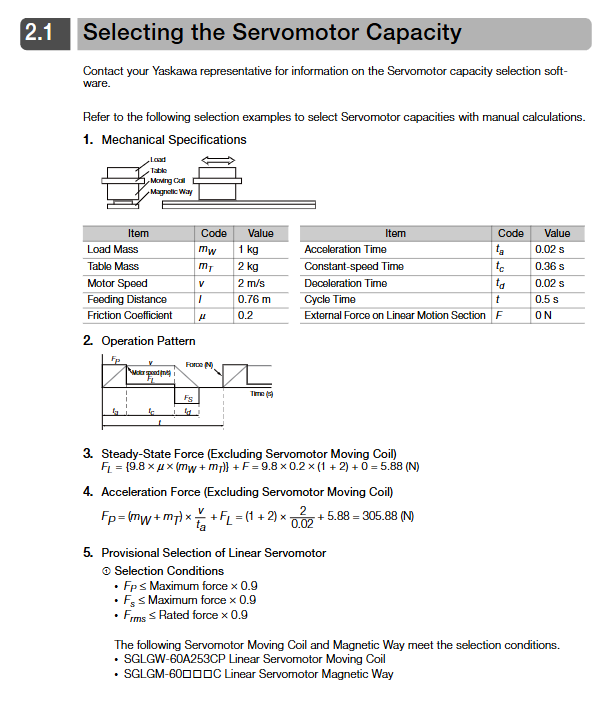
Servo main circuit cable transmission motor power supply ≤ 20 meters JZSP-CLN11 (SGLG), JZSP-CLN21 (SGLF), JZSP-CLN39 (SGLT) phase U (red), V (white), W (blue) corresponding connection, FG (green yellow) grounding
Encoder cable transmission position detection signal ≤ 50 meters JZSP-CLL00 (Renishaw encoder), JZSP-CLL30 (Heidenhain encoder) shielded twisted pair, away from power cables, with firm and secure joints without looseness
Sensor cable transmission polarity sensor/thermal protector signal ≤ 15 meters JZSP-CLL10 (regular model), JZSP-CL2L100 (model with thermal protector) polarity sensor+5V (red), 0V (black), signal terminal (white/blue) corresponding connection
(3) Serial conversion unit (JZDP series) connection
Function: Convert the sine/cosine signal of the linear encoder into a digital signal, transmit it to the servo amplifier, and receive signals from the polarity sensor and thermal protector;
Power supply requirements: Power supply+5V ± 5%, current consumption ≤ 160mA (excluding encoder and sensor currents);
Signal requirement: Analog input signal amplitude 0.4-1.2V, differential input, to avoid signal attenuation.
Safety regulations and compliance standards
1. Core security requirements
(1) Electrical safety
Power off operation: Disconnect all power sources before maintenance, wait for the servo amplifier CHARGE indicator light to turn off (≥ 5 minutes), use a multimeter to confirm that the main circuit voltage is ≤ 50Vdc before operation;
Static electricity protection: When touching the encoder or serial conversion unit, first release human static electricity (touching the grounded metal), and do not directly touch the pins with your hands;
Leakage protection: Motors with built-in EMC filters may experience leakage currents exceeding 3.5mA, requiring the use of Type B residual current monitors (RCM/RCD).
(2) Mechanical safety
Fall prevention measures: When installed vertically, a counterweight or braking device should be installed to prevent the load from falling during power outages;
Limit protection: Install mechanical limit switches at both ends of the motor stroke to avoid collisions caused by overtravel;
Strong magnetic protection: During transportation and installation, the magnetic track needs to be packaged with special anti magnetic materials to avoid adsorption and compression with other magnetic components.
(3) Operational safety
Personnel qualifications: Only qualified engineers who have received training can carry out installation, wiring, and maintenance;
Prohibition of modification: It is not allowed to disassemble the motor winding, magnetic track or modify the circuit, otherwise the warranty will be invalid and may cause safety accidents;
High temperature protection: When the motor is running, the temperature of the winding and magnetic track may exceed 60 ℃, and a protective cover plate should be installed to avoid touching and scalding.
2. Compliance standards
North American standards: UL 1004-1, UL 1004-6, CSA C22.2 No.100, branch circuit protection requires the use of specified semiconductor fuses;
EU standards: CE certification (EMC Directive 2014/30/EU, LVD Directive 2014/35/EU), compliant with EN 61800-3 (C2 environment) EN 60034-1;
Environmental standards: RoHS Directive 2011/65/EU restricts six hazardous substances such as lead and mercury, and scrap must follow the classification and disposal requirements of the WEEE Directive.
Maintenance and disposal
1. Regular maintenance projects
(1) Daily inspection (daily)
Operating status: Monitor the motor for any abnormal noise or vibration, and observe that the cables are not pulled or worn;
Appearance inspection: The surface of the magnetic track is free of dust and metal shavings, the plastic shell of the rotor is free of cracks, and the screws are not loose;
Indicator light: The servo amplifier no alarm indicator light is on, and the encoder signal is normal.
(2) Regular inspection (annually)
Gap calibration: Use a non-magnetic feeler gauge to re measure the gap between the rotor and the magnetic track. If the deviation exceeds 0.5mm, it needs to be adjusted;
Insulation testing: Disconnect the servo amplifier and measure the resistance between the motor U/V/W terminal and FG terminal with a 500VDC insulation resistance meter. A resistance of ≥ 10M Ω is considered normal;
Cable inspection: The cable shielding layer is not damaged, the joints are firm, and there is no aging or cracking at the bends;
Water cooling system (if any): Check that there is no water leakage in the pipeline, the quality of the cooling medium meets the standard, and the filter is not clogged.
(3) Overhaul cycle (every 5 years)
Contact YASKAWA technical personnel for comprehensive maintenance, including winding insulation testing, magnetic track detection, and sensor calibration;
Replace vulnerable parts: cooling fan (self cooling model), cables (frequently bent scenario), seals (water-cooled model).
2. Troubleshooting
(1) Common faults and solutions
Possible causes and solutions for the fault phenomenon
Abnormal installation spacing of encoder signal, cable interference, encoder damage, adjustment of encoder installation spacing (10-40mm), replacement of shielded cable, detection of encoder output signal
Motor overload alarm for excessive load, short acceleration time, thermal protector triggering to reduce load, extending acceleration time (parameter C1-01), checking thermal protector wiring
Insufficient thrust, large gap between magnetic track and rotor, low power supply voltage, incorrect phase wiring, calibration gap to standard range, detection of power supply voltage (200V ± 10%), verification of U/V/W phase wiring
Cable breakage with a small bending radius, repeated pulling and abrasion, replacement of cables with increased bending radius, fixing cables to avoid pulling, and installation of protective sleeves
(2) Principle of investigation
Turn off the power before troubleshooting, and prohibit live measurement signals;
First check the mechanical parts (gaps, fixing screws), then check the electrical parts (wiring, cables);
When troubleshooting is not possible, record the fault code and operating parameters, and contact YASKAWA technical support.
3. Scrap disposal
Demagnetization treatment: The magnetic track needs to be heated to above 300 ℃ and maintained for 1 hour to eliminate magnetism and avoid damage caused by strong magnetic adsorption;
Classification and disposal: Follow local environmental regulations, separate electronic components (windings, sensors), metal components (magnetic tracks, shells), and plastic components, and recycle them separately;
Prohibited from littering: Components containing permanent magnets and electronic components must be disposed of by professional environmental protection organizations to avoid environmental pollution.
Summary of Key Parameters (Core Commonly Used)
Parameter Category Parameter Name Typical Settings/Range Adjustment Scenarios
Motion parameter acceleration time (C1-01) 0.01-3600s: Prolonged if the startup impact is large, shortened if quick startup is required
The deceleration time of motion parameters (C1-02) is extended from 0.01 to 3600 years due to deceleration overvoltage, and can be shortened by combining with braking resistors
Protection parameter motor overload protection (L1-01) 1-6 levels, single motor drive selects 1-3 levels, multi motor drive selects 0 levels (disabled)
Sensor Parameters Polarity Sensor Mode (T1-01) 0-5 Induction Motor Select 0 (Rotation Tuning), PM Motor Select 4 (Rotation Tuning)
Cooling parameters: Water cooling flow threshold ≥ 4 liters/minute. Water cooling models require flow monitoring. If the threshold is lower, the machine will be shut down
- OMRON
- ABB
- General Electric
- EMERSON
- Honeywell
- HIMA
- ALSTOM
- Rolls-Royce
- MOTOROLA
- Rockwell
- Siemens
- Woodward
- YOKOGAWA
- FOXBORO
- KOLLMORGEN
- MOOG
- KB
- YAMAHA
- BENDER
- TEKTRONIX
- Westinghouse
- AMAT
- AB
- XYCOM
- Yaskawa
- B&R
- Schneider
- KONGSBERG
- NI
- WATLOW
- ProSoft
- SEW
- ADVANCED
- Reliance
- TRICONEX
- METSO
- MAN
- Advantest
- STUDER
- DANAHER MOTION
- Bently
- Galil
- EATON
- MOLEX
- DEIF
- B&W
- ZYGO
- Aerotech
- DANFOSS
- Beijer
- Moxa
- Rexroth
- Johnson
- WAGO
- TOSHIBA
- BMCM
- SMC
- HITACHI
- HIRSCHMANN
- Application field
- XP POWER
- CTI
- TRICON
- STOBER
- Thinklogical
- Horner Automation
- Meggitt
- Fanuc
- Baldor
- SHINKAWA
- Other Brands
- UniOP
- KUKA
- Iba
- Beckhoff
- ADLINK
-
 Sigmatek MDD111-1 DIAS Drive Axis Module
 -
 Sigmatek DKL042 05-024-042 Terminal Module
 -
 Sigmatek DM822 Control Module
 -
 Sigmatek CDM167 12-008-167-O Module
 -
 Sigmatek TAE151 Touch Display Unit
 -
 Sigmatek DCC041 SLIDES Module 05-700-041-D
 -
 Sigmatek AKM65M-ANC2GBB0 PM Servo Motor
 -
 Sigmatek ETT221 01-230-221 Operator Terminal
 -
 Sigmatek SLIDES DAM 124 Analog Module
 -
Sigmatek AKM31C-ANCNGBB0 Servo Motor
-
 Mannesmann Demag Sigmatek CP626 Central Unit
 -
 SIGMATEK 0332.554.03 Board 371071000154
 -
 SIGMATEK 12-250-021 Base Plate Back Panel CM5V020
 -
 SIGMATEK DM162 S-DIAS Digital Mix Module
 -
 DEMAG ERGOTECH 061 381 66 Sigmatek 9842.243.02 Circuit Board
 -
 SIGMATEK CP313-1 PLC Module
 -
Sigmatek ETV0551-2 VARAN Touch Terminal
-
 Sigmatek SDM 081 FS S-Dias Safety Module
 -
 DEMAG 05-250-023 Ergotech Motherboard with Sigmatek TMS012
 -
Sigmatek CM5V020 12-250-023-K Wiring Base
-
 Sigma Tek 5000B-37 Attitude Gyro Indicator
 -
 Sigmatek SDD120-2 DIAS Drive
 -
 Sigmatek CME221 Memory Module
 -
 Sigmatek DCP640 DIAS Central Unit
 -
 Sigmatek STO040 Safety Output Module
 -
Sigmatek CET281 Control Panel
-
 Sigmatek CIPC LX800 Demag NC5 CPU
 -
 Sigmatek DKL093 05-024-093 Terminal Module
 -
 Sigmatek AI088 20-009-088 Analog Input Module
 -
Sigmatek CAI888 Analog Input Module
-
SIGMATEK CCA021 12-025-021 Analog Output Module
-
SIGMATEK 1104.579.05 Control Module
-
SIGMATEK SDI100 Digital Input Module
-
 SIGMATEK C-IPC 256MB LX800 Compact Dias
 -
 SIGMATEK 9423.090.02 Control Module
 -
SIGMATEK C-IPC 256 Power Supply 148498
-
 SIGMATEK CAI025 Analog Input Module
 -
 SIGMATEK CTO166 Digital Output Module
 -
 SIGMATEK CP112 20-004-112 Processor Module
 -
SIGMATEK CAI887 12-009-887 Safety Module
-
 Sigma-Tek 4000B-31 Directional Gyro 1U262-002-42
 -
Sigmatek C-IPC 256MB LX800 IPC Controller
-
Sigmatek C-IPC 01-450-031 Industrial PC LX800
-
Sigmatek C-IPC 256 Industrial PC Controller
-
Sigmatek CCP-531 PLC Processor Module
-
Sigmatek CDI163 Digital Input Module
-
 Sigmatek ETV0501 VARAN Terminal 12-230-0501
 -
 Sigmatek CTMS020 C-DIAS Technology Module
 -
 Sigmatek CIV512 VARAN Switch Module
 -
 Sigmatek HU011 20-080-011 Interface Module
 -
SIGMATEK SLIDES DAM 124 Module
-
 SIGMATEK C-IPC 161 01-450-161L Industrial PC
 -
SIGMATEK C-IPC 128MB VIA 733MHz 01-450-024-K
-
 SIGMATEK 12-780-012 R8-IPC Geode LX800 Module
 -
SIGMATEK CAM124 Analog Module
-
 SIGMATEK S1 032-8AF61-R4 EZ Servo Motor
 -
 SIGMATEK CTO163 Digital Output Module
 -
 SIGMATEK CCP082 12-004-082 Processor Module
 -
 SIGMATEK CRCH081 C-DIAS Temperature Module
 -
 SIGMATEK PC322-K 01-310-322-K Industrial PC
 -
SIGMATEK SDD310-2 Servo Drive
-
 SIGMATEK AI084 Analog Input Module
 -
SIGMATEK CRCH081 12-752-081 Temperature Module
-
Sigma-Tek 5000L-4 Attitude Gyro 1U284-001-3
-
 SIGMATEK CM5V020 12-250-023-K Wiring Module
 -
Sigma-Tek 4000H-6 Directional Gyro IU262-035-7
-
 SIGMATEK Dias DCP160 05-004-160 Processor Module
 -
SIGMATEK 0147.395.02 Control Module
-
SIGMATEK A1084 Control Module
-
SIGMATEK DI200 20-006-2000 Digital Input Module
-
Sigmatek DNC115 Encoder Module
-
 Sigmatek DAM122 05-017-122 Analog Module
 -
Sigmatek 9802.289.01 Control Board TA71 Display
-
Sigmatek TO127 20-007-127 Digital Output Module
-
Sigmatek DNC031 05-011-031 Digital Module
-
Sigmatek VI022 20-003-022 Interface Module
-
Sigmatek CAI085 Analog Input Module
-
 Sigmatek CP111 S-DIAS CPU Module
 -
Sigmatek CTMS030 Krauss Maffei Module
-
 Sigmatek CAM123 Control Module
 -
 Sigmatek TAE732-P 01-240-732-P Touch Display Unit
 -
Sigmatek MDM021 Digital Mixed Module
-
Sigmatek DCP642 DIAS Central Unit
-
 Sigmatek CST022 12-014-022 C-DIAS Module
 -
 Sigmatek SRO021 20-893-021 Safety Relay Output
 -
 Krauss Maffei MC5 Control System Sigmatek
 -
 Sigmatek DC061 Module 18-24VDC 300mA
 -
 Herrmann EVT0855 Ultrasonic Welder Touch Panel
 -
Sigmatek CIV521 Control Module 1.4A 2W
-
Sigmatek DDI61 05-006-161 Digital Input Module
-
SIGMATEK ETT312-E Touch Terminal 01-230-312
-
Cessna S3326-1 Sigma Tek 5000B-67 Gyro 1U149-015-9
-
SIGMATEK PS101 Power Supply Module
-
SIGMATEK 0332.554.03 Control Module 371071000154
-
 SIGMATEK ETT312-E Touch Terminal 01-230-312
 -
SIGMATEK CDM163 Control Module
-
 SIGMATEK VSV046 16-023-046 Module
 -
SIGMATEK AM221 20-017-221 Analog Module
-
SIGMATEK CTS051 12-053-051 Control Module
-
SIGMATEK AM221 20-017-221 Analog Module
-
Sigmatek CSDI161 12-891-161 Safety Input Module
-
Sigma Tek 4000C-1 Directional Gyro Indicator
-
Sigmatek ETV0501 12-230-0501 VARAN Terminal
-
Sigmatek DDM165 SLIDES Module
-
Sigmatek N100 20-011-100 Control Module
-
Sigmatek AKM54K-ANC2R-B0 PM Servo Motor
-
Sigmatek CTO166 Digital Output Module
-
Sigmatek CP212-K 20-004-212-K CPU Module
-
Sigmatek CDI161 Digital Input Module
-
Sigmatek DCC080 05-700-080-2 Control Module
-
 SIGMATEK SCP011 S-DIAS Safety CPU
 -
SIGMATEK SCP011 S-DIAS Safety CPU
-
SIGMATEK SRO022 Relay Output Module
-
SIGMATEK MDD 121 Drive Axis Module
-
SIGMATEK DSI021 SLIDES Siemens Interface
-
SIGMATEK DIAS DCP161 Module 05-004-161
-
 Sigmatek ETT312 Built-in Touch Terminal
 -
SIGMATEK DCP 643 DIAS Controller System
-
SIGMATEK CIO021 Multi I/O Module
-
SIGMATEK CTMS020 Control Module
-
 Sigmatek CME 221 Memory Module
 -
Sigmatek 0420.615.01 Control Board
-
Sigmatek CP111 20-004-111 CPU Module
-
Sigmatek 9405.065.03 Control Board
-
Sigmatek ETEK 01-450-032-K C-IPC 256MB Industrial PC
-
Sigmatek CTO163 12-007-163 Safety Output Module
-
Sigmatek TO081 20-007-081 Digital Output Module
-
 Sigmatek SI021 20-022-021 Safety Input Module


