
TOSHIBA VF-AS3 inverter RS485 communication function
Core purpose: To achieve three major functions through RS485 bus - remote control (run/stop, frequency setting, torque adjustment), parameter reading and writing (internal parameter configuration of frequency converter), and status monitoring (output frequency/current/voltage, fault code, terminal status), supporting master-slave synchronous control between frequency converters without relying on PLC or upper computer.
(4) Broadcast communication
Only supports write commands (W/P), does not support read commands, suitable for batch configuration of all devices.
ASCII mode: INV-NO is set to "* *" (such as (* * PFA011770) CR), only the device numbered 00 responds, and other devices do not respond when executing commands.
Binary mode: INV-NO is set to FFH, and only the device numbered 00 responds to avoid bus conflicts.
2. MODBUS-RTU protocol (compatible with third-party devices)
Only supports MODBUS-RTU subset (binary transmission), does not support ASCII mode, suitable for networking with third-party PLCs, touch screens, and other devices. The core instructions are as follows:
Instruction code (Hex) function description applicable scene frame format (computer → frequency converter)
03H Read Keep Register reads one or more parameters (indirect read ≤ 5, direct read ≤ 8) inverter number+03H+communication number (high-order)+read word count (high-order)+CRC16
Write a single hold register in 06H and write one parameter (such as frequency instruction, run command): frequency converter number+06H+communication number (high-order first)+write data (high-order first)+CRC16
10H write multiple hold registers, write 2 or more parameters (such as block write preset parameters), inverter number+10H+communication number (high-order)+write word count (high-order)+data byte count+write data+CRC16
Write and read multiple registers in 17H, simultaneously write parameters+read parameters (such as write frequency+read output current), inverter number+17H+read communication number+read word count+write communication number+write word count+data byte count+write data+CRC16
2BH reads model information, manufacturer, model, and version (such as "TOSHIBA" and "VFAS3-2037P"), inverter number+2BH+MEI type (0EH)+equipment code+object code+CRC16
(1) CRC16 Calculation Rule (Required)
The CRC16 of MODBUS-RTU is a 16 bit checksum, and the calculation steps are as follows:
Initialize the CRC register to FFFFH;
XOR the data byte by byte with the CRC register;
Shift each byte by 1 bit to the left. If the lowest bit is 1, XOR the CRC register with polynomial A001H;
Repeat step 3 8 times to process all bytes;
The final CRC value is stored at the end of the frame with "low bits first, high bits second".
Example: The CRC16 of the command "01 03 FD 00 00 01" is B5A6H, and the complete command is "01 03 FD 00 01 B5 A6".
(2) Example: Read output frequency (communication number FD00)
Inverter parameters: Number 1 (01H), baud rate 19200bps, even parity.
Computer command: 01 03 FD 00 00 01 B5 A6 (01=number, 03=read, FD00=communication number, 0001=read 1 parameter).
Inverter response: 01 03 02 17 70 B6 50 (02=number of data bytes, 1770H=6000 → 60.00Hz, B650=CRC16).
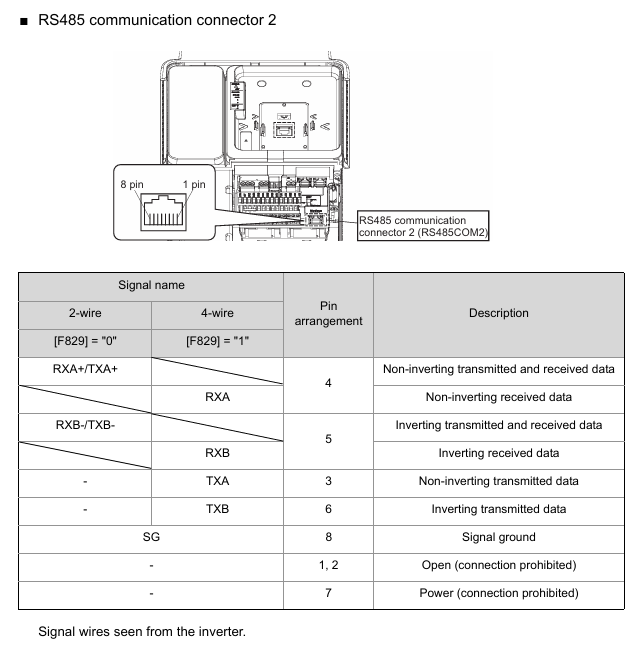
Core function: master-slave communication between frequency converters
Without the need for an upper computer, synchronous control of one master and multiple slaves can be achieved through the RS485 bus, which only supports Toshiba inverter protocol. The main station sends S command (53H), and the slave station does not respond when receiving commands, avoiding bus conflicts.
1. Master slave parameter configuration (key parameters)
Example Setting of Character Core Parameter Configuration Options (45Hz Output from the Station)
Master station [F806]/[F826] (master-slave mode) 3=frequency command, 4=output frequency, 5=torque command, 6=output torque [F826]=3 (frequency command)
Main station [F805]/[F825] (transmission waiting time) 0.00-2.00s (default 0.00s) 0.01s (to avoid the main station sending too fast)
Slave station [F806]/[F826] (master-slave mode) 0=0Hz in case of fault, 1=continue operation in case of fault, 2=emergency stop in case of fault [F826]=0 (fail safe)
From station [F823] (communication timeout) 0.1-100.0s (default 0.0s disabled) 1.0s (tripped when cable disconnected)
Slave [FMOd] (frequency command source) 21=Connector1, 22=Connector2 22 (same interface as the master station)
Slave [FH] (maximum frequency) 0.0-400.0Hz 90.0Hz (target maximum frequency)
2. Speed proportional control logic
The frequency of the slave station is calculated according to the proportion of the master station's instructions, and supports two modes: "no correction" and "two-point correction":
(1) No calibration mode (F810=0)
Calculation formula: Slave frequency (Hz)=(Master command value (%) x Slave maximum frequency (Hz))/10000
Main station command value: 1%=100 (e.g. 50%=5000), main station frequency command=(actual frequency of main station x 10000)/maximum frequency of main station.
Example: The maximum frequency of the main station is 60Hz, and the actual output is 30Hz → Main station command=(30 × 10000)/60=5000 (50%); The maximum frequency of the slave station is 90Hz → the slave station frequency=(5000 × 90)/10000=45Hz.
(2) Two point correction mode ([F810]=1, non-linear ratio)
Preset two parameters: [F811]=Point 1 command value (%), [F812]=Point 1 frequency (Hz); [F813]=Point 2 command value (%), [F814]=Point 2 frequency (Hz).
Calculation formula: Slave frequency=Point 1 frequency+(Main station instruction - Point 1 instruction) × (Point 2 frequency - Point 1 frequency)/(Point 2 instruction - Point 1 instruction)
- OMRON
- ABB
- General Electric
- EMERSON
- Honeywell
- HIMA
- ALSTOM
- Rolls-Royce
- MOTOROLA
- Rockwell
- Siemens
- Woodward
- YOKOGAWA
- FOXBORO
- KOLLMORGEN
- MOOG
- KB
- YAMAHA
- BENDER
- TEKTRONIX
- Westinghouse
- AMAT
- AB
- XYCOM
- Yaskawa
- B&R
- Schneider
- KONGSBERG
- NI
- WATLOW
- ProSoft
- SEW
- ADVANCED
- Reliance
- TRICONEX
- METSO
- MAN
- Advantest
- STUDER
- DANAHER MOTION
- Bently
- Galil
- EATON
- MOLEX
- DEIF
- B&W
- ZYGO
- Aerotech
- DANFOSS
- Beijer
- Moxa
- Rexroth
- Johnson
- WAGO
- TOSHIBA
- BMCM
- SMC
- HITACHI
- HIRSCHMANN
- Application field
- XP POWER
- CTI
- TRICON
- STOBER
- Thinklogical
- Horner Automation
- Meggitt
- Fanuc
- Baldor
- SHINKAWA
- Other Brands
- UniOP
- KUKA
- Iba
- Beckhoff
- ADLINK
-
 Sigmatek MDD111-1 DIAS Drive Axis Module
 -
 Sigmatek DKL042 05-024-042 Terminal Module
 -
 Sigmatek DM822 Control Module
 -
 Sigmatek CDM167 12-008-167-O Module
 -
 Sigmatek TAE151 Touch Display Unit
 -
 Sigmatek DCC041 SLIDES Module 05-700-041-D
 -
 Sigmatek AKM65M-ANC2GBB0 PM Servo Motor
 -
 Sigmatek ETT221 01-230-221 Operator Terminal
 -
 Sigmatek SLIDES DAM 124 Analog Module
 -
Sigmatek AKM31C-ANCNGBB0 Servo Motor
-
 Mannesmann Demag Sigmatek CP626 Central Unit
 -
 SIGMATEK 0332.554.03 Board 371071000154
 -
 SIGMATEK 12-250-021 Base Plate Back Panel CM5V020
 -
 SIGMATEK DM162 S-DIAS Digital Mix Module
 -
 DEMAG ERGOTECH 061 381 66 Sigmatek 9842.243.02 Circuit Board
 -
 SIGMATEK CP313-1 PLC Module
 -
Sigmatek ETV0551-2 VARAN Touch Terminal
-
 Sigmatek SDM 081 FS S-Dias Safety Module
 -
 DEMAG 05-250-023 Ergotech Motherboard with Sigmatek TMS012
 -
Sigmatek CM5V020 12-250-023-K Wiring Base
-
 Sigma Tek 5000B-37 Attitude Gyro Indicator
 -
 Sigmatek SDD120-2 DIAS Drive
 -
 Sigmatek CME221 Memory Module
 -
 Sigmatek DCP640 DIAS Central Unit
 -
 Sigmatek STO040 Safety Output Module
 -
Sigmatek CET281 Control Panel
-
 Sigmatek CIPC LX800 Demag NC5 CPU
 -
 Sigmatek DKL093 05-024-093 Terminal Module
 -
 Sigmatek AI088 20-009-088 Analog Input Module
 -
Sigmatek CAI888 Analog Input Module
-
SIGMATEK CCA021 12-025-021 Analog Output Module
-
SIGMATEK 1104.579.05 Control Module
-
SIGMATEK SDI100 Digital Input Module
-
 SIGMATEK C-IPC 256MB LX800 Compact Dias
 -
 SIGMATEK 9423.090.02 Control Module
 -
SIGMATEK C-IPC 256 Power Supply 148498
-
 SIGMATEK CAI025 Analog Input Module
 -
 SIGMATEK CTO166 Digital Output Module
 -
 SIGMATEK CP112 20-004-112 Processor Module
 -
SIGMATEK CAI887 12-009-887 Safety Module
-
 Sigma-Tek 4000B-31 Directional Gyro 1U262-002-42
 -
Sigmatek C-IPC 256MB LX800 IPC Controller
-
Sigmatek C-IPC 01-450-031 Industrial PC LX800
-
Sigmatek C-IPC 256 Industrial PC Controller
-
Sigmatek CCP-531 PLC Processor Module
-
Sigmatek CDI163 Digital Input Module
-
 Sigmatek ETV0501 VARAN Terminal 12-230-0501
 -
 Sigmatek CTMS020 C-DIAS Technology Module
 -
 Sigmatek CIV512 VARAN Switch Module
 -
 Sigmatek HU011 20-080-011 Interface Module
 -
SIGMATEK SLIDES DAM 124 Module
-
 SIGMATEK C-IPC 161 01-450-161L Industrial PC
 -
SIGMATEK C-IPC 128MB VIA 733MHz 01-450-024-K
-
 SIGMATEK 12-780-012 R8-IPC Geode LX800 Module
 -
SIGMATEK CAM124 Analog Module
-
 SIGMATEK S1 032-8AF61-R4 EZ Servo Motor
 -
 SIGMATEK CTO163 Digital Output Module
 -
 SIGMATEK CCP082 12-004-082 Processor Module
 -
 SIGMATEK CRCH081 C-DIAS Temperature Module
 -
 SIGMATEK PC322-K 01-310-322-K Industrial PC
 -
SIGMATEK SDD310-2 Servo Drive
-
 SIGMATEK AI084 Analog Input Module
 -
SIGMATEK CRCH081 12-752-081 Temperature Module
-
Sigma-Tek 5000L-4 Attitude Gyro 1U284-001-3
-
 SIGMATEK CM5V020 12-250-023-K Wiring Module
 -
Sigma-Tek 4000H-6 Directional Gyro IU262-035-7
-
 SIGMATEK Dias DCP160 05-004-160 Processor Module
 -
SIGMATEK 0147.395.02 Control Module
-
SIGMATEK A1084 Control Module
-
SIGMATEK DI200 20-006-2000 Digital Input Module
-
Sigmatek DNC115 Encoder Module
-
 Sigmatek DAM122 05-017-122 Analog Module
 -
Sigmatek 9802.289.01 Control Board TA71 Display
-
Sigmatek TO127 20-007-127 Digital Output Module
-
Sigmatek DNC031 05-011-031 Digital Module
-
Sigmatek VI022 20-003-022 Interface Module
-
Sigmatek CAI085 Analog Input Module
-
 Sigmatek CP111 S-DIAS CPU Module
 -
Sigmatek CTMS030 Krauss Maffei Module
-
 Sigmatek CAM123 Control Module
 -
 Sigmatek TAE732-P 01-240-732-P Touch Display Unit
 -
Sigmatek MDM021 Digital Mixed Module
-
Sigmatek DCP642 DIAS Central Unit
-
 Sigmatek CST022 12-014-022 C-DIAS Module
 -
 Sigmatek SRO021 20-893-021 Safety Relay Output
 -
 Krauss Maffei MC5 Control System Sigmatek
 -
 Sigmatek DC061 Module 18-24VDC 300mA
 -
 Herrmann EVT0855 Ultrasonic Welder Touch Panel
 -
Sigmatek CIV521 Control Module 1.4A 2W
-
Sigmatek DDI61 05-006-161 Digital Input Module
-
SIGMATEK ETT312-E Touch Terminal 01-230-312
-
Cessna S3326-1 Sigma Tek 5000B-67 Gyro 1U149-015-9
-
SIGMATEK PS101 Power Supply Module
-
SIGMATEK 0332.554.03 Control Module 371071000154
-
 SIGMATEK ETT312-E Touch Terminal 01-230-312
 -
SIGMATEK CDM163 Control Module
-
 SIGMATEK VSV046 16-023-046 Module
 -
SIGMATEK AM221 20-017-221 Analog Module
-
SIGMATEK CTS051 12-053-051 Control Module
-
SIGMATEK AM221 20-017-221 Analog Module
-
Sigmatek CSDI161 12-891-161 Safety Input Module
-
Sigma Tek 4000C-1 Directional Gyro Indicator
-
Sigmatek ETV0501 12-230-0501 VARAN Terminal
-
Sigmatek DDM165 SLIDES Module
-
Sigmatek N100 20-011-100 Control Module
-
Sigmatek AKM54K-ANC2R-B0 PM Servo Motor
-
Sigmatek CTO166 Digital Output Module
-
Sigmatek CP212-K 20-004-212-K CPU Module
-
Sigmatek CDI161 Digital Input Module
-
Sigmatek DCC080 05-700-080-2 Control Module
-
 SIGMATEK SCP011 S-DIAS Safety CPU
 -
SIGMATEK SCP011 S-DIAS Safety CPU
-
SIGMATEK SRO022 Relay Output Module
-
SIGMATEK MDD 121 Drive Axis Module
-
SIGMATEK DSI021 SLIDES Siemens Interface
-
SIGMATEK DIAS DCP161 Module 05-004-161
-
 Sigmatek ETT312 Built-in Touch Terminal
 -
SIGMATEK DCP 643 DIAS Controller System
-
SIGMATEK CIO021 Multi I/O Module
-
SIGMATEK CTMS020 Control Module
-
 Sigmatek CME 221 Memory Module
 -
Sigmatek 0420.615.01 Control Board
-
Sigmatek CP111 20-004-111 CPU Module
-
Sigmatek 9405.065.03 Control Board
-
Sigmatek ETEK 01-450-032-K C-IPC 256MB Industrial PC
-
Sigmatek CTO163 12-007-163 Safety Output Module
-
Sigmatek TO081 20-007-081 Digital Output Module
-
 Sigmatek SI021 20-022-021 Safety Input Module


