
Woodward VariStroke-I electro-hydraulic actuator: an innovative solution for steam turbine valve control
Woodward VariStroke-I electro-hydraulic actuator: an innovative solution for steam turbine valve control
Introduction
In the field of industrial turbine machinery control, precise and reliable valve actuators are crucial for ensuring the safe and efficient operation of the system. Woodward's VariStroke-I (VS-I) electro-hydraulic actuator is designed specifically for harsh steam turbine applications, integrating advanced servo technology, redundant feedback systems, and intelligent diagnostic functions, representing the latest developments in linear electro-hydraulic execution technology. This article is based on the "VariStroke-I (VS-I) Electro hydraulic Actuator Installation and Operation Manual" (manual number 26727, revised version R, January 2020) for in-depth analysis, aiming to provide comprehensive technical references and application guidelines for engineers, maintenance technicians, and system integrators.
1、 Overview of VariStroke-I actuator
1.1 Core Functions and Design Philosophy
VariStroke-I is a linear electro-hydraulic actuator used for precise control of steam turbine valves. Its core design concept lies in high reliability, strong anti pollution ability, and excellent dynamic performance. The actuator adopts a double acting or spring assisted power cylinder, integrating an electronic drive module, servo valve, and redundant position feedback system based on magnetostrictive linear displacement sensor (MLDT).
1.2 Main components
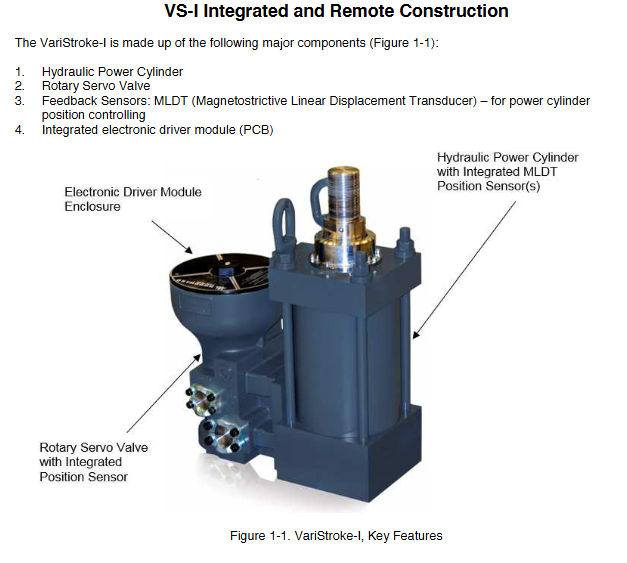
The actuator is mainly composed of the following components (see Figure 1-1):
Hydraulic power cylinder: provides driving force, and the stroke range can be precisely adjusted on site.
Rotary servo valve: controls the flow of hydraulic oil to achieve precise modulation of the position of the power cylinder.
Feedback sensor: Redundant MLDT sensor provides high-precision cylinder position feedback.
Integrated electronic driver module (PCB): executes control algorithms, processes input/output signals, and provides advanced diagnostic functions.
1.3 Product Form
To adapt to different installation spaces and application requirements, VS-I offers three configurations:
Integrated: The servo valve, power cylinder, and electronic drive module are integrated into a compact unit.
Remote servo kit: The hydraulic power cylinder can be installed up to 3 meters away from the servo valve.
Only servo version: allows users to use their own hydraulic cylinders, providing only servo valves and control systems.
2、 Key performance and specification parameters
2.1 Physical and Performance Specifications
Cylinder and Rod Diameters: Multiple cylinder diameter options are available, including 4 inches (101.6 mm), 5 inches (127 mm), 6 inches (152.4 mm), 8 inches (203.2 mm), and 10 inches (254 mm), to meet different force requirements.
Spring assisted version: Provides four different spring force levels, S, T, U, and V, to assist the valve in reaching a safe position when oil pressure is lost.
Position accuracy and repeatability: The full stroke position accuracy is ± 1%, and the repeatability is ± 0.5%.
Fault safe operation: The internal servo valve return spring ensures that the actuator can reliably move to the preset fault safe position (extended or retracted) in the event of power, sensor, or processor failure.
2.2 Environmental and Electrical Specifications
Environmental temperature: -40 ° C to+85 ° C. Under specific hydraulic oil temperature conditions, the allowable ambient temperature for servo valves and remote cylinder bodies can reach up to 105 ° C each (see Table 2-7).
Protection level: IP66, suitable for harsh industrial environments.
Power supply voltage: 18-32 Vdc, rated at 24 Vdc. Steady state current 2.3 A, transient peak current 10 A (up to 100 ms).
Input/output signal:
Requirement signal: Two redundant 4-20 mA analog inputs.
Position feedback signal: Two redundant 4-20 mA analog inputs (remote servo requires external sensors).
Analog output: A 4-20 mA output used to indicate valve position.
Discrete input/output: used for reset, operation enable, alarm, and shutdown status indication.
2.3 Hydraulic specifications
Working fluid: Suitable for petroleum based hydraulic oil and fire-resistant hydraulic fluids such as Fyrquel EHC.
Oil supply pressure: 5.5 bar (80 psi) to 34.5 bar (500 psi).
Fluid cleanliness: ISO 4406 20/18/16 or cleaner is required.
Flow demand: Sufficient hydraulic flow should be provided based on the full speed movement (Slew) and steady-state operation requirements of the actuator (see Figure 2-1 and Figure 2-2).
2.4 Performance Index
The performance of VS-I depends on the matching of servo valve size, oil supply pressure, and cylinder volume used. To ensure smooth operation of the actuator without excessive overshoot or limit cycles, the following performance index formula must be met:
VS_Constant * sqrt(P_supply) / ( (π * D_cyl^2) / 4 * L_stroke) ≤ 1
Among them, VS_Cstant=180. Not meeting this relationship may result in performance degradation and accelerated wear, and trigger a 'Performance Index Warning' alarm.
3、 Safety, Compliance, and Installation Points
3.1 Safety Warning
The manual emphasizes multi-level safety warnings that must be strictly followed:
- OMRON
- ABB
- General Electric
- EMERSON
- Honeywell
- HIMA
- ALSTOM
- Rolls-Royce
- MOTOROLA
- Rockwell
- Siemens
- Woodward
- YOKOGAWA
- FOXBORO
- KOLLMORGEN
- MOOG
- KB
- YAMAHA
- BENDER
- TEKTRONIX
- Westinghouse
- AMAT
- AB
- XYCOM
- Yaskawa
- B&R
- Schneider
- KONGSBERG
- NI
- WATLOW
- ProSoft
- SEW
- ADVANCED
- Reliance
- TRICONEX
- METSO
- MAN
- Advantest
- STUDER
- DANAHER MOTION
- Bently
- Galil
- EATON
- MOLEX
- DEIF
- B&W
- ZYGO
- Aerotech
- DANFOSS
- Beijer
- Moxa
- Rexroth
- Johnson
- WAGO
- TOSHIBA
- BMCM
- SMC
- HITACHI
- HIRSCHMANN
- Application field
- XP POWER
- CTI
- TRICON
- STOBER
- Thinklogical
- Horner Automation
- Meggitt
- Fanuc
- Baldor
- SHINKAWA
- Other Brands
- UniOP
- KUKA
- Iba
- Beckhoff
- ADLINK
-
 Micro Innovation GF1-10TVA-100 Touch Panel
 -
 Micro Innovation GSO-57EQD-000 Operator Panel
 -
 Micro Innovation XN-2AI-U Analog Input Module
 -
 Micro Innovation CAN-4AI/UI Analog Input Module
 -
 Micro Innovation ZSB-1.5/8-S/S/-/PE Base Terminal
 -
Micro Innovation AG XVH-340-57CAN-1-10 HMI Panel
-
 Micro Innovation GSO-57EQD-000 Micro Panel
 -
 Micro Innovation XN-2AI-PT/NI-2/3 Input Module
 -
 Micro Innovation AG GF0-57SQD-000 Display Panel
 -
 MICRO INNOVATION AG XN-16DI-24VDC-P Input Module
 -
 Micro Innovation XN-2AI-PT/NI-2/3 Input Module
 -
 Micro Innovation MC2-442-57CQB-1-2G Display Panel
 -
 Micro Innovation XN-16DO-24VDC-0.5A-P Module
 -
 Micro Design MC200PROFI Programmable Module
 -
Micro Innovation XV-252-57MPN-1-10 Micro Panel
-
 Micro Innovation CAN-4AI/UI Analog Input Module
 -
Micro Innovation GT1-MPI-A000 Panel
-
Micro Innovation MC2-440-10TVB-1-21 Display Panel
-
Micro Innovation XVS-430-57MPI-1-1S 6" HMI
-
Micro Innovation XV-442-57CQB-1-1AB Monitor
-
 Micro Innovation ZSB-1.5/8-S/S/-/PE Base Terminal
 -
Micro Design 895A Microfiche Reader
-
 MICRO INNOVATION XNE-8DI-24VDC-P Input Module 8550100794
 -
MICRO INNOVATION MICRO PANEL GF0-10CVD-002
-
 Micro Innovation XN-PLC-CANopen Controller 85 50 274124
 -
Micro Innovation Display Panel GS0-57E0D-000
-
MICRO INNOVATION CAN-32DI/P2X16 Input Module
-
MICRO INNOVATION XN-2DO-R-NO Relay Output Module
-
MICRO INNOVATION XNE-16DI-24VDC-P Input Module
-
Micro Innovation AG XN-2AI-U Analog Input Module
-
Micro Innovation XN-BR-24DC-D Power Supply
-
Micro Innovation MH2-342-57EIB-1-20 Panel
-
Micro Innovation XV-252-57MPN-1-10 Micro Panel
-
 Micro Innovation Display Card EIB2-TP
 -
 Micro Innovation XV-252-57MPN-1-10 6" HMI
 -
 Micro Innovation XN-B3T-SBC 16x DO Base Module
 -
Micro Innovation XVH-330-57MPI-1-10 Panel
-
Micro Innovation XN-BR-24VDC-D Power Module
-
 Micro Innovation EIB2-TP EIB2TP Module
 -
Micro Innovation GF0-10CVD-100 Touch Panel
-
MICRO INNOVATION XV-230-57CNN-1-10 HMI-PLC
-
MICRO INNOVATION XN-2DO-R-CO Relay Output Module
-
KMK MICRO INNOVATION GS2-90EMD-000 Micro Panel
-
 Micro Innovation XN-2AO-U Analog Output Module
 -
 Micro Innovation XN-1AO-I Analog Output Module
 -
 Micro Innovation CAN-32DI/P-2x16 Rack Module
 -
Eaton Micro Innovation MC2-440-10TVB-1-11 HMI
-
Micro Innovation AG CAN Bridge 8551224177
-
 Micro Innovation XN-2AI-I Analog Input Module Set
 -
Micro Innovation XN-4DI-24VDC-P Input Module
-
 Micro Innovation Winbloc CAN-16DO/0.5A-PK Module
 -
Micro Innovation Micro Panel GFO-10SVD-002 HMI
-
 Micro Innovation CAN-24DI/8DO/0.5A-PK Module
 -
 Micro Innovation DP-24DI/8DO/0.5A-PK I/O Module
 -
 Weidmuller Micro Innovation CAN-BRIDGE ZSFA 1,5R
 -
Micro Innovation CAN-3AI/1AO-UI Profibus Module
-
 Micro Innovation PDP-TP Profibus DP Module
 -
Micro Innovation CAN-3AI/1AO-UI Analog Module
-
 Micro Innovation MC2-430-12TSB-10 HMI Panel
 -
Micro Innovation XNE-8DO-24VDC-0.5A-P I/O Module
-
MICRO INNOVATION AG WINBLOC CAN-32DI/P-2x16 85 51 224182
-
 MICRO INNOVATION AG WINBLOC CAN-4AO/UI 85 51 224195
 -
Micro Innovation Xv-252-57cnn-1-10 HMI Panel
-
Micro Innovation XN Basis XN-S4T-SBBS-CJ 225200
-
Micro Innovation GF1-10TVD-100 Micro Panel
-
Micro Innovation XN-B3T-SBC 16-Fold DO Base Module
-
MICRO INNOVATION AG WINBLOC CAN-3AI/1AO-UI 85 51 224192
-
KMK Micro Innovation GS2-90EMD-000 Micro Panel
-
Micro Innovation MC2-430-10TVB-1-10 PanelView Terminal 24VDC
-
 Micro Innovation XNE-8DO-24VDC-0.5A-P I/O Module 8550100795
 -
MICRO INNOVATION GF1-10TVB-100 Touch Panel
-
MICRO INNOVATION AG WINBLOC CAN-4AI/UI Analog Input Module
-
MICRO INNOVATION AG WINBLOC CAN-32DO/0.5A-P-2x16 Output Module
-
MICRO INNOVATION AG CAN-32DI/P-2X16 8551224182 Input Module
-
 MICRO INNOVATION MK2-230/232-57 Circuit Board 85 28 200000
 -
 MICRO INNOVATION CAN-BRIDGE 8551224177 CAN Bridge
 -
Micro Innovation MC2-430-10TVB-1-10 Panel 24VDC
-
MICRO INNOVATION MC2-432-57CQB-1-10 HMI Panel
-
MICRO INNOVATION AG CAN-BRIDGE 85 51 224177 CAN Bridge
-
MICRO INNOVATION CAN-4AI/UI Analog Input Module
-
MICRO INNOVATION CAN-32DI/P-2X16 Input Module
-
 SIGMATEK MDD111 09-404-111 Drive Module
 -
 SIGMATEK DVI021 Display Interface Module
 -
 SIGMATEK 00-450-024 C-IPC Processor
 -
 SIGMATEK MDD-111 MDD111 Drive Module
 -
 SIGMATEK ICA011 20-102-011 Interface Module
 -
 SIGMATEK 01-250-010-D NC4Kompakt Control Module
 -
 SIGMATEK CRIF081 12-751-081 Interface Module
 -
 SIGMATEK S1026-8AF61-R4E-Z57 Drive Module
 -
 SIGMATEK 9305.081.02 9227.082.00 Control Module
 -
 Sigma Tek 5000B-36 Attitude Indicator
 -
 SIGMATEK CEZ201 12-051-201-O Counter Module
 -
 SIGMATEK DPS001 Power Supply Module
 -
 SIGMATEK 994 395 01z Via Interface Module
 -
 SIGMATEK PC411-K 01-310-411-K Industrial PC
 -
 SIGMATEK 9816.324.00 Demag NC4 Keyboard
 -
 SIGMATEK ET261 90010C-71 Operator Terminal
 -
 SIGMATEK DDI 164 05-006-164 Input Module
 -
 SIGMATEK CCP 082 C-DIAS Processor Module
 -
SIGMATEK CEZ201 12-051-201-O PLC Module
-
SIGMATEK MDD 1111 06178867 Drive Module
-
SIGMATEK S1 073-6AC61-RE-Y08-Z Drive Module
-
SIGMATEK MDD 111 Drive Module MDD111
-
 SIGMATEK CSDI161 Safety Module 12-891-161
 -
SIGMATEK C-IPC Processor 01-450-024
-
 SIGMATEK DIAS DAM122 Analog Mixing Module
 -
Sigma Tek 5000B-36 Attitude Gyro Indicator
-
 SIGMATEK TMS012 Motherboard Module 05-250-012-T
 -
 SIGMATEK CCP-531 PLC Module
 -
SIGMATEK DIAS DNC4 I/O Module 05-250-011
-
 SIGMATEK AI088 Analog Input Module
 -
 SIGMATEK CEZ201 Counter Module
 -
SIGMATEK CIC011 Industrial Computer Module
-
 SIGMATEK MDM021 Motor Drive Module
 -
 SIGMATEK DTO163 Digital Output Module
 -
SIGMA-TEK 5000B-36 Attitude Gyro
-
SIGMATEK DM161 Digital Input Module
-
SIGMATEK CCP-531 PLC Control Panel
-
 SIGMATEK HZS773 Touch Terminal Operator Panel
 -
SIGMATEK MDP101 3 KVA 45-65Hz Driver
-
 SIGMATEK ETV1251 Touch Panel 12-230-1251
 -
SIGMATEK CIO021 Safety Module 12-013-021
-
Sigma Tek 4000H-5 Directional Gyro
-
 SIGMATEK TAE531 I/O Module 01-240-531
 -
 SIGMATEK DAI081 Input Module 05-009-081
 -
 SIGMATEK DCP640 Drive Control Module
 -
 SIGMATEK DCP643 Slides Module A6-29
 -
SIGMATEK SCP011 Safety Module 20-890-011


