
XYCOM XVME-100 memory module
(2) Environmental adaptability parameters
Specific specifications of the project, industrial scenario value
Working temperature range: 0 ° C~65 ° C (32 ° F~149 ° F), suitable for wide temperature environments such as industrial workshops and outdoor equipment cabins
Storage temperature -40 ° C~85 ° C (-40 ° F~158 ° F) to meet extreme temperature environments during storage and transportation
Humidity range of 5% to 95% RH, non condensing (requiring anti-static protection for extremely low humidity), suitable for humid environments such as high humidity workshops and coastal areas, while also indicating requirements for electrostatic protection
Vibration (working) 5~2000Hz, peak acceleration 10g, peak to peak displacement 0.025mm (maximum) to resist vibration interference during industrial equipment operation, ensuring stable module connection
Impact (working) with a peak acceleration of 30g and a duration of 11ms to withstand impacts during transportation or on-site operations, enhancing the equipment's ability to withstand harsh environments
Altitude work: 0~3048m (10000ft); Storage: 0~15240m (50000ft) suitable for special geographical environments such as high-altitude areas
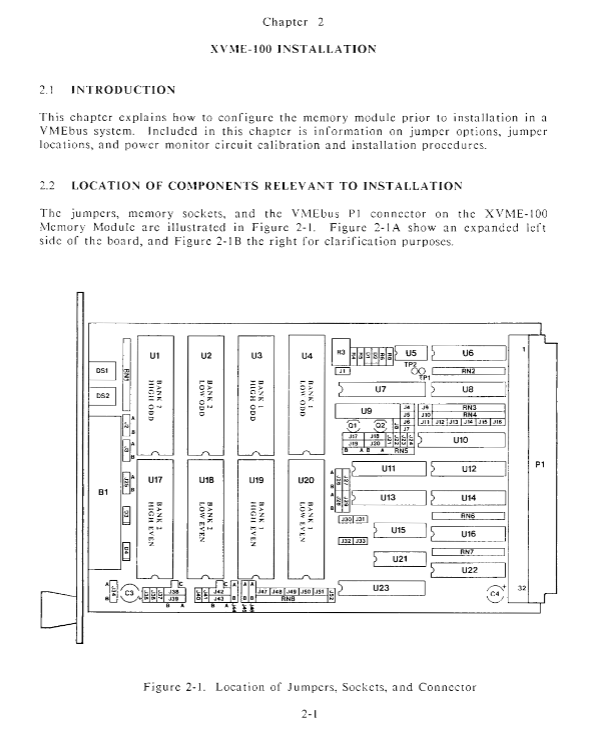
Core functions and design highlights
1. Core functions of storage and configuration
(1) Dual storage group independent configuration
Configuration independence: Bank1 and Bank2 can be set completely independently through their respective jumper groups, supporting:
Different storage types (such as Bank1 caching data in RAM and Bank2 storing programs in EPROM);
Different chip capacities (e.g. Bank 1 uses 64K x 8 chips, Bank 2 uses 128K x 8 chips);
Different backup strategies (such as using battery backup for Bank1 and no backup for Bank2);
Configuration flexibility: By combining jumper wires, flexible combinations of 8 chip capacities, 4 chip speeds, 3 backup power supplies, and 2 access permissions can be achieved without the need to modify hardware or software.
(2) Multi type storage adaptation mechanism
Requirements for storage type adaptation: Key points for jumper configuration
RAM supports static RAM chips and requires low data retention current (recommended Hitachi 6264LP-15, etc.). Enable backup power (battery or+5V STDBY) and set corresponding pin definitions for jumper wires
EPROM supports 64K/128K/256K/512K/1M capacity, TTL logic level is required to disable backup power supply, and EPROM dedicated pin definition jumper is configured
Mask ROM supports 64K/128K/256K/512K capacity with EPROM configuration, no need for backup power supply
EEPROM supports 8K × 8~32K × 8 capacity and needs to support fast write/polling technology. Disable backup power and set dedicated EEPROM pins to define jumper wires
2. Data security protection mechanism
(1) Triple Data Protection Design
First layer: Under voltage protection: Built in power monitor, when the+5V voltage is lower than 4.75V, the write function of the storage chip is automatically disabled to prevent voltage fluctuations from causing data confusion; Optionally enable SYSRESET * signal to trigger system reset to protect global data;
Second layer: Backup power supply: supports on-board battery and VMEbus+5V STDBY dual backup solution, with a typical battery backup life of 6 years, suitable for independent devices without continuous power supply; +5V STDBY backup is suitable for system level backup power scenarios;
Layer 3: Physical Protection: The pin definition jumper of the storage chip can prevent hardware damage caused by accidental insertion. In case of power failure, the write path will be automatically cut off. Combined with backup power, it ensures long-term storage of RAM data.
(2) Power monitor calibration
The power monitor has been calibrated at the factory and needs to be regularly calibrated after long-term use (recommended once a year). Calibration steps:
Place the module on the expansion board, power on, and remove the J1 jumper;
Connect the negative pole of the 4.75V reference power supply to TP2 (ground) and the positive pole to the left terminal of J1;
Connect TP1 with a multimeter or oscilloscope. If the voltage is greater than 4V, rotate the POT R3 potentiometer counterclockwise until the voltage is less than 0.8V;
Slowly rotate POT R3 clockwise until the TP1 voltage jumps to a high level and stops rotating;
Remove the reference power supply and multimeter, reinstall J1, and fix the POT R3 screw with glue to prevent loosening.
3. VMEbus compatibility and interface features
(1) Bus signal compatibility
XVME-100 fully complies with the VMEbus C.1 standard, with core compatible signals including:
Address bus: A01-A23 (A24-A31 are extended addresses), supporting a 24 bit address space;
Data bus: D00-D15, supports 8-bit/16 bit data transmission;
Control signals: AS * (address gating), DS0 */DS1 * (data gating), DTACK * (data transmission confirmation), WRITE * (read-write control), etc;
Interrupt and arbitration signals: IACKIN */ACKOUT * (interrupt response daisy chain), BUS GRANT (bus grant), BUS REQ (bus request), etc.
(2) P1 connector interface definition
The P1 connector is designed with 3 rows (A/B/C) of pins, and the core pin functions are classified as follows:
- OMRON
- ABB
- General Electric
- EMERSON
- Honeywell
- HIMA
- ALSTOM
- Rolls-Royce
- MOTOROLA
- Rockwell
- Siemens
- Woodward
- YOKOGAWA
- FOXBORO
- KOLLMORGEN
- MOOG
- KB
- YAMAHA
- BENDER
- TEKTRONIX
- Westinghouse
- AMAT
- AB
- XYCOM
- Yaskawa
- B&R
- Schneider
- KONGSBERG
- NI
- WATLOW
- ProSoft
- SEW
- ADVANCED
- Reliance
- TRICONEX
- METSO
- MAN
- Advantest
- STUDER
- DANAHER MOTION
- Bently
- Galil
- EATON
- MOLEX
- DEIF
- B&W
- ZYGO
- Aerotech
- DANFOSS
- Beijer
- Moxa
- Rexroth
- Johnson
- WAGO
- TOSHIBA
- BMCM
- SMC
- HITACHI
- HIRSCHMANN
- Application field
- XP POWER
- CTI
- TRICON
- STOBER
- Thinklogical
- Horner Automation
- Meggitt
- Fanuc
- Baldor
- SHINKAWA
- Other Brands
- UniOP
- KUKA
- Iba
- Beckhoff
- ADLINK
-
 Sigmatek MDD111-1 DIAS Drive Axis Module
 -
 Sigmatek DKL042 05-024-042 Terminal Module
 -
 Sigmatek DM822 Control Module
 -
 Sigmatek CDM167 12-008-167-O Module
 -
 Sigmatek TAE151 Touch Display Unit
 -
 Sigmatek DCC041 SLIDES Module 05-700-041-D
 -
 Sigmatek AKM65M-ANC2GBB0 PM Servo Motor
 -
 Sigmatek ETT221 01-230-221 Operator Terminal
 -
 Sigmatek SLIDES DAM 124 Analog Module
 -
Sigmatek AKM31C-ANCNGBB0 Servo Motor
-
 Mannesmann Demag Sigmatek CP626 Central Unit
 -
 SIGMATEK 0332.554.03 Board 371071000154
 -
 SIGMATEK 12-250-021 Base Plate Back Panel CM5V020
 -
 SIGMATEK DM162 S-DIAS Digital Mix Module
 -
 DEMAG ERGOTECH 061 381 66 Sigmatek 9842.243.02 Circuit Board
 -
 SIGMATEK CP313-1 PLC Module
 -
Sigmatek ETV0551-2 VARAN Touch Terminal
-
 Sigmatek SDM 081 FS S-Dias Safety Module
 -
 DEMAG 05-250-023 Ergotech Motherboard with Sigmatek TMS012
 -
Sigmatek CM5V020 12-250-023-K Wiring Base
-
 Sigma Tek 5000B-37 Attitude Gyro Indicator
 -
 Sigmatek SDD120-2 DIAS Drive
 -
 Sigmatek CME221 Memory Module
 -
 Sigmatek DCP640 DIAS Central Unit
 -
 Sigmatek STO040 Safety Output Module
 -
Sigmatek CET281 Control Panel
-
 Sigmatek CIPC LX800 Demag NC5 CPU
 -
 Sigmatek DKL093 05-024-093 Terminal Module
 -
 Sigmatek AI088 20-009-088 Analog Input Module
 -
Sigmatek CAI888 Analog Input Module
-
SIGMATEK CCA021 12-025-021 Analog Output Module
-
SIGMATEK 1104.579.05 Control Module
-
SIGMATEK SDI100 Digital Input Module
-
 SIGMATEK C-IPC 256MB LX800 Compact Dias
 -
 SIGMATEK 9423.090.02 Control Module
 -
SIGMATEK C-IPC 256 Power Supply 148498
-
 SIGMATEK CAI025 Analog Input Module
 -
 SIGMATEK CTO166 Digital Output Module
 -
 SIGMATEK CP112 20-004-112 Processor Module
 -
SIGMATEK CAI887 12-009-887 Safety Module
-
 Sigma-Tek 4000B-31 Directional Gyro 1U262-002-42
 -
Sigmatek C-IPC 256MB LX800 IPC Controller
-
Sigmatek C-IPC 01-450-031 Industrial PC LX800
-
Sigmatek C-IPC 256 Industrial PC Controller
-
Sigmatek CCP-531 PLC Processor Module
-
Sigmatek CDI163 Digital Input Module
-
 Sigmatek ETV0501 VARAN Terminal 12-230-0501
 -
 Sigmatek CTMS020 C-DIAS Technology Module
 -
 Sigmatek CIV512 VARAN Switch Module
 -
 Sigmatek HU011 20-080-011 Interface Module
 -
SIGMATEK SLIDES DAM 124 Module
-
 SIGMATEK C-IPC 161 01-450-161L Industrial PC
 -
SIGMATEK C-IPC 128MB VIA 733MHz 01-450-024-K
-
 SIGMATEK 12-780-012 R8-IPC Geode LX800 Module
 -
SIGMATEK CAM124 Analog Module
-
 SIGMATEK S1 032-8AF61-R4 EZ Servo Motor
 -
 SIGMATEK CTO163 Digital Output Module
 -
 SIGMATEK CCP082 12-004-082 Processor Module
 -
 SIGMATEK CRCH081 C-DIAS Temperature Module
 -
 SIGMATEK PC322-K 01-310-322-K Industrial PC
 -
SIGMATEK SDD310-2 Servo Drive
-
 SIGMATEK AI084 Analog Input Module
 -
SIGMATEK CRCH081 12-752-081 Temperature Module
-
Sigma-Tek 5000L-4 Attitude Gyro 1U284-001-3
-
 SIGMATEK CM5V020 12-250-023-K Wiring Module
 -
Sigma-Tek 4000H-6 Directional Gyro IU262-035-7
-
 SIGMATEK Dias DCP160 05-004-160 Processor Module
 -
SIGMATEK 0147.395.02 Control Module
-
SIGMATEK A1084 Control Module
-
SIGMATEK DI200 20-006-2000 Digital Input Module
-
Sigmatek DNC115 Encoder Module
-
 Sigmatek DAM122 05-017-122 Analog Module
 -
Sigmatek 9802.289.01 Control Board TA71 Display
-
Sigmatek TO127 20-007-127 Digital Output Module
-
Sigmatek DNC031 05-011-031 Digital Module
-
Sigmatek VI022 20-003-022 Interface Module
-
Sigmatek CAI085 Analog Input Module
-
 Sigmatek CP111 S-DIAS CPU Module
 -
Sigmatek CTMS030 Krauss Maffei Module
-
 Sigmatek CAM123 Control Module
 -
 Sigmatek TAE732-P 01-240-732-P Touch Display Unit
 -
Sigmatek MDM021 Digital Mixed Module
-
Sigmatek DCP642 DIAS Central Unit
-
 Sigmatek CST022 12-014-022 C-DIAS Module
 -
 Sigmatek SRO021 20-893-021 Safety Relay Output
 -
 Krauss Maffei MC5 Control System Sigmatek
 -
 Sigmatek DC061 Module 18-24VDC 300mA
 -
 Herrmann EVT0855 Ultrasonic Welder Touch Panel
 -
Sigmatek CIV521 Control Module 1.4A 2W
-
Sigmatek DDI61 05-006-161 Digital Input Module
-
SIGMATEK ETT312-E Touch Terminal 01-230-312
-
Cessna S3326-1 Sigma Tek 5000B-67 Gyro 1U149-015-9
-
SIGMATEK PS101 Power Supply Module
-
SIGMATEK 0332.554.03 Control Module 371071000154
-
 SIGMATEK ETT312-E Touch Terminal 01-230-312
 -
SIGMATEK CDM163 Control Module
-
 SIGMATEK VSV046 16-023-046 Module
 -
SIGMATEK AM221 20-017-221 Analog Module
-
SIGMATEK CTS051 12-053-051 Control Module
-
SIGMATEK AM221 20-017-221 Analog Module
-
Sigmatek CSDI161 12-891-161 Safety Input Module
-
Sigma Tek 4000C-1 Directional Gyro Indicator
-
Sigmatek ETV0501 12-230-0501 VARAN Terminal
-
Sigmatek DDM165 SLIDES Module
-
Sigmatek N100 20-011-100 Control Module
-
Sigmatek AKM54K-ANC2R-B0 PM Servo Motor
-
Sigmatek CTO166 Digital Output Module
-
Sigmatek CP212-K 20-004-212-K CPU Module
-
Sigmatek CDI161 Digital Input Module
-
Sigmatek DCC080 05-700-080-2 Control Module
-
 SIGMATEK SCP011 S-DIAS Safety CPU
 -
SIGMATEK SCP011 S-DIAS Safety CPU
-
SIGMATEK SRO022 Relay Output Module
-
SIGMATEK MDD 121 Drive Axis Module
-
SIGMATEK DSI021 SLIDES Siemens Interface
-
SIGMATEK DIAS DCP161 Module 05-004-161
-
 Sigmatek ETT312 Built-in Touch Terminal
 -
SIGMATEK DCP 643 DIAS Controller System
-
SIGMATEK CIO021 Multi I/O Module
-
SIGMATEK CTMS020 Control Module
-
 Sigmatek CME 221 Memory Module
 -
Sigmatek 0420.615.01 Control Board
-
Sigmatek CP111 20-004-111 CPU Module
-
Sigmatek 9405.065.03 Control Board
-
Sigmatek ETEK 01-450-032-K C-IPC 256MB Industrial PC
-
Sigmatek CTO163 12-007-163 Safety Output Module
-
Sigmatek TO081 20-007-081 Digital Output Module
-
 Sigmatek SI021 20-022-021 Safety Input Module


