
Woodward PG-PL Hydraulic Governor: Reliable and Accurate Engine and Turbine Speed Control Solution
Woodward PG-PL Hydraulic Governor: Reliable and Accurate Engine and Turbine Speed Control Solution
Introduction
Accurate and stable control of the rotational speed of prime movers (engines, steam turbines, gas turbines, etc.) is the cornerstone of ensuring equipment efficiency, safety, and reliability in key fields such as industrial drive, power generation, ship propulsion, and oil and gas pipelines. The Woodward PG-PL governor is a proven hydraulic Isochronous governor that integrates a pneumatic speed setting mechanism. With its sturdy structure, responsive nature, and easy maintenance, it performs well in various diesel, gas, and steam turbine applications. This article provides a systematic explanation of the principle, installation, commissioning, maintenance, and components of the PG-PL speed controller based on Manual 36694P.
Product Overview and Core Features
1. Basic composition
The PG-PL governor is a variant of the basic PG (pressure compensated) governor, and its core system includes:
Hydraulic pump, accumulator, and relief valve: Provide and maintain a working oil pressure of approximately 100 psi (690 kPa) (which can be increased as needed).
Centrifugal flying hammer pilot valve assembly: sensing speed changes and controlling oil flow direction.
Power cylinder (servo motor): outputs linear (maximum 25mm) or rotational (maximum 30 °) displacement, directly driving the fuel rack or steam valve.
Buffer compensation system: Ensure stable speed regulation process and avoid drifting.
Pneumatic speed setting mechanism: Remote speed setting is achieved through a pressure signal of 3-100 psi (21-690 kPa), supporting two modes: positive action (pressure rise, speed rise) and negative action (pressure drop, speed rise).
2. Main technical parameters
Standard working oil pressure: 100 psi (690 kPa), can be increased to 200 psi (1379 kPa) to increase output capacity.
The rated power capacity of the power cylinder is available from 12 ft lb (16 J) to 200 ft lb (271 J).
Speed setting range: usually 250-1000 rpm, with a maximum adjustable range of 200-1600 rpm.
Pneumatic signal range: typically 3-15 psi (21-103 kPa) or 10-60 psi (69-414 kPa), with a high/low pressure ratio between 2.5:1 and 10:1.
Working temperature: ambient temperature -20 to+200 ° F (-29 to+93 ° C); recommended continuous operating oil temperature is 140-200 ° F (60-93 ° C).
Key steps for installation and debugging
1. Key points of mechanical installation
The installation base should be flat and use shims to ensure that the drive shaft is aligned.
The linkage mechanism must have no jamming or virtual position. When in the "closed" position, the fuel/steam valve should be precisely closed; Before reaching the maximum position, the fuel control should be fully open.
Important safety warning: Before adjusting the governor on running equipment, it is necessary to confirm that the independent overspeed shutdown device is functioning properly.
2. Selection and filling of hydraulic oil
Hydraulic oil has both lubrication and transmission functions, and selection is crucial:
Viscosity range: At operating temperature, the viscosity should be between 50-3000 SUS, with an ideal range of 100-300 SUS.
Oil type: Mineral or synthetic oils that comply with API "S" or "C" series (SA to SF, CA to CD), or oils that comply with specific US military standards (such as MIL-L-2104).
Oil level check: When the engine is idling, the oil level should be between the markings on the oil level gauge. The oil level shall not be higher than the joint surface between the shell and the column to avoid foam generated by the flying hammer.
3. Core adjustment: compensating needle valve
This is the most critical adjustment that affects stability:
The engine is running at idle speed, and the compensating needle valve is opened several times to induce travel (to discharge air from the hydraulic circuit).
Gradually close the needle valve until the traveling block is just eliminated. The needle valve opening is usually between 1/16 and 2 turns. Do not completely close.
Manually interfere with the speed setting, and check that the recovery process should only have slight overshoot or undershoot.
If necessary, loosen the exhaust screw on the housing to exhaust until the bubbles disappear and tighten.
4. Speed setting adjustment (pneumatic mechanism)
The steps for setting positive and negative effects are different, and the manual provides detailed procedures. The core is:
Use the manual speed setting knob and the high-speed stop adjustment screw as a reference.
Match the pneumatic signal range and speed range by adjusting the pivot bracket.
Set the minimum speed adjustment screw and stop nut to define the behavior when the air source fails (to idle or stop).
Adjust the maximum speed limit valve and open it before overspeeding by about 10 rpm to provide additional protection.
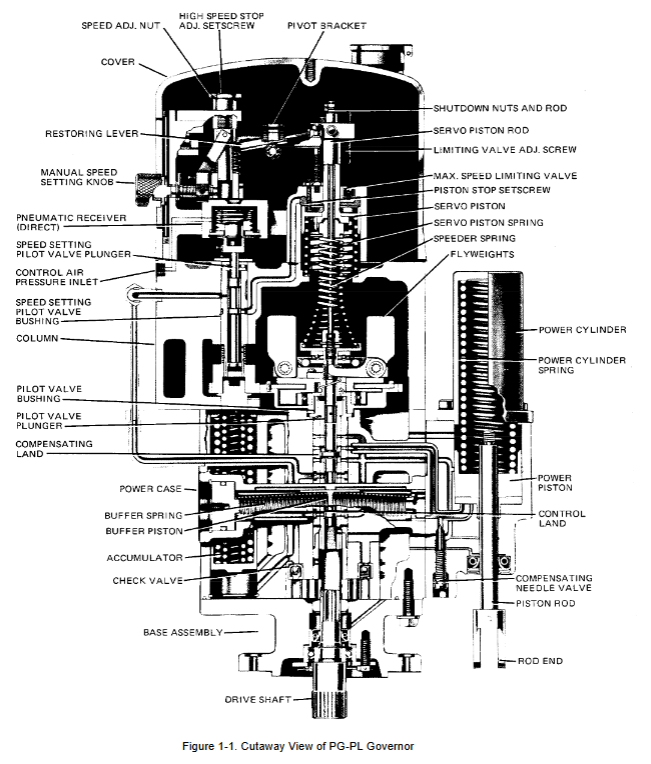
Deep analysis of working principle
PG-PL governor is a typical hydraulic mechanical constant speed governor, whose core is force balance and hydraulic feedback.
Speed sensing and comparison: The drive shaft drives the flying hammer to rotate, generating centrifugal force that counteracts the downward force of the speed regulating spring. When the two are balanced, the control console shoulder of the pilot valve plunger just covers the regulating oil port, and the power cylinder piston remains stationary.
- OMRON
- ABB
- General Electric
- EMERSON
- Honeywell
- HIMA
- ALSTOM
- Rolls-Royce
- MOTOROLA
- Rockwell
- Siemens
- Woodward
- YOKOGAWA
- FOXBORO
- KOLLMORGEN
- MOOG
- KB
- YAMAHA
- BENDER
- TEKTRONIX
- Westinghouse
- AMAT
- AB
- XYCOM
- Yaskawa
- B&R
- Schneider
- KONGSBERG
- NI
- WATLOW
- ProSoft
- SEW
- ADVANCED
- Reliance
- TRICONEX
- METSO
- MAN
- Advantest
- STUDER
- DANAHER MOTION
- Bently
- Galil
- EATON
- MOLEX
- DEIF
- B&W
- ZYGO
- Aerotech
- DANFOSS
- Beijer
- Moxa
- Rexroth
- Johnson
- WAGO
- TOSHIBA
- BMCM
- SMC
- HITACHI
- HIRSCHMANN
- Application field
- XP POWER
- CTI
- TRICON
- STOBER
- Thinklogical
- Horner Automation
- Meggitt
- Fanuc
- Baldor
- SHINKAWA
- Other Brands
- UniOP
- KUKA
- Iba
- Beckhoff
- ADLINK
-
 MICRO INNOVATION GF1-10TVB-100 Touch Panel
 -
 MICRO INNOVATION AG WINBLOC CAN-4AI/UI Analog Input Module
 -
 MICRO INNOVATION AG WINBLOC CAN-32DO/0.5A-P-2x16 Output Module
 -
 MICRO INNOVATION AG CAN-32DI/P-2X16 8551224182 Input Module
 -
 MICRO INNOVATION MK2-230/232-57 Circuit Board 85 28 200000
 -
 MICRO INNOVATION CAN-BRIDGE 8551224177 CAN Bridge
 -
 Micro Innovation MC2-430-10TVB-1-10 Panel 24VDC
 -
 MICRO INNOVATION MC2-432-57CQB-1-10 HMI Panel
 -
MICRO INNOVATION AG CAN-BRIDGE 85 51 224177 CAN Bridge
-
 MICRO INNOVATION CAN-4AI/UI Analog Input Module
 -
MICRO INNOVATION CAN-32DI/P-2X16 Input Module
-
 SIGMATEK MDD111 09-404-111 Drive Module
 -
 SIGMATEK DVI021 Display Interface Module
 -
 SIGMATEK 00-450-024 C-IPC Processor
 -
 SIGMATEK MDD-111 MDD111 Drive Module
 -
 SIGMATEK ICA011 20-102-011 Interface Module
 -
 SIGMATEK 01-250-010-D NC4Kompakt Control Module
 -
 SIGMATEK CRIF081 12-751-081 Interface Module
 -
 SIGMATEK S1026-8AF61-R4E-Z57 Drive Module
 -
 SIGMATEK 9305.081.02 9227.082.00 Control Module
 -
 Sigma Tek 5000B-36 Attitude Indicator
 -
 SIGMATEK CEZ201 12-051-201-O Counter Module
 -
 SIGMATEK DPS001 Power Supply Module
 -
 SIGMATEK 994 395 01z Via Interface Module
 -
 SIGMATEK PC411-K 01-310-411-K Industrial PC
 -
 SIGMATEK 9816.324.00 Demag NC4 Keyboard
 -
 SIGMATEK ET261 90010C-71 Operator Terminal
 -
 SIGMATEK DDI 164 05-006-164 Input Module
 -
 SIGMATEK CCP 082 C-DIAS Processor Module
 -
SIGMATEK CEZ201 12-051-201-O PLC Module
-
SIGMATEK MDD 1111 06178867 Drive Module
-
SIGMATEK S1 073-6AC61-RE-Y08-Z Drive Module
-
SIGMATEK MDD 111 Drive Module MDD111
-
 SIGMATEK CSDI161 Safety Module 12-891-161
 -
SIGMATEK C-IPC Processor 01-450-024
-
 SIGMATEK DIAS DAM122 Analog Mixing Module
 -
Sigma Tek 5000B-36 Attitude Gyro Indicator
-
 SIGMATEK TMS012 Motherboard Module 05-250-012-T
 -
 SIGMATEK CCP-531 PLC Module
 -
SIGMATEK DIAS DNC4 I/O Module 05-250-011
-
 SIGMATEK AI088 Analog Input Module
 -
 SIGMATEK CEZ201 Counter Module
 -
SIGMATEK CIC011 Industrial Computer Module
-
 SIGMATEK MDM021 Motor Drive Module
 -
 SIGMATEK DTO163 Digital Output Module
 -
SIGMA-TEK 5000B-36 Attitude Gyro
-
SIGMATEK DM161 Digital Input Module
-
SIGMATEK CCP-531 PLC Control Panel
-
 SIGMATEK HZS773 Touch Terminal Operator Panel
 -
SIGMATEK MDP101 3 KVA 45-65Hz Driver
-
 SIGMATEK ETV1251 Touch Panel 12-230-1251
 -
SIGMATEK CIO021 Safety Module 12-013-021
-
Sigma Tek 4000H-5 Directional Gyro
-
 SIGMATEK TAE531 I/O Module 01-240-531
 -
 SIGMATEK DAI081 Input Module 05-009-081
 -
 SIGMATEK DCP640 Drive Control Module
 -
 SIGMATEK DCP643 Slides Module A6-29
 -
SIGMATEK SCP011 Safety Module 20-890-011
-
SIGMATEK DDM 164-D Slides Module
-
 SIGMATEK C-IPC Processor 146267
 -
SIGMATEK ET3200 Display Screen
-
SIGMATEK CEZ221 C-DIAS Mixing Module
-
 SIGMATEK SDD120-2 DIAS Servo Drive
 -
SIGMATEK DIP011 05-058-011 Module
-
 Sigmatek DEC181 I/O Module
 -
SIGMATEK DCP640 DIAS Central Unit
-
SIGMATEK 00-450-024 C-IPC Industrial Computer
-
SIGMATEK AKM32C-ANCNR-B0 Servomotor
-
SIGMATEK DVI021 DIAS Power Module
-
SIGMATEK CTS051 12-053-051 Control Module
-
 SIGMATEK CTS022 Control Module
 -
 Sigmatek 01-250-010-D NC4Kompakt V2.1 Module
 -
 SIGMATEK Control Keyboard 01-285-042 Interface
 -
 SIGMATEK TO081 20-007-081 Digital Output Module
 -
 Sigmatek AKM73Q-ANCNGBB0 7.07kW Servo Motor
 -
Sigmatek DIP012 Demag 07024165 Processor Module
-
 SIGMATEK PC 411 Injection Molding Controller
 -
SIGMATEK CEZ201 12-051-201-O Processor Module
-
 SIGMATEK VI021 20-003-021 Digital Input Module
 -
SIGMATEK Computer C-IPC 144904 Industrial PC
-
 SIGMATEK 9307.083.01 9305.081.02 Industrial Module
 -
 SIGMATEK AI075 Analog Input Module
 -
 SIGMATEK HGT834-W Teaching Pendant
 -
Sigmatek CDI161 Digital Input Module
-
 SIGMATEK HGT834 Teaching Pendant
 -
 SIGMATEK CEZ201 12-051-201-O Module
 -
SIGMATEK Demag 9617.067.03 9708.244.00 Module
-
 SIGMATEK SCP010 Safety CPU Module
 -
SIGMATEK N100 20-011-100 Module
-
 SIGMATEK CNC 031 Positioning Output Module
 -
 Sigmatek 01-355-016 Control Module
 -
 Sigmatek MDM021 Digital Mixed Module
 -
Sigmatek DAI411 05-020-411 Analog Module
-
Attitude Gyro 1U367-232-2 Aircraft Instrument
-
 Sigma-Tek 5000B-36 Attitude Gyro 23-501-06-16
 -
Sigmatek HGT834-W Injection Molding Teach Pendant
-
Sigma Tek 5000EG Attitude Gyro 1U670-003-12
-
Sigmatek HGT834-W Teach Pendant
-
Sigmatek DEE011 05-068-011 Module
-
Sigmatek DIAS DCP643 Central Processing Unit
-
Sigmatek MDD111-1 DIAS Drive Axis Module
-
 Sigmatek DKL042 05-024-042 Terminal Module
 -
Sigmatek DM822 Control Module
-
Sigmatek CDM167 12-008-167-O Module
-
Sigmatek TAE151 Touch Display Unit
-
 Sigmatek DCC041 SLIDES Module 05-700-041-D
 -
Sigmatek AKM65M-ANC2GBB0 PM Servo Motor
-
Sigmatek ETT221 01-230-221 Operator Terminal
-
Sigmatek SLIDES DAM 124 Analog Module
-
Sigmatek AKM31C-ANCNGBB0 Servo Motor
-
Mannesmann Demag Sigmatek CP626 Central Unit
-
SIGMATEK 0332.554.03 Board 371071000154
-
 SIGMATEK 12-250-021 Base Plate Back Panel CM5V020
 -
SIGMATEK DM162 S-DIAS Digital Mix Module
-
DEMAG ERGOTECH 061 381 66 Sigmatek 9842.243.02 Circuit Board
-
 SIGMATEK CP313-1 PLC Module
 -
Sigmatek ETV0551-2 VARAN Touch Terminal
-
 Sigmatek SDM 081 FS S-Dias Safety Module
 -
 DEMAG 05-250-023 Ergotech Motherboard with Sigmatek TMS012
 -
Sigmatek CM5V020 12-250-023-K Wiring Base
-
Sigma Tek 5000B-37 Attitude Gyro Indicator
-
Sigmatek SDD120-2 DIAS Drive
-
 Sigmatek CME221 Memory Module
 -
Sigmatek DCP640 DIAS Central Unit
-
 Sigmatek STO040 Safety Output Module
 -
Sigmatek CET281 Control Panel
-
Sigmatek CIPC LX800 Demag NC5 CPU
-
Sigmatek DKL093 05-024-093 Terminal Module


