
YASKAWA ∑ - V series AC servo drive
YASKAWA ∑ - V series AC servo drive
Core positioning
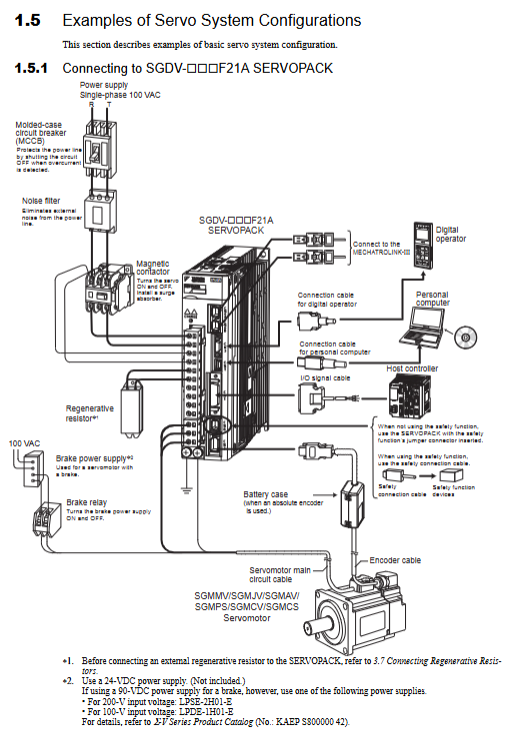
The YASKAWA ∑ - V series AC servo drive focuses on the entire lifecycle of design, testing, adjustment, and maintenance. It is compatible with SGDV series servo amplifiers and SGMMV/SGMJV/SGMAV rotary servo motors, as well as SGMCV/SGMCS direct drive servo motors. Its core applications include high-frequency, high-speed, and high-precision positioning scenarios (such as automated production lines, precision machine tools, robots, etc.), and it also specifies compliance requirements and safety operating standards such as UL in North America, CE in the European Union, and UKCA.
Product Core Parameter System
(1) Power supply and electrical parameters
Power supply type, model series, voltage range, frequency, continuous output current, instantaneous maximum output current
Single phase 100V SGDV-F series (R70F/R90F/2R1F/2R8F) 100-115VAC,+10%/-15% 50/60Hz 0.66-2.8 Arm 2.1-9.3 Weapon
Single phase 200V SGDV-A series (120A21A008000) 220-230VAC,+10%/-15% 50/60Hz 11.6 weapons 28 weapons
Three phase 200V SGDV-A series (R70A/1R6A/3R8A, etc.) 200-230VA,+10%/-15% 50/60Hz 0.66-78.0 weapons 2.1-170 weapons
Three phase 400V SGDV-D series (1R9D/3R5D/8R4D, etc.) 380-480VAC,+10%/-15% 50/60Hz 1.9-37.2 weapons 5.5-85 weapons
(2) Performance indicators
Speed control range: 1:5000 (the lower limit should be lower than the rated torque without causing the motor to stop)
Speed regulation accuracy: ± 0.01% (rated speed) when the load changes from 0% to 100%; 0% when voltage fluctuation is within ± 10%; ± 0.1% when the temperature changes by 25 ± 25 ℃
Repeatability of torque control: ± 1%
Positioning completion accuracy: can be fine tuned through electronic gear ratio (Pn20E/Pn210) and positioning completion width (Pn522), with a minimum reference unit of 1 μ m
Response characteristics: Soft start time 0-10s (acceleration/deceleration can be independently set)
(3) Environmental and Protection Parameters
Working temperature: 0-55 ℃; Storage temperature: -20-85 ℃
Relative humidity: ≤ 90% RH (no condensation, no freezing)
Vibration resistance: 4.9m/s ²; Impact resistance: 19.6m/s ²
Protection level: IP10 (to avoid contact with corrosive gases, dust, and oil-water)
Altitude limit: ≤ 1000m
Pollution level: Level 2
Key operations and configuration system
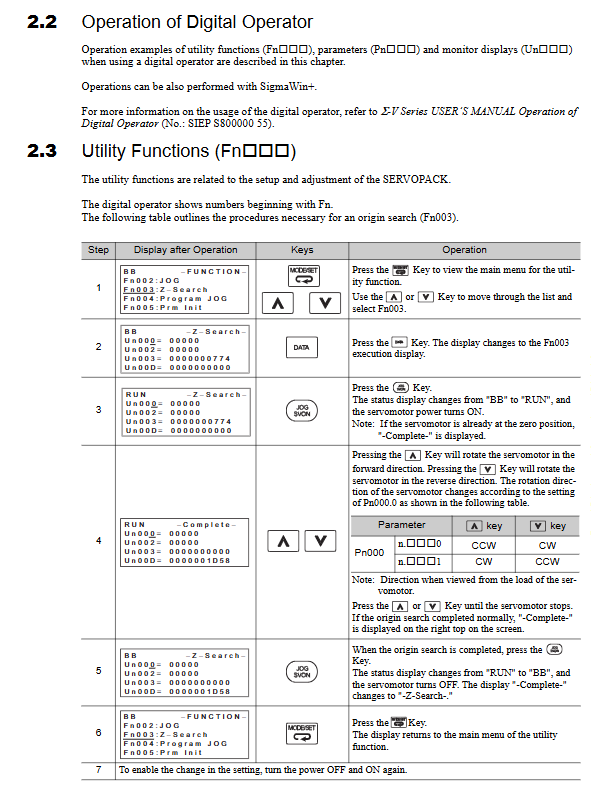
(1) Panel and digital operator
1. Core components
Seven segment LED display: displays servo status, alarm codes, parameter values
Function keys (MODE/SET, DATA, JOG/SVON, etc.): used for parameter configuration, utility function execution, and manual operation
Indicator lights: CHARGE (main circuit capacitor charging), L1/L2 (communication data transmission), CN (communication connection normal)
2. Core operating procedures
Parameter configuration: Switch to the "PRM/MON" menu using the MODE/SET keys, select the parameter (Pn series) using the directional keys, modify the value using the DATA key and save it
Utility function execution: Switch to the "Function" menu with MODE/SET keys, select Fn code (such as Fn201 advanced self-tuning), and press the DATA key to start
Monitoring view: Switch the MODE/SET key to the "PRM/MON" menu, switch to the monitoring item starting with "Un", and check the motor speed (Un000), torque (Un002), etc
(2) Parameter classification and core parameters
1. Parameter classification
Setup parameter: Basic operating condition configuration (such as Pn002 encoder type, Pn00B single-phase/three-phase power supply selection), after modification, it needs to be restarted to take effect
Tuning parameters: Control gain, filter, etc. (such as Pn100 speed loop gain, Pn102 position loop gain), partially effective in real-time
2. High frequency core parameters
Parameter Code Parameter Name Function Description Typical Setting Range
Pn002 encoder type selection switches between absolute/incremental encoder mode n. 0 (absolute), n. 1 (incremental)
Pn00B. 2 Power Supply Type Selection Three phase 200V Model Switching Single phase/Three phase Input 0 (Three phase), 1 (Single phase)
PN103 moment of inertia ratio matching motor and load inertia, affecting stability 1-1000 (adjusted according to actual load)
Pn20E/PN210 electronic gear ratio adjustment reference unit to actual displacement ratio 1-1073741824
Pn402/PN403 forward/reverse torque limit protection for mechanical loads, preventing overload from 0-800 (unit: rated torque%)
When the width positioning error of Pn522 positioning is less than this value, output the completion signal 0-1073741824 (reference unit)
(3) MECHATROLINK-III Communication Configuration
1. Hardware settings
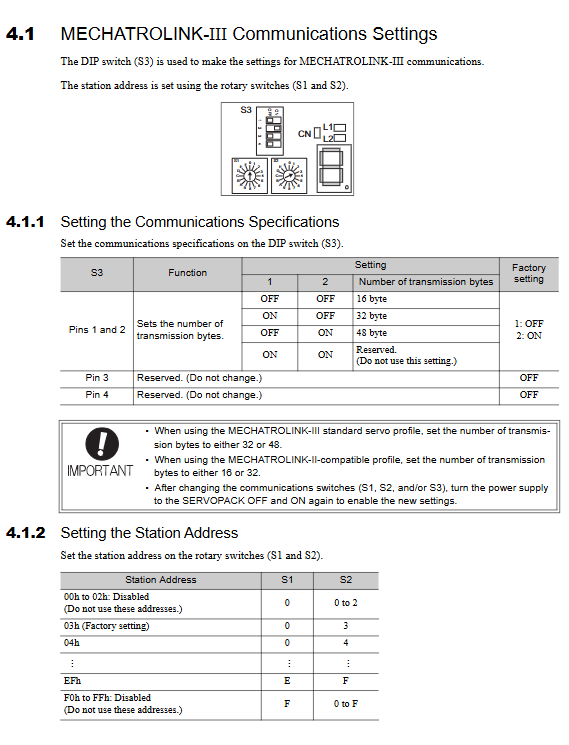
Station address: Set by rotating switch S1 (high), S2 (low), range 03h EFh (disable 00h-02h, F0h FFh)
Number of transmitted bytes: set through DIP switch S3, 16/32/48 bytes (standard servo profile requires 32/48 bytes)
Wiring: CN6A/CN6B connector, shielded twisted pair, maximum distance between stations 75m, terminal needs to be connected to 220-470 Ω matching resistor
2. Communication parameters
Protocol: MECHATROLINK-III
Baud rate: 100Mbps
Transmission cycle: 125 μ s, 250 μ s, 500 μ s, 750 μ s, 1.0-4.0ms (0.5ms step)
Core commands: CONNECT (establish communication), SENS-ON (read absolute encoder data), SV_SON (servo enable)
Wiring and installation specifications
(1) Wiring system
1. Main circuit wiring (power circuit)
Terminal definitions: L1/L2/L3 (power input), U/V/W (motor wiring), B1/B2/B3 (regenerative resistance), FG (grounding)
Cable requirements: HIV series heat-resistant polyvinyl chloride insulated wire, with a cross-sectional area ranging from 1.25mm ² (low power) to 22mm ² (high power) depending on the model
Wiring principle:
Three phase power supply needs to distinguish phase sequence, single-phase power supply is connected to L1/L2 (L3 suspended)
Regenerative resistor: Some models require the removal of the B2-B3 short-circuit and external connection, while models such as 470A/550A require an external regenerative resistor unit
Grounding: Independent grounding, 200V series grounding resistance ≤ 100 Ω, 400V series ≤ 10 Ω
2. Signal circuit wiring (control circuit)
Connector signal type core terminal wiring requirements
CN1 I/O signal+24VIN (6-pin), SG (16 pin), ALM+/- (3/4-pin) shielded twisted pair, with a maximum length of 3m and a distance of ≥ 30cm from the power cable
CN2 encoder signal PG5V (1 pin), PG0V (2 pins), PS/PS - (5/6 pins) shielded twisted pair, up to 50m long, single ended grounded
CN8 safety signal/HWBB1+/- (4/3 pins),/HWBB2+/- (6/5 pins) redundant wiring, 0V common ground, avoid sharing cables with other signals
CN6A/CN6B communication signal MECHATROLINK-III differential signal shielded twisted pair, terminated with matching resistor
(2) Installation specifications
1. Installation environment
Avoid direct sunlight exposure, condensation, corrosive gases, dust, and strong magnetic field environments
When installing inside the control board, it is necessary to reserve heat dissipation space: up and down ≥ 10mm, left and right ≥ 5mm
Stay away from strong interference equipment such as frequency converters and welding machines, with a distance of ≥ 1m
2. Mechanical installation
Fixed method: Standard base installation, optional rack installation/air duct ventilation type (high-power models such as 470A/550A)
Screw specification: 10.9 grade hexagonal socket screw, tightening torque 3.6-41.5N · m (depending on the model size)
When installed vertically: a counterweight or braking device should be configured to prevent the load from falling due to power failure
Core functions and operating procedures
(1) Safety function (HWBB hard wired base block)
1. Functional principle
Dual redundant input signals (/HWBB1//HWBB2), when either of them is OFF, cut off the motor current within 20ms and enter the HWBB state (no torque output from the motor)
External device monitoring (EDM1): ON in normal state, OFF when HWBB is activated, requiring host monitoring to meet EN ISO13849-1 PLd safety level
2. Key points of operation
Wiring: The signal requires 0V common ground and adopts dual circuit independent wiring to avoid disconnection faults
Reset process: After HWBB activation, it is necessary to first restore/HWBB1//HWBB2 to ON, then send the SV_SFF command, and finally resend the SV_SON command to unlock
Vertical axis application: Additional mechanical braking is required. When HWBB is activated, the brake signal (/BK) will immediately turn off to prevent the load from falling
(2) Tuning and vibration suppression
1. Tuning function system
Function code, function name, applicable scenarios, operation points
Fn200 has no tuning and does not require manual adjustment. It adapts to regular loads by selecting stiffness levels (0-4) and load levels (0-2), and automatically optimizes
Fn201 advanced self-tuning dynamic load, complex mechanical systems require stroke setting (≥ 0.5 motor rotation), automatic calculation of inertia, gain, filter
Note 202: The dynamic tuning based on the host reference input for reference self-tuning requires the host to send a positioning reference and automatically optimize the gain and filter
Note 203: Fine tuning of single parameter, adjustment of response characteristics, adjustment of LEVEL value (0-100), automatic correlation of gain and filter
Note 204: Anti resonance control suppresses 100-1000Hz vibration and automatically detects resonance frequency, setting damping gain (0-200%)
Fn205 vibration suppression suppression residual vibration detection vibration frequency of 1-100Hz after positioning, set suppression parameters
2. Tuning process (taking Fn201 as an example)
Preparation: Confirm correct wiring, no alarms, servo OFF, and travel setting ≥ 3 motor rotations
Start: The digital operator enters the FUTURE menu, selects Fn201, and sets Jcalc=ON (inertia calculation) and Mode=2 (positioning optimization)
Execution: Press the JOG/SVON key to start, the motor will move back and forth, and the parameters will be automatically adjusted
Save: After completion, press the DATA key to save and restart to take effect
(3) Absolute encoder related operations
1. Battery maintenance
Battery model: JZSP-BA01 (encoder cable comes with battery box or installed on the host side)
Replacement timing: A.830 alarm/A.930 warning triggered when battery voltage ≤ 2.7V
Replacement process: Keep the control power on → Replace the battery → Turn off the control power → Restart → Clear the alarm
2. Multi circle limit setting
Parameter: Pn205 (multi turn limit value), set as the number of rotations of the load axis -1
Effective: After modification, Fn013 (multi turn limit reset) must be executed, otherwise A.CC0 alarm will be triggered
Maintenance and troubleshooting
(1) Regular maintenance system
1. Daily maintenance (daily)
Appearance inspection: The cable is free of wear, looseness, oil and water stains
Operating status: No abnormal vibration or noise, motor temperature ≤ 60 ℃
Indicator light: No alarm light on, CHARGE light will turn off within ≤ 5 minutes after power failure
2. Annual maintenance
Insulation testing: Disconnect the servo amplifier and measure the resistance between the motor U/V/W and FG using a 500VDC insulation resistance meter. A resistance of ≥ 10M Ω is considered normal
Gap calibration: Use a non-magnetic feeler gauge to measure the gap between the rotor and the magnetic track. If the deviation exceeds 0.5mm, it needs to be adjusted
Cable inspection: The shielding layer is not damaged, the joints are firm, and there is no aging at the bends
3. Overhaul cycle (every 5 years)
Component replacement: cooling fan, aluminum electrolytic capacitor, cable (frequent bending scenario)
Comprehensive testing: winding insulation, magnetic track magnetism, sensor calibration (contact YASKAWA technical personnel)
(2) Common faults and solutions
Alarm code, fault name, possible cause, and solution
A. 830 absolute encoder battery fault, low battery voltage, poor battery contact. Replace the battery, check the battery wiring, restart and clear
A. 9A0 over travel warning limit switch triggered, P-OT/N-OT signal wiring error checked limit switch status, verified signal wiring, sent ALM_CLR to clear
A. F10 main circuit phase loss power supply wiring loose, single-phase/three-phase setting error check power supply wiring, confirm Pn00B. 2 setting matches power supply type
A. Insufficient capacity of 320 regeneration overload regeneration resistor, frequent replacement of larger capacity regeneration resistor for braking, and prolonged deceleration time
A. Eb1 safety function signal timing error HWBB signal single input, signal delay exceeding 10 seconds. Check HWBB dual wiring to eliminate signal interference
(3) Principles of troubleshooting
Power off before troubleshooting: Do not measure live signals, operate only after the CHARGE light is turned off
Mechanical first, electrical later: prioritize checking mechanical clearances and fixing screws, then checking wiring and parameters
Basic first, then complex: first confirm power supply, grounding, and wiring, then investigate parameters and communication
Compliance and environmental requirements
(1) Compliance standards
North America: UL 508C, UL 1004-1, CSA C22.2 No.100, branch circuits require specified semiconductor fuses
EU: CE certification (EMC Directive 2014/30/EU, LVD Directive 2014/35/EU), compliant with EN 61800-3 (C2 environment)
UK: UKCA certification, compliant with Supply of Machinery (Safety) Regulations, etc
China: Energy Efficiency Labeling for Permanent Magnet Synchronous Motors (CEL 038-2020, GB 30253-2013)
(2) Environmental Protection and Scrapping
Environmental requirements: RoHS Directive 2011/65/EU, restricting six harmful substances including lead and mercury
Scrap disposal:
Demagnetization treatment: Heat the magnetic track to above 300 ℃ and maintain it for 1 hour to eliminate magnetism
Classification and recycling: Separate electronic components (windings, sensors), metal components (magnetic tracks, shells), plastic components
Prohibited from littering: Dispose of by professional environmental organizations in accordance with the WEEE directive
- OMRON
- ABB
- General Electric
- EMERSON
- Honeywell
- HIMA
- ALSTOM
- Rolls-Royce
- MOTOROLA
- Rockwell
- Siemens
- Woodward
- YOKOGAWA
- FOXBORO
- KOLLMORGEN
- MOOG
- KB
- YAMAHA
- BENDER
- TEKTRONIX
- Westinghouse
- AMAT
- AB
- XYCOM
- Yaskawa
- B&R
- Schneider
- KONGSBERG
- NI
- WATLOW
- ProSoft
- SEW
- ADVANCED
- Reliance
- TRICONEX
- METSO
- MAN
- Advantest
- STUDER
- DANAHER MOTION
- Bently
- Galil
- EATON
- MOLEX
- DEIF
- B&W
- ZYGO
- Aerotech
- DANFOSS
- Beijer
- Moxa
- Rexroth
- Johnson
- WAGO
- TOSHIBA
- BMCM
- SMC
- HITACHI
- HIRSCHMANN
- Application field
- XP POWER
- CTI
- TRICON
- STOBER
- Thinklogical
- Horner Automation
- Meggitt
- Fanuc
- Baldor
- SHINKAWA
- Other Brands
- UniOP
- KUKA
- Iba
- Beckhoff
- ADLINK
-
 Sigmatek MDD111-1 DIAS Drive Axis Module
 -
 Sigmatek DKL042 05-024-042 Terminal Module
 -
 Sigmatek DM822 Control Module
 -
 Sigmatek CDM167 12-008-167-O Module
 -
 Sigmatek TAE151 Touch Display Unit
 -
 Sigmatek DCC041 SLIDES Module 05-700-041-D
 -
 Sigmatek AKM65M-ANC2GBB0 PM Servo Motor
 -
 Sigmatek ETT221 01-230-221 Operator Terminal
 -
 Sigmatek SLIDES DAM 124 Analog Module
 -
Sigmatek AKM31C-ANCNGBB0 Servo Motor
-
 Mannesmann Demag Sigmatek CP626 Central Unit
 -
 SIGMATEK 0332.554.03 Board 371071000154
 -
 SIGMATEK 12-250-021 Base Plate Back Panel CM5V020
 -
 SIGMATEK DM162 S-DIAS Digital Mix Module
 -
 DEMAG ERGOTECH 061 381 66 Sigmatek 9842.243.02 Circuit Board
 -
 SIGMATEK CP313-1 PLC Module
 -
Sigmatek ETV0551-2 VARAN Touch Terminal
-
 Sigmatek SDM 081 FS S-Dias Safety Module
 -
 DEMAG 05-250-023 Ergotech Motherboard with Sigmatek TMS012
 -
Sigmatek CM5V020 12-250-023-K Wiring Base
-
 Sigma Tek 5000B-37 Attitude Gyro Indicator
 -
 Sigmatek SDD120-2 DIAS Drive
 -
 Sigmatek CME221 Memory Module
 -
 Sigmatek DCP640 DIAS Central Unit
 -
 Sigmatek STO040 Safety Output Module
 -
Sigmatek CET281 Control Panel
-
 Sigmatek CIPC LX800 Demag NC5 CPU
 -
 Sigmatek DKL093 05-024-093 Terminal Module
 -
 Sigmatek AI088 20-009-088 Analog Input Module
 -
Sigmatek CAI888 Analog Input Module
-
SIGMATEK CCA021 12-025-021 Analog Output Module
-
SIGMATEK 1104.579.05 Control Module
-
SIGMATEK SDI100 Digital Input Module
-
 SIGMATEK C-IPC 256MB LX800 Compact Dias
 -
 SIGMATEK 9423.090.02 Control Module
 -
SIGMATEK C-IPC 256 Power Supply 148498
-
 SIGMATEK CAI025 Analog Input Module
 -
 SIGMATEK CTO166 Digital Output Module
 -
 SIGMATEK CP112 20-004-112 Processor Module
 -
SIGMATEK CAI887 12-009-887 Safety Module
-
 Sigma-Tek 4000B-31 Directional Gyro 1U262-002-42
 -
Sigmatek C-IPC 256MB LX800 IPC Controller
-
Sigmatek C-IPC 01-450-031 Industrial PC LX800
-
Sigmatek C-IPC 256 Industrial PC Controller
-
Sigmatek CCP-531 PLC Processor Module
-
Sigmatek CDI163 Digital Input Module
-
 Sigmatek ETV0501 VARAN Terminal 12-230-0501
 -
 Sigmatek CTMS020 C-DIAS Technology Module
 -
 Sigmatek CIV512 VARAN Switch Module
 -
 Sigmatek HU011 20-080-011 Interface Module
 -
SIGMATEK SLIDES DAM 124 Module
-
 SIGMATEK C-IPC 161 01-450-161L Industrial PC
 -
SIGMATEK C-IPC 128MB VIA 733MHz 01-450-024-K
-
 SIGMATEK 12-780-012 R8-IPC Geode LX800 Module
 -
SIGMATEK CAM124 Analog Module
-
 SIGMATEK S1 032-8AF61-R4 EZ Servo Motor
 -
 SIGMATEK CTO163 Digital Output Module
 -
 SIGMATEK CCP082 12-004-082 Processor Module
 -
 SIGMATEK CRCH081 C-DIAS Temperature Module
 -
 SIGMATEK PC322-K 01-310-322-K Industrial PC
 -
SIGMATEK SDD310-2 Servo Drive
-
 SIGMATEK AI084 Analog Input Module
 -
SIGMATEK CRCH081 12-752-081 Temperature Module
-
Sigma-Tek 5000L-4 Attitude Gyro 1U284-001-3
-
 SIGMATEK CM5V020 12-250-023-K Wiring Module
 -
Sigma-Tek 4000H-6 Directional Gyro IU262-035-7
-
 SIGMATEK Dias DCP160 05-004-160 Processor Module
 -
SIGMATEK 0147.395.02 Control Module
-
SIGMATEK A1084 Control Module
-
SIGMATEK DI200 20-006-2000 Digital Input Module
-
Sigmatek DNC115 Encoder Module
-
 Sigmatek DAM122 05-017-122 Analog Module
 -
Sigmatek 9802.289.01 Control Board TA71 Display
-
Sigmatek TO127 20-007-127 Digital Output Module
-
Sigmatek DNC031 05-011-031 Digital Module
-
Sigmatek VI022 20-003-022 Interface Module
-
Sigmatek CAI085 Analog Input Module
-
 Sigmatek CP111 S-DIAS CPU Module
 -
Sigmatek CTMS030 Krauss Maffei Module
-
 Sigmatek CAM123 Control Module
 -
 Sigmatek TAE732-P 01-240-732-P Touch Display Unit
 -
Sigmatek MDM021 Digital Mixed Module
-
Sigmatek DCP642 DIAS Central Unit
-
 Sigmatek CST022 12-014-022 C-DIAS Module
 -
 Sigmatek SRO021 20-893-021 Safety Relay Output
 -
 Krauss Maffei MC5 Control System Sigmatek
 -
 Sigmatek DC061 Module 18-24VDC 300mA
 -
 Herrmann EVT0855 Ultrasonic Welder Touch Panel
 -
Sigmatek CIV521 Control Module 1.4A 2W
-
Sigmatek DDI61 05-006-161 Digital Input Module
-
SIGMATEK ETT312-E Touch Terminal 01-230-312
-
Cessna S3326-1 Sigma Tek 5000B-67 Gyro 1U149-015-9
-
SIGMATEK PS101 Power Supply Module
-
SIGMATEK 0332.554.03 Control Module 371071000154
-
 SIGMATEK ETT312-E Touch Terminal 01-230-312
 -
SIGMATEK CDM163 Control Module
-
 SIGMATEK VSV046 16-023-046 Module
 -
SIGMATEK AM221 20-017-221 Analog Module
-
SIGMATEK CTS051 12-053-051 Control Module
-
SIGMATEK AM221 20-017-221 Analog Module
-
Sigmatek CSDI161 12-891-161 Safety Input Module
-
Sigma Tek 4000C-1 Directional Gyro Indicator
-
Sigmatek ETV0501 12-230-0501 VARAN Terminal
-
Sigmatek DDM165 SLIDES Module
-
Sigmatek N100 20-011-100 Control Module
-
Sigmatek AKM54K-ANC2R-B0 PM Servo Motor
-
Sigmatek CTO166 Digital Output Module
-
Sigmatek CP212-K 20-004-212-K CPU Module
-
Sigmatek CDI161 Digital Input Module
-
Sigmatek DCC080 05-700-080-2 Control Module
-
 SIGMATEK SCP011 S-DIAS Safety CPU
 -
SIGMATEK SCP011 S-DIAS Safety CPU
-
SIGMATEK SRO022 Relay Output Module
-
SIGMATEK MDD 121 Drive Axis Module
-
SIGMATEK DSI021 SLIDES Siemens Interface
-
SIGMATEK DIAS DCP161 Module 05-004-161
-
 Sigmatek ETT312 Built-in Touch Terminal
 -
SIGMATEK DCP 643 DIAS Controller System
-
SIGMATEK CIO021 Multi I/O Module
-
SIGMATEK CTMS020 Control Module
-
 Sigmatek CME 221 Memory Module
 -
Sigmatek 0420.615.01 Control Board
-
Sigmatek CP111 20-004-111 CPU Module
-
Sigmatek 9405.065.03 Control Board
-
Sigmatek ETEK 01-450-032-K C-IPC 256MB Industrial PC
-
Sigmatek CTO163 12-007-163 Safety Output Module
-
Sigmatek TO081 20-007-081 Digital Output Module
-
 Sigmatek SI021 20-022-021 Safety Input Module


